Fish Sticks

vp-sticks-beauty-shotI’ve seen a great deal of change during my life that I tend not to even think about most of the time. I am a Catholic and until I was a teenager there was an ironclad rule that none of us were to eat meat on Fridays. The idea behind that ruling was that Jesus died on that day of the week and in remembrance of his suffering we were to abstain from meat as a kind of penance and sacrifice. In 1966, the year that I graduated from high school, Vatican Council II amended that dictate to require only that Catholics avoid eating meat on Ash Wednesday, Good Friday and all Fridays during Lent. A council of bishops later clarified the church’s stance on the consumption of meat on Fridays by suggesting that all Catholics over the age of fourteen perform some type of penance on every Friday of the year with avoidance of meat being one of the suggested forms of meeting that goal. For all intents and purposes the vast majority of Catholics today are no longer concerned about whether or not to eat meat on Fridays. The times of worry about sinning by eating a hamburger are long gone for most who follow the Catholic faith.

I remember the old days when my mother did her best to create menus that did not contain any form of animal flesh. We’d often have tuna fish salad or pimento cheese sandwiches and sometimes she would prepare my favorite grilled cheese. Old standbys were tomato or cream of mushroom soup with slices of bread. We never had access to nice varieties of fish after my father died so the chief version of seafood that hit our family table was in the form of fish sticks, a staple that American Catholics kept afloat for years. Sometimes Mama would use butter rather than bacon to prepare scrambled eggs or she would boil the fruit from chickens and make egg salad. Shrimp was too rich for our budget and we rarely went out to eat but when we did it was usually to a cafeteria and on Fridays our entree was always fried fish.

Some of my aunts and mothers of my friends attempted to become a bit more creative by putting together tuna casseroles and topping cheese pizza with tuna as well. I tended to prefer my mom’s less ambitious Friday efforts that made no bones about eating simply at the end of the work week. Somehow she made those tuna sandwiches and stacks of pancakes seem more exotic and delicious than the pot roasts that she sometimes prepared on Sundays.

When meatless Fridays became a thing of the past for most of us we often joked about the people who had cheated by enjoying a thick steak when they were supposed to be dining on chicken from the sea, and wondered if they were going to stay in hell for their transgressions or if there had suddenly been a release of centuries of Friday meat eaters into heaven. We also watched our liturgies and ways of doing things change rather dramatically in one fell swoop as our mass was finally recited in English rather than Latin, and the priest faced us rather than showing us his back. It was all so democratic and inviting. Suddenly we began to imagine a Jesus who walked among people rather than elevating Himself as someone more special than the rest of mankind.

One of the traditions that had always irked me was that women were required to wear a head covering inside the church. For that reason our school uniforms included little brown beanies for use whenever we attended mass or other religious ceremonies. As we grew older we were allowed to exchange the ugly headgear for chapel veils that perched lightly on our bouffant hairdos without destroying the effect of the coiffures we had created. I vividly recall the silliness of women placing sheets of Kleenex on their heads whenever they arrived at church without the requisite hats or veils. It was commonplace to see the thin white paper hurriedly pinned tightly to strands of hair in an attempt to show respect for the occasion. I had to stifle my laughter at the ridiculousness of the whole idea. Somehow I didn’t think that God cared a wit whether or not a woman was showing her beautiful hair and eventually the church leaders agreed with me and dropped the archaic requirement.

Of course the changing of the rules was not always met with complete agreement. There were those who were horrified that the old traditions were going the way of the buggy whip. They bemoaned the use of English in the mass and declared it to be almost profane. They continued to wear their hats and kept up the practice of avoiding meat on Fridays. They could hardly bear to look at the face of the priest smiling down at them during the mass, preferring to view his backside instead. It took a bit of convincing to get the naysayers to calm down but at the same time there were also those like me who began to question more of the ideas that seemed to have little or nothing to do with the message of love that Jesus so eloquently preached. We insisted that our church become ever more inclusive and less rigid in its dictates. That lead to a great deal of rebellion particularly in the United States where even the most faithful Catholics now sometimes debate the need for many controversial practices.

Still there are those who tend to be nostalgic regarding the old ways. The conservative versus liberal dichotomy is alive and well in the religious world. I remember listening to a man of my age who regaled us with memories of how much he enjoyed the old fish stick days, and how he wished with all of his heart that they would return. He thought the women looked nice with their long sleeved dresses and pretty bonnets on their heads. He longed to return to a past that seems rather quaint and perhaps even a bit unfair today, but I can’t concur. I think of the fact that none of those old fangled rules were created by Jesus but by men who simply came up with ideas that over time that may have once made sense but not so much today.

Now we are allowed to go to church wearing slacks and some even go so far as to show up in shorts, which may be pushing the envelope a bit too far. Few women wear hats and luckily they no longer have to worry that some over zealous cleric will pass over them at communion for the sin of wearing a dress without sleeves. Eating a burger on Friday is no longer a condemnation to hell, if it ever actually was. The edicts concentrate more on ways of living than dress and what is consumed for dinner. Still there are many questions that for now remain unanswered for those of us who see remnants of laws that seem to be out of touch with the compassion that Jesus always demonstrated so freely. Perhaps the time will come when they too are deemed to be unfair and even unnecessary.

I am a woman of great faith but I have trouble with most organized religions that cite edicts that are manmade interpretations of the word of God. I believe that religion is at its best when it is kept as simple as possible. Over and over again Jesus defied many canons that he found to be without merit. He healed the sick on the Sabbath. He befriended individuals who were deemed to be undeserving outcasts. He walked among the lepers, the poor and the suffering. His message seems very clear to me and it is not one of exclusion of anyone. Instead it is one of unconditional love. I believe that as long as we follow His example as best we can, we are on the right track. Sometimes we sadly get so caught up in attempting to judge that we actually lose our way. Instead of worrying about how we look or what we eat we are on the right track when we welcome all.

A Rainy Afternoon

rainy-afternoon-zadar-93e60d499c2f267c33de164c89ad35caLast Sunday was a dreary day, a kind of last hurrah for winter in the south that always seems to arrive in the first weeks of March. The rain washed out my plans to tinker in my yard so I ended up at Costco along with a huge crowd that included some of my neighbors. I suppose that we all decided to go in spite of the weather, or maybe because of it.
I played a game of noting what everyone had in their carts. It’s always a ton of fun to see what items people select from the vast inventory of televisions and popcorn, clothing and canned goods. The winner always seems to be one of those big batches of toilet paper, the reason that I was there, but there are also many boxes of cereal and cartons of eggs lolling inside the grocery baskets of almost everyone.

Some people appear to be preparing for Armageddon with many years’ supplies of everything from vitamins to dog food. They literally need rolling pallets to carry all of their selections and I find myself wondering where they will be able to store all of the makeup and motor oil. I imagine rows of shelves along the walls of their garages with labels indicating when each item of inventory expires. I like to picture their families and the reasons that compel them to choose certain things.

I limited myself to purchasing only the basics, toilet paper, paper towels, two chickens, a pot roast and some pork chops. I have to control my impulses or I will walk out with more than will fit in my car and even worse, more than I will ever use. With no children in the house a flat of apples tends to be an overabundance that will lead to rotting fruit at the bottom of my produce drawer. Still I am often tempted to purchase enough facial tissues to last through several flu seasons simply because the price is so fetchingly low.

I almost always enjoy lunch while I am there. After all, I can’t resist the idea of getting a huge polish sausage on a bun with endless refills of Pepsi for only a dollar fifty. Besides, sitting at a table munching on my feast allows me a bit more people watching time and it is definitely a show. I find myself wondering who all these folks are and from whence they come. They are a diverse bunch who seem to represent every possible strata of American society. Somehow the buyers at Costco have managed to carry all of the items that they seek, including motorcycles and tires. I laugh a bit when I think of how much joy a place like this would have brought my mom. The two of us might have sat for hours just soaking in all of the entertainment that comes from viewing such a large a slice of life.

Once I got home the downpour had increased and it was obvious that there wasn’t going to be a break in the weather. I sat in my favorite chair and read one of my several latest books. I tend to be in the middle of three or four at a time which may sound a bit strange but I write it off to the effects of my attention deficit disorder. The one that seemed appropriate for a rainy day was a volume that I found on my last trip to New Orleans entitled 1 Dead in Attic. It is a compilation of articles written by a reporter from The Times Picayune written in the aftermath of hurricane Katrina. Each essay is short and quick to read so I can enjoy one or multiples depending on how much time I have to devote. The author, Chris Rose, shares his love of New Orleans and the stories of despair and revival that kept him and his fellow citizens from going insane in a time that was almost beyond the capacity of words to describe. His sense of humor and humanity captures the appalling images as well as the can do spirit of people who refused to declare their home town dead on arrival. It is a joyful dirge and intimate portrait of a city in total disarray that somehow found the where with all to overcome the most unimaginable tragedy. It will make you laugh and cry at one and the same time which is an oddly appropriate way of thinking about New Orleans.

I thought of the first time that I returned to New Orleans after Katrina. The city was still devastatingly somber. The crowds that had so often filled the streets were decidedly small. There were diehards attempting to keep the spirit of revelry alive but they were definitely struggling. We had breakfast at Brennan’s and there was still an odd aroma of mildew in the air. We didn’t need reservations because hardly anyone was there. The waitress who served us literally cried when we told her that we were from Houston. She and her family had found refuge in our city after hers had been so destroyed. She thanked us for our hospitality and told us that this was literally the very first day that the famous restaurant had been open since the storm. I almost lost my composure as she fell all over us trying to express her happiness that things were beginning to return to normal.

I remember how we drove around on the highways trying not to look like buzzards as we gazed at entire neighborhoods that had been reduced to rubble. It was like a scene out of a dystopian movie and it broke my heart. As I read Chris Rose’s descriptions of what he encountered only days after the hurricane it was difficult to imagine that I had first seen the city after it had actually made great progress in coming back to life.

I have always loved to watch rain from my windows. It comforts me. Sadly many of the people who came here from New Orleans after that horrific storm confided that for quite some time the sound of rain was terrifying. I remember having to console children and teachers who literally came undone whenever the weather became frightful. Some of them cried and related tales of things that they had seen that would never really fade from their memories. In reading 1 Dead in the Attic I have truly begun to understand just how much their lives were forever changed.

Its been twelve years since that unbelievable natural disaster. New Orleans was rocking on my last visit and yet it had still somehow changed. The people who stayed and those who came later have continued the traditions and still harbor the unexplainable feelings of devotion that they have for this very special place but now there is always an element of fear and caution in the back of their minds. Only recently they were once again reminded of just how fragile their home is when tornadoes ripped through an area of town that had barely been reclaimed from the ravages of Katrina. It takes a special kind of personality and resilience to live in New Orleans but Mr. Rose explains quite well why there will always be those who are willing to endure hell and high water just to experience the magic.

All in all I have to admit that people watching at Costco and reading vignettes from a well written book made for a very fine Sunday afternoon. It’s good to have a change of pace now and again. Sunshine is always nice but there is much to be said for the comfort of a gentle rain and a view of the ever present parade of humanity.

Good Luck

strangeluck-622x415Have you ever noticed that some people appear to be lucky and others seem to be plagued by one misfortune after another? I’m rational enough to realize that most events happen randomly and I’m hardly superstitious but I still wonder how it is that there are those who seem to have targets on their heads while others appear to find diamonds in the middle of common rocks.

We’ve all heard stories of people who were just in the wrong place at the wrong time and others of people who narrowly escaped tragedy. When the attack on the twin towers occurred on 9/11 there were countless tales of folks whose lives were saved because they were late for work while their coworkers all perished. I recall sitting with a man who was attempting to find his parents who worked in one of the buildings. He was an emotional wreck as he called again and again only to receive no answer. He became more and more certain that they had perished as the hours wore on. Finally he heard his father on the other line who explained that he and his wife had played hooky from work that day, something that they had never before done. They had marveled at the beautiful weather and came to the conclusion that it was a fine day for a picnic. They had been heading for a spot out in the country when the building where they worked collapsed.

Was it luck, a premonition or just a coincidence that they chose that very moment to so uncharacteristically miss work? Undoubtedly they felt lucky but there was nothing supernatural about their sudden decision to vary their routine. Some of a spiritual bent might claim that an angel was watching over them or they were saved for some grander purpose but believing such things leads to the inevitable conclusion that those who died were not given the same consideration and it calls into question God’s fairness.

I have always been taught that every person’s life is a series of ups and downs, triumphs and tragedies. Good times are as inevitable as bad times and often it is the individual’s attitude that determines how much positivity will occur. Hard work, determination and a willingness to keep trying even in the face of defeat often leads to success. A person who does well in life is always open to meeting people and seeking out opportunities. The odds that they will reach their goals improve mostly because over the course of time they have tried things over and over again. They are unwilling to quit just because the going gets tough. They take risks and often their attempts pay off.

Of course there are events that happen that are out of our control. Nobody chooses to receive a diagnosis of a terrible disease. We don’t go out of our way to be hurt in an accident involving a drunk driver. The people who perished on 9/11 could not have known what was in store for them on that day. They just happened to be part of a tragedy that was beyond anyone’s imagination. Bad things occur and unfortunately we sometimes become victims. If this is a sign of being unlucky then I suppose that there really is such a thing, at least in terms of describing the unfairness of such randomness.

I have known individuals who have endured terrible things and somehow remained optimistic. I have known others who are crushed by the weight of challenges that befall them. Some among us are more prone to depressive episodes than others, not so much because they are weak or negative but because they have a genuine chemical imbalance in their brains that causes them to be anxious and lose control. I have witnessed such illness in my mother, close relatives and dear friends. With care and medication they are able to lead normal lives but theirs is a constant struggle just to be happy. This is not a matter of luck but of vigilance.

I have often felt both lucky and unlucky. I know that being born in the United States gave me a head start that many people in the world do not enjoy. I had good parents and attended excellent schools. My extended family cared for me as well. I have never been abused and I achieved a comfortable standard of living through my own efforts and the encouragement of many people. On the other hand, I have sometimes felt sorry for myself because my father died when I was a very young child. Our family struggled economically. I was a late bloomer and felt awkward as a teenager. My mom suffered from bipolar disorder and I spent most of my life caring for her. Still if I were to fill out a scorecard I would have to admit that the majority of my existence has been one of great happiness. I have known much love and enjoyed many successes. I have little about which to complain. The difficult aspects of my history have been par for the course in the grand scheme of things.

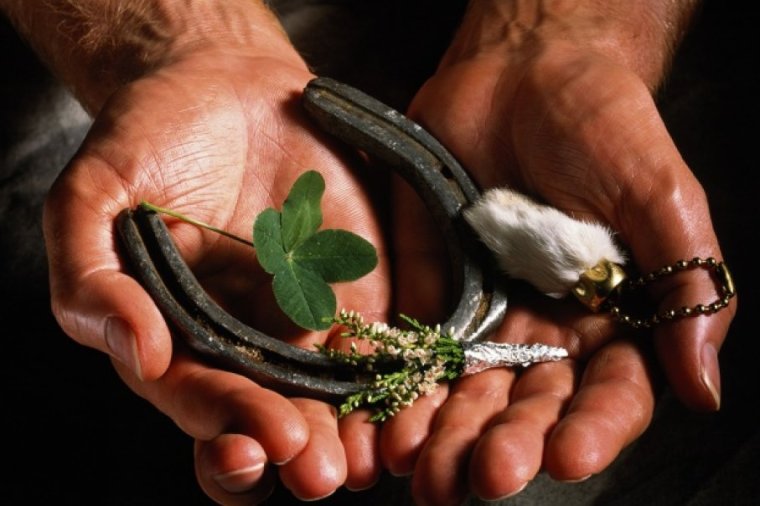
I am not above collecting lucky charms like the little pigs that I purchase for each new year. I do so more for fun than any actual belief that they will somehow make my life better. I might just as well have decided to bring four leaf clovers, mushrooms, lady bugs or horseshoes into my home in the hopes of increasing my good fortune. None of them would work as well as improving my own attitude and willingness to put in the time needed to bring a sense of peace into my world.

We humans have a long history of tempting the fates with magical actions. We cross our fingers and eat black eyed peas. We wear lucky hats and use the same shirt in which we enjoyed a victory over and over again. We hide a rabbit’s foot in our pocket and whisper so called magical words. In spite of all of our advances in mathematics and science that tell us our charms are silly we use them nonetheless. There is something comforting in thinking that perhaps we might bring unseen forces to bear on making life better. It doesn’t really hurt much as long as it’s not the only thing upon which we rely. Rejoice when good fortune seems to come your way out of nowhere but understand that it was only due to the randomness that affects us all. In the end we are the masters of our fates. It is in how we react to the inevitable joys and pitfalls that we determine our own luck.

The Colony

historic-colony-map-smMy husband still owns a house that his grandfather built in Houston in the nineteen thirties. It is on a tract of land that was part of the original Stephen F. Austin Colony that was deeded to Mike’s family before Texas won its independence from Mexico. The Sharman family traveled to Texas from Georgia in the hopes of starting a new life after experiencing hard times in a south dominated by large landowners. The parcel that they purchased lies just north of what is now downtown Houston and is bordered by Interstate 45 and Cavalcade Road.

When the Sharman’s first came it was wooded and undeveloped. They built a homestead and did some farming, never thinking that one day their place would be located in the fourth largest city in the United States and the second fastest growing metropolitan area. At the time that they arrived Mexico was hoping to develop the large swath of land to the north that was mostly wild and barren. They made a deal with groups like the one to which Austin belonged to provide low cost grants to anyone willing to settle down and develop the land. The Sharman family was willing to risk everything for a new start.

They used to own an area that included the place where the freeway now sits but that was taken by the state when it was deemed to be a good route for a major highway linking Houston to parts north. Mike recalls playing in the woods that lead down to the bayou when he was a young boy but that was before there was a concrete ribbon obscuring the once pastoral view. Later he rode his bicycle on the unfinished ramps while I-45 was being constructed. Sadly the finished roadway changed the feel of the neighborhood forever.

I often laugh whenever I read articles about that part of Houston. Nobody seems to realize the real history of the area. They speak of developments that happened long after my husband’s clan arrived in a time before there was even a Republic of Texas. Over the years much of the property has changed hands but Mike, his grandfather and his mother have kept the family legacy intact against all odds. In fact it was not until the nineteen eighties that one of them did not actually live on the land that has so much historical significance.

My mother-in-law was quite proud of the fact that her ancestors had been among the first settlers in what would eventually become the state of Texas and the city of Houston. She had so many stories of what life had been like for the pioneers. Those tales were handed down to her from her own grandmother who even told of her dealings with the native Americans who lived nearby as neighbors. We still have photos of family members standing in front of log cabins looking like visitors from the wild west. They worked hard and somehow overcame diseases, floods and many obstacles that might have driven away lesser souls. In many ways my mother-in-law became the unofficial historian of their trials and tribulations, a task that she enjoyed enormously. She loved being a Daughter of the Republic of Texas and kept up a membership for her grand daughters as well.

Her father’s home was built shortly after she was born. It is a quaint looking cottage that speaks of a simpler time. It was so well constructed that it will probably last for many more decades. Some of the nearby homes are even older and were the living quarters of her grandmothers, aunts and uncles. It was really a family compound where everyone contributed to the well being of everyone else. Being the only girl back then made my mother-in-law the center of attention and while she was quite spoiled by her adoring relatives, their love made her into a strong, generous and confident woman.

I would have enjoyed meeting her kin but they had all died by the time that I came into the picture. They were a tough lot, particularly the ladies. The Houston area was a harsh environment back then with outbreaks of yellow fever being commonplace due to the rainy weather and swarms of mosquitoes. Somehow the clan tended to stay quite healthy and live long lives in spite of the less than inviting conditions that they had to endure.

The part of north Houston where the family land still lies became downtrodden over time and my mother-in-law eventually moved after she inherited an uncle’s house in the Heights which is a gentrified area that is home to artisans and professionals. It felt safer there than in the home that had always been her residence. Lately however her childhood neighborhood is slowly but surely being beautified once again. It even has a new name that would undoubtedly horrify my mother-in-law with its ordinariness, Northside Village.

A Metro rail line runs only a block or so away from the property and its construction has prompted new interest in a part of town that lies only minutes away from the central business district. There are nearby lots selling for millions of dollars and tiny nineteen twenties houses are inching up in price. For now nothing particularly exciting is happening on the old Sharman tract but there are those who insist that it will one day become high dollar real estate.

I love the house that my husband’s grandfather built and always have. I can almost see myself living there with only a few updates to make it more amenable to twenty first century living. It is almost like a dollhouse in its design and even better in the love and care that went into building it. Right now there is still a great deal of crime in the area and the future of the street is uncertain. It’s difficult to know if it will become yet another rediscovered jewel or be ignored as it has been for the last couple of decades.

My daughter and I dream of rebuilding a kind of family village there. She wants to use some of the land to create a modern home for herself and I would be content with staying next door in the older house. We imagine the two of us riding the rails to shop in downtown or to visit the Medical Center. We think of buying our produce in the open air of the nearby farmer’s market or enjoying the of view of the skyscrapers that loom on the horizon. We envision a rebirth of the place with my mother-in-law serving as our guardian angel. We both know just how much she treasured the legacy that belonged to her and now is owned by her descendants. From the time that I met her she dreamed of the day when her homestead would be loved once again. She died without witnessing a renaissance but insisted that it was near. I’d love to see that happen before I too am gone. There would be something quite special about returning to the land that made her ancestors so very proud. We modern folk are so prone to throwing out the old in favor of the new. How grand it would be to find value in a place that has meant so much to generations of Texans who so proudly called themselves Houstonians.

Forgiveness

lent-easter-2780As a young Catholic girl I observed lent with earnestness but not much thought. I received ashes on the first Wednesday of the season, abstained from eating meat on Fridays and made the grand sacrifice of giving up sweets of all kinds. In reality it wasn’t that difficult to do because we never had sugary things around our house. Anything like a piece of chocolate or a bag of cookies was a rare treat. The truth was that I simply carried on as usual but gave myself a pat on the back for being good enough to totally insure that no sweets would pass through my lips during the forty days before Easter.

As I matured I learned that a far better exercise during the lenten season was to reflect on the way in which I was leading my life. After all, that is what Jesus did when He traveled into the wilderness. I realized that following His example was a much better way of honoring Him. I spent more time reading spiritual tracts and designing plans for becoming a better person. One of the things that I thought about a great deal is forgiveness. Jesus Himself made the ultimate sacrifice of His life to atone for our sins. Even as He hung on a cross He forgave those who executed Him along with one of the thieves who was crucified next to Him. It’s always been difficult for me to even remotely imagine the betrayal, abuse, brutality and pain that Jesus endured at the time of His death and yet His final act was one of compassion and absolution. In the death of His humanity He taught us how to be more Godlike.

It is so difficult to set aside our anger and hurt in a willingness to completely pardon someone for transgressions against us. We hang on tightly to our negative feelings, nursing them as though they somehow make us stronger. We are scornful of those who in their seeming weakness seek to bind old wounds and provide second chances. Ours is a world that seems to prefer unrelenting warriors over those who offer mercy. Peacemakers are not as much in vogue as crusaders. Diplomacy is trumped by force.

Our politicians only rarely dare to stand for what they personally believe to be right rather than adhering to a prescribed political platform. These days it is odd to see someone going against the groups to which they belong. We can’t seem to find enough understanding to realize that very little that happens in real life can be easily defined by hard and fast rules. We have all too often distorted the messages of the messiahs who created various religious sects. The idea of unconditional forgiveness is sometimes deemed to be hypocrisy, cowardice, a lack of real moral compass. Many among us have become judgmental people with unwaveringly self-righteous indignation. Thus is the root of so much trouble in the world today.

We insist that our republicans and democrats battle with one another rather than unite in common causes. Anyone who even suggests that they might find ways of compromising is cashiered out of the discussions. We prefer a stew of anger, distrust and sometimes outright hatred. We have religious groups who easily condemn and ostracize certain individuals and groups rather than attempting to demonstrate acceptance of differences. They preach a kind of ugliness that seems to counter good faith. Friends and family members turn their backs on one another, unwilling to forgive and forget slights and misunderstandings. They grow apart and turn unkindness into hatred.

All of the rancor and distrust is toxic and in its most extreme form leads to killing an innocent man on a cross for His thoughts or placing people in gas chambers for their religious beliefs. It leads to murder and war. It destroys relationships and rips families apart.

Perhaps the season of Lent was meant more than anything to be a time for forgiveness and mercy, a time when we work to repair rifts that have occurred in our lives. It is so easy to love and embrace those who think like us and agree with us. It is far more difficult to feel a sense of kinship with someone who has been cruel or in opposition and yet our challenge is to reach out to those very people.

Those of us who are Christians believe in our own redemptions, given as a gift to us from our Savior. Somehow we too often see ourselves as being exempt from a need to pardon our fellow men and women as well as ourselves from the imperfections that we all possess. One does not have be religious at all to understand the necessity of working together in the community of mankind. If we accept the complexities of living and admit that everyone makes mistakes we are more likely to demonstrate a willingness to embrace even those who have hurt us in the past.

We don’t have to be naive in attempting to reach out to our transgressors. There are certainly situations in which it is all too apparent that nothing that we do will overcome some evil other than imprisoning or extinguishing it. We had to defeat Adolf Hitler or he would have continued his murderous rage but there is little reason for us to push a former friend out of our lives simply because he or she has disagreed with our philosophies.

I have to admit to feeling unfiltered hate for George Wallace when I was young. He always seemed to be snarling and spewing the ugliest forms of racism. He was as despicable as anyone who ever governed others. I felt no sympathy for him when his wife died of cancer nor did I shed a single tear when he was gunned down in an assassination attempt that left him wheelchair bound for the rest of his days. Somehow I reveled in the karma that seemed to overtake his life with a vengeance. I hoped that he would rot away in pain and suffering but that is not how his story ended.

Wallace was unable to care for himself. That job was left to a black man of great faith and spiritual strength. He catered to the former governor’s every need and he also demonstrated a kindness of spirit that was unlike the ugliness of his boss. Day after day he treated Wallace with dignity and respect and in those interludes the two men began to talk and form an unlikely bond of friendship. Somehow the caretaker transformed the very soul of George Wallace until one day all of the former governor’s hate was stripped away by the love that had been accorded him. In a dramatic turn around Wallace asked his valet to take him to a church to speak with the very people whom he had once derided as being inferior and unworthy of even basic human rights. At that moment he wanted to apologize and so he ultimately did. It was unconditional love that brought about his stunning change of heart and it taught me that mercy often has the power of changing even the most hardened heart.

Goodness has always had more power than evil. In this season of lent rather than giving up something perhaps it is best that each of us make the biggest sacrifice of all, setting aside disagreements and forgiving someone who has heretofore been a source of anger and dislike. Think of how much change would occur in just forty days if every single one of us were to find enough compassion to mend even one relationship. Forgiveness is the sacrifice that we should all seek.