
Our Stories

Photo by Mark Neal on Pexels.com

The flow of life is rarely routine. We can plan for surprises, but are usually unprepared when they arrive. Much of the time we spend on earth is ruled by obligations to family and work. We list our duties and the times they will take place on calendars along with a scattering of ideas for taking breaks from our regular duties. Most of the hum of life is so regular that we almost forget that it is there. We take things for granted rather than being grateful for those days. It is only when some unexpected event changes the course of our journey that we look back in appreciation for times that had once seemed to be boring. 

I know about enduring the unexpected much the same as others do. I’ve sometimes found myself speaking to the spirit of Job and telling him that I fully understand the frustrations that he once felt. I often look around and it seems as though my situation is unfair, but then I realize that each of us is carrying burdens that weigh heavily on our backs. Some must face unthinkable challenges like witnessing the murder of a beloved child. 

When we are left to deal with the damage of the unwanted moments that tear our lives into tiny pieces we often want to rant about the unfairness of it all. In those times we may feel alone and brutalized by the experience. We see others still busying themselves with normal routines and like Job we wonder why we have been afflicted while they seemingly are not. It can lead us into a darkness of isolation, loneliness and depression or it can challenge us to create our own stories of how we might react to our woes. 

A work colleague of mine has been openly discussing the rollercoaster of emotions that have stalked him since the death of his son two years ago. At times he seems to be locked in a perpetual state of despair. At other times he is able to honestly speak of his pain and explain how he is attempting to deal with it. It is from him that I have learned the wisdom of writing our own stories by facing challenges with a different kind of mindset. 

Each of us will no doubt face issues that almost destroy us or at the very least sap our energy and joy. We do not have to focus only on the negativity of our troubles. We can find ways to look at the hard times differently than we might otherwise have done. For example, if the cashier at the grocery store is brusque we would do well to wonder what difficulty has made that person so angry. If we are running late to an appointment we may wish to slow down and simply enjoy to sights since our tardiness is inevitable. In other words take the worst that can happen and adjust the ways in which we react to them. 

Of course it is impossible to candy coat a tragedy as horrific as the murder of a loved one. Some things that happen to us are just so devastating that nothing can change the horror that we feel. What we can do is channel our feelings over time into the antithesis of the evil that we have seen. We can become so unlike the evil foisted on us that our kindness resonates with everyone that we meet. 

One of my recent blogs resonated with a number of my friends and readers who had experienced cruelty from teachers who should have known better than to abuse a child. They wondered aloud how adults had not understood the damage that they were doing with their harsh words and uncaring actions. It is indeed unforgivable for someone charged with the important role of teaching to misuse that responsibility as an avenue for abuse. I took my own memories of bad teachers as a reminder to never use my words or actions to harm a student. I worked from the premise that my punishments should always focus on behaviors, not persons. I often told my recalcitrant pupils that I disliked what they had done, but I would never dislike them. 

The past year has been more challenging for me than the years during the Covid pandemic. I have felt more isolated and sad. Mine has been a year of loss including a favorite aunt, a second mother-in-law, a very special friend, and a beloved cousin. My father-in-law has moved into my home changing the configuration of our routines much as a newborn child might do. My husband nearly died after a procedure that should have been a two day affair in the hospital. There have been no trips this year, mostly just long days adjusting to new routines. I have had bouts of anxiety and fear. There are times when I am exhausted and angry about my fate. I cry often and get irritated by small things. Then I get a call from a former students or an invitation to celebrate an engagement. I see that my life is only momentarily in a tiny bit of chaos. I know that  this too shall pass because I will ultimately adjust the way I always have. 

We may not be able to control what happens to us, but we can always take charge of how we react. If the event is so enormous that we are unable to know what next to do, we can always reach out for help. Being honest about our feelings may bring us to the person who will be able to sort things out. Perhaps a friend will let us scream for a moment. Maybe a therapist will listen to our woes and guide us to a better place. If we are religious we might find what we need from prayer or a visit to church. Maybe if we exercise or clean out a closet we may regain our perspective. 

The point is not to only fester and fume. While anger may actually have a place in the process of healing it cannot be the ultimate destination. At some point we have to face down the tragedy and find ways of coping. It will be difficult. It will take time. It will be worth our efforts. We can be the authors of our feelings. We can decide how to deal with our personal realities. We write the stories and hopefully they will ultimately be triumphant. 
Friends

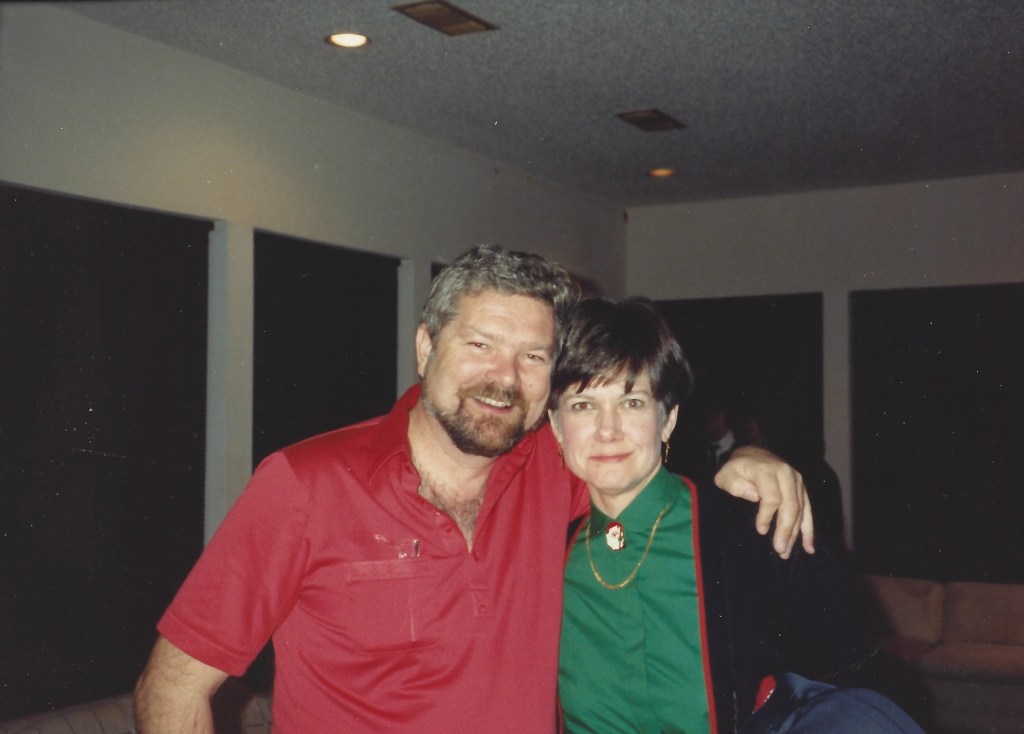
Friends were such an important part of our family life and to our great joy we seemed to have an abundance of them. They came from our high school and college days as well as from work and church. We even had fun times with the same cousins who had played hide and find with me on Friday nights at my grandmothers house. We enjoyed a full schedule of get togethers and celebrations. 

Linda and Bill Scheffler lived fairly close to our house. Our children learned to swim together and played with each other like siblings. We loved watching the University of Houston Cougars in any kind of competition and made parties out of any excuse. Linda and I decided to save on air conditioning one summer and challenged each other to use our units as little as possible. Linda took the lead immediately in that competition. She cooked outside on a grill and served dinner on a table nestled under the shade of a big tree. She was determined to hark back to our childhood days when we lived in homes cooled only by open windows and attic fans. 

Of course we found ways to cool down during the heat of the day at swimming pools and libraries. We might go window shopping at the mall or catch a movie in the afternoon. Nonetheless the heat was making me cranky. I realized that I no longer had the fortitude to withstand temperatures trending in the high nineties even with skimpy clothing. I soon gave in to my cravings for the cool of my air conditioner but Linda soldiered on. I was so proud of her and wished that I were as strong as she had always been. I thought she was amazing, but then I had always held that belief about her . 

Our friends Egon and Marita often invited us over for dinner and an evening sitting by their swimming pool. Egon would speak of his adventures as a boy in Bremen, Germany. He described playing in the rubble of the buildings that had been destroyed during World War II before he was born. He spoke of how his German father had met his Norwegian mother during the German occupation of Norway. He explained that his mother’s family had played a big part in a resistance movement, so when they learned that their beloved sister had married a German soldier they were bereft for many years. Eventually everyone buried the bad feelings and saw that love had bloomed in war which seemed to be a very good thing. 

Marita was from Chicago, Illinois and had come to Texas for college and never went back home to live. She was as brilliant as her husband and remembered events and the dates on which they happened with an uncanniness that was stunning. We always had fun with them while our girls got educated in the diversity of our world from listening to the stories that were bandied about. 

Pat and Bill also lived near us and our friendship with them became so casual that they could drop in without warning and so could we. Pat had a theory that her house should always be open. She kept a roll of cookie dough in the freezer along with some ice cream in case anyone decided to come visit. She often told me to keep the countertops and floor in my kitchen spotless and make sure that the guest bathroom was always nice. After that she argued that nobody would care about a little dust or things out of place. 

Mike and Bill loved to discuss all of the latests issues and I always thought that if someone had set up a camera during their conversations it would have made for must see television. Pat kept up with the latest trends and she perhaps more than anyone widened my horizons. She was also just plain fun, often coming up with fabulous ideas on the spur of the moment while I tended to cling to routines. She brought out the fun side of my personality.

Monica and Franz lived about an hour away from us on the other side of town but our times with them were always special. Monica was a fabulous cook created many a feast for us. Franz was an sweet man from Austria with an incredible talent for building wondrous things. He and Mike got along with a kind of comfort that made them seem like brothers. Now and again we would catch up with them on one of our camping trips where we learned that nobody made a better campfire than Franz. 

We made a point of meeting with Monica and Franz each year to exchange Christmas and birthday gifts. Monica was born in October and my birthday was in November. I always tried hard to find something very special to present on those occasions but somehow I never seemed to match the interesting and lovely gifts that they gave to us. Monica had a knack for knowing exactly what would enchant me. Maybe it was because we had been friends since the second grade.

We also enjoyed the company of Ed and Judy whom we had met at church. Ed was a talker with a wit that never failed to keep us laughing. Judy was a beautiful woman with such a calm personality that between the two of them I felt that our visits were akin to a therapy session. 

For a time we met regularly with Larry and Cappy as well. Larry had gone to high school with Mike and he met Cappy at Disneyland when he was serving in the Navy during the Vietnam War. When he brought her back to Texas we all took to her immediately. She was a real California girl and a friend who would lay down in the road if she thought it would help someone. Sadly the two of them did not stay together but Mike kept in touch with Larry and I continued my friendship with Cappy who always seemed to know exactly what I needed to hear when we were together. 

There were so many others who walked with us on our journey, sometimes for a brief moment and sometimes for the duration. There would be many more incredible people who would come our way, but these were the people who that we knew and loved as young adults just starting out in life. They shared our story as we guided our children from the time they were toddlers into their teen years. We were with them through good times and those that were bad. In a sense we grew up together and I must say that they made the pangs of that experience so much easier to bear. As we neared the end of the nineteen eighties much would change for all of us but our love for each other would be eternal. 

Scenes From A Very Good Life

Once I had begun working full time the years seemed to speed along at a pace faster than I wanted. My daughters were growing, progressing from one grade to another. Suddenly one was in high school and the other was an intermediate student. My calendar was filled with work and family related events. The times were good as we said hello to one new year after another and even decided to add a room and renovate our home. 

We had been looking for a new place to live, believing that we had outgrown our house, but our daughters complained at every turn that they did not want to leave the friendly neighbors who had become like family. Finally one of our neighbors suggested that her cousin might be able to transform our house the way he had done with hers. I had to admit that she had a great looking home and so we called the man to ask him to draw up a plan. His ideas ended up being wonderful and soon our place became a construction zone as he tore out walls and built new ones. In the meantime we also decided to change everything in our kitchen as well to make it more modern and useful.

For a time the place was in chaos but bit by bit it began to take shape and the results were stunning. Our home literally looked brand new and had nine hundred additional square feet along with another bathroom that would surely make readying ourselves for work and school each morning so much better. We had even moved our washer and dryer inside from the detached garage, added to our patio and built a deck. We were overjoyed to still be near the neighbors who had made our lives so wonderful and have a home that was modern and beautiful. Best of all, our girls were thrilled that they would not be uprooted from the bliss that they had always known on Anacortes Street.

Mike’s Uncle Bob had owned a little cabin set on property adjacent to Caney Creek near Brazoria, Texas. It was about an hour and half drive from our home and we had free access to it any time we wished to go there. It was a wonderful weekend haven that allowed us to spend real family time together. Knowing how much we treasure the place Uncle Bob left it to Mike when he died. We found ourselves spending more and more time there gathering pecans from the native trees in the fall and mowing the huge lawn in the spring and summer. 

The place had no air conditioning or heating. We had to rely on ceiling fans and the windows that lined the perimeter of the rooms to stay cool. When it was cold we used an old gas heater that required us to leave one of the windows open that that we would not poison ourselves. It was only a step above camping in the tent but we loved it. hardly a weekend passed that we were not there.

We liked to play board games and cards or just sit around a campfire made from fallen tree limbs. At one point we purchased a flat bottom boat to cruise down the shallow water of the creek. It felt heavenly there, a throwback to another time and place. 

Just down the road from the cabin was an old historic home dating back to an era before the Civil War. It looked sadly neglected with high grass growing around its weatherbeaten walls. We always wondered what the place was and why it had been so abandoned. Many years later archeologists would find all sorts of artifacts on the grounds. A group from the University of Houston would get permission to study the history of the place and bring it back to life. 

The road on which the property stood was called Bell Bottom, named after one of Uncle Bob’s friends who had been a mover and shaker in the town and the county. We called the little cabin Bell Bottom. and boasted to everyone how wonderful it was.

Bell Bottom was not far from Matagorda Bay in the town of Matagorda. We sometimes drove there on an afternoon to visit another relative of Mike’s, Uncle Haig. Haig was the brother of Mike’s grandmother and his Aunt Elsie who had been married to Uncle Bob. Haig was a bachelor after a long ago failed marriage. He spent as much time as his job would allow in a house along the Colorado River where he might often be found fishing. 

Matagorda was a fascinating place. I was nestled near the Colorado River, the Intercoastal Canal and Matagorda Bay. It was difficult to decide if it was a fishing river town, a beautiful beach or just a waterway to parts far away. Back in those days the only way to reach everything was to travel over a drawbridge. We were always the happiest if we had to stop while the bridge moved out of the way for a big ship. It was fun to watch the mechanisms at work. 

If Uncle Haig was home we stopped in to say hello and he would ply us with fresh table shrimp and oysters caught only days before. He was a very sweet man who seemed intent on looking out for members of his family since all five of his siblings had already died. He took great delight in seeing us and never failed to ask if we needed anything. I always believed he would have given us the shirt off of his back if we had taken a liking to it.

Of course we never left without a trip to the beach which was pristine, not filled with the remains of human presence in the form of trash. It always made me think of explorers from foreign lands in days when only the Native Americans roamed the area. It held a treasure trove of birds and sea life and its waters were cool and refreshing on hot days when the fans at Bell Bottom were not enough to keep us content. 

We really did know how blessed we were in those days. Life was comfortable and filled with people that we loved. The simplicity of it all was what made it work. It reminded me of my own childhood and the great times that I had with my grandparents and cousins. It was a moment when there was a lull in bad luck, illness and death that made life almost perfect, but in my heart I understood that change was inevitable so I cherished those moments with gusto and still remember them with a smile.

Our Human Experience

Photo by fauxels on Pexels.com

But for the serendipity of life I might have been an English teacher. After all I had imagined myself sitting on a high stool, swathed in a shawl, speaking of the human experience that is chronicled in literature and poetry. Because I had balanced my college course work with classes in mathematics I was instead redirected by the very first principal for whom I worked. I would end up spending most of my career explaining the beauty of the many threads of mathematics that tie together the inner workings of our world. 

It was an interesting and quite creative gig indeed, one rarely critiqued by students, parents or school administrators who often noted how difficult they had found math to be. I had the advantage of knowing things that sometimes mystified them. I’d often hear confessions of regret for not becoming better versed in the finer points of algebra or geometry. Most of the blame for that omission was placed on a lack of interest or a belief that nobody in the genetic line of the family had ever been particularly good at ciphering. Rarely was a mathematics teacher attacked for wanting to corrupt the minds of students with the highly structured scope and sequence of the curriculum.

On the other hand it seemed to be the English and History teachers who were the most likely to enrage protective parents who demanded that teachers proceed with caution. They had to carefully craft their lesson plans lest someone disagree with their methods or choice of books. While outrage was a minimal experience during my days inside schools, it seems now to have reached a fever pitch in which almost everything that teachers do is measured against the unique beliefs of individual families. Even the manner in which concepts are taught has come under scrutiny. It’s enough to drive wary educators out of the profession.

When I was in high school my English teacher was the king of his domain. He saw it as his duty to expose us to a cosmopolitan world view. As such we read books that challenged our limited thinking and expanded our willingness to think about differing ways of living. He took us to the Alley Theater to watch plays that were charged with adult topics. He told us about new books that were filled with controversy. He admitted that he wanted to make us citizens of the world. As a result he became the favorite teacher of virtually every student who ever sat in his classroom. We were fascinated by breaking the bonds of our isolated lives and learning about other cultures and lifestyles. 

Years later when I had worked my way up the career ladder to become the Dean of Faculty I watched another gifted English teacher expounded on the human experience with no holds barred. He opened the eyes of his students by showing them how intertwined we all are with a complex world. He allowed them to think for themselves and encouraged them to develop compassion for their fellow humans.

It pains me to observe the many misunderstandings about what English and History teachers are attempting to convey to their students. I can’t understand how being honest about what is happening around us can be misjudged as grooming or some kind of evil intent. Avoiding uncomfortable topics does not protect young people, but hiding reality from them might impede their growth into mature adults able to think critically about the situations that most certainly will challenge them. 

In the past year I have seen the difference between myself and my father-in-law who is only about twenty years older than I am. He grew up in a small town where economic and social divisions were pronounced. His worldview is defined by restrictions and the kind of thinking that comes from being unfamiliar with people not like himself. His upbringing is not uncommon at all for those in age group known sometimes as the traditionalists. His experience with other races or lifestyles has always been limited by the fences that were built to protect him.

By both happenstance and education my enclosures were knocked down. My life changed dramatically at several junctures and forced me into environments quite different from the one that my parents had originally designed for me. My education included the glorious freedom introduced by my English teacher and then expanded by other educators down the road. These influences have made more open to people who may at first seem unlike me but whom I ultimately know to be universally tied to me by our respective journeys through life. Good teachers have shown me how to relate with people from hundreds of years ago who may have been different in dress or custom, but who ultimately felt the same kind of emotions that I experience.  

Living out our lives can feel frightening and even dangerous at times. Going it alone or from the perspective of a limited range of people can make our journeys more difficult. Books and writings now being deemed to be controversial by those who would ban them are in reality a bridge to understanding and kindness. To Kill a Mockingbird, The Kite Runner, Things Fall Apart may cause us to cry or even become angry but mostly they demonstrate the resilience and goodness of people that helps them to defy even the most difficult situations with grace and honor. 

As a parent and grandparent I appreciate the teachers who have made my loved ones more open to new ways of viewing their fellow humans. Knowing about racism has not made them feel guilty, it has challenged them to be kinder and more fair. Learning about differences in lifestyles has not groomed them, it has made them more understanding and loving. Banning things is not the answer. Prohibition of alcohol quite clearly proved the ridiculousness of foisting a one size fits all way of living on an entire population. The much better way is to expand the possibilities of our young by helping them to become citizens of the world. The human experience is often more alike than different. Let’s help our children to realize that important feature of being part of the entire world, not just a tiny piece of it.

The Worst Hard Times

Photo by Santiago Manuel De la Colina on Pexels.com

Rocky Mountain National Park is one of my favorite destinations. I would visit there at least once a year if I were able to do so. The drive from my home is a long one that winds its way through two possible routes both of which take me through small towns that sometimes look as though they have been abandoned. For a long time, what I did not know about such places is that they are remnants of one of the worst environmental disasters in the history of the United States. These are areas in the Southern Plains where tall prairie grasses once boasted herds of buffalo that numbered in the hundreds of thousands. They are in lands where Native American tribes roamed freely in concert with nature. They were once claimed by France and Spain. Originally they part of what was called The Great American Desert. 

After Thomas Jefferson purchased a huge swath of land from France he sent the Army Corps of Engineers to survey the land and determine how useful it might be for pioneers hungry to move west. The report indicated that much of the land in the Southern Plains was uninhabitable. Thus it became known as a desert best left to the buffalo and the wild grasses that grew there. 

The growth of the population of the United States in the years prior to the outbreak of the Civil War saw families continually pushing west in search of the American dream. Texas had gained its independence from Mexico and when it became a state it took on its iconic shape as it left part of its real estate to become the panhandle of Oklahoma. It stopped at the thirty sixth parallel so that it its borders would not go into the area that would have prohibited slavery.

The parts of Texas, Oklahoma, New Mexico, Colorado and Kansas that were adjacent to one another had mostly been ignored by settlers. After Native Americans were moved from their land, the territory became the domain of ranchers and cowboys raising cattle and horses on the wide open plains. The prairie grasses were a cornucopia for the livestock which roamed as freely as the almost extinct buffalo had once done.

With the coming of railroads states enticed farmers to settle in the areas that had once been thought to be unfit for growing anything but grass. With the lure of cheap land and a slice of soil to call home many Americans and even immigrants from Europe came to the strange places and set up homesteads in sod houses built underground. Aside from the German Russians who had grown wheat on the steppes of Eastern Russia, few who came were well versed in how to tame the land. All they knew was that wheat was in demand and so they began to dig up the grass that had secured the soil for thousands of years to plant the seeds of wheat that they hoped would provide them with the wealth they dreamed of owning. 

What they found was uncertainty. Some years were wet and the wheat crops were good. Other years were dryer than anything they had ever witnessed and nothing grew. They were held captive to the whims of nature but they persevered. World War I gave them an advantage because the war in Europe made wheat grown there rather scarce. A boon for the farmers ensued that enticed more people to come to set up farms. As they arrived more and more of the land lost the native grasses.

The nineteen twenties were so good for the wheat farmers that they plowed up more and more land and took out loans to build regular houses to replace their sod structures. They purchased cars and pianos and put wall paper on the walls. It seemed as though the naysayers who had warned then not to count on the land for their existence had been wrong. Towns like Dalhart, Texas, Clayton, New Mexico, and Boise City, Oklahoma were thriving as more and more grass disappeared under the plow. 

Then the dry years came in brutal succession along with the stock market crash that heralded the Great Depression. Not only did the crops not grow, but the banks that had house the savings for such years had failed leaving the farmers with no means of paying their debts or even purchasing food for their families. With the land lying fallow the winds created huge dust storms so incredible that they moved through the air like dark monsters. Everything was covered in dust including eyes and throats and lungs. The animals became weak and began to die. The people began to lose hope. 

It has been difficult to read about this man made tragedy in the pages of an incredible book, The Worst Hard Times by Timothy Egan. I have seen the remnants of the disaster that occurred almost one hundred years ago in places that might have survived the ravages of the nineteen thirties but for human ignorance, greed and hubris. As with all tragic stories there were warnings of what might happen that were willfully ignored. It only took fifty years  for humans to obliterate the animal and plant life that nature had so wisely nurtured for thousands of years. In spite of warnings from Native Americans, cowboys and conservationists the land was abused and its answer to the humans was to turn against them in the most horrific ways. 

Those places through which I have travelled time and again became known as the Dust Bowl. The horror of that era sent countless families in search of new places to live out in California and Washington State. It created a massive migration of people who may or may not have learned important lessons about being stewards of the land.

Eventually with the introduction of better farming methods some of the area became fruitful once again but the scars of that horrific time remain and the dust still blows through the towns. Dalhart is little more than a dot on a map, a little place with a grain elevator and a set of railroad tracks. In some places there are abandoned homes that still sit on land that seems to have been forgotten.

I wonder if we have really learned anything about how our actions affect the places where we live. Drought has returned again and become a kind of plague of late and still the building goes on in places that are already showing signs of running out of water. Rivers and lakes that once brought irrigation are barely trickles. The aquifers that provide precious water are being emptied faster than they are revitalized. Will we humans once again ignore the warning signs and send ourselves into desperate times? Will we wait until the pain is brutal to honor the land and do the things that we must do to assure our own survival? I wonder and my thoughts become quite dark. The stories of the past are our warning. I hope we head them.