
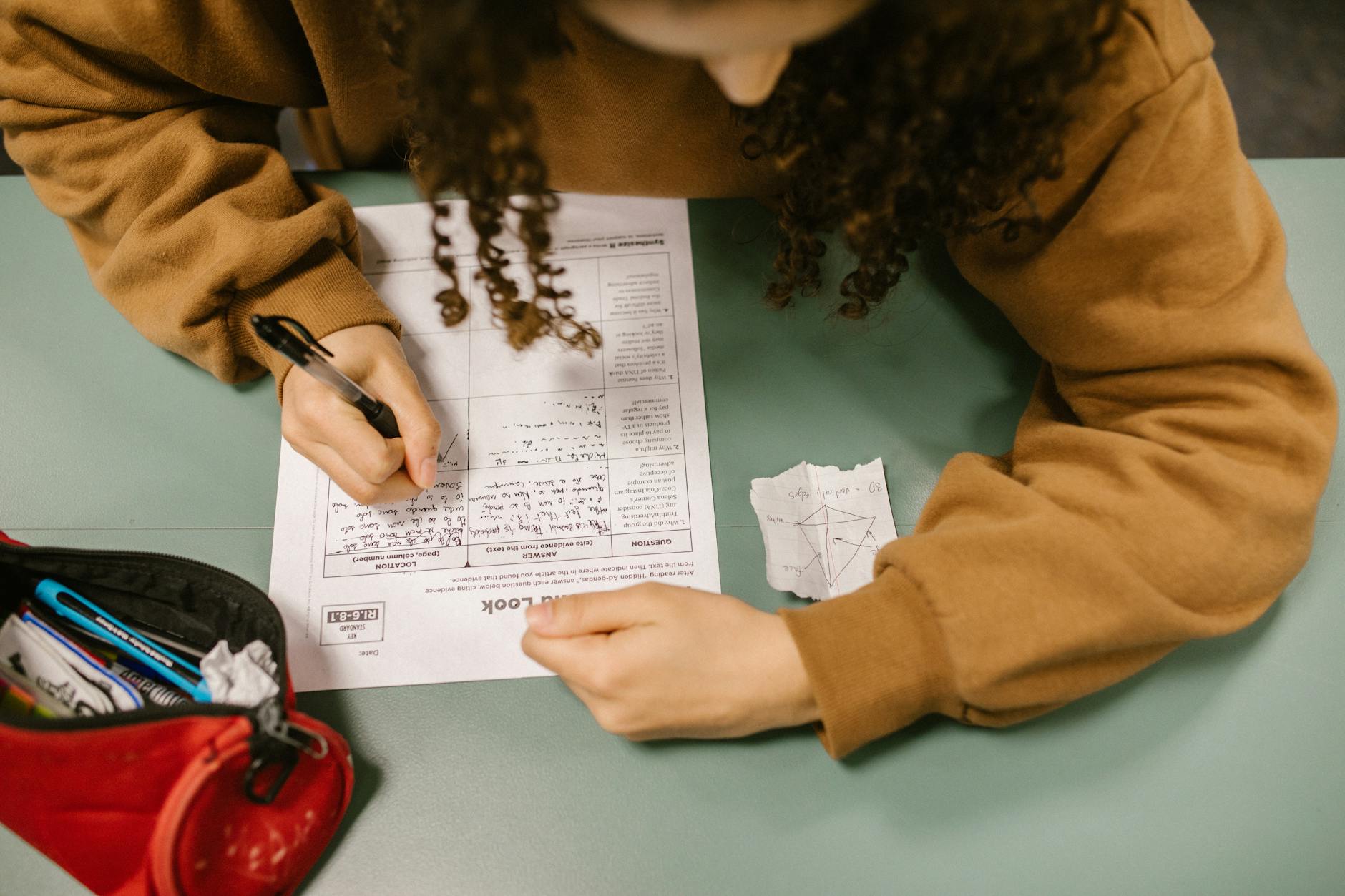
The National Assessment of Education Progress scores came out recently and showed that student assessments in science, reading and mathematics had dropped by three points from the previous year. In fact, scores are ten points lower than when the test was first administered in 1969. The questions about what is causing this are swirling and while I can’t make too many comments without studying all of the data over time, I have a few ideas.
I graduated from high school in 1966, so I have a fairly good understanding about what different subjects were like back in that time. I went to a private school and took all advanced classes. Nonetheless Pre-Advanced Placement and Advanced Placement studies were yet to come for students. Back then most high schools offered Algebra I in the ninth grade even for gifted math students. That course was followed by Geometry, Algebra II and an amalgam of Trigonometry and Pre-Calculus. Regular students only needed three years of mathematics and they were done. Many students who struggled in math first took a course called the Money of Math, fondly known as MOM. and then continued with Algebra I and Geometry.
Over time most states adopted a requirement of four years of mathematics in high school beginning with Algebra I. Advanced students often took Algebra I in the eight grade and began their high school years with Geometry. Highly exceptional students sometimes took Algebra I in the seventh grade and Geometry in the eighth grade but they were definitely outliers.
The top math students would learn Geometry, Algebra I, Pre-Calculus and Calculus A/B in high school. The most exceptional students would advance through Algebra II, Pre-Calculus, Calculus, A/B and Calculus B/C. All other students would take Algebra I, Geometry, Algebra II, and either Pre-Calculus or some kind of hybrid class that was less difficult than Pre-Calculus.
The faster pace worked well for the top students but often became a stumbling block for those who were unprepared. The general pacing for learning new knowledge and skills was faster for everyone than it had at one time been. Students went from one concept to another at a rapid pace that often felt like sprinting through a marathon. It became more and more difficult to keep reviewing what had already been presented to insure that students kept that information readily intact.
Then came nationwide interruptions like Covid when many students spent months or even entire years learning remotely. This lead to more and more use of computer generated homework and tests where students either chose answer from multiple choices or simply posted an answer without the work that was needed to arrive at the solution. It was difficult for teachers to know student strengths and weaknesses without watching them process the information in a classroom. Of course gaps began to form, sometimes even with the best of the best.
I have been doing a great deal of math tutoring of late and I have noted schools’ continued reliance on computer generated practice and testing. More often than not the teacher never sees the the students’ work which is critical in determining why mistakes are happening. A wrong answer might come from dozens of places like copying the problem incorrectly or making an addition error in one of the steps or even not having a clue about what to do. Students are sometimes simply guessing rather than putting in the labor to get an answer. The ones I work with seem not to understand that there are ways of checking answers and understanding when a computation is way off from where it should be. Such things were the meat of the past with teachers like me insisting on seeing all of the work and then pouring over the calculations line line by line to determine what is missing in each student’s understanding.
I was trained to look back at previous standardized tests that my students had taken looking for patterns. I would find students who had not mastered division or had to rely on counting their fingers to multiply. I saw those who did not understand the relationships between decimal, fractions and percents. I had to clear up those difficulties while also presenting new material. I had to do my best to make the processes make sense for them. I even sometimes gave them a problem with an answer that was wrong and had them study the student’s work to determine where the errors were.
I spent five nights a week pouring over every aspect of my students’ work. I created reviews constantly and tried to show them why processes worked. I wonder if enough of that kind of thing is being done right now. I also worry that we are moving our less capable students too quickly. Just as with babies learning to walk we humans progress through learning at differing paces. Our one size fits all approach that is demanded by state tests is forcing kids to move on before they truly understand mathematical material. Once they are discouraged the gaps only grow. It’s fine to challenge someone but when they are not quite ready we have to show them how slow and steady will also win the race.
It would be easy to blame lower scores on lazy students or bad teaching but the journey through mathematics is much more complex than that and simply judging the whole system by a yearly number is not enough. We have to ask ourselves if we are pushing curriculum to boast or if we are tailoring what we teach to the individual needs of our students. I have learned that taking the time to build confidence by showing students exactly where their problems lie and then fixing those areas leads to enthusiasm in math that might otherwise have ended in defeat and fear. Let’s start using those tests and those scores as a way to understand each and every student rather than ranking them and making them believe that they are flawed. When we get to the heart of the matter we avoid creating adults who forever hate the very idea of math.
 All It Takes Is A Little Love