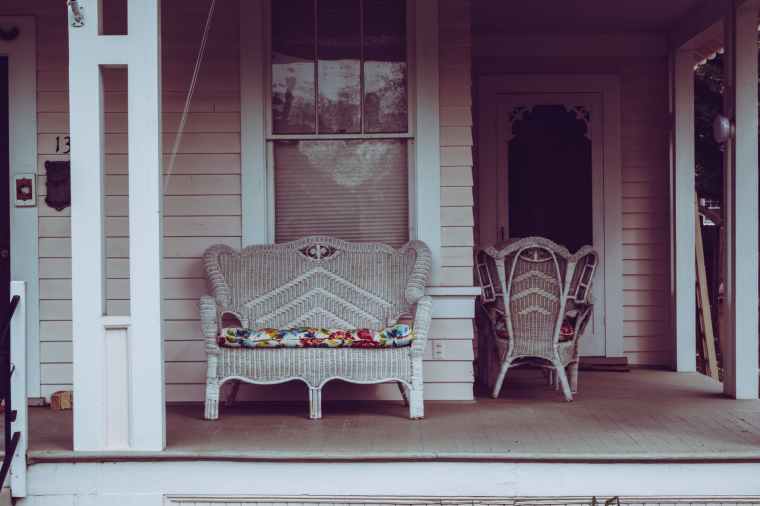
The Front Porch

white wicker padded bench
Photo by Brett Sayles on Pexels.com

There was a time when almost every house had a front porch, a place where family and friends would gather just to sit and relax and watch the world go by. People didn’t need an official “night out” to shout a greeting or wave at neighbors. They’d simply gather in the morning with their cups of coffee to watch the children scurrying off to school or in the evenings with a cool drink just to enjoy the glory of day’s end. It’s rare to see homes being built with porches in the front anymore. Instead we design our living spaces for ultimate privacy by placing our outdoor retreats in back of our homes where we are hidden from the rest of the world. Perhaps it is just one more sign of the times when we often feel isolated and unsure of our places in the big picture.

Visits to my paternal grandparents always included time spent on their expansive front porches which my grandfather enhanced with screen to keep the bugs out and to insure that even when the mosquitoes were having a roaring good time, we’d be enjoying ourselves as well without worrying about getting bitten. My grandparents always had the area furnished like an additional living room with a sofa like glider, rocking chairs and lots of extra seating. Grandma made sure that we had an endless supply of cool drinks and Grandpa kept a big fan in perfect running order to provide us with comfort. We’d join in the greetings of neighbors who passed by while on their walks and sometimes climbed up the steps to the house to spend a few extra minutes to find out how everyone was doing. We watched the birds during the day and fireflies at night, and talked of people, events and ideas. Somehow the time spent on their front porch always made me feel safe, content, proud and loved.

My maternal grandmother had a front porch as well. Hers was not covered or enclosed which was actually preferable to all of us cousins who gathered there every Friday evening while our parents played poker inside a tiny room so filled with smoke that it made us gag. We enjoyed the freedom and adventure of the outside with that porch serving as home base for the crazy games that we invented for our entertainment. Sometimes my grandmother would quietly sit in our midst, but because she rarely spoke it never occurred to us that she may have been watching over us. We just thought that she was escaping the raucous conversations of her children and enjoying the cleaner air on her porch.

None of my homes either as a child or an adult have boasted a front porch. I suppose that trend lost its charm for builders sometime in the middle of the twentieth century. We hosted our gatherings in our backyard where we might enjoy more privacy without interruption. The front of the house was reserved for coming and going and quick waves of the hand at our neighbors. Only once in awhile would we bring our lawn chairs to the front yard to join adventurous folks who decided to resurrect the old ways of relaxing together after long days of labor. I so enjoyed those sojourns with the Halls and the Turners and the Mayfields on somebody’s lawn when we would watch the children playing and laugh as our cares drifted away.

I rarely see people gathering in front of their homes anymore. Such enjoyment has in many ways become a thing of the past. Perhaps we are too rushed or too private or too wary of being on display. Maybe we don’t want to fight the heat or mosquitoes. For whatever reason we mostly stay enclosed in our own private worlds and seem to think it necessary to wait for special invitations to meet up with our neighbors. We know that there is life inside the homes on our street but it is only the passing of cars from the garages that alerts us to that fact. The old ways of lounging together outside on a summer’s eve are mostly the domain of the past.

Now my husband and I sit around the table on our backyard patio listening to the cooing of the doves and sounds of the people around their swimming pools or on their trampolines. Their dogs bark at us as we survey our garden and once in a great while a voice from behind the fence will ask us to retrieve a wayward ball that has found its way onto our space. Most of the time our contact is minimal and we get the idea that everyone prefers it that way.

My father-in-law has a lovely wrap around front porch at his house that was originally built in the early days of the twentieth century when such a feature was all the rage. He rarely sits out front preferring the deck in the back of the house instead. When I visit I imagine festooning the front porch with sumptuous ferns and plants. I think of placing a small table with chairs out there where one might enjoy a meal or a cup of morning coffee while watching the passersby. I suppose that I would wear out the swing that my husband and his best friend once hung so that my mother-in-law would always have a place to sit. I’d wring out all of the enjoyment that the front porch was intended to provide. Sadly I’m not sure that I would see much because I rarely observe anyone passing by whenever I go to visit. It seems that even those with the wherewithal to enjoy the neighborhood from the front don’t bother to do so anymore.

Front porches seem to have become a thing history, a pleasant memory of bygone days when the windows were open and the doors were unlocked. A neighbor need only shout a greeting from the sidewalk to be invited to come sit awhile. Everyone knew everyone else and there was an unspoken duty to watch over the children as they played. We were open and unconcerned with things like political differences. The whole neighborhood was one great big happy family. Along the way our televisions and phones and air conditioners lured us inside and pushed us at the back of the house. Maybe it’s time that we come back out to the front.

Learning by Doing

toddler climbing on wall
Photo by Susanne Jutzeler on Pexels.com

The warm weather has been a bit long in coming this year which is just fine with me. I don’t want to live in northern climes where winter lingers until May. Nor do I wish to deal with snow and blizzards, but I do prefer cooler weather that allows me to dress in layers and wear cute boots. My figure is long past the showy stage. The less skin I expose, the better for multiple reasons not the least of which is my tendency to get skin cancers. Too much sun leaves freckles and brown splotches on my face, and my waistline is hardly bikini worthy. Fall and winter fashion serves me best. I can fool the world into thinking that I’m still slender. It’s amazing how many sins a nice long sweater can hide.

Nonetheless  I remember my childhood when I longed for the warmth of the sun, even though my family did not own an air conditioner. How we managed to survive the hot Houston summers with only  open windows and an attic fan is beyond me, but I don’t recall feeling unduly uncomfortable. I suppose that we humans adapt to whatever is customary, and back then summers meant wearing very little clothing and eschewing footwear in favor of bare feet. We’d found comfort under the shade of trees or through strategically created ventilation from open windows. Of course an invitation here and there from a friend whose home was mechanically cooled never went unanswered. Now I don’t think that I would make it through a summer without my thermostatically controlled coolness, and I certainly am no longer willing to reveal the true nature of my physical shape by wearing skimpy outfits.

I wonder what we would do if we were somehow forced to return to those days of ninety degree temperatures inside our homes. To hear some scientists’ claims it could very well happen again. We might once more have to learn how to deal with whatever Mother Nature sends our way. It will take a great deal of cleverness like we used back in the day. For now I’ll just be glad that the continuous state of sweat is but a distant memory, made pleasant by the selective nature of my mind.

I laugh when I think of how my generation grew up. In today’s world our mothers would be reported to CPS for doing things that were just natural back then. We rode in cars without any kind of seatbelts, sometimes even standing on the seats, riding in the front, and hitching rides in the back of pickup trucks like cargo. We had no kneepads or helmets for skating or riding bicycles which we often mounted in our bare feet. We stepped on nails and glass and as long as our tetanus shots were up to date our moms cleaned our wounds, splashed some mercurochrome on them and finished with a bandaid that fell off within minutes of our returning to the streets without benefit of shoes.

We played games in the middle of the road, and Red Rover was one of our favorite neighborhood competitions. We almost always sported scabs on our knees and cuts on our fingers. We’d cool down with water from the hose which also served as our drinking fountain. We roamed the area in little hoards finding adventure down by the bayou or in walks along the railroad tracks. We all knew the sting of hot asphalt on the soles of our feet or sticker burrs between our toes. We’d have make believe battles with the little berries on tallow trees, tossing those makeshift weapons like grenades. I don’t remember anyone losing an eye, but I  suspect that somewhere some poor kid may have been injured in that way.

We were as free as Tom Sawyer and Huckleberry Finn and just as inclined to mischief. We’d scale mountains of sand meant to be spread on some neighbor’s yard. We’d climb roofs and stand on the peaks like intrepid adventurers who had successfully scaled some high peak. Nothing was out of the bounds of our imaginations and in the process we got tough and learned how to work as teams. We thought out of the box, inventing ways to have fun without many store bought tools.

Summers were great times when we were free as the birds in the sky, little noticing the stifling heat that hung over our childhood games. Now I get weak in the knees and short of wind if I attempt to be too energetic in the hottest times of the year. I’ve grown far too accustomed to the luxury of central air conditioning to submit myself to the tortures of the sun. In some ways it makes me sad to admit that I have lost my toughness. I was once like a young warrior ready for any challenge regardless of the weather. Now I am more like a hot house flower, as I suspect most of us, including many children, have become. So yes, the cooler times of year are now my favorite. That’s when I don’t mind taking a many miles long walk or working all day in my garden. To my utter delight of late there have been more days suited to my taste than usual.

I’m still admittedly proud of the way I grew up. I sometimes think that the “greatest generation” that raised me understood how to treat children far better than we do today. My friends and I have glorious memories of fun that don’t appear to be duplicated by many young folk today. Children have their play dates and formal classes which I suppose are fun, but I worry that they don’t have enough experience in which they make all of the decisions without adult supervision. There’s something quite wonderful about working things out by trial and error. It is a glorious way to gain all sorts of knowledge. The warm weather always reminds me of my outdoor classroom and all of the things that I learned by doing.

A Remarkable Man

lighted happy birthday candles
Photo by rawpixel.com on Pexels.com

My father-in-law, Julio Gonzalez, was born in April of 1929, in Lares, Puerto Rico, a little mountain town where the hillsides were filled with coffee plants and orange groves. He was a joy to his huge extended family of aunts and uncles and cousins, people who would pitch in to help raise him after his very young parents’ marriage fell apart and his brilliant father left him in their care while he continued his studies of medicine in Spain. He grew into a happy boy in the town where everyone seemed to be a relative watching over him, unaware of the worldwide economic depression and the political cataclysms that would lead to World War II. His was a place of fun with his cousins and baseball with his chums. When the winds of war hit the United States he was still a bit too young to join the young men enlisting to fight. His introduction to mortal conflict would be the Korean War when he proudly represented Puerto Rico in the regiment that had once been under the command of General Patton during the earlier war.

He spoke little of being a soldier in Korea. The memories were tainted by the death of comrades, visions that were painful to revisit. Nonetheless he was proud of his service as a citizen of the United States and after his stint in the army he and a buddy agreed to meet up for college. A bit of miscommunication about just where that would be landed his friend in Hawaii and brought him to Houston, Texas where he sat one day in the Cougar Den at the University of Houston when my mother-in-law was introduced to him.

Theirs was an almost instant attraction. They were still talking with each other long after their mutual friends had left. He was quite handsome and she was beautiful. Both of them were incredibly intelligent and managed to converse through his knowledge of English and her fluency in Spanish. She had been married before and had a little boy, my future husband, Mike. She was back in college attempting to forge a future on her own. She had not expected to meet someone who would attract her attention the way Julio had, but life is serendipitous and somehow changed direction for both of them as they fell hopelessly in love in a very short time.

They married and Julio took on the job of being both a husband and father. He was devoted to doing that role well. His whole world would center on being a good and responsible man. Neither he nor my mother-in-law would ever finish their college degrees, but they would use their innate intelligence to build a very good and secure life together. Julio eventually found work at a Hormel plant near downtown only minutes away from where they lived on the near north side of Houston. He began in the meat processing area, doing back breaking work in a cold environment. Eventually he worked his way into the business office where he did accounting and won the hearts of his fellow workers with his jovial ways.

He raised my husband as his own, being as loving a father as ever their was. He was a cautious man who lived frugally, enjoying the simple but most important aspects of life. He toured America with his wife and son, played poker on Friday nights with friends from church, and became a beloved and respected member of his wife’s family. He enjoyed golfing and partying with friends from work, and became more and more fiercely proud of being an American. He’d save for trips back home to see his family in Puerto Rico. His father had become a highly respected doctor who eventually remarried and had a second family of half siblings whom Julio loved with all of his heart.

My father-in-law taught his son to be as quintessential a gentleman as he himself has always been. He instilled a sense of honor and integrity in Mike and modeled all the best qualities of a good husband and father. He became the beloved center of the family as he proved time and again to be concerned and compassionate and willing to sacrifice for the needs of those around him. Year after year passed and so too did so many of the people he had loved including my mother-in-law, his loving partner for so many years.

He was heartbroken after her death, so bereft that his health seemed to falter. We worried that he might succumb to his sorrow, but he is at heart a survivor. He knows how to embrace challenges and keep moving forward. Before long he had not only recovered, but had met a sweet woman who stole a piece of his heart. The two married and now provide each other with fun and companionship.

My father-in-law loves children. He is the kind of man who likes to get down on the floor to join in their games. He runs with them and makes them smile with his gentleness and his playfulness. He spreads love wherever he goes.

It’s hard to believe that he is celebrating his ninetieth year on this earth. He looks far younger than that. He is hale and hearty save for a few minor issues. He still drives his car and takes care of both himself and his wife. He’s a good man who worries a bit too much about his son and granddaughters and great grandchildren. He has worked hard his entire life to insure that they will feel safe and secure. He has loved without bounds and in turn he is loved by everyone lucky enough to know him.

Julio Gonzalez is a quietly remarkable man who has asked for little and given so very much. We hope and pray that we will have the honor of having him with us for many more years to come.

Kindred Souls

Some people in this world are larger than life and my Uncle Bob was one of them. I was only six years old when he died at the age of thirty, but he had left an impression on me than never faded. He and my father had met in Corpus Christi, Texas when they were in high school and along with a third friend named Lloyd they became like the Three Musketeers, eventually attending college together at Texas A&M University. To everyone’s delight when my Uncle Bob met my mother’s sister, Claudia, the two of them fell in love and married. That’s how my father’s best friend officially became my uncle.

Uncle Bob was an athlete who played tennis and climbed mountains. When World War II broke out he enlisted and became a bombardier flying missions over Germany. When he returned from battle he completed a degree in Geology from Texas A&M and found love with my Aunt Claudia. Together they were a stunning couple, young and beautiful and brilliant.

Uncle Bob next enrolled in the South Dakota School of Mines to earn a masters degree in Geology. Before he had finished his studies he was diagnosed with cancer that required the amputation of one of his legs. True to his unflagging spirit he never missed a beat, studying during his recovery and graduating on time with the other members of his class.

After graduating he and my aunt returned to Corpus Christi where he landed a job in a small oil and gas company. At first his bosses gave him a desk job due to his disabilities, but he was itching to work in the field and finally convinced his superiors to give him an opportunity to demonstrate his prowess. He proved to be quite capable of doing the sometimes strenuous work at drilling sites, often being more adept that those without the constrictions that he bore.

Uncle Bob and my dad were quite the pair, two highly intelligent young men with big plans for the future. I remember them laughing together and enjoying each other’s company like two brothers. I loved the times when he and my aunt would stay at our house during their visits from Corpus Christi and we in turn often found ourselves traveling to Uncle Bob’s home which was filled with a museum worthy collection of rocks and minerals as well as his paintings of places he had been. 

Uncle Bob was planning to enter a program for a doctorate when he was once again diagnosed with cancer. This time he endured surgery to remove one of his lungs and was quite sick. While he was in the hospital in Houston my parents were visibly upset and our home was uncharacteristically in a state of turmoil. My mother had just given birth to my youngest brother and my aunt was also expecting her first child. There was a great deal of furtive whispering in those days which culminated in my being quickly enrolled in first grade at the age of five. The adults seriously thought that I had no idea of what was happening, but I was all too aware that my Uncle Bob was not doing well. He had already prepared me for such an eventuality during one of his visits when I discovered him attaching his wooden leg. He treated me with so much respect when he told me about his cancer. I loved him for his honesty and his understanding.

After Christmas of my first school year Uncle Bob died. My parents attempted to shield me from what was happening so I did not attend any of the memorials or funeral events, but I knew all too well that I was never again going to see the remarkable man who had so enchanted me. I also noticed a profound change in my father who would grieve for his friend for what ended up being the rest of his own short life.

My family moved on just as people always do after such tragedies, but in my heart there would forever be a special place for my Uncle Bob. My image of him never grew old, but remained frozen in all the glory of his youth. It was only when I began tracking my ancestry that I began to learn even more about my incredible uncle, and only recently I uncovered a newspaper article about his father that touched me to the very center of my heart.

I never knew anything about Uncle Bob’s childhood or his parents, so I was stunned to learn that before moving to Corpus Christi he had spent much of his boyhood in Chicago. There his mother became ill and died while he was still rather young. Like him, she too had cancer that ended her life far too early. Nonetheless he was the apple of his father’s eye, an only child who brought great joy to the man who guided him through his childhood.

Uncle Bob’s father was a machinist and was apparently rather skilled in his trade. At one point he created a unique steam engine for his son’s train set. He used scrap metal from junked cars and dental tools to build tiny parts that made the details of the model realistic. Over the years the man had kept the treasure which had been loved by his son. When the father was in his seventies and retired he decided to donate his creation to a museum, and the local newspaper ran a featured article about his work.

As I read a copy of the piece I felt a tinge of great sorrow for my Uncle Bob’s father. There was a look of sadness on his old face and the story of how he had worked so hard to please his little son was filled with so much pathos. There he sat gazing wistfully at his creation and possibly thinking of all of the might have beens. Somehow I felt a deep connection to this person whom I had never met because I knew that he had loved Bob even more than I did.

I suppose that there is nothing quite like losing a person who seems far to young to die. The pain never really heals because of a lingering sense of unfairness. I would eventually undergo the even more sorrow only two years later when my father died, and as a young mother I would see my Uncle Bob’s daughter, my cousin Sandra, die at the age of sixteen. Somehow I feel as though these three souls and that old man are linked with me in a primordial connection. I am now a seventy year old like Uncle Bob’s dad was in the article that so touched my heart, and I sense an unexplainable closeness with him. Somehow we are linked as humans through our spirits, kindred souls wandering through life’s experiences. 

A Hard Headed Bunch

woman and man wearing brown jackets standing near tree
Photo by Vera Arsic on Pexels.com

I truly enjoy talking with young people. They are filled with high energy, adventurous spirits, and a sense that anything is possible. Today’s youth are attuned to the environment, justice and a sense that change is not just inevitable, but something very good for all of us. They think about the world at large, not just the tiny corner in which they live. They are worried about the future and dedicated to improving it. They are anxious to get started, ready to demonstrate that they’ve got the chops to take on responsibilities. I love their enthusiasm and I remember when I felt their way.

I’m slower than I once was. Most of what I will accomplish in this life is behind me. I am in my golden years when I have time to think deeply and critically rather than to react. I have years of experience under my belt that have taught me to be cautious before proceeding with any plans. I analyze and search for unintended consequences. I still have ideas and things to say, but I am less certain that I have all the answers than I once was. I’m not yet ready to simply sit by the wayside and hand over the running of things to another generation, but I understand that it’s time to begin the process of doing so little by little. There is a time and a season for everyone, and I know that the young folk will soon be running the show, and deciding how things are going to be. It is the natural way of things that has been moving history forward since the beginning of time.

There has always been a tension between the young and the old, the future and the past, change and the status quo, the progressive and the conservative The differences sometimes appear to create a dangerous gap between generations into which much anger is hurled.

I was on the precipice of my adult journey at a time filled with excitement and promise, but also war and uncertainty. I leaned toward radical thinking about how to fix problems and run things. I was ready to make sweeping changes that I felt were necessary in a time that still seemed so old fashioned. Some of my elders called me and my peers by names meant to be insulting. To this very day we bear the weight of the negativity of the labels meant to define us. Our young men were sent to war, but we were not supposed to have any say in why and how that was happening. We were deemed too young and ignorant of the way things work to be worthy of a hearing. In our youthful exuberance we made mistakes that have been held against us to this very day. The term “baby boomer” is almost an insult to some, meant to define an entire generation of people as somehow selfish and ridiculously inept.

Of course in our hearts we know that such generalizations are inaccurate and unfair, and yet we continue to look at our youth and attempt to categorize them without ever having taken the time to consider their points of view, to think about the way that the times and the society has molded them. We wave off their concerns and laugh at the seeming ridiculousness of their ideas, rather than congratulating them on taking the time to consider solutions for problems that they see. Some among us saddle them with tags that are meant to disparage them and stuff them into square holes in which they rarely fit. We interrupt them in mid sentence to insist on the ridiculousness of their thoughts, after all they have no experience at living so how can they possibly know what we all need?

Few of us are well enough versed in history to know that with the exception of a few men like Benjamin Franklin and George Washington, our Founding Fathers were relatively young men, some of them barely in their twenties. They were bristling with a sense of injustice and filled with revolutionary ideas. It was in fact their youthful points of view that concocted a whole new way of governing. It might be true to say that the thought of a rag tag group of people taking on the might British Empire was both audacious and absurd, and yet with a firm determination they somehow became victorious. They were left with so many questions, so many ways to make mistakes that might cause their creation to tumble down before it ever got started. Indeed the imperfections of what they had done were soon apparent and yet the crux of their idea has endured.

History is in many ways the same song with endless verses. We change and modernize but return to the identical themes, the recurring refrains. Many of the young want to revolutionize the way we live and to do so quickly. The older among us are more cautious, wanting to take things slowly. They see problems and often suggest that doing nothing may in fact be the best alternative, Why change?

We are at one of those watershed moments in which one group thinks that we are doomed if we do not move with speed and another insists that things are mostly fine and hardly in need of an overhaul. One side feels a sense of urgency and another is worried that we will wreck everything if we throw caution to the wind. In such environments there tends to be more shouting at one another than listening and considering differing points of view. Historically wars have sometimes begun this way.

There is usually genuine sincerity in both sides of a disagreement, good points to be made all around. A gifted leader knows how to accommodate as many ways of thinking as possible. Everyone gets a bit and we all mostly win. Such political genius is difficult to find, but when it is present mankind gets to the moon in a few short years, people work together for a common cause.

An image from my youth often comes into focus in my mind. The war in Vietnam is raging. There are so many questions about why we are there and what we hope to accomplish and how we will do it. Young people are protesting what they see as injustice. They are camped at the Lincoln Memorial when the President of the United States comes to visit them. He is wise enough to ask them what they are thinking, but then he virtually ignores what they have to say, arguing more than listening. They too don’t seem to realize that this man is making an effort to come hear them out. They turn on him with blinders and an unwillingness to give him the benefit of the doubt or to learn about his point of view. There is an impasse.

We seem to have rotated into a time during which all sides cling to their preconceived notions and ideas with little hope of respecting one another. We prefer confrontations to conferences, arguments to discussions. We slap epithets on people and refuse to allow them to be more complex than our simplistic classifications. We worship cults of personality rather than ideas. We’ve been here before, and often such atmospheres of disagreement don’t end until we have grown weary of hurting each other. We humans can be a very hard headed bunch.

It remains to be seen how we will eventually proceed. Somehow the future keeps repeating our past.