Setting Aside My Selfish Fears

fear-videoSixteenByNineJumbo1600

I am wise enough to know that change is inevitable, but anxious enough to worry that it will occur. I despise the unknown, surprises that threaten my control. I used to laugh and brush off my mother’s accusations that I am a control freak, but she was one hundred percent correct in pegging me as someone who possesses a need to take charge. I am able to vividly remember the exact moment when my happy-go-lucky take on life became anxious and it was not on the occasion of my father’s death as some may suspect, but rather when my world was upended by an unexpected move to California only months before his demise.

I hated that long distance excursion. Nothing about it felt right. There was a tension hanging over my family that I was unable to explain but felt deeply. When things turned out badly and we ultimately returned home to our friends and family we were all exhausted from the frenetic swings our emotions. The change that was supposed to be exciting had sapped us all and made me fearful of living without routine from that moment forward. When my father died only weeks after we came back to where we had begun my abhorrence of change felt even more justified and thus began my long and often futile attempts to avoid the almost certain adaptations that are an integral and necessary part of living.

In my sixty odd years since that time I’ve been ambivalent about change. I know that it is not just inevitable but often quite good, and yet I have always felt a reluctance to trust the winds of change. I have so often associated them with violence as when I watched my mother’s personality alter because of her mental illness, I witnessed the horrors of political changes that ended in war,  assassination, and terror. I’ve even seen the climate of my youth change so utterly over time that my city filled with flood waters. I watched as our society has changed into a kind of tribal warfare pitting one group against another with little or no reason. I’ve seen the pride that once defined my country become a kind of self loathing in many quarters. I have observed the mutations of viruses and disease bringing misery and fear to mankind.

So it is that I selfishly wish that change would take a holiday so that I might enjoy the kinds of moments that I felt for a time when my mother created a safe haven for me and my brothers after my father died. She cloaked us in a routine and innocence that made us feel secure. Those were lovely times that were certainly destined to eventually disappear but I often long to experience them just one more time.

I patterned my adult life after the ways of my mother. I tried to create a kind of haven for my family. I did my best to make our home a happy place where the unexpected rarely came to call but those efforts often fell flat. Illness, death, financial worries refused to leave us alone and the world kept changing in spite of my efforts to keep it the way I wanted it to be.

My nest became empty and I had to watch over my children and then my grandchildren from afar. I tried to create continuity, traditions. I wanted everything to stay the same even as I knew that it would not. I selfishly wanted to run from change rather than attempting to adapt to it. Time and again I was forced by circumstance to accept the evolution of ideas and ways of doing things. Nothing ever really remains the same no matter how much we wish it to be so. Each of us has to endure many challenges, much loss. We watch as the old routines give way to the new. It’s not all bad. Some of it is rather good. I know that, and yet I dread the thought of doing things differently than I always have. I like continuity. It soothes me.

My grandfather often cautioned me to take each day and each challenge as it comes. He was a survivor who was ready to revise his life at a moment’s notice. He faced difficulties head on and did whatever necessary to deal with them. Often that meant being flexible and finding a grain of optimism in even the most seemingly hopeless situations. I suppose that the key to his long and mostly healthy life was that he let go of the past, enjoyed the present, and never worried about what the future might bring. He was a believer in progress and he understood that change had the power of making things better for all of humankind. He did not fear it, but instead embraced it.

Like so many who have lived for almost three quarters of a century I desire to spend the closing chapter of my life in a state of peace and quiet. I savor tranquility but I also know that the new world will belong to the young and that there are indeed changes that we need if we are all to survive. I will try to set aside own selfish desires for an unchanging uncomplicated ending to my story. I have learned that while change is often painful it is also the most inevitable aspect of our humanity. Only a tiny child actually believes that it is good to hang on to the past. I must open my heart to the possibilities that will not only make the future brighter for the rest of the world but, will no doubt bring me happy surprises as well.
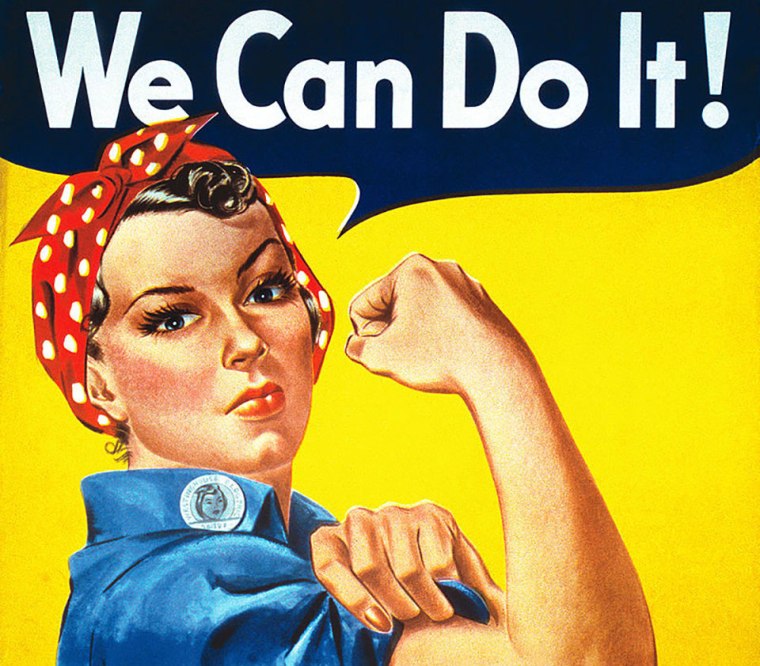
We Can Do It!

We_Can_Do_It-960-fragmento

So here we are in early March, a time for the Houston Rodeo, Spring Break, March Madness, St. Patrick’s Day celebrations. Our nature is to enjoy the promise of this time of year when the flowers begin to bloom again, at least in my part of the world. We are creatures of habit and regardless of how much we protest any insinuation that we are not flexible, we feel the earth move a bit under our feet when things don’t go as planned.

We are a generally lucky lot here in the United States of America, at least those of us who are members of the middle class. We plan trips and decorate for Easter and watch sporting events on our big screen televisions. Worries come now and again but we generally work through them. Sometimes Mother Nature brings destruction to our front doors like it did when hurricane Harvey hit Houston, but we take pride in taking control of such situations and putting things back to normal as quickly as possible.

We Americans are notoriously independent souls. We don’t like to be told what to do. Some among us even insist that the government should stay out of our business as much as possible. We can be quite vocal and sometimes even a bit brash when it comes to our ideas about how things should be done, but more than anything we tend to think that we can conquer almost any challenge better than most. We got to the moon, didn’t we? Surely we’ve got the best of everything in the world! We don’t think of it as boasting because it seems to just be the truth.

Suddenly the whole world is turned upside down by a virus that is new and strange. We’re not completely sure what it will ultimately do or how we will put it down. Our instinct is to ignore it as long as it doesn’t come near us. We’ve been saved by those two big oceans that have protected us from wars and left us relatively unscathed by rumblings in other parts of the world for most of history until terrorists found a way to bring fear into our midst. Now we hear warnings that the current threat will not be intimidated by our advanced technology, or national wealth, or borders. It does not respect our traditions or our freedoms. It does not see us any differently than it does the citizens of Wuhan or Padua or Kirkland, Washington. To it our bodies are all just targets for destruction, some more vulnerable than others, but all capable of carrying the deadly disease deeper into our midst.

Leaders across the globe are making decisions without any guarantees. They may as well be blind because there is no certainty as to what will actually work to halt this novel virus. We cannot compare it to the flu or measles or any other known disease because we have no scientific basis of doing so. We have yet to learn all of its mysteries and capabilities. We only have numbers of the sick and dead and the anecdotal stories of those on the front line of the battle against it to guide us.

Covid 19 seems to affect the elderly in more dangerous ways, as well as those who have other health issues. Children and young adults seem to generally have milder cases, but they are not automatically immune to the more critical symptoms and everyone who becomes infected is a carrier. Nations that have insisted on enforcing social distancing protocols early on have generally done better than those that waited until the toll of sickness rose to unbearable numbers. At this very moment there are countries whose healthcare systems have been overwhelmed and the end to their trials does not yet seem in sight. They send furtive warnings to the rest of us to take cautionary measures before it is too late.

This virus is not just a seasonal flu that is being overblown. It is not a hoax. It is not the fault of China or Democrats or President Trump. How we handle it will surely define us in history. We can rise to the occasion and do whatever is needed to end the contagion as quickly as possible or we can whine about inconveniences that we do not normally have. We can demonstrate our concern for all people everywhere by doing our utmost to cooperate with the efforts to contain the virus or we can demonstrate a false bravado by ignoring the requests that we stay home as much as possible.

The NBA season is done for now. Tom Hanks and his wife Rita are among those who have the virus. The world seems to be spinning out of control, to have suddenly gone insane. It will be up to everyone of us to restore calm and reason by following directives and doing our individual best to comply with each request for temporary changes in our behavior. This is a time for prayer, not just for those who are ill but for those who might become that way as well as for the medical personnel across the globe who are or will be fighting this demon virus. This is the time for unity and mending of the divisions that have produced so much rancor in recent times. This is the time for understanding, compassion and flexibility. This is the time to remind the people in our lives how much we love them.

If all goes well most of us will never be personally affected by the horrors of this virus. Hopefully when all is said and done we will actually be able to wonder if it was all much ado about nothing or if we did indeed prevent a more horrific scenario by doing whatever was needed at each juncture of the battle. We can only hope that by this time next year we will have dodged a bullet but for now it is  time to arm ourselves with calm and the good sense to do what is asked of us. Nobody is immune from the consequences if we presume to know more than the good souls who are attempting to protect us. Take care. Keep in touch with one another. We are a strong species that has faced down danger before. We can do it but it will take the combined efforts of everyone!    

The World At Our Fingertips

internet-facts

I’m not going to tell stories of walking a mile uphill through the snow to get to school when I was young. The fact is that I lived in a flat city with a rather temperate climate and the distance to my school was only a matter of blocks. My journey was a short and rather pleasant affair. What was the most difficult about learning fifty or sixty years ago involved doing research for papers or my debate class. The only way to get information beyond the outdated set of encyclopedias that my father had purchased before he died was making a trip to the library.

Of course the old way of doing such things was to be armed with lots of paper and index cards to jot down information by hand, starting with notes about where to find the books and periodicals that I needed. I’d begin with the card catalog and then pray that the items that I wanted would actually be in the library. About seventy five percent of the time some other fortunate soul would have already checked out what I had hope to find. Even worse was when I eagerly turned the pages of a magazine only to discover that someone had vandalized it by tearing out the very sections that I most desired to read. Research was a frustrating and time consuming project that often took hours on a sunny Saturday when I would have preferred to be anywhere but inside a library.

Unfortunately for me this mode of getting the data for my papers continued through both my undergraduate and graduate degrees in college. I never formally enjoyed the luxury of using the Internet to learn or gather information while I was still a student but I watched it become ever more sophisticated and capable of housing a vast array of ideas and processes unlike anything the world had ever before seen. Now it seems as though I can use this marvelous technological advance to self teach myself about virtually anything and hardly a day goes by that I do not take full advantage of it, all in the comfort of my home without ever having to get out of my pajamas or put on my shoes.

I suspect that people in my age group marvel a bit more over the Internet than young folks who have grown up taking it for granted. I often find myself considering how much more I might have accomplished in life if I had not been bogged down by the time consuming process of searching for information when I was still a student. Now I am able to find multiple sources and points of view on virtually any topic as long as the wifi is operating wherever I happen to be.

Of late I’m a YouTube geek when in comes to Pre-AP Pre-Calculus. In an effort to better prepare students for AP Calculus the methods for teaching and learning the fundamentals of Pre-Calculus have changed. When I was still in high school such a course didn’t even exist and even when I attended college the depth and breadth of what I learned was not equivalent to today’s course. Since I never taught mathematics beyond Algebra II, and that was over twelve years ago, I have had to update my knowledge so that I might better prepare my grandsons for their tests. I’ve turned to the Internet for my own tutoring sessions and the experience has been rather remarkable. There are a number of dedicated souls who film themselves explaining the various concepts and they have illuminated me time and again when I felt a bit confused about a particular way of doing things. I do believe that it might be totally possible to learn the full scope of high school mathematics simply by going online each day and then practicing the processes just a bit.

I never dreamed that there would be so much knowledge easily available for anyone desiring to partake of it. I continually find answers to my own questions about the world around me. I’ve learned to search for multiple sources and to check the credentials of the persons providing the narratives that I read. It doesn’t take long to realize that some of the information is false or a bit inadequate so I never rely on a single site but in general the entire world of knowledge is there for the taking at anytime of the day or night and I can’t think of anything more wonderful.

Through the lens of the Internet I’ve seen the world, found my ancestors, listened to lectures, enjoyed music and learned how to cook delicious meals. The possibilities are seemingly  limitless and so I marvel at how lucky we are in this day and time. Even someone who is homebound still has access to knowledge. We need go no farther than the room where our computer or laptop is housed to find works of art and great thinkers. It’s breathtaking to think how lucky we are.

Even as I write this blog there is much concern over what may happen if the coronavirus spreads through our country causing schools to close and isolation to become the temporary norm. People wonder how they will spend their time, what they will do with their children. I suggest that they go to the Internet for ideas. There is a whole cornucopia of ideas just waiting to be discovered. Passing time these days is just a moment away. Learn how things work. Read great literature. Study the history of a time and place. The possibilities are limitless. There is so much to learn and it’s become so easy to find. The world is at our fingertips.

A Better Investment

o-PILES-OF-AMERICAN-MONEY-facebook

When I was a student I earned a four year scholarship to any state school of my choice. Since I liked my hometown university and didn’t want to disrupt my mother’s well being by adding to her stress I enrolled in the University of Houston, the same school that Elizabeth Warren attended at about the same time. It was a happy decision for both me and my mom because that scholarship would take care of all of the costs as long as I kept up my grades.

My first year was exciting to me because I had been incredibly isolated up to that time. I had essentially attended school with the same group of students from second grade with a few more coming from Catholic schools in the area when I went to high school. My neighborhood was my world and I rarely went beyond its periphery. Even then it was to shop at nearby stores or to visit relatives. I was decidedly unaware of the rest of my growing city or the world outside beyond what I read in newspapers and books. Going to a large public university was somewhat akin to being thrown into a shark tank, but I was more than ready for the challenge. In fact, I wanted it more than anything. I saw striking out into a school where I would literally become a number as an exciting way to get a college experience without leaving town and making things difficult for my parent.

My first year at the University of Houston was a revelation. I had a few classes in huge auditoriums where there were almost as many students as half of the population of my private high school. Others, like a German seminar, had under twenty in the group. I went to Greek parties, attended the football games, hang out in the Cougar Den, participated in civil rights and antiwar demonstrations, and saw celebrities up close like Mohammed Ali who was still using his birth name of Cassius Clay. I met students from Alaska and around the world. It was a heady experience during which I kept up my grades to insure that my scholarship would be secure. Unfortunately I was totally unaware that I had an obligation to re-apply for the financial aid each year to verify that I was indeed maintaining a high grade point average.

Back then the process of registration for classes was an abomination. Each student received a specific time to wait in a line and then be allowed into an auditorium where grad students manned desks for each major. They had boxes of computer cards that represented the individual classes according to professor, meeting time and section number. I had to race from one station to another to hopefully secure cards for the courses that I wanted to take. If the cards were gone from one of my choices I had to make on the spot decisions regarding what to take because my scholarship required me to take a certain number of hours as well as to graduate within four years.

As a sophomore I was far more prepared for the onslaught than I had been as a freshman and I felt confident in the preparations I had made for the challenge of securing a decent schedule. In fact I had my fifteen hours secured without a hitch and as I walked to the financial aid station to get my scholarship money and guarantee my classes for another semester I felt somewhat smug. I had little idea that my world was about to shatter.

I handed my computer cards to the worker and gave her my student number so that she might verify the payment for them. She scanned the lists with a bored expression that did not change until she had reached the end and had failed to find my information. She asked me to write my full name and student number on a piece of paper that she used as a kind of guide to run down the list one more time. Still she found nothing and panic began to overtake me. I barely heard her instructions to take my cards and myself to the financial aid office to determine what was wrong.

Once I got to the official domain of loans and scholarships I wrote my name on a long list and sat waiting for what felt like eternity. A rather brusk woman ushered me into her office to find out what I needed. She made no attempt to hide her impatience instead rushing me to describe my problem. Without saying a word she began searching through alphabetized files. Within a few minutes she returned to her desk with a folder that evidently contained my information. Without fanfare she announced, “You no longer have the scholarship. You did not renew it.”

I felt as though I had been gut punched and was hardly able to admit that I had no idea that I had to renew the scholarship. I thought that it was good for four years as long as I kept my grades in order. Nobody had ever mentioned to me that there was a yearly process beyond simply going to classes, making the grades and then returning for a new semester.

The woman barely contained her annoyance with my whining that was rapidly turning into tears. She announced that there was nothing that she might do to help. My scholarship was gone, not just for that semester but forever. She made it clear that I needed to move on and allow her to get back to her work with the long line of other students who were seeking information. I left with my tail between my legs because I had no idea how I was going to pay for my classes and I did not want to ask my mother for money that I knew she did not have.

After spending several minutes sobbing inside a stall in the bathroom I screwed up my courage and came up with a plan. I had worked all summer and I had just enough funds to cover the classes and pay for my books. My fun money would be gone but at least I would still have courses to attend. I managed to pay for my classes then and in future semesters and never once had to secure a student loan which gets me to the heart of my story.

Back then the cost of college was low enough that I was able to work part-time and earn the funds needed to cover expenses. Today the price tag on even state universities has soared to ridiculous levels. A little work here and there is not sufficient to pay the bills of learning. Adding to the difficulty is the fact that today’s students are limited to the amount of time that they may take before graduating and being forced to begin the repayment process on loans with interest rates that would make Shylock appear benign. Instead of having a set payment for a certain amount of time those student loans operate more like a credit card, growing at a frightening rate as time passes. It can take years for someone to pay them back even when they are lucky enough to land a well paying job.

I find myself wondering what I would have done and where I would be today if the cost of my education had been in the same league with what students now face. I suppose that I would have had to drop out for a semester and gone to work until I had saved enough to return or somehow secure a loan. I managed to pay for two degrees from rather low paying jobs. By the time my daughters went to college my husband and I had to take out loans which took years to repay. The situation students face today is more dire than ever. I paid around five hundred dollars a semester for my undergraduate degree. Their tabs are more in the range of tens of thousands of dollars. Even using proportion based on the increases in salaries over the years the expenses related to  university educations has blown up to almost untenable levels. We need to find a reasonable plan for dealing with this, and so far the ideas are not particularly well thought out.

I think that universities should begin the process by cutting unnecessary items from their budgets. We did not have fully loaded gyms and entertainment venues on campus back in the day. We got by with a more bare bones approach to education that concentrated on the basics but still provided exceptional teaching. We can also streamline the student loan business and set up contracts with students that work more like the kind of loans that one might get to purchase a car or home rather than treating them like credit card charges that can take years to repay. There should be lower payment incentives for students who maintain high grade point averages or who major in particularly needed fields. Instead of placing hefty tax burdens on the wealthy there should be tax breaks for those who invest their money in educating worthy students, thereby increasing the number of scholarships or no interest loans available. Grandparents, aunts, uncle, friends, employees, businesses who help students should receive some kind of tax credit thereby making such contributions attractive. I’d certainly rather send my some of the money that I now pay in taxes to a worthy student. Such outreach should by definition include helping individuals pay for trade schooling as well as traditional university educations.

It’s way past time for our country to invest in the education of our youth. It need not mean a great burden on unwilling tax payers and it does not have to be free and without strings. It simply needs to be a complete overhaul that seeks to cut costs, incentivize the process of helping students to pay for college or any form of training, and find ways to simplify loans so that they have a set payment schedule that ends by a certain date. We can make things better but it won’t happen until we get serious and have a bit of compassion for the young people who really do want to make a better future for themselves and the rest of us. We need them to carry on the work of this nation. I can’t think of a better investment for the good of all of us.

Twenty Questions

twenty questions20 questions

A young man recently asked me to answer a set of twenty questions regarding my life. They were quite thought provoking, but more importantly they forced me to contemplate the arc of my life and how I had been affected by both unplanned events and the choices that I made. All in all I realized as I honestly reflected on all that I have experienced that mine has been a good life. While I’ve endured some rough patches much as most people do, I was able to overcome them because of the lessons I learned from my parents and the support of extended family and friends. At the end of the day it’s not so much what things I have amassed that is important as the sense of well being that I have because of a feeling that I have generally done my best to live well.

So often my life took turns that I would not have chosen on my own but my mother had shown me how to take back the power by reacting hopefully to even the most devastating events. She used to tell me to watch and learn and I suppose that I became an expert at sitting back and quietly observing how the people around me dealt with the blows that were thrown at them. Over and over again I witnessed acts of courage and strength that both inspired me and made me an optimistic person. I learned that we don’t always get what we thought we wanted but often we find something even better than what we had dreamed.

I was at dinner with my grandson and his brilliant and beautiful girlfriend and we had the most remarkable conversation. We spoke of how much my grandson physically resembles my father whom he quite naturally called “Grandpa Jack.” He commented that somehow my dad’s legacy had quite clearly registered with him. He wanted to believe that he is carrying on the traditions of a man that neither he nor his mother had ever met. Amazingly he is so much like my father, his “Grandpa Jack,” that it is almost uncanny. I smiled at the thought of how proud my father would have been to hear our discussions of history, philosophy, and great ideas. It was just the sort of thing that he so enjoyed. Had he been present he would have been beaming with joy and yet he had left this earth when he was only thirty three. It is remarkable how much we carry the marks of our ancestors even when we never knew them.

My mother and father both taught me to appreciate the happiness that comes from learning, exploring, challenging the mind. From a very young age they exposed me to music, literature, visual arts, mathematics, science. It seemed natural to me to spend hours poring over a book. All I ever needed as a child was my bicycle and a library card to find a state of nirvana. I never really noticed that our family was struggling to make ends meet because I was so busy exploring the world around me. My mother taught my brothers and I that there was always a way to survive if we used our wits and were willing to work hard. We watched her earn a college degree when she was in her forties. To say that she inspired us was an understatement.

I had once thought of being a doctor. I slowly realized that I wanted that career more for the income and prestige it would bring me than for the sense of purpose it would provide. Slowly but surely I found myself returning to the idea of being a teacher, something that many people counseled me against doing. They reminded me that I was capable of doing great things and they somehow believed that teaching was not worthy of my intellect. In my heart I knew that they were wrong. I found great personal satisfaction in working with young children and attempting to instill in them the values and love of learning that my father had shown me. Once I became a teacher I was satisfied that I had found meaning in life. Only once did I consider trying something different and luckily a professor convinced me that leaving education would tear my very soul apart.

With the twenty questions I had to speak of my childhood friendships which were rather remarkable in that I am still great friends with individuals with whom I went to elementary school. I can meet with neighborhood playmates and talk for hours as though we still live just down the street from one another. I have high school friends who constantly remind me of my good fortune. They were the foundation upon which I built my adult life. They never really knew how much they meant to me when times became tough for my mother and brothers and me. I have met people along the way at church, work and in my neighborhood who have sustained me and made me realize the importance and goodness of friendships.

Answering those twenty questions reminded me of the blessings that have helped me through the difficult times that each of us invariably face. Those inquiries showed me that I did indeed learn from the example of my parents, my extended family and my friends. Those probes into my past not only will help a young man to complete a project for one of his classes but they also helped me to reflect on the wondrous ways in which both accident and effort define who I am. I’m happy to pronounce that I feel quite good about how things turned out, something that might have been different were it not for a host of individuals who walked with me along the way.