Alike and Unique

Aunt Valeria

For as long as I can remember I’ve been told that I look just like my mother, my father, both of my grandmothers, my brothers, my aunts, my cousins, my daughters, my grandchildren. When people view me they see different things emphasizing certain traits in their minds. I’m certainly not a doppelgänger of anyone in my extended family, but the resemblances are there. I noticed that as I grow older I take on a kind of generic similarity to my relations even though I don’t appear to be a twin of any of them. It seems as though in the process of aging we take on characteristics similar to those of a baby without the external trappings of hair, makeup or clothing to distract from the essence of our appearance. We begin to look more and more alike.

I have a one hundred year old aunt from my mother’s side of the family. Invariably when I visit her at her nursing home someone will tell me that I am a carbon copy of her. My aunt doesn’t hear well these days so when I recently related such a comment to her in writing she commented with her trademark sense of humor, “Poor girl!” with a sly grin on her face.

The fact is that I have often thought that she and I resemble one another in a number of ways but most of them have more to do with the genetic makeup of our health issues rather than outward appearance. I somehow inherited the same propensity for osteoporosis and migraine headaches that have plagued her to the point of landing her in a wheelchair for many years whereas my own mother had none of those things.

I suppose that if a very observant artist or writer were to seriously analyze my facial features I would be found to more closely resemble my father and my youngest brother than anyone else in our big family. Such is also true of one of my grandsons and a nephew who bear a preponderance of features very similar to those of my dad. It’s funny how that works and often leads to one of those strange moments when finding an old photograph of an ancestor who appears to be a twin to one of the living relatives. It’s one thing to pick up the habits and nuances of people with whom we frequently interact to the point of seeming to be just like them, but it’s rather remarkable to discover an ancient still image that is eerily like a living descendent. Our DNA has a way of repeating patterns.

I now look at myself in the mirror and I see my face as a kind of microcosm of hundreds of years, perhaps thousands in a long line of people leading to me. Of course it never occurred to them to ponder so far into the future but I am intrigued by the thought of who they might have been and which of their traits I share. When I consider the miracle of those clumps of cells forming in a woman’s womb to make a new person with the evolved characteristics of people from the past I am in awe. It is breathtaking to consider the magnificence of the process of the creation of a human life and something not to be taken for granted.

Since joining Ancestry,com I have been able to put names, if not faces, to the people who came before me. I have put my spit in a test tube and sent it for DNA analysis. Through that process I have found distant cousins that I did not know existed. I have become a member of a Facebook group of people related to my paternal grandmother. I read their posts and their stories and realize that we share so many commonalities without ever having known each other before. Learning about them has made me feel an even stronger connection to humanity than ever before. It has made me realize that on the whole we share many more commonalities than differences even as we are separated by time and distance. I sometimes wonder if people would think we look or act alike if we had the opportunity to come somehow come together. Would the world instinctively know that we are related?

It’s difficult to imagine disrespect for human life whenever I think of how much I share with other people. There are basic traits that course through all of us. We laugh and cry and bleed and hurt in much the same ways. It seems contrary to common sense that we would ever think that one human is less worthy than another when we are so intertwined by our commonalities. The things that separate us are mostly cosmetic. If we were to be stripped down to the essence of who we are we might begin to look almost like reproductions of one another, just as babies and old people do.

At any given moment I do indeed look like my aunt or any of the people to whom I am related. I also resemble the more generic characteristics of being human just as we all do. It tells me to value myself and the people that I encounter. Each of us is both alike and unique. Perhaps there is nothing more important than treasuring every single life from the moment that we first begin to form to the instant when we take our last breaths. If we were to continually bear that in mind perhaps we might find ourselves in a more peaceful and just world. Languages and cultures may differ but the marrow in our bones and the blood in our veins tell us that we are the same.
The Journey to the Future

pioneers-usa-02

I’m beginning to understand my paternal grandfather more without gaining any concrete knowledge about his life before he met my grandmother. I’ve been researching the hints that he gave me about his heritage and in the process my understanding of what life may have been like for him has become clearer. At the same time I’ve learned more about life in the United States in the part of the world where he grew up as a boy. By following the tiny red thread of comments that he left I see a picture of the influences that touched him both as a boy and a young man.

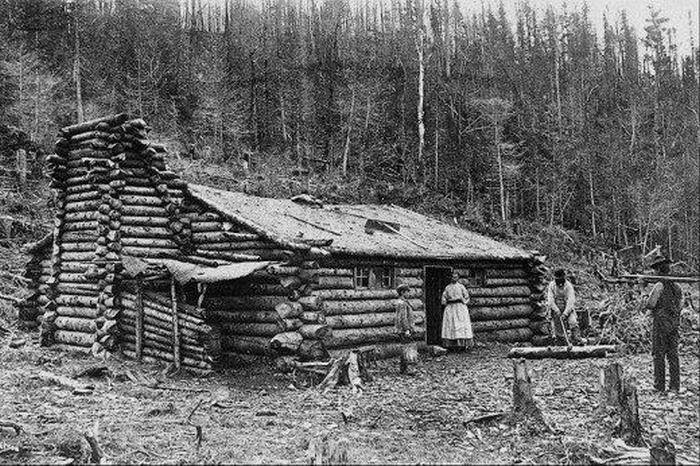
He always insisted that he was Scotch Irish which always seemed to be an oxymoron until I learned about the people from southeastern Scotland who journeyed on a odyssey that took them first to Ireland and eventually to the hills of Virginia and Kentucky in search of a home where they might be free to live and think without rancor. In the woods and secluded areas of what we now call Appalachia they found a way to be left alone, at least for a time. Just as my grandfather described they lived far from towns and cities in isolation among the forests and in the shadow of the mountains. They mostly farmed and kept to themselves often retaining the distinctive accents that they had brought from across the ocean.

The Civil War changed things for the entire country and the people in western Virginia were particularly affected by the strive and divisions that were literally tearing the nation and whole families apart. In choosing sides brother sometimes turned against brother and hard feelings, combined with the violence of war, left a lasting impact on the people who had always wanted little more than to live their lives without interference. With the end of the war the feuding that had disrupted routines often continued and as shown in a recent episode of American Experience on PBS it sometimes reached epic proportions as in the violent rivalry between the Hatfields and McCoys.

By the waning years of the nineteenth century the Industrial Revolution was changing the face of the United States and few were entirely immune to its effects. In the parts of Virginia, West Virginia and Kentucky near where my grandfather spent his boyhood businesses from the northeast came in search of coal to drive the industries that depended on that black substance from the earth. The land on which my grandfather lived was filled with it. In fact he told vivid stories of his grandmother owning a small coal mine on her property.

With the mines came railroads and strangers whose interests had little to do with the people in their way. The once pastoral land was stripped of trees and filled instead with mining operations including barracks style housing for the workers. Sometimes the labor of digging into the earth imposed itself on the land of the farmers. Where people and animals had once roamed free there were now restrictions on where passage was afforded.

Those with enough gumption to leave generally did better than those who decided to keep their families intact by staying. Once my grandfather lost the woman who had raised him (his grandmother) he had little reason to remain on the land. He was barely thirteen at the time and mostly on his own although he stuck around long enough to help out his father for a time. As soon as he was able, however, he struck a blow for freedom traveling in search of an acceptable way of life just as his Scotch Irish ancestors had done before him. He only returned to his boyhood home once and learned that there was nothing to keep him there.

My grandfather often spoke of the hardships of his youth and the intelligence of his grandmother in keeping both of them fed and safe. She was a rather amazing woman, living alone with a child and commanding respect from the community. She was light years ahead of the general customs of the time with her independent spirit and folksy knowledge of medicine. She owned rights to a coal mine on her property and kept her farm going without the aid of any man other than a boy. From what I can tell she was somewhat like the other hardscrabble women in that part of the country where shrinking violets never made it very well.

Grandpa entered the twentieth century ready to be part of the great move of progress that defined the United States throughout that era. He was part of the building boom that created iconic structures from sea to shining sea. He was on the move not so much to hide away but to experience the modernization of the country. He was proud of the work he did and the inventiveness of the United States. He saw his life from the promise of the windshield and not from the nostalgia of the rearview mirror. His philosophy was to embrace progress and to build a better future. I suppose that’s why he said little about his world back in the hills of Virginia. The past didn’t matter to him as much as the present and what was still to come. Perhaps he understood that standing still and looking back leads to stagnation and stagnation leaves one without hope.

The world is ever changing and my grandfather taught me not to be afraid of letting go of the past. He believed that the good old days are always ahead of us, not behind. We can treasure our history but it would be foolish to be mired in it. Progress marches on and the wise know when its time to join the future.

A Sense of Happiness

FireAntStoryTX102112

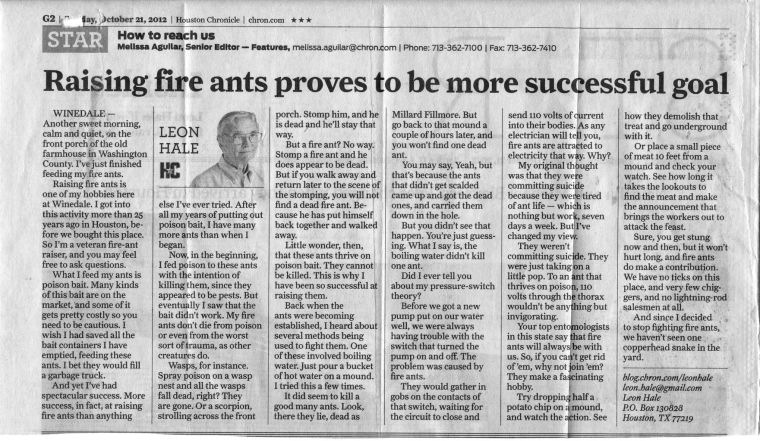
Does anybody remember Leon Hale? He was a writer for both The Houston Post and The Houston Chronicle who traveled around the city of Houston and the state of Texas writing about this and that. His columns revealed a man who was always on the lookout for a good story, and over the years he found hundreds that delighted readers like me. His best ones were often about rather ordinary people who came to life under the magic of the words he chose to use to describe them. His talent was so profound that he somehow made the mundane incredibly interesting. He had an eye for finding the beauty in a single moment or face or comment.

I know I would have enjoyed sitting down with Leon Hale to talk about his decades of adventures with folks. I would have liked to ask him how he developed his writing craft so well, but I suppose I already know many of the answers because he was masterful at noting even the tiniest details about his subjects and then finding words and phrases that painted pictures without so much as a single photograph. His was indeed a brilliant talent that brought me many years of joy. Even on days when I was too busy to peruse the other pages of the newspaper I found time to see what Mr. Hale had to say and I was never disappointed.

Leon Hale taught me as much about humor, love, acceptance and other such positive characteristics of the human heart as the sermons I heard in church. He got me to thinking about the best inclinations of humankind and his stories were as uplifting to my spirit as readings from a book of meditations. He also had a knack for describing people and situations with unique combinations of words that invariably brought out emotions that either made me laugh or cry. I literally felt as though I knew him and the people that he introduced in his tales.

The glory days of local newspapers are dimming. Houston was once a two newspaper town long before it was even close to being the forth largest city in the country. The Houston Post, which was always my personal favorite, went the way of dinosaurs long ago and The Houston Chronicle is just a shell of its once glorious self. A Sunday morning edition used to be so big that it came in two separate rolls from the paperboy. Now it is so slim that it’s hardly recognizable. It’s surface area is vastly diminished as is the quality of writing between its pages. Before long it won’t be too far different from the little suburban newsletters that come out once a month.

It was the printing press that wrought dramatic change in the world. As ordinary folk had more and more access to books and newspapers equality became more possible. The new revolution has been on the technology front with news and print entertainment on demand at any given moment. A morning or evening run of a hard copy is old news by the time it arrives and is less and less cherished by avid readers than it once was. Computers allow us to see the latest information whenever we wish. Blogs provide us with almost infinite numbers of writers that we might follow. The new Leon Hales can live and write in Texas and then publish for a worldwide audience within minutes.

I am definitely an electronic reader. I use my various devices to read wherever I go. I don’t have to cull through dogeared magazines about topics that have little interest for me when I wait to see my doctors because I have my trusty phone to keep me apprised of breaking news or to provide me with columns from writers that I enjoy. I even have a Kindle app that allows me to read from the latest best selling books. Still, there is something about the look and feel of paper and printed letters formed from ink that adds to the reading experience. Actually holding a physical copy of writing is as enticing to the senses as wearing fine perfume.

The glow of letters on a screen just ins’t as exciting as holding a printed version of a story or a book and I always have the sense that I may be missing something important whenever I read from an electronic device. I understand and learn best when I have a fully kinesthetic experience in which I can actually manipulate the words by circling or underlining them or making comments in the margins. I like to put paper tabs on certain pages or turn down the corners of the sections that contain my favorite passages. Not even mechanical highlighters on ebooks do the job as well for me. My photographic memory feels a bit lost in the world of computers, notepads and phones. I have to spend too much time remembering where all of my information is stored. With a paper copy I know exactly where to look.

Several years ago I rid myself of all of my long playing record albums and I had quite an extensive collection They took up a great deal of room in my house and I was more inclined to play CDs which were far easier to store and rarely had a scratchy sound from overuse. Eventually even my CDs became rather arcane and I was more likely to stream music to one of my devices. Low and behold LPs became a thing again, a kind of homage to authenticity in music.

One of my grandsons is slowly building a collection of records from artists of my generation. He finds them in thrift shops and half price stores. It pains me to know what a treasure trove of music I once had that I might have given to him as a gift. Instead I was a bit too quick to convert to the new ways. For some reason I have not been able to do the same when it comes to the written word. I still have books and magazines all over my house. Some are growing so old that the paper inside is yellowed and fragile which makes them even more precious in my mind.

I suppose that there is a good argument for conserving natural resources by using only electronic versions of writing. I think of all of the trees that were cut down just to satisfy the human search for knowledge. While the Amazon forest burns we might consider being more conscious of the cost to our world of eschewing more modern methods for reading. Perhaps it’s time for me to retrain my brain to be more appreciative of the evolution of the reading experience. It’s certainly more democratic and inclusive. Nevertheless, I still miss sitting with the latest copy of Leon Hale’s column and reading with enthusiasm as my fingers become smudged with newsprint and the paper makes a crinkling sound as I hold it on my lap. I can almost see it, hear it, and feel it now. It gives me such a visceral sense of happiness. I miss that.

It’s Time to Clear the Rubble

rubble

On September 11, 2019 the citizens of the United States once again remembered the events of 9/11. Somehow overcast weather in my city matched the solemn feelings that most of us have on this day each year as we recall where we were and what we saw with vivid clarity. It was an unbelievable, unexplainable moment when it became clear beyond a doubt that so much of who we are and what we believe was vulnerable and under attack.

I usually write and post a blog about this event more appropriately on its actual anniversary, but this year I found myself struggling for words to describe the evolution of my thoughts over the ensuing eighteen years since that day. Instead I simply read the touching feelings of others and felt that visceral punch in the gut that hit me almost two decades ago when we were still a somewhat naive citizenry. On that day we grieved together both for those who had so suddenly and tragically died and for the death of our innocence.

In the aftermath of the tragedy we stood together as a nation in our resolve to show the world that we would not be defeated by evil. We thought that we had the strength to overcome the forces that hoped to divide us, and at the time it seemed as though we would remain united and strong. At first it was our collective grief that kept us together, but over time it was our fear that began to tear us apart. We had different ideas about how to proceed forward and our debates became more and more brutal and personal until our discussions were no longer dialog but instead vicious arguments. Our united front crumbled as surely as the twin towers had done leaving us in a chronic state of war with one another. Instead of building our nation stronger than ever we became our own worst enemies.

In the eighteen years since 9/11 we have taken our political discussions to new lows. It’s been awhile since we showed respect for the offices of our government. There were those who hated George W. Bush and demeaned him in cartoonish ways. There were those who hated Barack Obama and demeaned him in racist ways. Now there are those who hate Donald Trump and demean him to the point of attempting to drive him from office. Our Congress is paralyzed by the infighting and unwillingness to compromise in a bipartisan way that is good for the country. It is now fashionable to destroy those who think differently by ravaging their character and their beliefs. In other words, whether we realize it or not, those men who so viciously attacked our nation on September 11, 2001, have accomplished more than just killing three thousand souls and bringing down two buildings. They have punched a hole into the very heart of democracy, and we have played into the their hands with our unrestrained anger which we now focuses inward rather than at the true source.

We began by restricting freedoms for safety’s sake and then we began pointing fingers here in our own country as though knowing who to blame for the tragedy might somehow make us feel better. Our debates ran the gamut from invoking punishing retribution to demonstrating kindness to our enemies. We were in new territory, not really knowing what to do. So many mistakes were made just as throughout all of history. We were so anxious to resolve our troubles that we let our impatience get the best of us. We were being ruled more by emotions than logic. Our feelings overtook us and led us to lose our focus. Every little thing was steeped in hyperbole that eventually evolved into propaganda.

We felt very lost and confused and when we turned to the media for understanding they only fanned the flames of our divisions. Soundbites became our arguments and dissolved into petty catch phrases that offered no real solutions. The media had a field day with our worries and our feuding, making hay from our fears and driving us further and further apart.

On the morning of the eighteenth anniversary of 9/11 the headlines in most of the major news outlets were not about remembering that horrific event but about clashes with the White House and innuendo about members of Congress and the Supreme Court. Stories of 9/11 were in small print, hidden among headlines about celebrities and sports. This alone told me much about where we find ourselves eighteen years after perhaps the most horrific moment in our country’s history.

It is long past time for all of us to regain our wits and demonstrate the true strength of this country that is found in good people everywhere. We are not the stereotype that some would have us believe we are. Ours is a flawed history just as that of every other country in the world, but it is a story based on an idea of freedom and dignity that we are still attempting to perfect. We must choose to be the people that we want to be rather than a fearful mob focused on degrading the very foundations of our country. We need to insist on a return to logic and calm in our national debates and understand that sometimes we only progress by accepting compromises. We each must be willing to address the needs of a changing world and do so with dignity.

There is great truth in the adage that “we have nothing to fear but fear itself.” It is time that we work together and without rancor. Eighteen years have done great damage to our republic. While we were arguing the rubble in New York City was cleared and magnificent structures were erected in its place. We need to begin the process of doing the same for the government of our country otherwise those terrorists will have won. We can’t allow that if for no other reason than to be certain that those who died did not do so in vain. It’s time to clear the rubble.

In Search of Criminal Justice

Angola-prison-in-Louisian-002

People sometimes do very bad things, things so egregious that we do not feel safe having them live among us. We have to find them, try them for their crimes, and if found guilty sentence them to punishments that fit their actions. We have a criminal justice system for that which is struggling on many fronts. At this moment in the United States we have the largest prison population in the world both in actual numbers and percentages. We struggle with ethical questions of what we should do to prevent crimes and how to treat the perpetrators once they have been convicted. We can’t seem to decide whether our system should focus on punishment, rehabilitation, or some effective combination of both. We wonder what we might have done to prevent crimes in the first place thus eliminating the need for so many centers of incarceration.

I’m fascinated by the criminal mind. I have always wondered what drives an individual to the point of committing unlawful acts, especially those that are violent. I’ve been a reader of mysteries from childhood and my favorite television programs and movies have always been those that depict detective work, the law, and the frightening world of prison life. I suppose that I have always believed that if only we were able to unravel the threads of lives gone so bad we might learn as a society what causes them to reach a point of breaking the law. I suppose that such a dream has confounded humans since Cain murdered Abel.

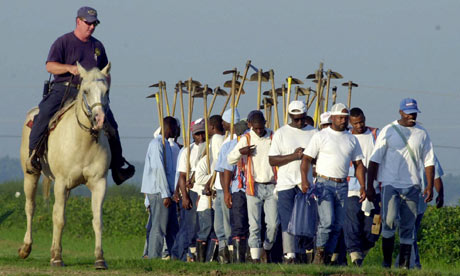
I am a frequent viewer of programs like Dateline, 20/20, and 48 Hours. I watch Oxygen and Investigation Discovery. Recently Dateline featured a hard look at the country’s criminal justice system by way of Angola Prison in Louisiana. The episode focused on the problems of housing large populations of prisoners for long periods of time and asked the burning question, “Should criminal justice focus on punishment or rehabilitation?”

One of the most pressing problems in our country’s prison systems resulted from the hard line of the war on drugs. Because of the no nonsense feature of our efforts to eliminate the drug trade by giving drug users harsh sentences the prison population swelled and many of those found guilty are serving excessively long terms. The medical community has learned through research that illegal drug usage and addiction is in truth a medical problem rather than a criminal one. What most drug addicts need is assistance in beating their habits. Instead we have all too often put them away in jails where they interact with murderers and other violent sorts. The money  that we are spending on warehousing them for decades might have better been spent on sending them to centers for rehabilitation.

Another concern has to do with another outdated trend to try minors accused of violent acts as adults. There are now individuals in their seventies who received life sentences when they were only sixteen or seventeen years old. They have spent their entire adult lives behind bars with no hope for parole until the Supreme Court recently ruled that minors must always be tried in an age appropriate manner and their sentences must reflect the extenuating circumstances of their ages. We now know that the human brain is not fully formed until around the age of twenty five, In particular the centers of the brain that control behaviors are often the last to form, Thus the kinds of risky and inappropriate acts in which teenagers are known to engage appear to be part of development. Courts have ruled that inmates who were convicted and sentenced as adults for crimes committed as minors have the right to parole hearings even when they were sentenced to life without any hope of reconsideration.

The optics of the Dateline program were disturbing. Many of the inmates at Angola work in fields cultivating crops day after day in harsh weather conditions. The vast majority of them are black, begging the question of why this is so. What is so wrong with our society that so many resort to criminal behavior and what might we do to change this trend before such individuals end up in the prison system? These are dire needs that we have yet to fully meet. We have to break the cycles that plague the poor, the undereducated, the hopeless.

President Trump recently signed a bill offering many reforms of the federal criminal justice system, but the vast majority of the prison population are governed by state laws that do not fall under the umbrella of the changes made by the president. There are also still many citizens who sincerely believe that the only correct answer to discourage criminal acts is to follow a hard line. The debate continues while the number of the incarcerated grows.

More and more criminologists are learning that people can and do change if given opportunities to redirect their lives. They know that removing all hope only creates even more violence. Prisons now use more women guards who have the effect of calming the prisoners. Conditions are improving as research teaches more and more about how to rehabilitate the fallen.

There are those whose acts were so horrendous that they should never again walk amongst us, but there are also people who have paid for their mistakes and truly changed. It’s time we consider humane and caring ways of helping them to become contributing members of society.  States should follow the president’s lead in enacting justice and prison reforms. We need programs that understand and support the unique needs of those who are attempting to reenter the world of freedom. We need to focus on education and counseling at the earliest possible ages. It’s not about letting monsters run lose but about providing purpose and direction for those who have genuinely changed. It’s about compassion and forgiveness for those deserving of our consideration. It’s a focus that should be a priority for all good minded people everywhere.