A Month of Madness

close up photography of blue and green smoke
Photo by rawpixel.com on Pexels.com

As I took my plants back outside after a couple of days of freezing weather I thought of how cyclical life is. I’ve been through seventy one winters now and watched the seasons change in quirky ways, but always somewhat predictably. Life is a series of repetitions during which we grow just a bit older and hopefully a bit wiser. We learn about the way of things and understand that while it’s unusual, it is possible to have a freeze in March in the south. We go with the flow and the routine even as big changes may occur to make things so very different. We understand that we can count on the calendar moving at its”petty pace” but surprises both good and bad may come our way at any moment. The traditions to which we often cling are ways of keeping us anchored even as storms roar around us.

March brings us the Houston Rodeo and Mardi Gras and Lent and the madness of basketball. In this month we celebrate St. Patrick’s Day even if we don’t have an Irish bone in our bodies. We decorate our homes with colorful beads and then replace them with shamrocks and finally bunnies. We take a break from work and school with an eye toward warmer days and fun in the sun, hoping that our plans to visit a beach aren’t spoiled with rain and cold temperatures. We seek a sense of control and continuity with our rituals. They create cohesion and memories that sustain us, but they can also be a source of sorrow when things spiral out of our control as often happens.

I remember a year when my friend Pat secured a beach house for all of us to use during spring break. Our children were teenagers who were not yet driving and doing things on their own although they may have been dying to do so. We happily packed enough food and clothing for what should have been a fun adventure, but things began to fall apart almost immediately beginning with the fact that we had to wear coats because it was so chilly. Nonetheless, by the time we had reached the rented house we had outlined a Plan B that did not include swimming in the still frigid ocean, but would still be filled with tons of fun. We were bound and determined to make the best of our situation.

As soon as we opened the door of the vacation home we somehow knew that even our alternate ideas were doomed. The place reeked of deceased rodents and there was no way that we were going to be able to stay inside. At that point our anger and disappointment reached its limit. We had no choice but to complain to the owner of the place and then return home. After shedding a few tears of frustration we were on our way back to where we had started with only a few lame ideas about how to have a fun time in spite of the frustrating developments.

I don’t remember what we actually did after that. I do know that we eventually found ourselves laughing in a kind of hysteria about how awry things had gone. At the time our misadventure had seemed so significant and horrific but as the seasons came and went and our children grew into independent adults the story of that spring break became more of a treasured memory of our continuing friendship than a terrible experience. Today my friend Pat is gone and I know in my heart that I would even stay in a stinky rat invested house if it meant that we might have a bit more time together. Such is life.

After someone dear to us dies the first few cycles of the the year are exceedingly difficult to endure. Each occasion reminds us of how much we miss them. Over time our wounds heal, toughen up, and turn into scars. We once again find joy in our traditions and the memories of those who once shared them with us. We realize how lucky we were to have them and the pain becomes bearable. Just as the dormant trees bud forth each spring, so too do we find ways to carry on even after we have felt as though we too have died inside.

I love this time of year. It is one of those grandly transitional months when we humans find ways to muddle through the last gasps of winter with the promise of spring just over the horizon. We gather together to celebrate all that has gone before and all that is yet to come. Our hats, parades, ashes, decorations, foods, and gatherings are inventions of the human spirit, attempts to maintain our optimism even when everything around us feels so wrong. How wonderful it is!

March is a hopeful month even as we witness destruction from the last gasps of wintery weather. It’s a month when we never quite know how things will turn out, but we plan them anyway. We may go to the Houston Rodeo in heavy coats with rain falling on our heads, but once we are inside the arena all of our worries seem to evaporate. March is ever a new beginning, a time to set the problems of the past aside and hope that better days are ahead. It’s also a time to prepare ourselves for whatever challenges may come our way by thinking outside of our own worries and needs. I’m now old enough and experienced enough to know that it’s often a month of madness that always seems to end with a feeling of peace.


A Practical Education

person holding multimeter beside white painted wall
Photo by rawpixel.com on Pexels.com

There is academic education and then there is life education. My paternal grandmother had little of the former but was a valedictorian of the later. It pained her that she was neither able to read nor write, but she possessed an encyclopedic knowledge of the world. We have none of her recipes because her cooking skills were all in her head. She learned from the school of experience about nature, running a household, and history. Hers was an oral and practical tradition of knowledge, and her skills were remarkable. All too often we base our appraisals of a person’s intellect on grades, degrees and credentials. We assume that without those things the individual is not particularly bright, confusing educational level with intelligence. We place a lesser value on skills that do not require a doctorate which leads to grave misjudgments of certain people.

There are many things that we must know in order to lead good and productive lives that are not generally in the domain of a classroom. Knowing how to appreciate all people and demonstrate kindness toward them is not necessarily something learned from a book. It is a characteristic that we see modeled by example. In that regard both of my grandmothers were exceedingly gifted. They were open and welcoming to anyone who came to their doors. They appreciated people for who they were rather than how they may have wanted them to be. Their love was unconditional, guileless and unselfish. If someone came to their door at dinnertime whether invited or not they set a place at the table for them.

My grandmothers could sew on buttons and create fashions out of sack cloth. They understood the concept of thrift and were saving the planet with their frugalities long before doing such things was fashionable. They gathered rain in barrels and ladled bath water to keep their plants alive. They cooked bones for broth and turned broken cookies into luscious deserts. Every scrap of everything in their homes was used and reused in ingenious ways. They lived in the heat of the south without using air conditioners, and instead planted trees to shade their homes and rested in the steamiest portions of day by sitting on their porches doing chores that required no movements that might make them hot.

They knew how to raise animals to provide milk and eggs for the family. They fished for food that was free. They knew how to wring a chicken’s neck, pluck the feathers, and cook up a delicious stew. They understood how to make medicines out of herbs, vegetables and fruits that helped to heal wounds and cure coughs. They seemed capable of growing a thriving plant from a stick. They gathered seeds and made cuttings to expand their gardens, understanding what do to in each season to keep their land healthy and green.

We need to instill some of the old ways into our young. It would be to our benefit and theirs for them to know how to sign their names with cursive handwriting. We should encourage them to compose thank you notes, and demonstrate how to act at restaurants and concerts. I had an English teacher who took the time to explain when to wait and when to clap during a symphony. He showed us how to watch the conductor for cues. I think of him to this very day and feel accomplished in knowing how to carry myself in public places.

Last Sunday I was enjoying brunch in a lovely tea room. The music was perfectly quiet and relaxing. The decorating created a pleasing ambiance. Sadly there was a group of young people who did not appear to realize how annoying their loud chattering and laughing was to the rest of us. They seemed not to notice that they were not alone, and apparently nobody had ever shown them how to moderate their voices in public. We heard every sentence that they uttered and every joke that they told. We did not mind that they were having a good time, but they might have done so a bit more quietly. I don’t think that they had any idea how annoying they were because undoubtedly they had not been coached as I was by my mother and my English teacher.

My little niece stuns people with her ability to introduce herself with such confidence. When I asked her where she had learned to do this so well she told me that her fourth grade teacher had asked his students to enter the classroom every single morning with a greeting and a handshake. It taught her how to be gracious and aware of the people around her. She also mentioned that it kept bullying out of the classroom because everyone was conscious of the worth of every single person around them. It’s a skill that we too often neglect, but one that is so important.

When I was a child we stood and welcomed every adult who ventured into our classroom. Young men removed their hats inside a building, and we used the words “please” and “thank you” throughout the day. We learned to be considerate ladies and gentlemen and our courtesies became second nature. I’ve known teachers who have started clubs that teach students etiquette and how to navigate in various situations. Such lessons will undoubtedly serve them well.

A full education requires knowledge of many things not found in a curriculum guide. We need to know how to change a  tire, hang a picture, create a budget, plan our time, and save for the future. Sometimes such little things make all the difference in the direction of our lives. Learning geometry is a good thing but we can’t ignore the basics while we are doing so. Most we need to be teaching just how much worth their is in every single person, something that my grandmothers showed me long ago.

Being Ourselves

photo of person covered with brown textile
Photo by Noelle Otto on Pexels.com

One of the hardest things in life is to be brave enough to be yourself

—-Bradley Cooper to Lady Gaga before their performance at the Oscars

It seems as though the whole world is suddenly in love with Lady Gaga. In the movie A Star Is Born she shed the outrageous costumes and makeup that has always been so much a part of her onstage persona and instead looked into the cameras in all of her natural glory. Without gimmicks or electronic orchestrations she simply sang and showed the world her inner beauty and vulnerability and strength. It landed her an Academy Award for her music and allowed her to come close to winning one for her acting in her screen debut. I suppose that we all love the movie both for its tender story and for the truth that in those celluloid moments a true star of enormous merit was born and her name is Lady Gaga.

I like pop music and I have enjoyed rocking and singing along with Lady Gaga in hits like Telephone, Bad Romance, and Alejandro. I smiled at her goofy costumes that I never thought she actually needed to attract attention. I liked her music just as it was, but I suppose that in today’s market there have to be ways of standing out from the crowded field of would be artists. It was when I heard Lady Gaga sing a duet with Tony Bennett that I first understood what astonishing talent she had. She stood next to him in a black evening gown reminiscent of the 1940’s and without much more than the accompaniment of a piano sang a torch song that displayed her voice as never before. Later she sang the National Anthem and both surprised and thrilled the crowd with the realization that she was much more than just a flash in the pan of music.

Still, it was other information that I had learned about Lady Gaga that made me a dedicated fan, someone in her corner for the long haul. I was tutoring students at a local high school when I met a sweet young man who was struggling not just with mathematics but with all of the kinds of angst that torture teenagers. He was trying to find himself and to determine the direction in life that he truly wanted to follow. He was a bright and reflective individual who constantly considered probing questions about the world and his place in it. He worked hard to improve his knowledge of math, but also was dedicated to critically thinking about life in general. He often spoke of both his fears and his dreams and I enjoyed being of small help in his journey of self understanding.

At one point he had an opportunity to apply for a spot at a conference for teens sponsored by Lady Gaga. He asked me to write a letter of recommendation for him which I was more than happy to do. Not long after he excitedly announced that he had been chosen to participate in the gathering of young people from across the United States. I was happy for him and felt that the committee that selected him had been wise in noticing how earnest he was to learn more about coping with our human condition.

The student returned to our usual tutoring sessions with a renewed spirit not just about his academics, but also his feelings about himself. He glowed with a new confidence and spoke of how inspiring all of the sessions had been. He showed me photos with the friends he had made and breathlessly described how he had surprisingly been tapped as a leader. Then he talked about Lady Gaga and how she had motivated him and all of the kids to love themselves and be proud of whomever they were. He showed me a video of her speaking to them that was so encouraging and understanding. He felt as though she understood the struggles that he and the others had been enduring. He noted how her concern for them showed in her facial expressions as she seemingly spoke to each of their hearts.

When I listened to him and then to Lady Gaga’s words I felt her compassion and sensed her wisdom. I understood why he believed that she was targeting him with her gaze and her advice. She was not a star pandering to her audience but a human with a generous heart hoping to help heal those that where broken or confused. It was a moving experience for me to see just how much she really cared about the teens who had come to find some kind of solace from her.

I’ve since learned that Lady Gaga is from a big happy Italian family. She enjoys old fashioned Sunday dinners with them and is unabashedly proud of her heritage. She is a sensitive soul who worries a bit too much and like many is sometimes her own worst critic. All of her natural beauty and talent and vulnerability came through in her movie portrayal under the direction of Bradley Cooper. What we saw on that big screen was as though a butterfly was emerging from a cocoon and we rejoiced at the wonder of it.

I suppose that most of us are romantics at heart. We enjoy a good love story and A Star Is Born is certainly one of those, but it is also a story of illness and addiction. I believe that given her real life efforts to help those who struggle it is little wonder that Lady Gaga’s role as an unconditional lover was a perfect part for her. Every aspect of the wonderful person that she is burst from the screen and into our hearts.

As we watched Lady Gaga and Bradley Cooper perform at the Academy Awards we witnessed a personal chemistry that may be the love of friends, the love of collaborators or perhaps even a bit of romance. Whatever it was came directly from Lady Gaga’s heart and Bradley Cooper’s belief in her. It was so true and good and devoid of guile that like my student we felt as though she was sending us all a personal message, telling us to be brave enough ourselves. There is nothing quite as beautiful.

Hypocrisy

red human face monument on green grass field
Photo by Mikes Photos on Pexels.com

Sunday’s readings at church spoke of those who are hypocrites in their judging of others. It admonished each of us to first consider our own shortcomings before pointing out those of the people around us. The word “hypocrite” comes from a Greek word meaning actor. In other words hypocrisy involves pretense, an attempt to show ourselves to be better than we actually are. In today’s world hypocrisy abounds, particularly in the political world. There’s more self-righteousness and judging in society at large than happens inside a county courthouse. Indignation abounds and most of those who participate in such behavior seem to believe that they have the answers to every problem and that those who disagree with them are evil doers who must be stopped. It’s enough to drive one a bit crazy.

While there are times when we must come to a consensus regarding someone’s guilt or innocence most of the time the conclusions that we draw about others are faulty estimates of petty grievances at best. We form instantaneous opinions about all sorts of situations, and don’t spend much time attempting to find the truth or concentrate on excising our own flaws. We see a photo of a teenager looking ominous in a hoodie and wonder what mischief lurks inside his soul. We catch a glimpse of a boy wearing a MAGA cap and what appears to be a smirk and instantly decide that he must be cold hearted and racist.

I remember meeting a man who had a shaved head, very pale skin and a kind of grimace on his face. Without knowing one iota about him I began imagining that he looked very much like a white supremacist. I felt uncomfortable around him and wanted to leave before getting past the introductions. Once I got to know him  I realized that nothing could have been farther from the truth than my initial observations. He was bald because he lost his hair at a early age, he just happened to have a very light complexion, and on the day that I met him he was in great pain because of an injury. Once I talked and worked with him I realized that he was kind and understanding and a staunch defender of the rights of all people. He was a truly wonderful man, and I felt embarrassed that I had been so quick to use a number of stereotypical signals to size him up.

I’ve sadly seen conclusions being drawn about individuals again and again, but even worse is when I see instances of people turning on former friends or even family members simply because they do not share the same beliefs about how to solve the problems that plague us. Often the two sides actually desire the same outcome, but have conflicting ideas about how to accomplish the goals. Examples of abound of such instances whether speaking of income inequality or immigration. The trouble with our present state is that we judge and judge again.

One the the things that most angers me is a kind of two headed monster. On the one hand there are devout Christians who spout hateful rhetoric, and on the other hand there are people pretending to be compassionate champions of justice who slam and poke fun Christian beliefs. Both parties are so busy being holier than thou that nobody appears to notice the contradictions in their arguments. They simply babble on hurling accusation after accusation all the while posing as defenders of righteousness. 

Today is Ash Wednesday in the Christian world. It’s the beginning of Lent and for the next forty days people will try to atone for their bad behavior. Many will pray or make sacrifices by giving up Facebook, or television or sugar. Few will consider engaging in self reflection and asking themselves whether or not they have been too quick to judge others. They will neglect to do the things necessary to first change themselves. The real challenge that we all face is to help even those who seem to be lacking in the characteristics that we most admire. The only way to do that is to first be honest about our own behavior.

Instead of casting stones we should be making stone soup, a savory brew made from the lovely variety of the people in our world. If we want to truly show that we are good we will be slow to anger and hypocrisy. We don’t need to beat ourselves up or wear hair shirts, but we can certainly learn to forgo our opinions until we have truly attempted to understand.

In anticipation of Lent I went to a Mardi Gras party hosted by my dear friends Dickie and
Tim in Galveston. We feasted on Dickie’s famous gumbo and imbibed in wine and hurricanes. We talked and laughed and then gathered on the street in front of the house to watch a parade with bands and floats and hundreds of people from every walk of life. There were smiles abounding and everyone loved everyone else in that moment with no thought of appraising appearance or behavior. It was just a nice celebration that made us all feel warm and happy. In many ways it was a reminder of how we should try to be all of the time, just enjoying the delight of life and taking those images to heart for when we need to refresh ourselves.

On this Ash Wednesday let’s do our best to look first in the mirror and then make a plan to spend the next forty days embracing the people that we encounter. Let’s try to wipe out our own hypocrisy and see if it helps others to work on theirs.

Reimagining Education

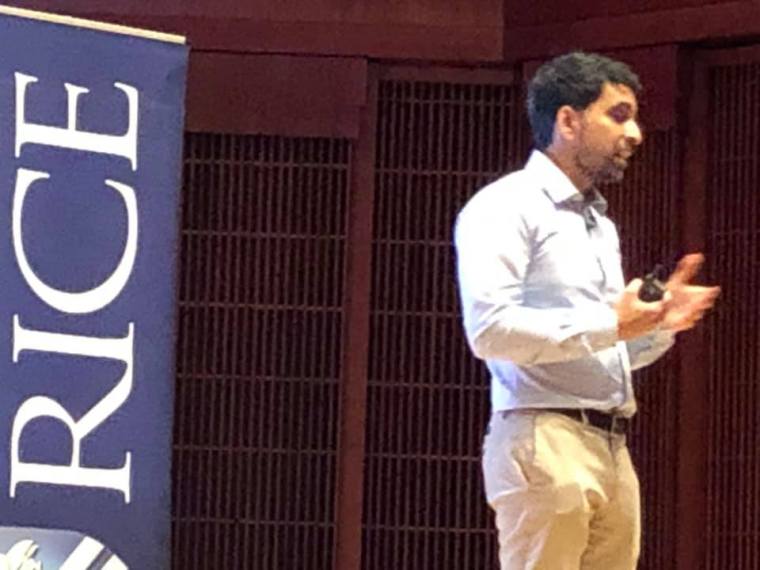
Kahn

Salman Kahn is a brilliant man with three degrees from MIT and an MBA from Harvard.  In 2004, he worked for a hedge fund firm in Boston, using his knowledge and skills to make money for his customers, his company and himself. He was rather good at both his job and the mathematics that it used so when his cousin Nadia asked for some tutoring he obliged even though it all had to be done long distance. Before long other family members were requesting his help so he made a few Youtube videos  to walk them through some of the basic concepts. It was a fun hobby that gave him a purpose beyond his career.

Along the way people that he didn’t even know began to watch his lessons and leave messages of gratitude for the help. He began to sense that perhaps those little tutoring films were more important than his professional work. In the fall of 2010, after consulting with his wife he began to invest the family savings into making his mathematics lessons into a not for profit business. He called it Kahn Academy, and it’s mission was to provide “a free world class education for anyone anywhere.” Since that time with donations from individuals and corporations his dream has grown into a world wide phenomenon with over 71,000,000 registered users in 190 countries and at least thirty languages.

There is hardly a mathematics teacher or student who has not used the services of Kahn Academy at one time or another. Now the site offers lessons in other disciplines as well. It has revolutionized education so much that incredible stories of its success abound. There are orphans in Mongolia who have become proficient in all aspects of mathematics and science simply from using the sequenced lessons. Perhaps one the most touching stories came from a young girl living in Afghanistan who was denied an education by the Taliban. In the privacy of her home she logged into the Khan Academy site and slowly worked her way through hundreds of hours of lessons, eventually earning admission to Arizona State University where she graduated with a degree in theoretical physics.

There is also the story a high school dropout who caught up on the classes he had missed, passed proficiency tests and returned to become the valedictorian of his high school all by using the lessons from Khan Academy. He ultimately went to Princeton University where he graduated with honors, and today he works for Khan Academy coding lessons so that other students like himself will have the opportunity to reclaim their lives all in their own homes and at their own paces. It’s a remarkable way of reimagining education.

Salman Kahn believes that learning at a fixed pace is a flawed methodology, one that most of us unfortunately endured. For decades we have followed the approach of subjecting large groups of students to a fixed schedule of coursework, moving along in tandem whether or not they are ready to move more quickly or struggling to keep up with the predetermined speed. The end result is a hodgepodge of understanding among the learners and a great deal of frustration for everyone. Kahn rightly believes that the sequencing and pace of learning should be based on mastery rather than a preconceived calendar and student age.

When we ignore the idea of individualized pacing with a goal of mastering concepts before moving forward small gaps in understanding often occur that over time lead to huge holes that give the impression that a student is incapable of learning certain things. When the curriculum is tailored for individual needs problems are addressed before going to the next concept, and research has shown that students actually begin to accelerate their learning curves as they build strong foundations and improved confidence.

The idea of individualizing pacing is not new. Educational psychologists have made attempts to find ways to move from a fixed schedule for decades. It is only with the technology that we now possess that such dreams seem to be within the grasp of reality. We can now teach anyone anything anywhere just as Kahn insists he will eventually do. The biggest hurdles that we must overcome are those that adhere too closely to traditional ways of teaching. Large schools filled with students all working at the same pace regardless of whether or not that is working for them are truly outdated, and yet it is the model that we insist on keeping simply because it is familiar.

We still need flesh and blood teachers. Our students must to be able to hear from humans and find inspiration in their skills as educators, but those who run classrooms of the future will need to be flexible and see themselves more has guides than the center of the schooling universe. Even our grading systems and the ways in which we quantify student progress will need to be retooled.

We are at the frontier of such innovations. We still have many who are unwilling to accept ideas like teaching for mastery rather than explaining concepts to a group, testing, and then moving forward regardless of results. We have to adapt to a growth concept of learning rather than one that is fixed, a supportive learning system whose emphasis is not on competition but rather on success for all. Technology will be a critical component of such thinking and innovators like Salman Kahn will be the Lewis and Clarks of the education frontiers. It’s an exciting thing to imagine, and we should be unafraid to take the first steps to make it happen.