Talent, Compassion and Wit

27857957_10216399335842193_7355374117100203653_nThree teachers stand out as my favorites when I was a school girl. I simply adored my first grade teacher, Sister Camilla, because she was kind and understanding of my needs both academic and psychological. I’ve always had a tiny bit of dyslexia and she created a number of visual tools to help me to distinguish between the letters of the alphabet, as well as encouraging me to use multiple modes of learning to decipher. Given that I was only five and feeling overwhelmed when I was her pupil, she somehow managed to use her skills to help me to enjoy the process of learning.

The next educator who had a lasting impact on me was Mrs. Loisey, my sixth grade teacher. The key to her greatness was an ability to explain virtually any topic in ways that were easy to master. Additionally she was perhaps the most wise and just instructor that I ever had. I think that I was more relaxed in her classroom than at any other time in my life, which speaks to her talent because the first year of middle school is usually filled with angst.

It was in high school that I met my muse, my English teacher Father Shane. He opened my eyes to the world of artistic expression and firmly instilled a love of literature and poetry in me. He introduced me to authors and playwrights, writing and self expression. I loved him and his class so much that I dreamed of becoming an author and teaching English just as he had.

These three individuals became my gold standard for excellence in educating the young. I modeled myself after what I had witnessed from them and measured the teachers that I would ultimately mentor by comparing their abilities to my masterful exemplars. I carried a mental rubric of what I considered to be exceptional teaching and it included the very best traits of my favorite teachers. My yardstick was exacting, but along the way I was gratified to learn that many of the educators with whom I worked were as dedicated and inspiring as those who had so influenced me.

The last years of my career as an educator were mostly spent recruiting, interviewing, observing, coaching and supporting teachers in my role as Dean of Faculty. My constant goal was to provide our students with the same quality of teaching that I had enjoyed when I was a student. I was proud to note that most of the individuals with whom I worked were indeed the best of the best, but even among such an elite group there were always shining stars such as Jenny Brunsell.

Jenny literally combined all of the traits that I most valued in an educator. Like Sister Camilla, Jenny was perennially patient and pleasant with her students. She spoke in a quiet and soothing tone making her pupils feel safe and respected. At the same time she was wise and fair like Mrs. Loisey and had a knack for explaining key concepts in a manner that made them attainable for everyone. Best of all, Jenny’s classroom was a fun place to be just as it was with Father Shane. She spent a great deal of effort searching for ideas that would make the time spent with her enjoyable and entertaining. She taught with grace and enthusiasm and I always sensed that her students loved her just as much as I had adored my own favorite teachers.

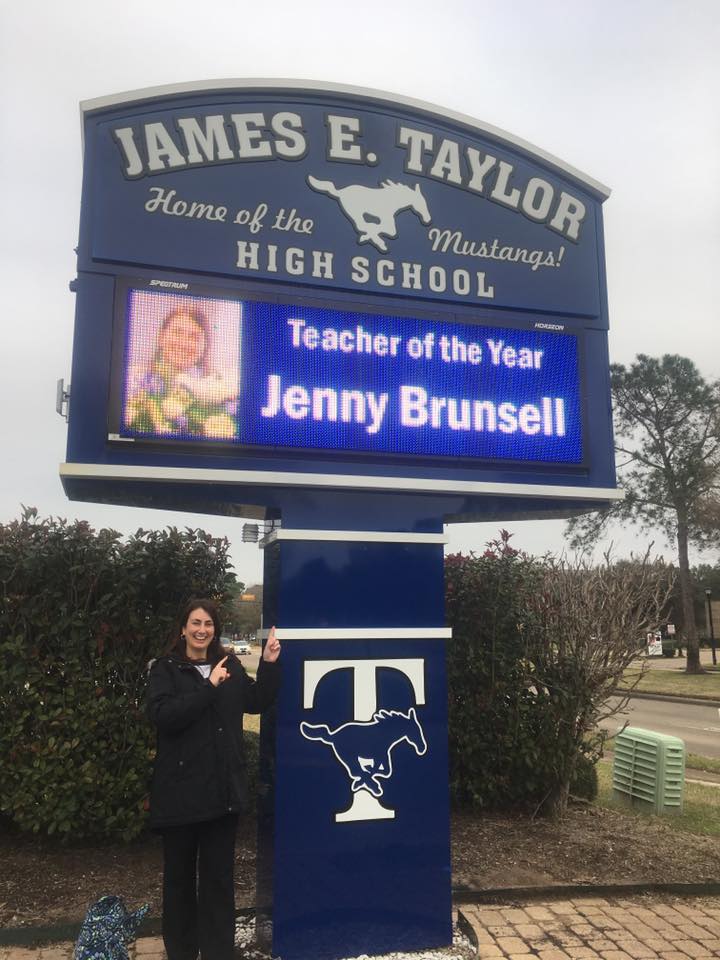
I eventually retired and Jenny went to another school where she continued to ply her magic. In addition to teaching English she became an Academic Decathlon coach with her husband. In a very short span of time her teams became perennial winners and the students in her classroom fell under the spell of her enchanting ways. It did not surprise me at all that she was so successful and that she was named the Katy Taylor High School Teacher of the Year earlier this week. My only question was why it had taken so long for someone to honor her with the recognition that she had earned long ago.

I believe that the key to our future lies in a three pronged effort from our children, their parents and their teachers. When all three of those groups work successfully together we produce a healthy productive society and all of the rest that we need follows. We do not often enough identify the finest traits of each of those three important contributors to human development. Sometimes due to uncontrollable conditions one or more of the triad is weak or even broken. A very strong effort by any of the remaining elements has the power of overcoming such difficulties. In particular a truly great teacher may literally change the course of another person’s life. This is the essence and the power of someone of the caliber of Jenny Brunsell. I have little doubt that many of her former students treasure the moments that they shared with her, and understand just how significant she has been in helping them to learn and grow.

We spend untold amounts of money on education each year. We do research and struggle to find ways of making our schools more uniformly excellent. The truth is that we need only begin to list the traits of the teachers that we love best to discover the elements needed to create thriving classrooms. The trick is in helping those who do not organically possess the qualities to learn how to incorporate them nonetheless. Therein is our challenge.   

Even in retirement there are parents and students and teachers who consult me. I hear horror stories of educators who are the antithesis of Jenny Brunsell. They seem uncaring and harsh to their pupils. They appear to lack justice, instead wielding power over their charges. They are unwilling to walk that extra mile for their students or to just be that one person determined to stay the course until everybody learns. They often even appear to dislike the very youngsters whom they are supposed to guide. Luckily that are the exception rather than the rule but even one of them is too many.

To know the greatest teachers is to be in the company of talent, compassion and wit. To have such a teacher is a never ending gift. I have been fortunate to learn from Sister Camilla, Mrs. Loisey and Father Shane. I have been encouraged by understanding that there are still teachers like them toiling away, often unsung. It’s good to know that now again someone takes the time to acknowledge the most remarkable of them like Jenny Brunsell.
In It For The Outcome

Teachers-teach-because-they-care.-Teaching-young-people-is-what-they-do-best.-It-requires-long-hours-patience-and-care.--300x300I happened upon a discussion of the holiday calendar for this school year on the Facebook wall of a teacher friend. She had originally been opposed to working through the Friday just before Christmas, but had changed her mind once she began enjoying the full two weeks of leisure time that this year’s schedule afforded. She and other teacher friends were quite happy with the fact that they have been able to take trips, totally relax and just enjoy a much needed break from the stresses of educating youngsters. Then the parents came out of the woodwork revealing a truth that has long troubled those of us whose profession is to teach. Namely there was a flood of complaints about having to find babysitters during such a long stretch of time away from school. In other words, schools in the minds of many adults are not just institutions of learning, but also convenient agencies for caring for children so that the parents will be able to work.

The babysitting aspect that schools have somehow inherited over time demeans the professionalism of teachers, and often flies in the face of research regarding when and how long children should be left at the doorstep of our nation’s centers of education. I have worried for some time about youngsters dragging into schools so early in the morning that they are half asleep or in tears. So too is my concern with many of the programs that keep them until late in the afternoon. This of course allows parents to conveniently complete their own work days without having to worry themselves with making additional arrangements for the care of their children, but it also requires teachers to work sometimes ungodly hours that include not only preparation for teaching but also development of ideas to keep the children occupied for long stretches of time. It is little wonder that my teacher friends are rejoicing over having a brief respite from their duties. Even worse, however, is the all too prevalent feeling that today’s educators are viewed with so little regard that many parents think of them as being little more than nannies whose function is not just to educate but also to accommodate work schedules.

I have nothing against working parents. I was a mother who worked as well. Ironically I often had to rely on my mother-in-law to care for my own children when they were sick or after they arrived home from school because I was required to stay beyond the regular hours for various programs designed to provide a safe and secure place for our students to be until their parents had finished their work days. I know how demanding it can be to be a mother and a reliable employee at one and the same time, but I have to admit to resenting that my hours at work were often dictated more by the needs of parents than either those of my students or me and my fellow teachers. It was assumed that we would be the caretakers even while our own children sometimes had to learn how to survive with a latchkey and stern warnings about how to behave while we were gone.

On most school days teachers leave home earlier than their children and return around the dinner hour. If they had the luxury of relaxing for the rest of the evening it would be all well and good but the reality is that most educators spend several hours each evening planning and grading and sometimes even conferencing with parents by phone or email. Days during the school year are long and too often filled with stress. Weekends are not much better from August to the end of May, so whenever I hear parents complaining about the free time that teachers enjoy I have to hold my anger in check.

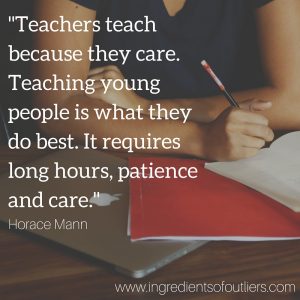
The truth is that there are few professions that are as demanding as teaching, and those who survive for the long haul do so with earnest dedication and love for the work. The pay doesn’t even begin to equal the amount of effort required to do the job well, and the tangible benefits are minimal. There are rarely parades or honors or even discounts for teachers as there often are for soldiers or first responders. Educators toil quietly away year after year because they are genuinely altruistic and devoted to a purpose driven life. They are concerned about the outcome, not the income and yet they invoke a generalized ire for their profession and are rarely consulted as the experts that they are. Still they return year after year because in spite of all of the negativity swirling around them they are answering a calling the compels them to attempt to make a difference in the lives of their students. They are not average souls who would be unable to do anything else, but rather remarkable individuals who have chosen a vocation that requires sacrifice and a thick skin. Their ultimate reward is a self knowledge that what they do is perhaps the most important contribution to society, and at the annual holiday pause of their labors they desperately need a period of rest to revitalize themselves for the big push of the coming semester. I can’t imagine why anyone would complain about the inconvenience of not having teachers around to care for their children, and yet it happens all of the time, and I suspect that if it were possible many parents would require teachers to be on call year round with only a handful of holidays.

The best system that I ever encountered was at St. Anne’s Catholic School. All teachers had regular hours as part of their work contract. Any additional time spent at the school was optional and provided extra income. The before and after school programs were separate from the school itself and paid hourly stipends to those who chose to participate. Many teachers enjoyed being able to extend their pay by volunteering for such work, but they also appreciated that they were not conjoined with professional expectations. Perhaps because parents paid tuition and fees for every aspect of the education they treated the teachers with great respect and esteem. I have never before or since felt as appreciated as I did when I worked there. Nobody took me for granted and everyone appeared to understand how much effort I was putting into my work. I felt as though I was a member of a team in my communications with parents. I believe that the success of our students was built on a mutual regard for one another that is sometimes missing in public schools. There is all too often a generalized feeling that our nation’s teacher are a rather ignorant bunch that are the source of most of the world’s problems. It doesn’t seem to occur to everyone that teachers are often asked to be all things to all people with very little support and not much compensation.

I suspect that parents who complain about long holidays and summer vacations just haven’t thought about how their cries of woe actually sound. They are juggling their own problems and it is easy to view the teachers as the enemy when they appear to be lounging far too long during the holidays. Those who have to return to work the day after Christmas may not be able to understand why teachers really do need that extra time to recharge. It is convenient to view our educators as the source of childcare problems, but I would urge parents to think again before voicing such complaints. As a society we give so little credit to our teachers that it is a wonder that anyone ever wants to enter the profession. The very least we can do is smile with them when they get excited about having time to enjoy themselves. Take it from an old pro, they have earned every single minute of their free time and they will be all the better with our kids because of it. We should be happy when we hear that they are feeling good. It means that they will do a better job when the school bell rings again.

The Season of Love

Christmas-LoveI’m celebrating my seventieth Christmas this morning and in another eleven months I will enjoy a birthday that makes me a septuagenarian. That’s a great number of December twenty-fifths, and somehow they have always been of great comfort to me even in years filled with tragedy. Christmas for me is bigger than me or any individual. It represents a brief moment when the vast majority of the the people in the world pause to celebrate, some for religious reasons and others just to have a good time. Whatever the motivation the season is all about showing our love for one another. It reminds us that our purpose here on earth is bigger than our individual needs and wants. From the humble beginnings of a baby born in a stable came a revolution in thought that eclipses even the greatest generals and politicians of history. Whether one believes in the sanctity of Jesus or not, there is little disagreement that His message of compassion and understanding is the key to peace on earth, goodwill toward all.

Perhaps my all time favorite Christmas card was a cutout of the word “Love” with the simple message, “Love was born at Christmastime.” I suspect that it moved me so because I had just delivered my own little girl only days before receiving it. I understood then as I do now that each tiny person who comes into to this world has the potential to be an apostle of Jesus’ message of unconditional love. Our challenge in life is to demonstrate kindness and understanding and to use our talents and our blessings for the good of all mankind. It is a daunting task, but one that brings us much joy when we make the attempt and find even a small level of success.

Even more so than Valentine’s Day, Christmas is all about love. As we gather with family and friends we demonstrate our humanity and its glorious potential. We celebrate each special person remembering those who have passed through this life before us and dreaming of those who are yet to come. We exchange gifts as an outward sign of our feelings for one another. We feast on our bounty as a way of sharing and enjoying our blessings. We send greetings to those who have touched our lives. We assess our yearly progress in becoming better persons who follow the message of giving and sharing and loving.

The world is an enormous place. Many among us have beliefs far different from our own. Christians celebrate the coming of the Savior. Jews continue to follow traditions as they await the fulfillment of a promise. Muslims follow the teachings of their Prophet. The nonreligious seek answers to life’s great questions in the words of philosophers and intellectuals. Our commonality lies in our very human quest to be good people whether for purposes of salvation or simply because it is the right thing to do. Christmas day is a time to embrace all of our brothers and sisters without judgement or self-righteousness. It is a moment to enjoy our individual uniqueness and to celebrate our own journeys through life.

There are those who are suffering on this day. It is up to us to remember them as well and to do whatever we can to help them. Maybe that means little more than brightening their day with a quick phone call or the delivery of food or a small gift. We’ve all endured Christmases that were bleak and challenging, but somehow even the most horrible situations have a way of turning around as long as we just keep trying.

Whether one believes that the little baby who so changed the world was truly the Son of God or just a very wise teacher, His words to us were always so simple to understand. By example and deed He demonstrated that every person is important and worthy of our love. Whether it be innocent children or those with whom we disagree He taught us to forgive and embrace everyone. The traditions of the Christmas season were all invented by people who followed Him to commemorate all that is best in our natures. The trees and sparkling lights are signs of the amazing power of life. The gifts are symbolic of our naturally giving natures. The food and the celebrating point to the fact that happiness is all around us and is meant to be shared.

So on this Christmas day of 2017 my hope is that each of us will find the spirit of love and peace that was born in Bethlehem so long ago. For over two thousand years mankind has been attempting to emulate better and better versions of our humanity. We have certainly missed the mark over and over again, but the most important point is that we continue to try even as we falter. Live your life today as though it is your grand opportunity to truly become the message of this season. Spread the love.

The Human Touch

teacher_crop380w

What is the next great idea in education? How might we best help our students to master difficult material? Does anyone have the key to unlocking minds?

These are questions that every teacher and concerned parent ask. We truly want to improve our educational system and we spend millions of dollars seeking answers. Our educational force travels to foreign lands to observe programs that appear to be successful. Our teachers spend summers learning new skills. Districts invest in diagnostic tools. We reinvent the educational wheel over and over again, hoping to stumble upon a magic bullet that will in one fell swoop increase our children’s knowledge, thinking abilities, and curiosity. We attempt to make mathematics and science more accessible to all, while we strive to demonstrate how to read and write more fluently. In spite of all of our efforts we find ourselves in a quandary. We still appear to be losing so many of our kids to struggles with learning, and so we continue to experiment in the hopes of one day stumbling upon the key to unlocking minds.

Fifty or sixty years ago when I was earning a degree in education a psychologist named B.F. Skinner was all the rage. His focus was on the types of reinforcement techniques that we humans use to motivate individuals, and so we learned that encouraging students when they do something right is more likely to have them repeat the good behaviors than punishing them for mistakes. He insisted that we can slowly move a person toward a goal with the just the right amount of encouragement. He even attempted to create a teaching machine that would be able to accomplish such a task according to the specific needs of the learner. Back in his days technology was a long way from being reliable or effective and so his efforts failed, but he predicted that one day there would indeed be a mechanism designed to enact his ideas.

Fast forward to the future which is now. The power of the computer has allowed us to create individualized instruction complete with feedback that would no doubt delight Skinner. While it has revolutionized education in general, there are still difficulties when it comes to creating effective programs for individuals. The fact is that it simply does not work for some people. There is till a need for a warm human to unravel questions and provide inspiration and motivation. A machine is far too cold to handle the task alone.

I do a great deal of interventional tutoring since retiring from education six years ago. I find that there is no substitute for small group interaction between humans. The first step in helping a struggling student is always a matter of dealing with fears and frustrations, something a computer can’t do effectively, at least not yet. Not all students have the ability to focus well enough to concentrate on a mechanized one size fits all instructional video, and yet they are being used in most of the schools that I encounter. Virtually every high school student is well acquainted with Kahn Academy, and while I use the lessons myself to brush up on ideas for teaching certain concepts, it cannot be used as a substitute for a good warm blooded teacher inside a classroom. It’s proper use is for reinforcement of material, not initial instruction.

I have encountered a new trend of late that involves assigning an instructional video to students for homework. They watch the electronic teacher explaining various concepts and then work independently on similar problems. The following day in class they are able to ask specific questions about the material. For the students with whom I work, this methodology has been a disaster. It is backwards from the way that works best for them. Namely, they would be better served by first receiving instruction from the teacher, then watching the videos to clarify the processes, followed by independent practice with problems and finally questions about the work. They are floundering but sitting quietly in the classrooms because they don’t even know how to begin their inquiries. They are simply lost and sometimes even drowning in confusion. By the time I get them they are feeling dejected and their confidence is in shambles. My job becomes demystifying the definitions and processes in a way that guides them to understanding. Sadly, the time that they have to spend with me often increases their stress because they are always just a bit behind in their mastery and so their grades do not reflect what they eventually manage to learn.

When I watch the videos that they must view I actually appreciate all of the time and effort that such teachers have put into producing them. I enjoy knowing how the instructor is presenting the material so that I might use similar terminology and practices. Still I find that I have to learn how and when to pause the stream of information so that I might take notes or try some of the problem solving on my own. I find that I am able to do so effectively only because I already know how to perform the operations and I am familiar with the vocabulary. I am also able to separate the chatter from the most important ideas. I suspect that the top students who are already rather gifted in mathematics have little difficulty doing as I do, but for the average to below average soul those videos must be just a cacophony of meaningless sound. For those with specific learning disabilities I can only imagine how frustrating it must feel.

I’ve been in a classroom and I fully understand and appreciate the frustrations of teachers as well. They have far too many students and increasingly complex demands that don’t always have much to do with teaching are placed on them also. Their days are long and exhausting and the vast majority of them are doing their very best. Sometimes the most gifted among them are able to break down the barriers that all too often separate them from their students. They become the inspirational individuals who change minds and manage to touch hearts as well. In other cases they simply feel as beaten down as the students. They desperately want to make a difference but can’t seem to find the way to do so. Far too many aspiring educators last less than five years before they leave in total frustration.

We seem to understand that people are complex and as such there is never one right way of doing things. It has been proven that even with regard to diet, there must be differences that take individual genetic tendencies into account. Why, I wonder, do we still approach education as though there is indeed a magical way of reaching all students without concern for their individuality? Why do we crowd our children into rooms as though they are being warehoused like cattle? Why do we push them at the same pace? Why are there so few of us who want to teach them in charge of so many? What is it about our society that we place so little value on such an important task? Why do we complain but demonstrate an unwillingness to support our schools?

The truth about education is that it has to be tailored to a person, not a crowd. Everyone is capable of learning, but not in the same way or at the same pace. How many times have we met an adult who struggled in school but eventually got it all together at a later date than his/her peers? It is the way of humans to meet milestones in a variety of ways. It is up to us to appreciate that fact and provide our young with educations suited to them. It’s perhaps the most important task that we might ever perform, and it will pay unmeasurable dividends to our future. It always requires the human touch.

A Matter of the Heart

automaton.jpg.pngWhen I entered high school placing students in particular tracks had become all the rage. Based on grades and an entrance exam I ended up in what was known as the Honors group. Things were a bit nerve racking for me because the principal inserted a caveat to my designation in a face to face meeting in which he indicated that I would only be part of that cadre on a probationary status. In fact he suspected that I would be removed within the first grading period because I was barely qualified for the academic rigors to which I would be subjected. Through sheer determination I hung on for four years and graduated with an Honors designation. It would not be until I was an adult that one of my former teachers would reveal that my peers and I had been part of a grand experiment that did not work as well as the adults had hoped.

Educators have a tendency to be constantly searching for what I call a magic bullet, a way of doing things that will transform the way we teach our children and result in dramatic advances in knowledge and critical thinking. Sadly as such attempts take place there is always a risk that they will not bring the hoped for advantages and may actually do damage to the students who become living guinea pigs. Thus it was with me and many of the other people in my class. Each of us became known more by our labels and less as the individuals that we were. We tended to believe that sets of numbers defined us, and in my own case I worried that everyone would learn that I was a fraud. Because the principal had so clearly indicated that I did not have the intellectual acumen to be a member of the elite Honors class, I was constantly stressed and uncertain of my abilities. Little did I know until that fateful reunion with my teacher that I was not alone in the emotional trauma that the untested methodology unleashed. The fact that the plan that had driven the daily routines of my class was eventually changed to address its blatant problems was of little comfort. The damage had already been done and it bothered me even though most of us had managed to overcome the difficulties perpetrated by faulty methodology.

As a teacher I understand the need to find the best practices for reaching students. Still I have watched a parade of bandwagon theories that have ultimately been rejected long after they have had an ill effect on the youngsters who were used to determine effectiveness. I don’t suppose that we are able to tell whether or not something will be successful until we try it, but for the group that is subjected to massive changes it can be disastrous. We watched the new math of the seventies be rejected because it never really clicked with either the teachers or their pupils. We worry about that the constant standardized testing and the thirst for hard data has somehow ignored the heart and soul of each individual. We sense that numbers alone are incapable of measuring the content of a mind. We try different styles of note taking, tutoring and delivery of lessons, only to realize that there is no one size fits all way that works for everyone. We labor to individualize learning and teaching but then insist on scripting lessons. We’ve tried cooperative learning, behavioral modifications, and on and on. All are noble and well intentioned efforts but instead of taking an entire group and radically changing the way they are taught, why can’t we try such interventions in small doses until we are certain that they are effective?

There is a trend in many schools today to modernize teaching by using technology with a nod to B.F. Skinner. Students watch educational videos or read lessons at their own paces. If they fully understand the concept they are free to keep moving forward. If they are confused they ask questions of the teacher who becomes more of an interventionist and less of a direct instructor. Interactions between teachers and their pupils are thought to be more targeted and thus more effective, but for many it has become a frustrating venture leading them to confusion and a loss of self esteem. As someone who has always understood that there is never one best way, I have to wonder what proponents of such radically different systems were thinking when they decided to abandon all of the traditional ways in favor of a grand experiment. Why not instead insert such changes in small doses and then measure their effect on each student? It would make much more sense to see what happens in a trial run rather than simply accepting that all of the old ways should be left behind. It really is possible to teach in a number of different ways and still get phenomenal results.

I would like to propose that teachers select the methods that work best with a particular set of students rather than tossing out the baby with the bath water in favor of new ideas that are still untested. We should instead tread lightly with innovations, use them sparingly until it is evident that they truly are effective. It’s never a good idea to overuse any practices. They can become too routine and boring to students. Variety truly works well and provides opportunities to try the latest educational ideas. The most important thing is for teachers to still be teachers, not just conduits of information. In other words the goal is to help every student to attain mastery of concepts. That takes patience and creativity because sometimes the secret to unlocking a mind lies not in how information is presented but in how an educator touches a heart and turns on the magic that lives inside everyone. There are truly some aspects of learning that have little to do with data points.

We have rubrics and measurements for literally everything today, neglecting to take our differences into account. Students who don’t quite fit the mold often feel that something is wrong with them. Only a talented and sensitive teacher knows how to help them to find themselves in a world that seems so intent on judging their worth based on numbers. We really do have to move beyond the test scores and grades to encourage our youth to see learning as a magical and exciting experience rather than one that places daily stresses on them. If a student does all of the steps correctly to find the equation of a line when given two points but then accidentally multiplies wrong to reach an incorrect answer, we need to be willing to give that person credit for what they did right and use the mistake as a learning tool. All too often we instead slash a big red mark over the entire effort and leave the child feeling inept. That borders on educational malpractice.

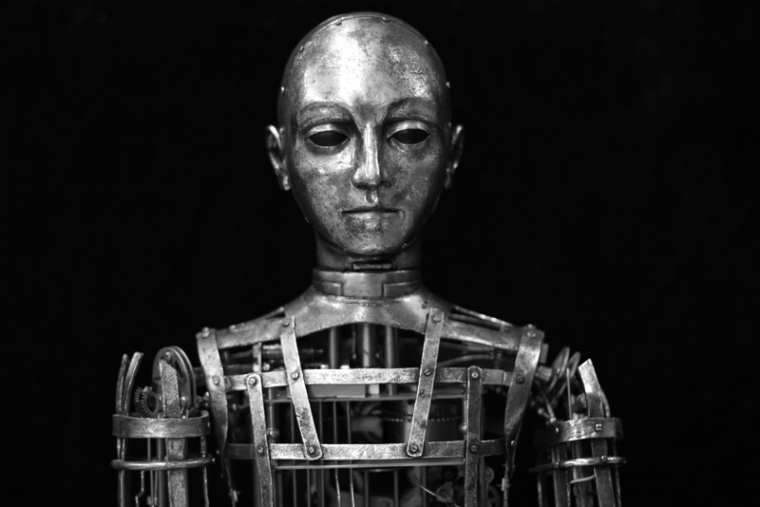
There are those who speak of today’s students as snowflakes, kids who can’t handle conflict or difficulties. Nothing is farther from the truth. Today’s children are busy checking off boxes that indicate that they are moving steadily toward success. It is an almost robotic atmosphere in which they must complete so many requirements just to move from one phase of education to another. Square pegs have to fit into round holes no matter how painful the process of doing that may be. Universities make it more and more difficult to land an acceptance letter. Students must have resumes that include rigorous courses, leadership roles, extracurricular activities and even community service. They work from before dawn until well into the late hours of night attempting to accomplish all of the expectations. Many of them are enduring mental distress in the process and questioning their worth when they falter. It is as though we have embarked on a nationwide experiment with their very lives and souls. We have become Tiger Adults who push and push and push without thought of where all of this will lead. It is little wonder that so many young adults are pushing back on the system once they come of age to make their own decisions. Perhaps it’s time for all of us to demand that schools take a long hard look at the effects of what they are doing.

I made it through my high school and graduated as the Valedictorian in spite of the negativity and pressures that were placed on me by well meaning adults. Not everyone is so fortunate in such highly charged situations, and we have to take every person’s needs into account. There are indeed great teachers who have found the keys to reaching students without destroying their confidence and we should observe them and learn from them. Isaac Owoyemi teaches mathematics for mastery, providing students with multiple opportunities for learning concepts in an encouraging environment. Seng Dao Keo understands the necessity of starting from the point where students are on the learning curve rather than failing them for not being ready for a particular idea. Chrystal Hunter deconstructs the most difficult aspects of mathematics and simplifies them so that her students will comprehend and feel accomplished. Dickie Written reaches the imagination of his pupils by making literature relevant and exciting. Lisa Sandifer understands that many students need the arts to reach their full potential. Jenny Brunsell brings the heart of an angel to her kids and they always respond. Such educators realize that while there is an element of science in teaching it is in the execution of its art that the true miracles happen. They do not rely on scripts or preplanned lessons or the latest fads, but instead select what is needed in a specific time and place. This is the trend that we need to follow. Until our children feel the joy of learning all of our efforts will have been in vain. We reach them first through the heart and then the mind follows.