
Time To Clean House

song-sparrow-sing-58a6d9af5f9b58a3c91533bf

The words you speak become the house you live in. —Hafiz

I once knew a woman who was a downer. She reacted to virtually every situation with negativity. Chicken Little had nothing on her. According to the ideas she expressed the sky wasn’t just falling, it had already crashed to the ground and we were all in the midst of a great apocalypse. I ultimately reached a point at which I was no longer able to be around her. Just listening to her endless stream of complaining became like venturing into hell. It began to affect my own attitude so much so that I was suddenly imagining slights that really weren’t there. Her words literally transformed my feelings to such an extent that my happiness began to slip away. Even after I drew away from her it took a bit of time to recover, and I have often wondered what kind of disastrous effect her utterances were having on her children.

It’s difficult to find the refuge of silence in today’s world. There is chatter everywhere and it is not always of the healthy kind. There was a time when unkind or ugly words made one a social outcast, but there now seem to be no bounds that hold us back from saying anything that pops into our heads. We’ve got a late night television host who has strayed from joking about our president to uttering disgusting and controversial statements without much retribution. The same president who is the butt of those commentaries is well known and often applauded for his own repulsive insults. There is less and less of a tendency in our present society to hold people accountable for speaking in ways that were once deemed unacceptable. It has become a linguistic wild west that makes me cringe, because it demonstrates a lack of respect that should be insisted upon for each of us.

Certain language registers have traditionally been appropriate for specific times and places. We were all taught to be more formal at work or school, in church or during a public gathering. We reserve our most intimate words for our closest family members and friends, people in whom we trust. It is generally when we blur the lines between our casual speech and words that are more polite and carefully selected that we become misunderstood. Those who do not know us well may infer meanings that we did not intend, so we need to think before we speak. Sadly that is not as often the case as it used to be. Words are now bandied about without regard to their potential effect. The world now twitters and chirps like unthinking birds, creating a cacophonous noise that is having a negative effect on all of us. Somehow deep inside we sense that we need to make it stop but we just don’t know how.

My students who were being psychologically and verbally abused rarely reacted to the barrage of insults to which they were being subjected in a healthy manner. Instead they became withdrawn and angry. They sometimes ran away or, even worse, they began to emulate the behaviors that they witnessed on a daily basis. They evolved into bullies and fighters. They demonstrated a bravado that they hoped would disguise their own degradation and feelings of uselessness.

Our words are important. What we say to others not only affects them, but it also affects ourselves. We literally become the product of our thoughts and utterances, so we have to ask ourselves what kind of people we wish to be, and then act and speak accordingly. We can tell ourselves to make the best of our situations and to take control of our ways of reacting to the world, or we can become victims who continually complain. Free will is still very much ours.

I’d like to think that our present ways of talking so negatively with one another represent a phase that will soon pass. Somehow we find ourselves elevating individuals whose comments make us cringe over those who speak with gentleness and respect. We appear to prefer harsh words over those that are poetic and inspiring. I place my hope for the future in the knowledge that the speeches that we remember are uttered by good men and women who want to motivate us to be our best selves. We carve words from Abraham Lincoln or Martin Luther King into stone because they represent the kind of people that we all long to be.

Each of us has a voice. We have the power to be the change that we wish to see. We can turn off the noise with the flip of a switch. We can lead by example. It does not require us to take to the streets nor to become like those whom we abhor. It begins with our own words. We need to start by examining our own remarks and ridding them one by one of the kind of words that are hurtful to others. We can take back the power from people who would lead us with utterances that make us cringe. We do not need to be ugly to be strong. Let’s all focus on saying something nice. It’s time to clean house.
The Old Is New

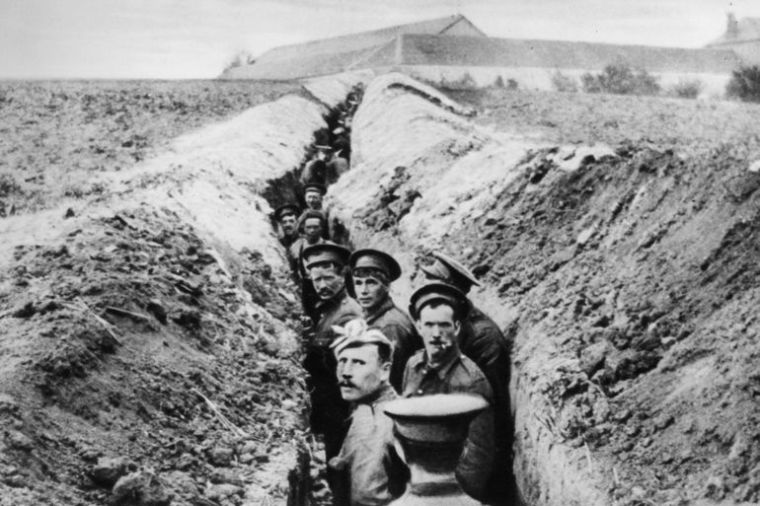
In The TrenchesIt was a dark time in history. The world was engaged in a heinous war whose purpose seemed unclear to most who tried to understand why millions of young men were dying. The brutality of the battles was unimaginable. Modernity had changed the nature of fighting in truly horrific ways. Mankind had not yet outlawed the use of chemicals as weapons. Nothing, it seems, was taboo, and so young men were permanently mutilated by agents like bombs and sarin gas. Never before had there been such murderous activity in mankind’s seemingly relentless quest for power. World War I is a war that we often ignore when in reality its effects continue to plague us to this very day.

The United States initially watched events unfold from afar. It’s hard for us to believe but our nation was very much a kind of backwater region at the onset of the twentieth century. Most of the world powers still thought of our government as a fluke in the annals of history, hardly worth noticing when compared to the vast influence of Austria-Hungary, Germany or Great Britain. Militarily the United States was ranked number seventeen, just behind Serbia. Few paid much attention to our still very young country as they engaged in an epic struggle in Europe.

At the beginning of World War I the United States was in debt and still far more rural than urban, but it had incredible natural resources and manpower which became a lifeline for nations like Britain and France during the fighting. With so many of their young workers unable to farm or work in factories it fell to the United States to supply the food and material needed to survive. The USA became a beehive of activity all while insisting on a neutral stance regarding the war. Initially most Americans were disinclined to become involved in a dispute that seemed to be more of a disagreement between royal relatives than a meaningful cause. Instead they enjoyed the fruits of commerce that were occasioned by the war.

The war that was supposed to be resolved in a matter of weeks dragged on with horrible consequences for European nations. The citizens watched helplessly as their youth were killed or maimed in heretofore unseen numbers. After almost four years of fighting France was on the verge of capture and collapse. Britain was little better. Russia was boiling over with a revolution that would dramatically alter the course of that country for the next hundred years. It appeared that Germany would soon dominate Europe. The United States enjoyed its relative safety and newfound prosperity while Europe burned.

Germany believed that it might break the will of Britain and France, thereby winning the war, if only the United States were prevented from sending supplies, and so they boasted that ships traveling across the Atlantic toward Europe would no longer be safe. Their gamble backfired and resulted in a declaration of war from the United States. Within months hurriedly trained American soldiers and weapons, began arriving to bolster the Allies, breaking the stranglehold that Germany seemed to have on the continent. By turning the tide of the war and helping the Allies to win the United States earned the respect of all the world. Suddenly our country had become a superpower and a king maker. For better or worse we have played that role ever since.

A hundred years ago President Woodrow Wilson justified our country’s involvement in war as a way of spreading liberty and democracy. It is an idea that is bandied about to this very day, but then as now a sizable number of people question the arrogance of interfering in the affairs of other nations. Such thinking was again used successfully as a rationale for World War II but lost its luster during the engagement in Vietnam. Presently the world finds itself in a confusing quagmire in the Middle East, a part of the world many of whose problems began with the peace negotiations at the end of World War I. One hundred years later we are seeing the results of arbitrarily dividing the spoils by redrawing colonial maps in a manner meant to punish the losers rather than consider the needs of the people living in the areas once ruled by European monarchs. The roots of today’s problems were unwittingly planted by power brokers whose intent had little to do with spreading freedom.

The world changed dramatically a hundred years ago particularly for the United States. We took on a mantle of responsibility back then that has always had an aura of discomfort. By nature we want to be the good guys, the heroes, but tiny voices of caution echo inside our heads. Part of our nature wants to be left alone, just as our forefathers who fought for their independence from an ever invasive government. Another side of our personalities feels compelled to constantly fix whatever we see as being broken including other governments. The tension between these two points of view are as prevalent today as they were back then. Our divisions are in reality nothing new.

One hundred years ago even as we appeared to be saving the world conditions were ironically far from ideal in our own backyard. Women were still fighting to win the right to vote. Race riots broke out in cities across the country in the summer of our victory. Many of those who had spoken against going to war languished in prisons. We still had much to do at home before serving as advisors to the world. Hypocrisy quietly reigned much as it often does.

Everything old becomes new again. After a hundred years much of the idealistic thinking of those who supported World War I has been tarnished by reality. We find ourselves feeling anxious as the world smolders as though coals of discontent from our past have once again caught fire. We ask many of the same questions and silently worry that a truly peaceful world is a pipe dream, the stuff of fools. We wonder if our warlike natures will always and for all time inevitably take hold. We would sometimes like to wish ourselves back to a time when we were number seventeen in the world and nobody expected much from us, but we know that our ship has sailed and now we much pray for the wisdom to find answers that will do the least harm. As we do so we would do well to remember the lessons from history.

The Strong

AlejandroAt one of my grandsons’ recent track meets there was a fun race that featured beefy football players running against one another. Of course there was also a big twist to the competition. Each of the guys, who looked like defensive linemen, had to carry a tire as they circled the track. They had everyone laughing and having a good time, and I was reminded of a story that my grandfather loved to tell.
Grandpa grew up in small town Virginia. In fact he was so far out in the country that he wasn’t even sure if the place where he lived even had a name. The townspeople had to create their own entertainment. There were no theaters or musical venues or such, just whatever talent they were able to throw together from the locals.

On one occasion the citizens decided to have a race between the biggest guys in the county. The idea was that they would have to run through a course carrying heavy barrels of flour. They had to ford rivers, climb over fences and go through fields strewn with rocks while lugging the heavy containers. The path extended for several miles and was so treacherous that only a truly strong man would be able to survive the grueling adventure.

Grandpa said that everybody’s money was on one particular man who was built like  Paul Bunyan. His arms and legs rippled with muscle and he was well over six feet tall. My grandfather was in total awe of this contender, and so he wagered a small amount of his earnings on the outcome.

From the beginning of the race this incredible hulk of a man sprinted far ahead of the competition. Nothing seemed to stop him and in one phenomenal show of prowess he even climbed over a fence without stopping to set down the heavy barrel. Grandpa laughed as he pointed out that there was actually no contest, and his bet was as safe as if he had placed his money in the bank.

We humans have always had a fascination with individuals who hone their bodies into powerful machines. Here in the Houston area we are all enamored with J.J. Watt, an affable defensive player for the Houston Texans who at times seems to most surely be related to Superman. He has performed some spectacular feats on the football field and in the locker room, including jumping from a standing position to the top of a chest that was at least three or four feet off of the ground. When I think of J.J. I understand the admiration that my grandfather had for his hometown strong man.There is something almost mystical about such people. They metaphorically represent the strength of mind and body that we all wish to have.

Of course we are not all made of the necessary stuff to enable us to accomplish such remarkable physical feats. Even in the race with the tires that made us all laugh at my grandsons’ track meet there was one young participant who was significantly smaller than the rest and in spite of tremendous grit he was not able to keep up with the bigger boys. Still, there was something quite appealing about his willingness to try even as he fell farther and farther behind. In the end he received as much cheering and applause as the winner. We all somehow knew that his positive attitude was as laudable as size and speed.

My grandfather’s stories all had a common theme, namely that we humans are continually faced with challenges and the best among us fight with all of their might to succeed. He himself overcame one difficulty after another, and somehow lived to tell about his adventures with a hint of laughter and the wisdom of someone who had traveled along life’s highway for one hundred eight years.

We love our athletes because we understand how much hard work and pain it takes for them to do the things that they do. They push themselves beyond the limits that so many of us simply accept. This is also true of those who take their minds to heights of thinking and learning that literally result in unheard of discoveries. There are people among us who are not satisfied with being ordinary and their dedication to their craft separates them from the ordinary.

A couple of weeks ago one of the former students of KIPP Houston High School performed in his senior recital at Wabash College. To say that Alejandro Reyna is talented would be an understatement as evidenced by what he has achieved since the beginning of his education there. As a freshman he regularly wrote a blog detailing the adjustments that he had to make in a place far away from home with a culture unlike his own. His openness and sincerity made his writing an instant hit, but it was only the beginning of the incredible things that he would ultimately do. By the time that he had reached his senior year he had composed original music for oboe, piano and strings in addition to being a proficient singer. The works that he wrote were stunning and plant him firmly in the ranks of incredibly talented individuals. In his own way he is as splendid as the strong men who have been the stuff of fascinating legends. We will most surely continue to hear from this exceptional man. 

Each of us is endowed with particular talents, but we don’t always push ourselves to be our very best. Athletes work hard and often ignore pain. Those who are brilliant move beyond the ordinary in their quest for knowledge and answers to questions. There is much perspiration involved in achieving greatness and that is why we humans are so in awe of those who push the envelope of life. They become our heroes and live in the stories that we tell of them. Alejandro Reyna has already earned a place among them and he has only begun.   

We All Fall Down

maxresdefaultI was twenty years old when my mother had her first mental breakdown. Mine had been a somewhat sheltered life. Aside from my father’s untimely death when I was only eight, I had not seen much of the dark side of existence. I certainly knew nothing about mental illness and the dramatic symptoms that seemed to so suddenly change my mom from a strong, independent woman into someone paralyzed by depression, paranoia and manic episodes. As I witnessed her decline that summer I was overtaken by a state of anxiety that made me feel as though I might surely die. I would visit her during the daylight hours and then return to my apartment in the evenings where I attempted to understand what was happening and to rally help for her among my aunts and uncles whom I was certain would have much better insights into her condition than I had. Mostly though I suffered from my own form of mental stress experiencing panic attacks that threatened to render me useless in the battle to bring my mother back to a healthy state of mind.

I slept little during that period. In fact, that August marked the first time that I was plagued by insomnia. I generally lay awake each night silently crying and feeling as though an elephant was sitting on my chest daring me to breathe. I felt so very alone, convinced that nobody might possibly understand how worried and sad I was. I was walking through those days in a continual daze, pretending to be in control of my situation while actually wanting to run away screaming in desperation. As my mother’s symptoms grew worse I realized that I had inherited total responsibility for her welfare. Circumstances forced me to grow up by a factor of one hundred. While my friends, save those who were fighting in the jungles of Vietnam, were still enjoying the adventures of college and the freedom of their youth, I understood that if I didn’t take charge my mother and my brothers would be in danger. I took a deep breath and became my mother’s keeper in a strange relationship that would span four decades. It was something that I would have happily given up if given even half a chance but the reality was that there was nobody else who could do this for her.

I was as imperfect at being unselfish as anyone might be. There were times when I was hardly able to function myself and when I resented the cross that I had to bear. I became an Academy Award worthy actress, hiding my fears and pain along with my mother’s tragic story as though it was an ugly and unspeakable secret. My unwillingness to open up to people who might have provided succor to me only made things worse but I was not yet ready to accept that I would be far happier bringing the truth into the light. When my mother became well again I naively believed that all of us were going to be fine and that I would never again have to face such a daunting experience. Sadly, she was sick again in only a matter of a few years and I fell apart at the realization that her illness was going to be a chronic fact of our lives.

I continued to be quite secretive about my mother’s fight with mental illness. My own stress increased to an unfortunate level as I quietly and continuously watched for symptoms that would alert me to get her to a doctor before she devolved into a more serious state of mind. I failed to mention my own bouts with anxiety and mild depression but they were quite real and they made me feel as though I wasn’t nearly as strong as I needed to be and that I was somehow defective.

At some point I was no longer able to maintain my silence. I began to speak of my concerns, my feelings of guilt, and the sense of despair that often overcame me. At first it was only the most trusted friends who heard such things but eventually I found the courage to talk with my doctors and finally anyone with whom I had contact. I learned that nobody was going to think ill of me or my mother. Nor was I abandoned. In fact, my admissions generally lead to sharing of similar stories and unlikely alliances. Over time I realized that we all fall down from time to time for one reason or another. We may lose a loved one, face a terrible disease, endure the breakup of an important relationship, fail in achieving a goal, become a victim of violence or suffer from mental illnesses of our own. The truth is that we are both fragile and resilient beings. As such we experience ups and downs throughout our lifetimes. Sometimes are lows are so devastating that we feel as though we may not make it through to the light of day.

I have found that there are always kind and empathetic individuals who are just waiting for our cries of help. All that we have to do is open up our hearts and we will find them, kindred spirits who have also had moments of brokenness and terror. They lovingly provide us with comfort just when we need it, but they will not be able to do so unless we are willing to confess that we are hurting. In acknowledging our humanity we take the first steps toward healing. It took me far too long to admit that I was as imperfect as I am.

I remember kneeling in prayer in the office of an assistant principal who cried with me as he spoke of the people in his family who also suffered from severe mental illnesses. I found succor from a doctor who was giving me a physical for work. He noted the checkbox that indicated that some of my relatives suffered from depression. He gently guided me to a confession that radically changed my life as he assured me that I had no reason to feel guilty about the times when I resented my role as a caretaker. I have had countless individuals hug me in an embrace of solidarity as they outlined their stories of struggles with either their own or someone else’s mental illness. Never once has anyone reacted negatively to my recounting of the journey that me, my mother and my brothers had taken in the house of horrors that was the reality of mental illness. Instead with each telling I felt reassured that I was not and never would be alone.

We all want to be viewed with dignity and respect. It is difficult to admit that we have feet of clay or that we make mistakes and yet it is in facing the demons that attack us in the middle of the night that we find the clarity and calm that we seek. Not only do we find a clearer focus for ourselves, but often we help others as well.

I know of two young ladies who are dealing with very difficult situations. They are far more advanced than I was at their ages. Rather than hiding the hurt and the pain that stalks them, they have been willing to share their feelings and the efforts that they have made to set themselves aright. They write blogs and speak to other young people. They tell of their journeys and admit that they still falter from time to time. The work that they are doing for themselves and for others is not just laudable, it is important. They are living proof that even the seemingly most perfect individuals often find themselves struggling to cope. They are both exceedingly beautiful, intelligent and talented, hardly the type of women who might falter, and yet they have. Their willingness to unmask their struggles is inspiring. They prove that the world is far kinder and gentler than we may imagine and that even the most remarkable among us may need a safety net now and again. It’s as easy as voicing the word “help” to begin the process of healing. We all fall down but there will always be someone willing to pick us up if only we ask.

An Education

free-spirits-ii-13891She was unlike anyone that I had ever known, a free spirit who seemed to float blissfully above the rules of society. She walked through life as though she owned the world, but in reality had few possessions of any merit. More often than not she kept her feet bare, unfettered, even at formal occasions. She was from the north but boasted that once she had found the south there was no turning back. She was an artist, an intellectual, a high school dropout. I could hear her coming in the battered and ancient pick up truck that was her pride and joy. It allowed her to haul items that might one day come in handy for one of her many projects that were rarely fully completed. Her mind skipped merrily from one idea to another with grand bursts of genius. Such it was with our friendship, glorious kinship until she was drawn like a moth to other places.

When she left we both pledged our fealty and promised that we would make great efforts to stay in touch. I even drove a rather long distance to her new home once, a littered slot in a trailer park that was made merry by a colorful garden that she had planted in an old wooden box. She greeted me warmly and we spent an afternoon sipping on herbal teas and laughing at her stories while her children ran like free range chickens in old fashioned play. She never owned a television and didn’t want one. She preferred entertainment from imagination and it was all she really needed because hers was so vibrant. She reminded me of a gypsy princess, exotically beautiful with a fiery personality. I had seen her face down the devil himself and walk away with her head thrown back in haughty victory.

Her husband was a car mechanic and she was madly in love with him, so much so that she had run away with him on the back of his motorcycle. It broke her parents’ hearts and even her relationship with them for a time. Eventually they came around when they saw how deliriously happy she was. She had left the mundaneness of her upstate New York upbringing for adventures that few of us ever experience. She purposely kept few possessions feeling that they held her back whenever wanderlust took hold. Her family was free to go wherever and whenever the winds blew. There were cars to be repaired by her husband everywhere, and her art was as easily created in a small unknown town as in a large urban area.

Eventually she was gone again, too far away this time to pursue. She was not one for exchanging phone numbers or addresses and our acquaintance was in a time before cell phones, email and social media. Our friendship became only a wonderful memory of time spent with a truly ephemeral spirit. Somehow I had known all along that it would not be a permanent thing. I simply enjoyed the moment, knowing that some people cannot set down roots. They must always be on the go, discovering parts of the world that most of us never see.

I still think of her and so many others who have passed through the parade of people I have known. I wonder if any of them ever realized how much I learned from them, how important they were in shaping me into the person that I am today. Each of us encounter individuals who find their way into our hearts, and while their stay is only temporary their influence is forever. There is something about them that we never quite forget no matter how many years and decades pass. Now and again we think of them and hope that they are doing well.

I gravitated toward strong-willed women at a time when I was shy and weak. I observed their behaviors and learned from them. It was an education without walls, so real and meaningful. I surrounded myself with ladies who had known grief, abuse and hard times. They had emerged with dignity and an unwavering sense of themselves. I was their intern, someone longing to learn from them. Like a sponge I soaked up their spirit and determination to face down whatever challenges arose. They did not have degrees or certifications but they were perhaps the smartest people I had ever known. I encountered them when I was struggling to find myself and they showed me how to be what I wanted to be, not what others wanted for me. They taught me how to respect even the most humble and broken among us, treating them with the dignity that everyone deserves.

I suppose I might attempt to find some of them like Diane or Rosie or Debbie. It isn’t that difficult a task with the Internet and all of its resources. Somehow though, I don’t think that it would be wise to do so. I believe that I was only supposed to know them for a certain time during which they would help me to emerge from my awkward cocoon. Their spirits have remained in my heart and they have been there again and again smiling and guiding me.

They would be old ladies now with middle aged children and perhaps a number of grandchildren. We might not even recognize one another even if we were to pass in a crowd. We went our separate ways long ago. Our personal demands overtook us leaving little time for the idle chit chat that we enjoyed when our babies toddled under our watchful eyes. We each found new homes, new jobs, new adventures that moved us farther and farther apart until one day we had lost each other, but never the memories.

We are the sum total of all of the events and people that we have ever known. Their influence lives inside of us and is even passed down to our children long after our acquaintances are done. We find the individuals that we most need at exactly the right times. It is almost magical the way that happens. There are so many who gave me so much of themselves along my journey who are now strangers. I would so like for them to know how much they helped me and how grateful I am that I once knew them. I’d like to think that things turned out as well for them as they did for me.