The Suit

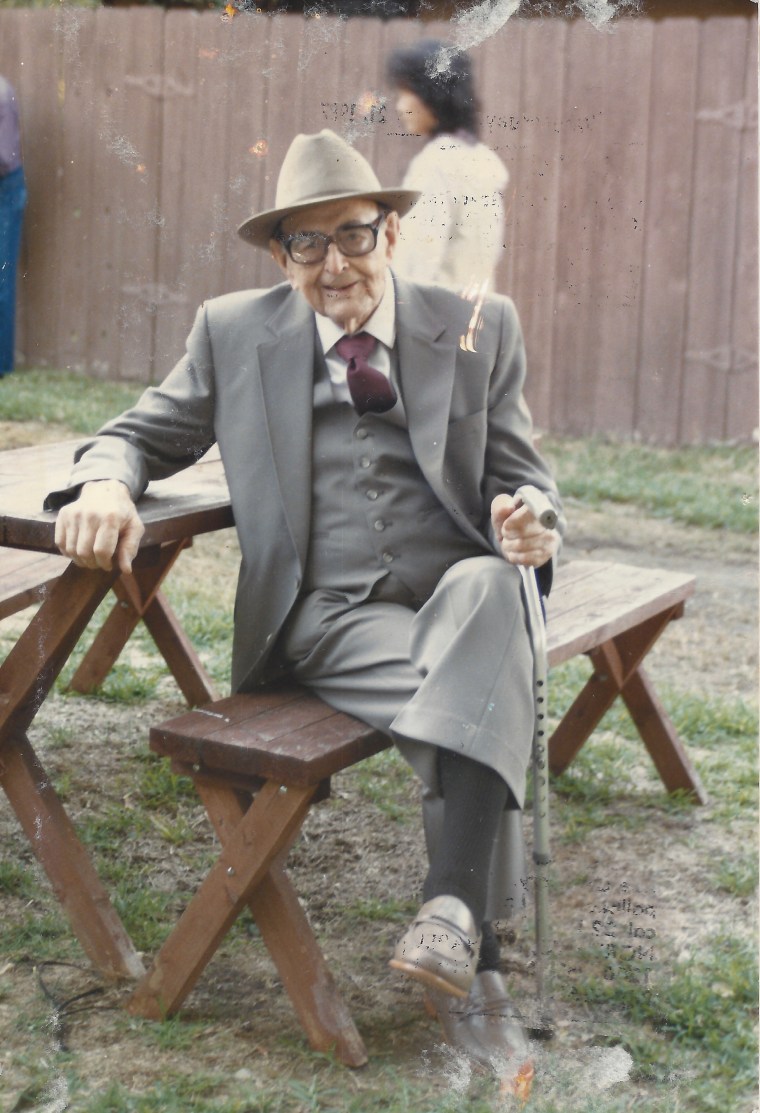
William Mack Little - Suit

My husband used to have to wear a suit to work every day. Each morning he would don a newly laundered and starched shirt, arrange one of his ties from his vast collection around the collar, and select one of the suits that served as his uniform. When he retired he stored the suits in the back of the closet and rarely pulled one on save for funerals and the like. Eventually he noted that those symbols of his forty years of daily toil were probably at least fifteen or more years old and looking a bit threadbare. Besides he had recently lost fifty pounds and they hung on him like a tent. It was time to purchase a new suit.

I accompanied my man to the store for consultation and while he was being measured by the tailor I found myself laughing at a memory of my grandfather. Grandpa had purchased a brand new gray suit for his ninetieth birthday party. He sat regally among his family members wearing the trappings of a sharp dressed man including a hat that shielded his bald head from the burning rays of the sun. Someone took a photograph of him on that day that became a treasure for those of us who so loved him. It would always remind us of how gentlemanly he always carried himself and how handsome he was. He hardly looked his age in the image, nor did his countenance betray the hardships that he had endured over ninety decades. I vividly recall that he had joked that he had purchased the clothing both as a birthday suit and the outfit that he planned to wear to his own funeral. Ironically he lived to the grand old age of one hundred eight and as he neared his last days he would note that his suit was all worn out.

Doctors said that my grandfather’s longevity was due mostly to having good genes. Nonetheless I always believed it was because he had the spirit of a survivor. Somehow he managed to use the tragedies of his life to grow stronger rather than to brood over his sorrows. He never knew his mother who died twenty days after he was born and by his own admission his father was a heavy drinking reprobate who did not amount to much. He was essentially abandoned to the care of his grandmother, a widow, who left a very positive impression on him. They lived a somewhat isolated existence in the backwoods of Virginia and his stories of their time together brought a mischievous twinkle to his eyes. Sadly his grandmother died when he was only thirteen and he became a ward of the court until the judge appointed one of his uncles as his guardian. Around that time his birth father who was still very much alive contracted small pox and Grandpa went to care for him. Some of his best tales centered around that time and the primitive nature of medicine back then. His father miraculously survived the disease and my grandfather amazingly never contracted the illness in spite of its highly contagious nature.

My grandfather grew up quickly as so many young men did in that era. He was on his own well before he had left his teenage years. His education was minimal but he was a quick learner with a willingness to adapt to any situation. He began traveling around the country picking up work wherever he went. It was a tough and lonely life but not that different from the norm of that era. He found solace in drinking which lead him to follow in his father’s alcoholic footsteps. After one evening of heavy imbibing he felt particularly repulsed with himself and vowed to mend his ways. He never again touched even a drop of liquor demonstrating the strength of character that we all saw in him.

Grandpa was forty before he met my grandmother and married. She was the center of his life and whenever he spoke of her his face lit up with pure joy. He often called her his buddy and talked of how much fun they had even long after she had died. Together they had two children, one of whom was my father. They were quite proud of my dad. He was a brilliant man who was the first in his family to graduate from high school and then earn a college degree. They always referred to my daddy as a good boy, so it was quite devastating to both of them when he died when he was only thirty three years old.

My grandmother was never quite the same after her beloved son died. Grandpa did his best to make her happy and the two of them enjoyed tending to their farm in Arkansas but seven years after my father died my grandmother was diagnosed with terminal cancer. Grandpa moved her to Houston so that she would be nearer the medical care that she would need. He tended to her with loving care, watching his savings dwindle to nothing because of the huge expenses associated with her treatment. He was eighty eight years old when she died. His pockets were empty and he had to sell his home to pay all of the medical bills. He found a room to rent and the strength to carry on.

By the time that my grandfather was ninety years old and wearing his new suit in his birthday photo his worldly goods consisted of what he was wearing, a few other changes of clothing, some favorite books and magazines, and the pipe that he smoked as he sat in his favorite recliner reading or enchanting his many visitors with his tales of a time so different from the modern era. His mind was sharp as a tack and his sense of humor never wavered. Only now and again would he speak of feeling tired, and that mostly occurred when someone that he loved had died which was happening with greater greater frequency as the years continued.

Grandpa took great pride in being independent. He admired courageous people. He took care of himself, proudly living within his limited means. He was perennially optimistic even when times became tough. He would tell us of the Panic of 1893, which in his words was a depression even more horrific than the so called Great Depression of the twentieth century. He had seen the world convulsing through the Spanish American War, World War I, World War II, the Korean War and the war in Vietnam. He had witnessed the world at its best and its worst over and over again. He understood that there really is a circle of life that repeats itself at intervals. He believed in the brilliance and goodness of mankind because he had seen the changes again and again that set the world aright even as it sometimes teetered into chaos. He had learned that there is always a way to carry on even in the most horrific of times.

We sometimes act as though our present situation is somehow unique in the annals of history. We behave as if the end of times is somehow near. We complain that daily life is more terrible than it has ever been. We wish for quieter times and complain about how difficult things have become. If my grandfather were still here with us he would calmly suggest that the world is actually unfolding in ways that make it just a tiny bit better with each passing day. Every generation has had is share of troubles and woes, but ours occur against a backdrop of plenty that was not even dreamed of in earlier times. Our advances in medicine, education, science, technology and even social programs were astounding to my grandfather and made him feel hopeful even when things became quite difficult. My grandfather was certain that we were headed in the right direction even when we felt lost or had to take a circuitous route to get back on track. He was a patient man who in the end taught those of us who knew him how to remain strong and positive and most of all loving. When I think of him in his dapper suit and I take a deep breath and carry on.
Not Yet Down and Out

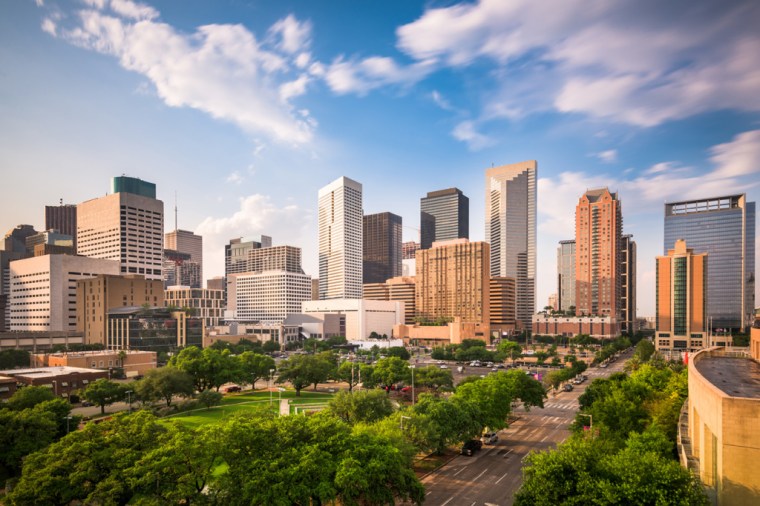
shutterstock_441927634-1024x683.jpgIt was a sunny day in Houston, Texas on a January afternoon. The streets and highways were filled with people enjoying the break in the cold weather. It somehow seemed impossible that only five or six months ago those same roads were filled with flood water from hurricane Harvey, creating unbelievable images of devastation. Everything appeared to be so normal, and it felt as though the recovery and healing of our scarred city had gone smoothly and far more quickly than anyone might have ever imagined. We had even begun to believe that we might have a good chance of winning the big Amazon prize that would bring thousands of jobs to our area along with millions of dollars to boost our economy. Perhaps it is in our Houston DNA to be upbeat and unwilling to be counted out. We’d done the impossible so many times before that those of us native to this flat featureless plain see our city with different eyes than those of outsiders.

This is a town built on land encircled by bayous that is otherwise landlocked, and yet we have one of the busiest ports in the country, dug from the Gulf of Mexico to a site in the shadow of the place where Texas gained its independence. Somehow our town took a field that had once been home to grazing cattle and transformed it into the center of the worldwide space race. A wealthy academic from the east coast imagined a Harvard of the south and founded the prestigious and renowned Rice University. A doctor imagined a home for cutting edge medicine and convinced benefactors to build a medical center that would one day be a leader in research and talent. We have done the impossible time and again with the help of visionaries who saw beyond the limitations of our geography, and on any give day it feels as though we have miraculously moved beyond the horrors that beset our beloved Houston on those three days in August when the sky rained its fury on all of us.

We all know that things are not always what they seem to be. Those whose homes were filled with brackish water that rushed in through the weep holes inundating their rooms and their peace of mind are mostly still working to get back to normal. The piles of debris that represented the destruction are generally gone misleading observers to believe that all is well. Inside the repair work continues at various stages. The mucking out of water and dirt is done. The walls of water soaked sheetrock have been removed leaving frameworks of studs marking load bearing structures and outlines of rooms. In some cases fresh new sheetrock and paint now brighten the areas. In others the skeletal frames await the resolution of claims that may one day bring the funds for repairs. Carpet and flooring is difficult to find even when there is money to purchase it. Cold concrete has become a way of life for many Houstonians who celebrated Halloween, Thanksgiving, Christmas and the new year with their homes torn apart, and still wait for normalcy to return. They sit on lawn furniture and sleep on air mattresses attempting to stay calm and carry on when in truth they are exhausted and broken hearted.

On that sunny day when all seemed so normal, of course it was not. I drove through a neighborhood that had been heavily impacted by the storms and at least a third of the homes still had huge dumpsters parked in the driveways. Trailers and RVs dotted the landscape and told a tale of homeowners still camping out while their homes recovered very slowly. Daily life has become a marathon for them as they cope with realities and fears that sometimes feel overwhelming. They walk through their days attempting to be as positive as possible even as they worry about the impact this all has had on their psyches and savings.

It has been estimated that eighty percent of those affected by hurricane Harvey did not carry flood insurance. They have had to rely on FEMA for funds to repair their houses and many of them still wait for that money to be forthcoming. Generally the most that they might receive is only slightly more than $30,000, and in the majority of cases it will be far less than that. FEMA does not replace their household goods, so many people are creating massive debts just to begin again. Those who did have flood insurance are all too often waiting even longer for the relief that they need to put their homes back into working order. Supplies are scarce, and the great deals that merchants offered in the early days after the disaster are mostly long gone. Nobody thought that there would still be people in need this long after the catastrophic event.

Our city is wounded and our spirit is being sorely tested. Naysayers warn us that we will never again be the same. Our luster feels somehow diminished as investors and dreamers grow wary of locating here. Amazon passed us over, choosing Austin and Dallas as more worthy possibilities for their center. People from outside our area view our town as an ugly humid place more suited for mosquitoes than humans. They underestimate our determination to overcome the odds that have often appeared to be stacked against us. Houston has always been a city that should never have been, and yet here we are winners of the World Series even as we limp through the worst days of our history. It seems that Amazon missed the essence of who we are as people and may have ignored the very qualities that would have made their venture truly great. They did not understand that the images of courage and community that they witnessed when nature had battered us mercilessly were not aberrations, but rather an unvarnished revelation of who we really are. The secret of Houston is that we are willing to take on any challenge and rise from the muck and the mud to triumph over adversity. This is a hard working city with dirt under its finger nails and visions of a better future in its soul. 

Think of us now and again. We are still here even though we have not yet totally healed. There remains much to do, but you will rarely hear us complain. We don’t want to be pitied or thought to be beyond hope for we still believe that our city has a great future. Don’t pass over us or assume that we are out of the game. This city called Houston is a miracle built on unstoppable dreams. Plan to keep hearing from us. We’re not yet ready to be down and out.

Charts and Graphs

AAEAAQAAAAAAAAfPAAAAJDBhNTVkMGFiLWI0MDUtNDQxOC1hMjBjLTg0MzA3ZTEwYTQ2YwDoes anyone else remember when Ross Perot ran for President of the United States? He was a funny looking little guy with big ears and a Texas drawl that wouldn’t quit. He was a third party candidate in the election that included George H.W. Bush and Bill Clinton. Bush was defeated in his bid for a second term and many folks thought that Perot was the reason that he lost, noting that Perot took votes that the President may have received. Anyway, Perot was a much tougher guy than he appeared to be. He had amassed a fortune making him a billionaire, and when Iran took several Americans hostage, he was the guy who planned, financed and executed their escape. He became a kind of folk hero in spite of his somewhat wimpy appearance, and at some point his groupies encouraged him to run for the highest office in the land on two different occasions. In many ways he was the precursor of Donald Trump, but with  a more pleasing kind of “aw shucks” personality.
Perot was most notable for giving visual presentations of his views on the American economy. He used posters and a pointer to demonstrate the problems in our nation and the solutions that he advocated. While people poked fun at his methods, there was something about his way of explaining things that brought clarity to ideas that had previously been rather difficult to understand for the average person. He won over a number of followers because he laid out his ideas with his charts and graphs in a highly understandable folksy manner. He was a cross between a kooky professor and a cowboy, a strange fellow who had managed to outfox the bullies and the naysayers in real life.

I didn’t vote for Mr. Perot, but I still think about his visual aides and I often find myself wondering if we need someone with similar tendencies today to show us the truth about the various issues that we face in today’s supercharged atmosphere. There is a great deal of chatter about various topics, but very little effort to elucidate what various ideas and laws really mean. I have learned for example that there is real confusion over the so called Dreamers, immigrants who were brought here illegally by their parents when they were children. Many people feel little or no pity for their cause because they think that they should have done the work to become citizens before now, little realizing that it was not possible for them to become citizens because of their illegal status.

I sometimes imagine Mr. Perot with an easel and a set of posters outlining all of the truths about the Dreamers, one visual at a time. Of course his instructional moments would need to take no more than three minutes or so, because I have learned over time that few people have the ability to concentrate and comprehend for more than a couple of minutes before they begin to drift away into their own thoughts. Still I think that with a targeted series of demonstrations everyone would eventually understand all of the issues surrounding DACA and the Dreamers far better than they presently do.

Knowledge is power, but we are provided with so little of it these days. Instead most of our leaders leave us with soundbites, tweets, rants and memes that keep us in a state of ignorance. Mr. Perot on the other hand actually wanted us to know the facts, and while I didn’t exactly agree with his points of view or solutions for problems, I liked his style. Perhaps because I am a visual, linear learner I appreciate the clarity provided by seeing a sequence of visual explanations for things. They don’t have to actually be old school posters on easels. A nice Power Point presentation might work just as well, but then again there was something rather catchy about Mr. Perot’s homespun looking presentations without the bells and whistles of today’s Instructional programming. They were eye catching simply because they were so primitive.

So I’d like to suggest that either a politician or a journalist be very very honest in outlining all of the information surrounding the big issues of the day. We need to be taught about chain immigration including when and why it came about and what it’s effects are today. We must know more about what actually happens when the government shuts down and which agencies and individuals are actually affected. It would be good to take some time to go through lessons on the constitution, where we might learn about how each branch of government is supposed to work. Our discussions might move from the irate to the rational with proposals for solutions that actually reflect the realities of various situations. It would be quite a change from the ignorance that is almost encouraged these days to keep us in the dark and in political trances. Perhaps even our memes would change to brief but accurate sources of information. The possibilities are wondrous.

Somewhere along the way we’ve been led down a garden path. The politicians know that we are rather busy and can’t get around to gathering all of the information that we need to make good decisions, and so they have learned how to play on our emotions and turn us against one another. While we’re busy brawling, they are kicking the can of responsible governing farther and farther down the road. They leave office with guaranteed health insurance, pensions and usually more money than they had when they arrived. We in the meantime are more confused than ever about what to think. Let’s bring back Mr. Perot and his pointer. He’s only eighty seven. Surely he has the energy to be our guide once again. We don’t want to know his philosophies or ideas, just the facts, only the truth. Perhaps his true destiny has finally arrived.

I’m So Mitt Romney

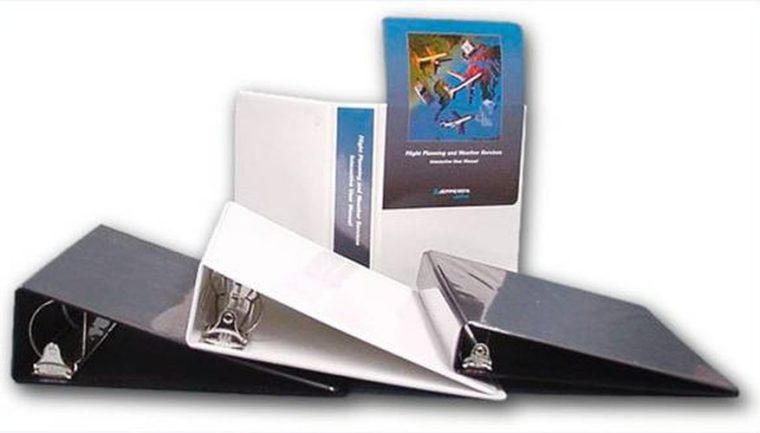
binders-made-800x800I bought my husband an Apple watch after he had his stroke, and he uses every possible feature that it allows. He thought of returning the favor by gifting me with one for Christmas, but soon enough realized that I would probably only get as far as telling time with it. He knows that I am technologically literate only to a point beyond which I’m just not willing to make the effort. For the most part I’m often still as old school as Mitt Romney with his binders. In fact, I decided to write about this after getting all tingly with excitement over finding a spiral notebook with three sections for taking notes. It’s a way of keeping track of what to remember, what to buy, and what I plan to do. I find as I get older that I need these kinds of reminders, and unlike my spouse who simply records his notes on his watch with his voice, I need a hardcopy to go with my visual learning style. I keep my scribbles on a table in my bedroom and refer to them periodically for ideas. Somehow my system seems easier and quicker than having to go through the motions of finding that information on a watch with print so small that I need 300+ reading glasses to see the letters.

I often laugh at myself and think of a time long ago when I was young. My mind was so sharp that I didn’t even need a calendar to recall appointments. Everything that I needed to know or remember was all in my very clear head. I look back at a time when I had to hold my laughter when I witnessed my father-in-law performing his daily ritual upon arriving home from work. He would walk to the kitchen table and immediately begin withdrawing slips of paper from the breast pocket of his shirt. Each paper contained something that he had thought about during the day that he wanted to remember. At the time I could not imagine becoming so absent minded that I would ever need such a system, but the need for ways of keeping track of all of the thoughts that race through my head soon enough became overwhelming, and I began to rely on planners and calendars that I carried in my purse.

These days I don’t have nearly as many appointments or goals as I did when I still had children and was working, but I continue to need a way of keeping track. I have surrendered to using Google Calendar because I can enter engagements quickly and also see what other members of my family are doing at a glance. I also keep track of my calorie consumption and exercise each day with an app that serves mostly as a kind of policing mechanism to keep me from over indulging. It chides me when I consume too much fat or sugar and threatens to starve me if I eat an item that leaves me without enough calories for dinner.

When I was still teaching my husband custom designed a grade book for me using a spreadsheet. I was one of the very first teachers in my school to use such a thing. I had to get permission from the principal to turn in printouts rather than the hand written calculations in the old style journals. I felt like a real trendsetter even though I did little more than plug in the numbers and then let the computer do the rest of the work. My program was so well attuned to my specific needs that I actually resented having to change over to the one that the school district eventually required all of us to use.

Perhaps the aspect of technology that I most enjoy is the word processor. Typing was always so difficult for me. It would take me longer to type a paper than to write it by hand. I labored over so many assignments not because I lacked ideas, but because I was a horrible typist. My final products were dotted with so much white out that I lost points for lack of neatness. God only knows how much I might have been to accomplish if I had been able to type on a computer keyboard instead of my mom’s electric typewriter with several keys that stuck.

I love emails and texts. In fact it was email that saved my bacon once when I was working on my graduate degree. I had completed all of the required hours, or so I thought, and was ready to graduate at the end of the summer until a counselor informed me that I needed one more class. Regardless of how I demonstrated that her math was faulty she refused to listen. I suppose that I became a bit overwrought and frightened her because she suddenly suggested that I get one of my professors to sponsor me in an independent study. She told me that I had exactly two days to make the arrangement. I frantically attempted to call my teachers with no luck. Then I recalled the professor who had required us to use email, a new idea that was still mainly the purview of universities back then. I sent him a message begging him to help me out. I mentioned that I would be taking a final exam the following day and joked that “if there is a God” he would answer my plea. While I was taking the test I heard a voice calling my name and saying,”God has arrived.” He helped me set up a program that evening and three weeks later I had completed the study. I became a fan of email from that point forward, and have never turned back.

I set timers with Amazon’s Alexa and request musical selections from her. She turns lights on and off by command and schedule and I have grown rather fond of her, especially when I didn’t have to squeeze behind my Christmas tree to plug and unplug the lights each day. Siri is another very dear friend of mine. She has taken me to exotic places that I might otherwise have never found. Now and again my southern accent confuses her, but mostly she is my constant guide. I am confident that she will get me safely to my destination no matter how far away it may be.

Still there is something about my hand written notes that is more reassuring than messages on a screen. I can place asterisks next them or cross them out when I change my mind. I can pull them from my pocket or my purse as I walk through the grocery store. I feel a sense of accomplishment when I crumple up a”To Do” list because I have completed all of the tasks. There is an aspect so wonderfully personal about seeing notes in my own handwriting. Perhaps it is the joy of being literate, a treasure that neither of my grandmothers ever knew. Being able to not just think, but also to record my ideas with my signature flourishes makes them feel more important, so I suppose that I will stick with my little notebooks and handwritten lists until something convinces me that there is a better way.

i’ve often thought that I might have enjoyed being an archeologist. I am fascinated by hieroglyphs and ancient paintings on the walls of caves. I wonder what we have today that will be as lasting as those ancient attempts to record daily life. Our paper eventually turns to dust. Our machines become outmoded and then seem to be more like inanimate bricks than keepers of our deepest thoughts. What will people of the future think of us, and how primitive will our efforts appear to be? The technology that we use today grows outdated so quickly. That watch that my husband wears is already becoming obsolete. We have to keep up with times that are moving faster and faster. Sometimes it’s just easier and more comforting to stick with the old familiar ways. Mitt Romney and I are about the same age. We like our binders and our notebooks. They have served us well. It’s not that we are against progress, we just see no point in getting rid of a good thing.

Opening Our Ears, Eyes and Mouths

flat,800x800,070,fThere is a video of four little babies loving and hugging one another that has gone viral. It is a precious demonstration of the innocence that is in our human natures that sometimes becomes twisted and ugly in some of our fellow humans as they grow into adults. I suspect that the clip is popular because it reminds us of how we dream for the world to be, devoid of bigotry and hatefulness. Sadly we know that no matter how hard we wish for such a reality, it will probably never completely occur, but what if we did indeed have a way of extending the goodness that lies in our hearts just a bit more? Would we do our best to make such a thing happen or would we choose instead to take an easier path in life?

We have seen instances of people throughout history who have decided to be the change they desired to see in the world. They did not turn away from challenges to demonstrate love and justice, and often they were ridiculed and even persecuted for their courage. Jesus showed us the way and the truth about how we should all live, and for his efforts he was nailed to a cross and killed as though he was a common criminal. Abraham Lincoln held fast to a belief in the dignity of all men and was murdered. So too did Gandhi die because of his determination to speak for those without a voice. Dr. Martin Luther King, Jr. lead his people to their rights as humans and citizens of this country all the while understanding how dangerous it was to do so. The greatest individuals of all time have overcome their fears to stand up for goodness, but there have also been instances when those unknown to us have been unafraid to be noble. Every single day someone somewhere is facing down evil and moving the dial just a bit closer to the kind of loving perfection that we all wish to see.

I find it heartbreaking when we witness hurtful behaviors and we simply allow them to happen. We turn our backs, close our doors, draw the blinds, pretend that we did not see or hear the transgressions. We do not wish to invoke the ire of the people around us. We don’t want to make waves, and so we remain quiet, making excuses for those who embarrass or hurt others with their actions. These days we even invoke the premise that the end justifies the means, even as those means are truly vile. We advocate strength in numbers and informally join groups even when those groups do things that we know are wrong. We don’t wish to be shunned, so we allow the infractions to occur, pretending that they really aren’t so bad even when we know that they are.

It is when the vast majority of us close our eyes and put our fingers in our ears in the face of a wrong that evil takes root among us. The leap from being a highly educated and cultured society to gassing innocents for simply being of a certain kind is not all that great, and when it happens we realize that we have lost control of a situation that might have been stopped if only we had been forthright in the beginning. History has taught us time and again that the line between civilization and anarchy is often very fine, and bullies will take advantage of our failure to enforce it.

I have tried to give the president of our country the benefit of the doubt. I have wanted to believe that perhaps his comments have been sensationalized by a press that does not like him, but far too often he gives me little reason to support him in his baseless tirades against certain groups of people. I’ve thought that perhaps he does not know how to properly voice his ideas properly because his vocabulary and knowledge seems so limited, but now I simply think that he is in truth a very mean spirited person, a bully, and a bigot. What bothers me even more than the horrible things that he says is that there are actually those who applaud his ugly ideas, and sadly some who dislike what he says but are unwilling to say so.

The most recent example of this came from a discussion of how to deal with immigration, a topic that has brought out some of the most egregious comments from the president. The fact that he used a guttural term like “shithole” to describe certain countries was not as horrible as the inference that it would be preferable to limit immigration to those who come from so called better places. The meaning behind such statements is appalling knowing that there was once a time when my own grandparents and mother were thought to be unworthy of citizenship in this country by prejudiced individuals who called them dirty and ignorant. They came from a part of eastern Europe that has historically been thought to be home to lazy people not worthy of admiration or respect. My mother never fully forgot the sting of the insults and rocks hurled at her for no reason other than her heritage. It is painful to me to consider that the leader of our country would still be categorizing people based on their nation of origin, economic state, or educational opportunities rather than seeing each of us as equal in the eyes of God. I had thought and hoped that such thinking was a thing of the past, but I have learned that I was wrong.

What truly worries me is that so few of the men and women in the Republican party have remembered the model of Abraham Lincoln and risked their careers to say and do what is right. Some who have no trouble standing up to the wrongful thinking of Democrats seem to have become sheep with regard to President Trump. If they actually agree with his sentiments, then they are a very cold hearted group that has forgotten what this country was supposed to represent to the oppressed peoples of the world. The message that they are sending is not one about protecting the American people and our way of life, but one of exclusion and prejudice. No matter how the president’s remarks are parsed or what exact words he used it comes back to the idea that we don’t want to provide opportunities and safety for citizens who do not fit a certain profile, and I have to strongly disagree with that kind of thinking.

I have written my two Senators and urged them to step forward and demand that the president cease and desist his campaign of disgusting pronouncements, but I have little faith that they will even read my comments much less act on them. In the meantime we are hurting and demeaning individuals who like my grandparents only want a chance at a fair shake.

This country was not founded by the squires and noblemen of Europe, but by the second sons, the downtrodden, the persecuted, those who realized that their home countries held little promise for them. Over time they came to our shores one by one eager to make something of themselves, and many did just that Their resumes would not have been likely to enchant someone based on merit, but they proved themselves when given a chance. This has been the exceptional story of our nation. This is what has made us great to this very day, not some imagined vision of isolation and unwillingness to learn from one another.

We cannot build walls around ourselves and expect to thrive and find happiness. It didn’t work when kings built moats and stone structures and it won’t work now. The world is a vibrant place with ideas pulsing in every corner. A truly visionary leader understands that we have a place in the larger community, not if we hold sway over everyone else, but by becoming part of the conversations about what each of us has to offer. We were at our best when we saw ourselves as helpers rather than dominators. We changed the world with our goodness, not our brute strength. Every time we have become confused about our role it has gone badly, and right now our president seems to think that a he alone knows how to keep our country safe. History shows us the folly of such thinking, We can’t keep looking away. It’s time for all good men and women to come to the aid of our country. We have to open our eyes, our ears, and our mouths.