Unleashing Horror

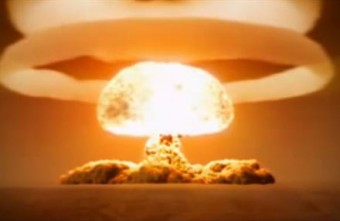
tsar-bomba1I am a child of the Cold War. I grew up hearing an air raid siren every Friday at noon. I practiced crouching under my desk along with my classmates in readiness for a possible nuclear attack. I watched movies that featured apocalyptic scenarios and creatures that had grown out of proportion from exposure to radiation. I saw reports of individuals building bomb shelters and observed adults worrying about the Cuban Missile Crisis. The threat of attack from Russia seemed to be a fixture of my childhood and teen years. Somehow the danger was so insistent that I and most of my peers actually began to ignore it. Of greater importance to us were the young men being drafted to fight and sometimes die or be injured in Vietnam. Violence was featured on the nightly news programs that entered our living rooms each evening, but we never became immune to the horrific images that we saw. Instead we grew weary of the constant hints that one day our world might explode. More than a few of us became peaceniks ready to do whatever it took to keep our country and our young men and women out of harm’s way.

For a time things settled down into an illusory peace. It felt as though the whole world agreed that we all loved our children too much to keep fighting. Unfortunately the lull in the militarism was brief and once again we have a generation of young people who have literally spent their entire lives hearing of wars, terrorism and the threat of nuclear annihilation. It is a horrible place for them to be. It takes great mastery to shelter our kids from the worry of horrors. Even with our best efforts they will no doubt hear of the realities of the world just as I did, and it will worry them.

There is great saber rattling taking place between the United States and North Korea that is frankly far too reminiscent of the fear mongering that forced me and my classmates to endure those drills underneath our desks. The power of nuclear warfare that was unleashed at the end of World War II has been a specter that won’t quite go away. The arms race has placed dangerous weapons in the hands of tyrants capable of doing very unexpected things. This makes for great tension and requires great diplomacy and skill in reading the minds of those who would harm us. We are presently engaged in a nuclear chess game with potential consequences that are almost unbearable to consider.

It would have been impossible for my generation to spend all of our time concerned that one day our civilization as we know it might be wiped out with the push of a button. We had to believe that our leaders and the leaders of other nations would take their responsibilities for the safety of their people seriously. John Kennedy and the men and women that he had assembled in his cabinet proved to be more than worthy of the task. They averted what might have been a disaster of Biblical proportions. The true story of the thirteen days in October in which they stared down the Russians is one of courage and rationality. I think that after that particular occasion most of us continued to live our lives confident that we would never have to actually witness another nuclear attack like the one that was rained down on Japan. We grew more and more aware that with great power comes even more responsibility. Our leaders seemed up to the task.

I hate to admit this but many of my old childhood fears have come back to haunt me since President Trump has decided to take such a belligerent stance in reaction to learning that North Korea has the capability of attacking the United States. The game that he and Kim Jong Un are playing is high stakes, and we can only hope that it will remain in the realm of schoolyard taunting. The leader of North Korea is young and notoriously unstable. He may have little real appreciation for the consequences of launching a nuclear attack, but President Trump is of my generation and he should know full well that even thinking about such a thing is worrisome. His words may be designed to scare Kim Jong Un, but I wonder if they also might push the dictator to demonstrate that he is not afraid. Dealing with someone known for being unpredictable takes great finesse and I am not convinced that remarks about destroying a country are the best way to prevent the ultimate tragedy.

I find myself holding my breath just a bit but also trying to grasp why we humans would ever have put ourselves into such a precarious position. Surely we have evolved enough to realize that the horror of war never ends well for anyone, and yet here we are again dealing with evil in its worst forms, all so that a few may keep or seize power.

I would feel far more comfortable if the men and women that we have elected to lead us would show signs of coming together in such dangerous times. Now is not the moment to argue with one another, but rather a moment for uniting to find ways to keep the world safe. The idea that one individual is allowed to voice his opinions without counsel or a filter is appalling to me. Where are the profiles in courage that we so desperately need?

Innocents of Hiroshima and Nagasaki were killed and injured because their leaders boasted that they would never surrender if it meant losing every man, woman and child. Even when it was apparent that the war had been lost the Japanese kept fighting, and so the decision was made to put an end to the conflict in the most terrible possible way. I shudder each time I think of what happened. A door was opened to unspeakable horrors that have threatened mankind ever since. Our goal should be to insure by hook or crook that nobody ever again has to endure such terror. Instead we seem intent on building our own arsenals even as we dare others to invest in their own. We appear to be at a standoff which is good, but what happens if someone finally decides to test the fates?

In the past when we still remembered how truly terrible a nuclear strike can be we asked ourselves who we wanted as our protector in the event of a possible nuclear holocaust. We have tended to neglect such thoughts of late. Perhaps it is time that we assert ourselves once again and be certain that there will be a steady hand at the helm. If that person is indeed President Trump, then more power to him, but if it is not then I urge the members of Congress to speak up now. We are all depending on cool heads to prevail. Let us pray that this crisis too will pass. God help us all if anyone makes a mistake. God help us to find the kind of men and women who have brought us safely through danger in the past. I want to believe that we will rise to the challenge. Our children are depending on it.

A Nation of Knowledge

Portrait-608x730.jpg

There are many national treasures in the United States, a number of them gifts from nature. The Grand Canyon is a breathtaking spectacle. The mighty redwood forests are haunting. The Rocky Mountains are the marrow of the country. We sometimes forget our manmade creations that seem to pale in comparison to the ancient edifices and wonders that lie in other parts of the world, but one that stands out as a true gift is the system of Smithsonian museums in Washington D.C. that span so many facets of human enterprise. Surprisingly the beginnings of that incredible institution came from a man who had never even been to the United States.

James Smithson was a wealthy Brit who possessed an intense curiosity about science and the world. From a young age he dabbled in research and his studies and findings enabled him to accumulate a rather tidy sum of money for the time. When he died his will stipulated that his fortune would go to his nephew, but if that nephew died without heirs then it would revert to “the United States of America, to found at Washington, under the name of the Smithsonian Institution, an Establishment for the increase and diffusion of knowledge.”  As fate would have it Smithson’s nephew indeed died without children and so a plan was devised to send the five hundred thousand dollar estate to the U.S.

After a flurry of debate over how best to spend the windfall Congress decided to create “a museum, a library, and a program of research, publication, and collection in the sciences, arts, and history.” In August of 1846, President Polk signed the bill into law and of course the rest is history. Today there are nineteen different museums in the Smithsonian family and countless visitors from around the world enjoy the exhibits and benefit from the research that happens all because of the largesse of one man who never actually explained why he had chosen to donate his wealth to the fledgling country. This generous act has indeed increased and diffused knowledge to countless ordinary people over the ensuing decades and has become one of the most popular destinations in the world.

I suspect that during his time Mr. Smithson saw the United States as a rather wild place with little history of which it might boast. The country was still struggling to define itself and to keep afloat in the early nineteenth century. Much of the world sat back waiting for the whole experiment that had been unleashed by the Founding Fathers to implode. It was easy to see that there were still many problems that needed addressing when Mr. Smithson died in 1829. He must have been considered rather eccentric to even consider leaving his fortune to a nation that had yet to prove itself, but in retrospect it was a brilliant idea. What better way to insure progress than to promote education? It is indeed in opening our minds to the knowledge that has come before us and the ideas of the future that we as people become stronger. The foundation of success lies in learning and uncovering truths. The Smithsonian Institution has dedicated itself to being a repository of information that is open to all people.

We are presently engaged in heated discussions about how to move forward in a world that is very different than the one that James Smithson inhabited, and yet his essential understanding of the importance of knowledge holds the key to unlocking our full potential. If the Smithsonian Museums that grace Washington D. C. have taught us anything it is that the power of mankind is unleashed at its best when we work together as people to provide win/win situations for all parties.

What worries me most about the environment that I observe today is that people are taking sides and demanding that their points of view be accepted without quarter. In other words there is an atmosphere of extreme partisanship that virtually insures that half of the population will be angry one way or another. Little effort is being made to consider alternatives or to engage in healthy research and discussion of issues. Much of the population is ignoring the knowledge that we have accumulated over time that might help in unravelling the challenges that we face. I find that few people even possess a fundamental understanding of our Constitution and why it was created the way it was. Even our presidents are sometimes guilty of believing that they have powers that do not belong to that branch of government. We seem to promote freedom of speech only as long as it aligns with our way of thinking and the entire political spectrum is quite guilty of intellectual laziness.

The Smithsonian Institution and all for which it stands should be more than just a vacation destination for Americans. It is not Disneyland, but rather a treasure trove of information and ideas about which we should be eager to learn and discuss while eschewing our preconceived notions. Ours is supposed to be a nation of “we, the people” not “you people” and yet so often I hear taunts that divide us into camps as though there is no possibility of ever coming together.

Propaganda is bombarding us every minute of every day. It is up to each of us to take the time to unravel fact from fiction, lies from truth. It should not be them against us, but rather all of us searching together for the truths that are evident and that may be found in the unfolding history of mankind much of which is housed in the Smithsonian Institution. Our goals should not be to defeat those who think differently from ourselves but to find ways of managing our beautiful diversity so that everyone feels a sense of belonging and power. Our journey to such ideals should begin with educating ourselves and our children.

As we begin yet another school year we would be wise to be inspired by James Smithson’s generosity and wisdom. Somehow he understood that all nations need to learn from the knowledge that mankind has assembled over time. It is in using our rationality that we better the lives of everyone and those who have come before us have demonstrated time and again that struggles for power are not the answer. All of the lessons are right in front of our eyes. It’s time that we buckle down and take them to heart.

Remembering A Wonderful Life

1892_small_fullsize

The classic movie It’s A Wonderful Life considers the difference that one individual might make in the world. The premise is that if the hero had never lived everything in his town would have turned out differently. It demonstrated that while each of us only touch a limited number of lives, our impact is nonetheless profound.

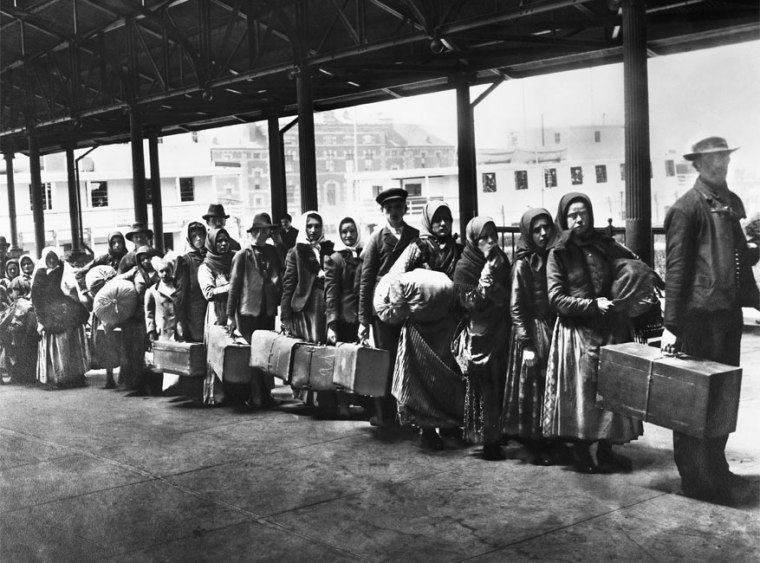
I was thinking about this when the new RAISE immigration plan was announced. I wondered what might have happened if such a law had been in effect when my grandfather first wanted to come to the United States from Austria Hungary. He had only minimal education and no real skills beyond a willingness to do the most detestable of jobs. His English was minimal. He came with little more than the clothes on his back and did the kind of manual labor that is brutal and dirty. He was frugal and saved money until he was able to send for my grandmother. She had even less to offer our great country than he did. She spoke no English and her education was virtually nonexistent. Once she had arrived she worked as a cook, a cleaning lady and at a bakery until she began to have children and then she rarely left her home again. My grandfather eventually settled on a job at a meat packing plant. He cleaned carcasses and equipment, hardly a grand career but certainly a noble way to provide for his family. From his meager salary he built a tiny house for which he paid cash and there he raised eight children.

According to the point system of the RAISE plan Grandpa would hardly have been a candidate for immigration. There was little to indicate that he would be of great economic use to the United States. I am rather certain that he would have been denied entry to our nation. What a loss that would ultimately have been.

All four of my grandfather’s sons served proudly in the military during World War II. During their lifetimes they worked hard at their jobs, rarely missing even one day of work. Two of them were employed by the United States Postal Service and two worked for Houston Lighting and Power. His daughters held a variety of positions that included teaching, doing research for a high blood pressure study, serving the United States Postal Service and working at a Naval Station. Their children, my grandfather’s grandchildren, were even more remarkable. Among them were accountants, teachers, managers, businesspersons, firefighters, and engineers. In fact my brother coauthored the program for the navigational system of the International Space Station. I wonder who would have done that if my grandfather had never come here?

It’s difficult to imagine how different the lives of countless individuals might have been had my grandfather never been granted permission to immigrate to the United States simply because his education was lacking, his skills were so basic and his English was wanting. On the surface he most certainly may have appeared to be a risk, and yet he was a proud American who encouraged his children to always work hard and be their very best. When many citizens were struggling to survive during the Great Depression he kept his family safe in a home that he had build one section at a time, paying for each addition as he went. He was frugal and refused to even accept even charitable gifts, insisting that he wanted to earn whatever he had. He was exactly the kind of American that has made this country great, but with a law like RAISE he might never have stepped on our shores.

With each successive generation his successors have become ever more important contributors to American society. There are medical doctors and those with PhD’s in public health and mathematics. There are teachers, accountants, nurses, electricians, business people, builders, athletes, ministers and scientists. The talent pool that has come from him has widened and the future of his great great grandchildren appears to be even brighter. His was the American dream and it was fulfilled beyond even his own expectations. Certainly it has made a difference to the country in a measurable way, but what if he had never been allowed to come?

My grandfather’s story is not that unusual. It has been repeated many times over in the history of our nation. Individuals who came with little or nothing to recommend them went on to build families whose impact was monumental. If we were to take away all of their contributions how different would our land be? How can we ever know who among us will be the teacher that we need, the inventor who will make our lives better, the leader who will find solutions to our biggest problems? Each of us traces our ancestry back to some distant place and in most cases the person who first ventured here was desperate to find a better way of life, but did not appear to be outstanding on the face of things. How can we use a point system to determine which people will ultimately have the best impact on our land?

I have taught thousands of immigrant children. Many of their parents spoke no English, but they were good people who did their share of work, often the dirtiest and least desirable. Like my grandfather they wanted a better life for their children and sacrificed greatly to make it happen, many times by working multiple jobs. Among my students from such families are college professors, medical doctors, nurses, engineers, teachers, police officers, soldiers, fire fighters, mechanics, builders, accountants, biologists, chemists, mathematicians, physicists, psychologists, public health administrators, computer programmers, public administrators, school principals, counselors, lawyers and even politicians. In a single generation they have fulfilled the hopes of their parents and are actively contributing to society in thousands of ways. They are the true face of immigration, not the hopeless gang members and welfare takers that fear mongers sometimes portray them to be. 

I respectfully submit that we should carefully consider what we might be missing if we restrict immigration to our country as outlined in the RAISE bill. Skimming what appears to be the cream of the crop from various foreign nations may or may not be the answer to a better economy. Sometimes the desire that comes from someone desperate to improve his/her condition cannot be measured by a rubric, just as the worth of my grandfather might have been considered rather low. What made him a good candidate for consideration was the “ganas” burning inside his belly. All he needed was an opportunity to demonstrate just how valuable he truly was. Thankfully he was given that gift and what a difference it has made to the United States.

We certainly want the best for our nation but we need to consider the consequences of limiting ourselves to rubrics that fail to recognize the intangible values that make truly good citizens like my grandfather and his descendants. The issue is far too complex to delineate with numbers. Human beings will surprise us again and again. We need to be open to thinking outside of the box, because it is beyond the confines of our imaginations that the best things happen. Let’s keep our lives wonderful and welcome the tired and the beleaguered. From them may come just the people that we have been waiting for.

A Not So Honorable Guest

ralph-de-la-vega-boy-scouts-of-america

I’ve been quite good about leaving politics out of my blogs of late. After all who really cares what I think about such things? Most people enjoy their freedom to have their voices heard in the ballot box, but not so much in public discourse. Our thoughts about government tend to be a private thing. Just as with religion most of us don’t care to mix our work and play with our deepest political thoughts. I do believe, however, that from time to time we are remiss if we do not speak out when we sense that a wrong has taken place. After all, the silence of otherwise good people allowed the concentration camps to flourish under Adolf Hitler’s rule. Certainly those who knew what was happening feared for their own lives and thus kept quiet, but what if large numbers of people had spoken out en masse? Would the horrific murders have continued? How many individuals working together are needed to stop injustice? Didn’t the civil rights movement of the sixties teach us that there is power in united voices? When does the time come to ignore the consequences and stand up and be counted?

I’ve not been shy about admitting that I am not a fan of President Donald Trump. Nonetheless I have been very respectful of those who earnestly believe that he will bring some good to our country. I have also noted that I generally think that it is best to support our leaders. Thus I have been silent for the most part even as I worried about the state of the union with such an amateurish individual as its chief executive. I mostly ignore the tweets and rants and firings and faux pas from our POTUS, but he recently did something that really bothers me.

It’s no secret that I have dedicated the greater part of my life to working with young people. Our future depends on helping them to develop principled lives. It is our duty as adults to model the traits that will help them to be successful as humans. We must help them to understand the value of honesty, loyalty, hard work, compassion, and such. I have learned that the only way they will listen is by observing our character in action. For that reason I have always counseled other adult leaders to walk the walk of their talk. It is imperative that we demonstrate the values that we want our children to have.

I have four grandsons who have learned some incredible lessons through their participation in the Boy Scouts of America. Two from them earned the rank of Eagle Scout and the other two are in the process of reaching that distinction. They follow the example of their father who is as upstanding as anyone that I have ever known. He has taught his sons to be young men of the highest integrity, mostly because they have seen him in action day after day. Membership in the Boy Scouts has enhanced the foundation upon which their character has been built, and has provided them with opportunities to be leaders. Our family has been very pleased and proud of the wonderful experiences that scouting has given them.

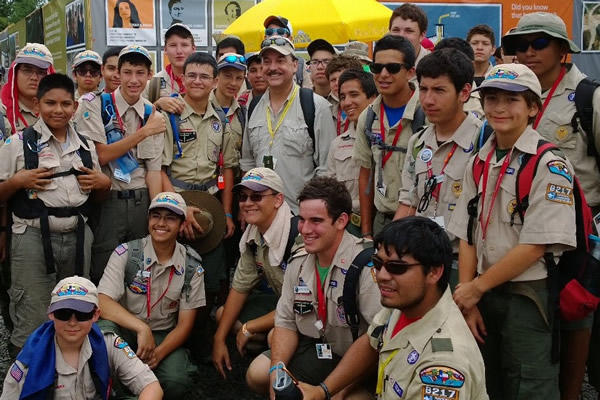
Thus it was with profound displeasure that I learned of President Trump’s speech at the annual Boy Scout Jamboree. It is traditional for the President of the United States to address the gathering or send a representative to do so. It has historically been understood that this speech is supposed to inspire the scouts to become their best selves. It is not meant to be a political opportunity. In the past those who have spoken have understood this quite well and made the occasion an enjoyable one for the young people. Enter Donald Trump who chose to bring his own personal politics and travails front and center. While he eventually settled into a more traditional celebration of the goals of scouting, he found it necessary to make digs about his predecessor, Barack Obama, his opponent, Hillary Clinton, and the press. To the dismay of many his remarks even encouraged some of the boys to boo and cheer.

His speech should be an embarrassment for both him and the Boy Scouts. His politics besmirched the unity and purpose of the occasion and caused many to question the role of scouting, which is a genuine travesty given that so many who participate hold political views that are diametrically opposed to his. It was a very uncomfortable moment that should never have happened. If the young men learned anything it was that one need not hold fast to time honored principles to get ahead in this world, and that is a tragedy. President’s Trump total disregard for the spirit of the Jamboree is unforgivable.

I’ve held my tongue until it is black and blue from the tooth marks that I have left on it. When will this man begin to show respect for the people of this country and quit worrying so much about himself? His immaturity and petulance is embarrassing and only appears to grow worse each day. If he really desires to make America great again, the first change that he needs to make is within himself. Sadly it’s unlikely that a seventy something year old man is capable of a character makeover. I can’t help but wonder what kind of horrible message he is sending to the young people of our country, and I find myself thinking that if he can’t control himself then perhaps it is up to the rest of the adults in the room to remind the kids that we shouldn’t act the way he does. In imparting that advice I intend to include myself, which is why I feel the necessity of stating loudly and clearly that he was and has been very wrong in his behavior over and over again.

It is one thing to be brave and strong in the face of injustice. We need our fighters for they are the ones who have set us aright throughout history. It is another to just be a loudmouthed and selfish braggart, which is the impression that President Trump is leaving wherever he goes. It is not good for our nation and it is heartbreaking to me that there appears to be little hope that he will rise to the requirements of the job and begin to show a semblance of dignity.

I hope that the Boy Scouts of America will not suffer too much backlash from the fiasco that recently transpired. In spite of fits and starts here and there it is still an amazing organization. It’s too bad that someone who had the power to inspire instead chose to inject so much whining and negativity into what should have been a grand moment. I hope that the leaders and the parents take the time to let the boys who were present know that scouting is not about backbiting, complaining or boasting. There are lessons that might be learned even from such a negative event. If on the other hand nothing is said the lasting impression may result in unintended consequences that will not be good either for the boys or for the organization. I sincerely pray that this is handled properly.

All of us have had childhood experiences with adults who should have been better than they were. We took note of their bad behaviors and in many cases did our best not to repeat them. This is my wish for the scouts. They have just witnessed how a true leader does not act when he/she is an honored guest at a special occasion.

Ordinary Heroes

3f6dad58d68a4947b09048d30b108e4d

Imagine that is it 1940, only a little over twenty years since World War I ended. Europe had been decimated by ‘the war to end all wars” as it was known. So many young men had been killed or maimed by the hideousness of trench warfare. Royal cousins had fought against one another in a seemingly unnecessary battle that left the common folk weary and eager for peace. In the midst of the rebuilding of nations along came Adolf Hitler with far reaching ambitions for making his country great again. At first the world stood back in stunned disbelief when he began a land grab starting with Czechoslovakia. By the time that he invaded Poland all of Europe understood that he had to be stopped. Britain joined other nations in agreeing to fight against the growing menace of German fascism. Thus in 1940, soldiers from Great Britain and France were engaged in a battle with Germany that had turned into a stunning rout, stranding 400,000 troops on the shores of Dunkirk with their backs to the sea.

It had been an inauspicious beginning to war for both Britain and France. At Dunkirk the soldiers from those countries were in retreat and things looked very bad. The Germans taunted the soldiers with flyers dropped from planes bragging that they had surrounded the Allies on all sides. The troops waited to be rescued and returned to Britain while being continually subjected to air raids from the Germans. They were like fish in a barrel. Added to the difficulty was the fact that big ships could not dock close to shore, so troops had to be ferried in small boats, a tedious and time consuming task. Even though the Brits were able to gaze across the channel and see the outline of home they may as well have been thousands of miles away. In that dark moment many wondered if Britain would be forced to surrender to Germany, leaving Hitler to overtake most of Europe with little or no resistance. It was an horrific possibility.

There are certain times in the history of mankind when ordinary people find the courage to do extraordinary things. Dunkirk was one of those moments. The British understood that they had to get their troops home safely at all costs or face the prospect of an invasion at home. The troops endured nine days of air battles that killed thousands of men, sunk ships and resulted in the loss of many Royal Air Force planes and pilots. It was a dispiriting time and one of the worst military defeats in the history of the country, but help game from a most unlikely source. When word of the disastrous situation reached the people of Britain an incredible thing happened. Fishermen and pleasure craft seamen sailed their boats across the channel to Dunkirk to assist in the rescue efforts. Many of them would become casualties as a result, but even more would bring hope and a way home to the thousands of soldiers who had all but given up any expectation of seeing Britain again.

It is a story of bravery and loyalty and love that Christopher Nolan has brought to the big screen with his usual genius. With an incredible cast, music from Hans Zimmer and sweeping camera angles the movie transports the audience into the tense and unnerving evacuation scene. It is an breathtaking film that provides the viewer with a birds eye view of both the fears and heroics of the soldiers and their leaders as well as the citizens who chose to risk their own lives to help their countrymen. Mostly it is a study of goodness overcoming evil, a subject that Nolan knows how to portray so well.

I haven’t been able to stop thinking about what happened at Dunkirk in a world that had quite evidently gone mad. I find myself wondering if those of us who live today would be able to muster the courage that the people of that era drew upon again and again until Hitler and his minions had been defeated. Would we have sat back helplessly or would we have been able to draw upon our inner strength to do what was ultimately right? I just don’t know. We seem to have somehow lost our willingness to confront evil. Maybe we have to literally be pushed to desperation before we will ever be able to rise up against the forces who bring so much violence and death to the world. We Americans certainly sat back watching even in 1940, hoping that all of the trouble would somehow just go away while we were safely an ocean away. Ultimately when we felt the sting of attack a couple of years later we too found the grit to join in the fight against an evil that had to be stricken from the earth. Maybe the truth is that none of us want to even think of war until there is no other reasonable choice.

I feel very uncomfortable with the state of things in the present time. We seem to have a president who is more worried about his reputation and popularity than with the needs of our country. We have citizens and lawmakers who are intent on fighting with one another rather than having genuine concern for the problems that plague us. I seriously wonder how we would fare as a people and a country if were we to suddenly find ourselves under attack. Would our dysfunction prevent us from doing what was necessary to save and protect our nation? Would we find a way to demonstrate the kind of determination to preserve freedom that the British citizens did back in 1940? Have we somehow lost our way, and if so will we ever be able to find our way back? These are the troubling thoughts that continually pass through my mind.

I would like to believe that in times of trouble we will be able to join together just as the people of New York City did after 9/11 and much like the citizens of Boston after the bombings at the marathon. Somehow I think that we as a people are in a state of lethargy, but our basic instincts to maintain liberty and justice at all costs still linger inside our hearts. I hope that if there comes a time when we are challenged just as our grandparents and great grandparents were we will find the determination that we need. I refuse to believe that we have all forgotten our role in promulgating the good rather than bad, love rather than hate.

Movies like Dunkirk are important. They draw on our emotions to challenge us to think. They push us to ask questions and learn from our human history. I recommend that all Americans who are over the age of thirteen see this film and take the time to educate themselves about what was happening in that time of long ago. Perhaps it will convince us of the need to consider what is really most important in our society today and to choose leaders who will help us to end our malaise, not further divide us.