Reimagining Education

Kahn

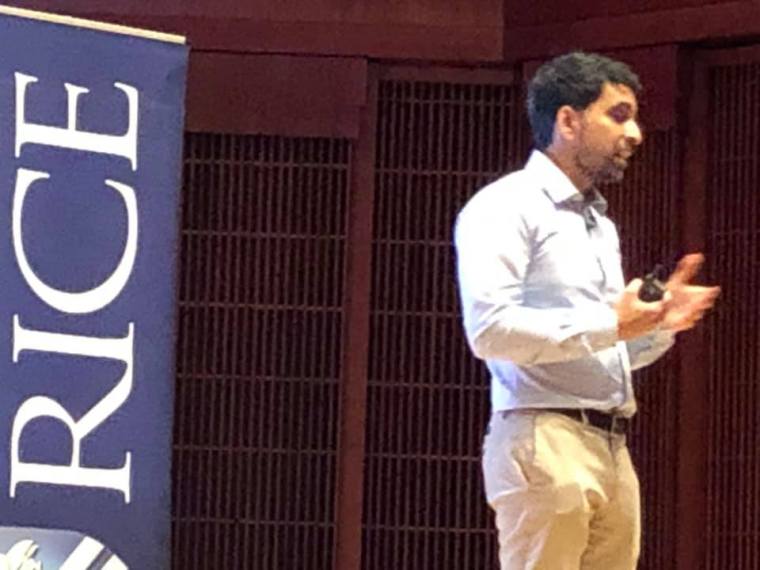
Salman Kahn is a brilliant man with three degrees from MIT and an MBA from Harvard.  In 2004, he worked for a hedge fund firm in Boston, using his knowledge and skills to make money for his customers, his company and himself. He was rather good at both his job and the mathematics that it used so when his cousin Nadia asked for some tutoring he obliged even though it all had to be done long distance. Before long other family members were requesting his help so he made a few Youtube videos  to walk them through some of the basic concepts. It was a fun hobby that gave him a purpose beyond his career.

Along the way people that he didn’t even know began to watch his lessons and leave messages of gratitude for the help. He began to sense that perhaps those little tutoring films were more important than his professional work. In the fall of 2010, after consulting with his wife he began to invest the family savings into making his mathematics lessons into a not for profit business. He called it Kahn Academy, and it’s mission was to provide “a free world class education for anyone anywhere.” Since that time with donations from individuals and corporations his dream has grown into a world wide phenomenon with over 71,000,000 registered users in 190 countries and at least thirty languages.

There is hardly a mathematics teacher or student who has not used the services of Kahn Academy at one time or another. Now the site offers lessons in other disciplines as well. It has revolutionized education so much that incredible stories of its success abound. There are orphans in Mongolia who have become proficient in all aspects of mathematics and science simply from using the sequenced lessons. Perhaps one the most touching stories came from a young girl living in Afghanistan who was denied an education by the Taliban. In the privacy of her home she logged into the Khan Academy site and slowly worked her way through hundreds of hours of lessons, eventually earning admission to Arizona State University where she graduated with a degree in theoretical physics.

There is also the story a high school dropout who caught up on the classes he had missed, passed proficiency tests and returned to become the valedictorian of his high school all by using the lessons from Khan Academy. He ultimately went to Princeton University where he graduated with honors, and today he works for Khan Academy coding lessons so that other students like himself will have the opportunity to reclaim their lives all in their own homes and at their own paces. It’s a remarkable way of reimagining education.

Salman Kahn believes that learning at a fixed pace is a flawed methodology, one that most of us unfortunately endured. For decades we have followed the approach of subjecting large groups of students to a fixed schedule of coursework, moving along in tandem whether or not they are ready to move more quickly or struggling to keep up with the predetermined speed. The end result is a hodgepodge of understanding among the learners and a great deal of frustration for everyone. Kahn rightly believes that the sequencing and pace of learning should be based on mastery rather than a preconceived calendar and student age.

When we ignore the idea of individualized pacing with a goal of mastering concepts before moving forward small gaps in understanding often occur that over time lead to huge holes that give the impression that a student is incapable of learning certain things. When the curriculum is tailored for individual needs problems are addressed before going to the next concept, and research has shown that students actually begin to accelerate their learning curves as they build strong foundations and improved confidence.

The idea of individualizing pacing is not new. Educational psychologists have made attempts to find ways to move from a fixed schedule for decades. It is only with the technology that we now possess that such dreams seem to be within the grasp of reality. We can now teach anyone anything anywhere just as Kahn insists he will eventually do. The biggest hurdles that we must overcome are those that adhere too closely to traditional ways of teaching. Large schools filled with students all working at the same pace regardless of whether or not that is working for them are truly outdated, and yet it is the model that we insist on keeping simply because it is familiar.

We still need flesh and blood teachers. Our students must to be able to hear from humans and find inspiration in their skills as educators, but those who run classrooms of the future will need to be flexible and see themselves more has guides than the center of the schooling universe. Even our grading systems and the ways in which we quantify student progress will need to be retooled.

We are at the frontier of such innovations. We still have many who are unwilling to accept ideas like teaching for mastery rather than explaining concepts to a group, testing, and then moving forward regardless of results. We have to adapt to a growth concept of learning rather than one that is fixed, a supportive learning system whose emphasis is not on competition but rather on success for all. Technology will be a critical component of such thinking and innovators like Salman Kahn will be the Lewis and Clarks of the education frontiers. It’s an exciting thing to imagine, and we should be unafraid to take the first steps to make it happen.

Learning Is A Beautiful Thing

img_0026A young woman that I know rightly noted that learning is a beautiful thing, and in the same breath wondered why our methods for conveying it garner such anxiety. We have somehow managed to take one of the loveliest aspects of being human and turned it into what is often an onerous competitive blood sport. In today’s world education is all too often a numbers game in which young people who are still developing are ranked and classified in life changing rituals that sometimes have the effect of changing the course of their destinies. It is a process that affects not only our students but also our teachers and our society. The attempts to quantify the learning process has ignored the more subtle aspects of people, and instead stamped them with life changing numbers that have the power of affecting where they will eventually work and how they will live.

The idea of joyful learning has become secondary to test scores and grades, often wringing the joy of schooling out of the equation. The message that we send our young is that education is a numbers game overseen by mega testing corporations and the College Board. The test is the thing, and those who learn in ways contrary to mastery of often trivial and subjective standardized questions need not apply. All too often the difference between an opportunity to follow a dream and condemnation to a lifetime of frustration is found in a rigid reliance on numbers, even as we somehow know that such things are incapable of truly determining the worth of someone’s talents.

As a small girl I was repulsed by situations that ranked me and my fellow students. The teacher who created a bulletin board with rockets bearing our names to identify those who were soaring to the moon versus those who crashed and burned at takeoff became loathsome in my mind. I understood that I knew how to please her, but that others also had great but different gifts to offer. I suppose that living with my brothers had taught me about the ways in which we grow and develop, not at a constant and linear rate, but in a kind of spiral with stops and starts. One of my brothers had a brilliant mathematical mind that was far advanced over the rest of us. He knew what he wanted to do with his life from the time that he was five. My other brother and I drifted here and there. As a people pleaser I was able to convince my teachers that I was indeed quite intelligent, but only by towing the line that they required of me. My little brother was more rebellious and thus often considered less likely to be successful. The truth was that he had a complex and creative mind that would eventually prove to be exactly what an entrepreneur needs.

Today the pressure to conform to the numbers game is more intense than ever. Students are ranked from the first day of high school. They are told that class standing and scores on entrance exams will determine whether or not they are allowed to enter the most prestigious universities and majors. They battle for the top spots by adding premium points to their GPAs with countless advanced placement classes. They worry about every little test, every rise or dip in their grades. They take courses to learn how to be better test takers. They eschew subjects that sound interesting or fun because they might cause them to fall in the ranks. Often they lose the joyfulness of learning in the process of pursuing their goals. School becomes an odious task that must be endured so that the future will be bright.

Even when they reach the hallowed halls of a favored university they may find themselves once again being sorted into the stars and the also rans. Competitions for internships and jobs are based more on grades than personalities and the kinds of traits that cannot possibly be measured with numbers. A single point difference shuts doors and opportunities. It is only after entering the real world of work that things like effort and creativity become marketable skills. An ability to work with a team is often more important than making the highest score on a test but such things are rarely considered in the world of academia.

People often ask me about my experience as an educator. In that capacity I literally taught people of all ages. My initial foray into the life of a teacher began with four year olds. By the time I retired I had worked with virtually every age group including adults. The one constant that I observed is that we each learn and progress at a different pace. Those who are the quickest to master a topic are not necessarily the ones who will ultimately do the best with it. My eldest daughter was fifteen months old before she walked, but on the day that she took her first steps she literally ran and then became a beautiful and graceful dancer. The fact that she took so long to walk upright had zero effect on the rest of her life. Thus it is with each of us. Learning is very personal and should be cause for joy, not anxiety.

One of the finest teachers that I have ever known devised a grading system that allowed for differences in the learning curve. If a student initially failed to master a skill he offered additional tutoring and then retested the individual and eliminated the failing grade, replacing it with the mark that celebrated success. His students adored him and often reported that they not only walked away from his class filled with knowledge, but they also felt more confident and willing to take new risks. They learned how to be resilient from him, and they found great joy in learning about topics that might have earlier terrified them. This is the way education is supposed to be but all too rarely is.

The young woman that I know is so right. Learning is a beautiful thing. Let’s hope that one day we will find a way to universally bring the joy to those who embark on the journey of becoming educated.

A Joyful Presence

heart shaped red balloon
Photo by rawpixel.com on Pexels.com

Eileen and her big family lived within sight of the church and school that I attended when I was growing up. She was a beautiful girl with long blonde hair and a welcoming smile. She was also very smart with a level of confidence that I was still hoping to find back then. By the time that we were in high school we were scheduled for the same classes with the same teachers and our friendship blossomed.

Eileen sometimes got to take her family’s  van out for a drive, thus becoming the designated chauffeur for our group. She’d take us to Friday night football games, days at the beach, and now and again a special concert like the time when we saw the Beach Boys. I adored her and counted myself lucky for being invited to partake in so many fun times with her and the rest of our friends. Some of the very best times of my teenage years were spent with Eileen.

Of course things change after graduation. Eileen and I went our separate ways. From time to time I would hear about what she was doing and where she was living. I knew that she had become a nurse and ended up in Washington state. I suppose that I should have made an effort to contact her to see how her life was going, but the world intervened and created a busy schedule for me. I was caring for two daughters, teaching, taking classes, and being a caretaker for my mother.  Somehow I barely kept up with my responsibilities and so I never found the time to reach out to Eileen. Nonetheless I often thought of her and remembered how much fun she had brought into my life. I hoped that she was doing well.

It was not until our fiftieth high school reunion that I saw Eileen again. She was as beautiful and as sweet and friendly as ever. She had a daughter and a handsome husband who seemed to adore her. She enjoyed living in Washington State and was hoping that some grandchildren might be in her future. We traded addresses and reignited our friendship on Facebook. I so enjoyed catching glimpses of her world. Over time I learned just how faith filled she was.

Eileen battled breast cancer for a time after I was once again in contact with her, and during that time she inspired those of us who read her optimistic posts that demonstrated her determination and belief that God was by her side. We rejoiced when her weeks of treatment resulted in a positive outcome, and celebrated even more when she announced the birth of her first grandchild. As when we were both young, I found myself in awe of this wonderful woman who somehow offered hope and happiness even in her darkest hours. It was so fitting that life appeared to be falling into place for her with long golf games and photos of lovely moments with her grandchild.

It never occurred to us that Eileen’s cancer might return, but it did. The news was difficult to accept, but as always seems to be the case with Eileen she was soon attempting to soothe our concerns. She stoically insisted that she had the very best doctors as well as the comfort of God to guide her through her latest journey with cancer. Even with her courageous spirit we saw how hard it was for her and so we began to pray.

Eileen keeps us updated on her progress. Some weeks leave her exhausted and without even enough energy to let us know how she is. Others seem to revitalize her. Always she tells us how wonderful God is and how she has doctors in whom she places all of her confidence. Inevitably I find myself thinking of her all day long, praying each morning and evening that the outcome of her battle will prove to be positive and with as little pain as possible.

Recently one of our classmates started a prayer chain for Eileen. It didn’t surprise me at all to learn how beloved she was. She has always been a generous and giving person to virtually everyone. She is open and honest in ways that few of us possess, so much so that I still find myself wanting to be more like her when I finally grow up. I want more than anything for the power of love that we are directing her way to gird her and comfort her.

It amazes me how neither time nor distance has the power to destroy the feelings that we have for another person. Eileen was and will always be quite special to me. She kindly took the gawky unsure teenager that I was under her wing. She made me laugh and feel good about myself at a time when I sometimes thought that I would always be a misfit. She still has the power to make my day with her smiles and her serenity. She is truly a joyful presence, a living angel. I only hope that she knows just how much she has impacted so many lives and how ferociously we are praying for her.

Finding My Way

auditorium benches chairs class
Photo by Pixabay on Pexels.com

I spent the first seventeen years of my life in a kind of bubble. I lived in a neighborhood that I rarely left for anything other than visits to the homes of my grandparents and aunts and uncles. I walked to my school and had classes all the way through the twelfth grade with many of the same friends that I had known since the first and second grades. My life revolved around a regular routine that was carefully orchestrated by my mother. I felt safe, secure and loved, but frustrated by how little I knew of the world beyond the borders of the small area of southeast Houston where I lived.

My single parent family had no extra money to send me and my brothers to college, so it was up to us to find ways to pay for tuition and such. I worked hard in high school and graduated with enough honors to be recruited by a number of private universities including some that were rather prestigious, but most of the scholarship offers would still have left me scrambling for funds and wondering how I would manage to get from Houston to distant towns. When it came time to choose a university I felt that I needed to be in an environment far different from the one that had nurtured me in my youth. Somehow the University of Houston appeared to be the perfect solution, and as it turned out I was correct.

I found myself surrounded by a of diversity of people and ideas unlike anything that I had ever before experienced from the first moment that I stepped onto the University of Houston campus. It was a bit frightening and exhilarating at one and the same time. Even though the school was only a short drive from the place where I had lived for most of my life, it was a world away in culture. With its massive student body I literally became a number which I had to memorize to identify myself in the system. I was little more than a face in a crowd as I learned how to navigate the brutal registration process and the routes from one class to another. I had to grow up fast and toughen myself just to survive. It was exactly the kind of experience that I needed.

I soon learned that nobody was going to coddle me at UH and that I would have to use my own voice to make myself known to my professors. I overcame the shyness behind which I had hidden myself for so long. I had to develop a willingness to be an advocate by stepping forward and speaking up. I found it to be a glorious experience, and a way to become the person that I truly wanted to be. I may have returned to my mother’s home each evening, but during the day I was exerting my independence and finding delight in meeting people from all over the world. It was an exciting time that was transforming me at warp speed. I was quite proud to know that I was capable of paying my own way and choosing the direction of my life without adults hovering over me. At the same time I realized that I was receiving an excellent education as well.

In the beginning I tended to assess the students with whom I attended classes with the very narrow lens of the restricted environment in which I had spent my childhood and teen years. Suddenly I encountered people of different races, religions, and socio-economic status on a regular basis. I found that it was a mistake to categorize them according to my preconceived stereotypes.

I particularly recall one of my first classes in which the professor paired me with a girl whom I would never have chosen to approach. She literally exuded beauty, wealth and confidence with her perfectly coiffed hair, manicured nails, and expensive clothing. I had noticed her when she first walked into the room and I had felt somewhat in awe of her commanding presence. I had thoughts of dropping the class when I learned that my fate was to be tied to her for the entire semester. I assumed that she would feel the same about being with me, but I was so wrong. In fact, she became a dear friend, someone in whom I was able to comfortably confide my deepest thoughts. We not only worked together in class, but spent time riding around in the sports car that had been a graduation gift from her parents. She was open and kind and unspoiled. She taught me the important lesson of getting to know a person before making judgements about character.

I certainly recall the knowledge that I gained during my time at the University of Houston, but it was the experience of growing up that had the most impact in molding who I am today. I suspect that the process might have been less encompassing in another place. The sink or swim atmosphere was exactly what I needed even though it was sometimes daunting. I would eventually realize that there were people just waiting to help me if only I took the time to elicit their support. I learned the importance of reaching out to my professors, getting to know them so that they would know me. I began to network and expand my horizons into an ever more expanding circle.

By the time I was thrown into the real world I was both knowledgeable and capable. Virtually every aspect of my talents and character were ready for whatever I might encounter. The best part was that my own confidence and way of viewing the world had grown in ways that might never have happened had I not chosen the University of Houston. By paying my own way and mixing it up in a place akin to a small city I had toughened up and become a true citizen of the world in a very short space of time.

My life would be challenged before I even turned twenty one. I would have to be an advocate not only for myself but for my mother and brothers as well. Luckily I was prepared. Without going more than a few miles I had managed to ventured far away from home into an exciting world in which I became my own person.

The original charter of the University of Houston indicated that it would be a place of learning for the children of the working people of the city. It has sometimes been said that the school is best represented with by a set of blistered hands with the grime of hard labor under its fingernails. It is a no nonsense place in which none of the “isms” really matter. There are no walls at UH on which to grow ivy. It is a living breathing microcosm of the world as it really is. I suppose that’s why studying there meant so much to me.

We’re Only Human

human s eyes
Photo by Pixabay on Pexels.com

Remember those stories we heard as young folk about the hardships that our parents and grandparents endured in their youth? You know what I’m talking about. They went something like this, “I walked five miles up hill in the snow to school, both ways.” Of course that’s an old joke about our elders attempting to shame us into believing that we had it easy compared to the lives that they had, but the exaggeration isn’t really all that out of line. The fact is that the act of preparing to be an adult is a tough one in almost any day and age. Behind the glamor of youth there is invariably a great deal of angst even for the seemingly most brilliant and well adjusted, and all too often we forget our own journeys and the mistakes that we made as we attempted to develop ourselves into persons able to contribute to society. We give the impression that all anyone ever has to to is set a goal, work really hard, and then watch the fruit of those labors grow. Somewhere deep in our hearts is the understanding that life is rarely that easy and that the push and pull between the world of childhood and becoming an adult is filled with challenges that often confuse and break spirits.

I continually applaud teachers and the work that they do to help build strong bodies and minds in our young. The best among them are the ones who go that extra mile “uphill” to touch the souls of their students. They understand that their duty as educators is not to play “gottcha” with kids but rather to demonstrate compassion and teach them how to navigate through the land mines that will most certainly litter their paths along the way. Teaching is so much more than conveying knowledge and then testing for learning. It is a process, a continuum that has to be individualized to the extent of realizing that we are all individuals who learn in varying ways. We bring both physical and emotional baggage to the classroom and a good teacher knows how to unpack it and tidy it up. No human is the sum of test scores, and yet we so often send the message that only those who make the grade will survive. As adults we know better but insist on spreading the myth that all hard work is duly rewarded.

I often repeat a story related to me by my husband from the days when he was a student at the University of Houston. He had a brilliant professor who had gone out of his way to know his students. This man took the time to discuss his subject in informal settings devoid of the pressures created by research papers and exams. In a conversational way he explored the gist of his knowledge with them, learning how much more they actually knew than what the snapshots of formalized appraisals might convey. My husband saw this man as a caring mentor, and took full advantage of the opportunities to become almost a disciple of him just as the students of Socrates had done in the long ago.

On one occasion my husband’s nerves got the better of him during an exam. He had one of those classic meltdowns that left his mind blank. The more he panicked the less he remembered. As he turned in his test paper he was certain that he had failed and he was disappointed and angry with himself. He immediately went to the professor to apologize for what might have appeared to be a lack of effort and concern. The kindly man began to talk about each question, prodding my husband to explain what he knew about the topics. Before long they were like two friends having one of those glorious discussions in which it is actually believable that they might change the world with their brilliance. By the end of my husband’s confessional the professor announced that it was apparent to him that his student had a deep command of the information and he promptly assigned a grade of “A.”

We rarely see teaching genius like this. In fact we are often an unforgiving society in which mistakes are held against people with dire consequences. We are proverbial Scrooges rather that Fezziwigs, sending individuals into spasms of self doubt and sometimes even severe depression. The truth is that we are continually spilling milk, messing up, making bad decisions and if we are fortunate we find people who will forgive us and help to redirect us. Sadly we are seeing less and less tolerance for the very normal and natural aspects of being human and our society is paying a very high price for so much indignation.

I had a delightful meeting with a high school counselor last week. He works hard on a daily basis to help young people find their way in our very complex society. Some of the students that he meets appear to have no problem heading straight for success, but most stumble and fall along the way. He makes a point of gently picking them back up and helping them the recover and begin again. He is one of the many heroes who takes the time to redirect and reassure even those who seem to have lost their way. This is indeed how we all should be approaching the people around us instead of abhorring words like forgiveness and amnesty.

We are losing far too many people to a competitive and combative world that chews them up and spits them onto a trash heap of hopelessness. We blithely seem to believe that we must only reward strength and perfection or we will create generations of weaklings. We set mistakes in stone and forever remind people of their faults rather than developing their best qualities. We insinuate that only those with specific talents will own the jobs of the future. We praise the young who excel, but send the message to those who struggle that their value is worth less. We even attack minors who don’t quite know how to act when they find themselves in touchy situations. We forget our duty to guide, forgive and encourage.

Luckily we still have many who quietly understand our human frailties and compassionately teach and reteach. They are educators, parents, friends, bosses, lawmakers who remember what it is really like to be human, those who understand that learning and becoming is a lifelong process that can’t be measured with numbers. Success is not made of discrete moments but rather a never ending progression of starts and stops, victories and defeats, exhilarations and frustrations, wisdom and mistakes. In reality it is never too late for each of us to become what we wish to be so perhaps it’s time that we set aside judgements set in stone whether they be test scores, grades or attempts to determine the content of character that is always evolving. We are all walking miles, sometimes even uphill in the snow, but the journey can and should be an adventure, not a dreaded task.