A Not So Honorable Guest

ralph-de-la-vega-boy-scouts-of-america

I’ve been quite good about leaving politics out of my blogs of late. After all who really cares what I think about such things? Most people enjoy their freedom to have their voices heard in the ballot box, but not so much in public discourse. Our thoughts about government tend to be a private thing. Just as with religion most of us don’t care to mix our work and play with our deepest political thoughts. I do believe, however, that from time to time we are remiss if we do not speak out when we sense that a wrong has taken place. After all, the silence of otherwise good people allowed the concentration camps to flourish under Adolf Hitler’s rule. Certainly those who knew what was happening feared for their own lives and thus kept quiet, but what if large numbers of people had spoken out en masse? Would the horrific murders have continued? How many individuals working together are needed to stop injustice? Didn’t the civil rights movement of the sixties teach us that there is power in united voices? When does the time come to ignore the consequences and stand up and be counted?

I’ve not been shy about admitting that I am not a fan of President Donald Trump. Nonetheless I have been very respectful of those who earnestly believe that he will bring some good to our country. I have also noted that I generally think that it is best to support our leaders. Thus I have been silent for the most part even as I worried about the state of the union with such an amateurish individual as its chief executive. I mostly ignore the tweets and rants and firings and faux pas from our POTUS, but he recently did something that really bothers me.

It’s no secret that I have dedicated the greater part of my life to working with young people. Our future depends on helping them to develop principled lives. It is our duty as adults to model the traits that will help them to be successful as humans. We must help them to understand the value of honesty, loyalty, hard work, compassion, and such. I have learned that the only way they will listen is by observing our character in action. For that reason I have always counseled other adult leaders to walk the walk of their talk. It is imperative that we demonstrate the values that we want our children to have.

I have four grandsons who have learned some incredible lessons through their participation in the Boy Scouts of America. Two from them earned the rank of Eagle Scout and the other two are in the process of reaching that distinction. They follow the example of their father who is as upstanding as anyone that I have ever known. He has taught his sons to be young men of the highest integrity, mostly because they have seen him in action day after day. Membership in the Boy Scouts has enhanced the foundation upon which their character has been built, and has provided them with opportunities to be leaders. Our family has been very pleased and proud of the wonderful experiences that scouting has given them.

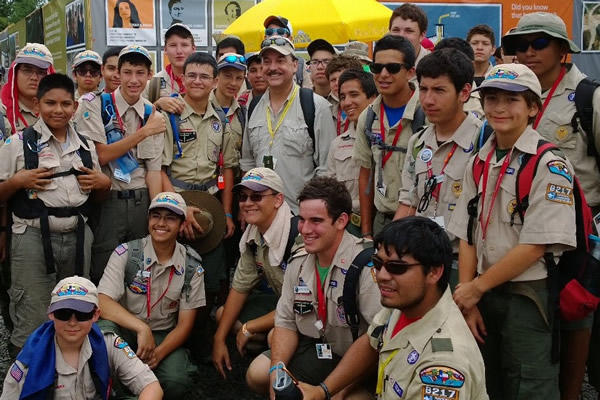
Thus it was with profound displeasure that I learned of President Trump’s speech at the annual Boy Scout Jamboree. It is traditional for the President of the United States to address the gathering or send a representative to do so. It has historically been understood that this speech is supposed to inspire the scouts to become their best selves. It is not meant to be a political opportunity. In the past those who have spoken have understood this quite well and made the occasion an enjoyable one for the young people. Enter Donald Trump who chose to bring his own personal politics and travails front and center. While he eventually settled into a more traditional celebration of the goals of scouting, he found it necessary to make digs about his predecessor, Barack Obama, his opponent, Hillary Clinton, and the press. To the dismay of many his remarks even encouraged some of the boys to boo and cheer.

His speech should be an embarrassment for both him and the Boy Scouts. His politics besmirched the unity and purpose of the occasion and caused many to question the role of scouting, which is a genuine travesty given that so many who participate hold political views that are diametrically opposed to his. It was a very uncomfortable moment that should never have happened. If the young men learned anything it was that one need not hold fast to time honored principles to get ahead in this world, and that is a tragedy. President’s Trump total disregard for the spirit of the Jamboree is unforgivable.

I’ve held my tongue until it is black and blue from the tooth marks that I have left on it. When will this man begin to show respect for the people of this country and quit worrying so much about himself? His immaturity and petulance is embarrassing and only appears to grow worse each day. If he really desires to make America great again, the first change that he needs to make is within himself. Sadly it’s unlikely that a seventy something year old man is capable of a character makeover. I can’t help but wonder what kind of horrible message he is sending to the young people of our country, and I find myself thinking that if he can’t control himself then perhaps it is up to the rest of the adults in the room to remind the kids that we shouldn’t act the way he does. In imparting that advice I intend to include myself, which is why I feel the necessity of stating loudly and clearly that he was and has been very wrong in his behavior over and over again.

It is one thing to be brave and strong in the face of injustice. We need our fighters for they are the ones who have set us aright throughout history. It is another to just be a loudmouthed and selfish braggart, which is the impression that President Trump is leaving wherever he goes. It is not good for our nation and it is heartbreaking to me that there appears to be little hope that he will rise to the requirements of the job and begin to show a semblance of dignity.

I hope that the Boy Scouts of America will not suffer too much backlash from the fiasco that recently transpired. In spite of fits and starts here and there it is still an amazing organization. It’s too bad that someone who had the power to inspire instead chose to inject so much whining and negativity into what should have been a grand moment. I hope that the leaders and the parents take the time to let the boys who were present know that scouting is not about backbiting, complaining or boasting. There are lessons that might be learned even from such a negative event. If on the other hand nothing is said the lasting impression may result in unintended consequences that will not be good either for the boys or for the organization. I sincerely pray that this is handled properly.

All of us have had childhood experiences with adults who should have been better than they were. We took note of their bad behaviors and in many cases did our best not to repeat them. This is my wish for the scouts. They have just witnessed how a true leader does not act when he/she is an honored guest at a special occasion.

Shall We Begin?

barn-raising-the-farm-at-walnut-creek-ohio-Large

There was a time when the world was a quieter place. There were fewer sounds, no cars, planes, trains, televisions, radios, telephones, complex machines. People heard each other, the calls of animals, the wind, the rustling of water. Life was stiller, slower and in most ways more difficult. The very things that so often annoy us, cause us to feel stressed and steal the silence that we often desire also make our lives easier than those of our ancestors. The conundrum that we face in the modern world is how to keep a balance between simplicity and over consumption. It is the tightrope that we walk in our pursuit of happiness and comfort.

I live in a southern climate. I might be happy to eschew using a great deal of energy in the winter because the days are mostly mild and even on an abnormally cold day a heavy coat and a pile of blankets make the chill go away. The summer presents me with a far greater challenge when temperatures linger in the mid nineties for weeks at a time. It is so hot that I take refuge in my air conditioned home and car during the middle of the day. The thought of being without the cool air is almost untenable and yet there was a time in the not so distant past when I lived through nineteen summers without air conditioning and never felt beset upon.

It was a normal and accepted way of life back then. We simply adjusted to our circumstances and carried on the way people had done for thousands of years before us. We led simpler lives that were still more modern than those that our grandparents had known. It never occurred to us that we may have been disadvantaged. We coped with what we had.

Somehow in spite of the multitude of improvements in American life our society seems to be more dissatisfied than ever. We tend to believe that we should all have more and more and more when just maybe we have reached a tipping point at which we should consider cutting back on some of the things that we do and take for granted. We often argue that each successive generation should do better than the last but what if that idea is flawed? What if our real goal should be to find ways to enjoy the best of our modern inventiveness without being so obsessed with accumulating wealth and things? Is it possible to live the good life while also being more frugal in our use of resources and capital? These are our modern day questions. Our dilemma is in finding the answers that will benefit the most people in the world, a gargantuan task at the very least.

I believe in the concept of liberty and as such I mostly disdain the idea of forcing a particular lifestyle on people. I prefer that we each decide on our own how to partake of the world’s benefits. Still I would like to encourage everyone to find their own personal ways of stepping back just a bit and considering how they might simplify and thereby save for the future. By that I mean in terms of both money and our precious resources. Small measures taken collectively often lead to great gains. Our ancestors knew this well and they pulled themselves out of a major depression and two world wars with determined effort and a great deal of patience.

When I describe the world of my youth it sounds absolutely antiquated. My family had one car, one phone, one television. Computers and cell phones were but dreams of inventive souls. Travel was by car for most people other than the wealthiest among us who had the means to fly from place to place. Eating out was a rare luxury. The books that we read mostly came from the library. I only knew one person who had a swimming pool in her backyard. The rest of us went to the city pool on hot afternoons. Air conditioning was a luxury that was only beginning to come into vogue and even then it was in the form of a unit set in a window. Homes usually had a single bathroom often shared by as many as six or seven people. Children bunked together in rooms. Most of us had two pairs of shoes, one for special occasions and the other to be worn for daily activities. We exercised by running and walking and riding our bicycles. It was a happy time and it never occurred to us that one day people would look back on how we lived and think it quaint and wonder how we were able to endure such seeming want.

The average household of old would appear to be more like a state of poverty today. We have improved things considerably but what have we lost in the process? Our desires seem almost insatiable. Our complaints would confound those who lived in another era. They would wonder at the luxuries of even an average person and ask why we still feel as though we need even more.

We argue over the state of our planet ad infinitum. Why would we risk being wrong? The simple answer is to always think about the consequences of our actions. Our golden rule should be to leave every place better than we found it. If that means recycling, planting trees, composting garbage, picking up trash, adjusting our thermostats, buying only what we really need, turning off lights, or finding our own ways of using less energy why would we complain? These are actions that our ancestors took for granted. It doesn’t matter who is wrong or right when it comes to climate change. We should all still want to be kinder to our world.

We probably will never receive the entire cake of benefits but we are certainly capable of sharing pieces of it with our fellow men and women. We will never be able to achieve perfection but surely we will find more contentment in working together just as our ancestors once did. They raised barns as a community and made certain that people experiencing hard times were cared for. My grandfather told countless stories of people coming together to insure that all members of the community were safe and secure and happy. It was understood that this was behavior expected of everyone. They had so much less than we have today but they willingly gave whatever they were able in times of need.

Sometimes it seems as though we have closed ourselves off inside our modern day castles. We have everything that we need inside and we may have anything that we want delivered to our front doors. We isolate and insulate ourselves from the problems outside our domains, often not even knowing the names of our neighbors or what challenges they are enduring. We come and go and rarely think of the difficulties that are ongoing all around us. We turn off bad news and idealize existence and quibble over issues that should have compromised solutions. We have lost our way on so many levels when we need look no farther than the examples of the past to know what to do.

Thoreau admonished us to simplify, simplify, simplify. Mother Theresa showed us how to share. Our grandparents demonstrated courage and a willingness to adapt to changing situations. Marshall rightly urged us to help our struggling European neighbors after World War II. Dr. Martin Luther King, Jr. taught us how to open our hearts to differences. The lessons to be learned tell us how to live without the worry and strife that exists in so many corners of our world today. If each person were to change just one way of doing things for the better perhaps we might all wake up to brighter days. It’s time to cease all of the grumbling and work together. Shall we begin?

When Children Lose Hope

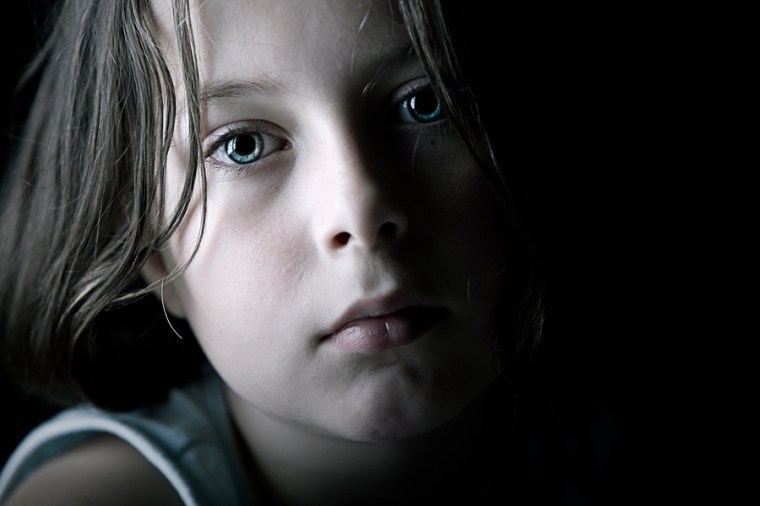
Sad ChildA recent study reported that for the first time ever more middle school students are dying from suicide than from car crashes. Not only that, but the number of suicides among children as young as eight, nine or ten years old is also increasing. Researchers are only guessing as to why so many of our children and teenagers are ending their lives in such record numbers. The trend has become an epidemic that is rarely mentioned and far too many parents are unaware of the signs that there is trouble.

There are a number of possibilities suggested as to why suicide has become such a problem. Young people today increasingly see the world as being a dangerous and violent place. News stories often make them feel as though they are living under constant threat of harm. In addition there has been a breakdown of healthy relationships in many families leading children to feel insecure and sometimes even unloved. Ours is a fast paced world that stresses hard work and excellence. Some kids feel unrelenting pressures to excel in every aspect of their lives. Television and movies all too often depict suicide as a good way to end problems. Of course there is also the specter of social media which sometimes serves as a catalyst for bullying and the creation of unrealistic expectations of beauty, luxury and unending happiness. There is also a problem with adults, particularly parents failing to acknowledge the signs of depression and its power to lead their children to suicide.

There have always been young people who decided to take their lives, but never in the numbers that are being recorded today. When I was young virtually everyone sat down together with members of the family to share dinner. We took that opportunity to talk about the days’ events and to reinforce the idea that we cared for one another. All too often today the tradition of gathering around the table has been replaced with meals quickly consumed in front of the television or on the go. Members of the family are often moving in so many different directions that opportunities to actually talk with one another are brief or rare, especially once children become teenagers.

Latch key kids are abundant and they spend their afternoons unsupervised. They may become isolated by hours of playing video games or may even find inappropriate television programs to watch. They spend hours texting friends with their parents rarely being privy to what kind of messages are being exchanged. They may be engaged in dangerous situations for which they do not have the maturity to react in a healthy manner. In a sense they often lead secret and disturbing lives apart from their parents without anyone knowing the extent of the treacherous paths down which they are travelling.

There are ways that adults should more closely monitor their children rather than just assuming that all is well. When my own daughters were teenagers a very good friend advised me to find out as much about what they were doing as possible. I did so in both overt and covert ways. I talked with my girls constantly and observed their behaviors, watching for even subtle changes. I also listened to their friends and the parents of their friends to find out more information about their habits. I enlisted the help of an army of caring people to make sure that all was well. Even then I missed cues now and again.

My youngest daughter suffers from depression just as my mother did. She began to exhibit more and more isolated behavior and seemed to be in a continual state of tears when she was in high school. I remember the night when I found her sitting in the dark in her bedroom rocking back and forth while crying. I sat on the floor with her and held her in my arms as though she was a toddler, coaxing her to tell me about her feelings and what was driving them until she finally admitted that she felt lost and confused. I made an appointment for her to see a doctor the next day and began to engage in more and more frank conversations with her. She made it past that valley of despair, but she often told me that ultimately it was her profound belief in God and the sanctity of life that had prevented her from harming herself. Ironically my mother had often told me the same thing about her own moments of mental distress. Needless to say I rejoiced in knowing that by providing my child with a religious foundation I may have saved her life.

If parents see dramatic changes in their children it is dangerous to simply assume that the new behaviors are hormonal or typical. Warning signs come in the form of falling grades, difficulties sleeping, headaches or other physical manifestations. Children who lose interest in hobbies or friends are sending signals that something is very wrong. Changes in personality are another clue. Frequent tears, outbursts of anger, long periods of isolation inside a darkened room may all be pointing to problems that must be addressed. While teenagers are infamous for their constant texting, if this habit also appears to be associated with aggression or a lack of self esteem there may be a need for getting to the bottom of what kind of information is being exchanged.

We’ve always had bullies but never to the twenty four seven extent that some kids now endure. Social media all too often becomes a minefield for attacking youngsters. Sometimes those participating in the emotional assaults don’t even know the people that they are intimidating. For them it is just a sick game, but for the teenager who is the butt of their commentaries it can become unbearable. There is nowhere to hide, no way to stop the misery. They all too often hide what is happening out of a feeling of shame. Being so alone bears heavily on them. They need help but don’t know how to find it. It is up to adults to be conscious of such situations and work to assist the victims in retrieving their sense of security and self respect.

It’s become popular for some adults to refer to youth who struggle to adjust to the many challenges that they face as “snowflakes” as though they are simply so delicate that they cannot adjust to the realities of life. This is akin to the people who would urge my mother to get control of herself when she was in the midst of a psychotic episode as part of her bipolar disorder. At the time the chemistry of her brain was so askew that she did not possess the power to stop the madness that engulfed her. She needed the help of caring family members, friends and medical professionals to get her life back on track. The lack of understanding that she continually faced made her challenges even more difficult than they needed to be. Such it is for youngsters who are in crisis. Shaming them for falling victim to depression so debilitating that they have suicidal thoughts is not an answer. Instead we all must be vigilant in assisting anyone whose ideation becomes dark and worrisome.

Teachers are often the first to notice problems with a young person. Instead of ignoring such concerns it is paramount that they contact the school counselor, the nurse, the parents or all of the above. Sometimes kids are so good at hiding their pain that their families are the last to know that there are difficulties. Honest conversations have to take place, always punctuated with love and concern. At the same time we should teach our kids to be good friends who are willing to let us know if someone is struggling more than normal. We must then either contact the school or the parents to alert them to what is happening. Those are difficult conversations, but they may save lives. 

Rescuing our children from thoughts of suicide should be of paramount concern to all of us. We need to spend more time talking with them and helping them to feel safe in confessing their problems. We need to watch for the warning signs and take aggressive and loving action before the worst happens. It is up to all of us to bring down the distressing suicide statistics among the youngest in our society. We need to begin some difficult discussions with ourselves, each other and our children. Nothing else that we do is more important. 

We Don’t Have To Be Who We Are

dnadoublehelix2I once took a psychology class that focused on reviewing the history of learning theories. The professor pointed out that our knowledge of the brain and how it works is less complete than say what we know about the heart. This is because for most of history the brain was considered to be an almost sacred vessel, the repository of the mind and the center of spirituality. For this reason it was considered sacrilege to invade the space in which it resides, even in terms of merely discussing it.
At the end of the nineteenth century pioneers in the study of how we think began to posit theories and perform experiments. Many of these men and women were seen as societal pariahs with ghastly and ghoulish ideas. Their work was often marginalized and misunderstood. Luckily they had the courage to continue their research and build a foundation of knowledge upon which much of what we know about the brain today is based.

The brain is perhaps the most interesting aspect of our human bodies. We are still learning how it works. We have yet to become as expert at repairing malfunctions of our brains as well as we do with our other organs. We are hundreds of years behind in our understanding of how it operates, but we have indeed made great strides in unlocking so many of its secrets. Those who spend their days in research and medicine take us closer and closer to the time when we may be able to fix even the most delicate problems.

The twentieth century heralded a kind of scientific renaissance. Not only did we conquer gravity and successfully fly above the ground and into the heavens, but we increased our knowledge about our own bodies and what makes the remarkable machine that resides inside each of us operate. Part of those studies lead to questions of just how much each of us is affected by nature versus nurture.

What we have learned thus far is that each person carries a specific set of DNA that defines much of our physicality and even affects our intelligence. Once we are born with certain traits it is up to first our parents and later ourselves to determine how we will use the basic aspects of our chemical and biological makeup. We can’t change the color of our eyes unless we mask them with colored contacts, but we are able to either enhance or retard other aspects of who we are with our upbringing and the choices that we ultimately make as adults.

We know for example that we may carry a propensity for obesity but if our parents feed us healthy diets and encourage us to exercise regularly we may enter adulthood with a foundation for maintaining a lifestyle that will keep us fit. If on the other hand indulgent parents fill our bellies with sugary treats and allow us to sit in front of gaming units for hours every day it is more likely that the gene that makes us obese will take the lead. In other words we are not necessarily bound to the fate of all aspects of our genetic makeup. There are things that we have the power to control if we are willing.

As we learn more and more about our own personal DNA we have the powerful capability of improving or even overriding certain tendencies that lurk inside our bodies. If we bear a marker that tells us that we may be prone to heart disease we may start early eating a cardiac friendly diet and exercising to make that muscle that is the engine of our bodies stronger. We don’t necessarily have to be victimized by the reality that we carry signs of pending trouble. We can be proactive in preventing the very disease that threatens us.

I am fascinated that DNA is even able to determine which of us are related to one another. I have found a host of cousins that I never knew existed just by testing my own DNA. There is something rather powerful and mysterious about the double helix that is the essence of our lives, but it is also rather liberating to know that we often have the power to change our physical destinies with our own choices and actions.

I don’t think that we use the power of our knowledge nearly enough. We all too often operate as though we are still as ignorant about our makeup as we were hundreds of years ago. We make studies of health and nutrition come across as so dry and boring that our young have little interest in such things when in reality the information is fascinating and has the potential of radically altering their lives for the better. 

One of my mother’s all time favorite high school classes was homemaking. In today’s world such an elective would no doubt be viewed as not only having little value but even as being a bit insulting to women. Ironically my mom was constantly quoting her teacher and speaking of the things that she learned from her. She had a keen sense of nutrition and how to create a healthy and safe environment in our home. She used the information that she had learned in highly practical and useful ways. The class was deemed important by her in guiding her daily life even as she grew into her old age.

We miss the mark with our students today. Our health classes are riddled with definitions and rules that do little to inspire. Perhaps we should instead be showing them how to cook healthy meals and which forms of exercise work best. Our quest for creating more scientists and mathematicians is a worthy one but we would do even better if we were to also emphasize and encourage healthy lifestyles, not with lectures but by demonstrating how to be kind to our bodies. We have sadly regressed in this regard.

I recall watching a program many years ago in which a particular tribe of native Americans were found to have a disproportionately high incidence of diabetes. Groups of researchers descended on the area in hopes of learning why this was happening. What they found was that the people ate enormous amounts of fast food and led sedentary lives. More importantly, the scientists did a study of the history of the tribe. They saw that these were people whose ancestors had been runners who traveled everywhere on foot at rapid speeds. They had even held an annual contest to determine champions able to navigate long distances over rough terrain in record time. Their genetic structures showed that they needed this kind of physical activity to keep from succumbing to the symptoms of diabetes. The scientists built fitness centers for the entire population and sent personal trainers and nutritionists to help the citizens change their habits. Within a year the incidence of diabetes had fallen to levels below the national average in most cases without the use of medications.

We owe it to ourselves to use the remarkable genetic information that is available to us to improve our lives and those of our children. To ignore the warning signs that lie inside our bodies is foolish. It’s time that we all became both aware and active in the care and feeding of the bodies that affect us for good or ill. Let’s choose good.

Words As Weapons

words-are-weapons“The tongue has no bones but is strong enough to break a heart. So be careful with your words.”

How often do we hear of words “killing” someone’s soul? Jesus tells us that gossip is like letting a bag of feathers loose in the wind. No matter how hard we try we are never able to get them all back. What we say has repercussions that are sometimes irretrievable. We know this and yet time and again cruel sentences leave our lips or end up floating in the ether on Twitter or Facebook. Sometimes this happens in a moment of anger but other moments are the result our intent to brutally harm someone with our most ugly thoughts. We say that sticks and stones can break our bones and words can never hurt us, but we know that this really isn’t true.

Sadly we read again and again of young people who are so harassed by their peers that they are driven to killing themselves. I suspect that none of the individuals who poke at someone and make them feel weak actually intend for harm to happen but all too often it does. I recently watched a program about a young woman who was recently found guilty of manslaughter for taunting a depressed friend into committing suicide. Texts on his phone showed that he was reluctant to take his own life, but eventually went through with it at the urging of this young lady who assured him that his family might grieve briefly, but would quickly get over their loss. When he admitted to her that he was scared to follow through on his plan she insinuated that he needed to man up. Eventually he did the deed. The jury felt that without the woman was complicit in his death because he was trying to back out, and she pushed him to follow through on what he had started.

While this is an extreme example of how words have the power of being lethal there are so many examples of youngsters whose confidence is ravaged by the horrific comments of their peers. It’s all well and good to teach our children how to ignore such behaviors, but we also must implore them never to be part of such destructive actions. We’ve all witnessed individuals who become the butt of jokes and sometimes we do so little to help them. It’s very difficult to stand up to kids who are popular or powerful, and yet we need to show our kids how to draw upon the courage to always do the right thing. We cannot sit back and watch the suffering of another even if it means losing our own place in the pecking order. Our children need to understand that they will ultimately be much happier if their own character is strong and just.

Most of the time none of us become involved in such extreme examples of using words as weapons, but we do sometimes say things to the people with whom we are the closest in the heat of a moment. We know their weaknesses and we charge ahead ready to hurt them with a little sting. We have to be very careful in such situations because once our barbs have landed we can’t really take them back. We would all do well to think before we speak and to consider the damage that our words may cause.

We seem to believe that we have a certain level of anonymity whenever we post comments on social media. We believe that out of the millions of words being slung around each moment there is little reason to think that ours will be noticed, but time and again people have lost jobs, tested relationships and angered friends over a snarky response, when the truth is that the only result that is likely to happen in such instances is to upset someone. We rarely change anyone’s opinion with our insulting remarks, so why would we take the risk of speaking out and possibly hurting feelings?  I have literally cringed over the words that I have heard people express or seen them write.

We have almost unlimited freedom of expression in this country, but it is up to each of us to know when saying certain things goes beyond the pale. A joke about assassinating the president isn’t funny. Racist comments about those who are different from ourselves have no place in the public forum. While we cannot and should not restrict speech, it is up to each of us to monitor our own utterances and to consider the effects of what we say. Perhaps it is time to instruct our young in such things as well.

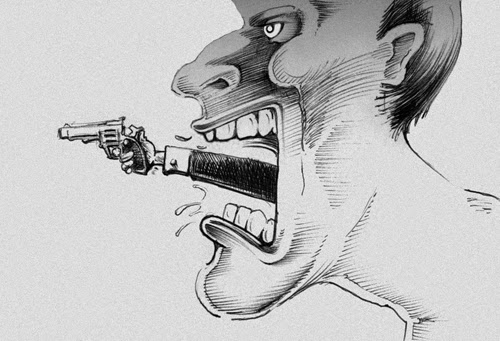
Words can be as sharp as any sword. They can mortally wound a soul. We really do need to watch what we say. Gossiping, lying, bullying, threatening, hurting should all be anathema to us. We would not point a gun at another human being, so why do we so blithely allow our words to sting? Whether we shout them or whisper them or write them down they should always be intended for the betterment of the people that we encounter, but never to tear them down.