
Without All the Drama

person holding terrestrial globe scale model taken
Photo by Artem Beliaikin @belart84 on Pexels.com

If I pay too much attention to the news these days it feels as though the whole world is engulfed in a dumpster fire. I’ve had to learn not to get too emotionally involved with the stories that I hear and read about until I do a bit of background checking. To say that journalism has become a bit too hysterical these days is hardly a stretch. I suppose that there is so much competition and so many hours to fill that news organizations have to become a bit salacious just to keep interest alive.

There are indeed many problems in our world today, but all too often our news agencies focus more on personalities, slips of the tongue, and ideas than facts. They give far too much exposure to persons and events that might best be left ignored. They choose to do such things because they know that it inflames people and creates enough stir to bring their stories notoriety. In some ways today’s reporting tends to resemble chatty posts on Facebook rather than attempts to get to the truth of various situations. Reporters argue with individuals as though they are participants in a debate rather than interviewers interested in facts.

I remember the days when there was a morning news report, another at the dinner hour, and a final one at bedtime. The newscasters projected an aura of fairness and seemed intent on providing us viewers with information that we might then formulate to make decisions. Now there is a decided effort to persuade rather than to simply inform. Frankly I have grown quite weary of such methods and I find myself feeling as though I am surrounded by little boys crying wolf. In other words there is so much panic and self righteousness in the voices of the national reporters that I tend to ignore them as much as possible. They have jumped the shark one too many times for my taste, and so I prefer culling through sources that are less inclined to inciting the kinds of rancor that are tearing our nation apart.

I’m a rather moderate person that one might find to be somewhat boring. I rise at about the same time each day and have a set of daily habits that I follow. I attempt to eat a healthy diet and get a bit of exercise. I abhor large crowds and loud noises and tend toward quiet gatherings. I like to spend time with family and friends and in the solitude of my own thoughts. I am a healthy mix of liberalism and conservatism which some say makes me a person with no real compass. I live on a very nice street with wonderful neighbors who represent many ethnicities and beliefs. It rarely bothers me when someone disagrees with my religion or my politics. I tend to think that I am in truth representative of most people. If pollsters and lawmakers want to really know what is on the minds of the nation they would do well to talk with me.

I truly believe that most Americans are very good people who want to be compassionate and open. We are taught from our youth to dream big dreams and very often we see our hopes come to fruition. We love our country even though we know that it has never been perfect, but then what country can lay claim to never having made horrendous mistakes? Each of us face difficulties and tragedies during our lifetimes and often the hard moments require our full attention, leaving us unable to worry about the rest of the world until we are better. Unlike most places in the world ours is a blend of many different cultures and somehow we have generally made our differences work for our betterment.

The problems that we face are real, and not all that different from those in other parts of the world. On personal levels we worry about issues like health, jobs, education and addictions. We know that we are doing the best we can in those areas but believe that we still have a way to go before we will be satisfied. Improvement is a good thing, but we are cautious about changes for change sake. 

On a national level we have different ideas about how to approach immigration, abortion and the violence that seems to be growing more prevalent. Sadly we argue more than we listen. We choose sides and refuse to budge even an inch from our preferences. We search for diplomats, peace makers, mediators and feel as though there are none. We sense that the squeaky wheels are running the show while those of us who are just doing our jobs the way they are supposed to be done are being ignored.

I am and have always been a quiet person. My voice is soft and it gets lost in the uproar of life. I have at times felt invisible. I have come up with ideas that were later claimed by those more boisterous. I have never known how to toot my own horn, nor have I really wanted to do so. I express myself with words and sometimes I am actually heard. I believe that I represent the true silent majority, a group of people who essentially enjoy living rather ordinary lives with a sense of peace. I’ve never wanted fame or notoriety, but I have grown weary of being sidelined by obnoxious persons who pretend to know how my life should be run. I am rather certain that I am but one of a very large group of people who are essentially like me.

I’ve turned off my television and tuned my radio to more soothing channels. I follow news sources that operate from a calm perspective. I spend a great deal of time listening to the sounds of life in my neighborhood. I take more and more time to reach out to people on a very personal level. I enjoy the birds that flock in my backyard and meditate on the goodness of life. I give of my time and talents to those who need me. I have found a semblance of contentment by ignoring the madding crowd. I do not classify people as this or that. Instead I see each person as a wondrous being who is simply trying to find a bit of happiness and a feeling of importance. I choose to see the world as a collection of humans who are more alike than different.  Our cultures, languages, religions and political beliefs may seem to be at odds, but when all is said and done we each just want to be allowed to be ourselves without all the drama.
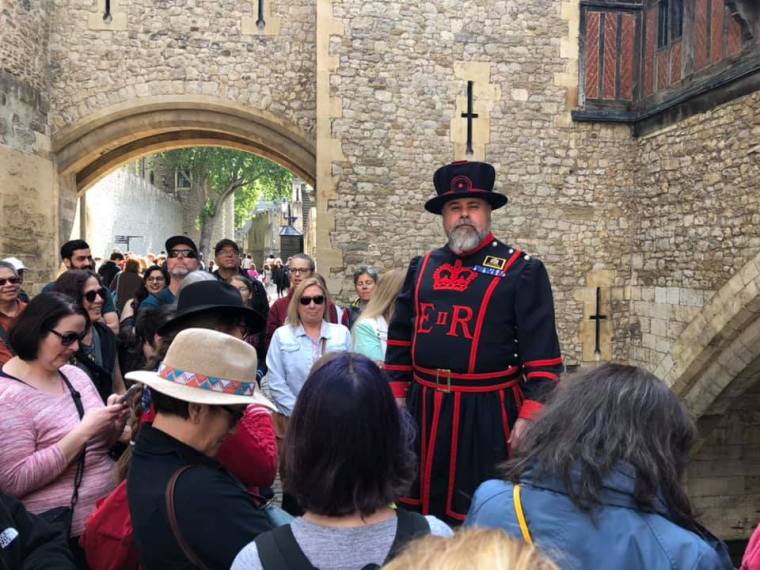

The Tower

Beefeater

In the heart of London along the River Thames lies one of the most extraordinarily historical places in London. Known as the Tower, it is a complex of buildings dominated by a white castle built by William the Conqueror shortly after the battle of Hastings in 1066. It is an impressive fortification with its moat, narrow winding staircases, and vast rooms. It was originally designed both as a home for the king and a defensive keep. Over time it became better known for the prisoners that were held on the premises and the executions that took place on the green. It is an imposing and improbable complex whose elevations seem both in and out of place in the modern world.

Some time ago I learned that my lineage can be traced back to William the Conqueror and from there to Vikings. I suppose that such is a somewhat dubious honor given that the Norman king was so often resented by the people of England who saw him as a bloodthirsty outsider. Nonetheless his legacy in creating the famous white tower remains as a reminder of the often violent and dangerous history of Britain.

What was once designed as living quarters for the first Norman king has evolved over time in its use, and now stands as a museum and respository of many stories. Visiting the Tower of London is perhaps the most fascinating tour in all of the city, complete with legends about the ravens who have lived on the premises for most of its existence. It is said that as long as they remain Britain will not fall and great efforts are made to keep them happy and willing to stay as permanent residents of the compound.

Countless mysteries and tragedies unfolded in the Tower. Richard II, the protector of his child king nephew, took both the little monarch and his brother there for safe keeping, but they subsequently disappeared thereby leaving the throne to him. Years later when the bones of two children were found buried under a set of stairs it was conjectured that they must have belonged to the long missing brothers. 

It was in that Tower that Anne Boleyn awaited her tragic fate once Henry VIII had decided that she was no longer of use to him. Later she would be publicly executed for treason on the grounds. Lady Jane Grey would serve as Queen for nine days after Henry’s son James died without an heir, and then lose her life when Mary I laid claim to the throne by right of being Henry’s eldest daughter. Elizabeth I would also spend time imprisoned in the Tower but was luckily spared a death penalty and eventually given the throne. Other famous prisoners like Sir Walter Raleigh spent years behind the walls as condemned persons before being put to death.

One of the most interesting areas of the Tower complex is a building in which prisoners left graffiti on the walls. Over time they meticulously carved intricate signs that they had been there. These were no ordinary scrawlings, but rather beautifully carved inscriptions left in the stone for all time. They told of the long days of isolation that the captives had to endure and their determination to leave their mark on history in spite of their wretched conditions.

The Tower complex also features a sampling of the crown jewels including the largest known diamond in the world. It displays goblets and plates of gold, as well as jeweled crowns and scepters. It is a remarkable showcase that points to the wealth of the monarchy and the traditions that have both evolved and continued over time.

A tour of the Tower grounds includes a rather jolly session with a Beefeater who reveals the history, the stories and the secrets of the complex. The Beefeaters live and work inside the Tower walls and provide visitors with an in depth detail of information. Our particular guide had a rather wicked sense of humor that added to the interest of his tales. He provided a voice to the people who had lived and worked and even died in that fascinating place.

The history of the world is one of violence and tragedy as people fought to gain and retain power. Their’s was not so much a fairytale as a story of intrigue, jealousies, and betrayals. Perceived treason brought imprisonment and death. Choosing sides carried dangers for both noble men and women as well as the common folk. The walls of the Tower of London indeed seem to talk of the fears and horrors of real people who either fought to maintain a hold on their power or suffered because they appeared to be threats. The chronicles of lives celebrated and lost are written in the very stone of this place. There is something majestic, awe inspiring, frightening and evil about what happened within at the Tower making the ravens that act as sentinels seem an appropriate symbol of both the ingenuity and the flaws of humankind.

I left the Tower of London in a rather pensive state of mind. It is a glorious edifice that is a remarkable reminder of the steadfastness and resilience of our humanity, but it is also a respository of our imperfect natures. It is a place where we should surely learn the lessons that history attempts to teach us. Our time on this earth is short in the grand scheme of the universe. The possessions that we accumulate are unworthy of our focus. We will all soon enough become ashes but our actions while still on this earth will have far reaching consequences. Let us hope that we have made good choices and demonstrated honor and integrity rather than greed. The history of mankind is littered with far too much hatred. It is our duty to work toward the good insofar as possible. Power comes and goes and too often corrupts, as we humans continue to work toward a more perfect union of our differences. 

Forgiveness

gray scale photography of jesus christ head
Photo by Alem Sánchez on Pexels.com

When I was twenty years old I became the caretaker for my mother when her bipolar disorder sent her into a psychotic state. At the time I was sorely ignorant of mental illness and lacking confidence in my own abilities to assess the situation and advocate for the very best care for her. I would make a decision regarding her therapy that would haunt me for well over forty years. I allowed my own instincts to fold under pressure from her doctor mostly due to my ignorance and non confrontational nature. I agreed to a treatment for her that I knew she would hate. I did not have the courage to stand my ground and insist that the doctor try something else. Nonetheless I learned from this incident and grew exponentially into a person who would never again be influenced to act against my own sense of right and wrong. Sadly, even though I changed I was never quite able to forgive myself and whenever my mother’s illness reared its most profound ugliness she would remind me again and again of what she saw as my betrayal of her. It took a great deal of internal reflection and wise counseling for me to finally accept that I was worthy of mercy.

Each of us has a story of something that we handled badly, something that we replay in our minds over and over again as though we might somehow change the outcome or at least assuage our guilt. On a rational level we know that we just need to genuinely apologize to anyone whom we have hurt, and then demonstrate through our actions that we have genuinely learned and changed. If we are willing to become better then there is little reason to continue to berate ourselves or to be reminded by others of our transgressions. Forgiveness should mean that our faults will never be mentioned again, and yet we all know of situations in which an offender is never allowed to fully transform because someone continually thinks of them as the incarnation of their sins rather than their contrition.

In the gospel of a few Sundays ago Jesus had died, risen from the dead and was with some of his apostles once again. Lovingly he chose not to remind them of how some of them had denied him when he most needed their support. He did not focus on the moments when their human frailties caused them to react badly. Instead he loved them for coming back to him and demonstrating their belated faith in him. It did not matter what had happened in the past because he knew that they loved him at that moment.

The Christian message is one of forgiveness, and yet so many of us pridefully hold grudges against people whom we believe have hurt us. Particularly in today’s society once an individual has displayed egregious behavior we tend to forever hold that person in infamy even when he/she makes attempts to repent. It is a prideful thing that we do forgetting that each of us has fallen from grace at one time or another. We want understanding for ourselves without granting it for those whom we have stereotyped with a broad brush of negative judgement.

Certainly there are acts that seem unforgivable and make it almost impossible to associate with any kind of absolution. When we think of the Holocaust we sense a special kind of evil that only God himself might unravel and pass judgement upon, but for the most part the hurts that we inflict on ourselves and others can be reversed. When people truly attempt to become better it is important that like Jesus we embrace them as they have become rather than what they used to be. Continually reminding them of the past is as cruel and hurtful as any wrong that they may have done.

I’ve always been impressed by stories of forgiveness and the people who demonstrated great love and compassion to those who had wronged them. They abound in our history, but of late they are the exception rather than the rule. Abraham Lincoln understood that if our country was to survive as a union we would have to have to embrace the people who had attempted to rebel against the nation, forgiving them for what they had done and moving forward without continually chastising them. Of course he was tragically assassinated and the resulting tendency to punish has bled over into the current political environment. As a society we focus on missteps rather than the evolution of character. It is not what a man or woman may have once done in a moment of thoughtlessness that should matter, but rather what kind of person he or she has ultimately become. 

I am a huge fan of Robert Downey Jr. not just because he is a highly entertaining actor but because I believe him to be a good man. There was a time when his addictions were so severe that he almost lost himself and his career. He was slowly dying in a haze of drugs and alcohol that made him unreliable. Nobody trusted him even after he had done much work to rehabilitate himself. He could not get the insurance necessary to land even a minor part in a motion picture. It was Mel Gibson who was fighting demons of his own who came to the rescue, offering his own money as faith in Robert Downey, Jr. Ultimately Downey’s career was resurrected, but the loveliest thing about him is that he never forgot the kindness form Gibson who also became a pariah because of an outburst when he was drunk and under the influence of his own mental illness. Downey has appealed to the motion picture industry and one time fans to demonstrate some compassion for Mel Gibson just as he was given. He understands as well as anyone that life is a continuum, a journey in which we struggle to become better versions of ourselves. He knows how important it is to cherish those who make great efforts to change.

We seem to forget that Jesus modeled forgiveness again and again. The stories of his mercy resound in the Bible, and yet even many who profess to believe in his words turn their backs on those who fall. It sometimes feels as though our society has become a judgmental nag when what we really need is more absolution. The strongest people in our world are not the ones who are unwilling to see the goodness emerging in a fallen soul, but those who embrace those who change with love and clemency. 

The Power of Prophecy

ball ball shaped blur color
Photo by Pixabay on Pexels.com

As a teacher one of the things that I hated to hear from a student was, “I’m no good at math.” Even worse was hearing such a sentiment reinforced by a parent who insisted that nobody in the family had ever done well with numbers. I knew that such thinking created a self-fulfilling prophecy whose hold on the mind of the student was difficult to undo.

If we or someone who knows us convinces us that something, whether good or bad, is true about us we tend to react in ways that reinforce the thinking. In education it’s often called the Pygmalion Effect. Researchers consistently have found that it is possible to affect outcomes merely by continually making particular comments to individuals or groups. If that happens to be about a lack of math skills, for example, it becomes more and more likely that mediocre success or even total failure will result. As humans we tend to give up trying when we believe that our efforts are futile.

I have a grandson who is doing quite well at Texas A&M University where he is studying computing in the engineering department. His classes are quite challenging but when I recently asked him how he was doing he immediately stated that his expectation was to make all A’s and perhaps one B in his courses. I was pleased to hear that he has set up a positive challenge for himself which he believes that he has the capability of achieving. Even if he sent a curve he understands that he has what it takes to nonetheless be ultimately successful. Because all of the people around him also believe in him, his faith in his abilities is reinforced. The interesting thing is that success bears the fruit of more success and the prophecy comes true.

Most of the time I encountered just the opposite effect with far too many of my students. Somewhere along the way the teachers and other adults in their lives had convinced them that they were academically doomed. They would relate stories of educators who had called them lazy and insisted that they would be lucky to graduate from high school much less a college. By the time I got ahold of them they were beaten down and unwilling to believe that I might help them. I had to work very hard to convince them otherwise.

Self-fulfilling prophecies are not just about academics. We are capable of convincing ourselves that we are klutzes or even that we are unloveable. I had a friend who became certain that she was only attractive to abusive men, and so she quit dating altogether after a few tries at meeting men seemed to prove her point. Someone who is told that he/she is ugly eventually gazes into the mirror and sees only horror. I’ve heard parents telling their children that they were losers, and then they wondered what had happened when those same kids began to exhibit defeated behaviors. We are the product of all that we hear and think about ourselves. If the negativity is repeated often enough it becomes the insight that we use to judge our personalities, our appearance, our intelligence and even the way the rest of the world sees us.

For these reasons it is critically important for all adults to monitor the things that they say to young people. If an entire class is told again and again how lazy and lacking they are, they might just give up and play the role of which they have been accused. If a young person makes a mistake he/she feels bad enough, but when those blunders are brought up again and again by the people who are supposed to care, a whole new personality of defeat begins to form.

When I was in middle school I was not yet five feet tall. I remember a PE teacher setting up the equipment for track. She brought out hurdles and measured distances for running. The first time she asked me to perform a task it was to jump over the obstacle. In reality I was no doubt too small to leap as high as I needed to be to clear the bar. Instead I slammed into the frame, toppling the entire apparatus and slamming my face into the dirt. The teacher’s reaction was not to coach me or demonstrate how I might do  better next time. Instead she simply barked that I was the most nonathletic, uncoordinated person she had ever encountered and shook her head in disgust.

Hers was a prophecy that went into effect immediately. From that day forward I avoided athletic pursuits like the plague. I explained to anyone who would listen that I was an blundering klutz and every time I was chosen last for teams my feelings were summarily reinforced. It was not until college when a kindly coach kept me after class for private lessons in every imaginable sport that I realized that all I had ever needed was for someone to show me what to do. I never became an athletic star, but I at least felt less subconscious of my abilities. I did fine until I joined a volleyball team at a school where I was teaching, and in a competition one evening one of the members of our group yelled at me just like the middle school coach had done and all of the old angst came flooding back. It paralyzed me with fear of any kind of participation in a sport. Old prophecies are difficult to overcome without help and understanding.

It is important that we see development for what it is, a gradual progression that moves at different paces for different individuals. We are all fully capable of learning how to succeed at most things, but our rate of improvement will vary widely depending on the totality of our genetic makeup and the environments in which we live. If we are surrounded by adults who understand such things and then provide us with optimism and expectations that we will ultimately succeed we are likely to reach our goals.

Life is a combination of nature, nurture, hard work, and beliefs. The thoughts that we have and that we hear are perhaps the most powerful forces in determining our ultimate fates. For that reason it would behoove every single adult who is in contact with others, not just the young, to think before speaking. Those words and attitudes will either create genius or destroy potential. We have to always remember that making mistakes is as much a part of learning as mastery. When someone falls it is up to us to let them know that we still have faith that they will one day overcome. The prophecies that we speak should always be filled with optimism and positive expectations even when progress is slow.

There Is No Better Way

photo of four persons uniting hands
Photo by rawpixel.com on Pexels.com

When I was still rather new in my profession of teaching I took a Myers Briggs test during one of the faculty meetings at my school. It turned out that I was an INFP which translates to someone who is introverted, intuitive, feeling and perceptive. I remember being a bit stunned by the tag of introversion because I assumed that it meant that I would not make a particularly strong educator. After all, a teacher is on view all day every day and to me being an introvert meant being someone unable to deal with other people. I soon learned that my homespun definition was totally inaccurate. Instead the idea describes how I unwind, come up with ideas, find peace. It seems that I am one of those individuals who finds inspiration and comfort on long solitary walks or inside the walls of my home. When I am feeling down I don’t want to go out on the town. Instead I need to recharge my soul quietly.

I have taken different versions of the same test many different times and get the same results again and again. I recently played a Facebook game for fun and ended up being described as a unicorn with my INFP characteristics. It seems that only four to five percent of the population earns that tag. I laughed as I realized why I have sometimes felt like a oddball in life, but it also helped me to realize why I seem to have a gift for understanding people, a talent that worked well with my teaching profession. In many ways I’m just one big gooey mix of emotions that from time to time drive my husband and other highly rational people insane. I greet the world with feelings and intuitions rather than a well thought out rational plan. I’m one of those people who quickly grows weary at planning meetings, which is ironic because a during my working years I frequently found myself guiding such events.

I had a dear friend who was impish and willing to go wherever the winds blew in a social setting, but when it came to more serious matters she planned with a vengeance. I soon learned that our relationship was glorious as long as it was all about fun. Whenever we worked together it went south. She was a person of outlines and scripts, while I preferred to quietly think for a bit and than go with the ideas brewing inside my head. I  corrected on the fly as needed and grew anxious with her need to plot and plan and fill notebooks with written descriptions. I suppose that we drove each other insane in our few collaborations, and so we ultimately abandoned all efforts and simply enjoyed each other informally.

We each have certain preferred ways of meeting the world. I’m not a psychologist so I don’t know if these are innate traits or learned or a combination of both. What I do realize as someone who has worked with thousands of people is that there is no one best way of doing things. We each learn and work and find joy in ways that feel the most comfortable. The person who is the life of a party may not necessarily be the most likely leader, but our styles may determine how those with whom we interact perceive us and how we see them. As a society we often place great value on particular traits thinking that they are the best way to do things. We often judge people by our own characteristics rather than understanding that each style of interaction has its merits.

When I begin ranting and my emotions are in high gear it makes those who are more attuned to rationality and structure feel uncomfortable. I learned over time that I had to curb some of my tendencies and provide more written documentation for my ideas than I might have been inclined to do. What few people knew is that I did not begin with outlines, but rather with ideas from which I worked backwards to create outlines and such. As I worked with my colleagues I found kindred spirits and those who needed more structure from me. I realized that some of my bosses needed little more than evidence that I was doing my job well and others wanted hard copy documentation. I had to learn how to comply with the needs and demands of everyone that I encountered even when it became irritating.

I used to assume that everyone hated meetings, and plans, and goal setting because those things were so abhorrent to me. I soon realized that for many people they are as necessary as breathing. My vague descriptions of the thoughts in my head were not enough for them, and so I found ways to comply in processes that I knew that I would never personally use. I taught my students in similar ways. I knew that some of my pupils were eager to simply jump from a cliff to test their wings and others wanted detailed instruction and practice before attempting trial runs. So too I worked with teachers whose lessons were crafted with the briefest of descriptions and others who wrote out their plans almost word for word. I allowed both versions of planning from members of my faculty as long as I saw good results.

We humans are far more complex and diverse than most of us imagine. It’s why we have liberals, conservatives, and libertarians. It’s the chief cause of our misunderstandings. We tend to see the world through our own lenses and feel confused when we observe someone who is so different from ourselves. Some of us are tidy and others are messy. In truth neither one or the other is necessarily best. The world is as exciting and productive as it is because of our differences, not our sameness. We learn from each person that we meet.

Being flexible and understanding of the people around us is a necessary aspect of our existence. Extroverts are not better than introverts, just different. Democrats are not better than Republicans, just different. Rational thinking is not better than being emotional, just different. When we put all of the various personalities together and truly value them we create a society capable of doing great things. We truly do need everyone because there is on one better way.