Just One More

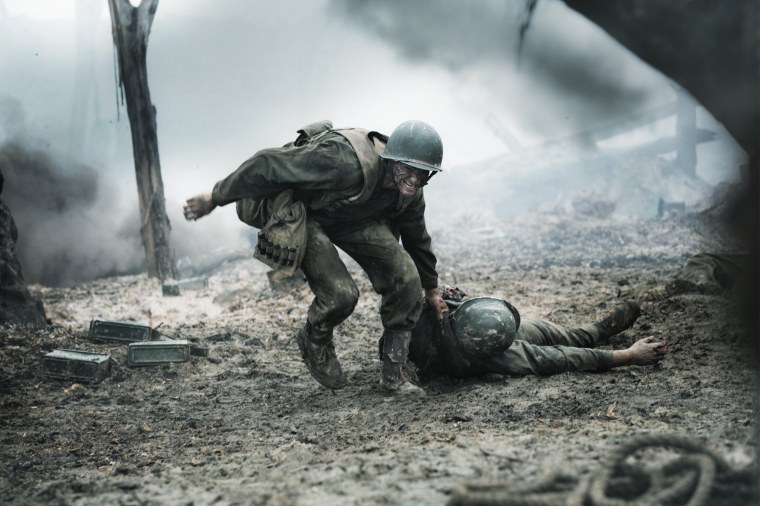
HacksawRidge_D33-15263.jpgFor centuries we have been sending young men into the abyss of war. Sometimes the causes have been noble but mostly the reasons for fighting have centered around politics that the average person found difficult to comprehend. History is stained with the very life blood of our youth. It takes great courage to volunteer to represent a country on a battlefield and even more to actually participate in a battle. It is something that most of us pray that we never have to endure and yet it has been a fact of history. Over and over again the treasure of our youth has had to bear arms against an enemy that they did not know for reasons that they may not have understood. We can almost all agree that war has and always will be hell and should be a last resort.

I am against all forms of violence. I think it morally wrong to abort babies, execute criminals and fight enemies and yet I understand that there are times when killing is the only choice to protect the innocent from danger. I am a conscientious objector up to a point. My faith tells me that if I have to choose between simply watching a despot like Adolf Hitler bullying his way across a continent or taking action to stop him with gunfire and bombs then I have every right to defend all that is good and just. I think that I might be able to set aside my gentle ways to stop such hate from spreading and I certainly commend those who put their very lives on the line in the call of duty. It is a sign of nobility to defend the innocent against aggressive tyrants and I often wonder if I would be capable of rising to such an occasion. I am in awe of those who find the grit within themselves to do so.

World War II was a nasty affair as are all wars but it bore the patina of being a just cause. Here in the United States virtually everyone in the country rallied to fight the despots from Germany, Italy and Japan. Young men joined the military at a fever pitch. High schools, universities and factories were emptied out as our youth eagerly volunteered to join the fight. Among them were my father, my uncles, and a young man from Virginia named Desmond Doss. What made Desmond a bit more unusual than most of his peers is that he was a Seventh Day Adventist who believed that it would be against God’s will to kill. Rather than registering as a conscientious objector and sitting out the war at home he decided to join with the intent of becoming a medic. With a kind of naive belief he actually thought that he would be allowed to accompany his unit without bearing arms.

His training for battle went well up until the time that he was instructed to choose a rifle and learn how to use it. When he refused to do so he became a pariah and the focus of a concerted effort to get him to simply quit. Somehow in spite of the bullying, insults and persecution that he had to endure he continued to insist that he wanted to be of service but simply could not and would not use a weapon. His conviction sent him to a military court where it was eventually ruled that he might be trained as a medic without bearing arms.

Doss’s battalion was sent to the war in the Pacific, a brutal theater where very different cultures clashed in some of the most horrific battles of that era. Their objective was to take a ridge known by the name of Hacksaw. When they arrived the fighting had already decimated entire units. The Japanese soldiers were relentless in their attacks and it seemed as though there would be no stopping them. Over a hundred and fifty thousand Japanese troops had been sent to keep possession of the area and so the battles were fierce. Doss followed his fellow soldiers as they attacked according to their orders. He provided medical aide to the wounded in the middle of a battle so bloody that it was almost overwhelming. Even after his group left to recoup for the night Doss stayed and rescued over seventy five men including some Japanese soldiers who had also been wounded. It was a miraculous and unbelievably heroic feat that earned him the respect of his brothers in arms. For the rest of his life he would tell of how he kept asking God to allow him to help just one more man to safety throughout that long and treacherous night.

Desmond Doss’s story is depicted in the movie Hacksaw Ridge, a brilliant film that brings us face to face with the sheer humanity of war. It is an homage not just to Doss but to all who risk their lives in battle. It slams the viewer into the visceral horror of fighting and asks us to imagine what soldiers have endured from the beginning of time. It forces us to consider questions of faith and to ponder our own beliefs. It is a brilliant work of art and a metaphor for both mankind’s brutality and its humanity. Through the eyes of a Godly man we see the chaos, fear and complexities of wars and those who participate in them.

I left the movie understanding that I had just seen something important. I was shaken and emotional. I thought of all of the people that I had ever known who had gone to war. I wondered what terrible and courageous things they must have seen that changed them forevermore. I realized just how fragile and strong each of us truly is. I was moved to tears as I pondered the importance of treasuring every life as a gift from God Himself. I worried that we humans have yet to find ways of resolving our differences without rancor and hate. The threat of war still looms in our hearts as long as we are unable to set aside our arms and our ugliness, as long as there is evil lurking on our planet. I contemplated our goodness as people as well. It occurred to me that there are individuals like Desmond Doss all around us, those who stand for something bigger than themselves. They quietly and peacefully work to serve us because it is right and just, not for glory or compensation. They are truly exceptional and they far outnumber those who would harm us.

Ours is a world of contradictions and uncertainty. We quietly wonder from one day to the next if we are truly living our best lives. We search for answers amidst noise and distractions. In the end we must do as Desmond Doss did in the middle of chaos. We must listen for the voice inside our souls that allows us to do just one more good thing, just one more.     

The End of the Curse

chicago-cubs-world-series-slot-2016-10-22For a time my daughter and her husband lived on a corner in an apartment in Wrigleyville, a neighborhood in Chicago. It was a busy area right across the street from a tavern where locals always seemed to be celebrating something. The elevated train system was only steps away so the clattering noise of mass transit was just one of the everyday sounds that echoed through the open windows of their place. It sat on the top floor providing an excellent view of the shops and eateries nearby. It was an old school residence without an elevator or air conditioning. The walk from the ground floor on the steep steps provided an unadvertised perk of daily exercise. The apartment was small but quite lovely with its polished wooden floors and windows that allowed the sun to create a homey warmth. It had the kind of character that comes from tradition and age. My daughter somehow made do with the tiny kitchen that barely provided enough room for two people to stand. It lead to a small private stoop and a fire escape that fascinated me. Somehow it felt like a setting right out of a novel.

I am a creature of the wide open spaces of Texas who had only read of multistory housing in crowded urban settings. When I first heard where my daughter was living I secretly worried for her safety. Upon visiting her domain and actually walking through the neighborhood near her place I became enchanted. Everything about Wrigleyville was quite wonderful, even the raucous noise that filled the air each evening as revelers relaxed in the local bar across the street. I most enjoyed sitting at her dining table in a corner room with windows overlooking the expanse. I imagined being there day after day and finding inspiration for my writing. I was intoxicated by the sheer adventure of observing so much humanity.

The area was called Wrigleyville because the home of the Chicago Cubs baseball team stood proudly at the center of the residences and businesses. It was an easy walk from the apartment to the field so of course I wanted to attend one of the games but my first visit was in the winter so I had to wait until my return in the summer. I had no idea that I would fall in love with the Cubs when I first entered the stadium on a warm afternoon. Everything about the experience was wondrous. It seemed to me to be what baseball was supposed to be like. The fans were all decked out in their gear and the place was packed. The hot dogs were a gourmet delight so unlike the plastic almost inedible ones that I had tried back home. People sat on the tops of nearby buildings to catch the action without benefit of sound. The crowd was happy, cheering and totally into the game. I can’t recall a single time that I have had so much fun at a baseball game. Forevermore the Cubs would be my favorite team with the exception of my Houston Astros.

I heard all about the curse that had once been placed on the Cubs by a local tavern owner who became incensed when he and his goat were turned away from the stadium back in 1948. I tend to be a believer in such things since I am sometimes a bit of a jinx myself. I’ve been known to turn the victorious tide of a sporting event just by my mere presence. I take such matters quite seriously. Somehow the whole idea that the Cubs were the victim of black magic seemed to be confirmed a few years back when they were on the road to finally ending their drought when a fluke play shattered their dreams. I just happened to be visiting my daughter at that time and watched in shock as a fan reached out from the stands and caught a fly ball before one of the players had the opportunity to force an out. I vividly recall how stunned we were as we realized that the Cub’s dreams had gone up in flames.

The apartment where my daughter lived caught on fire one evening. One of the residents had fallen asleep while burning a candle which eventually touched off a blaze that filled the entire building with smoke and flames. Luckily everyone escaped with only minor injuries but the firefighters had to vent the roof to control the burn and almost everything that my daughter owned was ruined by falling debris, smoke, and water. She was expecting twins at the time and decided that perhaps it was time to move to a place with more green space and so she left Wrigleyville but not without a heavy heart. We would all think back on that lovely place for years to come and reminisce about those Cubs games and the walks down tree lined avenues.

Eventually she and her family moved back to Texas taking memories with them that never grew dim. Year after year we all rooted for the Cubs but saw our hopes dashed again and again. Then came the news that they were going to the World Series. Prognosticators boldly pronounced that they were the underdogs in the matchup and I feared that something would surely go wrong in their quest to end the curse and become victorious. Slowly but surely they proved everyone wrong in one of the most exciting battles in decades, going back and forth with the Cleveland Indians until it was game number seven and they had to lay everything that they had on the line.

I had butterflies in my stomach all last night and did my best not to somehow influence the outcome of the game with my thinking. I busied myself and tried not to become too overjoyed when they held the lead for so long. When the game tied up near the end I held back the negative thoughts that clouded my mind. A delay of the game due to rain made me want to panic but I instead remained calm. I wondered if there had ever before been such a build up of tension in such a major contest. Then it happened. The Cubs won the pennant. After one hundred eight years they had finally done it.

I can almost hear the cheering in the tavern that still stands across from where my daughter once lived. I can see the smiles on the faces of the people of Chicago as they ride the trains to work and school. I want to walk down the street and celebrate with them. I want to eat a hotdog and wear a blue shirt. In a time filled with so much negativity and uncertainty it feels so good to have a grand reason to shout with joy. The Cubbies have shown us all how to keep the faith. I for one rejoice.

His Story

US_$10_Series_2003_obverse.jpgHe was a small man with a gigantic intellect. Nothing about his background might have indicated the greatness that he would achieve. He was born out of wedlock on an island in the West Indies at a time when illegitimacy was considered a curse. By the age of thirteen he was an orphan who so impressed a local benefactor that he was sent to New York to further his education. He eventually graduated from King’s College and became an up and coming lawyer. Without any wealth or influence he used his genius to be one of the driving forces behind the American Revolution and the development of the Constitution of the United States of America.  He earned the undying respect and trust of George Washington and became his personal aide during the war and the first Secretary of Commerce in the early years of the nation. Certain tragic flaws led to scandal, blackmail and ultimately his death in a duel. He has been the often forgotten Founding Father known best as the face on the ten dollar bill and the man shot and killed by Aaron Burr. In truth he is the person most responsible for creating the economic foundations of the country and in many ways he is perhaps the most quintessential representative of the American citizen. His name is Alexander Hamilton.

A few years back I became fascinated by Alexander Hamilton after reading a biography by Ron Chernow that my husband had given to me for Christmas. I identified with the sheer humanity of his story. He was someone who overcame tremendous deficits through sheer will and talent. He was a man who was unafraid to fight for what he believed to be right and just and yet he was also guilty of harboring resentments and falling prey to dishonest flattery. He was supremely confident in some situations and unsure of himself in others. He was a man filled with contradictions who often allowed his unbridled ego to determine his fate. He reminded me of so many highly gifted individuals who in spite of their multiplicity of talent too often become embroiled in personal battles that destroy them. Ultimately each and everyone of us struggle with inner demons.

It seems that while I was learning about Alexander Hamilton and celebrating his complexity there was someone else coming to the same conclusions as mine. In a stroke of genius Lin-Manuel Miranda created a brilliant musical to introduce the world to this fascinating character. Mixing history with modern day rap Miranda has created a stunning chronicle of the life and times of our nation’s earliest beginnings through the story of one of its most interesting founders. Hamilton represents the nitty gritty of America from his humble birth to his tragic downfall and Miranda has captured the sheer irony of Hamilton’s life in music that brings our forefathers into the modern world with all of their glory and baggage. The play has garnered well earned critical acclaim, honors and nightly packed houses. Best of all it has brought renewed interest in Hamilton and his costars in the unfolding of America’s story.

My dream is to one day see this musical on Broadway but that will have to wait until the tickets become more affordable for an average Josephine like me. Still I would love nothing more than to travel to all of the places that served as a backdrop to Hamilton’s life and then attend a showing of the play as the grand finale to my journey back through time. I think that it would prove to be the perfect vacation. My all time favorite trips have been educational in nature and this one would be beyond incredible. Judging from the ticket calendars for Hamilton that I have studied it will be several years before I will be able to fulfill my fantasy but in the meantime it will be a fun excursion to plan.

There are many aspects of Alexander Hamilton that remind me of my own grandfather. For all intents and purposes he too was an orphan. His mother died when was only three days old and his father gave him away to a woman that he lovingly called his grandmother. No documentation confirms who his relatives actually were. It is as though he simply sprang spontaneously from the earth. When he was only thirteen the woman who had raised him died leaving him on his own. He chose an uncle to oversee his small income and even stayed for a time with his father but it was not long before he was traveling across America alone and in search of work. He used his wits and determination to survive.

Grandpa was a brilliant man who in many ways was self taught. He loved this country and exercised his right to a voice in government by regularly voting well into his one hundredth eighth year of life. Like Alexander Hamilton he refused to allow his humble birth to dictate the direction of his life. He used all available opportunities to keep himself and his family afloat even in the most difficult times. He witnessed more than one economic depression, five different wars, and every presidential race from 1878 until his death in the mid nineteen eighties. Through it all he was an optimist who believed that each passing year of his life was just a bit better than his last.

My grandfather saw our human progress as a sign that the government was working just as it had been intended. He kept the faith in America’s democracy until the very day that he died. One of his last big reads was a biography of Thomas Jefferson which he was able to discuss at length just after he turned one hundred eight. He believed that his longevity and his gifts of freedom were great treasures. He left this world with not a penny to his name but he would have insisted that he was rich. He loved his country as much as he had his family. He had weathered a lifetime of tragedy and yet he was a happy man who thought himself blessed simply for living in a place that seemed to be ever improving. His take on history was that the United States of America was slowly but surely moving forward and that we all benefit from its continual search for justice and freedom.

Right now we are in a kind of valley of fear and criticism with regard to our country. We act as though these are somehow the worst of times and yet our history demonstrates that we have been in similar circumstances before. We find the divisiveness between Donald Trump and Hillary Clinton to be deplorable and we are shocked that they won’t even shake hands. We forget that Alexander Hamilton and Aaron Burr were such political rivals and enemies that they ended up on a field in New Jersey to settle their differences with pistols. Hamilton was mortally wounded and Burr who had been the Vice President of the United States was charged with murder and thought to be a villain for all time. Somehow our country moved beyond such a shocking turn of events just as it always seems to do.

My grandfather was able to use the breadth of his experience to see that we may falter and even lose our momentum but we always find our way back. He realized that great men like Alexander Hamilton understood the nature of humans even when they ignored their own flaws. Together individuals from different backgrounds and alternative points of view developed a government that was capable of sustaining itself and correcting its mistakes. Over two hundred years later it’s still here and not even the bombast and prevarication will tear it down as long as we the people cherish it and continue to work to make things right just as Hamilton did so long ago. He lived and died just as we all do but what a story he left behind.

Triumph

mt-carmel

On September 1, 1965, the Mt. Carmel High School Class of 1966 began day one of senior year and what a time it would be. We were ready to take charge and end our four years with unparalleled accomplishments. Our student body leaders, Tom King, Terry King, Janice Lowe, and Jeannine Mandola were more than up for the task of celebrating the school’s tenth year of providing educational excellence to the young men and women of Houston. This was our time to shine and we took on the world with confidence and determination.

The Vietnam War was raging and dividing the nation. The editors of the school yearbook, Elke Ahr, Diane Martin, and Monica Krider chose to dedicate the 1966 edition of Zelo to peace. Our school would be touched by the tragedy of the far away war when a member of the Class of 1965, Mike Hoelcher, was killed in the service of our country. It brought home the reality that our days of comfort and youth were drawing to a close. Soon we would be moving into a new phase of life that would demand that we demonstrate the wisdom and grace that our parents and teachers had instilled in us. But at least for the coming months it was our moment to enjoy the fruits of our labors as students.

Our academics had become ever more rigorous. We learned how the world around us works in physics and began to better understand the politics of the United States in civics. Our mathematics ventured into the realm of Pre-Calculus, challenging us ever more. We became more and more proficient in languages like German and Spanish. We spent hours reading and doing research for our senior year English papers, the culmination of all that we had learned before. Our religion classes delved deeper into ethics and questions that have confounded philosophers and saints for centuries. There was no respite from the mountains of school work that never seemed to decline no matter how hard we worked.

Of course there was time for play and development of our extracurricular interests as well. Frank Abegg and Claudia Dean were tapped as editors of the CarmeLight newspaper. I must admit to being disappointed that I did not get the nod. Being the general editor was the one distinction that I had most desired because more and more I wanted to spend time writing. I was instead named the news editor along with Susan McKenna. My dismay was only a temporary setback and I was soon enough working long hours to meet deadlines and keep the news current and interesting. Our Forensics group was doing its own bit to burn the midnight oil in preparation for tournaments that they would win again and again. Paul Colby and Harry Butler continued to dominate in debate.

The Medical Careers Club brought home three awards for excellence that year and continued to grow in size and stature. I was proud to be the president of the organization but had quietly realized that medicine was not in my future. Judy Loisey, Frances Harris and Linda Derks led the Future Teachers club while Kit Lyle and Marjorie Neely were officers of the Mission Club dedicating most of their efforts to sending parcels to Vietnam. We had an active Civil Air Patrol with Mario Zuniga and Carl Eschbach as commanders. Jeannette Mikeska and Linda Daigle chaired the ever popular Dance Committee that stayed busy that year planning twelve special events. Frances Harris and Manuel Manriquez enriched the Spanish culture of our school with a moving Nativity presentation while the senior members of the Texas Association of German Students created a riotously funny skit called “Ich Spion” that featured the guys dancing in fake lederhosen.

Our sports programs brought us honor and winning seasons and even the possibility of beating our biggest foe, St. Thomas High School. The football team gained respect by defeating opponents like Jesuit, Alvin, Kelly, Kirwin and Bishop Byrne. We became the surprise of 2-AAA with a team led by standout players like Leonard Luna. Senior players, Mike Bole, John French, Mike Getz, Mike Villars, James Mushinski, Paul Jauma, Allen Bare, Tom King, Donald Descant, Paul Kasper, Terry King, Tad Trahan, David Sonsel, Ronald Block and Jack Villagomez made Friday nights more exciting than they had ever been even though our ultimate goal of finally winning against St. Thomas never came to pass. The varsity basketball team placed second in the district with Paul Kasper, Joe Madden and Leonard Luna playing key roles. The track team went even farther fielding both district and state championships with Pat Hulin, Leonard Luna, Johnny French, Ronald Block, Chris Nixon and Donald Descant. Not to be outdone, the ladies played hard at volleyball, basketball and swimming with Linda Wilson, Janice Repsdorph, Diane Martin, Ruth Hoesel, Janice Lowe and Jeanette Mikeska representing us with determination and pride. Of course our cheerleaders, Lucille Warchol, Tommy Morrison, Jeanette Mikeska, Johnny McAughan and Patty Balke were ever present to lead the student body in supporting all of our Carmel athletes.

Homecoming that year featured an amazing bonfire with Mary Jo Cipriano reigning as our queen. The football field and the dance that followed was awash with extravagant mums that only Texans understand and a beautiful and sweet court of young ladies who had exhibited their school spirit in a multitude of ways. Janis, Margaret, Stephany, Jeanette, Jeannine and Kit were all smiles and the rest of us would always remember them as Mt. Carmel royalty.

The Cadettes were winners on and off of the field, bringing home a first place trophy for the International Trade and Travel Fair Parade. Officers who had marched rain or shine for three years before earning their stripes were Janis Lowe, Kit Lyle, Ruth Hoesel, Judy Loisey, Jeannine Mandola, Margaret Rae, Karen Wilson, Cindy Cash, Carolyn Snow, Diane Martin, Susan Kelly, Lou Anne Bering and Janet Key. I was asked to be the official announcer during their routines on the football field which was a job that I loved. It also allowed me to attend the Cadette Ball in the spring. I always felt thankful to whomever had come up with the idea of including me in this wonderful organization. 

Of course Mt. Carmel High School was first and foremost about academics. Bill Winn and David Patton were finalists in the National Merit Scholarship competition while Paul Colby and Claudia Dean received letters of commendation. After years of hard work prompted mostly by fear of failing and a need to honor my father I had the number one rank and became the valedictorian with Judy Loisey as the salutatorian. Hard work paid off for those of us who were senior members of the National Honor Society including Mario Zuniga, Mike Petru, John Kurtz, David Patton, Richard Powers, Bill Bailey, Frank Abegg, Judy Loisey, Margaret Rae, Linda Caldwell, Linda Daigle, Claudia Dean and me.

With spring came the Junior Senior prom and the traditional senior trip to Bandera. One hundred forty four of us had made it to the finish line. We played in the sun, danced, rode horses and recalled four years of memories. We followed the traditions of presenting a senior play and crowning the Virgin Mary in May. We received our “Academy Awards” from the juniors and at long last gathered together in the gym on May 22, to receive our diplomas. It was one of those bittersweet days for which we had longed. It was the culmination of our accomplishments and our friendships. We would process into the building as a family and leave to travel in many different directions. There would be many whom we would never see again. Our days as high school students were done. It was time for us to begin to assume the mantle of adults and demonstrate to the world what it really means to be a graduate of Mt. Carmel High School.

Fire

fire-generic-750xx724-407-0-38When my youngest brother, Pat, announced to our mother that he wanted to become a firefighter I suspect that she believed that he was just going through an adolescent phase that would soon enough pass. She told him that she would not give him her blessing to enter the Houston Fire Academy until he had first earned a college degree, a requirement that he dutifully completed. With his diploma from the University of Houston in hand he returned to her once again to announce that he had applied to become a candidate for the Houston Fire Department. This time he was only informing her, not asking for her permission. Shortly thereafter he began his training and was so taken with the lessons and skills that he learned that he graduated number one in his class. It was a proud day for him and all of our family when he earned his badge and a job at the downtown Houston Fire Station Number One.

Pat threw himself wholeheartedly into his work and it was not long before there was a major fire in the downtown area that was so large that it made the nightly news and there in a photograph for the ages stood my brother aiming a stream of water at a wall of red flames that dwarfed him. The image showed his back with his last name emblazoned on his jacket. It was a frightening reminder of just how dangerous his job really was. As a family we tried not to think too much about the kind of things that might happen to him but again and again there were reminders that firefighters literally place their lives on the line each time that they respond to a call for help. They never quite know what kind of situation awaits them and for the most part they rarely discuss what they have seen with those of us who would rather not be reminded of the dangerous possibilities.

Pat was as happy with his career as anyone that I have ever known. He spoke glowingly of the brotherhood and friendships that he shared with his crew members. He proved his mettle as a leader and began to work his way up the ranks, eventually becoming a Captain at one of the neighborhood stations. It was apparent that his men loved him as much as he loved them. They became a second family for him in an environment where he felt confident that he was living his dream.

He returned to school first to earn an advanced degree in Public Administration and then another in Fire Safety. He became such an expert in his field that Mayor Lee Brown tapped him to become the director of the Fire Academy. It was a post that he cherished because it allowed him to share his expertise with young men and women who were as eager to serve as he had always been. He upgraded the rigor of the training process with an eye to preparing his charges for the special demands of being a first responder in one of the nation’s largest cities. It was a very happy time for him but before long he was moving into other arenas of leadership.

He became a District Chief and then a Regional Chief. He helped to investigate fires and to set and maintain high standards for all of the firefighters in the city, all the while humbly doing his work without mentioning his ever growing status within the department. He was always far too busy working for the betterment of Houston to brag about his accomplishments but the men who had worked for him often whispered their admiration.

One of Pat’s most exciting moments came when he accompanied a group of Houston firefighters to New York City on the occasion of the opening of the 9/11 memorial. They traveled by motorcycle all the way from Houston and then participated in a parade in downtown New York. He was so moved by the stories of bravery that he heard from comrades from all around the world. It was a grand moment in which he truly realized the importance of his work and stood shoulder to shoulder with people who understood the unique challenges and joys of being a firefighter.

I can’t imagine what kind of courage it must take to don the heavy equipment of a firefighter and hop onto a truck for a ride to an unknown disaster. On any given day our firefighters know that they may walk into situations from which they will never return. Even in the best of circumstances they often experience damage to their lungs from the continual exposure to smoke. They may fall from the rafters of an attic or have a ceiling come down on their heads. They encounter life and death situations over and over again and are only able to relax once they are safely back at the station. Still they eagerly report to work again and again just as Pat has always done.

Pat Little has served the City of Houston with pride and enthusiasm for thirty six years. He has tirelessly worked during hurricanes, floods, freezes and even when he felt sick. On some nights the alarms awakened him so many times that he had little sleep. There were Thanksgiving and Christmas days when he was faithfully executing his duties while the rest of us were relaxing and celebrating without him. Missing even a single day of work was always anathema to him. He rarely complained when he had to be absent for the milestones of his children or when he had to forego special occasions because he was saving a life. Now his outstanding and selfless career is finally drawing to a close. On Sunday his crew is hosting a party for him and on October 11, he will retire for good. He will be remembered and revered by both family and fellow firefighters for the joy and dedication that he brought to his job for all of those thirty six years. I have little doubt that given the opportunity he would gladly relive his life as a firefighter all over again.

Congratulations, Chief Patrick Little, on a job well done. We are all proud of you and humbled by your quiet courage and your unflagging determination to make a lasting difference in the world. You have done well in a world that is all too often marked by evil and greed. You are our hero, a man who has shown the meaning of service.