
Each New Day

new day

I have reveled in my retirement from work, but I still have the urge and the energy to keep myself busy. I try to stay active because I’ve witnessed the times when people that I know became unable to get around like they once did. Admittedly I find it difficult to stay still due to a personality that is always pushing me to continue making a difference in the world. I still operate from a general routine which I swore I would never do once I dropped out of the daily rat race. Some habits are difficult to eliminate.

Nonetheless I enjoy my mornings the most. I used to hate the sound of the alarm clock announcing that I had to get a move on lest I be late for work. Now it is my internal clock and my bladder that push me out of bed in the early morning hours. If I try to catch a few more Zs I end up with a headache and dreams so goofy that they are disturbing, so I just rise and enjoy the quiet when the silence is only broken by the sounds of the birds and people beginning their daily treks. I brew some tea and sit in my front room reading about what happened while I slumbered.

I write five days each week as a kind of meditation. I challenge myself to put the random thoughts that run through my head on paper in a cohesive and meaningful form. It’s an exercise that I so enjoy and one for which I rarely had time in my teaching days. Back then I had to be out of the house by six thirty and then I would spend as much as an hour or more commuting to the campus where I worked. My mind was never ready for such a hurried and raucous start to the day and so I despised every aspect of the early hours. Being forced out of my home without time to sit quietly was horrific. Now I luxuriate in the moments that I have with my thoughts.

I’ve never been able to completely get away from working with young people. I still tutor seven students from nearby and I glory in being able to do so. They delight me with their optimism and honesty. I gain as much from them as they get from me. I find children to be a delightful diversion from the seriousness of the world. They keep me hopeful and challenge my brain to continue working. I look forward to my weekly visits with them and fill in my academic longings with tutoring sessions with my grandchildren.

As I have become older I have found more and more solace in attending church each Sunday. I look forward to my weekly pilgrimage when my heart and soul are filled with a sense of calm simply from being in the house of the Lord along with other people who have become so special to me. I never fail to leave feeling refreshed and somehow a bit more at peace.

I don’t need much to be happy these days. I have begun to take great delight in the most ordinary aspects of life. I now have the time to be more available for the people that I love. I enjoy a wave from a neighbor, a cute photo of someone’s child, a joke that makes me laugh from my belly. I get to read more and watch ridiculous television programs without feeling guilty. I do silly things like dressing up in costume for a party or festival. I don’t want excitement anymore. Serenity is the companion that I cultivate.

I have become more in tune with myself and with the people that I know. I enjoy celebrating their victories, milestones, and happiness. At the same time I don’t shy away from helping them through challenges and losses. I’ve finally learned how to really listen and hear the individuals who mean so much to me. I now have all the time that they may need. It feels wonderful to be able to embrace friendships without the obligations of work pulling me away.

I explore new ideas and challenge myself to remain open minded even when people’s beliefs differ greatly from my own. I have become a defender of the individual right to think about the world from differing points of view. I have lowered my blood pressure considerably by understanding that I don’t need to argue or judge or turn my back on someone just because he/she disagrees with me on matters of politics or religion. To each his own has become the gold standard of my reaction to such things.

My life is quiet, routine, relaxed. I know who I am and I really like myself. I have a group of wonderful friends, a loving spouse and an incredible family. None of us are without our flaws but I love all of us just the same. What more might I want? I go with whatever flux and flow enters my life and find ways to stay content. I look forward to each new day and the possibilities that it brings.

When Heaven and Earth Collide

Heaven-and-Earth-Collide.png

Our society places a high value on science, technology, engineering, and mathematics, the STEM subjects. We no doubt need the knowledge and advances in those fields and I tend to believe that the very future of the world will unfold through the ingenuity of the people who are skillful in unlocking the mysteries of the universe. We live far more comfortably than our ancestors because of the innate curiosity and genius of our left brained brethren. Nonetheless, we all too often underestimate the value of individuals with an artistic bent. We urge our talented painters, dancers and musicians to follow a “more practical and useful” pathway as though there is something less than about the ability to create more abstract inventions of art. I would argue that humankind is often at the apex of intellect whenever we move beyond the concrete of time and space and into the incredible universe of artistic imagination. The truth is that we need both our STEM leaders and the individuals who bring us so much pleasure with the arts.

Humans are quite breathtaking in abilities and it is often through our artistic expressions that we leap toward the heavens. Leonardo da Vinci was a mathematician and scientist but his paintings are the works that remind us of how truly awesome he was. The paintings on the ceiling of the Sistine Chapel by Michelangelo timelessly evoke our other worldly longings. The music of Andrew Lloyd Weber takes us to places that we might otherwise never have imagined and tugs on our emotions to leave us in tears of joy and pleasure. Watching Gregory Hines and Mikhail Baryshnikov dance in White Nights is sheer bliss that reminds us of how beautiful our very bodies can be.

I have always been awed by the ways in which we humans transcend our most basic needs to become creators of stunning works of art. I have often wondered what in our natures caused us to scratch out pictures on the walls of a cave. How is it that we realized that our very vocal chords were musical instruments? Why do we take such joy in using and twisting words to convey new meanings? What is it about us that prompts us to experiment with color and sights and sounds?

What truly separates us from the animals is the way that we use our minds and we don’t seem to be satisfied with merely building structures to protect us from the harshness of the elements. We want to decorate our abodes with artifacts that add a sense of individuality. We fill our lives with music, sculptures, paintings, dance, books, plays that strive to explain just who we humans are. We share an essential need to express ourselves. It is in our very DNA, and yet of late we tend to dismiss the artists and artistic contributions to society as being a notch below the work of our talented STEM citizens.

Try to imagine a world without art of any kind. Think of a totally utilitarian existence devoid of music, singing, visual arts, make believe. Only the colors of nature would surround us. Our minds would be focused on being ever practical. How dreary life would be. How frustrated many among us would become. Without artistic expression so much beauty would suddenly disappear. It is almost unbearable to consider.

There was a time when geniuses of all varieties were treasured. The era of the Renaissance enshrined all forms of human inventiveness. It almost seems as though the coming of the Industrial Revolution was a turning point in the way we view human talents. In the present day we tend to place more of a premium on STEM than on the arts. We scoff at a young man who majors in Creative Writing but admire one who follows a pathway to science. We are in awe of the mathematics teacher but believe that dance teachers are expendable in times of tight budgets. We constantly undervalue those with artistic talent and attempt to force our young to pursue the occupations that we deem more useful.

The miracle of humanity is that we are a species of great variety with brains that are capable of incredible thought. Some of us excel in STEM and others delight in the arts. If we are truly honest we will encourage our young to find themselves wherever that might lead. We will applaud not just the stars of the artistic world but anyone who is willing to make our lives more beautiful through art.

I was asked to describe my favorite work of art and I found that task to be impossible. How can I possibly narrow down my choice to a single artifact when there are so many incredible creations that fill my mind with profound appreciation? My home is filled with art in the form of music, books, movies, sculpture, paintings. I dance with joy in the sheer beauty of each day that is made better with the countless creations of the human mind. I am in awe of those who rise to the level of genius whether it be to build a driverless car or create a play that touches our souls. Art is the expression of our souls, the incarnation of heaven on earth.

A Sense of Happiness

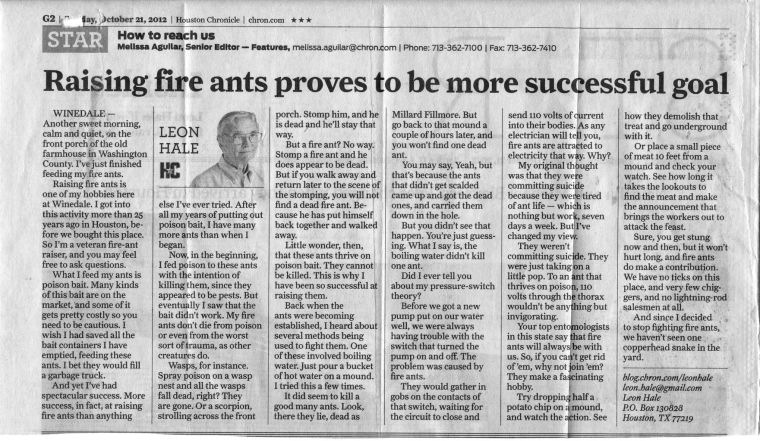
FireAntStoryTX102112

Does anybody remember Leon Hale? He was a writer for both The Houston Post and The Houston Chronicle who traveled around the city of Houston and the state of Texas writing about this and that. His columns revealed a man who was always on the lookout for a good story, and over the years he found hundreds that delighted readers like me. His best ones were often about rather ordinary people who came to life under the magic of the words he chose to use to describe them. His talent was so profound that he somehow made the mundane incredibly interesting. He had an eye for finding the beauty in a single moment or face or comment.

I know I would have enjoyed sitting down with Leon Hale to talk about his decades of adventures with folks. I would have liked to ask him how he developed his writing craft so well, but I suppose I already know many of the answers because he was masterful at noting even the tiniest details about his subjects and then finding words and phrases that painted pictures without so much as a single photograph. His was indeed a brilliant talent that brought me many years of joy. Even on days when I was too busy to peruse the other pages of the newspaper I found time to see what Mr. Hale had to say and I was never disappointed.

Leon Hale taught me as much about humor, love, acceptance and other such positive characteristics of the human heart as the sermons I heard in church. He got me to thinking about the best inclinations of humankind and his stories were as uplifting to my spirit as readings from a book of meditations. He also had a knack for describing people and situations with unique combinations of words that invariably brought out emotions that either made me laugh or cry. I literally felt as though I knew him and the people that he introduced in his tales.

The glory days of local newspapers are dimming. Houston was once a two newspaper town long before it was even close to being the forth largest city in the country. The Houston Post, which was always my personal favorite, went the way of dinosaurs long ago and The Houston Chronicle is just a shell of its once glorious self. A Sunday morning edition used to be so big that it came in two separate rolls from the paperboy. Now it is so slim that it’s hardly recognizable. It’s surface area is vastly diminished as is the quality of writing between its pages. Before long it won’t be too far different from the little suburban newsletters that come out once a month.

It was the printing press that wrought dramatic change in the world. As ordinary folk had more and more access to books and newspapers equality became more possible. The new revolution has been on the technology front with news and print entertainment on demand at any given moment. A morning or evening run of a hard copy is old news by the time it arrives and is less and less cherished by avid readers than it once was. Computers allow us to see the latest information whenever we wish. Blogs provide us with almost infinite numbers of writers that we might follow. The new Leon Hales can live and write in Texas and then publish for a worldwide audience within minutes.

I am definitely an electronic reader. I use my various devices to read wherever I go. I don’t have to cull through dogeared magazines about topics that have little interest for me when I wait to see my doctors because I have my trusty phone to keep me apprised of breaking news or to provide me with columns from writers that I enjoy. I even have a Kindle app that allows me to read from the latest best selling books. Still, there is something about the look and feel of paper and printed letters formed from ink that adds to the reading experience. Actually holding a physical copy of writing is as enticing to the senses as wearing fine perfume.

The glow of letters on a screen just ins’t as exciting as holding a printed version of a story or a book and I always have the sense that I may be missing something important whenever I read from an electronic device. I understand and learn best when I have a fully kinesthetic experience in which I can actually manipulate the words by circling or underlining them or making comments in the margins. I like to put paper tabs on certain pages or turn down the corners of the sections that contain my favorite passages. Not even mechanical highlighters on ebooks do the job as well for me. My photographic memory feels a bit lost in the world of computers, notepads and phones. I have to spend too much time remembering where all of my information is stored. With a paper copy I know exactly where to look.

Several years ago I rid myself of all of my long playing record albums and I had quite an extensive collection They took up a great deal of room in my house and I was more inclined to play CDs which were far easier to store and rarely had a scratchy sound from overuse. Eventually even my CDs became rather arcane and I was more likely to stream music to one of my devices. Low and behold LPs became a thing again, a kind of homage to authenticity in music.

One of my grandsons is slowly building a collection of records from artists of my generation. He finds them in thrift shops and half price stores. It pains me to know what a treasure trove of music I once had that I might have given to him as a gift. Instead I was a bit too quick to convert to the new ways. For some reason I have not been able to do the same when it comes to the written word. I still have books and magazines all over my house. Some are growing so old that the paper inside is yellowed and fragile which makes them even more precious in my mind.

I suppose that there is a good argument for conserving natural resources by using only electronic versions of writing. I think of all of the trees that were cut down just to satisfy the human search for knowledge. While the Amazon forest burns we might consider being more conscious of the cost to our world of eschewing more modern methods for reading. Perhaps it’s time for me to retrain my brain to be more appreciative of the evolution of the reading experience. It’s certainly more democratic and inclusive. Nevertheless, I still miss sitting with the latest copy of Leon Hale’s column and reading with enthusiasm as my fingers become smudged with newsprint and the paper makes a crinkling sound as I hold it on my lap. I can almost see it, hear it, and feel it now. It gives me such a visceral sense of happiness. I miss that.

All the World’s a Stage

The Globe

I was one of those young college students who struggled to decide what path to follow in preparing for a career. I began with an unspecified arts and sciences major and changed directions multiple times. I even dropped out for a time because I was so confused about what I really wanted to do with my life. In the end I graduated with many more hours than usual, ultimately majoring in English and Education with a heavy dose of mathematics courses for good measure. By that time I saw myself as a purveyor of literature, and I dreamed of inspiring students to love Shakespeare as much as I do. I carried visions of my favorite high school teacher, Father Shane, in my head and hoped that I might inspire a new generation of young people to appreciate the beauty of the the written word as much as he had impacted me.

To my surprise my first job was as a mathematics teacher, something I viewed as a temporary status wrought by a dwindling market for newly graduated educators. I assumed that within in year or so the economy would right itself and I would soon enough be dramatically quoting lines from Othello and demonstrating the art of writing. Somehow I instead became branded as someone capable of instructing students in the algorithms and formulas of algebra, geometry, probability and statistics. It became an unbreakable trend, and soon enough my preferred mode of work. Still, there hovered in the back of my mind an undying love for literature, grammar, linguistics and composition. The artistic side of my nature needed to be unleashed, but would have to learn how to express itself in unique lessons for teaching proportion and the wonders of circles.

Once I retired from my career I returned to my roots, writing almost daily, reading and rereading some of my favorite authors, and immersing myself in the beauty of language. I even enjoyed tutoring a student or two in the ways of interpreting literature and then writing about metaphors and other tools of language. If found great joy and relaxation in having the time to devote myself to explorations of the ideas that I have always so loved.

Still there remained a longing to visit the land where so many of my favorite authors had once lived and to experience the history and culture that had so molded them. The number one entry on my bucket list was to travel to London and its countryside, and I was determined to one day make it happen. It was with great expectations that I recently crossed “the pond” and had the opportunity to walk in the shadow of some of the greatest authors of all time, not the least of which is my favorite, William Shakespeare.

The original Globe Theater where Shakespeare’s plays were performed was destroyed long ago, but a replica now stands along the Thames River offering seasonal productions for those desiring to get a feel for how the Elizabethan world might have been. It is an outdoor venue with a large open area for the “groundlings” who must stand during the presentation with three levels of seating on the same type of narrow wooden seating that the more prosperous patrons of old might have enjoyed. The only nod to comfort in the arena are the small cushions that may be procured for an extra fee to soften the harshness of sitting on a hard surface for three hours.

My traveling companions and I went to see The Merry Wives of Windsor, a comedy that might not have been my first choice but was nonetheless the offering for the season. It was a greatly modernized version of the rollicking farce featuring the crowd pleasing character, Falstaff. The members of the company played well to the audience just as the actors of old most surely had done. Their light hearted banter kept all of us laughing and enjoying the ridiculousness of the story.

When intermission came I learned that the members of my family had little idea what was happening. They had not taken entire courses on the works of Shakespeare as I had. Only my sister-in-law Becky was somewhat attuned because I had gifted her with a translated version of the play since she was worried that her English might not be up to speed enough to understand the nuances of a Shakespearean production. I hastily describe the premise of the play and each character’s role in the tale. After that there were more laughs and enjoyment coming from my family, and I felt a small sense of satisfaction in being a purveyor of understanding for them.

I was literally floating on air as we emerged from the Globe Theater at the end of a riotously fun evening. The night sky was clear and illuminated by a million points of light from the city of London. I walked across the Millennium Bridge in high spirits as I marveled at my good fortune, and considered that the course of my life had gone full circle, returning me to the passion of my youth. I thought of Father Shane and gave him a silent nod of gratitude for instilling me with a love of all things literary. I felt quite complete as I considered how well the course of my life had gone. There was something very Shakespearean about the way that I was feeling and the contentment that filled my heart.

As if to remind me that life is filled with comedies and well as tragedies, in the midst of my elation my brother Michael ran into a low barricade, did a complete somersault, and banged his head on the pavement in view of St. Paul’s Cathedral. His glasses were broken, his body was bruised, and we worried that his injuries were severe. With the usual aplomb he brushed away our fears, but the bubble of perfection in which I had been floating returned to reality. It felt as though Shakespeare himself was reminding me of the vagaries of life that are the stuff of both tragedy and comedy.

I shall never forget my evening at the Globe Theater. I have seen better plays and more superior acting at the Alley Theater in Houston, but those entertainments did not feel as sacred as my pilgrimage to the place where the undyingly prescient words of the Bard still deliver their universal messages. More than ever I knew that “all the world’s a stage,” and I have been a player in its never ending plot.

And Still I Try

book book pages bookcase browse
Photo by Pixabay on Pexels.com

I don’t just like to write. I also love to read. I am in awe of great writers, and they are many in number. Some of them are friends of mine while others are strangers who become like friends through their words. There are those who have a knack for choosing just the right words, the most stunning imagery, the clearest poetic phrasing. I am often moved by their ability to convey a universe of ideas in the space of a sentence or paragraph. These are the true masters among us whose canvases are blank sheets of paper and whose art is created from combinations of letters, words, and punctuation. It’s a simple enough exercise, and yet some of us still draw stick figures when we attempt to write, while others join the infinite with their masterpieces. I am transformed by their work, even while I am a bit jealous of it. I want to reach their level of of excellence knowing that my own efforts are mostly feeble, and still I try.

I was listening to a program on National Public Radio that spoke of the emotions elicited by great art both visual and audible. Music by far is the most likely to stir something in our souls that brings us to tears. Studies show that paintings are often the most vivid representations of life, but we humans rarely gaze at them long enough to become as emotionally involved as we do when we hear songs or symphonies. When we read we often skim so quickly over the words that we absorb only a minimal appreciation for what they are conveying, but when those same words are acted by great players we may find ourselves sobbing. Music and acting are so fluid, while canvases and manuscripts may appear static, leaving us with little more than a passing idea of what they actually represent. When we actually take the time to allow our minds to feel the content of a great work of visual or written art we are transformed.

My father had an appreciation for all forms of art. He played music while he read, a daily routine that included hours of perusing newspaper columns, books of poetry, novels, and nonfiction. He returned to stanzas and passages again and again. Repeating the rhythms and phrases that most appealed to him. He memorized the best of them, ready to quote them in appropriate moments. Bookstores were his galleries, places where he found hidden jewels that appealed to his senses. He held books and printed papers as though they were treasures to be treated with the highest regard. He transferred his love for the written word to me. He showed me how to be discerning in my search for the artistry of a great poet or author, My high school English teacher, Father Shane, transformed my sensibilities into an art form of itself by insuring me that being a studied appreciator of great writing is a kind of accomplishment in its own right.

The best writers among us invert the world as we see it, turn it upside down and inside out making even the hideous beautiful. They appear to have a gift, a natural genius that makes it easy and inevitable that they will leave us breathless with their creations. Still we know from stories and examples that they have to work hard to hone their craft. They don’t simply peck out five hundred words in an hour to reveal thoughts and ideas so memorable that they will last through the decades and centuries. We hear of F. Scott Fitzgerald driving himself almost insane in his attempts to reproduce the beauty of The Great Gatsby. Shakespeare’s works were both brilliant and ordinary depending on which of his plays is being considered. The demon of perfection haunts writers and sends them into fits of desperation. There is no feeling as dreaded as having a block that creates an almost impenetrable wall between ideas and final copy.

I wonder how a J.K. Rowling is able to fashion and sustain a story and characters so perfectly that her books become beloved treasures, keepsakes to visit again and again. How does a Tolkien create entire worlds with a make believe history that seems so real, while others are one trick ponies or abject failures in spite of Herculian efforts? Is it possible to push ourselves to find our own inner genius and then demonstrate it to the world, or is the mark of greatness limited to only a select few?

I read, and read and read, learning new ways of saying old things. I practice and practice, but find myself falling short of the goals that I set for myself. My time is growing short. I am not a Grandma Moses who will suddenly stun the world with my talent, and yet I would like to be. I would so enjoy finding that sweet spot that might touch a place in a reader’s heart that makes them cry for joy. I want to transcend the ordinary and find my personal best, which I sense is buried somewhere inside of me. I suspect that I will know when I have managed to get closer to my ultimate goal, but I worry that there is some calculus that will keep me forever making only closer and closer approximations of what I want to achieve.

Reading and writing have become my routines. I push myself to exercise my mind the way some work on their bodies. I find peace in my experiments with words, and inspiration in the genius of those who have already accomplished what I hope to one day achieve. Writing is my Holy Grail, my Mt. Everest, my nemesis and my consolation, and still I try.