
Fact or Opinion?

news-stories

I usually listen to the radio whenever I’m driving. Rather than being a distraction, it is a habit that keeps me more alert. I tend to prefer talk radio but I’ve grown weary of political tirades, so my go to station of late is NPR. I enjoy the informative programming through which I learn lots of interesting facts. A few evenings ago I was returning home when I happened upon a newscast from BBC that lasted for most of the forty five minutes that it took me to reach my destination. I found myself feeling enchanted by the way in which the reporting was done. Refreshingly it was simply a recitation of factual events with no hint of editorializing. The news stories moved along so quickly that the narrator was able to provide information on literally dozens of world events of which I had little or no prior knowledge. By the time I drove into my garage I felt rather knowledgeable about situations from Turkey to Kenya to Myanmar. I found myself wondering why our own national news programs spend so much time on far less important situations, and why the reporters feel the need to discuss and analyze what is happening rather than just telling us about the events of the day without commentary. There is a certain irony that British broadcasting was so succinct and fact filled while ours now seems intent on creating controversy and inciting emotional responses. Perhaps we have brought this trend on ourselves because at the end of the day news stations are businesses and businesses must make money which means that they need high ratings. In other words we are pandering to the state of broadcast journalism by tuning in and accepting the politicization.

It used to be that news stories were based on “Ws and an H,”  such as who, what, where, when and how. Opinions were the domain of editorial pages and programs. We expected to hear differing points of view on Meet the Press, but the nightly news was more often than not an exercise in providing only information. We thought of remarks intended to change our minds as being propaganda. Now we endure personal attitudes in virtually every version of the news perhaps with the exception of local programming which still tends to follow a fact driven format. It’s enough to drive us all mad and it tends to encourage the airing of controversial stories over those that simply provide needed information, and then allow each individual to add their own personal spin to what they have heard.

I really believe that we need to more carefully delineate fact from opinion. We teach children this important concept from the time that they are very young, but then as adults we fall into the trap of accepting someone else’s thinking as factual. As a society far too many of us are blurring the line between actual news and editorializing. This has created culture wars and idealogical divisions that are unnecessary and has led to a tendency to defend points of view with false narratives and soundbites. In other words we appear to be living in an epoch that actually trivializes the news and our politicians are taking full advantage of the situation.

I have listened to old school radio programming in which Edward R. Murrow used words to describe world situations. His elegant use of the English language was almost poetic, but it also provided vivid mental pictures of what was actually happening, not how he felt about what he was seeing or whether or not such things should have been happening. That was the right way to present the news. In fact it should always be up to the listener or viewer to fill in the blanks of feelings and emotions, not the person who is on the scene giving us an update.

I actually enjoy the kinds of programs that provide an editorial analysis of current events, especially those that strive to provide alternate points of view. They give us an opportunity to think critically as long as they are transparent and willing to give each side of an argument an uninterrupted platform. I don’t mind at all when the guests debate one another, but I prefer for the host to be a moderator, not someone who joins in the fray. All too often these venues devolve into efforts to change minds and to advocate for one side over the other. That’s when I tend to sigh and then tune out. I suppose that I’d prefer just watching something like a Lincoln Douglas debate to feeling as though my intelligence is being insulted by biased reporting.

It’s funny how we teach students how to spot propaganda and then we unwittingly fall for it time and time again. We expect politicians to engage in such shenanigans because it is the nature of the beast, but when those charged with providing us with the news twist information to fit personal agendas I cringe. I believe that most people have enough common sense to decide for themselves how to react to the events that take place each day. None of us need interpretations. When those things happen there should always be full disclosure that what is being reported is a personal opinion rather than a fact.

I doubt that things will change anytime soon, so I will have to find alternative methods of seeking the truth. I would love for our American newscasters to learn a bit from the BBC. I think we would all be the better for getting more information about not only local and national events, but also the goings on around the world. We really do need to know about the problems in Myanmar and the elections in Liberia. We don’t live on an island and what happens in lands far away will indeed have an effect on things here. Ours is a global economy and we share a political symbiosis with everyone. We really are better served when we are informed. While we may be all abuzz about athletes kneeling for the national anthem, we also need to understand what the effects of famine in another part of the world will be on all of us. The truth is that we are spending far too much time being manipulated into arguments with one another when far more pressing issues are facing us. While we are being mesmerized by indignation over an individual’s sexual sins, there are citizens among us who are struggling with real problems that the infighting is preventing us from solving. While the media and the politicians are stirring up our anger and emotions they get away with making us believe that there is always somebody else to blame for the inaction that leaves so many in a state of distress.

We’ve got real work to do and it will only be done when we learn the facts and then decide how to address them. We can no longer afford to be taken in by propaganda masquerading as truth. Perhaps its time to quit rewarding the news programming that has so lost its way by providing them with the ratings they so need. If we were to turn them off and then boost the viewership of those who follow the old school rules of reporting without all of the chattering and blathering, then the spin might end. Until we do this we will be subject to the fighting that is slowly but surely tearing us apart and preventing us from accomplishing anything.  I don’t know about you, but I for one have grown weary of being manipulated.
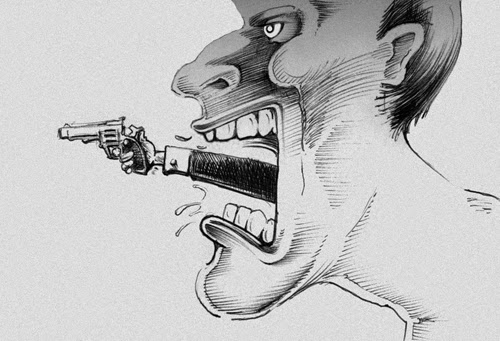
Words As Weapons

words-are-weapons“The tongue has no bones but is strong enough to break a heart. So be careful with your words.”

How often do we hear of words “killing” someone’s soul? Jesus tells us that gossip is like letting a bag of feathers loose in the wind. No matter how hard we try we are never able to get them all back. What we say has repercussions that are sometimes irretrievable. We know this and yet time and again cruel sentences leave our lips or end up floating in the ether on Twitter or Facebook. Sometimes this happens in a moment of anger but other moments are the result our intent to brutally harm someone with our most ugly thoughts. We say that sticks and stones can break our bones and words can never hurt us, but we know that this really isn’t true.

Sadly we read again and again of young people who are so harassed by their peers that they are driven to killing themselves. I suspect that none of the individuals who poke at someone and make them feel weak actually intend for harm to happen but all too often it does. I recently watched a program about a young woman who was recently found guilty of manslaughter for taunting a depressed friend into committing suicide. Texts on his phone showed that he was reluctant to take his own life, but eventually went through with it at the urging of this young lady who assured him that his family might grieve briefly, but would quickly get over their loss. When he admitted to her that he was scared to follow through on his plan she insinuated that he needed to man up. Eventually he did the deed. The jury felt that without the woman was complicit in his death because he was trying to back out, and she pushed him to follow through on what he had started.

While this is an extreme example of how words have the power of being lethal there are so many examples of youngsters whose confidence is ravaged by the horrific comments of their peers. It’s all well and good to teach our children how to ignore such behaviors, but we also must implore them never to be part of such destructive actions. We’ve all witnessed individuals who become the butt of jokes and sometimes we do so little to help them. It’s very difficult to stand up to kids who are popular or powerful, and yet we need to show our kids how to draw upon the courage to always do the right thing. We cannot sit back and watch the suffering of another even if it means losing our own place in the pecking order. Our children need to understand that they will ultimately be much happier if their own character is strong and just.

Most of the time none of us become involved in such extreme examples of using words as weapons, but we do sometimes say things to the people with whom we are the closest in the heat of a moment. We know their weaknesses and we charge ahead ready to hurt them with a little sting. We have to be very careful in such situations because once our barbs have landed we can’t really take them back. We would all do well to think before we speak and to consider the damage that our words may cause.

We seem to believe that we have a certain level of anonymity whenever we post comments on social media. We believe that out of the millions of words being slung around each moment there is little reason to think that ours will be noticed, but time and again people have lost jobs, tested relationships and angered friends over a snarky response, when the truth is that the only result that is likely to happen in such instances is to upset someone. We rarely change anyone’s opinion with our insulting remarks, so why would we take the risk of speaking out and possibly hurting feelings?  I have literally cringed over the words that I have heard people express or seen them write.

We have almost unlimited freedom of expression in this country, but it is up to each of us to know when saying certain things goes beyond the pale. A joke about assassinating the president isn’t funny. Racist comments about those who are different from ourselves have no place in the public forum. While we cannot and should not restrict speech, it is up to each of us to monitor our own utterances and to consider the effects of what we say. Perhaps it is time to instruct our young in such things as well.

Words can be as sharp as any sword. They can mortally wound a soul. We really do need to watch what we say. Gossiping, lying, bullying, threatening, hurting should all be anathema to us. We would not point a gun at another human being, so why do we so blithely allow our words to sting? Whether we shout them or whisper them or write them down they should always be intended for the betterment of the people that we encounter, but never to tear them down.

Churches

19510606_1819990221352292_3124586995295021826_nI write my blogs in the early morning hours when the world is a fairly quiet place. I look out on the little world of my backyard as I gather my thoughts and seek inspiration for a topic. Sometimes the ideas seem to pop out of nowhere like a distant call inside my head. It is as though I am being gently compelled to speak of a certain idea, event or individual. This day lead me to a rather strange place.

It began as I pondered my recent trip to Mexico and a visit to San Sebastian Church in an old colonial town dating back to the fifteen hundreds. Our tour bus stopped just long enough for a quick peek inside the old structure where daily mass was being celebrated in spite of all of the gawking tourists. The sounds of the ritual prayers were so soothing to me, and their familiarity in spite of being uttered in a somewhat foreign language helped me to fully understand just how the word “catholic” means universal. I remembered my religion teachers telling us back when I was still a child that we might go anywhere on earth and find the same mass with the same prayers. Here I was thousands of miles away from home and I knew exactly what was going on inside that historical church just as I suspect its earliest parishioners would have also known. It was a joyful moment for me as the people raised their voices in song and praise because I felt a deep connection to them that came from being part of a Church that transcends local geography.

Of course I also thought about the tragedy of missionary work in Mexico that had so ignorantly trampled the culture and traditions of the Mayan people who were indigenous to the area. In the misguided belief that the natives and their own religious ideas were somehow less advanced, the Franciscans built San Sebastian and other churches throughout Mexico hoping to save them. We now see the practice as questionable, but back then it was viewed as a matter of doing God’s work. Thus it often is with religious fervor. There is a very thin line between actually helping people by spreading the love of Christ and being presumptuously and wrongly judgmental. Sadly the history of missionary work in the colonies of the European nations intent on founding new worlds were sometimes far too dismissive of the local morays.

Such backward thinking is present in radical and fundamental religious sects even in today’s more enlightened world. In particular the members of Westboro Baptist Church are an example of demonstrating the most obnoxious and invasive forms of overreach. In a blind belief that they somehow have all of the eternal answers they time and again force their presence and their tainted ideas about God on people who would rather not have to deal with them. This past weekend was no exception as noted by a longtime and dear friend of mine whose children were shocked when they encountered a demonstration being held by the group in front of a Lutheran church in Pasadena, Texas. The zealots were holding signs that read, “God Hates Gays!” a particularly repulsive statement to my friend because she is in fact a lesbian woman.

I firmly believe as my friend does that God doesn’t hate anyone. To say so is to contradict all of the preachings of Jesus whose one and only commandment was that we love one another. I often wonder how we manage to take His clear and powerful message and distort it to conform to twisted interpretations. I have little doubt that if Jesus were to walk among us once again He would emphatically reiterate that His is a religion of peace and kindness devoid of judging and other such nonsense. I can almost envision Him tearing up signs that indicate that any form of hate is a product of God. To me such pronouncements are nothing short of blasphemy, a perversion of His words.

Ironically as I was experiencing the sting of anger over the hurt that I knew my friend was feeling because of the rabid Westboro folk, I encountered a grainy old black and white photo of Our Lady of Mount Carmel Catholic Church being built back in the early nineteen fifties. The church opened its doors for the first mass in the same month in which I turned four years old. Two years later I was a parishioner there along with my parents. I would spend the remainder of my school years learning about my Catholic faith in that parish built near Hobby Airport back when southeast Houston was little more than empty fields waiting to be developed in the post World War II boom. It was a wonderful experience in every sense mostly because it was where I was taught about a God who is all about love.

In the same spirit as Pope Francis today the nuns and priests and laypeople who were my teachers and mentors unveiled a love filled religion to me and my classmates. They taught us to honor our fellow humans and to see ourselves as citizens of a beautiful world in which we are all cherished by God. Ours were lessons in understanding and inclusion. We were told to empathize rather than indict, and so I struggle to understand how some fanatical Christians or those of other over zealous sects can be so self righteous as to presume that they are speaking and acting for God.

Of course religion or lack of it is a very personal thing. I would be loathe to foist my own faith on someone else. Still I would be remiss to simply leave my friend and others who are abused and misjudged to endure the taunts of groups like Westboro Baptist Church without defense from those of us who disagree with hateful preaching. Sometimes we have to speak up when the actions of others are so egregious.

Yes, it is a free country. Yes, the folks from Westboro Baptist Church have a right to their freedoms of religion and speech. I will not ever deny them those things. What I will do is shout from the rooftops that God is not about any form of hate and never will be. I will embrace my friend who is in fact a good and godly woman. I am certain that she is loved by our Lord, and I want her to know that those of us who have been lucky enough to join her in our collective journey through this life will always be by her side.

The Leftovers

leftoverheader3We humans are so incredibly complex. Even those of us who grow up in the exact same household with the same parents will be unique, just a bit unlike one another. We see beauty in different ways and are attracted to works of art according to our own preferences. We demonstrate our emotions in a multitude of ways, and when tragedy strikes there is no one manner in which every single one of us will react.

An amazing television production completed its final season a few weeks ago. The Leftovers was an offering of HBO that never quite caught the attention of a wide ranging audience, but it became a cult favorite of enough individuals to keep it alive for a year longer than HBO management intended. I am among those who believed from the very beginning that I was watching a masterpiece of theater unfold before my very eyes and I was rarely disappointed.

The Leftovers takes us to a situation in which people suddenly and quite randomly disappear on an otherwise normal October day. There is no rhyme or reason that explains who was selected or why certain people were left behind. Some families were not affected at all and others were decimated. It was a mysterious tragedy that left most of the world bereft and focused on dealing with the emotions that might accompany such a strange happening.

The story that unfolds introduces us to a cast of characters from Mapleton, New York who are dealing with the trauma each in his or her own way. The power of the program lies in the unveiling of the individual emotions of those people, and the actors portray them with a craft that is worthy of every possible award. They bring a humanity and believability to the stories even when they become far fetched indeed.

I don’t believe that anybody ever intended the audience to see the sequence of events in The Leftovers as anything other than allegories and metaphors for life. The plot unfolds in a kind of dreamlike sequence that strains credibility if one demands rational explanations. Instead it should be viewed much as one considers an abstract painting in which reality takes many forms. The best way to watch The Leftovers is as a tour de force of imagery and acting that is superior to most of the simple minded fodder on television.

In its three seasons the story moves from New York to Texas to Australia. I happened to be camping in McKinney Falls State Park in Austin when some of the Texas sequences were being filmed there. It was fun to see the images of places so familiar to me. My granddaughter was called for a role in the program that summer, but when they learned that she was not yet twelve they had to turn her away because the work would have been too dangerous for a younger child. I suspect that it might also have been a bit traumatic as well because The Leftovers is a show that is never fearful of taking emotional climaxes to the very limit.

This series is not for the faint of heart. It ruthlessly studies our humanity and the ways in which we choose to deal with tragedy or attempt to ignore it. Ultimately it becomes a story about love. It looks at questions of faith and portrays true believers as well as agnostics. It does not attempt to provide the audience with any kind of answers, but instead tempts us to think about such things and wonder how we might react if we were to endure a similar situation. I keeps the mysteries of our existence in the realm of unanswered questions, leaving us to decide for ourselves what everything that we see actually means.

I have discussed this series with a number of people who were discouraged from watching by the ephemeral feel of the story. I suppose that they require a bit more closure and reality than I do. I find myself agreeing with Bob Dylan, the most recent winner of the Nobel Prize for Literature, that if the words and ideas of an artistic endeavor somehow sound good to us, we will imprint our own meanings on them. For me The Leftovers is a journey into a kind of hell much like Dante’s Inferno. It shows the dark places that we take ourselves as we search for meaning in an often cruel and confusing world. It provides us with a small taste of optimism as well in demonstrating that it is in the relationships that we somehow manage to build even when the worst happens that we ultimately find our salvation.

Everything about The Leftovers is so carefully considered for its impact. The music is as important as the script. The images are often like great paintings from the most masterful of artists. The acting is so real and intense that it often leaves those of us in the audience breathless. It is like watching a moving definition of beauty and truth.

I am sometimes reluctant to recommend The Leftovers to anyone because it is the essence of a figurative world where every aspect of the show means something and those meanings can be very different for each person. If you tend toward the literal this program probably won’t work for you, but if you are willing to suspend reality for the sake of pure art then you may be in for a treat.

For those of us who are huge fans of this program it is sad to realize that it is no more, but it is also true that elongating the story for the sake of keeping it going would undoubtedly detract from its ultimate beauty. The Leftovers is a masterpiece that will be studied by writers, actors and directors for years to come. I’m glad that I was part of the audience that understood its genius from the very beginning. I will miss Kevin and Nora and Matt and the others, but I am thankful that they came into my life for three years and provided me with a glimpse of brilliance.

A Facebook Story

h0fvargheeyaybm4oyytI’ve been a member of Facebook for some time now, so I’ve watched it change. In the beginning it was a great way for me to keep up with friends and even to find people that I had lost along the way. Over time I accumulated a rather large following and I suppose that it was the same for most of the people who had signed up for the service. I understand that it would be rather chaotic if the posts from my hundreds of friends were to show up on my wall each day. It somewhat made sense that the folks at Facebook had to find a way to tame the beast so to speak. The result was the creation of various algorithms designed to ferret out the main people whose posts they thought I would most like to see. Unfortunately the rendering of a mathematical analysis resulted in my losing touch with a number of individuals with whom I had happily reunited. Facebook appears to think that I mostly want to hear from relatives and people who are my own age. While I have definitely enjoyed hearing from those individuals I have to admit that I am angry that I no longer see the posts from so many of my younger friends. The Facebook methodology is a rather presumptuous way of determining whose photos and comments I will see from day to day and who will see mine.

Since I write a blog each weekday I eventually created a special page on which to share the information. The idea was to find a larger audience for my stories. Admittedly it has been a bit of a bust in the last year or so, and I suspect that it is because Facebook is doing the same kind of things with that account that it does with my main one. In other words over half of the people who I number as my friends never see the post. Adding insult to injury is the fact that Facebook is perfectly willing to boost my reach if I pay them a certain amount each month. Since I am unwilling to give them any money we appear to be at an impasse.

I suppose that I should be happy enough that Facebook provides me with an advertising platform, albeit quite small, but a few years ago I was managing to inform around four to five hundred people a day in the same venue. Now I am lucky to gain the notice of a hundred. Perhaps it is the result of my writing having grown dull, or maybe it is because of another one of those strange Facebook algorithms, which leads me to another bone that I wish to pick.

Since setting up a page for my blog I have written over four hundred fifty entries, each with a special image attached. I tend to believe that a photo has a certain ability to entice people to read my thoughts, so I never simply use words. Awhile back I composed a piece about Heinrich Himmler. I had seen a documentary about him that prompted me to consider how often we have monsters in our midst whose physical appearance and background seems so harmless. The theme of my essay revolved around the horrors that this seemingly innocuous individual managed to perpetrate. My composition was in reality a verbal takedown of Himmler and his henchmen, and as usual I included a picture to illustrate my points.

For some reason out of the four hundred fifty odd other images that I had posted Facebook chose to single out the Himmler photo and display it prominently on my page as an example of what I have to offer. Seeing that horrible face again and again quickly began to irritate me, but I hoped that it would eventually be replaced by a newer offering. Day after day after day I had to look at that mugshot and wonder what someone who did not know me might think about that image being so prominently displayed on my wall. I began to worry that Facebook had some kind of algorithm designed to find right wing extremists and that perhaps they had pegged me as someone to watch because I had used that picture.

I’m a bit hard headed so I decided just to wait and see what might eventually happen, but the image never went away. They did not replace it with the lovely photos of my students or Mother Theresa or the heavens. Somehow the people who decide such things thought that it should stay. Finally in sheer desperation, and my own aversion to constantly viewing that mug, I simply deleted the entire post. He is gone forever from my wall but I truly wonder what kind of indelible and erroneous impression I may have made on someone who has never met me or read my ideas.

The world of social media can be a very scary place in which we take risks each time that we reveal a bit of ourselves. We never really know who is seeing our posts nor how they are interpreting them. I suspect that from time to time we all draw hasty conclusions about things that we see without ever bothering to read more about them or even to ask questions about why they are there. We fall for stories that are dubious without following up to determine their veracity or lack of it. We make instantaneous judgements and read between the lines overlaying our own thoughts on others. We question the intelligence of someone because of grammatically confusing posts and poor word choices when sometimes those errors are the result of autocorrect. What we think we see can be a real slippery slope of incorrect judgement, and in today’s world lots of people are being tried and found guilty in the court of public opinion without virtue of valid evidence.

I have so few visitors to my blog Facebook page that I’m probably okay, especially now that Himmler”s ugly mug is gone, but my own story made me think about how we all too often indict people without ever seeking explanations for the things that we think we see them doing. Mine is a good lesson in both being circumspect in how we present things and taking care not to draw swift conclusions. I have long held that our first recourse should be to give people the benefit of doubt. In most cases they are innocent of bad intentions. Only after we have assembled facts and evidence should we make judgements that might prove them guilty.

We are all too often manipulated by a steady barrage of opinions and innuendo from questionable sources. A good way to combat the propaganda is to always start by assuming the best and then put in the time and work to uncover the truth.