The World Was Swirling Around Us

Photo by Pixabay on Pexels.com

It took me awhile to move on from the death of my Grandma Minnie Bell, but I was a junior in high school and had come into my own with academics, clubs and friendships. I was soon enjoying my youth once again even though I would never really forget the impact that my grandmother had on me. Life was full for our family as our mother continued teaching her fifth grade students, enjoying every moment of he job. Michael inched toward high school proving himself in both his studies and his athleticism. In fact, he and Mama had a bit of a dust up when he announced his intention to try out for the football team. It was one of the only moments in which the two of them became involved in a major disagreement. Mama was adamant the football was a dangerous sport and she would stand firm in denying Michael her permission. The battle ended with my brother sulking away and mumbling like the teen he had become that she had ruined his life.

Patrick was the family entertainer. He kept us laughing with his ability to tell a good story or act out a funny joke. I would later realize that he was the latest in a family line of men who had the knack of delivering a punchline. It had no doubt begun with Grandpa Little, continued with my father and had now become one of Pat’s many talents. He was the delight in our family and in the neighborhood where he collected friends wherever he went. He ran like a gazelle, fielded balls like a pro and just generally enjoyed life with a kind of gusto that made us all smile. 

During that school year Claudia Dean became my closest friend and confidante. Her mother was also a teacher and Our Lady of Mt, Carmel school and so the two of us often sat together at the end of the day waiting to ride home with our moms. We’d share our dreams which of course included discussions of the boys in our class that we hoped might notice us. Sometimes we got together on weekends and listened to music from the Beatles and the Rolling Stones. We both enjoyed writing and worked on the school newspaper, but Claudia had a keen interest in science that I admired but was never able to develop for myself. We had both quietly decided that upon graduation from high school we would attend the University of Houston.

I was still uncertain about my future but I had joined the Medical Careers Club in the hopes of finding a niche in that arena. By my junior year I was an officer in the organization and I found myself leaning toward nursing without really having any idea of what that entailed. I had spent the previous summer as a substitute in our family doctor’s clinic. I worked at the receptionist’s desk and filled in as different clerks went on vacation. Somehow in the back of my mind I began to see that the life of doctors and nurses were not appealing to me, but I reserved judgement because I had only seen the day to day routines of a clinic rather than the excitement of a hospital. 

The Beatles came to Houston during my junior year but there was no way that I would have been able to secure a ticket to see them. I soothed myself when I learned that nobody was able to hear them sing during the concert because there was so much screaming. I was content just to listen to my records and imagine what it might be like to be John Lennon’s girlfriend. 

Lyndon Johnson, a fellow Texan, was duly elected to the presidency during that time as well. I had only begun to think about politics of late and I somehow deemed myself a democrat, mostly because of my former adoration of John Kennedy. I was still forming my political opinions but my most focused issue was on the civil right movement. I suppose that I had always believed that the segregation of black citizens in my country was wrong. Even as a young child I instinctively knew that we had been wrong to deny our them the same rights that the rest of us enjoyed simply because we were born Caucasian. I was sickened by the horrific day on the William Pettus Bridge in Selma, Alabama when Bull Connor unleashed dogs and tear gas on peaceful demonstrators. I had always questioned the prejudices that I witnessed, so when the Voting Rights Act was passed in Congress and signed by Lyndon Johnson I celebrated, hoping that our nation would one day see everyone as equal. 

Sadly the war in Vietnam was escalating. Claudia and I often spoke of how our country might extricate itself from that conflict. We worried about young men that we knew being drafted to take part in the fighting. We both wished that we were old enough to participate in protests, but for the moment we would simply be content to develop our beliefs together in the earnest conversations that we so often held with each other. 

At school I found that I really enjoyed my Chemistry class. It was perhaps the only time that I was enthusiastic about sitting through a science class other than the moments when Mrs. Colby talked about space exploration. I also began German class in addition to continuing with Latin. Nevertheless English class with Father Shane continued to be my favorite part of the day. By then I had read and reported on hundreds of books and written as many weekly themes as well. I was able to parse  and diagram sentences with ease. I felt like a master of the English language which reminded me of a story that my mother often repeated. 

When she was attending Austin High School she had an English teacher named Harlan Andrews who was the older brother of the movie star Dana Andrews. She often boasted that Mr. Andrews was as handsome as his brother the actor and one of the great teachers of her lifetime. She was most proud of a compliment that Mr. Andrews often gave her. He had told her time and again that she had a remarkable mastery of the English language. I think that compliment was especially important to her because her mother spoke little or no English and her father had a distinct accent that gave away his foreign birth. For the entirety of her life she would stress the importance of proper diction and grammar usage. Perhaps I had inherited her delight in analyzing our beautiful English language.

I spent the summer of 1965 working for our family doctor once again. The accountant encouraged me to study business in college. The nurses thought I should attend a nursing school. The doctors attempted to convince me to plan for medical school. The world was swirling around us and I would soon be faced with adult decisions that I did not feel ready to make.   

The Passage

It seemed so sudden when my grandparents decided to move from their beloved farm in Arkansas back to Houston, Texas. I knew how happy they had been with their animals and their gardens, but I also remembered how much work maintaining their place had been. The two of them were in their late eighties and beginning to slow down. Perhaps being back near family in a house with a smaller yard would be best for both of them. Besides, having them close would mean that I would get to see them more often. 

We almost immediately began visiting my grandparents every Sunday after church. Grandma prepared her famous feasts for lunch, but somehow her cooking was not as incredible as it had once been. She was having difficulty with her eyes and we would often find foreign objects in the dishes that she served. Our mother instructed us to begin with small portions so that if we decided that a particular dish was not up to Grandma’s standards it would be less noticeable if we left that food on the plate. It was sad to realize that our once energetic grandmother was slowing down and had lost much of her culinary magic. 

On most visits we accompanied Grandma on a tour of her backyard garden which did not seem to have suffered the way her cooking had. Her thumb was as green as ever so it was delightful to view the flowers and vegetables that grew in profusion in beds along the perimeter of the property. She was always so delighted by nature’s bounty that it made all of us smile. 

For a time Grandpa went back to work. He told us that he needed to stay busy, so he had landed a job at NASA through his connections with the union to which he had belonged for years. He helped install the rings for lighting on the ceilings of new buildings that were constantly cropping up at the space center. He looked and behaved much younger than his octogenarian age, but one day an inspector saw him perched high on a ladder and felt that something was amiss. When the man quizzed Grandpa about his age and learned how old he was, he immediately insisted that my grandfather leave the job. 

What we did not know at the time is that Grandma had colon cancer that had advanced so much that it was incurable. This was a time before Medicare for seniors existed so Grandpa had been drawing on his savings to care for her. He needed that job both for the income and the health insurance that it had provided. It was devastatingly horrible to later learn that my grandmother’s treatments were stressing the finances of my grandparents. 

It was not long before Grandma’s illness became apparent. She stopped cooking her big meals for us and when we visited we mostly sat on the couch watching television with our grandparents. Grandma told us that her favorite show was The Beverly Hillbillies. She’d laugh and explain that she identified with the “Granny” character on the series. 

Eventually Grandma spent time in the hospital where she underwent surgery that resulted in a colonoscopy. She was frail and mostly bed bound by then. We would sit with her as she slipped in and out of consciousness. The whole situation horrified me but I watched my mother behaving like an angel of mercy. Mama had so much strength and goodness in her heart that I was in awe of her. I mostly sat quietly in the room wishing that the grandmother I had always known might somehow become well again, but that was not meant to be. 

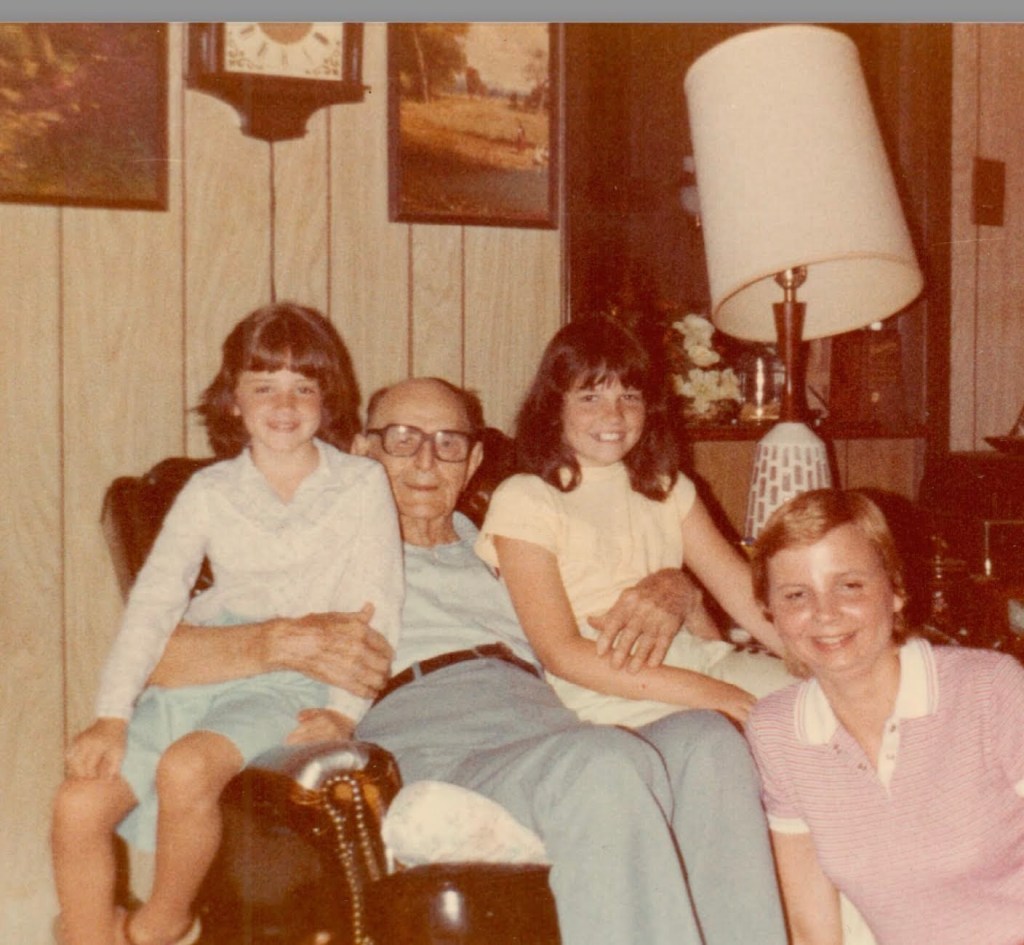
One day in October of 1964, my beloved grandmother, Minnie Bell Smith Little, died in her home. I was devastated as was anyone who knew her. Grandpa had tried so hard to restore her health, but in the end there was little he was able to do. His “buddy” was gone, the love of his life and he would talk of her constantly and the joys that the two of them had shared. 

After Grandma’s funeral Grandpa revealed that he would have to vacate the house where Grandma had ended her days. His bank account was depleted from the cost of her medical care. He liquidated all that he owned and moved to a room in his daughter Marion’s home. When that did not work out as planned he found a rented room with a sweet woman named Maryann Barbeaux, a widow who needed the extra income to stay afloat. His world was shattered and so was ours. Grandma had been the glue of the family and without her we all felt adrift. 

I would return to my books and my studying for solace, a pattern that I would repeat over and over again during my life. I don’t recall much about that school year because I suppose I was shrouded in grief without really understanding the process of working through the phases of loss. When I turned sixteen shortly after my grandmother’s death I felt inspired to emulate her goodness and the joy for living that she had so exuded. I also wanted to be like my mother who had shown me how to so lovingly care for the sick and the dying. I knew that I had a great deal of growing up to do before I would even come close to being like the two remarkable women who were my exemplars. Little did I know how close I would eventually become with my grandfather and how he would be a source of comfort and wisdom for many more years to come. The passing of time had made me strong, and Grandpa would show me how to navigate the difficult surprises that always come our way.  

A November Day That Changed The World

Sen. John F. Kennedy, ORNL by U.S. Department of Energy is licensed under CC-CC0 1.0

I have a granddaughter who enrolled for a class that focused on the Cold War with a particular emphasis on the nineteen sixties and seventies. I have been fascinated to hear her views on that era because that was a time when, like her, I was coming of age. Perhaps the most defining moment in those years came on November 22, 1963, when I had only days before celebrated by fifteenth birthday with gifts from my mother that assured me that she finally believed that I was no longer a little girl. I was a sophomore in high school studying subjects like Biology and Geometry, teasing my hair and wearing pink lipstick. Life was feeling upbeat and exciting as I held a seat on the Student Council and joined the Medical Careers Club while writing for the school newspaper. Best of all I still had my all time favorite teacher, Father Shane, for English where I was thriving. 

On the day before November 22, Father Shane had arranged for our class to attend a symphony concert in downtown Houston. Classmates and I rode to the event in the car of one of our friends who had already turned sixteen and thereby had secured her driver’s license. As we were riding down Interstate 45 from the Hobby Airport area we were passed by an entourage of vehicles accompanying President John F. Kennedy who had come to Houston to raise campaign funds and meet with political supporters. It was an exciting moment for all of us who generally were huge fans of the president even though none of us were yet eligible to vote. Somehow seeing him whiz by us made the day even more exciting than it might otherwise have been. I told my friends about the time I had seen him ride in a open car no more than a few feet away from me as I stood with my mother and brothers under the freeway near Hobby Airport. He had looked over at us and waved with a big smile on his face. It was a golden moment for everyone.

I don’t recall much about the concert that we attended other than the fact that Father Shane had taught us how to watch the conductor as a cue for when to remain silent and when to applaud. We had felt quite sophisticated with our learned manners. We would also buzz about our brief encounter with President Kennedy even though we had only seen his car rushing past. The following day, on November 22, we suspected that Father Shane would briefly discuss the nuances of the music that we had heard before transitioning into a lesson. 

The class had barely begun when one of the nuns who worked at the school rushed through the door declaring that the president had been shot in Dallas. My first instinct was to laugh at her comment because she often popped in to tease us with silly jokes. Somehow, though, this bit of dark humor did not feel right so I held back my laughter following the cues from Father Shane and my fellow classmates. It took a few seconds before I read the expression on her face and realized that she was not attempting to be funny, I suppose I went into a state of shock at that point. I only recall sitting among my friends feeling all alone. It was almost an out of body experience much like I had endured when my father died. We simply sat at our desks without making a sound, without daring to even move. 

There was a later announcement that the President had died. In that moment I heard a few sobs and saw that some of my friends had put their heads down on their desks. I simply sat frozen and feeling as though somehow the world had ended once again. My emotions were rioting in my head as disbelief, sorrow, and even fear overtook my thoughts. Somehow time both stopped and rush forward at the same moment. Before long I was walking home to the comfort of my mother and my brothers. 

The next days were cold and dreary as though the weather itself changed to reflect the mood of the nation. For the first time in my memory my mother kept the television tuned to the hour by hour reports that seemed to only become more and more disturbing. I watched in horror as Jack Ruby shot and killed the accused assassin Lee Harvey Oswald. It was the first time I had witnessed a murder in real time. 

We mostly stayed home but on the day of John Kennedy’s funeral Mama decided that she wanted to be with her mother. We sat in Grandma Ulrich’s tiny living room warmed by a gas stove that glowed in the darkened room. I remember little John John Kennedy, Jr. saluting his father and Jackie Kennedy wearing a long black widow’s veil as she walked behind the horse drawn caisson carrying her husband. The sound of the drumbeat became permanently embossed in my memory. I only need to hear a few seconds of it and I am once again sobbing for our wounded president. 

Somehow our nation’s reaction to the death of a president, a war in Vietnam that seemed endless and a struggle for civil rights for all of our citizens would dominate the rest of the nineteen sixties and much of the first half of the nineteen seventies. I began to fully understand that I would be stepping into a world far more chaotic than the safe little hideaway of my home. Unimaginable changes lay ahead that would push me into adulthood far sooner than I had ever anticipated. My family and my school would prepare me well for what was to come.  

Beauty Is Truth and Truth Is Beauty

Antique books in a library by Tong is licensed under CC-CC0 1.0

I sometimes think that I was born wanting to be in high school. It was not until I entered Mt. Carmel High School in nineteen sixty two, that the world around me began to make sense. While I had many good friends and managed to have fun during my time there, it was in the academic arena that I found the joy that had seemed to be eluding me. My English teacher was particularly a catalyst for lifting the veil that had been distorting my view of the world. 

The first day in his class was challenging and a bit frightening as he outlined the goals that he expected us to meet. One of them was to read a book and report on it each week of the school year. He explained that we would have to choose a variety of genres from a multipage list of titles that were housed in our school library. He noted that he wanted us to read fiction and non-fiction, poetry, classics and modern topics. The task seemed daunting, but since my father had modeled his love of books and reading to me, I knew that it would also no doubt be delightful. 

Our teacher, a Carmelite priest named Father Shane introduced us to book reviews in The New York Times as guides to creating a good report. He did not want a rehash of the story, but rather an insightful critique and analysis of the writing. We would have to learn a new way of discussing a book that would require us to think about the impact of what we had read. 

The reading assignment might have been enough to keep us very busy, but our teacher gave us an additional weekly task. We were to write a theme of around two hundred words based on a prompt that he provided on Mondays. Beyond using that guide for our writing we were free to take any direction of our choosing in creating an interesting essay. I would quickly learn how to write under the pressure of a deadline.

In the beginning I struggled to meet these basic demands along with the requirements other classes. I had to learn how to divide my attention and grappled with time management lest I sink under all the work that I had to do. I often put off writing my weekly theme until Sunday evening when I would grasp almost hopelessly for any idea to jumpstart my writing. The same was true for reading and reporting on a book each week. I had to teach myself how to speed read and  become familiar with short books like Animal Farm to fill the gaps when I felt overwhelmed. Along the way I became better and better at such things just as an athlete becomes stronger over time.

In spite of my apprehensions and often waning energy I eventually learned how to juggle many tasks at one time. I created workable routines for getting things accomplished. I learned how to write about almost anything with ease. I read with eyes more attuned to themes, metaphors, the use of words than simply reiterating stories and facts in my mind. I began to see learning as both a challenge and a fantastically life changing experience. I was in my element. 

Other teachers spoke to my heart as well. I was taking Latin and as I learned the vocabulary the rules of grammar and the declensions I saw the influence of Latin in most of the words I encountered. My teacher, Sister Wanda, put relationships of language together for me, making sense of the very ways in which we speak. She also helped us to laugh about our struggles and how to view learning new things as fun.

I had never been particularly excited about science other than my experience with Mrs. Colby in junior high, but my physical science teacher, Father Bernard, used tactile demonstrations to help me actually understand how and why things work. When he set up a telescope on the football field one evening and showed us the moon and the planets. I was sold. The sheer poetry of witnessing the craters in the moon and the rings of Saturn helped me to realize the poetry of the universe. I finally and truly understood why reading and learning had been so exciting for my father. 

My best teachers were the ones who opened new horizons for me, even if the subject matter was sometimes difficult and controversial to understand. My English teacher, a Carmelite priest named Father Shane, was the best at that. He wanted us to move from the comfort of our isolated little neighborhood into the expanse of the world. He read to us from The New Yorker magazine and took us on field trips to see plays at the Alley Theater and to hear concerts from the Houston Symphony Orchestra. He and other teachers treated us as young adults rather than children. They challenged our thinking and helped us to hone our abilities in language, history, mathematics, science and even religious ethics. To me it felt like the great awakening that I had been seeking and I poured my heart into soaking up as much of the knowledge as my brain would hold.

The Cuban Missile Crisis occurred in October of my freshman year. I’ve since heard that some people left Houston for safer places in the event of a nuclear attack. My family simply carried on as usual. We somehow had faith, that may have displaced, that all would turn out well. Our mother had students to teach and my brothers and I had school to attend. We were all on the brink of an era that would bounce us around like a roller coaster. Somehow with my mother’s calm and the honest knowledge that I was gaining from my teachers I felt safer than ever. I had learned that beauty is truth and truth is beauty. I was no longer afraid. 

Stoking Fear

Depressed musician vintage drawing by The British Library is licensed under CC-CC0 1.0

When I was still in my vibrant forties I remember a friend worrying about his mother who lived alone in Detroit. He had years before made his way to Houston and amazing work at NASA. He found love, married and settled down to work and have a family. He was an only child who visited his mother often. As she grew older and less and less able to care for herself he noticed how the once indomitable woman had become continually anxious. His conversations with her more often than not revolved around the many fears that consumed her. He learned that most of her information came from watching television news programs almost all day long. He wondered if she would be as convinced that the world was falling apart if she were simply to limit her viewing time or even give it up entirely. He believed that much of her angst had been created by the continual drone of reporters hawking their sensational stories. 

I often think about those conversations with my friend as I too enter the later years of my life and hear a constant drone of bad news from the media. Unlike my friend’s mother I rarely watch the news programs. Instead I get my information from news websites on my computer each morning and then I spend the rest of my day in activities that keep my mind free from a day long cycle of worry. Still, I have experienced many nights of insomnia in which I have a tendency to blow up the darkness of news reports more than I should. It is then that I wonder if all of us are suffering from a hyperbolic news overload. 

I like to be informed, but there is a tendency in the press to grab onto one topic and repeat stories about it so much that it begins to feel more like a commercial than an opinion free recitation of facts…who, what, when, where, how. Political bents seem to slip into even the very best reporting and often those without a discernible motive are unable to command the attention of the public. In a sense we are the customers of the news who are not just allowing, but actually encouraging commentaries rather than reporting. By our preferences we have unwittingly turned the news into entertainment that thrives on keeping us afraid. 

It has been duly noted that our young are presently enduring an epidemic of depression. Little wonder they feel that way when they see the adults continually carping with one another unable to solve problems with a willingness to compromise for the sake of everyone concerned. Battles are big news. They sell papers and provide higher ratings on television. They bring attention to individuals whose thoughts my otherwise be ignored. We have become a world of audacious people vying with one another for the stage and a voice. 

There was a time when real problem solving took place in society. Bullies and liars were given little or no berth. Honorable men and women tackled real problems rather than engaging in culture wars. They considered differing solutions and worked for a common good, not a particular base of voters. The news desks were manned by people like Walter Cronkite who only occasionally voiced his personal beliefs, once when he cried when announcing that President Kennedy had died and another time when he expressed his frustration with the ongoing war in Vietnam. 

Before my mother-in-law died last year she watched the news most of the day. When we visited her she would talk of nothing else but the fears that the reporting had created in her. She kept her home dark and locked up tight as though it was a castle under siege. My father-in-law too seemed unable to trust anyone because of what he saw and read about the state of the world. It reminded me of my friend’s mother who had become a prisoner in her home because of her worries. 

There are so many people suffering from the toxic influence of news services pretending to be factual when they are actually pits of propaganda. They drone on incessantly infecting the minds of good folks who believe that we are on a precipice of destruction. They push us into conflicting tribes and encourage us to be wary of one another. The results of such propagandizing are frightening.

We hear stories of a young man who accidentally knocks on the door of the wrong house being shot in the head. We learn that two women using a driveway to turn around are attacked. A child whose ball rolls onto the wrong lawn becomes a target of fear. People are inside their homes loaded with arms, listening to dire stories of marauders and then we are shocked with they take aim at innocents because they fear that they are under attack. 

I recently contacted the county health department because the swimming pool next door has become a toxic danger to the neighborhood. I had spoken with the owners multiple times before making that call and they just smiled and said that they would do something to fix the problems. After a time as the pool sat in a deplorable condition they no longer answered the door. When I came by to ask them if there had been any progress in eliminating the brackish water that had become home to bullfrogs and who knows what else I was greeted by silence from inside the home. When nothing was done after five months I call the county health department that assured me that they would take care of the problem. 

Recently I received a message from someone at the health department. She had come by to check on the pool but nobody answered the door at the home. She explained that she does not have the authority to even walk to the backyard of the home to take photos, so she wanted to come to my yard and attempt to learn what was happening next door by peering through the cracks of my wooden fence. In essence she admitted that she was afraid of wandering around my neighbors’ property. Since nobody can’t really see anything from my yard without climbing a ladder it seems that the health department will be unable to issue any citations or orders for cleaning the scum and mosquito filled pool. In other words, this is where we are today. Everyone is afraid, even the authorities.

I would hope that like other issues that our world has faced this era of fear mongering will only be a phase. I like to think that we will tire of the constant bickering fear-filled reports. Somehow we will find our way again to a reasonable way of living together with each other. When we do it will represent a good step toward helping our young to believe once again that we are leaving them a compassionate world of opportunities rather than a cesspool of problems. Perhaps the sooner we do this, the better everyone will be.