Uncovering the Mystery

I never had a conversation with my maternal grandmother, never knew what she was thinking, what her full life story had been. I took her inability to speak English for granted, never really wondering what thoughts and stories lay behind her sweet face. In my youth I was busy with learning about the world and myself. It was not until after she had died that I began to contemplate her existence. Too late I wanted to know more about her than the superficial portrait of a kind woman bearing cups of heavily sugared coffee. Sadly while she was alive I only truly knew that I felt quite comfortable and loved around her even though she and I never once had any kind of conversation. 

My mother adored her mother. She spoke of her in reverential terms as the ultimate purveyor of love and sacrifice. Mama told stories of her mother performing miracles in the kitchen to feed her eight children during the Great Depression, often saving the bones for herself when the fare was lean. Somehow it never occurred to me to ask for more details the mystery of Grandma until it was almost too late to piece together a more complete biography of her life.Perhaps all I really needed to know about my maternal grandmother was the sweetness that I felt in her presence, but I was determined to find out more. 

Long after my grandmother had died in the late nineteen seventies I realized the importance of her presence within the family. There was a kind of hole in the once dependable fabric of our family in her absence, a missing piece that seemed to be strange given that she had always been so quiet and unassuming. I began to ask questions and do research that helped me to develop a portrait of her that was more complex than I might have imagine. 

I had only known my grandmother as Mary Ulrich from Czechoslovakia. I found that her maiden name was Maria Bartakovic and that she was born in the Trencin area of Austria Hungary in 1890, the daughter of Andreas and Maria. She was baptized as a Catholic in that same year in Cachtice according to church records. After that her life is a cipher until she made a journey to Galveston, Texas in 1913 to meet her husband Pavel Uhrick who had preceded her the year before. 

My Aunt Valeria has told her daughter that Maria worked at a farm known as Magnolia Park alongside her husband when she first came to America. The place which was named for its native magnolia trees was located near what is now known as the Houston Ship Channel just east of downtown Houston. Within a year of arriving she gave birth to her first child, William, but continued working at various jobs that included cleaning office buildings at night and clerking at a bakery. From what my aunt recalls, her mother spoke English enough at the time to converse with others. When she lost that ability seems to have gone unnoticed by her children. 

My grandmother must have been an attractive woman with her black hair and blue eyes. My aunt revealed that while Grandma was working in the evenings her boss began to harass her. When she told my grandfather he insisted that she quit. Somehow I had never thought of the chubby woman who was my grandmother as being the object of a man’s unwanted attention, but given how attractive all of her children were, she most certainly must have been stunning herself.

Eventually my grandmother had a succession of births that gave her ten children. Sadly one of the babies died so quickly after birth that he remained unnamed. Another son, Stephen, lived for six months before succumbing to his inability to properly process food. Of the eight children who lived, four were boys and four were girls. My mother was the youngest of the brood. 

When my mother was still a toddler Grandma had a mental breakdown. Given that she had carried and birthed ten children from 1914 to 1926 with no medical care it is little wonder that she succumbed to the rollercoaster of hormonal changes that must have affected her. I can only imagine how tired and run down she must have been. I know that her absence had a profound impact on my mother. I was one of the few things that she ever revealed about her childhood.  

I suspect that my grandmother was also traumatized by her experienced in a hospital. From the time that she returned to her family in about 1931 until she died in 1977, she only left her home once when her appendix burst. She also never spoke English again. Her whole world would be encapsulated inside her house with her children and grandchildren buzzing around her.

The grandmother that I knew padded around her tiny home in her bare feet unless it was a particularly cold day when she grudgingly donned warm slippers. She quietly tended her garden and made her daily pot of coffee. She mopped her wooden floors each morning as if by habit and did little more. Much of her time was spent sitting in her preferred chair in the corner of her living room watching her children and grandchildren like a sphinx. What she was thinking was an enigma. The extent of her communication was to refer to anyone who entered her home as either “pretty boy” or “pretty girl.”

She was nonetheless the perfect hostess, almost instantly serving cups of weak coffee fortified with sugar and milk to anyone who entered her house, including small children. I loved that brew because it felt like sipping love to me. The smile on her face as she presented her offering told me all that I needed to know about how much she cared about all of us. 

Maria Bartacovic Uhrick must have been a beautiful young girl with her dark black hair arranged in a braid and pale blue eyes that were always so calm and comforting. She would grow into an old woman with a figure like an apple and streaks of gray in her hair. Her face was wrinkled and her hands were care worn from digging in her yard and performing countless chores. She had laid down on the floor of her home ten times and given birth more often than not without any help. She raised a motley crew in a tiny space and all of them would love her deeply and make her proud. 

I suppose that there was a time when I thought that Maria Uhrick was just a simple woman. I would have to encounter the trials of being a woman to fully appreciate how remarkable she actually was. I suppose that I know all that I really need to know about her now even as I thirst for just a tiny bit more information to fully uncover her mystery. Somehow I think that I should simply be content with now being able to infer the contents of her mind. She was brave and hardworking and content to play the most important role that anyone might tackle. She loved.
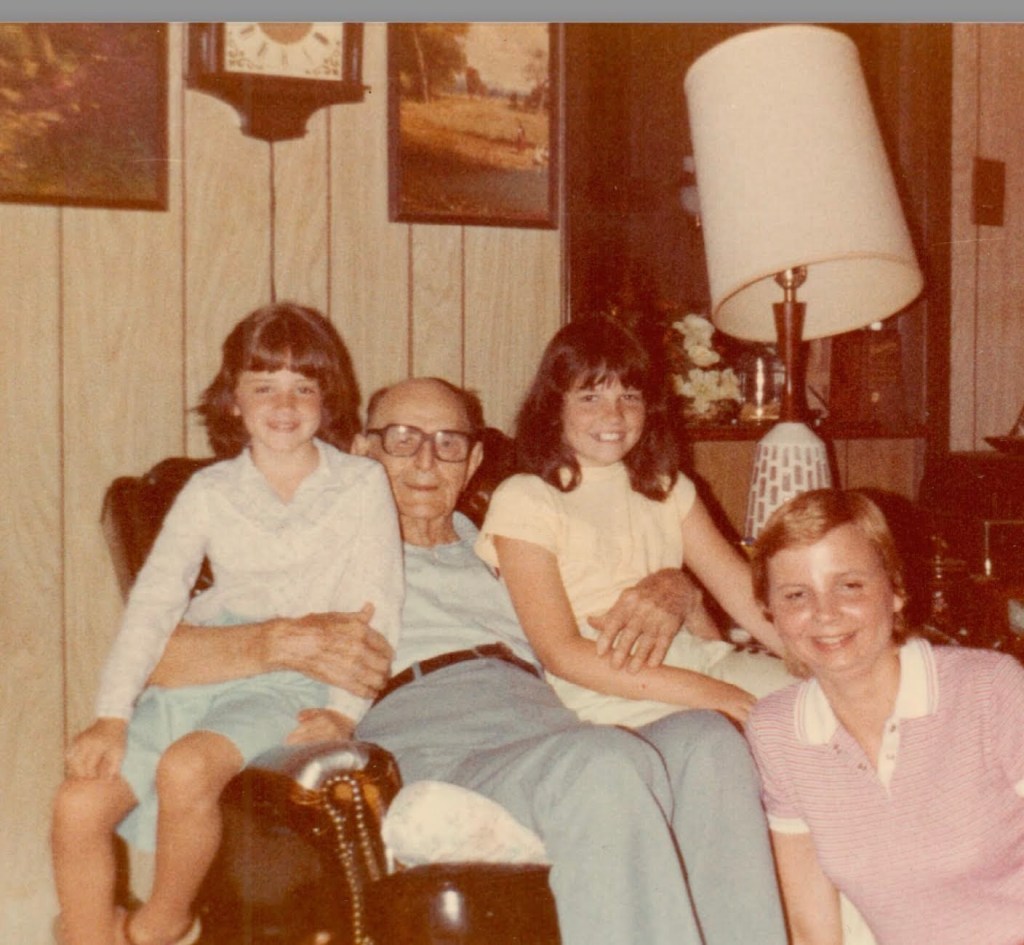
My Guiding Light

As a child I looked at my grandfather in awe. He was a giant of a man in my young eyes. He was always impeccably dressed even when he was performing hard labor on his farm. His trousers were always neatly creased, his shoes meticulously polished, his ironed shirt tucked neatly inside his pants, his suspenders perfectly placed on his chest. His hands were beautiful, strong. His face was handsome even in old age. He never ventured outside in the sun without his fedora. To me he was figure who was larger than life, a man educated through curiosity and experience.

As an adult I found wisdom and succor from him and it was my good fortune to be able to visit with him anytime I wished. I did not need to call for an appointment. His door was always open, his welcome always warm. Often when the anxieties of simply existing began to overwhelm me I would suggest to my husband, Mike, that we go visit Grandpa who was living in a rented room on the northside of Houston. 

Grandpa’s landlady was a widow who was young enough to be his daughter, and who in fact became much like a beloved family member to him. In the beginning he paid her rent for the room which helped her to meet her financial responsibilities. Over time they simply began to pool their resources to keep the place in good repair and to maintain a comfortable way of life. 

The house where he was staying was tiny, probably little more than a thousand square feet. It featured two bedrooms set between a small bathroom. Grandpa had his own space while the owner of the house shared her room with her sister. They were a congenial trio with each person pulling his or her weight with cooking and cleaning. In spite of the tight quarters they got along rather well. I suppose that none of them would have made it alone, but together they were safe and secure. 

Grandpa held court in a recliner in the corner of the living room that he had helped to panel so that there would be no further need to paint the walls. Due to his age he was only able to work on the bottom half under a ledge of trim. the upper section of the panelling was completed by the landlady’s son. I often noted that the bottom half was perfection while the top looked as though it had been installed by a child. it spoke of Grandpa’s craftsmanship that resulted from a lifetime of working on construction projects. 

Grandpa was proud of his contributions to some master works like the San Jacinto Monument in Texas and the capitol buildings of several states. He had built a home in the Houston Heights that still stands as evidence of his impeccable work. He had created special features in the kitchens where my grandmother created her mouthwatering recipes. I supposed that the mark of his craft was present in buildings all over the United States. 

Grandpa was always exited to see us. He’d settle into his recliner, prepare his pipe and then launch into tales of his life. He was a natural born storyteller who had lived through the modernization of the world. He had seen the birth of electricity, human flight into the air and then into space. He loved to speak of his childhood and then boast of the modern conveniences that made the later part of his life so much easier. He viewed innovation as proof of the genius of humans. He thought of himself as a lucky man for having witnessed the march of progress that only seemed to accelerate over time. He was an advocate of embracing change and looking forward rather than longing for the past. 

Some how his perspective always set me right. I was much like my grandmother, his beloved wife, who was a chronic worrier. Grandpa saw that in me and advised me to be less anxious and more focused on enjoying life no matter the challenges that it brought to me. He understood quite well the seasons through which we pass and he found beauty in each of them. For him the “good old days” were to be found in each present moment. He reveled in the wonders that made his life so much easier than those that his ancestors had endured.

From Grandpa I learned about preserving food in a time before refrigeration. I heard about the devastation of smallpox outbreaks and times when children only went to school for a few years to get the basics of reading and writing. He told me of his experiences in Oklahoma before that place was a state. He spoke of the mistreatment of the Osage Indian tribe by greedy white men who coveted the resources of their land. I learned about another depression that occurred during his boyhood and how Coxey’s Army came through his town. He was a folk history professor extraordinaire who enlightened me time and again. 

Grandpa was also a voracious reader who loved to talk about the latest book that he was reading. He tended to enjoy history more than other topics but he was open to new ideas from any topic. Best of all was his contentment and ability to make the best of whatever life threw his way. He never really stopped missing my grandmother but he had endured so much loss in his life that he had accepted its inevitability. That was apparent in the unfolding of his belief that there is indeed a time or a season for everything. 

Grandpa gave away his car when he turned ninety years old exclaiming that he was not as alert or able to react as well as he once was. He saw old people as hazards on the road. He did not want to take the risk of hurting someone simply because he was too proud to admit that his time had come to surrender to his age. He was wise beyond anyone else that I have ever known.

Those visits to see my grandfather were a lifeline for me. He represented a connection to my father and to my grandmother. He was my past, my present and my future all wrapped up in one person. He was my guru, my peacemaker, my guide. With his long life he was a force on whom I thought would always be able to depend. For the time being he would always be there for me.

Unadulterated Joy!

Photo by Monstera on Pexels.com

Life on Anacortes Street with Mike, my two girls, and the most wonderful neighbors was delightful. In the seventies life there was a slice of Americana reminiscent of my own childhood days. My two daughters were definitely free range kids who played with neighborhood children all up and down our street. The doors to our home were rarely locked with kids coming in and out, sometimes even staying the night in unplanned celebrations for just about any reason. I was quite content with life but one serendipitous event after another made me more and more certain that I needed to complete my degree and become a full time teacher. 

By the end of the seventies I was working regularly at Do and Learn Preschool and loving every minute of my time there. I also had expanded my reach with children when a neighbor asked me to care for her daughter while she ran a business. Soon word of mouth gave me four more youngsters to entertain and feed while their mothers worked at various jobs. I was still teaching at my church as well. My days became incredibly busy and delightfully fun, but I wanted more than anything to return to the University of Houston to complete my degree and get started with my own full time job, Since my youngest was approaching kindergarten age, I would have time to attend classes and study without having to worry about daycare. Besides, everyone was finally in good health and I had learned from my many child centered gigs that I really did enjoy teaching and being around children. Every single day required me to be creative and I liked the challenge. 

I finally gave my regrets to all of the folks who had entrusted their children to me either in my home or at the preschool or at church. I selected my classes, paid the fees, and soon enough found myself hunting for a parking spot at the University of Houston, a feat that was even more daunting than any of my classes. I was enchanted from day one with each and everyone of my courses and approached them with a confidence and eagerness that had been missing in my younger days. I literally basked in the enlightenment from every professor and threw myself into the assignments with abandon. I was like a child in a candy shop who could not get enough of the fare that lay before me. Needless to say, the professors took note of my enthusiasm as well and became unofficial mentors who believed that I would surely thrive in a classroom. 

When I combined my natural abilities with the experiences I had gained in the years since I had last taken a class, I felt a sense that I would be able to tackle any challenge that came my way. I was juggling my home life with being a student and never missing a beat. I even managed to keep my mother on track with her doctors and medications. I welcomed new members of our ever growing extended family as my brothers and sisters-in-law made me an aunt over and over again with Daniel and Shawn and David and Ryan becoming my new nephews. I had rarely felt as excited about life as I did in those glorious years of balancing on one foot while spinning plates on my head. 

I was ready to tackle anything, so when the two nuns who had been running the religious education program at St. Frances Cabrini Catholic Church announced that they were moving, I accepted their offer to head the program for preschool through fifth grade. I was far enough along in earning my degree that I felt certain that I would be able to work full time, care for my family and finish my coursework without any difficulty. Somehow my insane belief that I was superwoman actually worked. So by the time I finally had my coveted degree and certification my resume was bursting with evidence that I was more than just a good student.

Unfortunately I began my job search at one the few times in the history of Houston when there was a glut of teachers. A noticeable dip in the oil boom that had made the city a behemoth left schools with more educators than they needed as people moved to greener pastures and took their children with them. The professors who had taught me even apologized for the lack of jobs for the graduating class. On the day of our commencement only one member of our corps had a job and she was the daughter of a local superintendent. They rest of us were still searching almost hopelessly for positions. it would be late in the summer before I had a contract in spite of my grades, awards and fully packed resume. 

I went to work in September of 1983, at St. Christopher Catholic School. The principal had called me for an interview on the pretense of looking for an English teacher for the junior high. When I arrived she admitted that she actually needed a mathematics teacher and had noticed that math was my unofficial minor. Since I had learned how to be incredibly flexible from the challenges I had already endured, i thought it would be fun to try my hand at teaching six different levels of math. Little did I know that it would become my forever fate because each time I made a move, every school always seemed to need someone to teach the math courses rather than English. 

I went to work as a mature and seasoned teacher. I understood my students and most of all understood myself. I dove into my lesson planning and even volunteered to sponsor the school newspaper and head the fledgling computer committee. I had already been in many trials by fire, so I found the many demands to just be all in a days work. Teaching six different courses would ready me for the future. Having exceedingly well behaved students would allow me to master my teaching skills rather than having to focus on classroom management. Working at St. Christopher’s ended up being a job made in heaven. My first official year as a bonafide teacher was a good as it gets. 

Meanwhile my own family was supportive of my dedication to my students. It would only be in retrospect that I sometimes wondered if it had been difficult for them to share so much of my time and attention with the hundreds of little souls who were to come. I had finally found my passion and it consumed me with unadulterated joy.   

The American Dream of Owning a Home

Photo by Ksenia Chernaya on Pexels.com

When my grandfather first arrived in Texas from the Slovakian area of Hungary he rented a single room in downtown Houston near where Minute Maid Park, home of the Houston Astros now stands. A year later he sent for my grandmother and according to stories from one of my aunts the two of them lived and worked on a big farm in eastern Harris Country. They were seasonal workers moving around Texas wherever there were jobs back then, saving their money to buy a plot of land in Houston where they would ultimately build a house room by room. They paid cash for each addition until their home was finally completed. They would raise eight children in the impossibly tiny space and when the Great Depression came they would have no worries about losing the house because they owned it lock, stock and barrel. 

I was not even twenty when I married but by the time I was twenty five my husband and I were living in a very nice home near Hobby Airport in Houston. We paid on $19,000 for our house which had three bedrooms, a huge kitchen, a living and dining room, a den and a yard the size of a small park. While everything cost much less back then, we still appreciated the bargain price of our first home which left us with enough income to live a middle class life. 

Today’s young people are finding it much more difficult to find a place to live that does not stretch their budgets to a breaking point. In some parts of the country the housing prospects are even more dire due to a lack of available places to purchase. It is slowly becoming a kind of crisis as salaries don’t keep pace with rent or the purchase price of a home. Everywhere our youngest workers are wondering if they will ever be able to find a reasonable place to call their own. 

Back in 2005, my husband and I sold our first home with an incredible profit. We were able to trade up to a bigger house in a very nice neighborhood for not much more than the sale price of our old home. Today both our original home and the new one are valued at twice their worth in 2005. Our first house is valued at more than ten times what we first paid for it, while the income of those just starting out in their twenties is not equal to ten times what my husband and I had way back when we became proud purchasers of a house. 

The cost of living in Texas is definitely less than in many parts of the United States, but of late finding and affording decent housing has become a challenge for young adults even in the Lone Star state. It is estimated that someone earning the minimum wage of $7.50 in Texas would have to work three jobs just to afford a decent rental with one bedroom. Of course most individuals manage to gain skills or degrees to increase their earning capacity, but even those salaries can fall short of the needed funds to keep up with the inflationary costs of everyday necessities. 

In a city like Houston having a car is a must. That entails insurance, gasoline and maybe even payments for the vehicle. A one bedroom apartment can run over a thousand dollars a month or even more in a desirable location. Food, clothing, and student loans can stretch the income of someone with a bankable college major like computer engineering, so it is no doubt a challenge for anyone with less desired credentials. It takes a financial wizard to make ends meet and set aside savings for the future purchase of a home. 

I try to imagine what it must be like for someone in a place where homes are twice as expensive as comparable homes in the Houston area. Fulfilling the American dream of a house with a car is demanding two incomes and even then there may not be enough homes for sale to meet the demand. Cities and towns all over America are reporting housing shortages as our elder population lives much longer than they did even fifty years ago. They hold onto houses that they have owned for years. They pay a pittance in property taxes with homesteads. They have pensions and savings and few debts while young people are drowning in unbearably high costs for everything that they need just to get by. It is a situation that is forcing them to marry later and sometimes put off having families. 

My granddaughter is working for a small city government in Maine this summer. One of her projects is to research the housing crisis for the youngest wage earners. She has found that the problems in Maine mirror those in almost every state in the Union. The issues involve an imbalance between earning and costs as well as a shortage of housing that is available at any price. It is a trend that is growing but rarely mentioned until recently. 

A couple of summers ago my husband and I traveled to New Mexico in our trailer. While camping in an RV park I talked with a young man who worked in the office there. I mentioned how lovely the area was and opined that it would be a nice place to live. He quickly quashed my dreams, telling me that he was a thirty year old married man who worked two jobs along with his wife who also doubled up her working hours. Between the two of them housing was still unattainable so they paid his parents for a room in their house. They had been saving for years but the cost and availability of homes was so out of reach that they had never been able to finally get their own place or think about starting a family.

For decades there has always been an avenue for succeeding generations to do just a bit better than the ones that came before them. America was a place where families were able to own land and a house as long as they were willing to work hard like my grandfather did. Now that vision is vanishing for far too many young adults starting their careers and looking to their futures. Surely the housing issue is something that we must address much like the little town in Maine is attempting to do. In fairness to young people we need to be willing to find solutions and make it possible for them to fulfill the American dream of owning a home. 

In the Heat of This Summer

Photo by Pixabay on Pexels.com

it’s been a record summer for heat and I suppose that I am feeling cranky. I already have a condition that causes me to have flashes of extreme warmth flashing through my body even on wintery days. Adding one hundred degree temperatures to the mix does not help to keep me cool and calm. Since I like being outdoors the fact that I am stuck inside does little to alleviate my surliness as well. 

I’ve turned to reading to fill my time since travel is not on the agenda this year. I suppose that my mood is reflected in the choices of books that I are filling the hours of the long, slow days of summer. All of them seem to be political in nature, but then what is not pulled into the political spectrum these days?

I began with an optimistic memoir by Dan Rather and then turned to a biographic view of Jacqueline Bouvier before she married John Kennedy. The difference in the early lives of Jackie and Dan was striking. There was a certain irony that Dan’s childhood in Houston, Texas in a low income area of town was so much happier than Jackie’s life of wealth and opportunity. Parents really do make all the difference in a child’ life.

Off and on I have returned to a book about chemical dependency written by a minister with a long history of counseling people with addictions. It is essentially a critique of our nation’s idolatry of money, success, power, possessions, entertainment. In our quest for happiness we all too often turn to things when the real center of joy has to be found inside our very beings.

I thought of the contrast between the lives of Dan and Jackie while reading the advice from the good minister. Essentially we humans spend way too much time seeking things and pushing our feelings deeper and deeper inside our souls. We don’t really talk to each other the way Dan and his parents so obviously did. We do not share our feelings and attempt to understand those of the people around us who seem to be struggling. Our stiff upper lips and stoic natures keep us locked in toxic situations that steal our joy.

There is a great deal of talk these days about what it means to be “woke.” The reality is that wokeness is not a political stance as many attempt to claim. Instead it is a way of analyzing ourselves and the world around us. Done properly it teaches us that we are part of a daunting family history that does not have to remain the same. With truth and knowledge we have to power to become better versions of ourselves. To do so requires facing our weaknesses honestly. Doing so does not bring shame upon us, but rather helps us to change our bad habits and move forward. 

I have not yet begun the book about the two hundred seventy two slaves that were owned by Jesuit priests who had founded Georgetown University. I had grown up as a Catholic never imagining that religious people would have even thought of buying and selling humans for any reason whatsoever. It was a stunning revelation to learn that such was an absolute truth that points to our human tendencies to distort the parables and words of Jesus to fit our personal needs. Even priests are not immune to such frailties. Knowing what they have done over time in the pursuit of their mission of spreading the word of God is all too often heartbreaking, but because of my own weaknesses I know that I am not so sinless that I should begin casting stones. 

I am also reading a book that was written by a Jewish writer living in Germany when Hitler first came to power. It is a novel that follows the fate of a prominent family who owned a furniture store. it is not a book that I can continue reading for very long because I already know what is going to happen to them unlike those who read the book when it was written before and during the purge of Jews in Germany. Sometimes it becomes overwhelming to watch the slow demise of the once happy and too gullible characters marching so blindly to their doom.

I suppose that I analyze the world a bit too much. It is something that I have always done. My mother saw this trait in me and often opined that “ignorance is bliss.” I used to wish that I was more clueless and jovial. It seemed like an easier way to be, but then I would not have been a very good teacher. I would not have noticed students who were struggling and then felt compelled to help them. I have always needed to know more and more about the truth of the world. I have always tilted windmills and yelled that “the Emperor has no clothes.” It is a kind of self torture and self actualization at one and the same time. I watch and learn just as my mother often counseled me to do. I hunt for the truth, even within myself.

I think we would all do well to engage in soul searching and truth telling. Looking the other way when a stranger is lying injured on the side of a road is not how we are supposed to be. Plugging our ears when someone is attempting to explain who they are destroys the autonomy of all of us. We can’t live happily ever after in Cinderella’s castle in Disneyland. No trips or stimulants or possessions can make us whole. Only genuinely taking the time to understand ourselves and our histories can bring us together and help us to realize that in the end we all are equal and worthy regardless of where we live or how much wealth we own. There is no divine right that favors some and ignores others. Our role should be to first heal ourselves and then give that glory to anyone anywhere who is suffering. It’s our challenge in the heat of this summer.