Love Resides There

I don’t know exactly how old I was when I accompanied my mother and father on a shopping trip to choose new furniture for their first home. I could not have been very old because I don’t think that either of my brothers had yet been born. I have vague memories of walking through furniture stores and feeling a bit bored. Then there is a remembrance that is as clear as if it had happened yesterday. 

We were searching for a bedroom set for my parents. Suddenly they seemed to have found exactly what they wanted, a mahogany four poster bed with a tall chest with drawers. Alongside the set was a lady’s dressing table with a mirror and chair. After my parents had seemingly agreed on the bed and the chest I vividly recall my father walking over to the dressing table. He ran his had across the smooth almost glassy top and then began examining the drawers. He pulled them in and out, smiling as he commented that they were very well made. Then I remember him turning to my mother and with an impish grin as he said, “I want to get this for you as well.” 

My parents were still in their twenties at the time and very much in the early grip of love. Soon the furniture would arrive at our home and I thought it was so beautiful that even royalty would find it worthy of owning. My mother found a lovely rose colored silk bedspread to set off the gleaming dark wood. She put her combs and brushes and lotions and powder inside the drawers of the dressing table. Each week she would carefully dust and sometimes polish the wood. 

When my mother was only thirty years old my father died. His last gift to her would be a set of small lamps to place on her dressing table. They were adorned with tiny rosebuds that picked up the color of the bedspread that Mama had chosen. She would place them lovingly on the dressing table where they would remain until she too had died over fifty years later. 

Over time the bedroom set showed the scars of time and wear and tear. When my mother died none of us had room in our homes for the bedroom set that had been such a treasure to my parents. One of my brothers put them in a storage unit where they languished for a time. Then one day my brother announced that he was letting the storage unit go. He said that he was going to trash anything left inside that nobody wanted. 

My eldest daughter immediately claimed the dressing table. She said that she had lovely memories of sitting on the chair and styling her hair while her Grammy smiled at her. She suggested that she might one day restore it to its former glory. In the meantime she would store it in her garage until she found the time to make it lovely once again. 

As the years went by the dressing table sat in a corner of her garage, looking dreary and unloved. My daughter would often insist that she had not forgotten her hidden treasure, but her busy schedule had consumed her time. She assured us all that one day she would take on the task of making it beautiful again. 

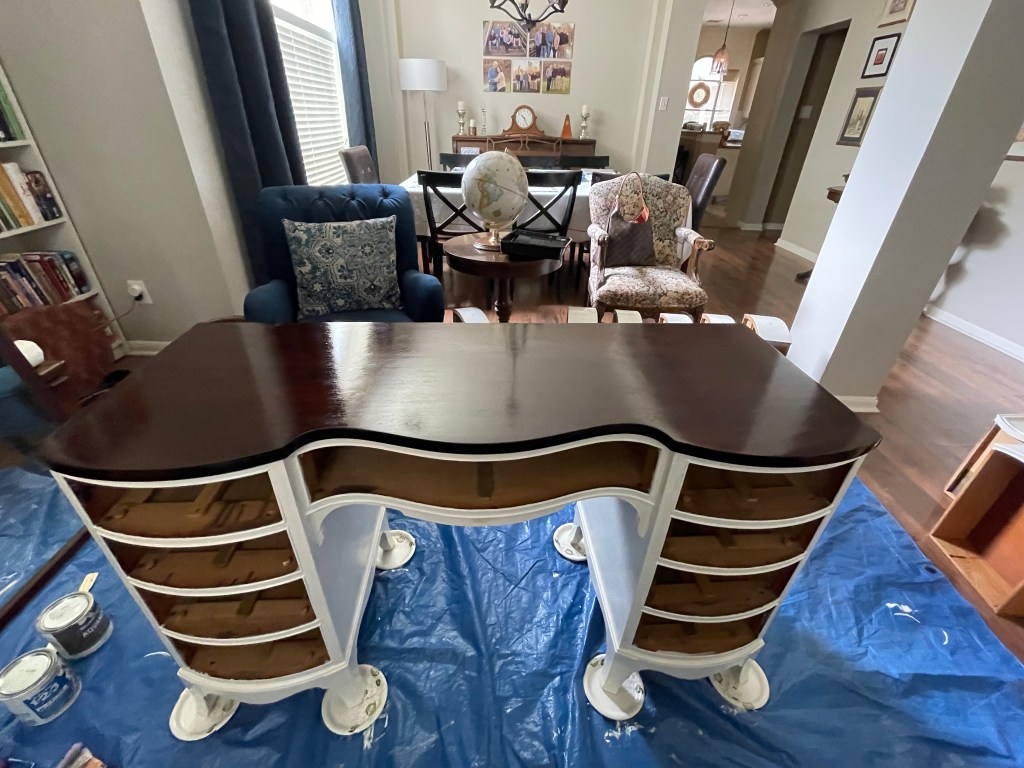
With all of her sons either working are off at college she suddenly had an empty house and a bit more time to take on projects. Finally she put down a tarp and began the process of removing the old finish and carefully sanding the surfaces of the dressing table. She repaired broken sections and took her time with each step of the process. She decided to modernize the piece by sanding and restaining the dark mahogany top, but painting the bottom of the structure with a cream color. The results were stunning.

When she sent me a photo of how the work was progressing I was amazed at how beautiful the old battered dressing table now looked. I found myself remembering that trip with my parents when my father impulsively decided to buy the piece for my mother. I thought of how he had moved the drawer in and out, in and out, until he was satisfied that the craftsmanship would last a lifetime. 

As my daughter was describing the long process that she had used, she mentioned how well made the dressing table was. She was particularly impressed with the fact that the drawers still moved in and out without sticking or showing signs of being warped. I cried when I heard this. I thought of my father being so very careful to purchase something that would last. I imagined him and my mother in heaven being very pleased. 

My daughter is taking her time. She is letting the paint on the drawers dry for a very long time before she puts them back in place. She does not want to be too anxious and create problems with sticking. She still has to repair the mirror and the chair, but she has made a magnificent start to creating an heirloom that hopefully will remain in the family for years. 

We hear stories of young people giving away old furniture and trinkets because it is not their style. I wonder if they would feel the same way if they heard the stories and the histories associated with certain things. Something may look like just stuff, but sometimes special pieces contain beautiful memories that everyone can understand. I’m happy that my mother’s dressing table has a new life. It was so much a part of who she and my father were. Love resides there and now my daughter can pass it down.

And here it is with the drawers. The mirror is still in progress…

It Is Okay To Cry

Photo by Pixabay on Pexels.com

Two events that occurred twelve years apart shattered my world and tested my vulnerability. The first is well known among my family members and my closest friends. It was the sunny summer day of long ago when I awoke to learn that my young father had died. I was only eight years old and knew little about suffering or sorrow. I had heard whispers about my favorite uncle’s death three years before, but I never told any of the adults that I understood what was happening and that felt quite sad. I suspected that because they did not engage me in discussions of death that it was somehow a taboo topic, and so even after my father had died I kept my feelings to myself. I even learned how not to cry to give away the pain and vulnerability that was lodged in my heart.

Decades laters some of my friends were stunned to know that I had mostly grown up without a father. I had shielded myself well against their inquiries. I rarely mentioned that I was living in a home where the mother was also the father. When filling out first day of school forms asking for information about my parents I leaned over the paper and created a visual barrier with my left hand as I wrote the word “deceased.” Somehow I thought that the people around me expected me to be strong and to carry on without asking for sympathy. 

I suppose that to some I seemed emotionless. I had learned how to control my tears in public. When others cried I held my upper lip stiffly in place. Eventually I had practiced such skills so well that being dry eyed even at funerals became easy. I would wait until the dark of night inside the privacy of my bedroom to let my emotions loose. I was determined to be the strong person that I believed everyone wanted me to be.

Twelve years after my father’s death my mother had a frightening mental breakdown. She became so deeply depressed that she kept her home darkened with drapes firmly closed against the sunlight. She was also paranoid, believing that forces were gathering to accuse her and her family of criminal deeds. She refused to turn on the one air conditioner that she had inside her home, nor would she open the windows and run the attic fan. It was so stiflingly hot inside that I was afraid that she would fall ill from the heat. No amount of cajoling convinced her that nobody was waiting outside to take her away to prison. She refused to believe that the food that her sisters brought to her home was edible and devoid of poisons. 

Once again I went into action with my strength and lack of public tears I would cry and rage when alone in my car, but smile as though I was just fine when in the presence of other people. I did not divulge how frightened I was or how anxious I felt to anyone but my husband. At least for once I felt comfortable enough to depend on him as an ally and confidante. I don’t think that I would have had the courage to get my mother the care that she needed without being able to collapse at day’s end into his arms sobbing until I fell asleep.

Still, for many years I hid the reality that my mother was chronically mentally ill. I spoke of it only to a small number of people in whom I had total trust. Mostly I pretended that my absences from work to take her for therapy were because of my own illnesses. I had learned that speaking of mental illness was taboo in most instances. People would squirm uncomfortably at the mere mention of the subject. I simply kept up a public persona that hid how truly vulnerable I was feeling. 

It was probably around thirty years after my mother’s first cycle of bipolar disorder that I broke down spontaneously in front of a coworker in a fit of tears that I was unable to control. Nothing like that had ever before happened to me, but my mother’s condition was the most frightening that I had seen. Fortunately this kind man understood my fears and my pain because he too had a family member who suffered from mental illness. He comforted me with all the right words. He demonstrated so much kindness and told me that I needed to stop holding all of my feelings inside. He assured me that I would find many exceedingly compassionate people willing to provide me with a listening ear. 

I suppose that is when I changed. I began to tell people about my father’s death and how much it had affected me. I spoke of my mother’s mental illness as though I was talking about someone with diabetes or heart trouble. I quickly learned when it was safe to keep revealing my story and when it was time to simply change the subject. I found loving and caring friends and acquaintances who walked with me through my troubles. 

Sadly, I have never yet learned how to cry in public. I suppose that my mind is only willing to go so far in showing my vulnerability. I am still the one dry eyed person at a funeral. I don’t cry during sad movies unless I am alone with my husband. I know that I do have real feelings and that I can cry a bucket of tears, but never when others are around. That is the one disturbing skill that I mastered in trying to be the strong little girl when my father died and the competent woman when my mother needed help. I’m working on letting my emotions run free. I wish that I had learned as a child that it really is okay to be vulnerable at times. I know that I don’t have to carry the weight of the world. Luckily I have people who love me enough to understand how I am the way I am.

All of us are vulnerable and that’s okay. This is a lesson that we would be wise to teach our children. Emotional education is just as important as academics. Our journeys through life will be a mix of joys and sorrows. We should demonstrate to our children how to navigate both with their rational minds and their emotional instincts. Balancing those things leads to healthy ways of living. It really is okay to cry.   

My Destiny

Photo by Pixabay on Pexels.com

When I was in high school I was certain that I should be a nurse or even a doctor. To that end I joined the Medical Careers Club and faithfully attended the meetings for years. I even held offices in my junior and senior years. By the time of my graduation I was not as certain that medicine was the right field of endeavor for me, so when I reached the university I tried all sorts of majors in a short space of time. Business classes did not work. Engineering felt tedious. I even considered journalism. I fought the idea of being a teacher because everyone around me seemed to believe that I should do more with my life. Eventually I gave in to my always returning fascination with the idea of being an educator. 

I spent over two decades working with students at different grade levels and while I found that I enjoyed every single day of work, I was drowning under the weight of sending my daughters to college. I felt that there must be a more profitable way of earning a living even if I did not enjoy it as much as teaching. I returned to the university to earn an advanced degree in Human Resources Management with an eye to becoming a corporate trainer. I supposed that I would still be teaching with the only difference being that I would be working with adults. It sounded like a fun challenge and so I enjoyed all of my courses. 

I found that I had a knack for making presentations to the adults in my classes. My favorite course was one that focused on Labor Law. I sparkled in the Training and Development class using all of my knowledge of pedagogy with the adults who were very engaged in my presentations. I learned about working with teams and had my eyes opened by a benefits and compensation class. Then came a course called Futures which I had thought would just be little more than an easy way to fulfill my hours and earn my master’s degree. 

The Futures course was perfect for me because it involved mostly writing. While others groaned at the assignments, I felt that I was in my element. I didn’t mind at all that each of the topics were somewhat personal, providing a kind of psychological look into who I am as a person. I delighted in providing a kind of autobiography of how I had come to that moment in life. I had little idea of the impact that my meanderings would have on my professor and eventually on me. 

On the final day of classes as I was literally completing my very last test before graduation when the professor asked to to talk with him before I left. I was a bit worried about what he might have to say because he looked very serious as he whispered his request. I nonetheless sailed through the exam and them waited patiently outside of the classroom until he was free to speak to me. That is when he laid an unexpected bombshell on me.

He hemmed and hawed for a time explaining his reluctance to tell me what he was about to say. He insisted that he had only my interests in mind and that he knew he had to say something before I left. Finally he got to the point. He said that he had enjoyed reading all of my papers, but that the same theme had jumped out of each page over and over again. He realized that I didn’t really want to leave teaching. He insisted that I seemed to be wedded to my profession by a sense of purpose that brought me great joy. He suggested that instead of leaving my job, I find a way to use my new degree to advance my career in education and perhaps my pay as well. 

I was quite stunned and silent during his persuasive speech. I stood there thinking that I had just spent two years, countless dollars, and most of my evenings and weekends earning my master’s degree and now someone was attempting to talk me out of the move that I had looked forward to making. I thanked him for his honestly but never once believed that I would change the direction that I had chosen for the remainder of my work years. I sent applications to companies all over my city and waited for responses.

I received several calls and most of my interviews were over the phone. I was accustomed to that kind of preliminary process and as usual I received a number of next level call backs. Each and every time I found myself saying things to the interviewer that I knew wouldn’t bode well. It was as though I was unconsciously ruining my chances of landing the job. I made silly excuses as to why I did not think I was a good fit for the various positions. I found myself feeling sick at the idea of working in the corporate arena. Finally I decided to simply return to the classroom for one more year until I might sort out my feelings. 

Not long after that my principal told me that he was planning to create a brand new position that would involve being a kind of teacher facilitator and trainer. Without missing a beat I told him that he need look no further than me. I showed him my certifications and my degrees and he immediately insisted that he could not spare me from the classroom. I came back with the argument that someone had probably once said the same thing about him. He laughed, but said nothing more. The following day he offered me the job. 

I spent the next many years as a Dean of Faculty, serving as a trainer and facilitator for the teachers in my building. I hired new teachers, managed the testing program, provided inservice education for both new hires and established teachers and generally served as the liaison between the members of the faculty and the principal. At the same time I kept in close contact with the students, acting as an advisor and team leader. It was a fabulous job with the kind of pay that I had hoped to get in the private sector while still allowing me to have my hand in education. 

I suppose that I have always known that my purpose in life was to be an educator. It was my dream as a young girl and no matter how many times I attempted to deny it, the desire to teach always came back. The classroom and even the board room was my happy place. To this very day I continue to tutor and teach small groups of students. It is not just in my blood. It seems to be my life blood. I suppose that it has been a blessing to find the perfect fit for my life’s work. I am so glad that somehow I always found my way back into the profession that seems to be my destiny.  

If Only They Knew

Photo by Andrea Piacquadio on Pexels.com

I will never be accused of behaving like the rabbit in the folktale of old. Instead slow and steady is my pace. I obsess over decisions until I finally make them. My planning to do or purchase things may take months or years. Only once in my life did I do something impulsive and that quick choice might have been a disaster, but luckily was not.

I was a month shy of twenty years old when I walked down the aisle to marry my husband. He was as wet behind the ears as I was, but at least he was a legal twenty one. We looked like children dressed in wedding clothes, but somehow I knew that in spite of the rapid nature of my decision it was the right one. I believed that if I had chosen to walk away from the relationship and think it over for a couple of years I might have ended up regretting my hesitation for the rest of my life.

I look back now and consider all of the possibilities that might have made my impulsive move a total disaster. Neither of us had any real skills or a steady job. We were launching our life together on a wing and a prayer. We found a nice little apartment with all utilities paid as part of the one hundred ten dollar a month rent and tucked away our wedding gifts in the drawers of second hand furniture. The only thing new in our tiny home was a burnt orange sofa that we purchased from FedMart with funds that we had earned from our summer jobs. Somehow we were as happy as any two people have ever been and not even aware enough notice that we were barely making it on our slender budget. 

Some evenings we ate cooked cabbage for dinner with canned pineapple for dessert. Once in awhile my mother-in-law would purchase a side of a cow and give us a few packages of meat. My mother brought us bags of vegetables and fruit. She had taught me how to make a feast out of almost nothing, so we never starved. 

Eventually we found our footing financially and expanded our family with the arrival of two little girls. My more cautionary nature took hold about that time, so it took me a long while to agree to purchase a house. Even then I was very conservative in what I was willing to spend. We ended up with a gem that was a bargain to boot. We would live in that house for over thirty years remodeling it once to expand the square footage and make it a bit more livable. During that time we had the most wonderful neighbors with whom we forged a lasting friendship. Life was as good on our street as I had imagined and hoped it would be. 

To this day I measure my decisions very carefully. I may sometimes appear to be spontaneous, but that is only because I silently stew over what to do before I finally feel that the time is right. So it was when we decided to move from the home that had seen birthdays, graduations, promotions, evenings with friends, holidays, and grieving for loved ones we had lost. It was a difficult determination, not at all like knowing that the time for getting married was exactly right. Even when we had sold the house and the movers had taken all of our things to the new home, I stood in the empty rooms sobbing and questioning why I had thought it was a good idea to leave. 

As it happened the old neighborhood eventually deteriorated. The neighbors we had grown to love moved away or died. Our new home became a happy place with as many memories as the old. We saw that the cycle of life moves forward whether we wish it to or not. We can’t stop the passage of our lives or the goodbyes to old friends. All of it is inevitable. The trick is in knowing when it is time for a change, for something new. 

I’ve learned to trust my instincts. Somehow they have always served me well, but only that one time that I got married almost without thought have I ever jumped at a change or a major purchase. I’ve learned to be patient, willing to wait for exactly the right moment to try a new job, take a trip, make an investment, get a new hairstyle.

I’ve seen that life is going to send many curve balls my way that force me to react. Emergencies arise and I do not have the luxury to hesitate. The water raining from the ceiling has to be cleaned up immediately, the dead battery has to be replaced. If I have been careful in all other things I have the wherewithal and the energy to take care of the unexpected. I save my rashness for such times. 

Nonetheless, I dream. I imagine throwing caution to the wind and moving to the mountains that I so love. I think of purchasing a plane ticket to fly to London and then crossing the Channel to France where I will begin a grand tour of Europe with no thought of how long I will be gone or how much I will spend. Instead I curb such dreams, compromising by thinking of how and when I might create a more defined plan that allows me to go to London and Paris without damaging my bank account. I find a time when I won’t have to worry about my father-in-law’s care while I am gone. When I have it all figured out I will move quickly leading some around me to wonder how I get by with being so impulsive. If only they knew the complexity of my thinking that allows me to finally make a move.

Talent or Hard Work?

Photo by Anderson Portella on Pexels.com

I like to consider how we humans developed certain things. it makes sense that we decided to find different ways of preparing the food that we eat, but what prompted an ancient person to paint figures on the wall of a cave? Babies seem to naturally sing, but how did people figure out how to build musical instruments and then invent a system of notes to record tunes? I can envision an individual of long ago making a speech, but what prompted someone to create a story and then act it out? We really are an amazing lot that goes so far beyond merely surviving like most of our fellow creatures on the planet. 

Acting is a particularly human invention. I suspect that it first came about as a way of teaching. Conveying information is much more fun and memorable if it comes in the form of a story with different characters. Virtually every civilization has used acting in one form or another either as a form of spreading beliefs or just for pure entertainment. There have always been individuals among us who are particularly adept at demonstrating emotions with facial expressions and voice. Ancient Greeks, Romans and primitive groups all enjoyed acting in some form or another. 

Over time acting has become an art form. We have geniuses who learn and perfect techniques much as athletes practice the skills of their trade. While some actors appear to have been born with the ability to play a thousand different roles, the best are continually training and refining their talents. Some become legendary for their ability to totally transform themselves into believable characters unlike themselves. Like Fred Astaire they make what they do look easy, but anyone who has attempted to act understands how difficult it really is.

I have a grandson who spent four years working with his high school theater group. I watched him evolve from silly roles to playing serious parts that brought the audience to tears. He began with a bit of ham in his bones, but he really became convincing in his roles after years of direction from his very talented teacher. Acting is not something that just anyone can do. It takes dedication and hard work. It is way more than just having a pretty face. Lots of people dream of making it big, but few actually make it. 

My favorite actors are able to convey a world of emotion in a single twitch of the eye or the phrasing of a sentence.  Denzel Washington and Tom Hanks are so good at such things that they probably merit an Academy award with every performance. Hard work and charisma have transformed both men into legendary actors who command the screen whenever the camera follows them. 

There are some actors who can take an ordinary part in a subpar film to greatness that would not be there without their presence. Sir Laurence Olivier was one of those people as was Jimmy Stewart. Some actors become famous simply because they are likable and they play roles in movies that people may enjoy, but few think of them as being geniuses in their trade. Others push themselves to go beyond the ways that their fans see them. Charlize Theron is way more than a beautiful, sexy woman. She is able to believably transform herself into a monstrous murderer. Doing his takes more than just raw talent.

My grandson sometimes misses his acting days. He studied to be a computer engineer and has a wonderful job that he enjoys and that will sustain him for years to come. Part of him thinks of joining a small acting company where he might perform once again, but for now he does not have the time that it takes to prepare for a play. The work on such things is far more demanding that most of us realize. It takes hours of memorizing lines and rehearsing until every second of the production goes smoothly. 

I sometimes hear people ignoring commentary from actors as though what they do is simply a frivolity that has little value in our lives. They complain that actors become unfairly wealthy for “playing” rather than earning a real living. Those who say such things really do not understand that most people involved in acting never reach the heights of the stars even as they toil away hoping to one day be discovered.

I knew a man who managed to make a living in Hollywood playing small parts. He had a rather impressive resume of movies and television programs in which he became minor characters with only a few minutes on the screen. His work kept a roof over his head and food on his table but not a great deal more. He loved his occupation but often bemoaned the realities of low pay, grueling work under the lights, and little recognition. When I once told him about my grandson’s love of acting he urged me not to encourage the young man to act for a living. He spoke of the anxieties and rejections that would be his lot in life if he followed such a dream. He told me that the biggest stars who work regularly surrender their lives to the craft and to the public. He said that it was a very difficult life that required dedication and thick skin and more often than not brought very little in rewards. 

I suppose that it is in our human natures to be creative enough to have invented acting. As with our athletes and scientists and engineers and writers and teachers and doctors we sort each other out into categories that emphasize our strengths. I admire actors, not because I believe that they are somehow magical but because I truly understand how difficult their work actually is. I thank them for the wonderful moments of entertainment that they have provided me. They are true artists and craftspersons to whom we owe a bit of respect. If done well their work causes us to learn and to think. In a way they are visual teachers whom we need to satisfy our own inquisitive and artistic natures. Life would be rather dull without them.