Monsters Under the Bed

MTE5NDg0MDU0OTk3MjcyMDc5We’ve all heard of Heinrich Himmler. We’ve seen his images, a weak rather nondescript looking man. He had one of those faces that just blended into a crowd. In most circumstances he would have been the quiet, frustrated and angry man who never quite accomplished much who seethed at imagined enemies. He might have simply been an unhappy crank or perhaps he would have one day become unhinged, perpetrating a one time shocking, violent deed. That is, however, not what happened to Heinrich Himmler. He lived during a time when his decidedly sick views were shared by people in power. His adherence to racist theories and unyielding allegiance to Adolf Hitler provided him with a prominent place among the dangerous rogues who held sway over Germany. He became one of the major architects of a profane attempt to purify the world by exterminating Jews, homosexuals, gypsies, Communists and anyone deemed to be infirm in body or mind. He was a cold calculating killer, an evil individual with psychopathic tendencies.

Heinrich Himmler appeared to be a sweet little boy but even in his earliest days there were signs that something was not quite right in his temperament. He struggled in school claiming that he was simply bored and lazy. He was sickly. He penned journal entries speaking of his strong desire to return to a time of “Germanic glory.” He was sad that he was not old enough to go to war for his country and longed for the time when he might fight. He wrote of his many grievances and tended to blame everyone but himself for the troubles that seemed to dog him. His hatred for the Jews was particularly vile but he railed against homosexuals as well. He somehow believed that his country would be a better place without such people.

Heinrich eventually fell in love with an older woman. His correspondence with her was as strange as his diary entries. He wanted her to be both pure and naughty at the same time. He demanded her subservience to him. She demurred and eventually they wed at a time when he was ascending the ranks of the Nationalist Party. Much of the couple’s time together would be brief. He was busy building a new Germany and a house for his family. He believed it to be the duty of all good Aryan citizens to populate the world with their strong and racially perfect children. Sadly his wife was only able to have one baby, a girl. The couple adopted a boy to be an example for their fellow German citizens. He then proceeded to have a secret affair with a younger woman who gave him yet another child.

Himmler was cold and evil and yet he doted on his little girl, sending her loving letters and extravagant gifts. He showed her a side of himself that was incongruous with the horrific deeds that he sanctioned. He thought of his ability to view the bodies of the individuals who had been murdered in the concentration camps as a sign of courage. He spoke of being able to do what he believed to be right and necessary for the good of the country as though he were a great hero. He celebrated the callous research of doctors intent on sterilizing the unwanted. He felt great accomplishment when methods of extermination became more effective. He spoke of the importance and difficulty of his work, patting himself on the back for being so devoted to making the fatherland a better place.

In the end he left his wife and children to fend for themselves, committing suicide when he was ultimately captured. He was a coward with visions of grandeur. A megalomaniac who insisted that he and his fellow savages were really decent men who did what they did out of love of country. He hoped that one day the world would realize the necessity of their actions and judge them in a favorable way.

What force of nature or environmental mistake creates such individuals? How does hate become so embedded in a person’s soul that he or she becomes blinded to the need for human decency? Why do we continue to see such dark souls living in our midst? Are such people cursed with a genetic flaw or does their upbringing play into their evil? These are questions that have daunted civilized society for centuries. We would desperately like to be able to fix those with broken deviated minds but we neither have the means to accurately identify them before they stalk us nor the knowhow to help them change. Their very existence remains a mystery to us and we generally only stop them once they have committed their horrific deeds.

As an educator I have once in a great while seen youngsters who seemed destined for grave trouble. It is difficult to be the person to identify such children. It hardly seems right to label them when they are so young and yet they do stand out from the rest of the little ones. I once had a student who was a twin. He was only ten but he had already demonstrated tendencies that were frightening. He regularly beat and berated his sibling. His mother was afraid to sleep at night lest he murder her while she slumbered. He tortured younger students and seemed to greatly enjoy his conquests. His father almost celebrated his deeds as evidence that he was strong. He was the classic bully but he also attempted to hide his evil. He cooperated fully in class, even appearing to be polite and quite intelligent. His were classic signs of a sociopath and yet the hands of those of us who worried about him were mostly tied. His father was unwilling to allow him to undergo counseling. His mother eventually ran away, leaving a note outlining her fears and her inability to cope with what she saw as a threatening storm inside her family. Years later this boy would commit crimes that sealed his fate. He became a resident of the state prison population. Thankfully he was incarcerated before he did too much harm. Still, I wonder to this very day if there might have been some form of intervention that might have helped him when we observed his tendencies so long ago.

Psychologists define sociopaths as having certain characteristics. They possess intelligence and a charm which they use to manipulate those with whom they interact. Their thinking is not psychotic or delusional but they are able to lie without signs of guilt. They show little remorse or shame for misdeeds, often attempting to cover themselves by parsing the truth. Their judgement is faulty and they appear to make similar mistakes over and over again which they often blame on outside forces. Their personal relationships are shallow and they often trivialize others. I have read that there is little that can be done for them. At least we have yet to unlock the key to helping them. Sometimes society manages to channel their tendencies into successful careers in politics or business. They seek power in acceptable ways. Some even manage to do good in order to achieve the notice that they desire. They appear to be truly decent people who tirelessly pursue laudable goals but their relationships with others are superficial and unreal. They operate out of selfishness, not a true concern for others. If only society were able to redirect those who show the tendencies that often lead to psychotic behaviors of grandiosity and violence. Sadly there is a very thin line between actually helping such people and performing heinous acts on them much as Heinrich Himmler and his henchmen did. We always have to be very careful when we embark down a road of changing minds.

Most of the world is indeed peopled by decent men and women but we all realize that we must be wary. There are those among us who would charm us into thinking that we are safe with them but whose ideas are dark and filled with great danger. We must be careful that we do not mistake them for heroes and then provide them with the power to do horrible things. Perhaps we should remember Heinrich Himmler just as he hoped we would, not as a decent man but as the frightening madman that he was. He among others has taught us that there are monsters under the bed that we must challenge before they have the power to overtake us. The trick is in knowing who and where they are. 

But for the Grace of God

RTX2L1P6

Home is supposed to be a safe place, somewhere to rest, recharge and be free. We select the places where we live according to our means and our preferences. We fill our houses with people and things and memories. Our abodes often hold clues as to who we are and what is most important to us. A home is more than just a structure. It is a backdrop for our experiences, the slate on which we express the inner workings of our very souls. When the places where we live are invaded either by mankind or nature it is grievously wrong. Somehow we all understand the sense of loss when we learn of someone whose home has been destroyed. The feeling is visceral and basic to our natures. When the tragedy is close to our own homes it becomes even more real. “But for the grace of God…” we utter and wonder how we have been so fortunate while others suffer.

Living along or near the Gulf Coast has always been a kind of crap shoot. The land is barely above sea level and storms from the sea are inevitable. Over time the manmade stretches of concrete and buildings make it more and more difficult for the water from the rains that fall to find a way back to the ocean. The land is often swampy, spongy after a deluge. Humans must engineer retention ponds, irrigation systems and levees to overcome nature’s tendencies to flood the land in such areas. As our populations grow we become more daring and build on acreage that has been empty for all time. The developers assure us that we will be fine because there have never been floods in this area. We forget to consider that there have never been people in such places either. We really don’t know for certain what will happen until the rains pound on the land. When we find that we were wrong it is too late to prevent the human misery.

The metropolitan area of Houston is my home. I have lived here for most of my sixty seven years. I know which areas are high enough to withstand heavy rains and which have flooded over the years. I have watched in horror as deluges from the sky have inundated entire neighborhoods. I have been stranded and unable to reach my home when the skies opened up in fury. I both fear and respect the ways of nature because I have witnessed their destructive forces. I have been lucky in that regard but I never feel completely immune from the possibility of one day finding water seeping into the rooms of my house. I have long ago prepared for the worst. I carry insurance for both the winds of hurricanes and floods caused by incessant rain. There is an ax carefully stored inside my attic in case I must create an exit to my roof in order to find refuge from rising water. I have a ladder that will allow me to climb safely from one of my second story windows. I have these things because of images that I have seen again and again. I want to be ready for any eventuality but hope that I never have to use the tools that allow me to sleep more soundly even when the storms are raging over my head.

The state of Louisiana is like a beloved relative to me. The people there are simpatico with those of us from Houston. We share common experiences much like cousins. The same plants that thrive in New Orleans do well in my backyard. The heavy blanket of humidity that marks summers here are found in the cities and towns of our neighboring Gulf Coast state. We are friendly people who embrace life. We face the same dangers from the storms that inevitably come our way.

The recent floods in Baton Rouge have been heartbreaking. This wasn’t supposed to happen there. When Hurricane Katrina threatened New Orleans many of those who fled from its fury sought refuge in the capitol city. It was farther inland and surely a safer way to hunker down until the storm passed. When New Orleans was seemingly destroyed beyond repair eleven years ago there were thousands of people who gave up on the idea of ever living there again. They did not have the emotional strength to risk enduring such an ordeal one more time. They had lost everything and would have to rebuild but they would do so in a more secure place. Some of them chose Baton Rouge or Houston  or San Antonio, anyplace that offered shelter from the horror.

I watched the people from New Orleans pour into my town like refugees with barely the clothes on their backs. They were frightened every time lightning lit up the sky, thunder roared and rain pounded on the roof. Their scars slowly healed and they moved on, leaving entire lifetimes behind. It was gut wrenching to witness and I remember feeling grossly inept in helping them. I also realized that none of us are entirely immune from such tragedy. Be it hurricanes, storms, tornadoes, wildfires, earthquakes or tsunamis we are all potentially in harms way. We never quite know when our circumstances will change. Mother Nature surprises us again and again.

This summer has been especially difficult. Fires still rage in both northern and southern California. Windstorms blow in Arizona. Floods have overtaken cities and towns in a swath that stretches across the country. Among those affected is the city of Baton Rouge, a place that has endured unspeakable manmade and natural tragedies in the space of only weeks. Somehow their sorrow seems all too personal and terrifying.

I listened to an interview with a woman whose home was under water following the rains that unrelentingly fell a couple of weeks ago. She had once lived in New Orleans but when the levees broke eleven years ago the waters swept away every possession that she had ever owned. She found a welcoming kindness when she fled to Baton Rouge and decided to stay. She worked hard to create a new life for herself and her family. She only recently purchased a new home. She was happy and proud of herself. She had been strong and resilient. She was careful. She had asked if her new neighborhood had ever flooded. She wondered if she needed to purchase flood insurance. She was told over and over again that she need not worry about such things. She was safe. She was finally home.

She loved everything about her new house. She didn’t have much to put in it but the place was filled with love. The people around her were friendly and helpful. Her terrible journey seemed to be over. She felt that she might finally rest. When the unthinkable happened and she once again watched the water encroach on her world her resolve wavered. She feels broken but determined. She tries to smile but only tears come from her heart. She wants to believe that she will one day feel safe again but somehow that seems to be an impossible task. When I saw this woman trying so desperately to be optimistic and brave my heart literally burst open in a flood of empathy. I felt her pain.

It is fine to wait for our government to come to the aid of those who are in need. We certainly hope that our President will understand their situation. What matters most is that those of us who have the means find ways to help them through their ordeal. They will need much in the coming days and weeks. There are ways to make a difference. We can give of our time, our talents and our treasure. Every tiny effort is multiplied a thousand fold whenever we work together. New Orleans rose from the dead because love poured into that city from all around the world. So too must we do our part to assist the good people of Baton Rouge. We need to loudly send the message that we will not forget them in their hour of need.

“But for the grace of God…”

This Is The Day

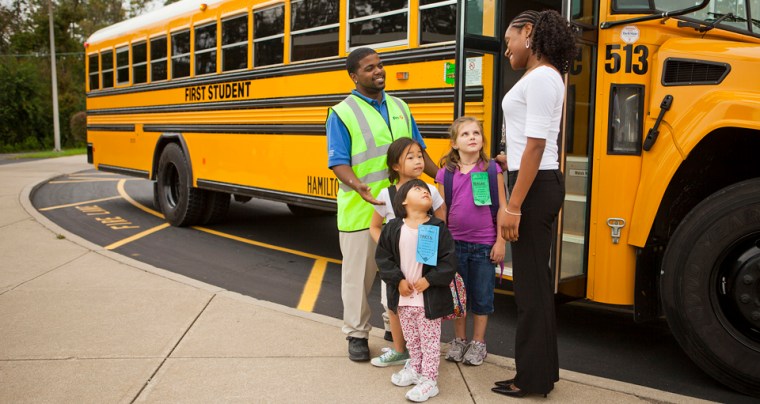
bus-halfimage

Facebook and Instagram are filled with first day of school photos this morning. Not only do we see pics of little ones but also the young men and women who are continuing with higher education in colleges across the land. There are images of teachers and their classrooms as well, some who are veterans and others who will greet their very first set of students today. There are nerves, fresh haircuts and new shoes making their way onto campuses from pre-school to schools of engineering. We see the innocent faces of kindergartners and the confident portraits of seniors. Yet another school year is beginning and once again as a nation we place our future hopes in the hands of the millions who are set to learn everything from the three Rs to Thermodynamics.

Our political world will discuss the importance of education ad nauseam. Some will point to the total failure and injustice of our system while others see schools as our only real hope for progress. We will argue about whether college is a right that should be free or a privilege that we must earn. We will discuss the over testing of our students and question the impact of political correctness on campuses. All the while the educators will quietly go about their work and the students will hopefully succeed in learning the skills and knowledge of the curriculum. In ten months everyone embarking on this journey will be irrevocably changed be it for better or worse. It’s virtually impossible to spend almost an entire year inside of a classroom without being affected by the daily interchanges that have taken place.

On Saturday I spent a lovely morning with a former student from the last school in which I worked before retiring. We chatted over omelets, waffles and hot tea. She is studying at the prestigious University of Houston Bauer School of Business and is in the final semesters of reaching her goal of becoming the first in her family to earn a college degree. She is an outstanding student not just because she is naturally bright but because she has a clear understanding of the amount of determination and willingness to work that achieving any worthy goal requires. She views education as an opportunity and realizes that it is up to her to seize the moment. She often advises and inspires other young people by reminding them that success is not easy but also not impossible. She warns them to be wary of defining themselves by their zip codes. In other words it doesn’t matter what ones economic status may be but rather how willing he/she is to put in the time and labor needed to grow and change.

This young woman is already on her way to great things. She understands the importance of networking with both other students and her professors. She knows how to ask for help when she is floundering. That is how the two of us first met and began to build a powerful relationship. She realizes that nobody is ever truly able to accomplish greatness alone. She constantly learns from everyone that she meets. She earnestly asks questions and listens intently. She reflects on what she has experienced and adjusts as needed. She shares the lessons she has learned with others. She has discovered the essence of education, the interplay of people and ideas that traces itself back to the challenges posed by Socrates. She fully understands that she will never be entirely finished with the process of discovery. It is a lifelong pursuit and she is not only willing but excited about the possibilities of her journey.

First days of school are always filled with hope. They provide both students and teachers with yet another chance to make good on their promises to be just a bit better than before. They define the moment when resolve is often at its peak. The fresh supplies and the new clothes are outward signs of gloriously positive intent. Everyone’s hearts are aflutter with both happiness and fear. We humans quite desperately want to be our best. It is part of our DNA to be curious. We have yet to completely understand what happens along the way to sometimes stunt the enthusiasm for learning among some of our young. We know that environment plays a huge role in beating people down but we nonetheless see many examples of individuals who overcome horrific conditions. We continue to seek answers as to how and why our children often seem to lose the innate sense of wonder with which they are born.

We sadly have a tendency to lay blame for perceived failures without really examining every facet of a situation. We all too often make false assumptions. We are particularly prone to pontificating about education without knowing the many layers of complexity that exist for each individual who enters the world of schooling. A child who is loved, well fed and blessed with a strong body and mind has a head start over one who is abused, hungry and saddled with disabilities. A teacher with a sunny, well equipped classroom of bright and well adjusted children is more likely to advance her pupils than one who must teach in overcrowded and dreary conditions that include an overabundance of children bearing the scars of living in fear. The fixes for broken schools require far more than an infusion of cash or a rewrite of the curriculum. They need faculties willing to invest their hearts into their work and students like the young lady with whom I spent my Saturday who understand the part that they must play in giving their all to the effort. It also requires parents who cheer for both the teachers and their children, making it clear that education is a family affair.

Today is a new day. The slates are blank once again. The pencils are long and sharp. The notebooks are filled with fresh sheets of paper waiting for the notes and calculations that will ultimately fill them. It is the season for planting new seeds, a time of great anticipation. We believe again. We try again. We are tan and rested and ready to go. It is what we do over and over as the school bells beckon our children once more. Our entire future depends on what will happen all across the land. Somewhere is the next great inventor, the peacemaker, the artistic genius, the brilliant business person, the contributor to our society that we cannot yet even imagine. There are teachers who will inspire our new generation and help to create the leaders that we will most surely need.

I feel a lump in my throat as I think of what lies ahead during the next ten months. There is an industry at work in schools that is filled with the best of intentions. I wish everyone well. I’ll continue to do my part by encouraging the educators who are still in the trenches and helping the students who struggle a bit with numbers. It’s up to all of us to join in this great endeavor and to celebrate the fact that we are never willing to give up on becoming our better selves. This is day one. Let’s all celebrate the possibilities and do our parts to make them happen.

Not So Strange

66.0.0Watching television in the summertime can be a dreary affair. The hundreds of available channels tend to pack their schedules with reruns or replacement programs of dubious value. Most of us are too busy enjoying travels and the long hours of daylight to really care about the dearth of decent options but when rain is dampening plans we sometimes reach for our remotes hoping to find something interesting and worthy to view. Sadly our options aren’t always promising.

The summer Olympics in Rio have been fun but somehow NBC manages to go into overkill with certain events and completely ignore others that might be interesting. I have found myself tuning out every time that they showcased yet another beach volleyball game. Don’t get me wrong. Those competitions are fast paced and even have the potential to be exciting but when they seem to be part of the programming every single day they soon get old. On the other hand we never get to see much related to soccer or rugby or basketball. I thoroughly appreciate the finals in swimming and track but don’t really need to see every event leading up to those matches. I’d much prefer a montage of the many different sports and not just those that NBC has selected for my viewing pleasure. I suspect that I am not alone in my thinking because ratings for the Olympics are down.

Luckily there is a bright spot in the vacuous desert of summer programming. Stranger Things is yet another Netflix original limited series that demonstrates how a great story, taut writing, a perfect cast and stunning production can elevate a simple idea into a winner. Stranger Things is so nineteen eighties and that is a very good thing. The tale weaves a tapestry of mystery with characters right out of the movies that we so loved in that era. Subtle but powerful touches include a soundtrack of eighties favorites that illicit memories of MTV with starring roles for once young actors and actresses who have settled into middle age. The formulaic themes so common in the golden age of the eighties are all there but with twists and turns that keep us on the edges of our seats. Stranger Things is a romp through the past that seems to have elements of Goonies, E.T., Sixteen Candles and Alien. In other words, it is great fun, especially for those of us who so enjoyed that glorious time.

When I think of the eighties I get a huge smile on my face. It was a decade when everything in my world was going well. I loved my job and had few worries. I lived in a great neighborhood and enjoyed adventures with so many wonderful friends. My two girls kept me busy but I loved every moment with them. I was still in my thirties, a time when I was confident, energetic and still rather nice looking. We traveled all across the United States as a family and created memories that are vividly exciting even to this day. The world itself seemed safer and less complex. We lived contentedly at the end of a cul-de-sac thinking that life would always be as perfect as it appeared to be back then. We were so busy enjoying our little slice of heaven that we hardly noticed the changes that were brewing just as they inevitably do.

We would all grow older. Family members and dear friends would die. Our children became adults who left our little nest to begin their own sagas. The world seemed to evolve into a more dangerous place. Our nostalgia for the good old days increased and yet if truth be told these are good times as well.

The reality of life is that it is in constant motion. As the Bible so beautifully tells us there is a season for everything. How we react to each stage of our existence will color the way that we view our past, present and future. With the right attitude we are able to accept and enjoy our status even with the many changes that alter the way we live. True joy comes in embracing the moment and finding the blessings that most surely are right in front of us.

My mother was masterful at enjoying the simplest of things. She had very little money but she never complained. She received as much joy from a McDonald’s sausage biscuit as she might have had from breakfast at Brennan’s. The simple act of waking up each morning was a grand miracle in her mind. Each day was precious to her and she packed her hours with generosity and love. Whether she looked backward or forward at her life she was filled with optimism. She loved the eighties like me but she appreciated all of the other decades as well and they spanned from the twenties of the twentieth century to the teens of the twenty first. She had a way of finding the silver lining even on the darkest of days and constantly assured us that every problem has a way of working itself out if we are willing to be patient.

Watching Stranger Things reminded me of one of my favorite times but it also made me think of just how wonderfully far I have come. I now have seven grandchildren who weren’t even part of my imagination back then. I have met so many remarkable people in the days since dresses had more padding than a football uniform. The inventiveness of humankind in the last thirty years has made virtually every aspect of my existence far easier than it has ever been. I can tutor my granddaughter or visit with my grandson without any of us leaving our homes thanks to technology. I am daily reminded of how lucky I am and of the goodness of most of the world. It is with a sense of anticipation that I think of what may lie ahead. I suspect that wondrous things are on the horizon and that’s a good thing.

The best thing about life is how creative we humans are again and again. We adapt and thrive and carry on because it is in our natures to build rather than destroy. We laugh and enjoy the adventure of a good challenge. The bonds that tie us all together weather the test of time and there is nothing strange about that.   

American Memories

general-sherman-newWhen I was growing up in the south the mere mention of William Tecumseh Sherman’s name ruffled feathers. The stories I heard described him as a despicable general with a drinking problem who swept across the southern landscape burning and pillaging and destroying everything within his line of sight. Because I knew little about my own ancestry I assumed that at least half of my family connections were steadfastly rooted in the old Confederacy because my paternal grandparents had lived in Kentucky, Virginia, North Carolina, Texas and Arkansas for decades. Thus I blindly derided General Sherman for being so cruel to those I believed may have been some of my innocent relatives.

When I finally took a history course in college I came to realize that the reasons for General Sherman’s dramatic sweep were far more complex than I might have imagined. Both the Union and Confederate armies were exhausted and decimated from years of skirmishes that had destroyed the lifeblood of both sides. The country could ill afford to continue the war for much longer. President Lincoln had been searching for a military man willing to make difficult decisions and take risks that would end the conflict once and for all. General Sherman understood the need to break the resolve of the rebels. While his methods were harsh they were no more so than the steadily rising death count that ultimately took more American lives than any other war in its history. The ethics of his tactics have been the stuff of controversy ever since he burned Atlanta and cut his destructive swath across the Confederacy but others applauded his willingness to do what needed to be done.

I would later learn that from a familial stand point I was more closely connected to the Union and William Tecumseh Sherman that I might have believed. My great grandfather was an officer in the Union Army who fought at Corinth and Shilo among other battles. His predecessors had served in the American Revolution. When I finally discovered my family history I realized that I should have been singing the Battle Hymn of the Republic all along when I was foolishly whistling Dixie.

Imagine my even bigger surprise when I learned that my paternal grandfather’s legal guardian and uncle, John Little, was a graduate of West Point who had married General Sherman’s niece. While my official relationship to Sherman is tenuous at best it is still there because if John Little was an uncle to Grandpa then his wife would have been an aunt. The web of family relationships certainly brings surprises and I have had to rethink my own background.

Ironically I have a friend who now lives in a small town in Georgia that once served as the capital of that state. She is descended from German parents so there is little chance that she might have a link to either the north or the south during the Civil War. She is able to view the events of that sad time with more dispassion than most of us who have kin who were alive back then. She is attempting to learn as much about her new home as possible and in that spirit she came across a book about Sherman’s controversial tactics, Through the Heart of Dixie: Sherman’s March and American Memory by Anne Sarah Rubin. The story of his exploits is written from multiple points of view and it demonstrates in striking contrasts how differently we humans may see the exact same incident.

Sadly the majority of the history that we study tends to be taken mostly from the standpoint of the victors. We all too easily forget that without conflicting opinions wars would be unlikely. It is in our differences that our disagreements arise. It is rare that one side is all good and the other is all bad. Generally there are shades of innocence and guilt for everyone involved. When humans lose the ability to empathize and compromise situations usually end badly. So too when we meet with evil that refuses to budge we must at times flex our muscles. Knowing when to hold and when to fold often determines our strategies. Navigating through a dangerous and political world can become a high stakes game that requires hard choices that we would rather not have to make.

I once led my students through a discussion of the beginning of the American Revolution by reading different accounts of that fateful day on the village green when somebody fired the shot heard round the world. We looked at a letter from a British soldier and an affidavit from one of the colonists. There were eyewitness renderings from people who just happened to be present but who had little desire to become part of a rebellious movement. The incident was described by both men and women, political prisoners and historians. It is stunning how different the accounts are. The crux of each description is totally dependent on the beliefs and allegiances of each individual. All of this of course points to the reality that we have unique world views powered by the totality of our experiences. The way we react to or participate in events is rarely as straight forward and simplistic as it may initially appear.

To this very day the majority of Americans herald the Revolution as one of the most amazing moments in history, a glorious cause, but I often wonder how it might have been viewed if the British had ultimately been the victors. Would we hear of patriots or rabble rousers? Would the efforts have been seen as being heroic or foolhardy? Would the Tories now be considered the wise men who understood the folly of fighting the best equipped army in the world? How different would our history be?

I suppose I am reflecting on such ideas because I have lately been watching biographies of many of our twentieth century American presidents. A common theme for each of them is the interplay of the human strengths and weaknesses that drove them. Not one of them was either all good or all bad. Each had fatal flaws as well as remarkable characteristics. Sometimes they were blamed for events over which they truly had no control or heralded for triumphs that they had not actually achieved. The accidents of timing often made them appear strong or weak. Those of us who lived through their tenures regard them based on what did or didn’t happen while they were in office. Our individual circumstances color our thoughts.

The lens of history often attempts to create winners and losers. The truth usually lies somewhere in between. Knowing my family connections with the Union cause has filtered my thinking in new ways and has taught me the valuable lesson of suspending judgements and attempting to instead seek truths. The only way to do that is to be open and honest, something that seems increasingly difficult but not impossible to do in today’s partisan supercharged political atmosphere. I have learned to truly listen to alternative points of view, something that I wish more of the electorate were willing to practice. Once I accepted that each of us is sometimes right and sometimes wrong I have been able to see through the deceits designed to attract blind loyalty. I now rarely agree with anyone on everything. I have learned to consider each proposal and observation separately. It is a truly freeing experience albeit messier than accepting a single point of view. It is the kind of critical thinking that we must teach our children to do. Only then will we as a nation make choices that favor the good of our country rather than victory for our own personal needs.