One Human Family

Photo by Ahmed akacha on Pexels.com

My mother, like her siblings, was a devoted Catholic. My father believed in God, but not a particular religion. In fact I suspect that he must have had some kind of bad experience with a group during his youth because of comments that he made about overly evangelical groups. Nonetheless, he encouraged my mother to practice her faith by raising my brothers and me in the Catholic church. He seemed to appreciate her insistence on following the the dictums of her beliefs even to point of signing a pledge upon his marriage to allow her to teach us about Catholicism from the time of our births. 

My father never went to church with us on Sundays nor did he have much to say about God or faith or any particular religion but he was a good man who loved as fiercely as any of the most religious people that I have ever known, maybe even a bit more unconditionally. He was not prone to judge, but rather to accept people just as they happened to be. I never heard him cuss or demean another person with his words. He quietly did good deeds without boasting. He was a humble man who was devoted to his family. 

My mother was a living saint. She only missed Sunday mass if she was sick. She read her Bible daily and lived the kind of life that Jesus instructed us to follow. She sacrificed for my brothers and me and for other people for all of her adult life. She found so much solace in God that she sometimes cried tears of joy when describing how she felt about her faith. Nonetheless she did not believe that it was her place or her duty to tell others how and what they must believe. She was best friends with a Jewish woman and often noted how beautiful that religion is. 

My mother took my brothers and me to church, sent us to Catholic school and spoke of her own beliefs. She was such a pillar of faith and service to our Catholic community that she received a papal blessing from Pope John XXII. It was one of her most treasured moments in life. In spite of her own devotion she was quite liberal in believing that ultimately my brothers and I would have to choose our own paths in determining what our respective thoughts on religion would be. She often praised the many different ways that we humans have attempted to determine the existence of a deity. 

I ended up following my Catholic faith for a lifetime. One of my brothers became a Baptist. The third brother is agnostic, believing that there may be some kind of God but not feeling drawn toward a particular kind of religion. Mama was fine with all of our choices. She believed that what mattered most was how we treated our fellow humans and in many ways it was in fact my agnostic brother who followed the most Christlike way of living. 

I often think of the irony of having a mother who was at once a diligent follower of Catholic teaching and at the same time so very liberal about accepting each person’s right to form his/her own beliefs. She reminded us all of the time that Jesus befriended people who were spurned by the rest of society in his time. She felt that his message could be distilled into the idea that what matters most is loving our fellow humans. 

I’ve gone back and forth in my own religious journey. I was not much of a fan of the somewhat conservative teachings of Pope Benedict, but whenever he spoke of migrant people I found the essence of the Catholic faith that had always stood out for me. He was adamant in his belief that we are one human family. He once asserted that, “The parents of Jesus had to flee their own land and take refuge in Egypt, in order to save the life of their child: the Messiah, the son of God, was a refugee,” He believed that it was our duty to welcome and minister to those who flee from horrific conditions to save their families. It is what Jesus would expect us to do.  

Somehow of all of the things that Pope Benedict said during his lifetime that one sentence seemed to encapsulate the heart of teachings that I learned from my church, from my mother and even from my father. It has fashioned my relationships with people, my politics, and my desire to lead a purpose driven life. It has made me a nonjudgemental person and it has helped me to see the beauty of humanity.

Our present Pope Francis has echoed the mandate to keep our hearts and our borders open to people fleeing from war and injustice. On a recent visit to Africa he enjoined us to remember our duty to speak out whenever we see others being abused, saying ” we cannot remain neutral before the pain caused by acts of injustice and violence. To violate the fundamental rights of any woman or man is an offense against Christ.”

I sometimes think that many organized religions and those who belong to them have lost their way. As has too often been the case throughout history people have politicized religion as a cudgel to force their beliefs on others. It has caused much suffering which may have been my father’s rationale for abandoning it. The rules have often hurt as much as helped. Perhaps it’s time that we all step back and consider the simple idea proposed by Pope Benedict that we are indeed one human family. Then it will make perfect sense to each of us that our goal should not be to judge or inflict pain but rather to unite against injustice and violence wherever it may be. It does not take participation in a formal religion to be a very good person. My mother and father both seemed to understand that quite well. 
Honesty, Humility and Devotion to Humanity

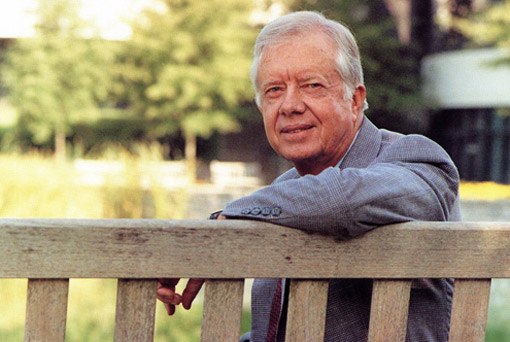
Former U.S. President Jimmy Carter at The Carter Center in 1993.

Thirty years ago I attended a graduation ceremony at Rice University on a sunny day in May. It was an outdoor affair which can sometimes be uncomfortable in Houston, Texas known for its hot humid days that begin as early as March. On that day, however, the weather gave us a break. We sat on folding chairs enjoying a rare breeze as we waited excitedly for the graduates to walk across the stage to receive their diplomas. The fact that former President Jimmy Carter would give the commencement address was an added treat. 

I had voted for Jimmy Carter when he ran for the highest office in the land. I pegged him as a kind man and his engineering degree told me that he was also quite bright. I felt comfortable with his leadership, but as sometimes happen events that probably would have taken place without or without him in office sunk his hopes for a second term. The overthrow of the Shah of Iran and a takeover by religious extremists disrupted the flow of oil resulting in shortages at the pump in the United States. When the U.S. embassy was raided and those working there were imprisoned  the blame was heaped on President Carter. 

Things eventually worked themselves out which is generally the way history goes, but it was too late for President Carter. He was soundly defeated in the next election. After a smooth transition for the next man in line, Carter returned to his home in Georgia and began a new and incredible phase of his life. He dedicated himself to helping those in need and preaching at his local church. He proved in the ensuing years to be a true man of God and a disciple to his fellowman. 

It would be difficult to find an more genuinely kind and loving man than Jimmy Carter. His charitable works have become legendary. He has built more habitats for humanity than most contractors. He is not just the founder of a great charity, but also someone who picks up tools and works alongside people far younger than himself creating places to live for those who have struggled to find permanent homes. Even in his nineties he was still driving nails and laboring for the good of other people.

On that day in May at Rice University in the long ago I was not sure what his speech would be. I only knew that it felt nice to be in the presence of a famous man. With his first utterance I realized that he was speaking from the depths of his heart. He assumed that anyone graduating from the highly ranked university where he stood would make great contributions to society with their intellects and skills. Instead he challenged each of them to acknowledge the good fortune that they had by paying their riches forward. He insisted that they had a duty to care for the earth and all of its people. He urged each student to be as passionate about doing good works as he suspected they would be about their careers. He spoke with such force that even those of us who were spectators felt inspired to go forth and bring light to darkness wherever we may be. 

Jimmy Carter has now lived longer than any former President in history. He returned to his home to die. His time on this earth is drawing to and end and may even over before this post is published. As he spends his last moments on earth I find myself concentrating on his never flinching honor and goodness. He was a man of his word, someone who lived a Christian life better than most who have traveled through life. If he were a Catholic I think he might one day be officially named a saint. As it is, I am certain that he has been a saintly man with or without a title. He is an example for all of us to follow. 

There may be many debates about Jimmy Carter’s presidency, but few will be able to honestly question his integrity and generosity. He most surely was devoid of the many hypocrisies that we see all around us. He never asked any of us to do something that he was not willing to do himself. He reminds me of all of the biographies of saints that I read as a young child, a person who lived outside of his own ego. If we were to rank all former Presidents by character he most surely would be in the top five. 

I have a cousin who has always insisted that Jimmy Carter was the best president in her lifetime and she has facts to prove that she is right. She went to see President Carter not long ago on a pilgrimage to the church where he often preached. Her trip was akin to finding the Holy Grail, the secret to life. She was inspired just as I was thirty years ago on the campus of Rice University. She felt his charisma and humanity in her soul. She cherishes the moment as one of the most impacting days of her life. 

The world will miss President Jimmy Carter. We don’t seem to have enough people doing what is right rather than what they think others want them to do. We have a dearth of honesty, humility and devotion to all people in our world today. Perhaps now we can all pause to consider the message that Jimmy Carter delivered to us all the days of his life and follow him in performing random acts of kindness and understanding wherever we go. It’s an ideal that he has achieved and a challenge for us all.  

We Can No Longer Delay

Photo by Ivan Samkov on Pexels.com

“Tonight, I am sitting under my desk at Michigan State University, once again texting everyone ‘I love you’ When will this end?”

This message from a college student to her family says something incredibly wrong about our society not just because she had to send this kind of text once, but because she had relayed a similar message while she was in high school only months before. Our nation is under attack from mass shooters taking out their anger on innocents in stores, churches, schools, nightclubs, parades, workplaces with a regularity so shocking that our sensitivity to such things is seemingly being dulled. By Valentines Day of this year of 2023, there had already been sixty seven mass shootings and no doubt the count will have risen before this post becomes public. 

An entire generation of young people has grown up in the United States with the specter of gun violence. Training for an active shooter is as much a part of preparedness at schools as tornado and fire drills. Students and teachers are on as high alert as we were when I was a young person hiding under a desk in preparation for a possible enemy attack during the Cold War. Each of us has come to realize that there may come a time when we have to react quickly if a shooter enters our space. As citizens we know something has gone terribly wrong, but we argue about what we must do to quell the bloodshed that takes innocents so horrifically from our midst. 

Talk is cheap. Thoughts and prayers are nice, but they somehow feel hollow when we have allowed years to pass since Columbine and the many other locations of violence without doing anything of real substance. Seemingly the growth of such incidents feels exponential as we do little to quell the hurt and loss of wonderful people wrought by predators with guns. Politics and power seem more likely to win the day than serious discussion of the issues and development of laws and precautions that might stem the tide of such incidents. Our nation and its people are sick and weary. Our young ask us why we care so little about them that we cling to the status quo and become ever more insistent on using bandaids to patch the wounds of gun violence. 

We desperately need peacemakers and brilliant legislators in our midst who know how to bring about meaningful protections for our nation. We can’t just build moats around our public places and post cannons and guards to keep danger at bay. We have to honestly look at ourselves and ask very difficult questions about what we have been doing wrong. How have we betrayed our children by becoming a country with more guns than people? Why have we ignored mental illness as though it is a dirty little secret that must be locked away in the attic? Why do those that we elect to lead us only pander to those willing to finance their campaigns rather than seeking to do the right thing? How has our religion become so twisted that we conflate guns with God? How can we just keep moving on to the next event without ever addressing the losses of innocents and innocence?

My tears have done nothing. I write about finding solutions and fewer people read my words. We don’t want to talk about this monster in our midst. We tell ourselves that freedom to accumulate arsenals is more important than the “occasional” incident. We can’t seem to face the truth of our situation which grows more and more out of hand with the passage of time. All of the studies in the world regarding what we should do are of no use if we remain at an impasse. Those Christmas cards of entire families proudly holding their guns create horror shows yet to come. 

I for one have lost my patience. I want those who represent me to quit pandering to the NRA and gun salesmen everywhere. I want them to stop running for office and blindly groveling to a base that seems to think that the second amendment to our Constitution entitles us to creating little armies in every home. I will no longer only cry and fret over the latest tragedy. I don’t want time spent worrying about a drag show that few will ever see. I am not so concerned about what we might read in books in our public places. I do believe that not one of us other than those in the military or law enforcement require an assault weapon. I think it should be more difficult to buy a gun than apply for admission to a university. I think that we have to really invest in improved mental health resources. We can even make our public places safer if we think that will help. Whether or not we responded to Covid properly or adequately is far less important than facing the issue of mass shootings head on and with reasoned cooperation. Let’s not argue about defaulting on our debt. Let’s pay our bills and then convene a national effort to quell these violent attacks. Let’s show our young that we really do care more about them than arguing over how a Super Bowl should be run. 

I will always be a teacher. I will always remember discussions with my students regarding what we would do if a shooter came to our campus. I recall drills and even a time when we went into a lockdown because a shooter was on the loose in our area. I felt the responsibility for the lives of my students in the most visceral way. It’s time to end the insanity of our adoration of a gun culture. It’s past time in fact. We can no longer delay. 

Not So Long Ago

Photo by Charlotte May on Pexels.com

When I was a child segregation still had a stranglehold on the south. I recall being confused by the reality of the times. It made little sense to me that there were two sets of water fountains and bathrooms for whites and blacks. I often rode the city bus to downtown and never understood why there was a line of demarcation that kept me apart from the Black children. I actually thought it would be way more fun to ride in the back of the bus. I did not realize that the Black people sitting there had no other choice. It never really occurred to me that I never saw a Black student at my school. It was not until a summer visit to my grandparents’ farm in Arkansas that I became aware of a brewing struggle in the civil rights movement that would eventually become a passionate cause for me. 

Whenever we visited my grandparents we always ended up sitting on their screened in front porch during the hottest part of the day. There the adults would discuss topics that did not always make sense to me, but one day in a summer of sixty three years ago they spoke of pending efforts to integrate Arkansas schools. The topic caught my attention and made me feel as though adults were silly to worry so much about kids getting together to learn regardless of the color of their skin. I did not fully understand the concerns that they discussed at that time. It was only when I became a teenager in the nineteen sixties that I learned how long the struggle for civil rights had taken for the Black citizens of our country. It was then that I l read about the horrific treatment of this school aged kids who had been courageous pioneers in the integration of schools. It was only then that my own school saw its first students of color. 

I was a quirky little girl who seemed to become an old soul upon the death of my father. Before he died I had floated through life like an unconcerned and happy butterfly. Everything became dramatically serious for me when he was gone. I suppose that my passion for equality and justice began on the summer day when all of my questions surrounding segregation coalesced into the simple thought that there was no reason for any of us to be forbidden to enjoy the same rights. My simplistic thinking was idealistically pure in reasoning that we are all the same and therefore discussions about living together should have been simple rather than filled with the rancor that accompanied the Civil Rights movement. I viewed the hardships of Black citizens from afar, in a retreat of comfort while they were on the front lines.

In many ways the idealism of my immaturity followed me after the passage of the Civil Rights bill in the nineteen sixties. I naively saw the battle for justice as being won and over. It did not occur to me that the same prejudices that created a furor over six year old Ruby Bridges attending an all white elementary school were still very much alive in the hearts of some of my fellow Americans. I was wrong to assume that racism would magically go away simply because a law declared the rights for all people in our country. I suppose I just was not paying enough attention, but my sleep walking would not last. 

By the final decade of the twentieth century I was teaching in one of the most diverse schools in the city of Houston. I saw the blending of many colors and cultures, but also disturbingly felt the rumblings of prejudice that smacked of the days of my childhood. Some of my Black colleagues assured me that their struggles were far from over and that was brought home to me when a relative of one of them was brutally murdered in a little town not far from Houston. The homicide smacked of the lynchings of old and I felt ashamed that I had not seen such things still happening with regularity. 

The election of President Barack Obama seemed to herald a new day of brotherhood among Americans, but then the bigoted commentary and cartoons about him and his family oozed into the public forum. I did not want to believe that the underbelly of racism was still alive. I fought against such thoughts even as the evidence demonstrated that I was wrong. My optimism faltered as the worst was yet to come. 

As we celebrate Black History month echoes of the horrific racism of my childhood are becoming louder and more widely accepted. Tucker Carlson openly hawks a racist screed about Barack and Michelle Obama without the least fear of losing his lucrative job as a purveyor of propaganda. I hear his words in horror and wonder if we got to this point because too many people like me were lulled into thinking that the civil rights work was done. We lost our passion and went about our lives while Black citizens were still feeling the sting of racism. We thought that warnings from our Black friends were hyperbolic. We chose to insulate ourselves into thinking that problems no longer existed. After all, we saw that Blacks were working alongside us, living in our neighborhoods, sitting next to us on busses, becoming successful, even winning elections to become President of the United States. How could we imagine that anything was wrong with the status quo?

As we take time to celebrate our nation’s strides forward during Black History month we would also do well to accept that there is still work to be done. The signs and realities tell us that our nation and many of its people have not yet admitted that the journey for justice still looms before us. It was only sixty three years ago when little Ruby Bridges so bravely represented the hopes and dreams of equality shared by all oppressed people. Don’t fall asleep. Read about the struggles then and now. Keep the passion for justice burning. Speak out when wrong is done and listen to those who have experienced and may still be experiencing prejudice. Their stories are as important now as they were not so long ago.

Indoctrination

Photo by Tima Miroshnichenko on Pexels.com

There is a great deal of talk today about the role of education in brainwashing or grooming students to accept particular sets of beliefs. The question is whether or not schools that present alternative points of view about race, diversity, women and lifestyles are actually attempting to indoctrinate students or instead teaching them to think critically about different points of view. Considering whether or not those who would ban certain ideas while pushing others may in fact be the ones engaged in whitewashing the truth further muddies the water. Is it a good thing to let students hear about and discuss controversial topics or should we shield them from ideas and philosophies that may cause them to view the world without rose colored glasses?

Years ago I took a series of lessons on “critical thinking.” For four Saturdays in a row I sat through eight hour sessions describing what critical thinking is and how to show students methods for looking at the world, its philosophies, histories, and laws from different points of view so that they may understand how and why individuals, groups and organizations are affected by the totality and reality of the past, present and future. It was one of the most enlightening educational experiences of my life and I became convinced that our very future depends on the ability of each individual to carefully assess everything thing they see and hear.

I suppose that I had an aha moment during that training when we had to read six descriptions of “the shot heard round the world” that signaled the start of the American Revolution after gunfire was exchanged at Lexington and Concord. One of the accounts was from a colonist who was an eyewitness, another came from a British soldier who was also there. One came from a colonial journalist who heard about the incident and then wrote about it. Yet another came from a British soldier who had been captured and imprisoned but was not present when the event occurred. Even Winston Churchill wrote about the incident in an historical tract years later. The final entry was from an author who had done painstaking research using primary and secondary sources. 

The eye witness accounts were totally at odds with one another. It seemed as thought the reports were from two different events. The hearsay writings while concurrent with the revolution were more the stuff of propaganda that depended on who had relayed the story. Finally the history written years later by Churchill seemed slanted in favor of colonialism while the one written with the intent of presenting all of the differing points of view with great honesty felt the most authentic. Nonetheless I realized that we each have filters that sometimes distort our views of the world. To get a full picture we need to hear all of the voices. Only then do we begin to realize the complexity of the world around us. There are few easy answers about anything. 

One of the things I liked best about being on my high school debate team is the gathering of data to support both pro and con arguments on a particular topic. My own views meant nothing. What I was tasked with doing was to be able to convince the judge that my side of the argument was the most persuasive. I learned how to parse statements to find the imperfections in them. It made me realize that there is often more to a topic than my initially limited view of it. I learned how to use data and facts and rebuttals to seek truth. It was a life changing process for me. 

I grew up in a relatively isolated bubble that was safe and filled with love and opportunity. I would later learn about a darker side of life, and while it sometimes saddened me, I understood that I would better be able to serve my country by knowing the full truth rather than a childlike bit of propaganda. I remember thinking as a youngster that I had to sing Dixie and boo the Battle Hymn of the Republic because I lived in the south. Imagine my utter shock when I learned that my great grandfather had fought for the Union Army even though he was born in the south. Think of how the scales fell from my eyes when I learned more details about the Civil War in college and from books that I read. Suddenly I understood that horrific era armed with knowledge and the ability to ask important questions. I learned how to view slavery from the point of view of those who were in bandage and whose descendants were still struggling for equality and justice. Such revelations made me appreciate my education and respect those who had been willing to tell me truths. It did not make me adopt a certain point of view or even to feel guilty or hate my country. It led me to a reasoned and adult reality that allowed to me see what had been good and what had been bad about our history and what is now right and what is still wrong.  

Learning even the ugly parts of humankind does not indoctrinate. I enlightens. It is a freeing experience to hear differing accounts of life. Banning uncomfortable books or ideas is the worst possible idea for maintaining a thinking citizenry capable of defending freedom and democracy. Information and truth and transparency should be the tools for making our young strong, not shielding them and pretending that certain things do not and never did exist. Students are far more resilient than we think. They know a lie from a truth. Nothing excites them more than realizing that adults respect them enough to let them hear about the world from from any voices, not just some carefully doctored recitation of western civilization. 

The world is a big place with many cultures and ways of doing things. We would do well to teach our children about all of it and show them how to weigh the differing ideas in a careful and critical way. Otherwise we really are indoctrinating them and when they find out what we have done one day they will be disappointed and angry. We are a country of many ideas. We don’t need to emulate places like Russia or China or Iran where free thinking is quashed. Put the books and the AP courses and the diversity back in the schools. Our hope for the future depends on such freedom to learn and think.