Progress Through Science

Photo by Pixabay on Pexels.com

Most of the Founders of our country were highly educated men. One was the son and grandson of men who had been presidents of Princeton University. The Founders based many of their ideas for our country on the works of philosophers who were quite progressive for the times. They were also very much attuned to the latest discoveries in science. The idea of being anti-science was not part of who they were so I suspect that they would be somewhat concerned about the recent tendencies to condemn science by some politicians and their followers in our country. 

When I visited Philadelphia I was enchanted by the museum dedicated to its most exciting citizen, Benjamin Franklin. The truth of the matter is that Franklin was often considered to be one of the greatest scientists of his time. He did way more than make observations about lightening. He studied all sorts of ideas and theories and concluded many of his own along the way. He was an incredibly inventive man renowned worldwide with a title of Doctor Franklin.

Thomas Jefferson’s home at Monticello is filled with his books and artifacts from nature. He studied the physical world around him and invited the greatest minds of the day to his home. He was a thinker and a man who was willing to experiment and learn. I can’t imagine him being anything but excited about the discoveries of science that have made life in the modern world so much better for us all. I firmly believe that he would be more than inclined to believe the scientists at NASA who have visual proof from space of the effects of climate change. 

There are people who seem to be wary of any idea that we humans might have something to do with the more violent weather patterns that we are presently experiencing. They believe that we will be just fine if we simply carry on the way we always have and wait until nature adapts to us. They think it foolish to attempt to have an impact on the climate with different forms of energy and new ways of living together on this planet. Some are even audacious enough to boast that they will not even be here if and when the worst consequences happen so why should have nothing about which to worry.

Science was not my favorite subject. It tended to be heavy with facts and definitions back when I was in school, but much of that has recently changed. Students are more likely to complete hands on activities to demonstrate how things work in science labs. They are given opportunities to be creative in using the laws of physics to build things. They discuss and use the scientific method rather than simply being able to name its steps. I would think that with the new emphasis on really understanding rather than memorizing we would surely have a much better informed population. In many ways it seems as though that is true, but most of those folks are to be found in the younger generations. It is mostly among the older folk that the doubting Thomases reside.

Somehow we have politicized science as though what is true and what is false is a matter of opinion rather than provable facts. Now we even will have rulings about pollution and the safety of food and drugs coming from judges untrained in science rather than experts in various fields. Somehow I don’t trust the judgement of a lawyer as much as the informed sources of scientific knowledge who have done such jobs heretofore. Benjamin Franklin and Thomas Jefferson did not turn to lawyers to learn about the physical world around them. I would rather have a person from NASA giving advice about navigational systems on rockets than a district judge. 

Somehow I fail to see how determining the truth about any scientific concept should be akin to one of our freedoms. If a doctor tells me that he does not want me in his office without a mask I am inclined to believe that his reasons are legitimate. I can’t say the same about an ordinary person who simply feels uncomfortable covering his mouth. It is frightening to me that political candidates are making sweeping pronouncements that would end vaccine or mask mandates even in hospitals and schools Perhaps these people have never read about the deaths from the Spanish flu outbreak of 1918, that was exponential because the medical community did not yet have the knowledge they needed to know how to treat the virus or to keep people from catching it. 

I don’t have the expertise nor the chutzpah to ignore the advice and warnings of learned men and women. I can do a great deal of reading but in the end I go with the scientists because I know how rigid their methodologies are designed to be. My gut tells me that we are destroying our planet with our arrogance and the evidence proves that it is so. As I sit in unusually hotter and hotter temperatures each year I sense that something is amiss. When scientists explain why that is happening and what we must do stop the decline I plan to listen. So far they have not let me down. 

I am constantly learning from my grandchildren as they discover more and more about the marvels of science. They have been educated in some of the finest universities in the country and I believe what they are telling me. I have doctors in my family who are dedicated to their patients. I follow their advice. 

Many scientists from around the world have traditionally been attracted to working in our country because of the freedoms for their work. I would hate to think that the current anti-science trends will drive many of them away. When we have members of a political party threatening to hang scientists or attack their families because they do not like what those scientists are doing we run the risk of experiencing a brain drain much as happened in 1930s Germany. We don’t want that to happen. Instead, like Franklin and Jefferson, we should be open to the discoveries that are designed to help us live in a better world. They both understood that there is progress through science. We would do well to adopt that kind of thinking as well.

Love Is The Answer

Photo by Anna Frolova on Pexels.com

I’m what might be called a hybrid American. From my paternal grandmother, Minnie Bell Smith, I am able to claim that I am a descendant of people who fought for independence in the Revolutionary War. In fact, I have solid information that one of my ancestors, Thomas Smith, was a captain from the colony of Virginia. Later in our history my great grandfather, John William Seth Smith, served as a lieutenant in the Union Army during the Civil War. I have my bonafides from that branch of my family but my mother’s family makes me part of the great immigration story of the early twentieth century. That is when both my maternal grandfather, Pavel Uhrik, and my grandmother, Maria Bartokovik, sailed to the United States from Slovakia, landing in the Port of Galveston, Texas. 

The American story cannot be told without both the colonists from Europe and the later immigrants from around the world. For many among us the Native Americans and slaves brought unwillingly from Africa also play a key role in who we have eventually become as a nation. Our strength lies in our glorious variety. Ours is indeed a beautiful tapestry of many colors interwoven in the hopes and dreams of generations. 

I sometimes complain about the difficulties that have challenged me in life, but all in all mine has been a quiet journey filled with love and support from my family and the friends I have enjoyed along the way. I was lucky to have some incredible role models in the women who were most responsible for guiding me from infancy to adult life. I found great wisdom and support from the men who lovingly watched over me. I have learned through my experiences as a teacher that not everyone is as fortunate as I have been to be always surrounded by people who truly cared about my wellbeing. 

When people ask me if I am better off today than I once was I have to admit that I am quite content to have lead a good life. My mother worked hard to provide stability to me and my brothers after our father died and she did so with aplomb. We were adults before we realized the miracles she performed in providing us with a safe home in a loving and generous atmosphere. She might have made a fortune showing people how to make ends meet on a small income. She was resourceful and ever optimistic so that we never had to worry. She taught me how to be grateful for whatever good fortune I have and also how to share with others who have less than I have. I watched her share her talents and her joy with abandon.

I learned the value of every person from the people who influenced my life. Later I would learn from my students and their parents, who were often categorized with labels like immigrants, under served, low income, low achieving. I found that when all is said and done everyone has hopes and dreams and longings to rise above the difficulties that life throws at all of us. I thought of my mother urging me to meet my pupils where they were, not where I thought they should be. She cautioned me to learn as much from them as they would hopefully learn from me. Because I accepted Mama’s wisdom they filled my heart with love and great hope for the future of our world. 

I do not see my responsibilities as beginning and ending with my own family, my own neighborhood, my own country. All of the wonderful people who have brought me to this point have shown me how to view differences as something wonderful, not fearful. I have become a far better person than I might otherwise have been each time I joyfully embrace different cultures, lifestyles philosophies. My view is that of a citizen of the world just as my high school English teacher encouraged me to be. It is a wonderful vantage point that leads to great comfort, not anxiety. 

I am happy to be the way I am. I am glad that my children and grandchildren are following in the pathways that those who came before us showed us how to do. We take forks in the road. We risk questioning the way things have always been done. We listen and watch and learn. It is a great gift to widen our horizons and to understand the loveliness of seeing the incredible value of all of humanity, not just a one size fits all description. 

I sometimes worry when I encounter narrow minded people. I do not trust those who would turn us against one another. i dislike laws that seem intent on forcing us all to be just alike. I worry about my nation whenever its leaders cast doubt on the value of immigrants or ask us to believe that certain ways of life are better than other alternatives. I have learned that such isolated ways of living almost always lead to greater difficulties when embracing each other just as we are is always the best way forward. 

I am content with what I have and willing to share with those who have less. It is up to each of us to lift up those who struggle with sacrifices like the ones my mother so happily made without complaint. She understood so clearly how little we actually need to be happy and the importance of being generous whenever we are able. Love is always the answer and thanks to all of the people who cared for me I have much of that to give. 

Trying To Act My Age

Photo by Marcus Aurelius on Pexels.com

It started with an innocent accident that left me with a bruised bone and a hematoma that forced me to wear a medical boot to all of my usual Christmas activities. I felt foolish for having disregarded common sense that led me to banging my leg against a table with such force that walking was almost impossible without the assistance of some ibuprofen and the shield of the horrific looking boot. 

I eventually got past that incident only to find that my always perfect blood pressure had become high. I had not even noticed the change because I only have my pressure checked when I visit my doctor or dentist. Nonetheless I soon found myself keeping a twice a day diary that demonstrated plainly that the higher numbers were not a fluke. That lead to a weeks long attempt to lower the diastolic and systolic readings with various medications that were accompanied initially by some icky side effects. Slowly but surely the numbers came down but not as miraculously or quickly as I would have hoped, and definitely not as low as they had once been when I prided myself in being a perfect specimen of health. 

One thing seemed to lead to another when a routine eye exam revealed that I had cataracts that would have to eventually be removed. I remembered that it had only been a year before when my primary care physician had boasted that I did not look or act like a woman in her seventies. I wondered how a few months could bring about such change without warning. Before long other issues popped up like suspicious mammograms and a clicking noise in my mouth whenever I ate. 

I soon found that my social life revolved around all of the medical appointments that I had along with those of my father-n-law who now lives with us and my husband who has heart disease. I began to think that I should rent an apartment in the Smith Tower of Methodist Hospital so I would not have to keep driving to the same place over and over again. I feel like a failure just for beginning to look and act more like my age. My sense of pride was challenged in ways that I never expected. I held myself responsible for simply beginning to show the natural signs of aging. 

I hated all of the visits to the medical center where I sat in rooms filled with old people who seemed so unlike me. I pushed myself to keep working as hard as ever in order to prove that I was not some weakling like everyone else. My false pride jerked me down with an unbearable spasm in my lower back and days when my knees screamed that I should be more than ready to consider replacements. It was all so distressing even as I watched my contemporaries enduring far worse illnesses with such grace. I decided that my pity party had to stop. I realized that I had been fortunate to get as far along as I am before beginning to experience a slight degeneration of my health. I saw that I was being ridiculous in refusing to accept the small changes that were coming my way. I reluctantly admitted that it was okay to cool my engines a bit and ask for help now and again. 

I have always modeled myself after my grandfather who was a very wise man. He lived to a ripe old age mostly because he understood when it was time to accept change at each stage of his life. He was never a crotchety old man who insisted on doing things just as he had always done. He knew when to stop driving his car, when to ask for help, when to sell his home and live with in a group home, when to adjust his way of life. I suppose that was his key to reaching the grand old age of one hundred eight without being a burden or a problem for anyone else. He grew old gracefully and with humility and gratitude rather than pride. He kept his mind and his body strong at a slow but steady pace. He found joy in simple moments and worked around the slowing of his energy and the ailments that mounted up over time. 

I suppose that I was a fool to think that I might outsmart father time. I’m simply settling into the aging process that will change the way I look and act as the years go by. I’m witnessing my friends endure far more serious problems than my own with stoic smiles on their faces. There is indeed a season for everything. I’m certainly not done yet but I’m won’t keep up with my grandchildren who are at the peak of vim and vigor and that is okay. It’s time for me to adjust the way Grandpa did so beautifully. That twitch in my back can be erased with a leisurely walk around the neighborhood where I will find joy in just witnessing life at every stage. I still have miles to go but perhaps it will take me a bit longer to get there than it once did. It’s time to act my age.    

My Inheritance

Photo by Pixabay on Pexels.com

I often listen to PBS radio on my way to and from the mathematics classes that I teach. I enjoy the interesting programming, particularly The Engines of Ingenuity a short feature from the Engineering Department of the University of Houston. There is no predicting what the brief spot will be about, but it is always quite interesting. 

A recent edition found a most unique way of discussing the old question of nature versus nurture, the debate regarding whether a person’s DNA or the opportunities provided by parents have the most influence on the eventual outcome of how learned and successful an individual will ultimately become. Of course there are many studies and much evidence that that two operating in tandem are the most powerful predictors of how well a person will develop. Having good genes is certainly a plus, but combining those genes with parents who create an environment focusing on learning and observing the world heightens the possibilities for a child to grow into an intelligent and productive adult. 

I enjoyed a real life story on the program that spoke of George Boole, the son of a shoemaker who essentially taught himself mathematics and then contributed greatly to the study of Calculus as a mathematical innovator and professor. Many may know of George Boole as the inventor of Boolean Algebra which eventually became a foundation for the computer world of today. For his efforts Boole was given a gold medal and recognized as a brilliant theoriatician, but sadly his life was cut short when he contracted pneumonia and died a young man. 

Boole left a wife and four daughters and not a great deal of money for them to survive. It was the nineteenth century, a time when women were thought to be more comfortable maintaining a home rather than working. Mrs. Boole had to find a way to support her family while also encouraging her daughters to become highly educated women in an era where such things were uncommon. To accomplish her goal she worked as a librarian and invested heavily in education for the daughters rather than in savings accounts or things. At one point she even sold the gold medal that her husband George had won to pay tuition for her children. 

The young women went on not only to work in complex positions but also to attract highly intelligent men so that their own children left remarkable legacies to the world just as they and their father  and mother had done. Eventually one of the Boole grandsons, Geoffrey Taylor became an engineer and a major figure in wave theory and fluid dynamics. Few students of engineering earn a degree without studying Taylor’s ideas. Eventually he earned a gold medal for his pioneering work just as his grandfather, George Boole, had done.

I was touched by the story of the family of George Boole. I found an emotional connection with him and his wife. I too came from a family that placed a high priority on learning. Both my mother and my father urged me and my brothers to read and explore from very young ages. When my father died Mama continued to provide us with learning opportunities. She invested heavily in education, adhering to a ridiculously a strict budget that allowed her to stretch her meager income to include books and classes that would help us to develop our interests. She insisted that there was no limit to what we might achieve. She became a cheerleader and major force in helping us to understand that we had everything we needed to accomplish our dreams. 

My mother was quite proud that she herself served as a model for us by working during the day, taking college classes in the late afternoon, studying in the wee hours of the night and still maintaining a loving and healthy household. She often boasted that she came from a mother and father who had little more than grade school educations but she herself had a college degree. What made her even more proud was that my brothers and I all had master’s degrees and her grandchildren were all college educated with some earning PhDs and medical degrees. She left a legacy of encouragement and example rather than a fortune in money and things. She taught us to use our talents and our diplomas to make a difference in society. I became a teacher and school administrator with a master’s degree. My youngest brother had two advanced degrees and was a Chief in the Houston Fire Department. My other brother had two advanced degrees and wrote the computer program for the navigation of the shuttle to the International Space Station. 

The value of the legacy from our mother is incalculable. Se had a very difficult life in terms of tragedy, illness and lack of money but somehow she managed to leave the world owning her home and having zero debts while sending us to private schools and excellent universities. Her priority was always working to help us to achieve our potential. She was amazing in that regard and no doubt should have written that book that she always said she might do to help others to know how to inspire and challenge their children to be their best. I can’t think of a better inheritance that she might have left us. She was a woman who elevated nurture to its highest possible level. What a great woman she was!     

It Is Our Shame

Photo by Milan Cobanov on Pexels.com

In the last years of my career as an educator I was privileged to work in one of the KIPP Public Charter Schools. My students were mostly Hispanic or Black and many of them came from low income families. They were sometimes referred to as underserved, one label among others that they did not like. In fact, they often reminded me and the other teachers that their parents were hard working, loving people intent on providing them with the best possible education and opportunities to succeed in life. I grew to respect them and their families enormously, witnessing the sacrifices that they made to rise on the educational and economic ladder. 

One of the students asked me to be the adult sponsor for a club whose sole purpose would be to raise funds to distribute to worthy causes that help the people of the world. She offered a convincing proposal for such an organization so we decided on a day and time for the first meeting. We sent out flyers to students inviting them to be part of the group and then held our breaths in anticipation of who might actually attend that first meeting. To my surprise and relief the classroom was packed with eager participants who listened intently to the ideas of the young woman who had created the new group. Before the end of the gathering she had planned a weekly after school bake sale with promises from many students of homemade goodies to offer. 

The first sale was an enormous success but I worried that the initial enthusiasm would wane as the school year moved forward. Instead more and more students wanted to take part in the club and the selection of cupcakes and cookies and only grew. Before long I had locked away a veritable treasure in the school vault that belonged to the club, so it was time to decide how to donate the proceeds from the bake sale and other events like car washes and such. 

There had been a terrible earthquake in Haiti that seemed to demand our attention from the get go. Our first choice was to send half of what we had earned, which was substantial, to the Red Cross fund that had been set up specifically for that horrific tragedy. With our first donation sealed the students’ enthusiasm grew in ambition. The energy behind the scenes was electric and the meetings involved lively discussions of who and how to help.

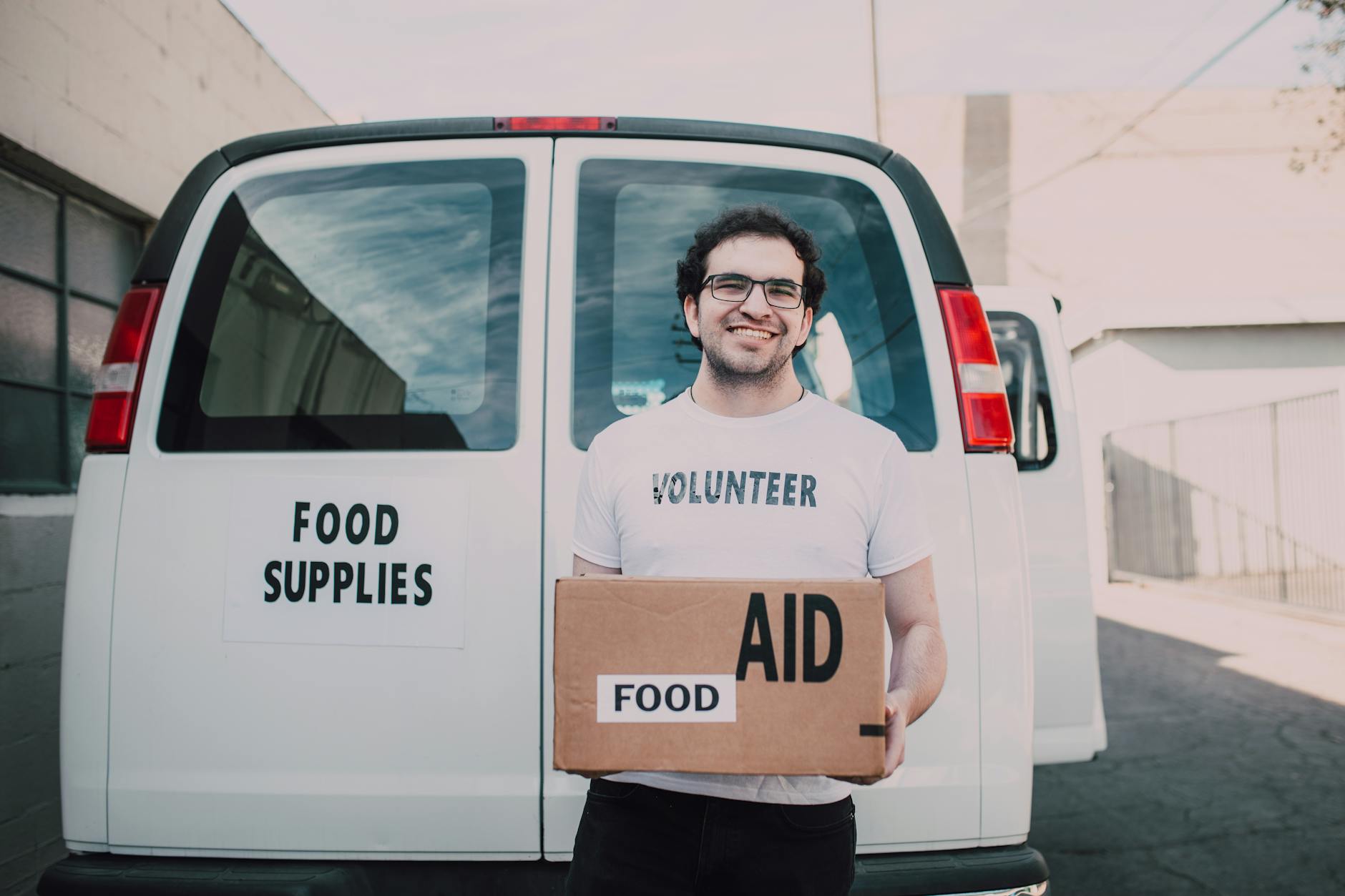
One of the most genuine and generous students suggested that we make dinners to distribute to the homeless people who gathered in certain spots of downtown Houston. He described a process that his mother had used to make chicken with rice for big crowds. He describe how we might place the meals in individual containers and them carry to the people who would no doubt enjoy some good home cooking. His idea was so detailed that we already knew how much it would cost, how long it would take to prepare, and where the best places to distribute it would be. 

I explained to the students that I had to get approval for such a venture by checking with the upper levels of administration since we would be officially representing the charter schools and delivering our food in a school owned vans. I did not tarry in attempting to garner all of the appropriate consents and soon found out that nobody can distribute food to homeless people in our city without an official permit acquired through a long process at City Hall. Inquiries soon convinced me that our group would never get such a document and therefore this was not something that we would be able to do no matter how wonderful it seemed to be. 

Of course the students were distraught to hear to news. Some of them went so far as to do research on their own to find a loophole. They soon enough learned that the roadblocks to such charitable work are enormous and we gave up on the idea with great sorrow.

This background story gets me to the heart of this essay. There are a magnitude of rules and laws that make it almost impossible to help homeless people without handing them cash and hoping that it gets used for all the right purposes. We can’t distribute food without jumping through legal hoops and now the Supreme Court says that if a city or town outlaws sleeping in public places, homeless individuals may be punished for doing so. The question becomes who is going to make sure that they have the resources they need to eat and be able to sleep at night?

Our homeless population is on the streets for a multitude of reasons. Some are indeed addicted to drugs or alcohol, but many suffer from mental illnesses that have been left untreated. There are families that have simply hit hard times. There are veterans suffering from multiple illnesses including PTSD. My grandson recently reminded me that we should not just view such people as losers or somehow deficient. But circumstance we might find ourselves or someone we know among them. 

My grandfather often spoke of the grinding inhumanity of poverty. He remembered seeing Coxey’s Army when he was a young boy. They were a congregations of poor souls who were starving, homeless and unable to enjoy the security of home and food that most of us take for granted. This was back in the nineteenth century and we still have people who struggle to find the most basic necessities of living more than a century later. 

Over time we’ve called such people bums or hoboes or Okies. We’ve read about them in The Grapes of Wrath. We often dehumanize them and view them as nuisances who scar the landscape of our cities. We see them as a problem but do so little to help solve the problem like my students attempted to do. We want to punish them rather than work to help them live a dignified life. We don’t want to spend money on them because we see them as helpless and hopeless individuals who will waste or efforts. 

It is our shame to be this way. My grandfather told me this years ago. My students saw this as well. It’s time that we find a humane way to deal with the people who have no place to go instead of creating laws that dehumanize them. They have many needs that we can provide on the way to helping them overcome the issues that have made them homeless in the first place. It’s long past time to really try. We can no longer just look the other way or tsk tsk when we see them. Surely we have enough to share our bounty and our love.