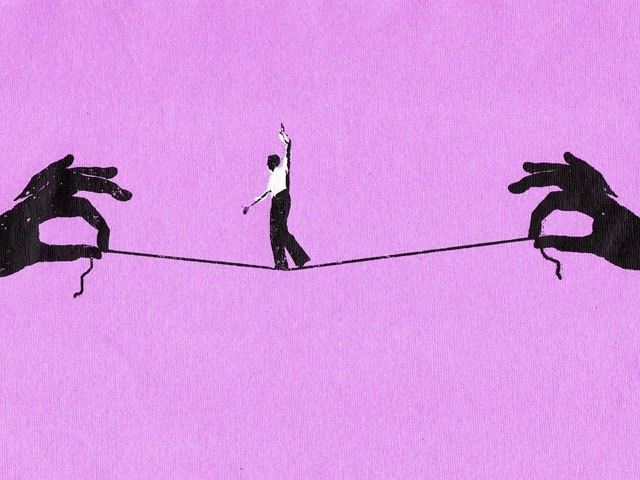
The Balancing Act

BalancingThere it was, a meme that spoke to me more than I cared to admit. “You’re killing yourself for a job that would replace you if you dropped dead within a week.” It’s a rather simplistic thought that generalizes a bit too much, but it’s point is thought provoking. It’s main thrust might be applied to almost any situation in life with just a few changes of words. The fact is that we sometimes become so over involved in certain situations that we lose sight of what is really most important in our lives. Our work ethic overtakes us to the point of wearing us down, and then we grieve when we realize that perhaps our efforts were not appreciated nearly as much as we had thought. Finding that sweet spot that allows us to achieve balance in our lives is one of our greatest challenges, and one that is far more important than we might imagine.

We are taught the importance of hard work from the time that we are quite young. In today’s world those lessons begin earlier and earlier as very small children are enrolled in early education programs, sports clubs, music lessons and a host of activities that keep them busy from the time that they awake until they fall into their beds at night. Some tiny children have an endless round of appointments designed to develop the best of their talents. Parents and nannies help them adhere to carefully orchestrated schedules. Admittedly there are many children who thrive in such circumstances, but there are others who begin to show signs of stress in the form of crying fits, behavior changes and exhaustion.

I have seen such children hanging limply onto their parents with vacant looks and sometimes even fear. When I worked in an after school program for pre-schoolers and kindergartners it was sometimes difficult to keep them awake because they were so tired. Many of them had arrived at the school at seven in the morning and would not be picked up by their parents until six in the evening. They were grumpy and probably would have benefitted more from play time at home than the all day structure that ruled their little lives. Smaller doses of opportunity generally work better for little ones, but we all too often adopt a more is better philosophy forgetting that all of us need respite from the daily grind now and then.

As children grow older the demands on their time and energy only increase. Not only do we plan their hours, but we also introduce them to the glories of competitiveness. We expect them to perfect their skills and talents so that they will eventually become champions. Of course there is nothing innately wrong with that, but often in our quest to help them to become their best selves we over extend them so that their hours are filled, leaving them with little time to explore and create on their own. Sometimes down time can be more powerful in helping youngsters to begin to know themselves than keeping them so busy that they can’t really think, It is when they are on their own that they organically develop and learn through trial and error.

By high school the pressure on our teens can be overwhelming. Not only are they expected to do well academically in as many Advanced Placement classes as possible, but also to participate in extracurricular activities and community service. As one young man recently noted, they generally have about seven hours to themselves each evening if they stay up until midnight, less if they go to bed earlier. If they are involved in athletics or other organizations that number of hours may be reduced by two or four hours each day, leaving them only a short amount of time to study and just relax and be a teenager. Research has shown that most high school students are sleep deprived from attempting to pack so much into their daily schedules.

One of my grandsons decided on his own to remedy the trend of over extending. While he was in high school he achieved balance by carefully limiting the number of activities and advanced classes in which he was willing to participate. He realized that he was more often enriched by discussions at the family dinner table or late night intellectual conversations with his father and older brother. He understood the importance of quiet times without obligations attached to them. He saw that far too many of his peers were crashing and burning because they were carrying way too much excess baggage on their shoulders.

When we finally go to work we want to impress our supervisors as well as our peers. We are often willing to go an extra mile to demonstrate our loyalty, which is all well and good if we also remember our own personal needs. When our job becomes an obsession then we may want to step back just a bit. if we see that family and friends are suffering because we are continually absent, a real problem is beginning to brew. When we can’t even rest without dwelling on our work, we may have become over involved. 

I’m not particularly someone to give advice regarding work life balance because there were multiple instances when I became so focused on studies or work that I totally neglected those who really loved me. I have been competitive to the extreme at times, and sadly my efforts were not always noted and appreciated by my superiors. Luckily those dearest to me were always there to pick up the pieces of my disappointments. At some point along my journey I finally managed to find a kind of work/life balance that made me far healthier than I had ever before been.

I am a living example of someone who looked outward and did my best to impress people who no doubt would have quickly found a substitute for me had I dropped dead. I worked so hard to be the valedictorian of my high school that I missed many of the joys of friendship and adventure that are an integral part of growing up. My achievement was soon forgotten and I found myself having to prove my mettle again and again in real life. I strove to be that person who demonstrated a willingness to be the last woman standing in pursuit of the goals of those for whom I worked. When others went home, I stayed behind to help, sometimes even when my own children needed me to be with them. I regret that I pushed myself so hard, but I am also thankful for dear friends like Pat and Bill who gently counseled me to learn how to focus on what was most important in my life. With such guidance and the support of my family I eventually found ways to have it all. I was able to clock out from work and leave it behind while I luxuriated in the warmth of home. It took me far too long to get there.

If I had one bit of advice for young men and women who are just beginning their careers or for new parents it would be to follow the wisdom of one of my teachers from long ago. He told us that we all needed to be fully present in whatever we were doing, never allowing ourselves to dwell on other things that were bearing down on us. He emphasized that we should work hard and play hard with equal vigor. He cautioned us to adjust whenever we found ourselves too preoccupied with any one thing. Keeping that balance, he suggested, would make us both healthy and happy. His was a message that all of us would do well to hear. Unfortunately I ignored his message for far too long. I’m glad I finally got my head on straight.


It’s Ten O’Clock

disillusionment-clipart-analog-clock-in-yellow-at-ten-o-clock_416058

It’s ten o’clock. Do you know where your children are?” If you grew up or were a parent in the 1960s, 1970s or 1980s you heard this question every night before the late newscast came on. It was a public service announcement that made sense then, but may be a bit confusing in today’s world. Back in those decades most children were what we now call “free range kids.” They played outside for hours at a time, often with little or no supervision other than a quick glance outside a window from a parent. They wandered away from home to visit with neighborhood friends, not always bothering to check in with parents before doing so. It wasn’t unusual at all for children to return outdoors after dinner to play in the dark under a street light or on someone’s front porch. It was a time of innocence when parents and kids both rarely worried about being harmed. Everyone knew everyone else and watched over one another. Perhaps the freedom that little ones enjoyed back then was fueled by naivety, but it was highly unusual for someone to be lost or harmed, there was little reason to worry.

The closest thing to a dangerous experience that I recall came when my youngest brother was playing a game of football in his bare feet in an overgrown field of grass. Hidden in the tall weeds was a broken bottle with its ragged edge pointing upward. When he stepped back to catch a pass he placed his unprotected foot on the shard of glass which immediately severed his achilles tendon. He bled profusely, but my mom and I miraculously got him to the doctor’s office in time to get it stitched back in place. I remember my mother instructing me in how to apply pressure to the wound to keep the bleeding to a minimum while she drove the car. I was quite frightened but didn’t let my mom see my fears. Of course at that time none of us were wearing a seatbelt and my mother did not carry health insurance either. The former was not yet invented and the latter was too expensive. The doctor did all of the surgery in his office proclaiming again and again that it was a miracle that my sibling didn’t bleed to death on the way over. I suspect that our final bill was little more than around twenty dollars and that even included pain medication that the doc threw in for good measure.

Needless to say times have changed so very much. Parents who allow their children to roam freely today run the risk of being reported to CPS. Few doctors would meet a patient at the office and take care of such a serious situation, especially if the family was uninsured. The world often feels far more dangerous than it ever did back then. Most of the time there are very few children playing outside for hours, and never all alone. They are busy with more carefully planned activities. Play dates have become the norm rather than random knocks at the door from friends seeking adventure. Children spend hours involved with computer games and surfing online. The real dangers lie in encounters with child predators masquerading in anonymity. Bullying either online or with texts has become epidemic. It’s no longer a matter of wondering where your kids are, but of whom they may be encountering on the worldwide web. The simplicity and innocence that marked my childhood and that of my own children seems to be a relic of the past. Parents have to be more careful than ever, even as they hover nervously.

I’m  not certain when everything began to change. Perhaps my experiences come from living in a city that had fewer than a million people when I was young and then somehow became a behemoth of over four million in a short period of time. Being in a place that large certainly makes a huge difference in how willing parents are to allow their children the freedom to interact without their watchful eyes. The dangers seem to grow exponentially in a major urban area. Still it just seems that over the years we have become more worried as a whole society. Maybe our twenty four hour news cycle has made us more aware of what might happen if we ride a bicycle without a helmet or drink from a water hose. I still wonder nonetheless why we no longer see children roller skating down the sidewalk or climbing the tree in the front yard even when their parents are around to guard them. Where are the street basketball games? When did our kids stop playing hop scotch on the driveway? Are they missing something wonderful, or is their world actually just an improved version of ours?

Children today certainly appear to be happy enough. I’ve always known youngsters to be quite adaptable. They tend to accept whatever reality is theirs. They don’t feel that they are missing something that they have never experienced. The child who lives in a high rise building in New York City learns to play in different ways from a counterpart growing up on a farm in Iowa. Both of them will tend to be perfectly happy as long as they are nurtured and loved. Perhaps the nostalgia that old folks like me have is thought to be quaint or even strange by the children of today. They would think it unwise, perhaps even crazy to ride down a highway in the bed of a pickup truck. They might easily bore of lying on their backs staring up at clouds searching for shapes of animals.

Sometimes it’s difficult to tell if things are getting better or if we have lost something special that we once had. I suppose that the reality is that we will always move ever forward, and while it may feel pleasant to lose ourselves in memories we are better served by joining in the forward progress. We have surely learned a great deal about how to be healthier and safer than ever before. We understand what smoking will do to our overall health. We realize that wearing seat belts and engineering safer cars has truly saved lives. We have used our common sense and our inventiveness to prevent harm and injuries to our most vulnerable. I suppose that it is a very good thing that we no longer have to ask where are children are when the clock strikes ten. 

Waking Up Rich

My-heart-set-on-waking-up-rich-today---ecardA meme caught my eye and I found myself thinking about its message: Really had my heart set on waking up rich today. Of course the idea of being wealthy is relative despite demographic brackets that provide numerical outlines to help us determine who is affluent and who is not. How we feel about our circumstances is often a better determinant of our financial value than our bank statements. We all know someone who has very little but is content, and others who should be comfortable who are never quite happy. The reality is that virtually everyone in the United States is richer than most of the people in other less prosperous places of the world, and as a matter of fact here in our country most of us enjoy existences that would have impressed even the very prosperous of bygone eras.

Recently I watched a program that featured the stories of immigrants who lived on London’s East End during the late eighteen hundreds. Many of them came from Russia as a result of economic hardships or political atrocities. They found themselves in an unfamiliar land without employable skills or facility with the language. They were forced to toil in sweatshops laboring for fourteen hours six or seven days a week just to barely survive. They were fined for the slightest of transgressions like talking while on the job,  usually making their eventual pay quite meager. Conditions were cruel made even more so by the competition for back breaking employment that might end at any moment. Many a wretched soul died from malnutrition, disease, exhaustion, injuries, or violence. People who lived in the East End were thought to be stupid, lazy and prone to criminal natures. The wealthy and those in the middle class rarely saw them as equal humans, and often enjoyed taking guided tours to the slums to gawk at the life styles of the unfortunate poor, but rarely to actually help them. Life in the slums was brutal and demeaning, almost impossible for most of us to imagine. Even more incredible is the fact that such situations were commonplace only a little more than a hundred years ago, and still exist in many parts of the world.

We have our chronically poor, our homeless, and those who live in difficult circumstances even to this day, but generally there are programs designed to help them. Indigent children receive free or reduced price breakfast and lunch. We provide food stamps and welfare assistance for those in need. Even though such programs are far from perfect, they are more generous than the want that some of our ancestors experienced. For the most part we do indeed care for those who are lacking in the basics of existence. Education is free. There are ways of improving our stations in life. There is light at the end of poverty’s dark tunnel here in the United States, leaving room for optimism, and yet even among those of us who are above the poverty line there is often great dissatisfaction. The grass all too often appears to be greener and we find ourselves wishing for more.

There is certainly nothing wrong with working hard and achieving goals that allow us to feel more economically secure, but in our quest we should all allot enough time to enjoy and appreciate what we have rather than constantly wishing for more. The years go by far more quickly than we might imagine and all too often people find themselves running out of time to find contentment, especially if they have always measured it in terms of money and possessions. The real question becomes how much does anyone truly need to have a sense of security?

I was recently talking with a woman who would qualify as being poor by almost any standard, and yet her spirit is as bright and satisfied as anyone whom I’ve ever met. Her life is simple, uncomplicated and she lives modestly from paycheck to paycheck. She has learned how to stretch her finances to the maximum, and seems to take joy in playing the game of getting the most out of how little that she has. She lives in a low cost but nicely maintained apartment that is stocked with the appliances that she most needs, including a washer and dryer. She found all of her furniture at thrift stores and is quite proud not just of the low prices that she paid, but also of how well she put the disparate pieces together to create a warm and inviting environment. She is always on the lookout for bargains and items for which she might trade her skills or something that she no longer wants. For example she doesn’t travel anymore so she exchanged a suitcase for a rocking chair. She finds things in the dumpster that she repurposes, including plants that appear to be half dead but still have enough life in them to benefit from her green thumb. She gets the books that she reads from the library and uses bargain priced old clothing to create pillows and cushions for her decor. She clips coupons and creates low cost but healthy recipes. It’s a challenge to stay afloat, but instead of stewing over what she lacks she takes great pride in knowing how to stretch her pennies. For entertainment she volunteers at museums and reads each morning over a long cup of coffee. She remains one of the most upbeat individuals that I know even while living on the edge. She refuses to waster her time with worry, instead finding joy in the simplest of pursuits.

On the other hand, I also know of people who have great wealth but constantly worry about losing it. They have made themselves miserable with fear. They cling to their bank accounts wary of spending or sharing lest some unforeseen disaster befall them. The years tick by and they live like miserly hermits, ranting about those that they think might unfairly get handouts. Somehow like Ebenezer Scrooge they have lost their hearts and sometimes even their souls. They cannot see that most of us are the descendants of people who once struggled as mightily as the poor folks who lived in the slums of London’s East End. They avert their glances from thoughts of pain and suffering, isolating themselves from their very humanity.

Admittedly it would be nice to wake up to find that our bank accounts are full and that we will never again have to worry about the future, but even better is adopting an attitude of being happy regardless of our circumstances. At the end of the day the measure of our lives will be found in our relationships and the purposes for which we lived. In fact, research has shown that our longevity is more likely if we have spent our time being joyful social beings. 

I woke up this morning and I wasn’t any wealthier financially than I had been last night, but as I glanced around my home I saw reminders of those special kind of moments that literally took my breath away. As I made my breakfast I thought of how wondrous each passing year has been and listened to my neighborhood coming alive. I realized that if truth be told I wake up rich every single morning because of the wonderful life I have been fortunate enough to live. It was comforting the know that I am so prosperous. 

Being There

a-heart-made-of-stone-from-god-to-remind-us-of-his-love-brigette-hollenbeckImagine being an American of Japanese decent immediately after the bombing of Pearl Harbor. It had to have been a very frightening time for everyone, but the overreaction to the incident resulted in fear of anyone who was Japanese even if they were born here and had lived in our country for decades. The United States government answered the attack by rounding up these citizens and placing them in detention camps, one of the more unfortunate missteps in our country’s history. Among them was a little girl who lived in Los Angeles. She was in the first grade at the time and her best friend was Mary Frances. Immediately after Pearl Harbor the little girl became a pariah through no fault of her own. Only Mary Frances continued to be her ally and to protect her from the taunts that rained down on her head. Eventually the child and her family were sent to Wyoming where they lived behind a chain link fence fortified with barbed wire. Their conditions were cramped and frightening, and the little one did not understand what was happening, but she would always remember how Mary Frances had stood up for her. She loved Mary Frances and never ever forgot her.

A lifetime of years passed. The little girl became a woman. She studied to be a nurse and worked all over the world. She had a very good and productive life, but more than anything she wanted to find Mary Frances to thank her for her unfaltering friendship. She had no idea how to even begin, but with the help of professionals she tracked Mary Frances down. They planned to meet in the Japanese Gardens in San Francisco. There the once tiny child who was now an old woman rejoiced upon seeing her old pal. She was finally able to describe how important Mary Frances had been to her at that crucial time.

As I heard this story I thought of the people who have passed through my life who were exactly where I needed them to be at important junctures in my development. Most of them were there and then they were gone forever. I never really had an opportunity to tell them how much they actually meant to me, and I so wish that I might one day see them again.

My first recollection is of a woman named Pat Wright. She was our next door neighbor when I was no more than four or five years old. She was a striking woman with a flair for the spectacular. She might have played the role of “Auntie Mame.” She was a commercial artist and her home reflected her avant guard take on life. She often invited me to visit with her and in those times she and I created art work together. She told me how talented I was and made me feel as though I was the most special person on earth. Nobody other than family members had ever before been so attentive to me and I loved her dearly. We moved when I was six and my parents made promises to get together for visits, but somehow that never happened, and so I never again saw Pat Wright. I have thought of her over and over again and smiled at the memory of being in her extraordinary home and drawing with her professional tools. I suppose that if she were even alive she would be well into her nineties. I would so enjoy being able to tell her how much I enjoyed our time together, but I suppose that will never really happen.

When I was five years old my parents enrolled me in the first grade with no warning. One day they simply announced that I would be going to school the following morning. I was terrified, but unwilling to reveal my fear with tears. I needn’t have been so worried because I was soon to meet two angels who have forever been in my heart. The first was my teacher, Sister Camilla, who in so many ways inspired me to become a teacher and influenced my teaching style. She was gentle and loving and helped me to feel welcomed and secure. I also met a girl named Virginia who seemed to sense just how upset and worried I was. She guided me through the ropes of being a student as well as a youngster is capable of doing. She gave me wise advice and encouraged me. I adored her as much as I did Sister Camilla. Between the two of them school became a happy place for me. I had thought that Virginia and I would surely be best friends forever, but that was not to be. My family moved to a new neighborhood and soon I was in another school.

I imagined that I would never again see either Sister Camilla or Virginia, but as with Pat Wright I carried the warm memories of being with them in my memory. Consider my surprise when I learned at my fiftieth high school reunion that a number of my classmates had been in that same classroom when I was, and among them was Virginia. I have learned that Virginia is today as sweet and wonderful as she was back then, and I hope that she doesn’t think it too strange when I tell her what a profound impact she had on me.

There have been others like Rose Marie Frey, a neighbor who was perhaps the most beautiful woman that I have ever known. She had five children of her own but somehow she always found time to talk with me and make me feel very grown up. She taught me how to do so many things that I might otherwise never have known about. I was quite sad when she and her family left our neighborhood. We went to visit them many times but as so often happens we soon lost touch. I truly hope that she has had a very good life.

Perhaps Edith Barry wins the grand prize for being there when I most needed someone. She and my mother were the best of friends and had shared many secrets with one another. One of the things that my mom had confessed to Edith was her fear of being diagnosed as mentally ill like her mother had been. She asked Edith to promise that she would be a protector if anyone ever even suggested that Mama needed medical care for such an illness. Of course how could Edith have known that my mother would have a terrible nervous breakdown requiring hospitalization? When virtually every adult abandoned me as I struggled to get my mom the care that she so desperately needed it was only Edith who was willing to incur Mama’s wrath and be a true and loving friend by insisting that she admit herself for care. By helping me Edith did in fact lose my mother. Their friendship suffered, but I understood all too well that Edith had made the ultimate loving sacrifice and she would become my all time hero. I don’t suppose that I really ever explained to her how much I appreciated what she had done. Now she is gone and I can only hope that somehow she knew.

We each have those special people. They do remarkable things for us that we almost take for granted at the time, but in retrospect we realize how wonderful they actually were. We would do well not to wait too long to let them know how important they have been. 

Bogey Men Under The Bed

bogeyman.jpg.560x0_q80_crop-smart

Not long ago I awoke in the morning to find that we had left the garage door open all night long and forgotten to lock the door into the house as well. I flew into a state of panic considering what might have happened to us had we not been very lucky, and I began to think about my experiences as a child. Back then our windows were wide open all summer long, all night long. We didn’t own an air conditioner, so we relied on the breeze from our attic fan to keep us relatively cool. It never occurred to us to be frightened that someone might enter our home quite easily, but it would have required little effort to pop out the screen and climb right inside. In fact, we had done just that a few times when we didn’t want our mom to know that we had been out and about a bit too late. She no doubt wasn’t fooled by our antics, but we thought ourselves quite adventurous. At no time did we imagine that someone with criminal intent might one day use the same route as ours to invade our home. We always felt quite safe whether we should have or not, and nothing ever happened to change our beliefs.

During the day we kept the doors to our home ajar as well. Friends and neighbors came and went with little more than a quick knock and a shouted “hello” to warn us that they were incoming. It was as though we were just one great big happy family in our community with nary a thought of home invasions or such. Perhaps we were naive, or maybe it really was as secure as we assumed.

The funny thing is that my mother was quite relaxed inside our little haven, but she was quite guarded whenever we were traveling through the city, especially at night. She was distrustful of strangers and instructed us over and over again in the necessity of avoiding any kind of contact with people that we did not know. She freaked out royally when I once accepted a ride from a man that I only minimally new. She raised such a ruckus that I found myself almost running if a stranger even looked my way. I suppose that I was more afraid of her anger than I was of someone that I did not know. Luckily it was quite rare for unknown persons to come our way.

I watched our little world change over time. My brothers and I moved away from home and my mom purchased a new house in a different neighborhood where she never felt quite as relaxed as she had in the home where I had grown up. She put chains and extra bolts on the doors and screwed her windows permanently shut. She installed peepholes and kept her blinds and drapes tightly shut. There was little wonder for her caution for not only was she living alone, but  she had also been burglarized multiple times by then. Fortunately the robbers only came when she was not home, but her fears grew nonetheless, as did my own.

I was living in a very nice apartment project where I had many good friends when i learned that one of them had been raped upon returning from the laundry room one day. A man had followed her back into her place and threatened her with a knife. She silently submitted to his demands because she had a sleeping child in another room, and she feared what might happen if the baby awakened. I recall the horror that all of us felt along with the unadulterated fear. My husband often worked an evening shift during that time and I grew more and more uncomfortable living in that place. I was somewhat relieved when we finally moved, but my sense of complacency was forever gone. Never again would I be lax in protecting myself, even when I lived in a neighborhood where I knew everyone and felt quite secure.

As a society we have become very afraid, sadly often with good reason. Virtually everyone that I know has been the victim of some kind of crime, from the somewhat trivial to horrific incidents. One of my husband’s uncles was bound and gagged in his home while thieves ransacked his belongings. But for the grace of God they chose to keep him alive. The worst of the terrifying situations were the murders of two of my former students in unrelated incidents.

Our streets and our homes have seemingly become unsafe, and so we install cameras and alarm systems in addition to heavy metal doors and locks, even when we have few possessions that would be of much worth to home invaders. The idea of sleeping with the windows open is unimaginable.

I sometimes wonder if those who speak of “making America great again” are thinking less about issues of equality and more about a time when crimes against strangers were unusual rather than as frequent as they now appear to be. Given the ages of the supporters of the MAGA idea I suspect that they remember an era when everyone felt incredibly safe without walls or locks or loaded guns. Maybe they actually believe that given the right circumstances we might once again return to less fright filled lifestyles. My guess is that they long for the serenity that once felt so commonplace.

The saying goes that you can’t go home again. I suppose that we are long past the days of openness to the extent that we enjoyed fifty or sixty years ago. We have to adapt to the new ways, but we needn’t become overly afraid either. The fact is that in spite of rising crime rates and the need to exercise caution, we mostly enjoy our lives without incident. The reason that hearing of terrible events is so shocking is because they are still mostly rare. We don’t have to lock ourselves away as long as we have a bit of common sense, which includes checking doors and such before going to sleep. We don’t need to be so lax as to leave ourselves wide open for trouble like my husband and I accidentally did, but we don’t have to be constantly worrying either because given the odds most of us will blessedly never encounter trouble.

I’d truly enjoy having the same peace of mind that I experienced as a child, but in reality it came mostly because I was too innocent to even imagine that I would be touched by violence. Bad people were out there even back in the day, but I paid little attention to them chiefly because my mom sheltered me from such things. We had a neighbor who was murdered by her husband, and my sweet mother explained that the man had just been very sick and we did not need to worry. Our response was to avoid walking near the house where the crime had occurred, but otherwise having little concern that something similar might one day happen to any of us. Our innocence was in actuality not that far off of the mark, and we would be wise to carry on with our lives without overthinking our possibilities of being harmed.

Humans have worried about boogeymen under the bed for centuries. Sometimes they are real, but mostly we are just as safe as we have ever been as long as we take care not to place ourselves in harms way.