Haste Makes Waste

quote-take-time-for-all-things-great-haste-makes-great-waste-benjamin-franklin-65418Has it really only been four weeks since Donald Trump was inaugurated as President of the United States? It’s been wild to say the least. I find myself wondering if Mr. President and his family are wishing that the “nasty woman” had been elected and they were safely enjoying life in Trump Tower. He is surely learning the job in a trial by fire and his opponents are licking their chops gleefully with every mistake that he makes.

It’s been pretty well documented that I am no fan of President Trump, but my personality is such that I have actually been feeling a bit sorry for him of late. He is proving to be quite amateurish and more and more the butt of jokes with each passing day. In the one Mardi Gras parade that I attended this past weekend in New Orleans he was skewered from stem to stern. The jokes were funny but after a time they almost became tedious even though Trump has brought most of the insults on himself.

It’s obvious to me that  President Trump has a strong need to be loved and right now adulation is in short supply. I suspect that he is desperately hoping for a win, something that will put him back in the “good guy” status that he had when he was just a reality television personality and super salesman. Surely he is longing for the days when his and Ivanka’s merchandise were big sellers in major department stores and he was a ratings king on NBC. Now it seems that he is a pariah in the very places that he most loves. He surely proves that it can be very lonely at the top. (Side note: Have you ever tried Ivanka’s dresses? They are actually superb and make women look thinner than they actually are.)

I like to be fair and in all honesty this is not the first time that I have watched an administration produce some wildly unsuccessful policies before they got their sea legs. As beloved as President Kennedy now is, history demonstrates that his invasion of the Bay of Pigs was a total disaster. If he hadn’t been able to face down the Russians in the Cuban missile crisis his reputation for foreign policy would have been dreary. Lyndon Johnson messed up royally in the Bay of Tonkin and even lied about what had actually happened. Of course such missteps contributed to keeping him from seeking a second term of office and probably didn’t help his heart either. I don’t even need to talk specifically about Nixon whose administration might have actually been deemed a success had he not been so paranoid. Then there were all the wonderful highlights from Carter’s time including those long lines at gas stations and the Iranian hostage situation. In the first year’s of Reagan’s tenure elements of the press were certain that he was going to get us into a world war and destroy our economy. George H. W. Bush couldn’t live down his promise not to create new taxes after he turned around and created new taxes. Clinton’s first years had so many scandals that few thought he had a chance of being reelected and that was before he had even met Monica. In case you don’t remember what happened just think about the suicide of his closest aide, the imprisonment of a former business partner in the Whitewater affair and the infamous firing of the entire travel department. Poor George W. listened to some faulty advice and got us entangled in Iraq among other dubious efforts. Obamacare was designed so quickly that it was flawed from its inception. In other words, there have been few presidents with perfectly executed administrations, particularly at the very beginning. Still, President Trump has shown a particular talent for speaking and acting before thinking through the implications of his efforts. I believe that it is now time for him to learn from his mistakes and begin to take more care in making decisions.

We have a tendency in today’s world to want everything to happen quickly, forgetting that sometimes the best results come slowly. We seem to always be focusing on results but we want to see progress as fast as possible. In education we demand that school reforms demonstrate dramatic improvement in the space of only months even though we tend to understand that real change takes time.

I recall once reading about a school that had defied all of the odds in demonstrating excellence in what had once been a sub par campus. The principal explained that it had taken him ten years to create an educational environment in which students consistently learned at a high level. He had to build his faculty and dedicate hours to creating a curriculum attuned to the needs of the student population. He sent school leaders to learn the best educational practices. He and the teachers helped students to build their confidence and push themselves higher and higher. The principal was thankful that he was provided with the time that he needed to accomplish his goals. He noted that if his supervisor had been too anxious he might have been relieved of his duties before his plans had begun to show progress. He urged all leaders as well as the public to be patient and realize that deliberation was always a better strategy than haste.

I would suggest to President Trump that he slow his pace. I understand that he wants to fulfill his promises to his voters but his grand designs can’t be achieved in a matter of days or weeks or even months if they are to have a wise and lasting effect. He would be far better served by spending more time listening not just to his inner circle but also to his critics before writing any more ill conceived orders. I hope that he is beginning to realize that making far reaching pronouncements is not as easy as it may have seemed. Without thinking long and hard disastrous roll outs like his temporary travel ban will happen again and again. If he doesn’t take more care in choosing his closest aides and cabinet members he will be embroiled in legal battles for years. It’s time for him to take a deep breath and recalibrate. He might begin by ridding himself of the very negative influence of Steve Bannon as long as he is in the “you’re fired mode” of this week. Mr. Bannon is reinforcing the worst inclinations of President Trump. He may seem loyal but I think that he actually has his own agenda and is only using his influence to create policy.

I have a bit of advice for the opposition as well. Be selective in your criticism. Be aware that constant negativity soon begins to resemble nagging which virtually nobody likes or considers. Remember that if you make yourself too obnoxious President Trump will never listen to a thing that you have to say. Recall also that he wants to be liked. You can get your foot in the door if you use a bit of positive reinforcement now and again. If someone wise and honest wants to help President Trump encourage them to do so rather than condemning him/her. We definitely need good people around our president, not just those who want to build walls. My suggestion goes for athletes and stars as well. Be willing to go visit him and then quietly and respectfully present your points of view.

I’m hoping for a change all the way around but I’m not counting on anything. I fear that we are so far apart from one another that we are at present incapable of finding even an inch of common ground. I still believe that the answers to our problems lie in compromise. For too long the extremists in our society have been calling the shots. If we are to ever move forward we are going to need to work together. If there were one idea that I would most love for President Trump to embrace it would be to find ways of deliberating with all parties in an attempt to work together for the good of the country. As long as we keep fighting we will simply move back and forth in place never making headway of any kind. Since we can’t seem to agree on much of anything maybe for now that’s a good thing but we have to be ready to feel frustrated until we finally learn how to get along once again.
Karma and Lessons From History

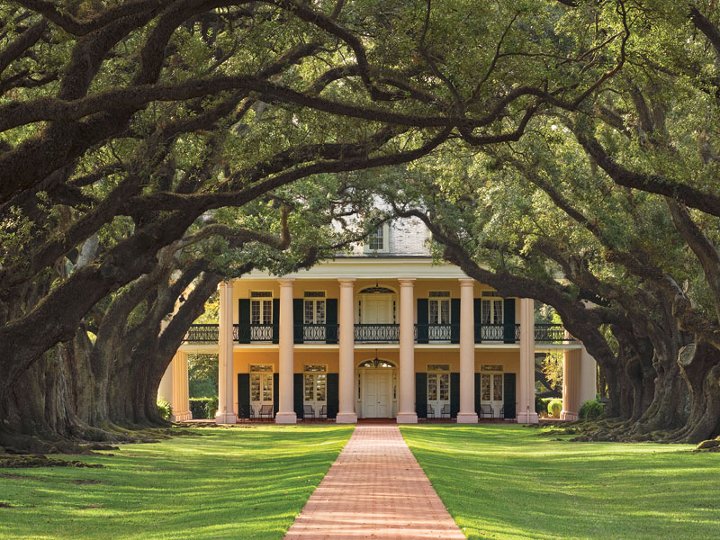
gallery-121Way back in the 1700’s someone planted two rows of oak trees in land facing the Mississippi River. More than a hundred years later Jacque Roman, a wealthy French Creole, saw the avenue created by those trees and purchased the land to build a mansion for his wife and a plantation as a business. The estate that he created would one day become known as Oak Alley and it stands today as a reminder of a controversial time in our nation’s history.

Jacque Roman was a handsome, wealthy and well educated fellow who grew up in the French Quarter of New Orleans. He was considered a promising catch for some fortunate young lady. He thought that he had found the woman of his dreams when he saw Celine, a high spirited soul who lit up drawing rooms and parties wherever she went. Jacque was as shy as Celine was outgoing, but he impressed her with his gentlemanly devotion to her. They married and he promised to one day create a magnificent home for her. Thus he knew that he had found just the place when he saw those elegant oaks.

Jacque started his sugarcane business first. He added more than a hundred fifty slaves to those who came with the land. He paid top dollar for some of them and even sent one to France to train as a chef for the time when Jacque would bring Celine to his dream house. He thought of every little detail that might make her happy and indeed when she first set eyes on the place she was overwhelmed. Sadly her joy was not long lived. She birthed six children in seven years. She had to watch three of them die from diseases like yellow fever and tuberculosis that were the norm for plantation life. It was a sad lifestyle for a social butterfly like Celine. The only people around for miles and miles were Jacque’s relatives with whom she had little in common. Her dislike for them only grew to total disdain as the tedium overtook her once delightful personality. She came more and more to hate the plantation and the dreary routine that her husband had created for her.

When news came that Celine’s mother had died and that her father needed help raising her younger siblings she jumped at the opportunity to leave the plantation. She took her remaining children with her to New Orleans and her visits to her husband grew farther and farther apart until she was no longer even pretending to want to go back to what had been a home built just for her. She made one final visit when Jacque was dying from tuberculosis. After that she attempted to run the plantation from afar racking up huge debts from her profligate spending habits. By the time that her eldest son took over the plantation was mostly in ruins and the Civil War would sound its death knell.

Celine and Jacque’s three children abandoned the family estate. One of the girls lost her left leg in a terrible accident and with no prospects of marriage after becoming disabled she entered a Carmelite convent. The other daughter lead a rather mundane life with a husband and four children. The son was a successful businessman but had to sell the plantation at a huge loss which barely covered the family’s debts.

The house itself languished in ruins until the nineteen twenties. By then the roof had caved in and animals roamed freely through the once elegant rooms. The Italian marble floors were broken and it seemed as though the old place was destined to be destroyed but for a woman from south Texas who had met and married a wealthy New Orleans businessman by the name of Stewart who had promised her that when he retired he would purchase a farm or ranch for her. When the time came Mrs. Stewart became enchanted with the idea of resurrecting the old structure. With an investment double the price of the property the house was renovated and made more modern. Mrs. Stewart brought cattle and horses to the land. She lived happily in the house until the nineteen seventies. She had no children and fearing that her heirs might neglect the estate, Mrs. Stewart created a foundation to care for the antebellum home in perpetuity. Today it stands as a reminder of a time long ago, open to visitors seven days a week.

The story of Jacque and Celine was touching but my feelings for them were offset when I walked to the area that would have once held the slave quarters. The names of the people who built and cared for the house and the land are listed on a wall. They are souls with only first names whose dignity and freedom were stripped from them without regard to their humanity. There were implements of punishment and torture on view. Chains and shackles that were used to hold and torture them. There were copies of letters in which Jacque gave his overseer instructions on how to imprison and punish disobedient slaves. Somehow those very clear words erased the pity that I had felt for this man who was making millions of dollars off of the free labor of two hundred souls. I imagined them living in cramped quarters without heat. I thought of how oppressive it must have been for them in the summer when the humidity was at one hundred percent and the mosquitoes were swarming. The contrast with the way that they were forced to live versus the members of the Roman family was heartbreaking.

One of the things that most struck me was the irony that Jacque thought enough to have his slaves baptized in the Catholic church but he did not see the immorality of his actions toward them. On the one hand he saw them as God’s people but on the other hand he considered them his possessions. He carefully recorded their names and the prices that he paid for them in a ledger. His handwriting was neat and precise and without feeling of any sort. They were simply part of the inventory of his possessions. While they served his every need, he was inside his elegant mansion with ice transported in barrels from the north to the tune of three hundred pounds each week. Somehow I began to feel that his estrangement from his wife and his family’s ultimate downfall was a kind of karma.

I realize that it was a different time. Slavery was legal and very much the rule in both the north and the south. The slaves were the human engines who drove the economic machines. Somehow the vast majority of people had convinced themselves that what they were doing was just, but the fact is that the abolitionists were already quite active when Jacque first decided to build his plantation. He would have heard their calls for emancipation but obviously ignored their arguments. It would take many more years for a war to break out between the states that would ultimately become a means of freeing the slaves. Sadly amidst all of the splendor of the remarkable home there is a stain that somehow can never be erased. Perhaps touring this place should remind us of our own duties to speak up for the rights of those who have no voices for themselves. We will all ultimately be judged by history. Let us hope that we will be on the right side.

A World At War

usa-la_-nola_-wwiimuseumIt’s difficult for most of us to even imagine what the world was like in 1941. The United States was not thought to be a powerful force. In fact it was ranked eighteenth in the terms of military might. The country was only beginning to recover from the effects of the Great Depression. Most of the country was rural and there were still a majority of homes without electricity or indoor plumbing. The mood was isolationist as the populace here watched events unfolding in Europe with horror but an intense belief that our nation needed to stay out of the fray. My mother was fifteen and my father eighteen as December began that year. They were yet to meet one another and naively unaware that life for every American citizen was about to change dramatically.

My mother often spoke of December 9, 1941 when the Japanese bombed the American fleet in Pearl Harbor. It was a fearful and shocking moment. She along with her countrymen listened to President Roosevelt as he reassured the nation. She remembered how quickly people answered his call for all Americans to participate in the coming war effort. She saw her brothers enlisting in various branches of the Armed Forces one by one, and saw high school friends leaving the classroom as soon as they were old enough to lend their help to the cause.

World War II was like no other engagement in history. Its influence stretched across the globe, affecting people on virtually every continent. Here at home citizens of every age contributed in one way or another. Women who had traditionally kept the home fires burning took over manufacturing jobs. Industries were cranking out planes and ships and munitions at a fevered pace. Everyone rationed their use of critical materials, including paper. My mother-in-law often showed me the yearbook from her senior year of high school. It was thinner than a monthly magazine, made only of the cheapest quality pulp. It mirrored the reality of the time with row after row of photos of mostly young girls. The boys had dropped out of school and to join the fight.

When our troops first went to faraway places like northern Africa and the Pacific they were ill prepared to battle the well trained and experienced Germans and Japanese. They often found themselves overwhelmed and in retreat in the earliest forays. They learned on the job and became just a bit better as they slowly understood the demands of the new ways of fighting. I have often wondered how those of us living in today’s world might react to news of battlefield losses and situations requiring our troops to run for safety. Would we have the heart to continue the fighting or would we give up quickly? Luckily the generation who fought World War II was made of stern stuff. They were determined to do whatever it took to free Europe from the grip of Nazi Germany and the Pacific from the Japanese.

There was much at stake and the American people understood that they could not be deterred from seeking total victory. In that regard both Japan and Germany had greatly underestimated the will of our country. There are those who wonder if the world might indeed look very different today had the United States not allied with Great Britain and Russia in that great fight against fascism and tyranny.

The World War II Museum in New Orleans, Louisiana is a repository of the remarkable history of that era. It is filled with the stories of both the leaders and the common people who worked together to defeat the enemies and free the world from their dominance. With hundreds of photographs, artifacts, videos and research texts it leads visitors from the beginnings of the conflict to its horrifying end with the explosions of atomic bombs over Hiroshima and Nagasaki. It is a touching and personal journey that is honestly and beautifully told.

The city of New Orleans was chosen as the site of the museum because it was the birthplace of the the inventor of the Higgins boat which was used to bring troops ashore at Normandy on D Day. Mr. Higgins was already making shallow draft boats for fishing in the bayous and swamps when the military expressed a need for a military version of such craft. He was ready to design a larger boat capable of transporting troops. The Higgins boats that were manufactured in New Orleans have often been credited with helping to win the war in Europe.

It’s been seventy five years since our nation entered World War II. By the end of the conflict the United States was viewed as a major political power. With an infrastructure unharmed by the devastation of the war we were poised to enjoy an economy exploding with innovation and production. The soldiers returned to an exciting time that included creating a new generation of children that would become known as the Boomers. The United States was slowly but surely transformed by the building of a system of interstate highways that made travel from one ocean to the other quicker and more open to all people. The same spirit that drove the success in the war continued its inventiveness all the way to the moon and back.

Those of us who were the children of the men and women who endured the uncertainties of war would inherit the fears of the atomic age. We would wear dog tags for a time to identify us in case of a nuclear attack from the Soviet Union. We practiced air raid drills each Friday afternoon, crouching under our desks in wonder and confusion. Our generation would be drafted into a new and different war in Vietnam that somehow never made as much sense as the one our parents had fought. We would march for the civil rights of our Black neighbors and those of us who are females would blaze new trails in education and work.

World War II was never just a long ago historic event to us. We saw those photos of our dads and uncles in their uniforms. We heard the stories of life under siege. We watched the old black and white movies that celebrated the accomplishments of our generals and troops. We saw the sadness in the eyes of those who lost loved ones in places so far away that nobody had even known that they existed before the battles. We were the link between the past and the present, the generation that watched the world change at such a rapid pace that it was sometimes difficult to keep up. We truly appreciated what the brave men and women of the world endured to secure a time of promise and opportunity for us.

Few people in 1941 might have imagined a nation so filled with the bounty that we now have. Ordinary citizens enjoy lifestyles that once belonged only to the wealthy. We live in modern homes and watch our big screen televisions that bring the world into our living rooms. We travel the world and study at universities at a rate that our parents never saw. We have much for which to be thankful and most of it resulted from the brave and unselfish acts of a generation that chose to defeat the forces of pure evil. Their story is on full view seven days a week at the World War II Museum in New Orleans. Every one of us should take the time to absorb the importance of the stories that are told there and to thank the veterans of that war and those who serve today to protect us. 

Finding Courage

confusionI have written a book. It has essentially been finished for more than two years and yet it languishes in the memory of my computer and in a distant hard drive that is protecting it lest my laptop suddenly crashes. If I were to take the time to do so I might have it uploaded as a Kindle or Apple book in less than a week. I would be a published author albeit by dent of my own initiative rather than interest from a company. For some reason I have been reluctant to take the final risk of revealing my story to the public. Upon self reflection I realize that my procrastination comes from enormous fear. Even though I place my ideas on public view five days and week, when it comes to my most personal essay ever I feel anxious about being misunderstood.

We live in a very contentious society. Words are continually being parsed and twisted into meanings that were never intended. Good people are all too often portrayed in very misleading and untrue ways. We take sentences out of context and figuratively burn people at the stake for having the temerity to suggest something with which we do not agree. We place our own interpretations on all utterances often to the detriment of what is actually true. Our sense of self-righteousness and judgmental natures have no bounds. It takes great courage to come forward in a very public way and so far I have to admit to being somewhat of a coward.

The topic of my book is quite delicate. It outlines my family’s journey through the tragedy of my father’s death and into the despair of my mother’s battle with bipolar disorder. Because we each perceive reality in different ways I have little doubt that my telling and interpretation of events my vary from others who shared some of the moments that I describe. They may disagree with how I have seen things and even feel betrayed that I have even spoken of some of our very private moments. I suspect that there will be those who do not understand that the intent of my book is to inspire and comfort anyone who has ever had occasion to deal with the complexities and difficulties of mental illness. It is not to embarrass or be disloyal.

Even in our very modern era we tend to have somewhat primitive reactions to mental illness. We do not understand the many forms that it may take. We still hide such diseases and too often treat them as personal defects rather than medical conditions. Our ignorance is indicative of our unwillingness to bring discussions of mental difficulties out into the open. If I mention that my husband has heart disease nobody recoils but if I speak of the bipolar disorder that so tragically invaded my mother’s brain I can visibly see the discomfort on people’s faces. Such conversations often stop abruptly because as a society we are not yet ready to face the realities of conditions that cause our brains to work differently.

There were times when my mother’s illness was quite frightening. She was consumed with paranoia and unable to complete even simple tasks. She became a victim of the delusions that raced through her brain and it was exhausting for her and for those of us who attempted to help her to get the care that she needed. She was not bipolar, she had bipolar disorder. The difference in the wording is significant. She was never defined by her illness. There were times when she appeared to be a very different person but she was merely exhibiting symptoms of her diagnosed disorder. Her true essence could only be found when she was doing well and the ravages of the depression and mania were not affecting her thoughts and actions. Most of the time with diligence on the part of everyone she was able to function in what we often describe as a normal fashion. At other times she experienced setbacks much like anyone with a physical problem might have. It often took time to return her to good health. Her condition was chronic. Like diabetes it could be controlled but it was never going to just miraculously go away.

My mother did nothing to create her illness. It did not come from bad habits or wrong choices. It was a disease that infected the chemistry of her brain without her consent. Her psychiatrist once told me that she might have never had a psychotic experience had my father lived. She may have just appeared to be a bit eccentric, a little manic or melancholy now and again. The stress of losing her husband and being a single parent to three small children only increased the likelihood that her bipolar disorder would become more pronounced without intervention. Since none of us had any idea that she was walking around with a time bomb slowly building up pressure inside her. We were all shocked when she had her first breakdown. It was an event that none of us were able to understand. We would have known what to do if she had been diagnosed with cancer but our knowledge of mental diseases was nil.

For years I was silent about my mother’s condition. Only those closest to me knew the extent of her countless breaks from reality and our efforts to get her the help that she needed. She herself denied that she had bipolar disorder, instead insisting that my brothers and I were being brutally cruel and unfair to her. She was very good at hiding her symptoms from other people but doing so was tiring for her. She often missed work because she worried about being unmasked. She did not realize that her coworkers had figured out what was happening and they quite lovingly allowed her to play out her charade. They were exceptionally good people who alerted me each time that she began to show signs of becoming ill again. They were courageous allies in our family’s fight to keep our mother as healthy and independent as possible.

These are the kinds of things that I want my book to portray. I want people to understand that mental illness is a legitimate medical condition and that each person afflicted with it responds differently. I believe that if we are ever going to effectively treat such disorders we have to become very honest about the mere fact that they exist. We have to teach the public how to cope with such situations in loving and rational ways. Right now we are a long way from being where we need to be but I believe that the more we are willing to learn, the more likely we are to bring such diseases out of the shadows.

Right now there are millions of people suffering needlessly simply because neither they nor those who love them understand that mental illnesses can affect anybody and that they are not signs of weak character. Having a mental illness does not mean that someone is doomed to an abnormal life any more than having cancer is a death sentence. We still have much to learn about how and why such illnesses affect individuals. I believe that with determination we may one day eradicate many of the mental disturbances that now wreak havoc on so many lives, but we have to have open minds and a willingness to honestly dialogue about the realities of mental illness if we are ever to bring the kind of relief and understanding that we need. We have to have courage, something that I am attempting to find inside myself so that I will be willing to share what I believe to be a very important and inspiring story.

No Golden Ticket

the-analogy-of-the-golden-ticketWhen I was a little girl I often drove my friends crazy by suggesting that we play school. Of course I always insisted on being the teacher. I had a cardboard box that was ready for a very realistic rendition of a classroom. It held paper, pencils, pens, textbooks and even prepared tests and report cards that I designed in my leisure time. I suppose that it was rather nerdy on my part but my buddies and brothers placated me now and again by sitting in the makeshift desks that I created and listening to my lessons. There is little wonder that I ultimately dedicated my entire life to education.

I literally worked my way up the ranks of schools. My first job was at Do and Learn Pre-school. I met with my four year old students on Tuesdays and Thursdays in rented rooms at the local Methodist church. I so loved my little foray into the academic world that I became convinced that I had a bonafide vocation to be a teacher. I was determined to finish my degree at the University of Houston and get started as soon as possible.

I’ve always had an abundance of energy and so in addition to working at the pre-school I was also a Sunday school teacher at my church. There I taught kindergarten kids about Jesus. Evidently the nuns who ran the program liked my work enough to recommend that I take over the pre-school and elementary classes when they decided to leave for another posting. I served as the Director of Religious Education while continuing to work on finishing my degree. This gave me my first taste of being an administrator. I was still as happy as a clam and became utterly convinced that I wanted to devote my life to children.

Upon graduating I landed a position at St. Christopher’s Catholic School which was admittedly a bit disappointing to me because I had wanted to go directly to a public school. The economy was in the ditch at the time and there were simply no jobs for teachers that year. As it was, the job at St. Christopher’s was more perfect than if I had hand picked it for myself. I had a super principal who was innovative and child centered. I had great students who allowed me to practice my teaching skills and best of all I was the one and only mathematics teacher for the junior high. I taught the full spectrum of skills and even headed the computer and newspaper electives. I was happier than ever and certain that I had chosen the correct career.

When a public school job became available I reluctantly left. I became a self contained teacher of fourth graders under the guidance of yet another incredible principal who taught me so much about classroom management and taking care of my own physical and emotional needs. The children at this school were far more needy and underserved by society than my private school youngsters. Their stories were often tragic and I had to learn how to keep my emotions in check so that I would be able to provide them with what they needed.

Over time I taught multiple subjects, students from varying races and economic backgrounds, and many different grades. Each experience strengthened my abilities and demonstrated the complexities of teaching. Eventually I became the first ever intermediate Peer Facilitator in the Pasadena Independent School District, an idea from yet another of the outstanding principal for whom I worked. Today every intermediate school has multiple Peer Facilitators. I’d like to think that I helped to convince the higher ups that it was a worthwhile position to have.

I ended my career at KIPP Houston High School, one of the KIPP Charter schools, as the Dean of Faculty. By then I had been working with kids in one way or another for almost forty years. I’d seen public, private and charter schools. I’d taught reading, language arts, mathematics, science, social studies, art, theology and journalism. I had worked in daycare, pre-school, Sunday school, fourth, sixth, seventh, eighth, ninth, tenth, eleventh and twelfth grades. I had observed countless teachers and taken part in hundreds of parent conferences. I had been a Title I Coordinator, Gifted and Talented Coordinator, Magnet School Coordinator, Peer Facilitator, AP Coordinator and Testing Coordinator as well as Dean of Faculty. I conducted training sessions and taught mathematics teachers at an Algebra seminar at Rice University. In other words, I have been around the educational block a time or two and along the way I never lost my enthusiasm for my work. Now that I am retired I continue to tutor intermediate and high school students at both public and private schools.

With all of my knowledge and experience I find it disheartening that our newest Secretary of Education, Betsy Devos, cannot even come close to matching the depth of what I know about schools. She may be a very nice lady who has contributed generously to education and she may even be quite interested in helping to improve our current educational system but it takes way more than just a desire to help to even begin to make the changes that are necessary to make our educational system as strong as possible. It requires someone with intimate knowledge of schools from the ground floor up and I personally believe that it should be an individual with experiences that are so deep and expansive that he or she has a clear understanding of how every facet works. Obviously Ms. Devos is not that person.

The public is always searching for a quick and simple fix for our nation’s educational problems. Every teacher will tell you that there is no golden ticket or one thing that will make everything all right. Children like all people are very complex. Each classroom requires individualized instruction that is seamless. It is a difficult task to pull off but there are many exceptional educators who are doing it every single day. There is something almost magical about watching a great teacher in action but the reality is that it took hours of hard work and practice and self reflection to get there. This takes time and patience and has little to do with whether a school is public, private or charter. There are good, bad and ugly examples of each. The trick is in finding more of the really good educators who understand that they will have to be nimble when adapting to the needs of their kids.

Sadly Ms. Devos appears to be of the mind that the key to improving our American schools lies in turning them into a marketplace using a business model that assumes that demand will eventually supply quality for all students. Of course we all know that even in the world of retail all the economic pressure in the world will not transform a dollar store into Saks Fifth Avenue. It is ridiculous to think of education as some type of commodity and that allowing everyone to choose will somehow spur better possibilities for everyone. It is also a pipe dream to believe that a child in a run down neighborhood will be able to take the meager funds of government to a high priced private institution and suddenly be allowed to run with wealthy. For one, most such exclusive schools have long waiting lists, require entrance exams and cost well above government allotments. Furthermore they may or may not want to accept government money because that will make them beholden to rules not of their own making. Additionally, not all private schools are actually good. I interviewed at one or two that in all honestly should have been shut down. Charter schools are also of varying quality. While the KIPP Charter Schools have managed to maintain a solid reputation, many of those currently available peddle an inferior product that should not even be allowed to exist. The complex network of neighborhood public schools display a wide variety of quality from excellence to despair. The reality is that once the best are filled to capacity most children are still caught in the web of underperforming schools from which there is no escape. If the only idea for improving our schools is to provide students with vouchers, nothing really changes and we have wreaked unnecessary havoc for everyone.

I sincerely hope and pray that Betsy Devos listens to the counsel not of lawmakers but of educators who know more than she does. My wish is that she think very carefully before the burning bridges of our public school system. The project upon which she is embarking will determine the future of millions of young children. She must be very careful and very wise. Somehow my impression of her is not particularly positive. More than anything I want to be wrong because missteps in education will impact our nation for decades.