Risky Business

Business challenge

I have twin grandsons who have confounded their teachers and sometimes even family members with their almost identical looks. When they were babies my daughter had to always dress one of them in blue just to be able to quickly tell them apart. Over time their individuality became more and more apparent, particularly in their personalities. One of them is daring to the point of taking risks that might cause most of us to pause while the other is far more cautious. Life can be a rather risky business and each of us chooses different degrees and ways of taking chances. Being courageous does not always mean flirting with danger. Sometimes it simply requires a willingness to push ourselves to do things that frighten us or seem impossibly difficult. In that regard both of the twins are willing to engage in the risky business of failing while pursuing a goal.

Our society today is marked by competitiveness. We rank people beginning in their childhood. We place tiny babies into quartiles based on size. We note dates when they achieve certain physical and mental milestones. We begin testing them for this or that from their early years. Our efforts are intended to derive useful data that may assist in keeping them healthy but all too often our rankings have the unintended consequence of unfavorable comparison. We ferret out the gifted and the special needs children from the general population and begin the process of sending the message that we are often defined by our perceived level of intelligence. We may not mean to do so but we subconsciously tell our young that comparisons with others are important.

Over time our ways of doing things create more and more problems. Our children become acutely aware of who learns the most easily and who struggles. Everything evolves into a kind of contest to determine who is the biggest, fastest, smartest, prettiest, most likable. As humans we all too often strive not so much for the joy of learning or achieving some new skill but in a kind of perennial competition to prove our worth. It can be maddening to the point of causing us to feel insecure and at worst even unworthy. Many shut by dropping out of the race, refusing to take risks of any kind lest they be deemed losers. They quietly hide away, often unhappy with themselves and  angry at the world.

It would be wonderful if we were able to begin the process of development by focusing on self growth. The message we might send to our young is that if there is to be any form of competition it should be in that of continually improving by attempting to become our very best. Contrary to the wisdom of Yoda we might all aspire to a credo of trying many things without fear of failure. The best performances and innovations the world has ever seen often began with mistakes. Those willing to take the risk of  rejection again and again are likely to eventually overcome the challenges that befall them.

The most important message that we should give to all people is that the process of growing better should be couched in self care and improvement, not rankings with others. In this life we will always find someone who does things better than we do. If our measure of happiness and success is based on how we compare to others we are doomed to a life of frustration in which someone will always manage to best us. Contentment comes instead from a willingness to work hard to be just a tiny bit better than we may have been before. It means learning for the joy of discovering new ideas or developing new skills. It means walking a few more steps or lifting a bit more weight. Mostly it means understanding that each of us has unique talents and purposes that should be cultivated at our own individual paces. 

As adults it is important that we not unconsciously teach our young to fear taking risks because they know that we are continually judging and ranking them. We need to help them focus on opportunities to relearn, redo, retry until they reach a point of feeling confident of their mastery of knowledge and skills. It should not matter that one child completes a task quickly and another takes longer to achieve. The goal is the same but instead we sometimes leave so many youngsters behind to wonder about their worth. We reward and adore those with natural talents but rarely stop to consider that with a bit of time and effort we might help develop those who require just a bit more encouragement. Think of the power that we might unleash if we were willing to reconsider our rankings and our systems of scoring and comparing and instead kept a personal growth chart for each person detailing their success in increments great or small.

I suspect that we humans might become more and more likely to take risks if we were certain that nobody would laugh at us or think ill of us if our efforts proved disastrous. How glorious it would be to have a worldwide willingness to see our attempts as ways of learning and making slight adjustments that slowly lead us to success. Imagine our world cheering on each person willing to try things instead of making fun of them when they fail. How great might it be to be told what we did right in our efforts and then shown how to fix the things that were not quite how they needed to be. I suspect that we would discover so much untapped talent and most certainly would eliminate some of the unhappiness that so dominates societies today. Best of all risky behavior might not be so risky at all.

A Change In Course

change

Life is rarely simple for humans. Sometimes the most horrific moments when we are at our lowest emotionally lead us to the changes that make us better people. When I think of myself before my father died versus the person that I eventually became I wonder If I would have been as compassionate if I had continued to behave as I had before his death. I suppose that I will never know for certain what might have been but I am convinced that the loss of my father resulted in my becoming far more focused on the value of life.

At the age of eight I was rocking along in a rather self centered bubble which is rather normal. I was quite aware that my father was better educated than my uncles and that as a result our family lived and moved in a higher socio-economic world than the rest of the extended clan. Our house was newer and larger than theirs were and we travelled around in more luxurious autos. I saw those differences even as a child and felt a sense of pride even though I had done nothing personally to earn such perks. It would not be much of a stretch to guess that I was somewhat spoiled, taking my good fortune for granted.

I learned somewhat easily but never really pushed myself to improve academically. Just before my father’s tragic accident he openly worried that I did not seem to care about learning the way he had hoped I would. I was somewhat silly, even lazy, and used only a small portion of my abilities. He worried that I was more focused on being a social butterfly and that I was stereotyping myself as a giddy girlie girl. Of course I was still quite young and in the process of finding myself but I also had little concern for anything beyond my own perceived needs.

On the day of my father’s death something snapped inside my juvenile brain. I literally felt a strong sense of obligation to be an example for my little brothers and to ease the burdens that I  believed my mother was feeling. I found myself noticing people other than myself and considering the impact of my actions. It was as though I had taken a quantum leap into maturity that had not existed before. As I grieved I had a strong desire to better appreciate every aspect of my existence because I had suddenly seen how much I had taken for granted and how much I had lost in an instant.

I began to look outward and realize the fragility of everything and everyone. The ruins of our family car and the loss of my father were eternal reminders that I must cherish each moment and fulfill the purposes for which I was placed on this earth. I floundered a bit as I attempted to be a better person in my childlike way. It would take years for me to become more adept in my attempts to lead a good life, but I embraced my new role with gusto.

I saw with clarity how wonderful every single person is, even those who seemed lost and confused. I somehow realized that the human potential is only constrained by our own fears and unwillingness to work hard. I often heard my father’s voice in my head reminding me to rise to the challenges of responsibility that I would most assuredly face. I saw that the marks of a person do not lie in educational level or economic status but in the heart. I remembered my father’s lessons and the frustration that he had felt when I seemed not to care about them.

My mother was an enigma much like the bipolar disorder that lurked inside her brain. She was a tower of strength who nonetheless seemed on the verge of falling apart at any moment. I did not want her to endure any more burdens than necessary so I was very conscious of staying out of trouble and helping her in any way possible. My motives were not born because I was some sort of angelic person, but because I did not want to see her hurt more than she already was. I shunned the risky behaviors of adolescents so that she would have one less thing about which to worry. I earned the reputation of a very good girl only because I was keenly aware of the impact that my actions might have on my mom.

In honor of my father I took my studies seriously and found that I actually enjoyed reading and writing and learning about new ideas. Whenever possible I pushed myself to do just a bit more than I believed was possible. My efforts soon became a kind of routine way of living for me and would ultimately help me through the difficult days of caring for my mother whenever her mental illness overtook her ability to be the rock of the family. It also allowed me to see the hurt and pain of the people around me. I developed a sixth sense for knowing when someone was hurting, a skill that guided me to the teaching profession. I wanted to share both my joys and sorrows so that I might help those struggling to find themselves.

I still miss my father and wish that he had never died. I suppose that I might have eventually developed into a better person without having to endure the tragedy of such great loss but it may have taken me longer to come to the same conclusions inside the bubble of privilege that shielded me when he was alive. When my world burst so suddenly I was forced to face realities that I had never before even noticed. Something quite extraordinary clicked in my mind that changed everything and I suppose that this is so for many who endure the pain of loss. After the sorrow there is a glorious moment of clarity that illuminates the pathway to a purpose filled and happy life. All any of us need do is find the courage to follow it. Therein lies the glorious difference that creates great good from something so profoundly bad. 

The Power of Truth

lies

I was nineteen years old the first time my mother had a mental breakdown that rendered her unable to cope with the demands of caring for herself or my brothers. She took to her bed filled with paranoid anxieties, not even willing to run her air conditioner in the heat of July in Houston, Texas lest some intrigues find a way into her home. She drew her drapes and sat in the darkness imagining dire scenarios. Her fears became more and more frightening as I visited her each day hoping against all hope that she might experience a spontaneous recovery and become her old self once again. As her situation became more and more uncertain I understood that I would have to take charge of finding care for her, even though I still thought of myself as an insecure child.

My father had been dead for eleven years by then and the other adults in my life were as confounded by my mother’s sudden turn into depression and then mania as I was. Help was difficult to find. Not even the pastor of our church was willing to offer counsel as he admitted that he had a difficult time dealing with such situations. I felt abandoned in my hour of need and forced to rely on my own wits and the wisdom and kindness of strangers.

Our long time family physician advised me to find psychiatric care for my mother, an almost unheard of route in 1969. Mental illness was still a topic confined to whispers behind closed doors which was no doubt the reason why none of my elders felt comfortable discussing my mother’s sudden downward turn. I groped in the dark hoping that I would do the right thing for my mother. I found a doctor with a seemingly good reputation and crossed my fingers.

Few things went we’ll during that first battle to restore my mother’s mental health. The doctor was patronizing toward me, treating me like an ignorant child and revealing little about my mom’s prognosis as she appeared to be getting better with each passing day. I had to simply accept that our family was on the right path and that my mother would soon be her amazing self again. When I heard the words,”Your mother is cured.” I eagerly believed them and went about the business of living a routine life once again.

I kept the secret of my mother’s illness closed up in my heart. Few people who knew me, including members of my extended family, knew of her illness and I was more than happy to keep it that way. Mental illness was a conversation killer and something that felt somehow shameful as though it indicated a weakness in our family that must never  be mentioned by any of us. I clung to the hope that my mama’s mind would never again be as diseased as it had been during that horrific time even as I saw signs that she was somehow different from the tower of strength who had guided me into my adult years.

Within a year or two it became apparent that my mother was descending into madness once again. By that time my own confidence had grown and I did a great deal of research before finding her a doctor who was more open and sympathetic to her needs. It was a blow to have to begin anew but things turned out well once again. In spite of the recurrence of her illness I continued to rather naively tell myself that she would somehow beat this monster that invaded her thoughts and behavior while I also continued to hide the reality of our family’s struggles from all of my friends and coworkers.

Such was the continuing routine year after after. My mother would cycle in and out of psychotic moments and I would get her the medical interventions that she required then we would both act as though nothing was essentially wrong. Relapse after relapse occurred until we both became quite good at seemingly hiding our secret. I pretended as much as my mother did that all was well until it wasn’t.

During a particularly devastating occurrence of yet another breakdown of my mother’s mind I found myself desperately needing to share the burden of caring for her. For the first time I spoke openly to colleagues at work and discussed the toll that being her caretaker had imposed on me. I felt utterly selfish for admitting that I was exhausted. I thought of myself as an utter failure and a fraud. It was only in my moment of honesty that I found the comfort that I had needed for so long. I also became better at helping my mother. By allowing the light of day to illuminate the problem everything became easier. I learned that I was not alone in my concerns and sorrows and that people were far more understanding than I had been willing to believe.

I found a great doctor for my mom who finally provided me with the frankness that I needed to hear. He had a diagnosis for her recurring bouts of depression and mania, bipolar disorder. He explained to both me and my mother that her illness was chronic but with regular care it need not be as debilitating as it had been. He forced us to face all of the demons that had haunted us and to accept that mental illness need not be hidden from view anymore than one might pretend that a heart attack was something about which to be ashamed. He provided us with an epiphany that free us from the self imposed prison that we had build around our worries.

From that point forward I became a vocal advocate for those with mental illness and their families. I felt compelled to speak about the journey that our family had travelled and to share the struggles that had threatened to break us. While there were still those who shied away from my openness most people embraced my honesty and supported my family as we continued to deal with my mother’s lifelong illness.

Mental illness is a disease just as surely as diabetes is. There are treatments for such conditions that help individuals to lead better lives. The more we discuss mental heath the more likely it will be that those afflicted with disorders will find hope and perhaps even a bonafide cure one day. I learned that we must have conversations about such things. It is the only way to erase the stigmas that make such illnesses somehow seem unmentionable. I no longer lie to myself or anyone else. My mother was a remarkable woman who also happened to have bipolar disorder. She was so much more than her illness. 

A Formula For Success

903338-frustrated-student

While visions of sugarplums should be dancing in my head, instead I am inundated with thoughts of foci and directrixes on parabolas, and unit circles whose angles and radians haunt my dreams. I want to be enjoying the spirit of Christmas present but am forced to patiently explain the nuances of mathematical concepts to my grandchildren who are being rushed through advanced topics by teachers feverishly staring down deadlines that won’t stop for the holidays. The mad rush of the season is as evident in classrooms as at the malls and Amazon distribution centers. Christmas will be here and gone before anyone associated with schools manages to catch a breath and this year I’m caught up in the insanity because my grandchildren are drowning in information overload and I have the tools to help them survive.

The human brain is capable of great leaps of learning but knowledge must be ingested in appropriately measured chunks and then practiced and reviewed well enough for mastery of concepts. When new ideas are presented before the old ones are completely understood the brain tends to seize up in frustration and the individual experiences a sense of failure that is only compounded as more and more information is piled on a foundation that is faulty. This is what I am seeing in my grandchildren as they attempt to balance unreasonable demands on their capacity to learn. They are literally operating at full tilt each day while falling behind in the race to meet the demands of their teachers. It’s not that they are lazy or slow to learn. The problem is that nobody seems to realize that they are existing on five hours of sleep each day while filling every waking minute with assignments that take far longer to complete than their teachers seem to understand.

One grandson recently took a fifty minute test in Pre-Calculus that was four pages long. He knew how to do every problem but ran out of time when he was only about three fourths of the way through the questions. He made one of the few passing grades but it was still rather low. The teacher chided the students insisting that he had been able to do all four pages in only thirty minutes, hardly a reasonable way to determine whether or not the students should have been able to finish in a timely manner. He has been teaching the topics for decades and he made up the questions. Of course it would take him less time than those who had first learn the concepts only a week before the test.

Another grandson who is generally quite competent with all things mathematical described the breakneck speed at which his teacher is pushing the class. On the last exam the class average was 62 and the highest grade was a low eighty. This is a group of hard working gifted and talented students who are members of the National Honor Society. It is not that they did not expend the necessary effort to better learn the concepts. The problem was in the pacing which required them to deconstruct all aspects of exponential functions in the space of about four days time and then take a major exam on the concepts. There was not enough time for them to develop fluidity in their understanding and, even worse, in spite of their poor performance on the test they had to move on to the next topic while still in a state of confusion.

Much of this insanity is driven by the demands of the College Board, a group that mainly focuses on testing, an industry that brings them great financial profits. They develop tests like the SAT and then create workshops and curriculum for both students and teachers. All of the moving parts cost money that fills their tills in the guise of being helpful.

Today’s successful high school students are leaving for classes in the dark, spending spending seven hours in a classroom, participating in another three or four hours in after school activities, arriving home in the dark, and then studying until well past midnight. They are exhausted and often confused particularly when their teachers and society view them as being lazy. Their frustrations are real and few people are taking them seriously.

Each teacher is in turn encased in a pressure filled bubble with the scope and sequence of the curriculum more often than not predetermined by administrators who never see the struggles of the students to keep pace. The classroom often feels like a long distance race across a desert that leaves all but the strongest behind. The teachers see the problems first hand and realize all too well that in the process over which they have so little control so much potential is destroyed.

Sadly schools have become political tools for individuals who have little or no understanding of how the brain works or what proper teaching and learning looks like. There is often a one size fits all approach to education that does not take the needs of each individual into account. The platitude, “All children can learn” is true but with a caveat. The rate at which they truly master concept varies considerably and in a reasonable situation they are not tested for a grade that defines their abilities until they are ready. The goal should never be to frustrate, but to encourage. Time and patience is a critical aspect of the process. Because we are each so very different it is a huge mistake to assume that a canned program tied to a calendar will work for everyone.

Our schools are in trouble not because they are filled with incompetent teachers and unmotivated students, but because they are being run from afar. Learning should never be a race. When it is not a pleasant and encouraging experience it changes minds in negative and unpredictable ways. It’s time we all speak out about the problems that we see and seize control of the process from politicians and businesses who do not know our children. We have to return to a formula for success, Good teaching + time for practice + attention to individual needs = Mastery. That should be our goal.

Another Place In Time

Dickens

I live less than an hour away from Galveston, Texas, a heavenly island in the Gulf of Mexico with a storied history. On a lovely day it’s easy to understand why it was one of the fastest growing and most influential cities in the United States at the end of the nineteenth century. It’s avenues boasted lovely Victorian homes, many of which still stand, and panoramic views of sandy beaches and the ever changing sea. It was a mecca for entrepreneurs and folks hoping to enjoy a better life. It certainly seemed to be a place that would fulfill all of the hopes and dreams of its citizens. In 1900, a storm approached that would destroy much of the city and kill more individuals than any other hurricane ever has. The terror of the night when nature turned what had been a model city into splinters dashed the optimism of many, but not the underlying spirit of the city of Galveston itself.

While the neighboring town of Houston became the behemoth of growth and progress Galveston settled for transforming itself into more of a sleepy resort and home for a determined populace that would forever boast of the courage and ingenuity of those who were BOI, born on the island. They literally raised the entire city and built a seawall as a defense against future hurricanes. While the citizenry has seen destruction from storms again and again it always finds a way to bounce back from the momentary setbacks and to enjoy and celebrate life on the island.

There are a number of festivals that have become traditional in the city that is a little bit New Orleans, a little bit refined gentry, a little bit touristy, and always bold. It feels as though life in Galveston is a year long party, a determined celebration of life. Perhaps it is so because the people there understand just how tenuous the human experience actually is.

My favorite of the Galveston festivals has always been the Christmas themed Dickens on the Strand. The buildings of commerce from long ago Galveston still grace the landscape near the city’s port, a place where immigrants first saw the land of the United States and where titans once ruled. Lovely shops and restaurants now attract visitors from places near and far. It’s a wonderful weekend haunt for residents of Houston and its suburbs and for vacationers from other parts of the country and sometimes even the world.

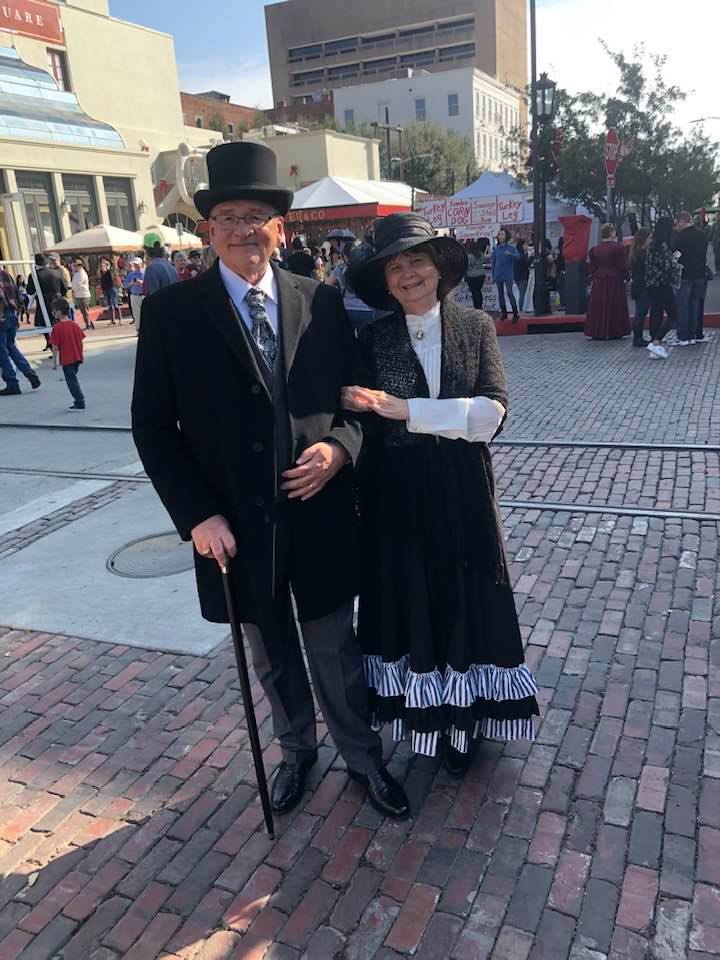
In early December the Strand is decked in Christmas finery and peopled by actors in regalia from the time of Charles Dickens complete with visits from Queen Victoria herself. Those who attend the annual party often wear period costumes filling the street with a long ago feel as they walk among wardens from London, men in top hats, and ladies boasting their finest bonnets.

There are craftsmen and merchants selling all form of goods from Christmas ornaments to art and fine clothing. The smells of roasting chestnuts and cinnamon treats fill the air along with the music of bagpipes and the tunes of Irish jigs. It’s a kind of frivolous way to simply enjoy the season without the worries of time constraints and shopping lists. For a moment it feels like Galveston may have seemed in the long ago when Victoria was still on the throne and a lovely December day in the city was filled with soft sea breezes and brilliantly blue skies. It’s a time when everyone is friendly and happy and seemingly without cares.

The event extends from a Friday evening preview until late afternoon on Sunday usually on the first December weekend before the big Christmas rush begins. Each day features a parade and St. Nicholas wanders through the crowd ready to pose for photos and a recitation of Christmas wishes. One might encounter a band of pirates or a group of steampunk dandies, There are British Bobbies and Scottish clansmen. In other words, its a feast for the eyes and the imagination.

My husband Mike and I have generally arrived incognito in our modern attire but this year we decided to join in the fun of dressing as characters from the past. Mike was particularly impressive with his striped grey suit pants with matching vest, his long coat, top hat and paisley cravat. His neatly polished shoes and silver handled cane made him a Victorian dandy for certain. I found a long black skirt to pair with my high collared white blouse which I adorned with a cameo pin that came from either my mother or my grandmother. I found a hat worthy of a visit with the queen and wore a black shawl in case the fickle weather turned cool. I also happened to have a pair of black boots with three little button fittings to secure them. On the whole we looked rather authentic and turned a head or two as we strolled down the Strand.

It was amusing to be approached by strangers who wanted to take their pictures with us. There was even one child who held us in as much awe as she might have done with Mickey and Minnie Mouse. I found myself getting into character and wishing the people that I passed a good day in my most refined accent.

Our afternoon was a much needed diversion from the hectic demands that seem to overtake us the closer we get to December 25. It reminded us to focus on the fun and meaning of the season, perhaps more so because we silently remembered the Galveston citizens of long ago who had so innocently believed that they had found heaven on earth before their lives were ended so brutally and abruptly . Life is indeed short and unpredictable so we have to grab delight wherever and whenever we find it. Dickens on the Strand is a wonderful way to remember to have fun and to love.