Not Today!

Churchill War Rooms

Our trip to London had been carefully planned, but in our concern with hundreds of little details it had never occurred to me that scheduling a visit to the Churchill War Rooms at the end of a week of seeing all of the major sights would turn out to be so perfect. In fact by learning about so much of the history of this great city I truly understood what was at stake when Adolf Hitler threatened to overtake the whole of Europe with his warped political philosophies. In an effort to keep the peace much of the continent had bowed to his demands only to realize that his appetite for domination was not easily sated. For a time Great Britain seemingly stood alone in its determination to remain free from Nazi tyranny and the consequences for doing so were grave. Somehow through the inspired leadership of Winston Churchill the people fought valiantly against the greatest of odds.

History will never know how things might have ended had Great Britain compromised with Germany as some desired. It is uncertain if the people would have been able to endure the unrelenting attacks from the air on London were it not for Churchill’s determination to convince the citizens that surrender was not an option. The entire world might be very different today if Britain had fallen before the United States eventually entered the war. Instead the people of the British Isles fought with every fiber of their courage even as the landscape around them was turned to rubble. They were a proud and determined people with a leader who loved his country and its freedoms so much that he was committed to making whatever sacrifices needed to save Britain from unwanted domination.

The Churchill War Rooms were hastily created in an underground area near the government offices in the center of the city of London. They became the nerve center for the planning of strategies and battles. While they now appear secure from dangers above ground the fact is that they might have been instantly destroyed had an enemy bomb caused the building above them to fall. The honeycomb of offices, sleeping quarters, and conference rooms was improvised to provide safety to the key leaders of the war effort, including Winston Churchill. Today it stands as a vivid reminder of what was at stake not just for the people of Great Britain, but for the entire world during those fateful years when evil was overtaking most of Europe, Africa and the Pacific.

I had not realized how deeply affected I would be by viewing the Churchill War Rooms, but as I walked through a maze of rooms left just as they had been on the day that war ended for Europe I was moved to tears at virtually every turn. Because I had spent a week learning so much of about this great country I was able to fully understand both the fears and the determination that the citizens must have felt as the specter of pure evil hung over them. They were literally on the brink of losing all that they had ever cherished, and after fifty seven straight nights of bombing over the city they must have felt even more terrified. Somehow their leaders found the inspiration needed to keep hope alive, and much of what they did took place in the tiny rooms below the ground.

The tour of the Churchill War Rooms lays out both the brilliance of leaders like Winston Churchill and the humanity of the British people. I literally heard their voices telling the story of one of the darkest times in history. I saw their faces in countless photographs and films, and witnessed the devastation that seemed almost unending. All of my senses were immersed in a retelling of the horrors of the time and the bravery of a generation that said a resounding “No!” to those who would enslave nations.

I felt humbled beyond words and filled with my own private thoughts as I slowly wound my way through the tales of privation, loss, and courage. The ghosts of the people who had worked there came fully alive as did all of the citizens who chose to stand firmly against surrender. I felt the spirit of good versus evil, right versus wrong. I understood the humanity of what had happened before I was even born.

When I returned to the light of a gloriously beautiful day I was happy that I had time to sit quietly and collect my thoughts. I had been moved from one emotion to another and I needed a moment to simply meditate on what I had seen. Never before had I quite understood what my parents and grandparents had felt during that terrible war. Not once had I realized why occasions like D-Day in Normandy were so important to them. I had not fully comprehended how frightening life must have been nor had I felt so grateful for freedom.

As we walked through lovely gardens in sight of those underground bunkers I felt a sense of profound appreciation for the most simple aspects of the world. I saw the flowers and the birds in a new light. I felt gratitude for the people of Britain for holding the line against the evil that threatened the future into which I came.

I smiled when we encountered a political demonstration in the streets in front of Parliament. It was a raucous affair decked with flags and the nation’s colors. Traffic was stopped for miles around. The sound of bagpipes filled the air. People spoke their minds without worry. It was a show of freedom that might not have been there had things gone differently during World War II. I silently gave thanks for the folks who had said to Adolf Hitler, “Not today!”

Demonstration.jpg

Whodunnit?

Jack the Ripper

It’s rather ironic and appropriate that it is a dark and rainy day as I write about the Jack the Ripper Tour that we took while we were in London. It was a Friday evening at the end of a week in which the sun had shone gloriously on us every single day. We had seen so many of the treasures that make the city so remarkable and had enjoyed good food in spite of rumors that the cuisine often leaves something to be desired. Everything about our visit had been picture perfect, so it was only right to have a threat of rain as we boarded a double decker tour bus in search of the infamous places where five women were brutally murdered by a killer who was never found, but came to be known as Jack the Ripper.

We used our age and the fact that we were the first to arrive at the bus station to be the first in line to enter the bus. This advantage gave us a seat at the top of the bus that had a cover so that our enthusiasm was not the least bit dampened by the chilly precipitation that was moving over the city. A gifted movie director could not have created a better backdrop for the tale that our guide was about to unfold. His thick Scottish accent only made the experience seem somehow a bit more sinister.

I suppose that I had thought that a visit to London’s east end and the Whitechapel area would have taken me back in time to a place where the clock stood still. I did not expect to instead see modern buildings and signs of great progress that cloaked the poverty and want that had once defined the area. The story that we were hearing was of people whose existences were so dreary that they had often lost hope. In particular the women whose lives were so brutally taken were victims not just of a murderous rage, but of a society that had thrown them into the trash heap long before they were killed.

As I listened to the circumstances of each woman who met such a merciless ending I felt that the real tragedy lay in the way that they were perceived by a society. They were attempting to survive in a world so cruel that they had little hope of finding a semblance of peace. These ladies were sometimes abused by men, spurned as being somehow indecent, and left to their own limited resources to get from one cruel day to the next. As our journey through their nights of horror progressed I found myself pondering the sadness of their fates, and seeing them as vivid examples of the societal problems that have challenged women throughout history.

There was one victim who had come from Sweden to learn the housekeeping trade. At some point she became pregnant without benefit of marriage and was thus spurned forevermore. Left alone in a city that was foreign to her with no support systems of family or friends she had to turn to any means possible just to have food and a place to stay at night. She was at the mercy of people who viewed her as a fallen woman and her opportunities for a decent life were forever gone.

Another of the victims had been thrown out of her home by her husband, a situation that was quite common at the time. She ended up in a poor house lodged in a building that is still standing to this very day. There she had a bed and food, but few prospects for a better future. Eventually she left to be on her own, only to somehow encounter the man who murdered her.

There have been hundreds of theories about who Jack the Ripper might have been. Some believed that he got away with his crimes because he was a man of influence, perhaps a royal personage or someone who worked in law enforcement. Others considered that he might have been a doctor, a barber or a butcher because of his seeming skill in ripping the bodies of his victims apart. The saddest aspect of his crime spree is that he was almost operating in plain sight, but because his victims were at the bottom of the societal pecking order his actions seemed to have gone unnoticed. He was simply one of many men who preyed on the hopelessness of women caught in untenable situations.

Our group became rather quiet by the end of our journey. Somehow we were all thinking less on the idea of whodunnit and more on the sadness of the five women’s lives. In an ironic twist they are now remembered and even mourned. We fidgeted as we thought of their how awful they were treated not just by the killer but by all who saw themselves as more decent. They lived in the darkest shadows of a city where status was parceled out with a punishing stinginess. Simply by dent of birth they were relegated to unimaginable hardship. The true crime was the way in which they were shunned so cruelly by people who never took the time to know them.

At the end of the tour we were left at the Sherlock Holmes Pub where I suppose we were supposed to enjoy some merriment and a few laughs after our evening’s entertainment. Somehow instead we felt the need to just go quietly back to our hotel where we said little about what we had seen. Each of us were left with our own thoughts, and mine we steeped in great sadness with a touch of anger that anyone would ever have to live as the five women did. How many more like them were there? How many more like them live in fear even now? What must we do to ultimately end the cruelty that reduces the status of little girls and leads them into lives of domination and hurt? What will it take for us to make keeping them safe a priority no matter where they may live? That is a more important question than solving an old crime.

The Glory

St. Paul's Dome

St. Paul’s Cathedral has a storied history. It has existed in one form or another in the heart of London for over fourteen hundred years. Built originally by monks in medieval times it endured neglect and fires. Over time there were many different versions of the structure, but it is the majestic architectural creation of Sir Christopher Wren that stuns visitors today. Wren’s masterpiece eschewed the dark stone, heavy pillars and stained glass of other churches and instead featured a massive dome hovering overhead like a window into heaven. There is a lightness and airiness about the interior not seen in other churches of the era. It has a modern, yet classic feel that is incomparable.

We traveled to St. Paul’s Cathedral on a Friday morning. We had enjoyed a foretaste of what we would see during Evensong the afternoon before when we were treated to the voices of a magnificent choir and a tradition that reaches back in time. The Church of England came about in the reign of Henry VIII when he broke with Rome and declared that as king he had the right to serve as the head of the Church in England. His was not a reformation, so the services and prayers continued in the same vein as those of the Catholic Church. Which is perhaps why, as a Catholic, I felt so at home in the cathedral.

We were fortunate to find a wonderful guide to take us through the church and to explain each aspect of the history and the architecture. St. Paul’s Cathedral has been the site of many famous events including the Diamond Jubilee of Queen Victoria and the state funeral of Winston Churchill. To this day it is a gathering place where people sun on the steps and drop in for prayer in the chapel or noon day services. It is both a working church and a tourist attraction whose income from visitors provides financing for upkeep and renovations. 

The high altar was eventually changed during the reign of Queen Victoria when it was encrusted with the kind of heavy gilding so popular during that era. It had a cleaner look in its original iteration as designed by Wren, and wondered what he might think were he to see it now so dark compared to the rest of the structure. In some ways there is a kind of disconnect between the heaviness of the altar and the etherial feel of the  rest of the cathedral.

The choir stalls were also changed by the addition of dark and heavy woodwork during Queen Victoria’s reign. Nonetheless the cathedral is still dominated by the dome that makes it so unique. That pediment stands out in the London landscape from every angle whether day or night. It is a glorious beacon representing so much that is great about the city and its people.

During World War II London endured fifty seven straight nights of bombing from the German Luftwaffe. Parishioners served as security for the building hoping to protect the structure in the event that it became a target. One evening the people noticed a fire breaking out as the bombs burst overhead. They called for help in putting out the flames, and firefighters worked tirelessly to save the beloved church from destruction. When morning came virtually every building that had surrounded the cathedral was demolished, but St. Paul’s stood rock solid thanks to the heroics of the people who had been watching over it.

The basement of St. Paul’s serves as a crypt and memorial for many of London’s most imminent citizens including Admiral Nelson and the Duke of Wellington who is beloved for saving the country from Napoleon’s domination. Much like Westminster Abbey it is a repository of much of the nation’s history.

There is a stairway that leads to the top of the grand dome. My brothers, Mike and Pat, navigated the winding and narrow passages along with my sister-in-law, Allison, to enjoy the sweeping vistas of the city and a closer look at the construction and magnificence of the the building. Sadly my knees would not hold up under such stress so I joined my husband Mike and sister-in-law, Becky for tea while the younger among us enjoyed the adventure of the climb. In another decade I surely would have been right there with them, but I have learned to respect the signs that such adventures are past.

St. Paul’s Cathedral is a marvel of architecture and a treasure for all of the people of London. I felt a very spiritual connection to the church that was different from the awe of Westminster Abbey. It is a place where worship rather than history plays a more dominant role. It is a showpiece, but also a refuge from the hustle and bustle of the city. It has a calming presence that made me want to just sit and linger and meditate. I truly felt God’s presence there.

I would see the dome of St. Paul’s on the horizon again and again during my time in London. Sometimes it was like a beacon of hope, others it was a compass point helping me to find my way. Always just seeing it brought a sense of calm to me. It is one of those places that I will certainly conjure up when I feel the need to meditate on the goodness of humans, for that is what I felt there from the moment that I first entered.

Even now as think about St. Paul’s Cathedral my heart slows, my mind focuses and I feel a sublime sense of well being. I see the minister who looked at my face and smiled as though he knew the content of my heart as he invited me to attend Evensong. There is an otherworldly essence there that will sustain me whenever I close my eyes, quiet my heart, and remember the glory.

The Tower

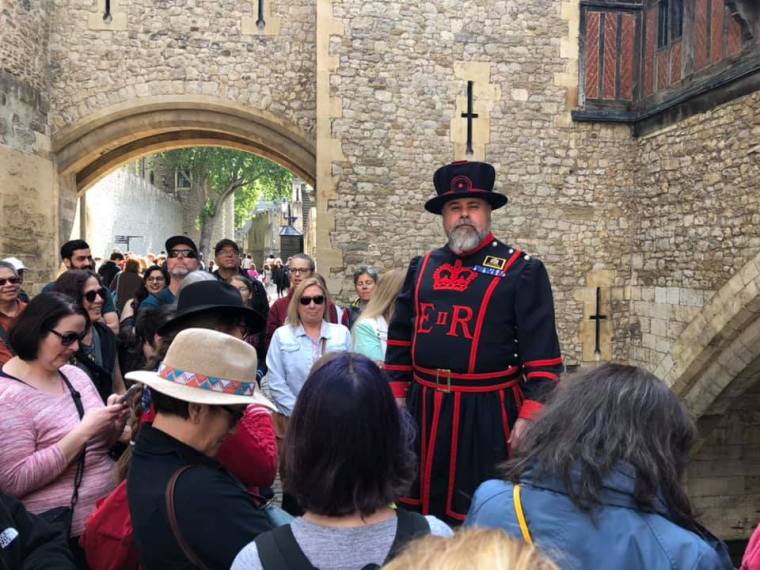
Beefeater

In the heart of London along the River Thames lies one of the most extraordinarily historical places in London. Known as the Tower, it is a complex of buildings dominated by a white castle built by William the Conqueror shortly after the battle of Hastings in 1066. It is an impressive fortification with its moat, narrow winding staircases, and vast rooms. It was originally designed both as a home for the king and a defensive keep. Over time it became better known for the prisoners that were held on the premises and the executions that took place on the green. It is an imposing and improbable complex whose elevations seem both in and out of place in the modern world.

Some time ago I learned that my lineage can be traced back to William the Conqueror and from there to Vikings. I suppose that such is a somewhat dubious honor given that the Norman king was so often resented by the people of England who saw him as a bloodthirsty outsider. Nonetheless his legacy in creating the famous white tower remains as a reminder of the often violent and dangerous history of Britain.

What was once designed as living quarters for the first Norman king has evolved over time in its use, and now stands as a museum and respository of many stories. Visiting the Tower of London is perhaps the most fascinating tour in all of the city, complete with legends about the ravens who have lived on the premises for most of its existence. It is said that as long as they remain Britain will not fall and great efforts are made to keep them happy and willing to stay as permanent residents of the compound.

Countless mysteries and tragedies unfolded in the Tower. Richard II, the protector of his child king nephew, took both the little monarch and his brother there for safe keeping, but they subsequently disappeared thereby leaving the throne to him. Years later when the bones of two children were found buried under a set of stairs it was conjectured that they must have belonged to the long missing brothers. 

It was in that Tower that Anne Boleyn awaited her tragic fate once Henry VIII had decided that she was no longer of use to him. Later she would be publicly executed for treason on the grounds. Lady Jane Grey would serve as Queen for nine days after Henry’s son James died without an heir, and then lose her life when Mary I laid claim to the throne by right of being Henry’s eldest daughter. Elizabeth I would also spend time imprisoned in the Tower but was luckily spared a death penalty and eventually given the throne. Other famous prisoners like Sir Walter Raleigh spent years behind the walls as condemned persons before being put to death.

One of the most interesting areas of the Tower complex is a building in which prisoners left graffiti on the walls. Over time they meticulously carved intricate signs that they had been there. These were no ordinary scrawlings, but rather beautifully carved inscriptions left in the stone for all time. They told of the long days of isolation that the captives had to endure and their determination to leave their mark on history in spite of their wretched conditions.

The Tower complex also features a sampling of the crown jewels including the largest known diamond in the world. It displays goblets and plates of gold, as well as jeweled crowns and scepters. It is a remarkable showcase that points to the wealth of the monarchy and the traditions that have both evolved and continued over time.

A tour of the Tower grounds includes a rather jolly session with a Beefeater who reveals the history, the stories and the secrets of the complex. The Beefeaters live and work inside the Tower walls and provide visitors with an in depth detail of information. Our particular guide had a rather wicked sense of humor that added to the interest of his tales. He provided a voice to the people who had lived and worked and even died in that fascinating place.

The history of the world is one of violence and tragedy as people fought to gain and retain power. Their’s was not so much a fairytale as a story of intrigue, jealousies, and betrayals. Perceived treason brought imprisonment and death. Choosing sides carried dangers for both noble men and women as well as the common folk. The walls of the Tower of London indeed seem to talk of the fears and horrors of real people who either fought to maintain a hold on their power or suffered because they appeared to be threats. The chronicles of lives celebrated and lost are written in the very stone of this place. There is something majestic, awe inspiring, frightening and evil about what happened within at the Tower making the ravens that act as sentinels seem an appropriate symbol of both the ingenuity and the flaws of humankind.

I left the Tower of London in a rather pensive state of mind. It is a glorious edifice that is a remarkable reminder of the steadfastness and resilience of our humanity, but it is also a respository of our imperfect natures. It is a place where we should surely learn the lessons that history attempts to teach us. Our time on this earth is short in the grand scheme of the universe. The possessions that we accumulate are unworthy of our focus. We will all soon enough become ashes but our actions while still on this earth will have far reaching consequences. Let us hope that we have made good choices and demonstrated honor and integrity rather than greed. The history of mankind is littered with far too much hatred. It is our duty to work toward the good insofar as possible. Power comes and goes and too often corrupts, as we humans continue to work toward a more perfect union of our differences. 

Skye Garden

London is not just about the past. It’s skyline is filled with ultra-modern buildings with unique architecture. Among them is Skye Garden, a thirty seven floor wonder with a three hundred sixty degree glass viewing area. This unusual structure literally appears to be falling forward onto the pavement below, but it is a sturdy structure that provides some of the best available panoramas of the city.

After a long day of taking in the sights of Buckingham Palace and the Victoria and Albert Museum we rode across town to learn what we might see. Because the number of visitors allowed into the viewing area of Skye Garden at any one time is limited, we reserved six spots for the late afternoon. The venue is free, so all we needed were the tickets that we had secured a month or so before our trip. That way we were assured a space without having to possibly wait in a long line.

The ride up to the rooftop area was smooth and we were immediately delighted when the doors opened to an airy garden like atmosphere. Because the days are long in London during the spring and summer months we were in no hurry to make the circuit on the viewing platform, so we paused at the bar ordering our individual favorites among the many wines, ciders, and beers being offered. It was pleasant just sitting and looking over the landscape as far as the eye might see as well as watching the people who were comprised mostly of young Londoners enjoying happy hour after working all day.

We spoke of the things that we had experienced on that day and celebrated our good fortune with weather, knowing that the clear sky would afford us a special look at the city. After a time we scurried out to promenade around the perimeter of the upper floor. What we saw was quite breathtaking and well worth our effort in getting there. There was the River Thames, the London Eye, and the Tower. We were able to point out the dome of St. Paul’s Cathedral and some of the newer structures like the Shard which literally appears to be a pieces of broken glass belonging to some giant. Of course there was also the building formally known as 30 St. Mary’s Axe but better recognized by its nickname, the Gherkin, a silly structure that is often ridiculed with rather insulting monikers.

It was incredible fun to see the city as a whole and to realize the sheer density of the over eight million person population as evidenced in the many high rise apartments. It was also astounding to view the old historical structures seemingly side by side the more modern buildings. It seems that Londoners honor both history and progress.

There is a lovely restaurant at the top of Skye Garden but it was a bit much for us on that evening when we were growing a bit weary from our many adventures, so after taking multiple photos and marveling at the beauty both inside and outside the glass platform we decided to head back to our hotel in Bloomsbury.

By this time we had already grown fond of the pub inside the Holiday Inn which appeared to cater to more locals than tourists. We had already made friends with several of the people who came each night to visit with one another, watch some football and drink a bit of stout beer. We ordered some great pub food and set up a game of Jokers and Marbles, a strategy game that is a cross between Sorry and Parcheesi.

We played in teams of women versus men. In a three out of five tourney that lasted for more than a week the women were the victors. More importantly was the laughter and fun that we enjoyed of an evening as we gathered around a huge wooden table sipping on brews and snacking on pub food like bangers and mash, fish and chips, meat pies, onion rings, or soup with bread. It was a great way to get to know the people from the neighborhood and to sample some of the traditional food and drink. Over the course of our trip we grew to look forward to the leisurely evenings in Callahan’s Pub.

We had already experienced so much of both the old and the knew in London. We had been dazzled by the rich history of this city and delighted by the friendliness of the people that we had encountered. We felt right at home in the hotel and on the Tube. In fact, I was greatly impressed by the polite behaviors that I continually encountered. Each time I entered a tightly packed train car there was invariably some young man wanting to surrender his seat to me. It was nice to see such mannerly behavior to be called “Mum or Mother” out of respect. I was very quickly learning to love this city and its people.