Lean On Me

friend comfort

We’ve all had those moments when everything changed in a flash, those traumatic times when it doesn’t seem possible to ever feel happy and optimistic again. Such events fashion us into new people, sometimes more courageous and determined and sometimes defeated and cynical. Always we feel the wound on our hearts that ultimately becomes a scar reminding us of our vulnerability as humans and of the vagaries of living.

While virtually everyone is able to describe such an event, some seem to have a Midas touch that keeps harm away from them for most of their lives and others appear to be chosen as the continual targets of tragedy. Coping with our fates whether they be few or seemingly never ending is always a struggle and while some may appear to be better at enduring the horrific, everyone is hurt by them in ways that burrow deeply into their hearts. We should never judge or underestimate the impact of bad news on anyone.

My own defining moment was of course the death of my father. I was young, only eight, and shy to boot. I tried to be brave for my mother so I went deeply inside my own psyche and rarely spoke of how devastated I felt. I pretended to be little more than a child who was ignorant of such things but my unspoken anxieties would haunt me for decades. We often forget that children have emotions as powerful as adults, sometimes more so. Ultimately my own story helped me to be intensely understanding of the problems that my students faced. I knew how greatly they were affected by the most intense moments of their lives because I had walked in their shoes.

I will always remember those battle scared children who had developed reputations as troublemakers when in fact they were driven by fear and anger over what they had experienced. There was the little tyke who had been set on fire by his mother when he was three, the teen who had watched his father murder his mother, the adolescent who felt unwanted because he was passed from one adult to another throughout his childhood. I grieved for them but also shared my own story with them and began a healing conversation that helped them to understand that they need not be defined by the tragedies that had so engulfed them.

As grew older I began to identify more and more with my mother. I realized the fear and the loneliness that she must have endured after my father’s death. She was brave to the point of stifling the deep feelings that swirled in her head. She set them all aside to care for us, but they were still there and would come back to haunt her again and again. People in her generation rarely spoke of their challenges. They had been taught to be like soldiers guarding their words lest they appear somehow broken. Being that way took its toll on my mother in the most horrific ways. I only wish that she had been able to talk with someone honestly about the trauma that never quite went away. Now I know and understand how important it is to allow anyone who has endured a shocking event to let their thoughts out knowing that they will be safe and without judgement.

Each of us should learn how to become a compassionate place of refuge. It is not an easy thing. It means setting aside our own concerns, avoiding platitudes, suspending judgement, just permitting someone who is hurting to describe the contents of his/her heart. Knowing that it is okay to voice even the most terrible of thoughts is a beginning in the process of healing.

All too often we humans tend to tell people how they should feel about certain things. We fear displays of emotional weakness because so often they get very close to touching the most fragile parts of our souls. We prefer to see someone smile through their troubles because it makes us feel better when we should be more concerned with how they are dealing with the reality of what has happened to them.

If we are very lucky we each find a person or persons to whom we might reveal our innermost thoughts without hesitation. Such beautiful souls allow us to express ourselves honestly. They gently drain the poison from our hearts. Perhaps we should each strive to be that kind of individual for someone, a haven of understanding and compassion. We call such people our brothers, sisters, best friends, partners. They know us as well as we know ourselves and love us “warts and all.”

Someone that you know is suffering right now. Reach out to them. Be the person on whom they can lean. Allow them to be however they need to be in the moment.
Guilty Until Proven Innocent

central-park-5_bhm

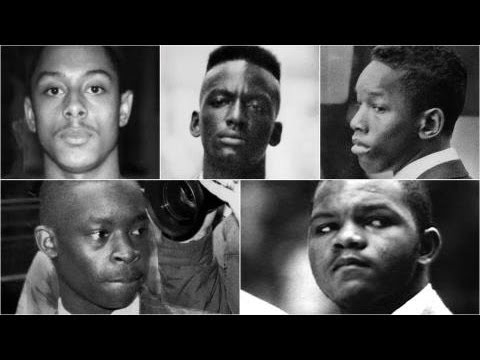
Try to imagine the time when you were fourteen, fifteen or sixteen years old. Did you know much about the world? Were you confident? Did you do some stupid things? How would you have reacted if you had been picked up by police who accused you of a heinous crime? What might you have done or said if they wore you down after more than twenty four hours of interrogation without your parents or an attorney being present? What if they told you that all you had to do is go along with a story about people that you did not know and then you would be allowed to go home? Who among us would have held up under such intense pressure? How much worse do you think it might have been if you were poor and Black or Hispanic. Such was the situation of five teenage boys in New York City on an April night in 1989 after they had been partaking in a raucous game in Central Park called “wilding” in which they harassed passersby, sometimes going a bit too far but mostly just letting off steam.

New York City was a crime ridden shell of what it is today back then. The public had grown weary of the muggings and violence that were a daily occurrence. The failing economy of the city at that time created extreme economic divisions. There was a tension between the haves and have nots that was almost certain to blow. The situation exploded on that April night of 1989, when a young woman who had been jogging was found near death in Central Park. There was an immediate urgency to find the perpetrators of the crime and a sense that somehow the young men who had created havoc that same night must surely be the ones who had done this egregious act.

The police created a scenario in their minds and then without any physical evidence convinced themselves that some of the young men that they had rounded up early must indeed have been the thugs who had done the violent deed. With no substantiation other than a hunch they began to grill five young men only two of whom knew each other at the time. They lied to the teens telling them that others had implicated them in the crime. In spite of the boys’ claim that they knew nothing of the matter the lawmen persisted in their insistence that they would get the truth that they wanted one way or another. Promising a route home if the exhausted teens cooperated they fed each one details that were created to frighten them into making taped confessions each of which contained conflicting stories. Only one boy never implicated himself or any of the others because his mother rushed in to rescue him from the invasive interrogation but even he was doomed.

Thinking that the worst was over after providing the forced statements each teen was shocked upon being charged with the rape and the violence associated with the incident. Thus began a prolonged journey through the court and prison system for five young men who maintained their innocence in spite of what they had said on tape. They became known as the Central Park Five and their story is one of incomprehensible injustice.

Antron, Raymond, Kevin, Yusef, and Korey would be tried in both the media and the courts. They became reviled symbols of all that was wrong with society. They had essentially been found guilty from the moment that the police learned of the raped and battered woman in the park. They were damned every step of the way and without the resources of money, good lawyers and parents who understood how things worked they were left to a kind of mob rule. Needless to say all five were found guilty in spite of a case so weak that it should never have resulted in indictments. The four who were younger were sentenced as juveniles and one, who was sixteen at the time of the crime but seventeen when he was found guilty, went straight to Riker’s Island as an adult.

Antron, Raymond, Kevin and Yusef spent seven years imprisoned. Korey endured thirteen years during which time he was brutalized multiple times. All had been robbed of their youth and any promise of the future until a serial rapist finally admitted to the crime for which they had been convicted. In a dramatic turn of events the actual perpetrator was able to provide police with details that only someone who had committed the crime would have known. Additionally his DNA matched that found on the victim at the scene of the crime. Eventually the five young men who had suffered so needlessly were exonerated and years later the city of New York gave them financial compensation for the mistake that had been made.

I have not been able to get this story out of my thoughts. I watched a documentary of their saga by Ken Burns called The Central Park Five and a limited series titled When They See Us. Both features were stunning in their depiction of an horrific injustice that is no doubt less uncommon than any of us would like to believe. In spite of the eventual outcome every one of the young men were scarred in ways that will never be erased by either apologies or restitution. Mostly I found myself thinking that something like this might easily have happened to so many of my former students who like these innocents might appear to be of a sort that is not even close to who they are. The color of their skin, the places where they live, their lack of income are often indictments by a world unwilling to seek the full truth. Our society has a dangerous tendency to act based on little or no facts. We follow outrages without thought, rushing to disaster like lemmings running toward the edge of a cliff. It happens over and over again.

I’d like to think that we might learn from such miscarriages of justice. I want to believe that we will adhere strictly to the idea that all Americans are innocent until proven guilty. I pray that we have learned the importance of protecting the rights of all people without prejudice. What worries me most is the feeling that we have yet to fully embrace such wisdom. We still have to fight for the rights of young men like Antron, Raymond, Kevin, Yusef and Corey. I pray to God that their numbers will be few. In the meantime I recommend that The Central Park Five and When They See Us should be required viewing for all Americans.

What We Need

common-ground-dove

There were horrid things happening across the globe before I was born. There were horrid things happening across the globe when I was a child and a teen. I have witnessed horrid things happening as a young adult and now that I am in my seventies I still see horrid things happening both near and far. For a cockeyed optimist like myself it can be quite distressing to admit that there is something in our human natures that is sometimes violent and cruel. I always wanted to believe that mankind has been slowly evolving into a better version of itself, and I still think that is indeed true, but sadly it is such a slow process that it’s difficult to define the progress at times.

On a more personal level I see goodness in each of my friends and family members, people striving even sacrificing to be kind, loving, wise. Each individual has small moments of imperfection but on the whole they are grand examples of what mankind might aspire to be. They give me hope for the population at large because I do not believe that they are the aberrations, but rather that it is in the hateful and violent members of society that we find the outliers. Normal is good, abnormal is an unusual data point removed from the cluster of morality that defines most of the people in the world.

There are those who believe that the current times are somehow worse than other eras, but I would urge them to more carefully and thoughtfully study history because there is little that is actually new in the ways of our relationships and our politics. People have been lead astray by demagogues and tyrants for all time whether it be in a family, a friendship, a neighborhood, a town, a state or a nation. You would think that we would be more circumspect given all of the information about past troubles that we have, but in truth most of us are busy taking care of ourselves and those that we love. We tend to only have time to react rather than to reflect. Besides, with so many ideas and ideologies being thrown at us at once it is daunting to determine what is actually best. Instead history has often been a vast experiment of trial and error with some decisions enhancing mankind and others being dangerously abysmal failures. All too often hindsight becomes our teacher.

We can indeed learn from past mistakes but even then it’s important to realize that we are different from our ancestors. Times continually change and we are influenced heavily by our environments, what we love and what we fear or even hate. Making choices that will affect us and the people around us can be a gamble. Because each person on earth is unique there is no one size fits all way of educating or governing and yet we try even as we know that it is impossible to exactly meet everyone’s needs. Someone always seems to feel left out, abandoned either by family or nation. Such is the conundrum of our human attempts to make sense of the world and the reason why it is so difficult to enact solutions to the problems that plague us.

Freedom is a word with many meanings. Taken too far it can lead to trouble. Constricted too much it creates hostility. The key to a healthy person and society is providing just the right dose of fairness which may mean that the balance will sometimes seem unequal. Even within families a wise parent understands that no two children are identical, not even twins. So too it is with societies that attempt to be fair and just. It is difficult to know the best course of action.

As a school administrator I learned that some of my teachers wanted to be free to be themselves without much direction while others actually desired to have precise sets of rules by which to guide themselves. The trick in working with them involved crafting individual plans that took their specific needs into account. Allowing for differences sometimes created tensions because there were always those who insisted that everyone had to be treated exactly the same. The trouble with that logic is that it does not consider our human uniqueness and sounds good until it is executed in a real situation.

I find myself becoming increasingly disturbed by the urge of various forces to make us all think and act the same. We become enraged when we witness someone deviating from the thoughts and actions that we find the most appropriate. We harangue or shame those who disagree with us in the false hope that we might force them into submission to our way of looking at the world. Such has become a national pastime with celebrities being lauded or ostracized based on what they believe. In truth it is a kind of nationalized bullying that we need to abandon. We should be extremely careful that we are not ruining people’s reputations based solely on a desire to force agreement to our individual thoughts about how things should be. 

Propaganda and unwillingness to allow freedom of speech is growing all around us. Such efforts to control beliefs has been tried throughout history but it has never worked. We should be wary of those who would insist on conformity and resistance to divergent ideas. Right now we have people on both the far left and far right attempting to shut down our freedoms. What we need is for those who treasure liberty to lead by example which means acknowledging that we must make more efforts to consider the needs of each voice, not just our own. We must curb the outrage and find ways to understand and respect the very natures of our humanity. In doing so we might find the common ground that we both desire and need. As long as we keep censoring one another we will escape from the current cycle of outrage.

Snakes and Dentists

emblem_bwpho·bi·a

/ˈfōbēə/

noun

  1. an extreme or irrational fear of or aversion to something.

I’m not superstitious nor to I believe in things like good luck charms. In general I am a very rational person who eschews conspiracy theories and urban myths. Still, I have to admit to having a number of phobias, among them being forced off of a bridge while driving my car and being caught in a burning building. Without a doubt, however, my two most heart pounding fears are of snakes and dentists.

We humans once lived in trees and so the fear of snakes is primordial and I suppose even a bit Biblical. In my own case it tracks back to two events from my childhood. The first occurred when an elderly neighbor was bitten by a water moccasin that wandered into her backyard from a nearby bayou. She stepped on it in the dark and at first thought she had accidentally stumbled over her dachshund. When she felt the sharp sting of the reptile’s venom she looked down and saw what had really happened. She spent many days in the hospital lingering near death and those of us who knew her kept vigil and prayed. I suppose that her advanced age had more to do with the seriousness of her condition than the actual bite but the thought of danger lurking in the dark of my yard haunted me so much that over time I developed a total aversion to any form of snake whether poisonous or not.

Like Indiana Jones I become mush at the mere thought of a snake and my anxieties with regard to them only increased after an incident with my grandmother when I was about six. She and my grandfather were living on a farm in Arkansas back then and they prided themselves in being able to live mostly off of the bounty of the land. They planted crops that kept them generously supplied with fruit and vegetables and raised chickens and a cow for meat and milk. Grandma was a kind of pioneer woman who was handy with a rifle and she proved her mettle by bagging deer and squirrels as well. More than anything she was an expert fisherwoman. I suppose my father learned to love fishing from her.

One afternoon when we were visiting the farm my grandmother and grandfather decided to go angling for fish and asked if I wanted to come along. I so enjoyed being with them that i joyfully agreed to go. When we got to the place where they hoped to get some fresh trout for dinner my grandmother first went to inspect the area. Without any sort of explanation she returned to the car with a concerned look and sternly warned me to stay in the car assuring me that they would not take long. To say that I was disappointed would be an understatement. It was a warm summer day and even though the car was parked under the shade of an enormous tree I soon became hot and bored. I defied my grandmother’s command and decided to join her on the rickety wooden pier where she was so intent on fishing that she did not see me coming up behind her.

As I approached my grandparents I suddenly saw what seemed to be an army of snakes lifting their heads out of the water as though waiting for a handout from the humans invading their habitat. When one of them attempted to slither up a pillar of the structure where she was standing Grandma took her fishing pole and beat it away. I was so stunned and horrified that I began screaming in terror. Grandma spun around to see me and without a word hurried me back to the safety of the car, chastising me for ignoring her instructions. As she and Grandpa gathered up their catch and their fishing gear I sat in the automobile more disturbed than ashamed. I could not get the horrific vision of all of those snakes out of my mind. In all honesty it still haunts me if truth be told. From that moment forward I have been totally terrorized by the mere thought of snakes.

My dental anxieties are also a product of my youth. I had the unfortunate bad luck to have a pediatric dentist who never should have been allowed to interact with children. From a very young age I needed a great deal of work on my teeth and he did little to make the process bearable. In fact he berated me for what he was sure were bad eating habits each time I visited his office. In truth my mother never purchased sugary treats or drinks with the exception of very special occasions and she was fastidious about having me brush my teeth both morning and night, so the doctor’s harangues were always confusing to me because I was only about five years old when he seemed to take delight in punishing me by inflicting pain.

I never mentioned any of this to my mother because I just assumed that his methods were the way it always was. As I grew older I simply armed myself with prayer which on one occasion included bringing a set of rosary beads to pray while he tortured me. When he saw me clinging tightly to the beads and moving my fingers along them one by one he became enraged and called my mother back into his office. His tone was accusing when he demanded to know why I was insulting him by insinuating that I needed the help of the Blessed Mother herself to endure my session with him. At that point all of my concerns spilled out at once in a kind of core dump of fear. My mother gathered me up immediately and we never again returned to his office.

Since that time every single dentist that I have visited has been kind and virtually pain free but my phobia continues. It is as though I worry that one day I will once again encounter a thoughtless dentist who will subject me to pain. I can’t seem to get over the trauma of my earliest experiences of keeping my teeth strong and healthy. Such is the nature of a phobia.

I suspect that most phobias are born in our earlier memories of painful situations. We sometimes assume that frightening experiences need little explanation but sometimes they linger in the subconscious growing into monsters that never leave us. When my eldest daughter was only three we took her to a lovely park in San Juan, Puerto Rico. As we sat on a bench enjoying the view a huge swarm of pigeons flew in to greet us and perhaps get a snack or two. We laughed with delight but it was apparent that our daughter was quite disturbed. A cousin who was with us happened to also be a psychologist. He insisted that we talk with our little girl about what had happened and allow her to express her fears Over the next few days he gently brought up the incident several times until he was certain that she truly understood that it was okay for her to feel frightened and that the birds had actually meant no harm.

Perhaps if someone like the cousin had been around to counsel me way back in the past I might be comfortable with both snakes and dentists. Sadly that is not to be.

Opening Hearts and Minds

peacemaker

I am what is sometimes known as a people pleaser, not so much because I want to impress anyone with my goodness but because I have an uncanny ability to sense people’s feelings. I have spent most of my life striving to help others to be their best selves and making great effort to see differing points of view. My work has included titles like mother, teacher, peer facilitator, dean of faculty. In those roles I focused on walking hand in hand with my charges rather than being an authoritarian. I prefer being a diplomat to executing orders. To my utter dismay I more and more often find myself in a kind of new world order in which I am constantly challenged to choose a side or be considered outmoded and ineffective. The middle ground where I have long stood so that I might extend a hand to each side is now considered the choice of wimps, those unwilling to take a stand. I find it more and more difficult to please anyone and I am often accused of being the kind of person who has actually caused most of the problems of the world.

We appear to be in a phase during which manners and decency toward all is considered passé. Tough guys, bullies, those willing to hurl insults are thought to be the new saviors of the world. Being polite and soft spoken is out. Being brash is in. Passive resistance and peaceful assembly has lost its lure. Instead shouting and insistence that all agree to a kind of tandem manner of thinking is the way of the new heroes. Sound bites have replaced thoughtful discourse.

As a teenager I read John Kennedy’s Profiles In Courage with an almost reverential mindset. I saw the heroes that he described as role models for my own life. I liked the stories of fortitude in the lives of the saints that had so fascinated me as a child. I wanted more than anything to be a fair and just individual who held tightly to the belief that each of us has an important purpose in this world. I read and reread tales of men and women who changed the world without harming others. I came to believe that the most glorious aspect of living where I do is the unalienable right of individuals to have the liberty of their own thoughts. I enjoyed the idea of bridging gaps between diverse groups. It is who I am and what I do.

It seems as though a perverse stubbornness has invaded the world. We are at an impasse with one another. Society has become judgmental without taking the time to analyze situations devoid of prejudice. Our favored leaders often hurl insults at one another. We blame entire generations for our problems with sweeping pronouncements. Some taunt the “snowflakes” while others dismiss the “boomers” as the lot that has destroyed the earth. Anger is even invading families and rending friendships in two. There is a kind of worldwide psychosis that is making all of us sick.

It has become almost impossible for me to use my diplomatic skills. Of late I seem to anger everyone whenever I attempt to consider all sides of a discussion. My efforts are derided as useless and perhaps even counterproductive. I am reminded of how souls like Mitt Romney are not the heroes I think them to be, but spineless cowards who are of little use to the world. People are demanding action and those who attempt to broker compromise and peace are thought to be a large part of the world’s problems.

As a student of history I know how dangerous such thinking can be. While mankind divides itself into winners and losers suffering prevails. The power brokers unwilling to give an inch one way or another wreak havoc on innocents. Problems fester and grow in an atmosphere unwilling to consider compromise. When people no longer listen to one another grave mistakes are made. Divisions like north and south, left and right, red and blue, Christian and atheist, Sunni and Shia, Israeli and Palestinian, educated and uneducated, rich and poor are the sources of conflict and war. It is only when we truly attempt to work together that solutions begin to arise.

I was quite taken by an image that one of my friends posted on Christmas Day. In the photo were two women, sisters from a loving family. One of them stood in front a blue car with a “Warren” sticker and the other posed by a red car with a “Trump” sticker. Both women were laughing and obviously quite happy with one another, unwilling to allow their political differences to change their feelings of warmth and affection. It was a hopeful sign for me, a reminder that when all is said and done we humans may have differing opinions of how to solve problems but we are united by love.

I’d like to believe that our current state of rage is only a temporary phase and that the peacemakers will come into fashion again. In the meantime I pray that relationships that have been broken by differences in points of view may be mended. We need each other now more than ever. Life is far too short to spend time quibbling when we might be better off finding ways to get along. All it takes is a willingness to open our hearts and minds. Perhaps that is the best resolution that anyone might make for the new year and new decade of 2020.