Her Wonderful Life

Jeanne

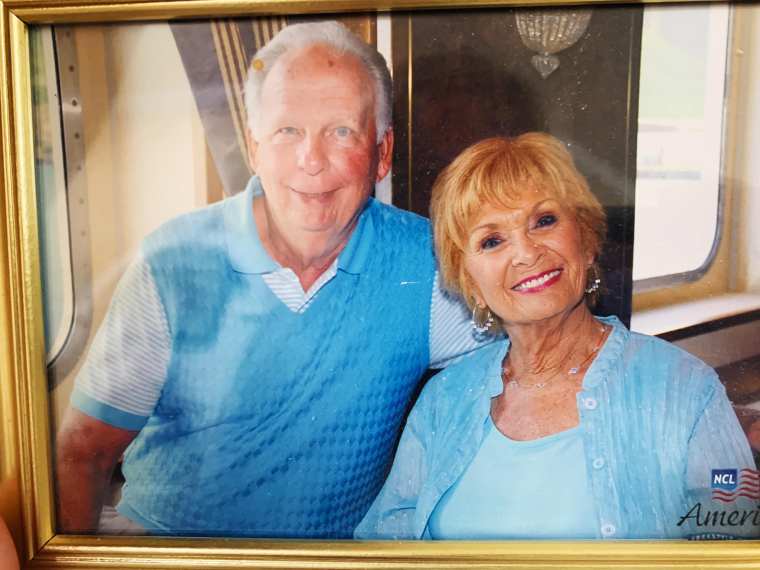
I vividly remember when I first met Jeanne. She was the kind of person who left a lasting impression on people and she definitely had that effect on me. I was about six or seven years old when my cousin, Leonard, brought his girl friend, Jeanne, to a family gathering at Clear Lake. She was a stunningly beautiful teenager with a mega watt smile and a confidence that made her an instant hit with my aunts and uncles. It wasn’t too long after that when she and Leonard were married providing me with my first encounter with what I thought of as the holy grail of true love.

Jeanne was undoubtedly one of a kind, a delightful spirit who found and gave joy wherever she went. She had a way of making everyone feel special and loved, and she always took time to let people know how much she cared about them. Even the smallest children knew that her interest in them was genuine. With her seemingly boundless energy she gave her heart and soul to every person who came her way. Her humble way of giving of herself guaranteed that she would become a favorite in our big extended family. It was not long before she was the person we felt most excited to see whenever she arrived at our events.

Jeanne and Leonard started a family of their own that grew and grew and grew filling their home with laughter and unmitigated love. Jeanne was at the center of the antics and delighted in planning raucous gatherings where fun and mischief were the order of the day. She was a premier hostess who literally chose her homes with entertaining in mind and understood the importance of having enough room to hold all of the love that was a constant presence in her life.

Jeanne was the bearer of so many gifts that she in turn generously lavished on her family and friends. She was a teacher, a woman of great faith. She was a light of optimism and a ray of hope. She humbly spread her kindness leaving no one untouched by her generosity. She loved to cook and she made preparing a feast for a crowd look easy to do. She danced her way through life grasping every possible opportunity to enjoy people and places and events. She built traditions that brought those that she loved together, hosting family annual reunions and scheduling week long camping trips at Garner State Park each summer.

Jeanne had a particularly amazing way of making each person that she encountered feel welcomed. Nobody in her presence went unnoticed. She took great pains to make everyone part of the fun that seemed to surround her like a halo. She possessed a charisma that made her unique and exciting but more importantly she maintained a quiet strength that was comforting. I found myself drawn to her just so that I might basque in the sunshine of her warmth.

Jeanne lived as full and meaningful life as anyone might desire. She was a loving wife, mother, grandmother, great-grandmother, daughter, daughter-in-law, sister, sister-in-law, cousin, friend. She lived a simple life by choice but somehow everything she touched became extraordinary. She earned a college degree after her children were grown, proving to them that learning is a lifelong goal. She found ways to attend athletic events, band concerts, birthday parties, graduations and funerals with a faithfulness and sincerity that told people how important they were to her.

Jeanne had a beautiful heart but she was also an incredibly attractive woman with a flair for the flamboyant.. She loved bright colors that seemed to perfectly match her exciting personality. There were no grays and whites in her home or her way of living. Instead reds and oranges and deep blues shouted out her never ending joy and matched her ever present smile.

Jeanne left this earth last Friday. She had been very ill for some time. In her classic way she willed herself to remember others even as her health failed. She came to my fiftieth anniversary party with her oxygen tank and looking feeble, but still managing to have a glorious time. On Christmas Day she was surrounded by her huge family doing her best to laugh through the pain that had become her unrelenting companion. It was a fitting final act of love that was the definition of who she was.

Jeanne will be sorely missed. A great light in our lives seems to have gone away, but I believe that her impressions are so indelibly imprinted on our souls that we will always see and be guided by her example and her brightness. I agree with Jeanne’s granddaughter Madison who imagines her grandmother laughing and joking with Jesus and dancing with delight in her new heavenly home. She is waiting for us there, preparing a party for the time when we join her. For now we rejoice that her pain is no more and that she has so justly received her reward for living a truly wonderful life.

I saw a magnificent sunset not long after Jeanne died. Somehow I felt that it was a sign from her that we are supposed to continue to celebrate the beauty of life just as she always did. I know she would want us to embrace and comfort one another and find a way to dry our tears and carry on her traditions. She taught us well.

Opening Hearts and Minds

peacemaker

I am what is sometimes known as a people pleaser, not so much because I want to impress anyone with my goodness but because I have an uncanny ability to sense people’s feelings. I have spent most of my life striving to help others to be their best selves and making great effort to see differing points of view. My work has included titles like mother, teacher, peer facilitator, dean of faculty. In those roles I focused on walking hand in hand with my charges rather than being an authoritarian. I prefer being a diplomat to executing orders. To my utter dismay I more and more often find myself in a kind of new world order in which I am constantly challenged to choose a side or be considered outmoded and ineffective. The middle ground where I have long stood so that I might extend a hand to each side is now considered the choice of wimps, those unwilling to take a stand. I find it more and more difficult to please anyone and I am often accused of being the kind of person who has actually caused most of the problems of the world.

We appear to be in a phase during which manners and decency toward all is considered passé. Tough guys, bullies, those willing to hurl insults are thought to be the new saviors of the world. Being polite and soft spoken is out. Being brash is in. Passive resistance and peaceful assembly has lost its lure. Instead shouting and insistence that all agree to a kind of tandem manner of thinking is the way of the new heroes. Sound bites have replaced thoughtful discourse.

As a teenager I read John Kennedy’s Profiles In Courage with an almost reverential mindset. I saw the heroes that he described as role models for my own life. I liked the stories of fortitude in the lives of the saints that had so fascinated me as a child. I wanted more than anything to be a fair and just individual who held tightly to the belief that each of us has an important purpose in this world. I read and reread tales of men and women who changed the world without harming others. I came to believe that the most glorious aspect of living where I do is the unalienable right of individuals to have the liberty of their own thoughts. I enjoyed the idea of bridging gaps between diverse groups. It is who I am and what I do.

It seems as though a perverse stubbornness has invaded the world. We are at an impasse with one another. Society has become judgmental without taking the time to analyze situations devoid of prejudice. Our favored leaders often hurl insults at one another. We blame entire generations for our problems with sweeping pronouncements. Some taunt the “snowflakes” while others dismiss the “boomers” as the lot that has destroyed the earth. Anger is even invading families and rending friendships in two. There is a kind of worldwide psychosis that is making all of us sick.

It has become almost impossible for me to use my diplomatic skills. Of late I seem to anger everyone whenever I attempt to consider all sides of a discussion. My efforts are derided as useless and perhaps even counterproductive. I am reminded of how souls like Mitt Romney are not the heroes I think them to be, but spineless cowards who are of little use to the world. People are demanding action and those who attempt to broker compromise and peace are thought to be a large part of the world’s problems.

As a student of history I know how dangerous such thinking can be. While mankind divides itself into winners and losers suffering prevails. The power brokers unwilling to give an inch one way or another wreak havoc on innocents. Problems fester and grow in an atmosphere unwilling to consider compromise. When people no longer listen to one another grave mistakes are made. Divisions like north and south, left and right, red and blue, Christian and atheist, Sunni and Shia, Israeli and Palestinian, educated and uneducated, rich and poor are the sources of conflict and war. It is only when we truly attempt to work together that solutions begin to arise.

I was quite taken by an image that one of my friends posted on Christmas Day. In the photo were two women, sisters from a loving family. One of them stood in front a blue car with a “Warren” sticker and the other posed by a red car with a “Trump” sticker. Both women were laughing and obviously quite happy with one another, unwilling to allow their political differences to change their feelings of warmth and affection. It was a hopeful sign for me, a reminder that when all is said and done we humans may have differing opinions of how to solve problems but we are united by love.

I’d like to believe that our current state of rage is only a temporary phase and that the peacemakers will come into fashion again. In the meantime I pray that relationships that have been broken by differences in points of view may be mended. We need each other now more than ever. Life is far too short to spend time quibbling when we might be better off finding ways to get along. All it takes is a willingness to open our hearts and minds. Perhaps that is the best resolution that anyone might make for the new year and new decade of 2020.

The Voices We Need To Hear

Senior Woman Relaxing In Chair With Hot Drink

As I grow older I have more and more appreciation for history and the times in which my parents and grandparents lived. As we head toward a new year and new decade I find myself thinking of my grandparents as young men and women who had endured World War I and seen the influenza epidemic that killed millions worldwide. Somehow they managed to find enough optimism to carry on with their lives and their work. They began their families with hopefulness and hard working attitudes that they passed down to their children. They wanted little more than to have a home and food on the table at night. At the dawn of the 1920’s there was a feeling that the world had finally set itself aright and there was much rejoicing. They had no idea that by the end of the decade a gut wrenching economic depression would threaten the very security that they so longed to have but they were not to be defeated. Instead they took all means necessary to keep going.

Both of my parents were born in the roaring twenties of the last century. They would feel the effects of the cataclysms that were to come. The rising storm in Europe of the nineteen thirties would punctuate their youth and the attack on Pearl Harbor in the nineteen forties would send them to war. They had inherited a can do spirit from their parents that would define their lives and cause them to wonder again and again about the complaints of the generations to come. They knew how to sacrifice and save and endure hardship with a stoic determination.

The grandparents of my era have long been gone and the parents are slowly leaving this earth as they struggle with the diseases of the very old with the same kind of dignity and courage that has defined their entire lives. As one of my high school classmates pointed out about her recently deceased mother they would expect us their children to “dust off our boots and keep on.” This is the way they were and so too were their parents.

I don’t recall hearing many complaints from my elders. They took it for granted that life would sometimes be quite hard. They tackled difficulties silently and with a sense that all things both good and bad end soon enough, They seemed to have the patience of Job and the wisdom of Solomon. They needed very little to be happy, finding contentment in meaningful relationships rather than things. They never seemed to dwell on the negative, instead they set to work each day rejoicing in the simple fact of having a roof over their heads and dinner on the table. For the most part they were a happy lot who understood the ebb and flow of life and accepted both their tribulations and their trials with great dignity.

We have so much more bounty today than our elders ever did and yet we seem to be stuck in a rut of discontent. We do a great deal more complaining than they ever did. Perhaps a critique now and again is a good thing, but constant whining seems to be counterproductive and a bit ridiculous given how much progress we have enjoyed. We seem to take our luxuries for granted in ways that my generation’s parents and grandparents never would have. Our wants seem at times to be unquenchable.

As children my grandparents had no electricity or indoor plumbing. They were lucky to get seven or eight years of education before being sent to work. Both of my grandmothers were illiterate. My mother and father were the first in their families to graduate from high school and then continue on to college. They were frugal even as their prospects for success rose. They vividly recalled the depression years and the lengths to which their parents went to keep them housed and fed. When my father died and my mother assumed the role of a single parent she already possessed the survival skills that she would need to lead me and my brothers into adulthood.

I learned so much from my elders but I often wish that I had listened to them even more. They had a remarkable approach to living that is sometimes missing in today’s world. They were the generations that kept calm and carried on even in the face of challenges that should have broken their spirits. They attempted to pass on their wisdom to me but my mind was always in a hurry to be its own master. Their stories and advice were all too often like the incomprehensible babble of Charlie Brown’s teachers. Now that they are gone I find myself wishing that I had spent more time recording their voices, asking them questions and taking their experiences to heart. I suppose that the curse of our youth is our tendency to disregard the common sense of the adults who raised us. By the time we realize our mistake it is often too late.

In my own family only my father-in-law and two of my aunts remain to provide me with guidance. I find myself valuing their sagacity more and more. They all possess a kind of contentment that comes from a clear understanding that life can at times be quite hard but there is always joy to be found in the smallest of things. They have learned the value of family and laughter and seeing the sun rise in a new dawn. They have known economic hardship, war, loss, bad health and yet they still smile and feel gratitude. They know better than to sweat the small stuff because they understand that there is always small stuff that matters little. I hope I can continue to learn from them and listen with a rapt attention when they speak that I should have adopted long ago. Theirs are the voices that all of us need to hear.

Risky Business

Business challenge

I have twin grandsons who have confounded their teachers and sometimes even family members with their almost identical looks. When they were babies my daughter had to always dress one of them in blue just to be able to quickly tell them apart. Over time their individuality became more and more apparent, particularly in their personalities. One of them is daring to the point of taking risks that might cause most of us to pause while the other is far more cautious. Life can be a rather risky business and each of us chooses different degrees and ways of taking chances. Being courageous does not always mean flirting with danger. Sometimes it simply requires a willingness to push ourselves to do things that frighten us or seem impossibly difficult. In that regard both of the twins are willing to engage in the risky business of failing while pursuing a goal.

Our society today is marked by competitiveness. We rank people beginning in their childhood. We place tiny babies into quartiles based on size. We note dates when they achieve certain physical and mental milestones. We begin testing them for this or that from their early years. Our efforts are intended to derive useful data that may assist in keeping them healthy but all too often our rankings have the unintended consequence of unfavorable comparison. We ferret out the gifted and the special needs children from the general population and begin the process of sending the message that we are often defined by our perceived level of intelligence. We may not mean to do so but we subconsciously tell our young that comparisons with others are important.

Over time our ways of doing things create more and more problems. Our children become acutely aware of who learns the most easily and who struggles. Everything evolves into a kind of contest to determine who is the biggest, fastest, smartest, prettiest, most likable. As humans we all too often strive not so much for the joy of learning or achieving some new skill but in a kind of perennial competition to prove our worth. It can be maddening to the point of causing us to feel insecure and at worst even unworthy. Many shut by dropping out of the race, refusing to take risks of any kind lest they be deemed losers. They quietly hide away, often unhappy with themselves and  angry at the world.

It would be wonderful if we were able to begin the process of development by focusing on self growth. The message we might send to our young is that if there is to be any form of competition it should be in that of continually improving by attempting to become our very best. Contrary to the wisdom of Yoda we might all aspire to a credo of trying many things without fear of failure. The best performances and innovations the world has ever seen often began with mistakes. Those willing to take the risk of  rejection again and again are likely to eventually overcome the challenges that befall them.

The most important message that we should give to all people is that the process of growing better should be couched in self care and improvement, not rankings with others. In this life we will always find someone who does things better than we do. If our measure of happiness and success is based on how we compare to others we are doomed to a life of frustration in which someone will always manage to best us. Contentment comes instead from a willingness to work hard to be just a tiny bit better than we may have been before. It means learning for the joy of discovering new ideas or developing new skills. It means walking a few more steps or lifting a bit more weight. Mostly it means understanding that each of us has unique talents and purposes that should be cultivated at our own individual paces. 

As adults it is important that we not unconsciously teach our young to fear taking risks because they know that we are continually judging and ranking them. We need to help them focus on opportunities to relearn, redo, retry until they reach a point of feeling confident of their mastery of knowledge and skills. It should not matter that one child completes a task quickly and another takes longer to achieve. The goal is the same but instead we sometimes leave so many youngsters behind to wonder about their worth. We reward and adore those with natural talents but rarely stop to consider that with a bit of time and effort we might help develop those who require just a bit more encouragement. Think of the power that we might unleash if we were willing to reconsider our rankings and our systems of scoring and comparing and instead kept a personal growth chart for each person detailing their success in increments great or small.

I suspect that we humans might become more and more likely to take risks if we were certain that nobody would laugh at us or think ill of us if our efforts proved disastrous. How glorious it would be to have a worldwide willingness to see our attempts as ways of learning and making slight adjustments that slowly lead us to success. Imagine our world cheering on each person willing to try things instead of making fun of them when they fail. How great might it be to be told what we did right in our efforts and then shown how to fix the things that were not quite how they needed to be. I suspect that we would discover so much untapped talent and most certainly would eliminate some of the unhappiness that so dominates societies today. Best of all risky behavior might not be so risky at all.

A Change In Course

change

Life is rarely simple for humans. Sometimes the most horrific moments when we are at our lowest emotionally lead us to the changes that make us better people. When I think of myself before my father died versus the person that I eventually became I wonder If I would have been as compassionate if I had continued to behave as I had before his death. I suppose that I will never know for certain what might have been but I am convinced that the loss of my father resulted in my becoming far more focused on the value of life.

At the age of eight I was rocking along in a rather self centered bubble which is rather normal. I was quite aware that my father was better educated than my uncles and that as a result our family lived and moved in a higher socio-economic world than the rest of the extended clan. Our house was newer and larger than theirs were and we travelled around in more luxurious autos. I saw those differences even as a child and felt a sense of pride even though I had done nothing personally to earn such perks. It would not be much of a stretch to guess that I was somewhat spoiled, taking my good fortune for granted.

I learned somewhat easily but never really pushed myself to improve academically. Just before my father’s tragic accident he openly worried that I did not seem to care about learning the way he had hoped I would. I was somewhat silly, even lazy, and used only a small portion of my abilities. He worried that I was more focused on being a social butterfly and that I was stereotyping myself as a giddy girlie girl. Of course I was still quite young and in the process of finding myself but I also had little concern for anything beyond my own perceived needs.

On the day of my father’s death something snapped inside my juvenile brain. I literally felt a strong sense of obligation to be an example for my little brothers and to ease the burdens that I  believed my mother was feeling. I found myself noticing people other than myself and considering the impact of my actions. It was as though I had taken a quantum leap into maturity that had not existed before. As I grieved I had a strong desire to better appreciate every aspect of my existence because I had suddenly seen how much I had taken for granted and how much I had lost in an instant.

I began to look outward and realize the fragility of everything and everyone. The ruins of our family car and the loss of my father were eternal reminders that I must cherish each moment and fulfill the purposes for which I was placed on this earth. I floundered a bit as I attempted to be a better person in my childlike way. It would take years for me to become more adept in my attempts to lead a good life, but I embraced my new role with gusto.

I saw with clarity how wonderful every single person is, even those who seemed lost and confused. I somehow realized that the human potential is only constrained by our own fears and unwillingness to work hard. I often heard my father’s voice in my head reminding me to rise to the challenges of responsibility that I would most assuredly face. I saw that the marks of a person do not lie in educational level or economic status but in the heart. I remembered my father’s lessons and the frustration that he had felt when I seemed not to care about them.

My mother was an enigma much like the bipolar disorder that lurked inside her brain. She was a tower of strength who nonetheless seemed on the verge of falling apart at any moment. I did not want her to endure any more burdens than necessary so I was very conscious of staying out of trouble and helping her in any way possible. My motives were not born because I was some sort of angelic person, but because I did not want to see her hurt more than she already was. I shunned the risky behaviors of adolescents so that she would have one less thing about which to worry. I earned the reputation of a very good girl only because I was keenly aware of the impact that my actions might have on my mom.

In honor of my father I took my studies seriously and found that I actually enjoyed reading and writing and learning about new ideas. Whenever possible I pushed myself to do just a bit more than I believed was possible. My efforts soon became a kind of routine way of living for me and would ultimately help me through the difficult days of caring for my mother whenever her mental illness overtook her ability to be the rock of the family. It also allowed me to see the hurt and pain of the people around me. I developed a sixth sense for knowing when someone was hurting, a skill that guided me to the teaching profession. I wanted to share both my joys and sorrows so that I might help those struggling to find themselves.

I still miss my father and wish that he had never died. I suppose that I might have eventually developed into a better person without having to endure the tragedy of such great loss but it may have taken me longer to come to the same conclusions inside the bubble of privilege that shielded me when he was alive. When my world burst so suddenly I was forced to face realities that I had never before even noticed. Something quite extraordinary clicked in my mind that changed everything and I suppose that this is so for many who endure the pain of loss. After the sorrow there is a glorious moment of clarity that illuminates the pathway to a purpose filled and happy life. All any of us need do is find the courage to follow it. Therein lies the glorious difference that creates great good from something so profoundly bad.