
 My early years at the University of Houston were marked by a highly charged political atmosphere. I was there during the height of the Vietnam War when young men the same age as I was had to register for the draft. Attending college gave them a temporary deferment as long as they were full time students, and made passing grades that allowed them to continue to progress toward a degree within a reasonable timeline. Back then the intensity and stress normally associated with the college experience was exacerbated by the threat of losing that deferment and being called to serve in the army. For many avoiding the draft was simply a matter of not wanting to be forced to serve. For others it was a matter of principle, namely that they did not want to participate in a war that they thought to be unwarranted and unjust. Others were strict pacifists who would not have wanted to fight under any circumstances.
The university was the site of protests and political speakers on a regular basis and for those of us who were against the war there was ample opportunity to meet with like-minded individuals to voice our concerns. I had analyzed the situation and found little reason for the United States to be involved in the conflict unfolding in Vietnam. It had begun as a civil war between opposing political factions and ideologies and the United States had originally only intended to provide support to the democratic government of the south. By 1968, however, our nation had become hopelessly mired in the fighting with our youth being sent a world away to a war whose purpose few really understood. By the time that I was a college student the country was hopelessly divided over the issue of whether or not we should be sending troops to Vietnam. The divisions would ultimately destroy the reputation of President Lyndon B. Johnson and show its ugliest side in riots at the 1968 Democrat convention in Chicago.
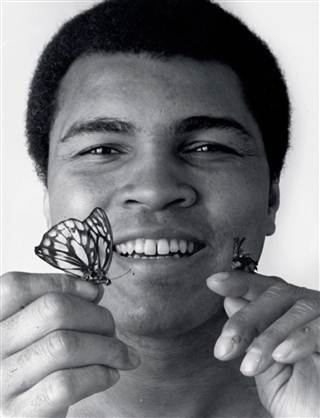
While my concerns about the political atmosphere of our country often outweighed my interest in my studies, I was only peripherally involved in the student efforts to voice our point of view. I knew many of the key players in the anti-war movement at school but mostly just attended meetings and went to hear speakers who came to our campus. I was particularly excited when I learned that members of the student government had secured a visit from Muhammed Ali and that he would speak at an informal gathering inside the Cougar Den. I knew that I had to be there.
Back then the Cougar Den was little more than a wooden shack nestled under a grove of trees to the left of the Ezekiel Cullen building. It was a dark, noisy, smoke-filled and always crowded room under the best of circumstances. On the day of Muhammad Ali’s visit it was a madhouse as students eagerly jammed inside hoping to get a glance of the greatest boxer in history. When a good friend and I arrived we realized that we would be lucky if we were even able to hear him speak much less actually see him. Fortunately fate intervened on our behalf. My friend was an incredibly beautiful and popular coed and as we were jockeying for a decent place to stand we encountered an officer of the Young Republican Club who had a huge crush on her. He offered to take us both upstairs to the organization’s headquarters where we might stand along the railing and watch the proceedings from a bird’s eye view. We eagerly followed him and the location proved to be perfect.
When Muhammad Ali entered the room a respectful hush fell over all of us. The mere sight of him was mesmerizing. Here was a man who had risked everything by refusing to be inducted into the army. With the famous words, “I got nothing against no Viet Cong” he had refused to step forward when his name was called to be drafted. His actions had resulted in the loss of his boxing title and the inability to fight in many places. He was threatened with five years in prison and had to pay a stiff fine. He would be involved in an appeal for the next many years, citing his Muslim religion as the reason for his pacifism. For some he was seen as a traitor but to those of us who believed that the war was wrong, he was a hero of the highest stature. On the day that I heard him speak he appeared to be godlike and was truly the greatest in my mind.
Muhammad Ali’s appeal would go all the way to the Supreme Court where his conviction would eventually be overturned. He was cleared to resume his boxing career and he went on to have a legendary career that is spoken of with reverence to this very day. His presence, his confidence and his style was unlike anything that the public had ever before seen. Even his detractors had to admit that he was an incredible man.
I was never a fan of boxing so I can’t say that I followed Muhammad Ali’s career very closely. I had uncles who loved to watch the matches that were broadcast on television but I was never interested. One of those uncles had gone to see George Foreman train here in Houston. I remember his unmitigated excitement when Foreman was slated to fight Ali in Manilla. He was convinced that it would be one of the best contests ever and it indeed became one of those sporting moments that boxing fans would never forget. In the searing heat Muhammad Ali pushed George Foreman to a state of exhaustion and then knocked the giant off of his feet to secure a victory that stunned the world.
I suppose that what I admired most about Muhammad Ali was his integrity. He was a man who lived the principles that were the foundation of his beliefs. He was unafraid to speak even when the truth was difficult. He was a warrior for social justice and a peaceful man. When Parkinson’s disease began to ravage his body he demonstrated courage and grace. I’ll never forget the moment when he carried the torch to light the Olympic flame at the games in Utah. He was already frail but he bravely ran up the ramp as though he were holding the light of the world for all of us. He was as beautiful as he had been when I saw him as a young lion those many years ago.
Muhammad Ali became an example and spokesman for those of us who are nameless. He never varied from his determination to make the world a more tolerant and peaceful place. From his days as Cassius Clay in Louisville, Kentucky to his most triumphant moments the public knew that he was indeed a remarkable man. At a time when a black man dared not speak out lest he be punished, Muhammad Ali refused to still his voice. He held his head high and reminded us that he was beautiful and great. He would proudly boast, “I am Muhammad Ali, a free name – it means beloved of God, and I insist people use it when people speak to me.”
Muhammad Ali was beloved, not just by God but by people the world over. He taught us the importance of faith, family and conviction. Now he may rest in peace. His battered body will hurt him no more. He is with God and moving like a butterfly in his heavenly home.

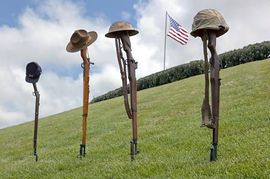 Memorial Day on the last day in May has come to represent the beginning of summer even though the laws of astronomy give that designation to a different date. It is a three day weekend holiday designated by Congress. There are few better times to buy mattresses or large home appliances. People flock to the beach on this day and gather around swimming pools and barbecue pits. American flags fly from the porches of homes all across the land. For many the true intent of Memorial Day has become lost in a haze of celebration having little to do with what this national holiday was originally intended to be.
  I’ll be the first to admit that the end of May through the beginning of June is not my favorite time of year. In fact, I tend to dread this period, for it cycles through the dates when each of my parents died. I’d love to be able to tell everyone that there comes a moment when I actually forget the trauma of Memorial Day, 1957, when my father was killed in a car accident, but that would be a lie. For fifty-nine years I have felt the same pangs of loss that I experienced way back when I was only eight years old. The fact that my mother died quite suddenly and unexpectedly on the very day before I was to celebrate my retirement five years ago, only compounds my solemn mood as I watch the calendar head to those two terrible anniversaries.
  Most of us go about our business each day quietly bearing burdens that we rarely mention. We tend to downplay our worries and sorrows, instead displaying a stiff upper lip and carrying on as if nothing has happened. When things become too much for us and we feel broken, we may find ourselves unable to keep it together. We experience a moment when we confide our woes or shed tears without the usual filters that we place on our feelings. Then there are those among us who always manage to keep a public face of strength and optimism even when they feel as though they are dying inside. We each have our unique ways of dealing with death, disappointment and hurt.
 All It Takes Is A Little Love