Surrender

sea of clouds sunrise wallpaper
Photo by Rahul Pandit on Pexels.com

At the age of thirty my mother was left alone with three small children in an era when women were still mostly housewives, not yet integrated into the work force. She was faced with raising her little family with no money, not even a life insurance policy to ease her worries while she quickly learned how to make ends meet and provide safety and security for herself and her family. A little more than then years later she would have proven her mettle and determination to make things work, but her troubles were far from over. The symptoms of her bipolar disorder revealed themselves in full force with a psychotic episode of paranoia that would make her life even more difficult in the years to come.

Her hospitalization and treatment would weigh heavily on her mind for the rest of her life. It was a frightening experience for everyone, but mostly for her. The nurses carefully checked her belongings to be certain that she had no objects with which she might harm herself. They spoke of great fear that she might be suicidal. Of course no such thoughts were ever present in my mom’s mind. Her faith in God and profound belief that he would always love and protect her insured that she was never going to consider such violence upon herself. Even in the worst episodes of her illness suicide was not part of her frightening thoughts. The psychiatrists who took the time to know her well all insisted that she was never at risk of killing herself. Somehow her profound faith was like a protective shield of armor even in her most confused moments.

This past Easter season I found myself being reminded again and again of how much my mother loved God. She was one of those persons who proudly displayed the palms that she received at church on each Palm Sunday. During Holy Week she virtually lived at the church beginning with Holy Thursday and culminating with special services on Good Friday, Holy Saturday, and Easter itself. She seemed to have a very special relationship with Jesus, and she found great comfort in the story of his short life here on earth. She often spoke of how he protected widows, and she sincerely believed that he was actively caring for her from heaven.

Good Friday was a particularly moving occasion for my mother. She seemed to understand the message of Jesus’ death on the cross far more clearly than most Christians. She often cried at the very thought of the pain that he endured and the injustice of his execution, but she saw it as the ultimate sacrifice that anyone might make for his/her fellow human. She also thought of it as a model for the kind of suffering that each of us will experience on earth. She felt that such challenges would ultimately be a passing thing when our time here reached an end and we are reunited with God in heaven. She was so unswervingly convinced of the truth of her beliefs that she literally glowed with joy on her deathbed in the knowledge that she was about to receive the ultimate reward for all humans who have done their best to live good and decent lives.

I admittedly often felt sorrow for my mom. It seemed to me that she had convinced herself that the tragedy of her life was not nearly as bad as some seemed to think. She focused on the prize and never once wavered in her beliefs. She often spoke of how blessed she was and how good God had been to her. Not poverty, nor illness, nor the loss of those that she loved ever led her to question that love that she was convinced he had shown her. She daily read her bible and made it from one difficulty to the next with an optimism that sometimes annoyed me. It was only at the very moment of her death that I felt that there was something bigger than the challenges of humanity at work in our lives. In the years since she left this earth I have found myself remembering just how much comfort she found in the words and deeds of Jesus. I have recalled how she actually felt privileged to have suffered a bit like he did. She found so much joy in the spiritual relationship that she had with him, and she truly believed that he was the reason that she had made it.

My mother was a very special and saintly woman, a tower of strength in spite of the illness that rose up to threaten her again and again. Where I became angry about her fate, she saw it as life unfolding just as it was supposed to be. Somehow she found virtue even in her own imperfections. Her interpretation and understanding of the message of the Christian gospels was one of great exultation. I on the other had often over thought and focused on the horrors that I saw in the world, particularly those inflicted on her. Unlike my mother I wanted to know how she could be so content when she seemed to have been give so little. I had a hard time accepting her belief that she was fortunate and blessed.

In the years since her death I have found myself pondering her life and realizing just how carefree and generous she always seemed to be. While I was worrying about worldly things, she was viewing life through a far more spiritual lens. She did not need the trappings of humanity to feel good. She was truly like the lilies of the field in her innocence and her willingness to find beauty and peace in small things. She needed little more than her bible to feel safe and secure.

Somehow this past Easter season I began to truly understand her life, and mostly her faith. I had moments when I was overcome with emotion in the realization of how powerful her relationship with God had been. I felt her presence in my heart and it allowed me to feel closer to her and to God than ever before in my life. I realized that I too have been the beneficiary of God’s goodness even when it was not apparent to me. Somehow I began to have a clearer understanding of his message to us. While I cannot explain it to the extent that I wish, I now understand that it is about surrender, the same kind that Jesus demonstrated when he allowed himself to die on a cross. It is not about rules or judgements or the kind of things that we humans have added to virtually every religion on earth, but about love and trust. That is the secret that my mother discovered, the truth that kept her untroubled even when her story seemed to be so unfair. I’m working on becoming more like her. I still have a long way to go, but I can see a ray of light that has never been there before.

Finding Hope

people gathered inside house sitting on sofa
Photo by Daria Shevtsova on Pexels.com

Statistics can be a powerful way of understanding trends in our society, but they can also be misleading. Learning the truth about the numbers that we see requires analysis, critical thinking. Since we are continuously bombarded with information regarding the state of our world based on statistics we need to consider what that data is actually telling us. Something as simple as the intervals of a graph has the power of visually changing the way we interpret the facts. So it is with the ever recurring claim that the lifespan of the average American has continued in a downward direction since its apex in the nineteen sixties. It’s important that we begin to understand what that bit of information actually means, and what we may need to do to halt the decline.

We are often told of the need to improve medical care in this country by the use of this astounding statistic. For most of us it simply seems almost impossible to believe that we have such phenomenal medical facilities and still are losing the battle of saving lives, and yet it is real. A deeper analysis demonstrates that the downward trend is related mostly to alcoholism, drug abuse, and suicide. It is not so much that our country is lacking in quality medical care as that we have an epidemic of self harm that results in deaths from overdoses, cirrhosis of the liver, and increasing numbers of suicides, especially and shockingly among our middle age population. It is a quiet and grim trend about which we say little, but it is prevalent all across the country and most particularly in areas where businesses have failed and lifestyles have drastically changed.

HBO in conjunction with Dr. Sunjay Gupta filmed a documentary called One Nation Under Stress that attempted to get to the heart of why so many are turning to drugs, alcohol and even death as answers to problems. We know that addictions can be difficult to overcome, but what attracts people to chemical means of coping with anxiety in the first place? Why are ordinary middle class individuals in so much pain that they feel compelled to shut out their sadness with chemicals that alter their brains and damage their health?  What is really happening?

Dr. Gupta and the experts that he consulted note that our society is continuously and relentlessly changing, particularly in small towns that often rely on particular industries for the welfare of the populace. Many of the old avenues for work are being eliminated and in the process people find themselves suddenly left with no meaning or income in their lives. The losses that they incur both physically and emotionally drive them to seek solace in harmful ways or to despair entirely. Additionally our society has lost many of the support systems that were once so prevalent. The extended family units and neighborhood associations that were once so common have crumbled in many ways leaving individuals feeling alone and unable to cope. In fact, a certain irony is that recent immigrants are actually doing better than long time citizens because they cling to one another in communities that emphasize care and support.

Those in the middle of the economic spectrum are the most likely to feel the weight of stress. They are subjected to a kind of collective pressure and worry about losing their status and all of their comforts. They often feel quite alone in their struggles and so the abuses to their bodies and minds begin. They are reluctant to share their concerns, and often feel that they have nobody whom they trust enough to do so anyway. The anxiety bears down on them both mentally and physically.

I experienced a kind of microcosm of such feelings during the rains of hurricane Harvey which so inundated my city. My husband Mike and I were alone in our home hearing reports of devastation that was affecting both strangers and dear friends and family. Mike had suffered from a stroke only a few weeks earlier and we had been told that his chances of suffering from another attack were at their highest during this time. I was quietly frantic with worry, so much so that I was hardly sleeping and had to keep my mind occupied by preparing my home for the possibility that it might flood. When my daughter and her family had to leave their neighborhood for fear that the levee that protected their home high fail I felt incredibly alone with the realization that they were now so far away and Mike and I were so isolated from everyone. It was a series of reassuring texts from a former student who assured me that he was on alert if Mike and I needed a rescue that kept me from totally losing my composure. The lifeline that he gave me quelled my fears as did the random meetings with a neighbor across the street with whom I spoke as we both assessed the drainage system that was working to keep the water away from our homes. Facebook also gave me a way of knowing what was happening to friends and members of my family. It provided me with a way of expressing my anxiety rather than bottling it up inside. Ultimately I made it through those horrific days, but I found myself wondering if it would have been possible without those human connections that kept me grounded.

What happens when a person feels that there is no one to help? How does one cope when the pressure is not for just a few days but over a long period of time? What might each of us do to help those who have lost their way? Do we sometimes underestimate the power of a text, a message, a phone call in changing the tenor of a person’s thoughts? Have we emphasized independence so much that we have lost the emotional support of multi-generations living and working together?

Mike and I were recently discussing the Great Depression. Our parents were children during that time. It was our grandparents who bore the full brunt of that era. We noted that they survived by sharing responsibilities and resources. Whole families of sons and daughters and cousins and grandparents pooled their funds and their food to keep afloat. It was a cooperative effort that brought our ancestors through the tragedy. Hidden in their efforts was a great deal of love. Our people understood that the were going to make it because so many cared about the welfare of each individual.

We would do well to reinstate the power of family and neighbors to ease suffering. Old people should feel assured that they will find the care that they need if they become sick. Young folk should know that they will have the encouragement and support to launch themselves as adults even when they make mistakes. Those in the middle should never be reluctant to ask for help when things go awry. If we open our hearts and begin to embrace the people for whom we care perhaps we can stem the tide of self medication and self destruction that is literally killing people in our midst. The change that we need is to be found inside our relationships. If we focus on strengthening them many of our problems will be solved.

Kindred Souls

Some people in this world are larger than life and my Uncle Bob was one of them. I was only six years old when he died at the age of thirty, but he had left an impression on me than never faded. He and my father had met in Corpus Christi, Texas when they were in high school and along with a third friend named Lloyd they became like the Three Musketeers, eventually attending college together at Texas A&M University. To everyone’s delight when my Uncle Bob met my mother’s sister, Claudia, the two of them fell in love and married. That’s how my father’s best friend officially became my uncle.

Uncle Bob was an athlete who played tennis and climbed mountains. When World War II broke out he enlisted and became a bombardier flying missions over Germany. When he returned from battle he completed a degree in Geology from Texas A&M and found love with my Aunt Claudia. Together they were a stunning couple, young and beautiful and brilliant.

Uncle Bob next enrolled in the South Dakota School of Mines to earn a masters degree in Geology. Before he had finished his studies he was diagnosed with cancer that required the amputation of one of his legs. True to his unflagging spirit he never missed a beat, studying during his recovery and graduating on time with the other members of his class.

After graduating he and my aunt returned to Corpus Christi where he landed a job in a small oil and gas company. At first his bosses gave him a desk job due to his disabilities, but he was itching to work in the field and finally convinced his superiors to give him an opportunity to demonstrate his prowess. He proved to be quite capable of doing the sometimes strenuous work at drilling sites, often being more adept that those without the constrictions that he bore.

Uncle Bob and my dad were quite the pair, two highly intelligent young men with big plans for the future. I remember them laughing together and enjoying each other’s company like two brothers. I loved the times when he and my aunt would stay at our house during their visits from Corpus Christi and we in turn often found ourselves traveling to Uncle Bob’s home which was filled with a museum worthy collection of rocks and minerals as well as his paintings of places he had been. 

Uncle Bob was planning to enter a program for a doctorate when he was once again diagnosed with cancer. This time he endured surgery to remove one of his lungs and was quite sick. While he was in the hospital in Houston my parents were visibly upset and our home was uncharacteristically in a state of turmoil. My mother had just given birth to my youngest brother and my aunt was also expecting her first child. There was a great deal of furtive whispering in those days which culminated in my being quickly enrolled in first grade at the age of five. The adults seriously thought that I had no idea of what was happening, but I was all too aware that my Uncle Bob was not doing well. He had already prepared me for such an eventuality during one of his visits when I discovered him attaching his wooden leg. He treated me with so much respect when he told me about his cancer. I loved him for his honesty and his understanding.

After Christmas of my first school year Uncle Bob died. My parents attempted to shield me from what was happening so I did not attend any of the memorials or funeral events, but I knew all too well that I was never again going to see the remarkable man who had so enchanted me. I also noticed a profound change in my father who would grieve for his friend for what ended up being the rest of his own short life.

My family moved on just as people always do after such tragedies, but in my heart there would forever be a special place for my Uncle Bob. My image of him never grew old, but remained frozen in all the glory of his youth. It was only when I began tracking my ancestry that I began to learn even more about my incredible uncle, and only recently I uncovered a newspaper article about his father that touched me to the very center of my heart.

I never knew anything about Uncle Bob’s childhood or his parents, so I was stunned to learn that before moving to Corpus Christi he had spent much of his boyhood in Chicago. There his mother became ill and died while he was still rather young. Like him, she too had cancer that ended her life far too early. Nonetheless he was the apple of his father’s eye, an only child who brought great joy to the man who guided him through his childhood.

Uncle Bob’s father was a machinist and was apparently rather skilled in his trade. At one point he created a unique steam engine for his son’s train set. He used scrap metal from junked cars and dental tools to build tiny parts that made the details of the model realistic. Over the years the man had kept the treasure which had been loved by his son. When the father was in his seventies and retired he decided to donate his creation to a museum, and the local newspaper ran a featured article about his work.

As I read a copy of the piece I felt a tinge of great sorrow for my Uncle Bob’s father. There was a look of sadness on his old face and the story of how he had worked so hard to please his little son was filled with so much pathos. There he sat gazing wistfully at his creation and possibly thinking of all of the might have beens. Somehow I felt a deep connection to this person whom I had never met because I knew that he had loved Bob even more than I did.

I suppose that there is nothing quite like losing a person who seems far to young to die. The pain never really heals because of a lingering sense of unfairness. I would eventually undergo the even more sorrow only two years later when my father died, and as a young mother I would see my Uncle Bob’s daughter, my cousin Sandra, die at the age of sixteen. Somehow I feel as though these three souls and that old man are linked with me in a primordial connection. I am now a seventy year old like Uncle Bob’s dad was in the article that so touched my heart, and I sense an unexplainable closeness with him. Somehow we are linked as humans through our spirits, kindred souls wandering through life’s experiences. 

A Month of Madness

close up photography of blue and green smoke
Photo by rawpixel.com on Pexels.com

As I took my plants back outside after a couple of days of freezing weather I thought of how cyclical life is. I’ve been through seventy one winters now and watched the seasons change in quirky ways, but always somewhat predictably. Life is a series of repetitions during which we grow just a bit older and hopefully a bit wiser. We learn about the way of things and understand that while it’s unusual, it is possible to have a freeze in March in the south. We go with the flow and the routine even as big changes may occur to make things so very different. We understand that we can count on the calendar moving at its”petty pace” but surprises both good and bad may come our way at any moment. The traditions to which we often cling are ways of keeping us anchored even as storms roar around us.

March brings us the Houston Rodeo and Mardi Gras and Lent and the madness of basketball. In this month we celebrate St. Patrick’s Day even if we don’t have an Irish bone in our bodies. We decorate our homes with colorful beads and then replace them with shamrocks and finally bunnies. We take a break from work and school with an eye toward warmer days and fun in the sun, hoping that our plans to visit a beach aren’t spoiled with rain and cold temperatures. We seek a sense of control and continuity with our rituals. They create cohesion and memories that sustain us, but they can also be a source of sorrow when things spiral out of our control as often happens.

I remember a year when my friend Pat secured a beach house for all of us to use during spring break. Our children were teenagers who were not yet driving and doing things on their own although they may have been dying to do so. We happily packed enough food and clothing for what should have been a fun adventure, but things began to fall apart almost immediately beginning with the fact that we had to wear coats because it was so chilly. Nonetheless, by the time we had reached the rented house we had outlined a Plan B that did not include swimming in the still frigid ocean, but would still be filled with tons of fun. We were bound and determined to make the best of our situation.

As soon as we opened the door of the vacation home we somehow knew that even our alternate ideas were doomed. The place reeked of deceased rodents and there was no way that we were going to be able to stay inside. At that point our anger and disappointment reached its limit. We had no choice but to complain to the owner of the place and then return home. After shedding a few tears of frustration we were on our way back to where we had started with only a few lame ideas about how to have a fun time in spite of the frustrating developments.

I don’t remember what we actually did after that. I do know that we eventually found ourselves laughing in a kind of hysteria about how awry things had gone. At the time our misadventure had seemed so significant and horrific but as the seasons came and went and our children grew into independent adults the story of that spring break became more of a treasured memory of our continuing friendship than a terrible experience. Today my friend Pat is gone and I know in my heart that I would even stay in a stinky rat invested house if it meant that we might have a bit more time together. Such is life.

After someone dear to us dies the first few cycles of the the year are exceedingly difficult to endure. Each occasion reminds us of how much we miss them. Over time our wounds heal, toughen up, and turn into scars. We once again find joy in our traditions and the memories of those who once shared them with us. We realize how lucky we were to have them and the pain becomes bearable. Just as the dormant trees bud forth each spring, so too do we find ways to carry on even after we have felt as though we too have died inside.

I love this time of year. It is one of those grandly transitional months when we humans find ways to muddle through the last gasps of winter with the promise of spring just over the horizon. We gather together to celebrate all that has gone before and all that is yet to come. Our hats, parades, ashes, decorations, foods, and gatherings are inventions of the human spirit, attempts to maintain our optimism even when everything around us feels so wrong. How wonderful it is!

March is a hopeful month even as we witness destruction from the last gasps of wintery weather. It’s a month when we never quite know how things will turn out, but we plan them anyway. We may go to the Houston Rodeo in heavy coats with rain falling on our heads, but once we are inside the arena all of our worries seem to evaporate. March is ever a new beginning, a time to set the problems of the past aside and hope that better days are ahead. It’s also a time to prepare ourselves for whatever challenges may come our way by thinking outside of our own worries and needs. I’m now old enough and experienced enough to know that it’s often a month of madness that always seems to end with a feeling of peace.

The Greatest Gift

Gary

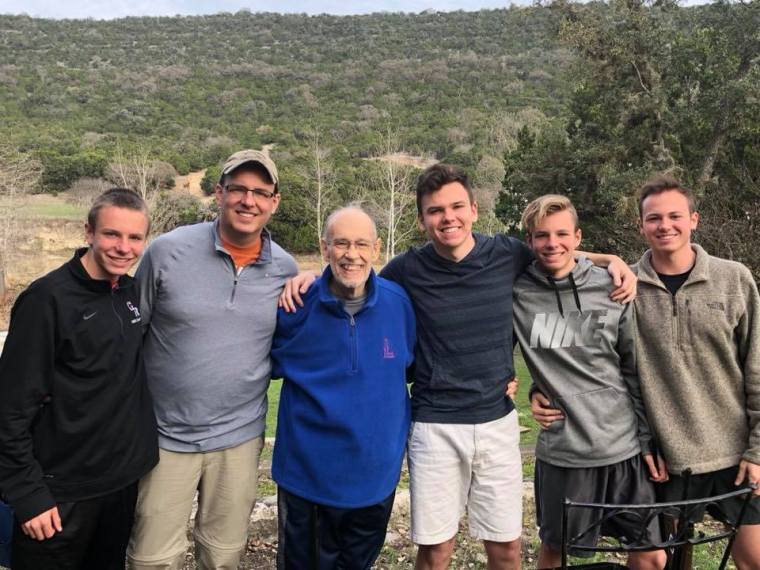
My son-in-law, daughter, and grandsons are in a state of grief. Their beloved Boppa died on New Years Day. Boppa, otherwise known as Gary Greene, was a good man who loved his wife without reservation and cherished his children and grandchildren with every fiber of his body and soul. He was also filled with a spirit of fun. He believed in squeezing as much joy out of each day as humanly possible.

Gary was born in Houston, Texas and grew up in an area not far from the Texas Medical Center. He graduated from Bellaire High School and then set out for the University of Texas where he earned a degree in Chemical Engineering. While he was a student there he met his wife Barbara and the two of them fell in love, married and set out on a five decades long adventure that took them all over the United States and around the world. In fact, traveling became one of their greatest joys along with their two children Scott and Terri.

Gary worked hard at his jobs, dedicated to making a comfortable life for his family. He was a Texan through and through but whenever his companies asked him to move he dutifully went where he was needed and turned the relocation into an opportunity to learn more about different places. All the while he always found time to support his children’s interests and to open his home and his heart to their friends. His loyalty to his beloved Texas Longhorns never wavered either no matter where he roamed.

Gary eventually found his way back to Texas as his working years slowly came to a close. He retired to the Austin area and threw himself joyfully into the role of being a grandfather. He took each his six grandchildren on special trips to places like London, Germany, Washington State and such. A few years ago he planned a gala vacation right after Christmas for the entire family in Mexico. On another occasion he took everyone to Hawaii. Every excursion was punctuated with his impish sense of humor, exciting activities and lots of ice cream.

Gary rarely missed the yearly reunion of his wife’s family on Thanksgiving Day. He reveled in the games and songs and loving significance of the event and became known as the resident genealogist, creating expansive charts outlining the history of the family and recording all of the new births. For many years he and his crew were the reigning champions of the washer contest, and he became as loved by his extended family of in-laws as he was by Barbara and his children.

Gary had a sonorous voice that might have served him well as a radio broadcaster. He used it often to tell his many stories and jokes. He also enjoyed singing and had hours of fun in a barber shop quartet. He and Barbara even learned how to square dance when he demonstrated yet another unexpected talent.

Most of all Gary enjoyed watching the birds that live around us. He often rose early in the morning and walked quietly through wooded areas with his binoculars and a scope to catch a glimpse of feathered creatures. It was a relaxing hobby that was so in tune with his affection for nature and the joy that spending time outdoors always brought him.

Gary had been a leader when his son Scott was in the Boy Scouts. He never lost his interest in the remarkable training that the organization affords young people. He often wore his regalia and badges when his grandsons moved up through the ranks in their own quests of excellence in the scouts. Nothing made him prouder than watching them grow into fine capable young men with amazing skills and a love of our earth and each other.

In many ways Gary Greene was an old fashioned kind of man who earnestly embodied the traits of a Mr. Rogers or a Jimmy Stewart. Family was paramount to him and he enjoyed introducing first his children and then his grandchildren to the places and skills and ideas that he had known as a young man. He taught them how to drive and how to fish. He showed them how to respectfully handle a BB gun. He played games with them like Spoons and taught them to love listening to John Denver. He took them rafting down rivers, horseback riding in the country, and zip lining in exotic places. Mostly though he just loved each one them for whomever they chose to be.

There is great sadness among the members of Gary Greene’s family. He has died after a years long struggle with cancer during which he showed them what true courage really is. He slowly lost his ability to walk and his body was riddled with pain, but he continued bringing fun into their lives as long as he could. He has left a big hole in their hearts, but the legacy of joy and optimism with which he approached each day will sustain them for all of their years to come.

Gary Greene really lived and loved. The torch of all that he believed has been passed to his children and grandchildren to remember and honor who he was with their own lives. He demonstrated to them all of the character that one needs to live happily and well. He will no doubt live on as they emulate his spirit, the greatest gift that anyone might ever leave on this earth.