Not Today!

Churchill War Rooms

Our trip to London had been carefully planned, but in our concern with hundreds of little details it had never occurred to me that scheduling a visit to the Churchill War Rooms at the end of a week of seeing all of the major sights would turn out to be so perfect. In fact by learning about so much of the history of this great city I truly understood what was at stake when Adolf Hitler threatened to overtake the whole of Europe with his warped political philosophies. In an effort to keep the peace much of the continent had bowed to his demands only to realize that his appetite for domination was not easily sated. For a time Great Britain seemingly stood alone in its determination to remain free from Nazi tyranny and the consequences for doing so were grave. Somehow through the inspired leadership of Winston Churchill the people fought valiantly against the greatest of odds.

History will never know how things might have ended had Great Britain compromised with Germany as some desired. It is uncertain if the people would have been able to endure the unrelenting attacks from the air on London were it not for Churchill’s determination to convince the citizens that surrender was not an option. The entire world might be very different today if Britain had fallen before the United States eventually entered the war. Instead the people of the British Isles fought with every fiber of their courage even as the landscape around them was turned to rubble. They were a proud and determined people with a leader who loved his country and its freedoms so much that he was committed to making whatever sacrifices needed to save Britain from unwanted domination.

The Churchill War Rooms were hastily created in an underground area near the government offices in the center of the city of London. They became the nerve center for the planning of strategies and battles. While they now appear secure from dangers above ground the fact is that they might have been instantly destroyed had an enemy bomb caused the building above them to fall. The honeycomb of offices, sleeping quarters, and conference rooms was improvised to provide safety to the key leaders of the war effort, including Winston Churchill. Today it stands as a vivid reminder of what was at stake not just for the people of Great Britain, but for the entire world during those fateful years when evil was overtaking most of Europe, Africa and the Pacific.

I had not realized how deeply affected I would be by viewing the Churchill War Rooms, but as I walked through a maze of rooms left just as they had been on the day that war ended for Europe I was moved to tears at virtually every turn. Because I had spent a week learning so much of about this great country I was able to fully understand both the fears and the determination that the citizens must have felt as the specter of pure evil hung over them. They were literally on the brink of losing all that they had ever cherished, and after fifty seven straight nights of bombing over the city they must have felt even more terrified. Somehow their leaders found the inspiration needed to keep hope alive, and much of what they did took place in the tiny rooms below the ground.

The tour of the Churchill War Rooms lays out both the brilliance of leaders like Winston Churchill and the humanity of the British people. I literally heard their voices telling the story of one of the darkest times in history. I saw their faces in countless photographs and films, and witnessed the devastation that seemed almost unending. All of my senses were immersed in a retelling of the horrors of the time and the bravery of a generation that said a resounding “No!” to those who would enslave nations.

I felt humbled beyond words and filled with my own private thoughts as I slowly wound my way through the tales of privation, loss, and courage. The ghosts of the people who had worked there came fully alive as did all of the citizens who chose to stand firmly against surrender. I felt the spirit of good versus evil, right versus wrong. I understood the humanity of what had happened before I was even born.

When I returned to the light of a gloriously beautiful day I was happy that I had time to sit quietly and collect my thoughts. I had been moved from one emotion to another and I needed a moment to simply meditate on what I had seen. Never before had I quite understood what my parents and grandparents had felt during that terrible war. Not once had I realized why occasions like D-Day in Normandy were so important to them. I had not fully comprehended how frightening life must have been nor had I felt so grateful for freedom.

As we walked through lovely gardens in sight of those underground bunkers I felt a sense of profound appreciation for the most simple aspects of the world. I saw the flowers and the birds in a new light. I felt gratitude for the people of Britain for holding the line against the evil that threatened the future into which I came.

I smiled when we encountered a political demonstration in the streets in front of Parliament. It was a raucous affair decked with flags and the nation’s colors. Traffic was stopped for miles around. The sound of bagpipes filled the air. People spoke their minds without worry. It was a show of freedom that might not have been there had things gone differently during World War II. I silently gave thanks for the folks who had said to Adolf Hitler, “Not today!”

Demonstration.jpg

The Tower

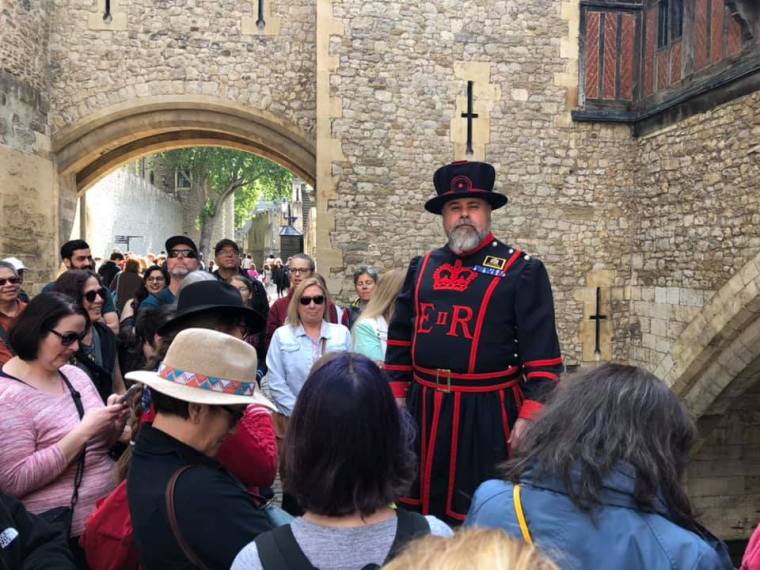
Beefeater

In the heart of London along the River Thames lies one of the most extraordinarily historical places in London. Known as the Tower, it is a complex of buildings dominated by a white castle built by William the Conqueror shortly after the battle of Hastings in 1066. It is an impressive fortification with its moat, narrow winding staircases, and vast rooms. It was originally designed both as a home for the king and a defensive keep. Over time it became better known for the prisoners that were held on the premises and the executions that took place on the green. It is an imposing and improbable complex whose elevations seem both in and out of place in the modern world.

Some time ago I learned that my lineage can be traced back to William the Conqueror and from there to Vikings. I suppose that such is a somewhat dubious honor given that the Norman king was so often resented by the people of England who saw him as a bloodthirsty outsider. Nonetheless his legacy in creating the famous white tower remains as a reminder of the often violent and dangerous history of Britain.

What was once designed as living quarters for the first Norman king has evolved over time in its use, and now stands as a museum and respository of many stories. Visiting the Tower of London is perhaps the most fascinating tour in all of the city, complete with legends about the ravens who have lived on the premises for most of its existence. It is said that as long as they remain Britain will not fall and great efforts are made to keep them happy and willing to stay as permanent residents of the compound.

Countless mysteries and tragedies unfolded in the Tower. Richard II, the protector of his child king nephew, took both the little monarch and his brother there for safe keeping, but they subsequently disappeared thereby leaving the throne to him. Years later when the bones of two children were found buried under a set of stairs it was conjectured that they must have belonged to the long missing brothers. 

It was in that Tower that Anne Boleyn awaited her tragic fate once Henry VIII had decided that she was no longer of use to him. Later she would be publicly executed for treason on the grounds. Lady Jane Grey would serve as Queen for nine days after Henry’s son James died without an heir, and then lose her life when Mary I laid claim to the throne by right of being Henry’s eldest daughter. Elizabeth I would also spend time imprisoned in the Tower but was luckily spared a death penalty and eventually given the throne. Other famous prisoners like Sir Walter Raleigh spent years behind the walls as condemned persons before being put to death.

One of the most interesting areas of the Tower complex is a building in which prisoners left graffiti on the walls. Over time they meticulously carved intricate signs that they had been there. These were no ordinary scrawlings, but rather beautifully carved inscriptions left in the stone for all time. They told of the long days of isolation that the captives had to endure and their determination to leave their mark on history in spite of their wretched conditions.

The Tower complex also features a sampling of the crown jewels including the largest known diamond in the world. It displays goblets and plates of gold, as well as jeweled crowns and scepters. It is a remarkable showcase that points to the wealth of the monarchy and the traditions that have both evolved and continued over time.

A tour of the Tower grounds includes a rather jolly session with a Beefeater who reveals the history, the stories and the secrets of the complex. The Beefeaters live and work inside the Tower walls and provide visitors with an in depth detail of information. Our particular guide had a rather wicked sense of humor that added to the interest of his tales. He provided a voice to the people who had lived and worked and even died in that fascinating place.

The history of the world is one of violence and tragedy as people fought to gain and retain power. Their’s was not so much a fairytale as a story of intrigue, jealousies, and betrayals. Perceived treason brought imprisonment and death. Choosing sides carried dangers for both noble men and women as well as the common folk. The walls of the Tower of London indeed seem to talk of the fears and horrors of real people who either fought to maintain a hold on their power or suffered because they appeared to be threats. The chronicles of lives celebrated and lost are written in the very stone of this place. There is something majestic, awe inspiring, frightening and evil about what happened within at the Tower making the ravens that act as sentinels seem an appropriate symbol of both the ingenuity and the flaws of humankind.

I left the Tower of London in a rather pensive state of mind. It is a glorious edifice that is a remarkable reminder of the steadfastness and resilience of our humanity, but it is also a respository of our imperfect natures. It is a place where we should surely learn the lessons that history attempts to teach us. Our time on this earth is short in the grand scheme of the universe. The possessions that we accumulate are unworthy of our focus. We will all soon enough become ashes but our actions while still on this earth will have far reaching consequences. Let us hope that we have made good choices and demonstrated honor and integrity rather than greed. The history of mankind is littered with far too much hatred. It is our duty to work toward the good insofar as possible. Power comes and goes and too often corrupts, as we humans continue to work toward a more perfect union of our differences. 

Wonders of the World

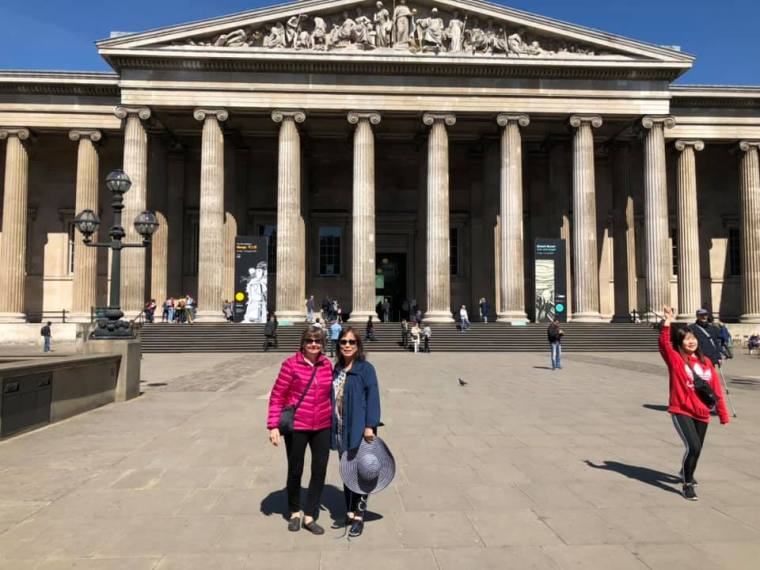
British MuseumThe Bloomsbury area of London is the home of the university of London, Kings Cross Station, and the British Museum. A short stroll in almost any direction leads to lovely sights. In May the gardens and window boxes are filled with lovely flowers of every hue. Tiny markets offer fresh fruit and sweet bouquets. It’s a pedestrian world in which the sidewalks are filled with walkers strolling more leisurely than in the heart of the city. It is a place where lingering just a bit longer is in fashion.

On the first full day of our trip we chose to eschew hurry, and instead enjoyed a scrumptious English breakfast buffet in our hotel. We feasted on fried, scrambled and poached eggs with little English sausages, baked tomatoes and sautéed mushrooms. We enjoyed steaming pots of Earl Gray tea or tasted the brew from the latte machine. Crusty loaves of bread beckoned us and a bounty of pastries were ours for the taking. We had our choice of cereal and fresh fruit, cheese and pancakes. It was a good way to start our adventures for we would walk ten of thousands of steps, many miles in a single day.

Our quest was to visit the British Museum about which we had long heard. The building in which great treasures are housed is an imposing structure which would be worth a look even without ever going inside. Once we had entered we were in awe of the great halls and sensed that we were about to see magical things that we had only before read about in books. After gathering and studying a map we decided to go first to the Egyptian section where we were immediately taken aback by the presence of the Rosetta Stone, an imposing treasure that would have been worth the trip all by itself. 

From that first moment we were in awe of the treasures that were displayed for what seemed like miles. It was difficult to know where to first look or what direction to follow. The trove of artifacts was so expansive that it gave me the feeling of being an adventurous archeologist who had suddenly stumbled upon a great find. I felt humbled as I gazed at items so exquisite and so old that I had difficulty processing an image of the creative and skilled people who had made such things in a time when tools were simple and scarce. I found my mind going far back into the history of mankind, and I marveled at the human connections that I felt with the people who had left such incredible marks on the world. I also thought of those who were simply nameless persons attempting to deal with the challenges of living, often under great duress.

I was brought back to present day reality only when I saw a group of young school boys careful taking notes about what they were seeing. They were so cute in their jackets with crests on the breast pockets and their earnestness in deciphering the mysteries of the many artifacts that they passed. I suppose that I will always love children and feel proud of the tiny contribution that I have made in the long range history of a generation. I think that we humans create because we have always desired to find some kind of purpose to our existence,

I was so caught up in seeing Roman statues, Greek urns, and Chinese porcelain that I hardly noticed that six hours had passed and it was time to enjoy a traditional afternoon tea gathering. Our group ate little sandwiches filled with chicken, salmon and eggs. There were scones and cakes and tiny cookies. We relaxed and chatted about what we had seen and how we felt. We worried just a bit about how so many things had been brought to Britain from the places where they were found. We wondered if they had simply been confiscated or if there had been permission, agreements, and payments for taking such things. I suppose that there are many different points of view as to the ethics of having such museums, particularly when the items include actual mummies. Is it wrong to raid a sacred tomb, or should we honor the purpose of such rituals by leaving them intact?

After refueling ourselves and debating the pros and cons of how and whether or not we were somehow complicit in the rightness or wrongness of such a museum we continued our study of the many different rooms. We saw Mayan carvings, and intricate woodworking from Abysinnia. We walked past glorious creations from India and Japan. Our heads were swirling from trying to read the descriptions of what we saw and achieve some kind of understanding of the magnitude of the glories of each culture represented in space after space.

Soon it was nearing five in the afternoon, and we realized that we had literally spent an entire day mesmerized by what we had viewed. Nonetheless there was still more to see, but that would have to be for another day, perhaps on another trip. The doors were closing and we were explorers forced to reluctantly set our adventures aside.

Russell Square near the museum was by that time filled with tourists and locals enjoying the coolness of the afternoon under enormous trees. They lolled in the grass and sat smiling on benches. There was an unspoken collegiality between all of us as we exchanged smiles and greetings. We felt as though we welcome in this place and it felt so good.

We finished our day in Callahan’s pub in our hotel. We feasted on a variety of food. I chose bangers and mash which were as tasty as I had hoped they would be. I enjoyed a nice glass of wine while my travel companions chose ciders and beers. We played a game on a large table and watched soccer on the television above our heads. We got to know some of the locals who came to the pub of an evening just to have a swig and a bit of conversation. It was a fun closing of a perfect day in Bloomsbury in London town.

Our Hidden Universe

person holding string lights photo
Photo by David Cassolato on Pexels.com

As an educator I have always been interested in the human brain and how it works. Sadly because it is so complex and we still have much to learn about it and what information we do have is sadly incomplete. Part of our difficulty in understanding it lies with the fact that we have only been seriously studying the brain for a little over a hundred years. Superstitions giving the brain a kind of spiritual aura actually prevented examinations out of a sense that it is wrong to invade the sacred nature of the mind. We are far behind the kind of knowledge that we have of our hearts and other organs of the body when it comes to the brain. Unlocking the inner workings of that most marvelous aspect of who we are may one day help us to eradicate some of the most life changing and difficult of the diseases that stalk us.

I dream of a day when we will literally be able to mend our brains in the same ways that we repair hearts. Surely the universe of our minds holds secrets to eradicating mental illnesses, learning difficulties, and other diseases that now so confound us. I can’t think of more challenging and ultimately rewarding research than studying how and why our minds work. As an educator I have seen the heartbreak of those who struggle to grasp ideas and concepts. As a caretaker I have watched my mother’s beautiful mind attacked by mental illness. As a friend I observed a delightful man slowly losing his ability to think and remember. I have seen the ravages of Parkinson disease steal away a cousin’s adventurous life, and I watched with horror as a brain tumor killed another a dear sweet loved one. I witnessed in great sadness as a friend succumbed to the ravages of ALS. It seems obvious to me that we need to support the people who are quietly working to find out how the mechanisms in the brain that control the very functions of our bodies work, and why the processes sometimes go awry.

I’ve often heard that we use only a small portion of our brain’s potential. Why is that so? Are the geniuses among us simply those who have unconsciously tapped into the power of their minds in a better way than the rest of us? What differentiates such souls from the crowd? Think of how wonderful it might be to truly understand how to coax more of those abilities out of each and every human. How exciting would it be to eradicate the kind of learning disabilities that educators see all of the time?

Our brains are encased in a bony structure that both protects them and hides their inner workings from us. We have machines that can record blood flow and even demonstrate where thinking is happening, but what we really know about the brain is rudimentary. It is as though we are still working with theories about humors and using leeches and blood letting to fix problems. Our psychotropic drugs work only sometime, and our therapies are often hit and miss at best. We do what we can with our limited knowledge and in the meantime some of the most intense suffering on earth continues in those with diseases of the brain.

I often think of how smallpox ravaged the world for centuries and is now almost unseen in the world. I dream of a time when we might be able to identify all forms of brain disease and cure them with medications or surgeries. I know that there are indeed individuals devoting their lives to discovering such miracles. We don’t often hear about them or even send our monetary support to their efforts, at least not until someone that we know is struck by brain disorders that rob them of the ability to care for themselves.

We spend a fortune on pizzas on the day of the Superbowl. We rush out to see the latest movies hardly thinking about the cost of entertainment. We treat ourselves to a four dollar cup of coffee without much regret. Our expenditures make us feel good, but think of how much better we might feel if they were deliberately aimed at the kind of research that is slowly unlocking more and more secrets of the brain. A slight change in our budgets here and there might allow us to invest in work that is as important as anything we humans do.

I know young people who are earnestly concerned about phenomena like PTSD, depression, dementia, strokes, multiple sclerosis. They want to earn the knowledge and the credentials that will allow them to delve into to inner workings of the brain, but doing so costs money that they sometimes do not have. It is important that we all agree to support the efforts of those who might one day discover how to eradicate some of our most confounding problems. The work may be tedious and may require more time than we wish, but in the end the efforts may lead mankind to solutions for difficulties that have plagued us since the beginning of time. If we can make to the moon or Mars surely we have the power to have better understanding of the hidden universe of our minds. 

We have the foundations for success in place. We just need to be sure that the momentum continues. Individuals and families are waiting for the answers that will change their lives and end incalculable suffering. They keys are inside our brains waiting to be found. This is who we really are as humans. By using the triumphant side of our natures to find the good, we may be able to counteract the conditions that cause us to despair. Then we will truly be able to proclaim, “What a piece of work is man!”

Saving A Mind

colorful fluorescent lamps
Photo by Timea Kadar on Pexels.com

The world can often seem to be far more violent than it once was, but even a brief glance at the past proves that we have always had evil in our midst. The biggest difference between now and then is that we hear about every instance of criminal or terroristic behavior almost instantly regardless of where it happens. Not that long ago we maybe heard a one minute blurb on the nightly news or read about the incidents in our local newspaper. It was easy for knowledge of such things to slip through the cracks so to speak. Those who committed heinous crimes usually did not achieve the level of notoriety that they do in the current climate. There was not as much incentive for copy cats. There was not as much information for those with sick minds to emulate.

I have a fascination with people and the way they do things. My interest made me a good educator because I did not just provide information to my students, but I was also understanding of who they were and what they needed to be confident and successful. I quickly learned that the teen years are difficult for even the most gifted and mentally healthy young people. In following my students after they graduated from college and entered their twenties I realized how confusing it can be to transition into the adult world. What I found in my observations is that there are certain situations that lead to more frustrations and tendencies to feel lost and abandoned. Our journeys through life require love and support which is not always forthcoming for every person. Feelings of alienation are amplified by mental illnesses and a sense of aloneness.

If we examine the lives of criminals and those who do horrendous things there are often commonalities. Loss of a parent or loved one can trigger unresolved anger, particularly at certain critical ages or when the individual has other mental problems. So many of our offenders are people who have been abused or who have disorders of the mind that have been improperly treated. They are already filled with frustrations and then some comment or incident triggers the rage that has been seething inside of them. In the aftermath of their criminal acts there always seem to be individuals who noted disturbing behaviors in them but felt helpless to do anything about them.

The conundrum that we have is how to balance our right to individual freedom with common sense approaches to treating conditions that may lead to tragedy. At the present time our society bends in favor of caution with regard to personal rights. We are more likely to defer to a person’s decision to be left alone, even when our instincts tell us that trouble is brewing in his/her mind. Our laws only allow us to force therapies and treatments in extreme cases. Furthermore, we often ignore cues as being just the way a certain individual is rather than seeing them as signs of greatly needed attention.

When we couple all of this with the generalized anger that is so commonplace today, we are creating human time bombs that have the potential to go off at any moment. While we rant over things that make little or no difference in people’s lives we miss opportunities to help someone overcome the war raging in the mind. Over and over again we ask why we have so many guns or bombs or implements of violence while showing little or not interest in discovering why we have such broken beings. Maybe because we are still too timid to speak of the diseases that exist in the mind or to tackle childhood abuses that so often lead to monstrous adults.

We ask when we will have enough courage to take away the means of violence, but we rarely ask when we will have enough courage to attack the problems of the mind that so often lead to that violence. We act as though noting the mental problems of a criminal are akin to excusing the acts rather than admitting that we somehow missed the cues that might have prevented the murderous rage from ever happening, and there are always signs.

There were teachers, students and parents who expressed their fears of the young men who wreaked mayhem at Columbine long before anything happened. Their concerns were all but ignored. There was a psychiatrist who noted that the crazed attacker of a movie theater was dangerous, but she was ignored. Nobody really listened to the mother of the autistic loner who was afraid of her son who would later kill little children at an elementary school. The list goes on and on and on yet we still do not insist that our system of mental health needs a full overhaul. We continue to avoid the family with the strange acting child or teen. We forget to support and counsel someone who has experienced a tragic loss.

When my father died I was only eight years old. Few adults thought that I had any real idea of what had happened or that my emotions were developed enough to really matter. The truth is that I was filled with a mixed bag of confused feelings. I was depressed but mostly angry. Luckily my mother created an environment in which I was able to eventually sort the toxic thoughts that ran through my mind. I experienced stability and kindness that helped me to feel secure in a moment when my world felt so chaotic. It took a long while to reach a point of well being, but the healthy routine of my world along with an entire village of people who were interested in helping me led me out of the darkness. As an educator I know that far too many young people in similar situations who feel totally alone and hopeless. Unless their anxieties are addressed they will only grow more and more angry over time. Before long society will simply view them as troublemakers and evil doers. We will have missed the opportunities to help them to become better versions of themselves.

When a shooting or other violent act occurs it should be a reminder to us that we have much work to do to save more minds. We inoculate against disease and treat illnesses of the body routinely, but we are still way behind when it comes to the mind. It’s time we attempt to catch up.