Unrest

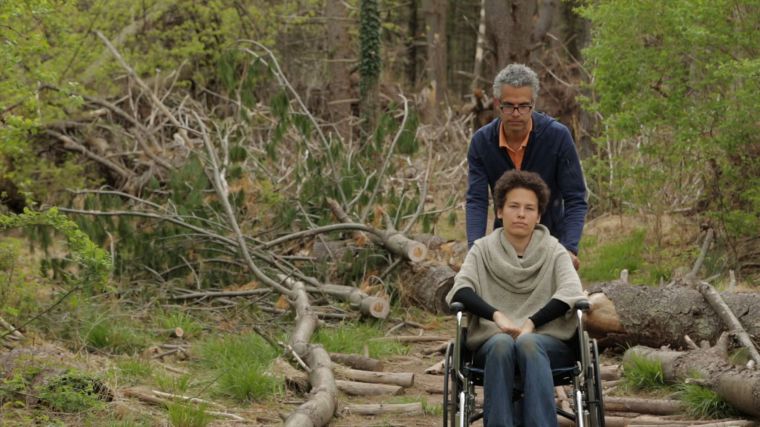
omar-jen-wheelchair-woodsShe is incredibly bright and beautiful, a graduate of Harvard who was about to complete her doctorate at Princeton. She was in love with a brilliant man and the two of them travelled the world together. They made plans to marry, have a family, build their stunning careers together, and then she caught the flu. It was a particularly harsh case with fevers of one hundred four degrees. When she was well once again she felt debilitated, but thought little of the residual effects. She had after all been very ill. She told herself that it would simply take time to regain her energy, but something was very wrong because instead of growing stronger she began to feel more and more weak. There were even times when her mind did not seem to work properly. She was unable to find the proper words to express herself. It was all so frightening.

Eventually her symptoms became so concerning that she sought the expertise of a medical doctor. He insinuated that it was all in her head, diagnosing her with what used to be known as hysteria. He suggested that she was reacting to some deep seated trauma that she most likely was unable to remember. He sent her home with no real explanation for what was happening, and she began to wonder if she was indeed going crazy. That’s when she got an idea.

The next time her symptoms became so severe that she literally collapsed in pain, unable to move or express herself, she asked her husband to film the incident. She took the video to a neurologist who was stunned by what he saw. He eventually told her that she had ME. Myalgic Encephalomyelitis, a strange disease that is thought to afflict ten to fifteen million people worldwide. There is no definitive test for the illness and no cure. The diagnosis is made based on symptoms alone which include excessive fatigue after mental or physical activity, intolerance to exercise, joint and/or muscle pain, memory problems, difficulty walking, sore throats, headaches, flu-like symptoms, sleep disturbance, bowel problems and mood swings.

The disease is also known as chronic fatigue syndrome and affects those who have it along a spectrum from individuals who endure a mild attack and then recover fully, to those who become completely homebound and bed ridden. There is no known cause but the disease appears to follow otherwise fairly typical and minor illnesses like the flu. Some believe that the roots of the problems lie in hormonal or allergy issues, but none of the research has proven any of the theories. It is a greatly misunderstood disease that sometimes results in psychiatric diagnoses rather than physical ones.

The woman whose life was so impacted by ME is Jennifer Brea, and she has a debilitating case of the disease that has radically altered the trajectory of her life. In a fashion keeping with her personality she decided to film her journey along with that of four other victims so that she might shed light on a mostly misunderstood illness. In conjunction with Sundance Films she created the documentary. Unrest, that chronicles her experiences as well those of the four others whose lives have been so radically changed after contracting ME. The film debuted on the PBS program Independent Lens this January and its power to visually explain what happens to those who have ME is emotionally visceral.

Jennifer Brea holds back nothing in her depiction of what ME has done to her and the relationship that she shares with her husband. She honestly expresses the fears and disappointments that plague her as much as the symptoms. She presents a compelling argument for more research by noting that those who are stricken often become like missing persons as they are forced to be hostages to their illness. She tells a compelling story of families broken apart and individuals losing their identities all while the rest of the world remains mostly ignorant of the horrors of this strange condition.

Her own story is one of the love that she and her husband share in spite of the problems that have so changed the way that they once thought they might live. She wants to be able to give him the kind of relationship that she had thought they would have, but instead is continually thwarted by recurrences of the most trying symptoms. Her husband has nobly stood by her, but even his patience is often tried by the confusing nature of his wife’s illness.

Ms. Brea shows a family in Sweden whose child was institutionalized in a psychiatric facility because doctors there were unwilling to accept a diagnosis of ME for her. Brea also introduces us to a woman who had been a happy wife and mother, one who had no idea that she would eventually be confined to bed with her own husband believing that she was just insane rather than physically ill. Her marriage deteriorated and she struggled to survive. When one of her daughters came down with the same disease her world unraveled even more.

The film is so personal, so real that those of us viewing the stories become involved with the characters, particularly Jennifer Brea herself. We watch her gaining strength and find ourselves hoping as much as she and her husband do that she will somehow miraculously improve. We cry with empathy as we become all too familiar with the struggles associated with ME.

Unrest is a touching and important documentary and quite worthy of the accolades that it has received. Hopefully it will also become the impetus for more research into the mysterious illness that it depicts with so much unflinching insight and compassion. At the present time very little is being done to learn how and why this illness affects certain people. There is only a smattering of interest in finding something that will cure those afflicted with its devastating symptoms. It is a grand mystery that shows no signs of being solved while real people suffer from the misunderstandings and lack of knowledge surrounding it. Hopefully Jennifer Brea has opened a door of awareness that will ultimately lead to the studies that will eradicate it or at least lead to more hopeful treatments. Perhaps just by spreading information about ME Unrest will at the very least bring more compassion to those who deal with its tragic effects.

Thinking Inside the Box

clichés-900x675“It’s such a cliche,” she says. “I am weary of platitudes,” he complains. “That comment was so trite,” they observe.
I often see such statements in the quibbling that arises in discussions involving politics or religion. The putdowns are intended to be an assessment of the quality of ideas rather than a sound rebuttal. There is more emotion than rational thought in such outbursts, more insult and arrogance than counterpoint. The use of snide commentary has become fashionable in the modern world of tweets and soundbites. The more outrageous the idea, the more memorable it becomes and so we eschew the old ways of using parables and fables and familiar sayings or themes to explain our human natures. Instead we search for originality and condemn the laziness of quoting ancient ideas.

The dictionary tells us that a cliche is a phrase or opinion that is overused and betrays a lack of original thought.

“the old cliché “one man’s meat is another man’s poison.””

synonyms:

platitude, hackneyed phrase, commonplacebanality, old saying, maximtruism, stock phrase, trite phrase; old chestnut

“a good speechwriter will steer clear of clichés”

As someone who strives to string words together in unique ways there is probably no greater disappointment than to be considered trite, and yet I know full well that much of what I communicate is as old as the dirt on the ground. There are few totally original ideas. The themes and phrases that we use tend to simply be variations on ways of expressing ourselves that were actually invented eons ago. Furthermore, there is a usefulness of maxims that rings true through the centuries and captures our imaginations even though we have heard them many times before. The best of the old sayings are powerful educational tools perhaps because they are so familiar.

Each day those who watch television find hundreds of possible viewing choices, many of which feature programming that is quite original, modern, even avant guard, and yet in the month of December it was the Hallmark Channel that achieved the highest ratings. This of course was due in the main because of the 24/7 airing of Christmas films most of whose plots were as easy to predict as the fairytales of our childhood. They featured characters who had become lost and eventually found, families that were united in love, communities where the spirit of the season was bright. The stories were predictable and filled with the commonplace, all of which viewers enjoyed with unadulterated delight. They provided an often wished for break from the anger and confusion of our present day situations, and the comfort of the familiar that is all too often missing in the angst driven programming that is the fare of more critically acclaimed features.

The fact that such mundane movies were so embraced should tell us that people are generally weary and prefer light hearted positive messages over the portrayal of the complexities of life that daunt us in the real world. The public is voting for a break from gritty depictions of trouble, and instead choosing hackneyed positivity because sometimes we simply need a time out and a return to the familiar.

Cliches have in fact served as potent truisms whether in the form of fables or films throughout history. They are teaching tools that help us to remember and reflect on important ideas. Just because they are so on target that they are often quoted does not make them useless, but rather timeless and memorable. They provide us with a compact way of expressing important thoughts when our own minds are unable to create new phrases. There is a usefulness in them that we should not eschew simply because they are old and well known, or because they express ideas with which we do not agree.

There are indeed times when we find ourselves at a loss for words. When we hear of a mother who has lost a child or a spouse whose mate is dying, we often find it difficult to know what to say. We turn to the old masters who somehow found the brilliance to create comforting phrases that have a universal appeal throughout the ages. To argue that they make a comment moot simply because they have been used before is a kind of cliche in and of itself. It is a smug put down without really addressing the actual situation. The person who does such a thing may feel superior, but is in reality showing little original thought. An insult is rarely an effective argument as we see all too often in social networking.

There is a disconcerting haughtiness in the insinuations of those who mock the use of time honored phrases that is frankly disturbing to me. It is as disquieting as suggesting that one way of living is superior to another. In reality the abundance of variety speaks to the human need to be free to choose, a reality that we should respect rather than mock.

I would so love to see 2018 become the year of understanding and acceptance. It would be grand if we were somehow able to put an end to so much division and unwillingness to allow everyone to live and let live, and we might start by listening to the intended meaning of what people say rather than parsing their words for significances that are more in our minds than theirs. Our constant critiquing and arguing has become so loathsome that we find ourselves wanting to tune out and tune in to make believe worlds where everything comes out well in the end. We prefer staying inside the security of the box to venturing into unknown thoughts.

The truth is that if we worked just a bit harder to be open to differences of opinions and ideas we might indeed find closer approximations of the happy endings portrayed on those Hallmark movies. The platitudes that our mothers and fathers and teachers taught us were not meant to be nags, but guidelines for living more fully. There was a reason why they became so popular that everyone was repeating them, and they may in fact provide us with ways of better enjoying our human experience. Let’s not be so quick to dismiss them or the individuals who remind us of their power. We needn’t snicker with superiority. We all have much to learn.    

Love Honor Cherish

15975072_10211601975865667_328586816067567646_oParenting is one of the most difficult tasks that we humans attempt to master. It pains us to see our children hurting, but we know that we will never be able to completely eliminate struggles from their lives, so we teach then how to effectively deal with both trials and tribulations. We hope that our foundation will help them when we launch them into the adult world. Mostly we pray that they will know how to surround themselves with good people who love and care about them as they begin their independent journeys without us. So it was with my two girls.
Like any other parent I did my best and hoped with all of my heart that my efforts would be enough. My eldest Maryellen had always made me proud, and she appeared to have a good head on her shoulders as she left our home to become educated by others at the University of Texas in Austin. There were some shaky moments in her early days there when I received phone calls and heard the strains of uncertainty in her voice, but she managed to make it through the rough patches and secured a place for herself among friends both new and old. Along the way she met a young man named Scott through the encouragement of one of her more gregarious friends.

At first Maryellen was tentative about being more than just a good pal to Scott, but before long she was drawn to his good nature and his intellect and they began to date. Her face would light up whenever she spoke of him and I could tell that her relationship with him was far more special than any that she had ever experienced. He had a way of understanding her and treating her as an equal that pleased her. Even his gifts to her at Christmastime were astutely thoughtful and romantic. I found myself believing that she had found the man of her dreams and when I finally met him I was pleased to sense that he was a truly good person who respected and cherished her as much as I did.

Maryellen and Scott enjoyed a delightful courtship at the university, peppered with serious study sessions and fun times with a group of remarkable friends. They cheered the Longhorns at football and basketball games and enjoyed the same music and movies. Mostly they talked and realized how neatly their hopes and dreams meshed with one another. They fell in love.

I was quite pleased when they announced that they were engaged. They were both mature and thoughtful individuals who had transitioned well into adulthood. They both were within striking distance of earning degrees in the respected fields of business and engineering. Their futures were promising and together they were certain to be a power couple, but more importantly they shared values that would help them to build a life of love and devotion.

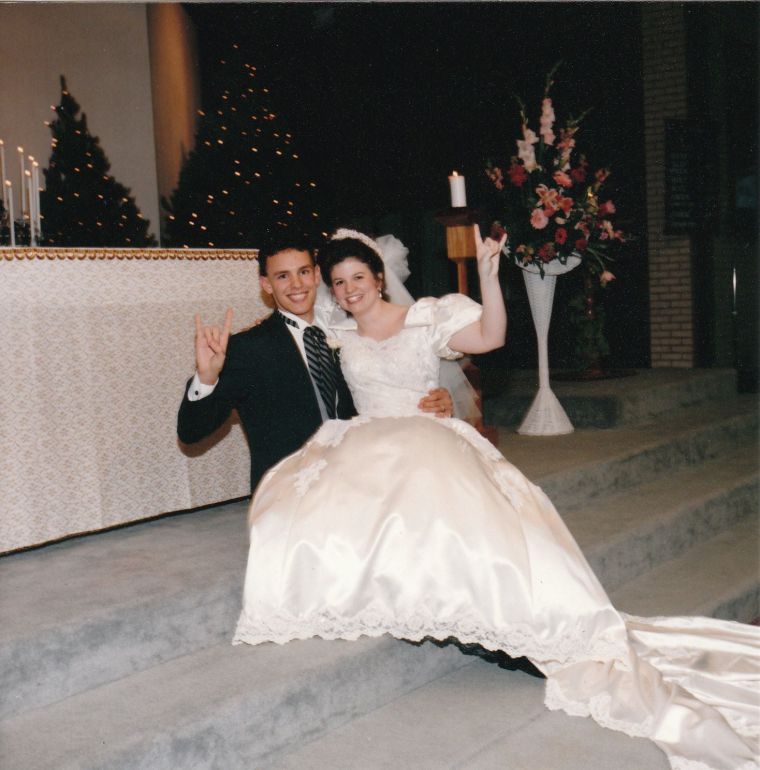
Twenty five years ago today they exchanged their vows at St. Frances Cabrini Catholic Church. It was a beautiful service shared with a crowd of friends and relatives. Maryellen glowed with the flush of love and anticipation and Scott had “the look” in his eyes that assured me that he would be forever faithful and loving to my daughter. Our family priest John Perusina said the mass and Scott’s Lutheran minister assisted with the proceedings. The bridesmaids wore blue and one of Maryellen’s childhood friends sang Sunrise, Sunset like an angel, making everyone in attendance cry as we recalled how quickly the years had gone by since the bride and groom had been children. It was a gloriously happy day that bode well for the future.

Maryellen and Scott moved to Beaumont after a memorable honeymoon in Yosemite National Park, yet another idea of Scott’s that was so perfectly suited to Maryellen. They set up housekeeping in a cute apartment and began their careers. It was a fun time and it was wonderful to see how happy they were and how well things were going for them.

Eventually Scott received an offer that he couldn’t refuse from a firm in Indiana and so the two of them were on the move. They purchased a lovely house in Lafayette and began to explore the midwest during their free time. They were only two hours away from Chicago and so that exciting city became a frequent destination. It was a time filled with new adventures and new confidence for them when all of us realized that they had indeed become a powerful team.

Four years after they married their first child, Andrew, was born and our visits to Indiana became ever more frequent as we enjoyed visits with our grandchild. I always felt so intensely happy to see the relationship between Maryellen and Scott growing ever stronger and thus it would be as one year flowed into the next and three more children joined the family as they moved again to Beaumont and finally back to the Houston area.

Maryellen and Scott have been models of love and dedication. They are beloved pillars of of their community known for their dedication to being exceptional parents and generous neighbors. They inspire others with their devotion to each other and to their sons. Together they have weathered the rollercoaster ride that is life and managed to overcome every challenge that appeared on their horizon.

In a very troubled world where it almost seems old fashioned to hold tightly to values and traditions Maryellen and Scott Greene have proven that the power of love is still one of the most priceless treasures that any of us might possess. For twenty five years they have steadfastly honored one another and passed on their mutual love to their sons who are growing in the same wisdom and age and grace that they have so beautifully exhibited.

Somehow I am overwhelmed by the rapid passage of time. In my mind they are still the twenty something young adults with so much hope in their eyes and a whole lifetime ahead of them. They have done a remarkable job of cherishing the promise that they made on that day in the glow of tiny lights from the Christmas trees on the altar. They have fulfilled all of their vows and done the hard work of keeping the flame of their never ending love alive. It makes my heart burst with joy to know that they are such incredibly fine people.

Happy Twenty Fifth Anniversary, Mr. and Mrs. Greene. May you enjoy many more wonderful days together as you share a special love. You are a blessing to all of us.

In It For The Outcome

Teachers-teach-because-they-care.-Teaching-young-people-is-what-they-do-best.-It-requires-long-hours-patience-and-care.--300x300I happened upon a discussion of the holiday calendar for this school year on the Facebook wall of a teacher friend. She had originally been opposed to working through the Friday just before Christmas, but had changed her mind once she began enjoying the full two weeks of leisure time that this year’s schedule afforded. She and other teacher friends were quite happy with the fact that they have been able to take trips, totally relax and just enjoy a much needed break from the stresses of educating youngsters. Then the parents came out of the woodwork revealing a truth that has long troubled those of us whose profession is to teach. Namely there was a flood of complaints about having to find babysitters during such a long stretch of time away from school. In other words, schools in the minds of many adults are not just institutions of learning, but also convenient agencies for caring for children so that the parents will be able to work.

The babysitting aspect that schools have somehow inherited over time demeans the professionalism of teachers, and often flies in the face of research regarding when and how long children should be left at the doorstep of our nation’s centers of education. I have worried for some time about youngsters dragging into schools so early in the morning that they are half asleep or in tears. So too is my concern with many of the programs that keep them until late in the afternoon. This of course allows parents to conveniently complete their own work days without having to worry themselves with making additional arrangements for the care of their children, but it also requires teachers to work sometimes ungodly hours that include not only preparation for teaching but also development of ideas to keep the children occupied for long stretches of time. It is little wonder that my teacher friends are rejoicing over having a brief respite from their duties. Even worse, however, is the all too prevalent feeling that today’s educators are viewed with so little regard that many parents think of them as being little more than nannies whose function is not just to educate but also to accommodate work schedules.

I have nothing against working parents. I was a mother who worked as well. Ironically I often had to rely on my mother-in-law to care for my own children when they were sick or after they arrived home from school because I was required to stay beyond the regular hours for various programs designed to provide a safe and secure place for our students to be until their parents had finished their work days. I know how demanding it can be to be a mother and a reliable employee at one and the same time, but I have to admit to resenting that my hours at work were often dictated more by the needs of parents than either those of my students or me and my fellow teachers. It was assumed that we would be the caretakers even while our own children sometimes had to learn how to survive with a latchkey and stern warnings about how to behave while we were gone.

On most school days teachers leave home earlier than their children and return around the dinner hour. If they had the luxury of relaxing for the rest of the evening it would be all well and good but the reality is that most educators spend several hours each evening planning and grading and sometimes even conferencing with parents by phone or email. Days during the school year are long and too often filled with stress. Weekends are not much better from August to the end of May, so whenever I hear parents complaining about the free time that teachers enjoy I have to hold my anger in check.

The truth is that there are few professions that are as demanding as teaching, and those who survive for the long haul do so with earnest dedication and love for the work. The pay doesn’t even begin to equal the amount of effort required to do the job well, and the tangible benefits are minimal. There are rarely parades or honors or even discounts for teachers as there often are for soldiers or first responders. Educators toil quietly away year after year because they are genuinely altruistic and devoted to a purpose driven life. They are concerned about the outcome, not the income and yet they invoke a generalized ire for their profession and are rarely consulted as the experts that they are. Still they return year after year because in spite of all of the negativity swirling around them they are answering a calling the compels them to attempt to make a difference in the lives of their students. They are not average souls who would be unable to do anything else, but rather remarkable individuals who have chosen a vocation that requires sacrifice and a thick skin. Their ultimate reward is a self knowledge that what they do is perhaps the most important contribution to society, and at the annual holiday pause of their labors they desperately need a period of rest to revitalize themselves for the big push of the coming semester. I can’t imagine why anyone would complain about the inconvenience of not having teachers around to care for their children, and yet it happens all of the time, and I suspect that if it were possible many parents would require teachers to be on call year round with only a handful of holidays.

The best system that I ever encountered was at St. Anne’s Catholic School. All teachers had regular hours as part of their work contract. Any additional time spent at the school was optional and provided extra income. The before and after school programs were separate from the school itself and paid hourly stipends to those who chose to participate. Many teachers enjoyed being able to extend their pay by volunteering for such work, but they also appreciated that they were not conjoined with professional expectations. Perhaps because parents paid tuition and fees for every aspect of the education they treated the teachers with great respect and esteem. I have never before or since felt as appreciated as I did when I worked there. Nobody took me for granted and everyone appeared to understand how much effort I was putting into my work. I felt as though I was a member of a team in my communications with parents. I believe that the success of our students was built on a mutual regard for one another that is sometimes missing in public schools. There is all too often a generalized feeling that our nation’s teacher are a rather ignorant bunch that are the source of most of the world’s problems. It doesn’t seem to occur to everyone that teachers are often asked to be all things to all people with very little support and not much compensation.

I suspect that parents who complain about long holidays and summer vacations just haven’t thought about how their cries of woe actually sound. They are juggling their own problems and it is easy to view the teachers as the enemy when they appear to be lounging far too long during the holidays. Those who have to return to work the day after Christmas may not be able to understand why teachers really do need that extra time to recharge. It is convenient to view our educators as the source of childcare problems, but I would urge parents to think again before voicing such complaints. As a society we give so little credit to our teachers that it is a wonder that anyone ever wants to enter the profession. The very least we can do is smile with them when they get excited about having time to enjoy themselves. Take it from an old pro, they have earned every single minute of their free time and they will be all the better with our kids because of it. We should be happy when we hear that they are feeling good. It means that they will do a better job when the school bell rings again.

Hard Choices

winston_churchill

On New Year’s Eve my husband Mike and I went to see the movie The Darkest Hour which is a presentation of the early days of Winston Churchill’s tenure as Prime Minister of Great Britain. It was May of 1940, and Adolf Hitler was marching across Europe seemingly with ease. One country after another had fallen under his conquest and it appeared as though he was unstoppable. Many in Great Britain were certain that the only logical choice for the empire was to broker a peace deal that would allow them to maintain independence while acceding to German influence. There was much talk that Britain had neither the manpower nor the stomach to endure a war with the superior German forces. It almost seemed inevitable that the country would fall just as so many European nations had already done. It was indeed one of the darkest hours in the history of the country.

Winston Churchill had only recently replaced Neville Chamberlain as Prime Minister. The government had lost confidence in Chamberlain and his efforts to maintain peace with the Germans appeared to be appeasement rather than diplomacy. He was being blamed by some for the fall of so many of Britain’s allies and Churchill was reluctantly chosen to replace him as head of the government even though many believed that his tenure would be short-lived. He had not particularly distinguished himself in either World War I or his other forays into governing. Many thought that he would soon be replaced by Lord Halifax who was viewed as a more reasoned leader. Furthermore there was great concern about Churchill’s unwillingness to consider a peace accord with Hitler, whom he considered to be a despicable despot unworthy of deference of any kind. 

At the time the entire British army of 300,000 troops was hopelessly trapped by German troops in Dunkirk and seemingly on the verge of total destruction leaving Britain completely unprotected. In a desperate move Churchill commanded one of his admirals to distract the Germans so that civilian sailors might employ their crafts to rescue the stranded troops. It was a daring plan that many thought was dangerously foolhardy. Churchill understood that it was instead the country’s last hope, and he was joined by the King in believing that any peace deal with the Germans was unacceptable. He did not believe that Britain would really be allowed to be independent of Nazi rule, and he could not imagine being able to accept the sight of Nazi flags flying over Buckingham Palace. He remained firm in his resolve to fight off the invading German army one way or another.

Churchill ultimately garnered the support of the government as well as the people of Great Britain when he delivered a stirring speech in which he insisted that Britain would fight to the last man, and if that was not successful then they would rely on being rescued by the other nations of the commonwealth and the people of the new world. His unflinching challenge captured the imagination of his countrymen, and as Lord Halifax noted Churchill had commandeered the English language into the battle.

We know of course what the rest of history was. The United States entered the fray a year and half later, and Hitler split his forces and resources by embarking on a new front of war with Russia. Ultimately he was defeated and Britain never came under his rule. But for the courage of Winston Churchill many historians argue that Europe may have been dominated by Germany and been changed in ways that would have had even more horrific consequences for mankind than they did.

The Darkest Hour was a captivating movie and Gary Oldman did a yeoman’s job of portraying Winston Churchill. More importantly was its story which made clear the dire situation of the world in 1940. I learned many things that I had never before known and they gave me a better perspective of what it must have been like to live during that era, particularly in Europe. This truly is a movie that everyone should take the time to see, but sadly the audience on the day that I went was almost totally comprised of individuals either my age or older. I only saw three young men in the entire crowd which is truly a shame because I doubt that most of today’s millennials have any idea of how dangerous the world situation was back then. I hear so many people today complaining that this is the most menacing time in history, and while there is certainly a grain of merit in such pronouncements I also have to wonder if our present situation even compares to what was happening in the spring of 1940 when the very face of Europe and Asia was changing so rapidly that it appeared that there would be no way to stop the autocratic land grabs. It chills me to even consider what the world might have become without the courage and determination of Great Britain and its eventual allies in the fight against fascism and fanaticism.

There is a popular series on Amazon called The Man In High Castle that considers what the world would be like if Hitler had succeeded in his goal of world domination. It is a dark look at the possibilities that were actually closer to fruition than most of us ever thought. The United States was still little more than a second rate nation at the beginning of that war, totally ill prepared for the battles to come. In the first weeks of the conflict they were utterly befuddled and defeated, but somehow just as with the citizens of Great Britain the American people maintained their resolve to defeat the evil of Adolf Hitler and his Nazi party. With the combined efforts of some brilliant military men, the bravery of the troops, and the luck of bad decisions by Adolf Hitler good ultimately triumphed over evil, but it is horrifying nonetheless to even imagine how things might have been had the Germans actually won.

If you have not yet gone to see The Darkest Hour or have yet to even consider viewing it, I highly recommend that you do so. Be sure to take your middle school and high school age children with you as well as the young adults in your family. We learn from our history and the story outlined in the film is one that is probably not familiar to most of us when it should be. We face our own tyrants in today’s world and we need to consider the lessons learned in the past as we make important decisions. We also must ask ourselves just how willing we will be to look the other way when we see monsters denying people the human rights that we all deserve. When do we compromise with them and when is it time to draw a line. We need to know these things because the time may come when such hard choices will have to be made.