Fortunate Son

5377620The little child that lives inside each of us never quite goes away, not even as we age and mature decade after decade. Our memories of childhood whether magical or nightmarish linger inside our very souls and color the way that we view the world. Those like myself lucky enough to have known mostly love are often guided by the nostalgia of kindnesses and happy times. For others overcoming painful experiences is a lifelong battle. During the holiday season we often become more acutely aware of our long ago histories, and depending upon how they are affecting us we either feel an exhilarating happiness or a sense of sadness. Thus is the power of our pasts and our emotions.

I once wrote a paper detailing the folk history of my grandfather. Rather than guiding him in any particular manner I simply asked him a series of questions and then allowed him to respond in a way that revealed his personal take on the world in which he had lived and grown. He was approaching his hundredth year when I undertook this project and I uncovered a theme in his way of dealing with the ups and downs of life that he somehow passed down to me. Every single story that he told me involved elements of strength, courage and love. It was his personal point of view. His heroes were the people who overcame difficulties through not just their own determination, but with the assistance of caring individuals who often appeared serendipitously to save them. He firmly believed in the idea of personal accountability, but understood that everyone struggles, and when things become almost too much to bear there always seems to be someone who arrives to help.

Convinced that we each have an inner strength in spite of the problems that stalk us, and realizing that we are never truly alone was my Grandpa’s foundational philosophy and the cannon of his life. His was one of those nameless stories that never lead to fame or riches of the concrete kind, but rather the wealth of friendships and love that is far more substantial than the ephemeral nature of titles and things. By the time that he had reached his one hundred eighth year he had become an inspiration to all of us fortunate enough to have known him, and I was chief among his fans. I suppose that I either consciously or unconsciously modeled my own personality after his. I adopted his optimism even in the face of difficulties and soldiered through irritations and tragedies by reminding myself that I came from strong ancestors who refused to let anyone grind them down.

I often thought of my grandfather as a young virtually orphaned boy who never knew his mother, and yet honored and cherished her by naming his daughter after her. He spoke of her a hundred years after she had left him with a profound reverence as though her death in childbirth had proven to him how much she had loved him. The sacrifice that she made to bring him into the world was the foundation upon which he built the entirety of his extraordinary character. The fact that his father abandoned him meant less to him than the knowledge that his mother had died giving him the opportunity to live. His devotion to her was as deep as if she had raised him into an adult.

It was his grandmother who did the job of guiding him into a purpose driven life, and she did so with great care, providing him with wisdom and an unstoppable sense of humor. She gave him the tools that he would need to continue even after she too had died before he was quite ready to be alone. At the age of thirteen h head already risen to a level of maturity that was far beyond his years, so when he was charged by a judge to select a guardian he decided upon an uncle who seemed to be quite noble and honest. This man was so upstanding that my grandfather ultimately adopted his name to honor him for his morality and character. Indeed he also emulated the traits that he saw in this individual who was kind enough to take on the duties of helping a teenaged boy even though he himself was barely into manhood.

Grandpa was stalked by bad fortune. Not so long after he chose the man who would be his surrogate parent a deadly hurricane came to Puerto Rico. My grandfather’s uncle who was a graduate of West Point and a military man served his country by traveling to the devastated island to direct the distribution of aide and supplies. While there he contracted typhus and died. My dear grandfather was alone once again, and so affected by his multiple losses of loved ones that he was rather confused for a time. He bounced around the country doing jobs wherever work was to be found, living in boarding houses and drinking more than he should have to still the sadness that sometimes threatened to overwhelm him. On one particular evening he experienced a moment of clarity, raealizing that he had become his own worst enemy. He thought about his mother and grandmother and uncle and suddenly felt their spirit reminding him that he was meant to be better than he had allowed himself to become. He resolved at the moment to be the man that they had intended him to be, and with an iron will he turned himself around. Luckily he did so in time to meet my grandmother, the ultimate love of his life and the woman to whom he would surrender his heart. They became lovers, buddies, the best of friends.

The funny thing is that there was never really a time in my grandfather’s life when things came easily to him. He had to work hard and deal with tragedies that broke his heart, but never his will. Somehow regardless of his circumstances he found ways to survive and to find that one tiny speck of hope that kept him going year after year. When he was one hundred eight years old he had lost his beloved wife, his son and one of his daughters. Even some of his grandchildren had preceded him in death. Most of the friends in his age group had left this earth years before, and yet he rarely complained other than to note that he missed them all.

I always enjoyed visiting my grandfather in the tiny house where he rented a room from a widow who needed the extra income to stay afloat. He maintained his independence with a fierceness that I so admired. Much as he had done throughout his life he found ways to keep moving forward even when times became tough. When he grew older he became a bit more nostalgic, and even found ways to understand and forgive his father whom he kindly referred to as a bit of a reprobate, a man whom he nonetheless had grown to love or at least accept.

I find myself thinking of my grandfather more and more often these days, and when troubles come my way I wonder what he would do in similar circumstances. I know that he would somehow find the silver lining that he insisted is a part of every situation. He had been a penniless, homeless, seemingly unwanted orphan who was dropped on his grandmother’s doorstep like a stray cat, and yet he rose above the hurt and anger that might have been his guiding light. He chose instead to focus on the positive aspects of his story and those of the people he had met along the way. He saw himself as someone whose life had been blessed again and again.

We mostly choose how to view our individual stations in life. In the proverbial way of the glass we either decide that our lives have been half empty or half full. Grandpa taught me to choose the optimistic path, to proudly be a Pollyanna. What I have encountered has not always been pretty, in fact it has often been scary and wrought with tears. My grandfather showed me that rather than wallowing in the pity that may indeed be rightfully mine, I always need to ultimately find a way to pluck up my courage and move forward once again. Like him I have repeated the drill time and time again, and along the way discovered new friends, new allies and great love. My grandfather’s worldview has been one of the most amazing gifts of my life. He was indeed a fortunate son just as he believed and I inherited his wealth.

What Would Jesus Do?

15245699_GHer name is Rosa Maria. She is ten years old and has cerebral palsy. She’s just had gallbladder surgery and is being released from the hospital with her aunt by her side. She wears a pair of pink fuzzy slippers and a balloon waves over the hospital bed on which she is being transported. She is confused and frightened because an armed man walks behind her. He is a member of ICE and is taking the little girl to a detention center because she is an undocumented immigrant who came to the United States when she was only three months old. Her mother brought her across the border so that she might get the medical care that she will need for all of her life. Her grandfather and her aunt are legal and they take her to her appointments just as she was brought to San Antonio for her recent surgery. She will go to the detention center without her aunt or her mom. She will be kept there, alone and wondering what is happening. It can’t be easy for her. She is young and innocent but she is being treated like a criminal.
Maritza lives in northeast Houston. She attends Furr High School and is one of the top students. Her modest home flooded when hurricane Harvey dumped fifty one inches of rain on Houston. The rooms are now empty and life is difficult for her family, but Maritza’s mom urges her to make the most of each day in spite of the family’s problems. Maritza is also an undocumented immigrant. She was planning to enroll with the government to extend her grace period for being here. Because of the rains Maritza was unable to meet the deadline for submitting the paperwork. She had been waiting for information from her school, but it was so damaged that it did not open in time for her request to be honored. Now Maritza worries that she will be deported and all of her hopes and dreams will evaporate. She had been on track to attend a Texas university and earn a degree, the first in her family to do so. She is a good girl who had nothing to do with her illegal entry into the country. She has studied hard and worked to be a model citizen even though that distinction is not offered to her. She had hoped that Congress would offer an extension to the young undocumented students of Houston, but they have refused.

Attorney General Jeff Sessions has said that it is not compassionate to offer amnesty to those who have broken the immigration laws. He and the President and many members of Congress concur that those who flaunted the rules must pay for their crimes. So Rosa Maria and Maritza and others who have known no other home than the United States presently live in fear of being sent to countries of which they have little or no familiarity. Their lives have been upended and they continually live in fear of the moment when someone will knock on their doors and take them to a detention center just as was done with Rosa Maria. Their ultimate fates are uncertain, dependent on a Congress that has shown little inclination to work together to accomplish anything, much less pass a permanent law that will protect them. They worry that they will become victims of the current anti-immigrant ardor that has taken hold of so many citizens, most of whom care little about the personal stories of those affected.

There is a kind of coldness of heart, a meanness that is sweeping the land in a so-called effort to make America great again. Many citizens view the immigrant situation through a narrow lens that does not allow for exceptions. Surprisingly a fair number of those who are so adamant that the undocumented should be sent to their original homes have never even met any so called illegals. They have little idea of the human cost of decisions that do not consider the unexpected consequences of their thinking. They suggest that they might be willing to offer a DACA like law for the young people, but only if it includes the building of a wall between the United States and Mexico and if there are strict penalties for those who came here without documentation as adults. Sadly it appears that none of those things will garner enough votes to pass, and so the fates of Maritza and Rosa Maria and others like them hang in the political balance.

I live in the Houston, Texas metropolitan area. It is estimated that that ten percent of the students in the Houston Independent School District are undocumented and were brought here by their parents at a time when they wee too young to have any idea of what was happening. They have lived here for the entirety of their lives and know no other ways. They speak English and have adopted many of our customs in addition to those of their parents. They cheer for the Astros, the Texans, the Rockets and the Dynamos. They wear western gear when the rodeo comes to town. They enjoy going to movies and shopping at the mall. They have friends at school and teachers who care deeply about them. They like to eat Whataburgers and buy groceries at HEB. They feel as American as any of their peers and yet they hide the secrets of their situations. For a time after President Obama signed DACA through an executive order they felt safe. They began to dream. Many of them went to college and earned degrees. They have been working and living decent and productive lives. Now a shadow hovers over them. They have no idea what they will become of them. President Trump gave Congress six months to pass legislation to fix the problem. The clock is ticking and no solution appears to be on the horizon. Nobody seems willing to budge from their ideologies to help them. They can only wait and hope but their fears grow with each passing day.

Rosa Maria still sits alone in a detention center without her mother or the love and protection of her family. It is heartbreaking to attempt to imagine what a nightmare this all must be for her. It is difficult to understand how uncaring the adults who have done this to her appear to be. Sometimes we need to remember that forgiveness is not a sign of weakness. One of the last acts of Jesus before He died on the cross was to forgive the thief who expressed his sorrow. I have always believed that this was a very purposeful act designed to show us that how we also should behave and to help us understand that nobody should be forever doomed for actions done in the past, particularly when they had no control over what happened. If we ask ourselves, “What would Jesus do?” I have little doubt that the answer is couched in mercy.

It’s past time for all of us to demonstrate enough compassion and trust in our fellow man to grant people like Rosa Maria and Maritza the peace of mind that they so need. We must urge our Congresspersons to think beyond their own prejudices and find it in their hearts to model kindness for all of us. I have grown weary of the fighting and ugliness that so permeates our world. It’s time for a change and this is a good place to start.

Imperfectly Perfect

Down_in_a_hole_by_matmoon

My husband had a saying that he often used whenever one of our children was struggling in some capacity, particularly at times when they had really made some major mistakes that appeared to be threatening their futures. He would invariably tell them, “You can’t be a failure at age (insert some number here)…” His wisdom became a kind of family mantra because no matter how old our girls became he would dust them off after they had mucked up plans and remind them that they were far too young to believe that they were irretrievably doomed because of questionable choices. As the digits marking their ages changed and grew into ever larger indicators of life on this earth he reminded them again and again that they still had opportunities to recover from decisions and actions that had not worked out so well. When one of them finally asked him to define the age at which it really was possible to be deemed a failure he winked and said that would probably be the day after never. In other words there is always a new moment for finding success, a time when the sun rises and we have the possibility of setting our courses aright once again.

We all have dreams. Sometimes through little fault of our own those visions change or even become impossible. Beating ourselves up because we finally realize that something in our lives that once seemed to be a holy grail is in reality a source of grave unhappiness is a form of personal self abuse. We should never feel trapped in a situation that quite simply isn’t working out as we had once expected. We’ve all been to beautiful weddings that were dripping with love and good intentions only to hear a few years later that the couple is getting a divorce. We have witnessed young students choosing college majors at the age of eighteen that seemed so right at the time, but developed into living nightmares along the way. We know of individuals who became so stressed by what they saw as their floundering lives that they turned to alcohol or drugs to mask their pain. Many of the social crises that we see in today’s world stem from honest mistakes that have grown so big in an individual’s mind that there appears to be no way out without shame and sorrow. In our embarrassment we withdraw deeper and deeper into ourselves and shun truths that are staring us in our faces.

I’ll admit that we are often a harsh and judgmental society that likes winners and tosses those we deem to be losers aside, but we still love a good story of salvaging a life gone astray. We admire the people able to stand up and redirect their futures. The phoenix is still a potent symbol for the act of rising from the ashes. We love Robert Downey Jr. because he managed to overcome life threatening addictions and reemerge as a popular and compassionate cultural icon. We adore President Jimmy Carter for openly admitting to his personal flaws and forgiving those who have trespassed against him. Each of us knows countless individuals who stumbled and fell only to eventually succeed beyond their wildest imaginations. Most of the time all we need do is gaze in the mirror to see such a person.

It is in our natures as humans to make mistakes, and so more often than not life becomes a serpentine journey filled with pitfalls, potholes and poor choices. It is actually quite rare to find someone whose entire existence has been fault free. Few roads are straight and narrow. Even St. Mother Teresa had moments of darkness in which she questioned her very faith in God and humanity. The key to her sanctity was not in living a trouble free existence but in being able to forgive both herself and the rest of mankind for being imperfect.

I am a great fan of the television program This Is Us. The writers have tapped into the realization that each of us is imperfectly perfect. We spend most of our lifetimes chasing after ideals rather than happiness. It often takes us a long long time to understand that all we need to feel really good is to accept ourselves with our warts and all, to realize that every person is wonderful and beautiful. Once we are able to be the individual that we believe we were meant to be the good feelings that we have inside spill over into everyone that we meet. Our confidence and abilities grow and grow and we become ever stronger and better versions of ourselves. Doing this takes forgiveness and a willingness to avoid the tendency of thinking that our inevitable mistakes have made us failures.

Of course we have to live amongst other people, many of whom have been so abused either by others or by themselves that they project their own feelings of inadequacy on us. We sometimes fall into the trap of believing them when they tell us that we are at fault or that we are somehow unworthy. They want us to be as miserable as they are, but we never have to loathe ourselves or stay in their orbits. It is not just okay but actually necessary that we leave such situations behind no matter how painful the extrication may be. Mostly we must remember that other people’s transgressions are not our own no matter how many times they attempt to blame us for their misery. One of the most difficult situations that we will ever encounter is the realization that we cannot save everyone that we meet, and that evil exists. The key is to leave behind relationships that hurt and demoralize without feeling that we have somehow failed.

As we journey through our lives we will falter again and again. Bad days will turn in excruciating weeks. Instead of beating ourselves up we only need to step back just long enough to chart a new course. We must learn how to ally ourselves with people who support us when we make hard but wise choices and don’t abandon us when we manage to muck things up.

We have a dearth of role models these days. We have a president who is prone to blaming everyone but himself for his troubles. We have watched a candidate for that same presidency fumble to find the answers as to why she failed to land the prize. Both of them are loathe to look inside their souls where the truth most certainly lies. They are unwilling to admit that they perhaps don’t possess all of the answers. They are as flawed as any of us, imperfectly perfect. Both are searching for confirmation of their worth in all the wrong places when what they need is the simple admission that they have sometimes been wrong. Those who learn to admit their flaws and love themselves nonetheless literally glow from the experience. It is a truly freeing experience.

The moral of the story is that we can’t be failures at any age as long as we keep trying. The reality is that there will be thousands upon thousands of “tries” in each life. We all must learn how to get back up again after our falls. It is one of the most important lessons that ever need to know. Once we grasp it everything changes. We know that we will encounter countless challenges along the road and we won’t always deal with them in the best possible ways. We will make messes. It is what we do. The key to the happiness we seek is to just keep moving no matter how many times we find ourselves climbing out of a pit once again. Soon enough each of us will a way to be imperfectly perfect.

Let It Go

12-_00168v

I grew up in Houston, Texas in the south. As a child I remember hearing Dixie being played and sung now and again. When I was young I actually believed that I had descended from Confederate Rebels and it was only later that I found out how wrong I had been. Of course my mom’s ancestors were busy chafing under the rule of Hungarians while the Civil War raged here. It was from my father’s side that I assumed that I had come from bonafide Johnny Reb stock. Imagine my shock, and maybe even a bit of relief, when my genealogical searches revealed that my great grandfather, John William Seth Smith, was a Lieutenant in the Kentucky Volunteers and that he fought for the Union. In fact, he participated in a number of crucial battles and was around to bury the dead at Shiloh. It ends up that the inclement weather and horror of that event badly affected his health in later years and after the war he seemed rather intent on putting his days of fighting behind him. I suppose that those of us who are still arguing over the aftermath of that terrible conflict might be wise to follow his lead.

I’ve always had a fascination for history and so I have read a number of biographies and historical texts. Robert E. Lee was someone about whom I wanted to know more. In so many ways he was an enigma. He graduated from West Point and for a time was one of the most highly respected generals in the Army of the United States. He sometimes questioned the morality of slavery, but nonetheless held the odd belief that it served a purpose in helping the enslaved humans to learn the necessary skills to be full fledged members of society. He loved his country but felt a higher allegiance to his state. He saw secession as treason, but agreed to join the Confederate cause nonetheless. In other words he was a highly conflicted man who wanted to be honorable but often demonstrated profound confusion about how one should live. In the end he actually felt that the long war should never have happened, and he spent much of his later years attempting to free his soul from guilt. 

The aftermath of most wars becomes a time for trying and punishing those guilty of crimes or treason, while the rest of the population goes on to live ordinary and quiet lives like my grandfather. The days after the Civil War were different. Both Abraham Lincoln and Ulysses S. Grant felt that no purpose would be served in meting out vengeance against their fellow countrymen who had gone astray. There were no trials in which Robert E. Lee and other Confederate leaders were held accountable or punished. Instead they were allowed to live with only their own self reflection to determine the final chronicle of what they had done. For Robert E. Lee it was a bitter pill to ruminate on the utter folly of the war and its impact on the entire country. He must have asked himself time and again why he had gone against his own beliefs that secession would be a fools errand.

Time has a way of glossing over the ugly realities of history. As the years passed people from the south often found ways to excuse the actions of their ancestors who had believed that destroying the country was actually the only way to deal with political conflicts. They saw the war as being noble and courageous, but the truth is that it was a horror that need never have happened. To celebrate those who led their fellowmen into the very jaws of hell seems to be a rather ridiculous idea, and yet that is what happened in cities and towns all across the south where monuments and statues were erected to honor men who in many ways had been fools. Perhaps it was a way of ignoring the truth of how incredibly wrong the entire conflict had been.

It would be one thing to mourn the lost souls who died in those terrible battles that pitted American brother against American brother, but it is quite another to glorify those who had took the common people so far astray. It would be akin to building monuments in honor of Adolf Hitler all over Germany. We would surely see the inappropriateness of such memorials, but somehow we fail to realize how ludicrous it is to honor men who literally performed treasonous acts against the United States when they chose to go to war against the government. Perhaps Robert E. Lee said it best. “I think it wiser not to keep open the sores of war, but to follow the example of nations who endeavored to obliterate the marks of civil strife and to commit to oblivion the feelings it engendered.”

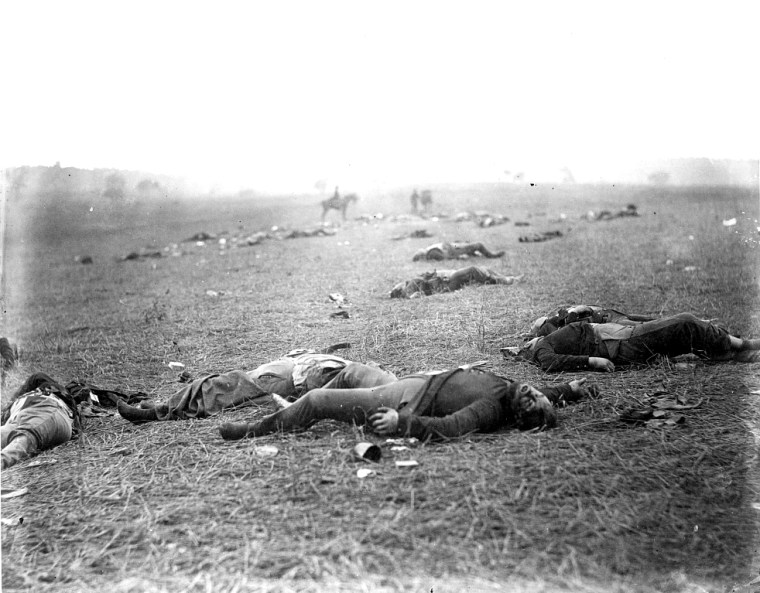
We have harbored the feelings of separation and divisiveness far too long. Walking through the Shiloh battlefield I felt no glory, but only a deep sadness that people were unable to find ways to settle their differences through any means other than fighting and killing. There is no magnificence at Gettysburg, only despair that man’s anger overwhelmed his ability to find common solutions. War is always hell. Slavery was wrong. We all know in our hearts that these are truths. Why then do we continue to quibble over hunks of stone and metal that remind us of a past that was horrific by anyone’s standards? We can remember all of those who lost their lives with compassion, but we need not attempt to honor those who were responsible for the carnage. Taking down the troublesome statues does not erase the history, for we can never forget how terrible it was. Instead it focuses on understanding and a willingness to move on and let go of feelings that seem to have festered long after they should have been set aside.

I suspect that if Robert E. Lee were to hear of the battles that now ensue over the appropriateness of monuments to in his honor he would remind us of his own words and respectfully ask us to take the monoliths down. We should do so not out of a sense of political correctness, but because it is time for healing that will never fully happen until we are willing to admit to the wrongness of that terrible chapter of our history. We can place those images on battlefields or inside museums where the story of that time might be told, but it is no longer necessary to glorify the mistakes of our past. We must move ever forward and remember the words of another contemporary of Robert E. Lee.

As the war neared its end and President Abraham Lincoln delivered his second inaugural address his mood was melancholy and compassionate. He pointed to the horrific waste of the war but also its necessity in bringing justice to our land. Still he wanted all of us to come together as brothers “with malice toward none, with charity for all, with firmness in the right as God gives us to see the right, let us strive on to finish the work we are in, to bind up the nation’s wounds, to care for him who shall have born the battle and for his widow and his orphan, to do all which may achieve and cherish a just and lasting peace among ourselves and all nations.”

This is our challenge as the American people. In the name of all 600,000 men who lost their lives as well as those who were forever altered, it is time for us to heed the words of our great president who himself became a martyr to his noble dedication to the proposition that all men are created equal. It is far past time to stop the fighting and to let it go.

The Very Best Way

Image-credit-Aldo-Tapia-A.-via-Photopin-CC

There are so many things in life over which we have little or no control. Rain may ruin the outdoor party that we planned. A loved one may die leaving us feeling alone and bereft. We may not get the job that we so wanted to land. The candidate that we worked so hard to get elected loses. Someone we thought was a friend betrays us. We may be diagnosed with a life threatening disease. A criminal steals from us or even worse murders someone about whom we care.

Each of us will face terrible moments throughout our lifetimes that have the potential to leave us feeling devastated and powerless. We will find ourselves wanting to whine or cry or rage about our bad luck, but the truth is that we are not alone in facing great challenges. It is part of the human journey to encounter difficulties. It is our reaction to such things that determines how we will feel about ourselves and the people around us. If our only thoughts are of anger or self pity we may be continually whining that life is unfair. If on the other hand we accept that everyone faces disappointments, we might instead think less about our misfortune and more about what we might do to deal with the realities of the situations.

Last fall I learned that one of my favorite cousins was dying. He had battled heart disease for decades and had tried multiple medications, surgeries and life style changes. His doctors told him that he had run out of options. His heart was failing and there was nothing anyone might do to change that reality. He was sent home to spend his final days. Amazingly whenever I spoke with him he kept his ever present sense of humor and made me laugh in spite of wanting to cry for him. He spent his last days saying his goodbyes to the people that he most loved. He prepared for his passing in every possible way, and made it clear that he was ready for what was to come.

I always loved my cousin. We had shared our childhood together and had so many stories of the fun times that we had experienced. I knew that he was a very special person, but I found myself nonetheless in awe of his faith and the way in which he so unselfishly gave so many of us the gift of peace and comfort. He had taken what might have been a horrific time and somehow transformed it into something beautiful and inspiring. In the process he had actually seized control of his life rather than allowing his circumstances to dictate his reactions.

My own life has been disrupted on so many occasions. Losing my father was life changing, but my mother demonstrated so much courage and determination to keep our family safe that I was able to keep moving forward with a sense of security. Later when she was overtaken by bipolar disorder I was  given a role that I did not want. I was put in charge of her care by default. I made a number of mistakes, but ultimately learned how to get her the help that she needed and how to monitor her progress. It was neither fun nor easy to spend four decades watching her go up and down again and again, but I knew that I would always be able to get her back on the right track if I did what I had to do. Eventually my brothers joined me in keeping her as healthy as possible. As a result our memories of our mother are filled with far more happiness than sorrow. We found a sense of accomplishment in knowing that we never let her down.

Now I’m faced with a new challenge. My husband had a stroke that was quite serious. My first instinct was to cry and feel quite sorry for myself, but ultimately I understood that the only aspect of the situation that I might control is my own attitude. I’m doing whatever I can to encourage him to adopt a healthier lifestyle, and I’m determined to enjoy each minute of each day. I’ve quickly learned that true joy comes from within myself, and I am finding ways to bring it into the open in the very simplest of ways.

We all get those terrible blows that seem to be so unfair, and it is only natural for our first reactions to be negative. Sometimes it appears to us that other people have it so much easier than we do. The truth is that when we begin to learn more about others we generally find that everyone is dealing with pain, illness, problems. The people who seem to be the happiest are often that way mostly because they have chosen to smile rather than to wallow in negativity. They understand that they have choices about how to live, and they choose joy.

At the end of her life my mother had little of material consequence. She kept her life quite simple  often out of necessity. She had lost her husband at the age of thirty. She battled mental illness for decades. She was told that she had lung cancer that was too far advanced to treat. A lesser person might have felt beset upon, but she continually spoke of how blessed she had been throughout her life. She was proud of her accomplishments that included raising three children alone all of whom had advanced college degrees. She loved the members of her family and was confident that they would always stand beside her, and she was absolutely correct in that assessment. She spoke of her adventures and travels with a big smile. She felt that hers had been a full and remarkable journey. She was as satisfied and content as she might have been if she had accumulated vast amounts of power and wealth. She had all that she ever needed, because she had chosen to be the mistress of her thoughts.

I have a friend who is attempting to simplify his life. During the month of July he began to remove many of the possessions that seemed to be occupying far too much of his time and attention. Each day of the month he donated the number of items that corresponded to the date. By the end of the cycle he was scrambling to find thirty one things that he no longer needs. It was such a freeing experience that he plans to repeat the process in August and until he no longer feels as though possessions are impeding his happiness. I think that his is a delightful idea that all of us might consider, and we might also begin to apply it to our attitudes as well.

If we feel as though life is terribly unfair and that we are continually on the wrong end of luck, then maybe it’s time that we begin to change the way that we think about our situations. We need to ask ourselves what we might adjust or do to reorient ourselves. Perhaps we might begin with small steps and then slowly accelerate our efforts as time goes by until our attitudes begin to lean toward the positive exponentially. To do that we will need to be as good to ourselves as we are to the people around us. We have to be willing to extend our sphere of kindness to everyone.

It may take time for the dividends to pay off, but when we begin to see that we really do have the power to determine our own destinies everything becomes more beautiful, even in the midst of trouble. We will learn how to refocus our fears and our pain and our anger in ways that make us feel good about ourselves. We will begin to view the world from a perspective that makes us feel powerful rather than powerless. Those who have mastered this art will tell you that it is the very best way to live.