
Longevity

OldAgeNE-Post

The leaders of Naples, Florida have embarked on a program designed to help its citizens live longer, happier healthier lives. To that end they studied five places around the globe where the average life span is above those of other cities and countries. Their research has revealed that there are indeed some things that we can do that appear to help individuals find better ways of living longer. Since embarking on this program the money spent on medical care has gone done and the life span of the populations has dramatically increased in Naples. So what are the simple ideas that seem to be doing wonders there?

Everyone is encouraged to eat healthier by particularly including more plant based menus in diets. Stores feature products and options that are known to produce longevity, and restaurants are vying to offer entrees that use healthy ingredients. The populace is responding positively by choosing healthier foods and exercising more. In fact, many employers are providing time during the work day for physical activity and offering attractive incentives and bonuses for those who participate. People are walking, biking and making exercise part of their daily routines. Schools are even opening early each morning so that children will have time to play outdoors or in gyms before settling down to academic routines.

The studies all demonstrated that having one glass of red wine each day also does wonders for the health and well being of adults. It’s becoming commonplace for the locals to pause for a glass of wine and fellowship each afternoon or evening. Whether it’s the wine or the time spent with others that is making the biggest impact isn’t certain but results are happening.

Those who have some type of religious beliefs or philosophies also appear to live happier and longer lives. Religion seems to lessen stress and provide people with a sense of belonging to something bigger than themselves. Those who have a purpose in life also do better, and so many religious activities encourage service to the community where everyone wins.

City planners are deliberately changing the environment of the city so that the locals almost naturally begin to adopt lifestyles that lead to better mental and physical health. There is an emphasis on being outdoors, gathering together, and eliminating stress when possible. Even the landscaping and building of roads is designed in the hopes of slowing down and enjoying the moment. Pleasant walkways have been added all over town and old roads have been reconfigured. There are cycle lanes that make it possible to get to work and run errands without ever needing a car.

The increased level of participation in the various programs has been almost exponential. As one person gets healthier others are encouraged to see what happens if they also change their ways. Everyone begins to benefit. The city’s longevity age has gone up to 83.1 years while that of the rest of the country is declining. People are enthusiastically embracing the lifestyle movement, even attending discovery classes that provide them with ideas as to how to feel more productive and part of the fabric of  society.

The hope is that the people of Naples will live longer without chronic illnesses or pain and that when it is time to die the end will be quick. In many parts of the world this is already happening, and aside from genetics, the places where this occur share the kinds of lifestyles that Naples is trying to implement for its citizens.

I suppose that I would not mind living to one hundred or beyond like some of my relatives have done. My only concern is that I might become a burden to my family and spend my final years in a reclusive state of pain or dementia. If I were able to enjoy my days as my grandfather did until the last few months of his one hundred eight years I would be eager to hang around for a very long time. Sadly I have too often seen the exact opposite of this where elderly individuals are confined to beds and wheelchairs with little stimulation or purpose day after day for years. They grow weary of waking up to yet another morning of slowly watching the hours tick by. Their children grow old themselves and become less and less able to care for their parents. Often the ancient ones end up all alone and at the mercy of care givers who may or may not be dedicated to making them comfortable and happy. It is one of the big secrets of our society that we tend to avoid because the thought of it is so unpleasant.

My doctor tells me that medicine is making great strides with hundreds of diseases that used to greatly restrict the lives of the elderly. He is confident that even within the next ten years people will be free of illnesses and conditions that now plague us. If that is so then we will need to plan for more and more old people living longer and longer. Hopefully those added years will be good ones.
Who Knows What The Future May Hold?

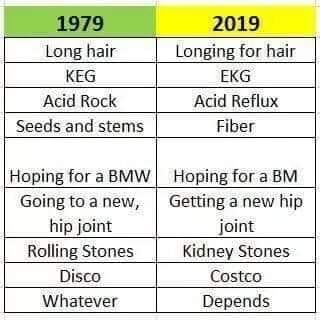
times change chart

I saw this chart on Facebook and laughed until my sides hurt. I’m not quite old enough to have undergone all of the listed changes, but I’m slowly moving in that direction. I worry the most about that new hip joint because of my osteoporosis. For the time being I still listen to acid rock while successfully treating my acid reflux with a little pill, and I often joke that if and when I do end up in a wheelchair I will be moving it to the beat of Satisfaction. In fact, I’m going to see the Rolling Stones in concert at the end of this month.

I have to admit to being amused that the members of that rock group are getting so old. I hand it to them for still having enough energy to go on tour, particularly Mick Jagger considering that he recently had open heart surgery. I have always liked his style and now he’s serving as an inspiration for all of us who are tempted to surrender to our aging bodies. If he can strut about for a few hours, then surely we can do those crunches at the gym and push ourselves to keep moving.

I’m happy to report that a cardiologist recently pronounced that he doesn’t think that I will ever need his services. My heart is strong and showing no signs of slowing down. When it comes to hair, however, I seeing major signs of thinning. I actually had someone recently suggest that I use a hair growth shampoo or consider adding some hair extensions or even investing in a wig. The truth is I had no hair when I was born and it took almost two years before I had enough to resemble a girl. I’ve fought and lost the hair battle for most of my life, so nothing is new in that regard. The good news is that even after five months of growth I have so little gray that most people would not even notice it. In that regard I appear to take after the people on my mother’s side of the family. Those women live long and with very few problems, but they usually end up unable to walk.

Recently I went to the nursing home where my one hundred year old aunt now lives. She looks remarkably healthy and has an astounding sense of humor even though she has a difficult time hearing these days. She laughed and joked the whole time I was there and but for the fact that she is wheelchair bound she doesn’t fit in the others who live around her. So many of the other people appear to be completely out of it, unaware of what is actually happening. I doubt that they would be able to hold a coherent conversation much less remember things the way my aunt can.

I suppose that if I am to live as long as the ladies in my family it won’t be so bad if I am as alert as they are. I’d pass my time reading and writing and watching a bit of television. I’d get some good hearing aides from Costco (Yes, I love going there!) and I’d manage to keep my mind busy. On the other hand, I have to admit that I don’t like the idea of being wheelchair bound but most people get there after a certain age. Having to roll around isn’t nearly as bad as losing memories or dealing with dementia. Besides my doctor tells me that some great therapies are on the horizon that will keep most people upright and moving much longer than people now do. He tells me that I may never end up confined to a wheelchair like everyone in my family has done once they reach a certain age.

I also have some of the genetics of my paternal grandfather who was a kind of superman. He lived to one hundred eight years of age and was clear headed and able to care for himself until his last few months. He was hanging wood panelling in his house and reading biographies of Thomas Jefferson well past one hundred. He only stopped driving because he felt that it was the appropriate thing to do. I have some of his same DNA in my body, so it’s likely that I will hang around for a quite a bit longer.

I’m not necessarily of the mind that long life is better. It all depends on what kind of life it becomes. I saw those poor souls sitting all alone in the living room of the nursing home, staring into the air and even making incomprehensible noises. I don’t know if they are suffering or not, but surely it must be difficult for members of their families to see them that way. I know that both my mother and my mother-in-law prayed that they would never have to be confined to months or years of being trapped inside minds unable to fully express themselves, and I have to admit that it seems quite sad when it happens to someone.

I suppose that none of us know how much or how little time we will have on this earth so the old saw that we need to make the most of each day becomes more and more true with each birthday. In 1979 I was thirty one years old and literally at the peak of my intellect, my appearance and my health. I laughed at the very thought of growing old. Now almost  forty years later I’m still going fairly strong, so I intend to make the very best of every single moment. I’m taking trips, attending rock concerts, enjoying family and friends. Who knows what the future may hold! 

Our Hidden Universe

person holding string lights photo
Photo by David Cassolato on Pexels.com

As an educator I have always been interested in the human brain and how it works. Sadly because it is so complex and we still have much to learn about it and what information we do have is sadly incomplete. Part of our difficulty in understanding it lies with the fact that we have only been seriously studying the brain for a little over a hundred years. Superstitions giving the brain a kind of spiritual aura actually prevented examinations out of a sense that it is wrong to invade the sacred nature of the mind. We are far behind the kind of knowledge that we have of our hearts and other organs of the body when it comes to the brain. Unlocking the inner workings of that most marvelous aspect of who we are may one day help us to eradicate some of the most life changing and difficult of the diseases that stalk us.

I dream of a day when we will literally be able to mend our brains in the same ways that we repair hearts. Surely the universe of our minds holds secrets to eradicating mental illnesses, learning difficulties, and other diseases that now so confound us. I can’t think of more challenging and ultimately rewarding research than studying how and why our minds work. As an educator I have seen the heartbreak of those who struggle to grasp ideas and concepts. As a caretaker I have watched my mother’s beautiful mind attacked by mental illness. As a friend I observed a delightful man slowly losing his ability to think and remember. I have seen the ravages of Parkinson disease steal away a cousin’s adventurous life, and I watched with horror as a brain tumor killed another a dear sweet loved one. I witnessed in great sadness as a friend succumbed to the ravages of ALS. It seems obvious to me that we need to support the people who are quietly working to find out how the mechanisms in the brain that control the very functions of our bodies work, and why the processes sometimes go awry.

I’ve often heard that we use only a small portion of our brain’s potential. Why is that so? Are the geniuses among us simply those who have unconsciously tapped into the power of their minds in a better way than the rest of us? What differentiates such souls from the crowd? Think of how wonderful it might be to truly understand how to coax more of those abilities out of each and every human. How exciting would it be to eradicate the kind of learning disabilities that educators see all of the time?

Our brains are encased in a bony structure that both protects them and hides their inner workings from us. We have machines that can record blood flow and even demonstrate where thinking is happening, but what we really know about the brain is rudimentary. It is as though we are still working with theories about humors and using leeches and blood letting to fix problems. Our psychotropic drugs work only sometime, and our therapies are often hit and miss at best. We do what we can with our limited knowledge and in the meantime some of the most intense suffering on earth continues in those with diseases of the brain.

I often think of how smallpox ravaged the world for centuries and is now almost unseen in the world. I dream of a time when we might be able to identify all forms of brain disease and cure them with medications or surgeries. I know that there are indeed individuals devoting their lives to discovering such miracles. We don’t often hear about them or even send our monetary support to their efforts, at least not until someone that we know is struck by brain disorders that rob them of the ability to care for themselves.

We spend a fortune on pizzas on the day of the Superbowl. We rush out to see the latest movies hardly thinking about the cost of entertainment. We treat ourselves to a four dollar cup of coffee without much regret. Our expenditures make us feel good, but think of how much better we might feel if they were deliberately aimed at the kind of research that is slowly unlocking more and more secrets of the brain. A slight change in our budgets here and there might allow us to invest in work that is as important as anything we humans do.

I know young people who are earnestly concerned about phenomena like PTSD, depression, dementia, strokes, multiple sclerosis. They want to earn the knowledge and the credentials that will allow them to delve into to inner workings of the brain, but doing so costs money that they sometimes do not have. It is important that we all agree to support the efforts of those who might one day discover how to eradicate some of our most confounding problems. The work may be tedious and may require more time than we wish, but in the end the efforts may lead mankind to solutions for difficulties that have plagued us since the beginning of time. If we can make to the moon or Mars surely we have the power to have better understanding of the hidden universe of our minds. 

We have the foundations for success in place. We just need to be sure that the momentum continues. Individuals and families are waiting for the answers that will change their lives and end incalculable suffering. They keys are inside our brains waiting to be found. This is who we really are as humans. By using the triumphant side of our natures to find the good, we may be able to counteract the conditions that cause us to despair. Then we will truly be able to proclaim, “What a piece of work is man!”

The Appointment

blue and silver stetoscope
Photo by Pixabay on Pexels.com

We never really know when something that we say or do will have a stunning effect on someone. I can think of instances when certain people briefly entered my life and left impressions so strong that I still think of them and feel thankful that my path crossed with theirs. In such moments it felt as though we had been meant to encounter one another for all time in a kind of spiritual appointment.

When I entered my sixties I had mostly been lucky enough to have little need of doctors, but I decided that it was time for me to have a better than usual checkup. I’d heard of an executive screening at Kelsey Seybold Clinic that included all kinds of tests and a conference with the doctor all within the span of a couple of hours. The appointment included breakfast after the required fasting and a personal conference with the doctor to discuss problems and further steps. It was a kind of concierge setting with no waiting and a very personal feeling.

I didn’t know any of the doctors at the clinic so I randomly chose a Dr. Dickerson and then jumped through each of the diagnostic hoops. When the time came for my diagnoses I met a man who exuded interest in my case, but admitted that he had almost nothing to discuss in our guaranteed time together because he had found nothing troubling about my health. He laughingly asked me if there was anything concerning me that I wanted to share with him. Thinking quickly I began to discuss my mother’s difficulties with bipolar disorder and the toll her illness had taken on her and on me in the forty years since she first showed symptoms of being mentally ill.

Our discussion began with generalizations but soon led to my full-blown admission of the struggles that had continually worried me. I spoke of the guilt that I often felt for having to be so aggressive in my mother’s care. I described the chasm that had developed between my mother and me because of the role reversal in which I so often had to become the adult. Not long into the conversation I realized that Dr. Dickerson had a crystal clear understanding of what was happening and how both my mother and I felt about it. He admitted that psychiatry was one of his areas of interest and continued to to probe my state of mind, sometimes helping me to fill in the blanks when I struggled to describe my frustrations. Ultimately I cried openly, letting out all of my fears and anger without filters. It was something that I had never before done.

Dr, Dickerson allowed our conference to continue for over an hour during which time he gave me a new and healthy perspective regarding my role as a caretaker for my mother. He suggested that I use my experiences to help others in similar situations. He believed that my teaching skills and my love of writing might gain even more purpose if I were to honestly describe the journey of our family and the love that had glued us together even in the most desperate times. He asked me to focus more on my own compassion and strength rather than on the mistakes I felt I often made, and his parting prescription was that I write a book about what our family had learned about mental illness.

I have written that book which still languishes because of fears that I have of hurting someone who may misunderstand my message. I’ve had to think about that conference with Dr. Dickerson again and again because his words indeed made me feel healthy and brave. His name is included in my dedication because I don’t believe that I would have had the courage to put my feelings and my history into words without him. As I do my best to finally go public with my story I also cling to the advice that he so wisely gave me on that fateful day. When my story eventually sees the light of day it will be in great part because of the encouragement that I received from Dr. Dickerson.

I never had the privilege of returning to see Dr. Dickerson again. Changes in insurance and the policies at Kelsey Seybold Clinic made that impossible. Nonetheless I have always believed that somehow he and I were fated to meet if only that one time. Never before or since had anyone tapped so clearly into the turmoil that raged inside my head over the uncertainty that I had always felt regarding the role I played in getting psychiatric help for my mother. I had the support of very close individuals but I still constantly questioned myself and worried that I was not doing enough or even perhaps doing too much. Dr. Dickerson cleared the demons from my head and demonstrated kindness at a time when I surely needed it.

It’s amazing how such chance encounters happen. They always feel planned even as they are serendipitous. It is as though the heavens themselves conspired to create the intersection that made the powerful moments occur. There is a miraculous feeling to them, an other worldly aspect that can’t be explained. They are beautiful and memorable, but often fleeting, a single moment in time that provides us with whatever it is that we truly need.

I know that somehow I was supposed to meet Dr. Dickerson and that I was deigned to heed his words. I will always be thankful for my encounter with him as well as other times when I suddenly found myself in the right place at exactly the right time. Those appointments seemed random, but I believe that they had been made before I even knew that I needed them. Miracles abound.

Saving A Mind

colorful fluorescent lamps
Photo by Timea Kadar on Pexels.com

The world can often seem to be far more violent than it once was, but even a brief glance at the past proves that we have always had evil in our midst. The biggest difference between now and then is that we hear about every instance of criminal or terroristic behavior almost instantly regardless of where it happens. Not that long ago we maybe heard a one minute blurb on the nightly news or read about the incidents in our local newspaper. It was easy for knowledge of such things to slip through the cracks so to speak. Those who committed heinous crimes usually did not achieve the level of notoriety that they do in the current climate. There was not as much incentive for copy cats. There was not as much information for those with sick minds to emulate.

I have a fascination with people and the way they do things. My interest made me a good educator because I did not just provide information to my students, but I was also understanding of who they were and what they needed to be confident and successful. I quickly learned that the teen years are difficult for even the most gifted and mentally healthy young people. In following my students after they graduated from college and entered their twenties I realized how confusing it can be to transition into the adult world. What I found in my observations is that there are certain situations that lead to more frustrations and tendencies to feel lost and abandoned. Our journeys through life require love and support which is not always forthcoming for every person. Feelings of alienation are amplified by mental illnesses and a sense of aloneness.

If we examine the lives of criminals and those who do horrendous things there are often commonalities. Loss of a parent or loved one can trigger unresolved anger, particularly at certain critical ages or when the individual has other mental problems. So many of our offenders are people who have been abused or who have disorders of the mind that have been improperly treated. They are already filled with frustrations and then some comment or incident triggers the rage that has been seething inside of them. In the aftermath of their criminal acts there always seem to be individuals who noted disturbing behaviors in them but felt helpless to do anything about them.

The conundrum that we have is how to balance our right to individual freedom with common sense approaches to treating conditions that may lead to tragedy. At the present time our society bends in favor of caution with regard to personal rights. We are more likely to defer to a person’s decision to be left alone, even when our instincts tell us that trouble is brewing in his/her mind. Our laws only allow us to force therapies and treatments in extreme cases. Furthermore, we often ignore cues as being just the way a certain individual is rather than seeing them as signs of greatly needed attention.

When we couple all of this with the generalized anger that is so commonplace today, we are creating human time bombs that have the potential to go off at any moment. While we rant over things that make little or no difference in people’s lives we miss opportunities to help someone overcome the war raging in the mind. Over and over again we ask why we have so many guns or bombs or implements of violence while showing little or not interest in discovering why we have such broken beings. Maybe because we are still too timid to speak of the diseases that exist in the mind or to tackle childhood abuses that so often lead to monstrous adults.

We ask when we will have enough courage to take away the means of violence, but we rarely ask when we will have enough courage to attack the problems of the mind that so often lead to that violence. We act as though noting the mental problems of a criminal are akin to excusing the acts rather than admitting that we somehow missed the cues that might have prevented the murderous rage from ever happening, and there are always signs.

There were teachers, students and parents who expressed their fears of the young men who wreaked mayhem at Columbine long before anything happened. Their concerns were all but ignored. There was a psychiatrist who noted that the crazed attacker of a movie theater was dangerous, but she was ignored. Nobody really listened to the mother of the autistic loner who was afraid of her son who would later kill little children at an elementary school. The list goes on and on and on yet we still do not insist that our system of mental health needs a full overhaul. We continue to avoid the family with the strange acting child or teen. We forget to support and counsel someone who has experienced a tragic loss.

When my father died I was only eight years old. Few adults thought that I had any real idea of what had happened or that my emotions were developed enough to really matter. The truth is that I was filled with a mixed bag of confused feelings. I was depressed but mostly angry. Luckily my mother created an environment in which I was able to eventually sort the toxic thoughts that ran through my mind. I experienced stability and kindness that helped me to feel secure in a moment when my world felt so chaotic. It took a long while to reach a point of well being, but the healthy routine of my world along with an entire village of people who were interested in helping me led me out of the darkness. As an educator I know that far too many young people in similar situations who feel totally alone and hopeless. Unless their anxieties are addressed they will only grow more and more angry over time. Before long society will simply view them as troublemakers and evil doers. We will have missed the opportunities to help them to become better versions of themselves.

When a shooting or other violent act occurs it should be a reminder to us that we have much work to do to save more minds. We inoculate against disease and treat illnesses of the body routinely, but we are still way behind when it comes to the mind. It’s time we attempt to catch up.