Our Human Dilemmas

uyghurs-680x444

There was a time when most of us who are common folk knew little about what was happening in the world outside of our own little communities. News from other parts came slowly if at all. We humans concentrated on the problems of daily life that affected us directly with little thought of what life was like outside of our narrow sphere of reference. Even as late as the end of the nineteenth century most people lived in relative isolation.

My grandfather often spoke of life on his grandmother’s farm and his lack of knowledge of the happenings outside of the insulated world of his youth. It was not until World War I that the average person began to take notice of the symbiotic nature of world politics. That feeling of being part of something larger than a radius of a few square miles beyond our homes grew even stronger with World War II. By the mid twentieth century we were developing a worldview that even included a foray into the universe.

As we have navigated the political waters of worldwide citizenry we have had to determine what exactly our obligations to people outside of our own borders are. There are few clear guidelines and so we tread a wary line between isolationism and serving as geopolitical saviors of those who are being persecuted across the globe. Sometimes it is difficult to determine who the players are. There are no perfect guidelines for choosing sides, and often we wonder if we should even think of getting involved in the politics of places so far from our own. Moral questions abound in the many decisions that we must make, none of which are without contradictions.

Our human natures prefer clear choices between good and evil and so we often attempt to distill complex issues into very simple ideas. In the process we are bound to make mistakes because very few political questions have easy answers. When we make our issues partisan we run the risk of ignoring realities on either side and making things ultimately worse. Rhetoric and emotion are more likely to result in stop gap measures rather than long tern solutions that will endure the tests of time.

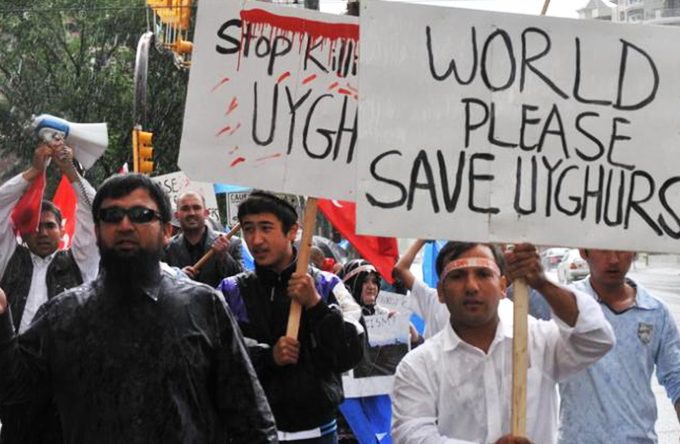
The world is on fire in so many places, few more frightening the Xinjiang region of mainland China. In the north west corner of that nation there live a Muslim minority group known as the Uyghurs ( pronounced “Weegurs”). The Uyghurs speak a Turkic language and have a culture far different from the rest of China. They were incorporated into the country in 1949, but mostly lived in their own way until more recent times. Of late the Chinese government has cracked down on them with tactics that should alarm the entire world, but very little of their plight has been discussed by the world powers.

It is believed that upward of one million Uyghur men have been sent to reeducation camps that were hastily built in the Xinjiang region. Some of them have seemingly disappeared and are thought to be dead. Stories of torture and murder are rampant. While the men are imprisoned Chinese males from other parts of the country are sent to take over the Uyghur homes, often forcing the wives who have been left behind to cohabit. Whispers of rapes and great fear are captured by the thousands of cameras that police the region. At any given moment the people are subjected to random searches and accused of being enemies of the state simply because of the way that they walk or present themselves.

There are countless stories of minority people being threatened, imprisoned, and killed in places across the globe. Our instincts tell us that we should somehow help but caution asks us to wonder if and when it is right to interfere in the workings of countries that are not our own. After all, we argue, we have enough of our own problems right here. There are signs of injustice in our own backyards. Should we clean our own house before we are audacious enough to find fault with others? What is the red line beyond which we can no longer simply sit back and watch horror unfolding? How much of our own human and financial treasure are we willing to invest in problems that don’t appear to directly affect us?

These are the questions that plague us and none of the answers are either obvious or without grave concerns. Doing nothing or doing the wrong thing has consequences, some of which we cannot foresee. Our natures leave us frozen with indecision while ideologues rush in head first  often seizing the day and the power. For the most part the rest of us just quietly go along, allowing the squeaky wheels to get all of the attention until things come to a dangerous head forcing us to act one way or another. In the meantime there is so much suffering in the world that is seemingly unchallenged.

Our own civil war was bound to occur because slavery was indeed wrong and our nation was irreparably divided as to how to uncouple itself from something so horrific. In the end as is too often the case it took outright war and horror to force the issue. Perhaps the fact that the rest of the world chose to simply watch as we fought brother against brother rather than choosing sides whether for humane or financial reasons was the right response. Maybe in the long run each country has to find its own way out of social and political divisions, but what about those instances that aggressively overtake and murder innocents? Are we morally bound to help them in some way?

These are the kind of questions that fill my head and I know enough about history and human nature to understand that the world has been filled with intrigue since its very beginning. Knowing when to intervene on behalf of a person or a group is a tricky thing but something that we should always seriously consider not as a means of gaining our own power but as a way of protecting those unable to protect themselves. Such discussions should not be a matter of partisan preference but honest communication in search of reasonable answers.

Right now it feels almost impossible to achieve such noble goals. I worry about what may have to eventually happen to bring us to our senses, to help us understand that we should not be enemies. History tells me that it may be a very unpleasant learning experience that we must endure before we find our way. I pray that we figure that out before it is too late.

A New Way To Praise

christ5d-2.jpg

I once went to a church service with one of my former students. As a cradle Catholic I grew up with a very formalized kind of religion that has often been critiqued and misunderstood so I kept an open mind as I experienced a very different way of connecting with God. After a reading from the Bible and a few words from the minister the people began praying aloud, sending their petitions to God all at one time in a confusing mix of sound. I was not quite sure how to react so I simply attempted to quiet my mind. That’s when I began to hear the profound beauty of their individual prayers and their deep faith that God would somehow comfort them and ease their pain. Before long the sounds of their very personal pleas brought tears to my eyes and a realization that each of us longs for hope and peace in different ways.

My mother was a confirmed Catholic. She believed in its teachings and traditions with all of her heart. Nonetheless she was quite open to other religions and often voiced her philosophy that her main hope was that each person would find a relationship with God in the manner that worked best. To that end she was just fine with the idea of people following their own hearts in deciding which kind of religion worked best for them. She believed that God comes to humans in many forms. She had great respect for the beliefs of others but was always troubled by those who thought that the very idea of a
God of any kind was a human myth. She prayed that each person might find the goodness and power that she felt from a closeness with a personal God.

I watched my mother’s faith and prayer life take her through challenges that might have defeated a lesser person. There was nothing easy about her life and yet she was known far and wide as an optimistic and happy person, someone who gave when she had so little of her own. I witnessed her love of God firsthand and I saw the incredible strength that it gave her. It convinced me that she was not just experiencing some human fairytale. What she felt was unexplainable in the scientific sense but nonetheless quite real.

Religions of all kinds have taken heat in the long course of history. My own Catholic Church is a target for derision these days because of scandals that shake the very foundations of belief. Other sects sometimes appear to be far less kind that they ought to be. The human discussion of all things spiritual is often fraught with anger and hypocrisy and yet at the heart of the matter is the idea that there is a being much bigger than our humanity upon whom we should depend. For some this is the stuff of legend and a source of ridicule, but for people like me and millions of others it is a deeply held conviction.

The most recent class that I have been taking at Rice University School of Continuing Education centers on the Stuart kings, the monarchs who took the throne of England after the death of the childless Elizabeth I, the last of the Tudor rulers. That particular moment in history was marked by sometimes violent religious struggles between the Church of England, more fundamentalist sects like the Puritans, and the Catholic Church. At that point in time the tendency was to attempt to eliminate any group of believers who did not concur with the monarchy and the national church. Strict laws prohibited true freedom of religion and in many ways served to influence later attempts to form fairer democracies, including the one that resulted right here in the United States of America. By law we are supposed to be as tolerant of all faiths as my mother always was.

I bring up all of this because I see so many instances of derision and sometimes even hatred being aimed at various religious groups and individual beliefs. We all too often presume to understand what is in the hearts of people who profess particular philosophies. We judge in places where we have no business to do so.

A perfect example of this is to be found in the person of Kanye West, a brilliant and talented musician and master of words who has by his own admission led a troubled life. Much like my mother he is challenged by the sometimes crippling mood swings of bipolar disorder. He has courageously admitted to having this terrible illness even knowing that it is so misunderstood. We are still in the dark ages when it comes to tolerance and compassion for the mentally ill, and so Kanye has been ridiculed and sometimes even spurned in his journey to find peace of mind. Along the way he has experienced a seemingly dramatic conversion to the Christian faith.

His enthusiasm for Christ has been mocked by those who think that perhaps he is just going through a manic phase. They call him crazy and joke about the strange twists and turns of his life. Others cynically suggest that he has just found a new way to make money. They see his foray into religion as nothing more than a scheme. Thus his new album Jesus Is King has been panned by many of his critics as little more than the mad ravings of a diseased mind.

I have listened to Kanye’s songs that praise the glory of Christ and I hear instead the work of a genius who has found a power that had previously been missing from his life. I applaud his courage in putting his entire career and reputation on the line with such a daring project. He will no doubt be questioned and misunderstood by many but the message in each track tells the story of someone who truly believes. He has taken his God given talents and used them to shout the good news that he has found. Jesus Is King is a gloriously creative gift, not the ravings of a madman and it is impossible and even wrong for any of us to question what truly lies in the heart of Kanye West. Instead we should celebrate the happiness and comfort that he appears to have found in God.

Liturgical music has included the compositions of giants. There have been Gregorian chants and litanies, symphonies and gospel pieces. Now the voice of Kanye West uses rap to tell of the glories of Jesus. It is both brilliant and lovely. His is a new way to praise. We should all celebrate that he has found a way to ease the tempest in his mind by sharing his genius with those of us who believe.

When History Comes Alive

newellboyd

I’ve become fascinated by a series of classes at the Rice University Glasscock School of Continuing Education featuring the history of the kings and queens of England. Dr. Newell Boyd uses primary and secondary sources to bring the reigns of the British monarchs to life. His courses are exciting strolls through history that illustrate that human nature tends to be the same from one era to the next. The cast of characters may change but the themes echo over and over through time. His is a very personal look at history through the eyes of those who wrote commentaries about the people and events as they were happening.

The thing that has most struck me throughout the series of lectures is that so many of the problems that we humans face today were concerns hundreds of years ago. Those of us who are not royalty or “mighty barons” today may have a better quality of life than the common folk of yore, but questions of religious freedom, power, and economic equality remain essentially the same as they were when peasants’ lives were brutish and brief. The saga of mankind has been a story of wars and intrigue but it has also been one of slowly evolving equality and freedom and opportunity even for those not born into wealth and power. Much of that trend began in the rise and fall and ultimate decline of aristocracy and the belief in the Divine Right of Kings.

I’ve learned from the study of the Tudor kings that the audacious dealings of Henry VII in his quest for an heir had more to do with keeping peace in the empire than simply attempting to father a male child. Prior to Henry’s reign there had been years of warring between families to claim the throne. Henry desperately hoped to maintain a firm hold of legitimacy and continuity in the royal hierarchy. He believed that only a male heir would insure that there would be no challenges to the authority of his line. Of course we know in hindsight that his beliefs about biology were erroneous and that a woman would ultimately rise to the throne and do so successfully.

This semester Dr. Newell is outlining the story of the Stuart kings who descended from Mary Queen of Scots. Because Elizabeth never married and died without an heir there were many questions about who was the rightful heir to the throne. Untangling the family tree that lead to James I  is a story in itself but the gist of his troubled monarchy lies in the fact that he was raised in Scotland as a Presbyterian and as such was never fully accepted by the people of England. His reign and that of his descendants was continually marked by both political and religious intrigue that lead to unrest, civil war and revolution.

The Protestant Reformation had let the genie out of the bottle. While the Church of England was the official religion of the land there were still Catholics and Puritans determined to defy the dictates of the king who served as the head of the church. In his efforts to demonstrate his power and legitimacy James I was rigidly doctrinaire which lead to treasonous attempts to assassinate him by religious groups, perhaps the most famous of them being the plot to blow up Parliament when James was present by a group of Catholic revolutionaries that included Guy Fawkes.

James’ son Charles did little better than his father to earn the love and respect of the people. It was during Charles’ reign more seeds of revolution were sowed as Parliament became more and more powerful and the king became more dependent on their whims. It was also a time when grand new philosophies regarding the rights of ordinary people began to flourish. The world of royalty in England would never again be quite the same.

I have been particularly intrigued by this period of time in history because I can trace my own ancestry to the times. Charles was being plagued by warring forces in Scotland. People of the Puritan faith refused to bow to his demands that they adopt the beliefs of the Church of England. In an effort to rid him of those problems while also diluting the Catholic influence of the Irish Charles encouraged many Scots to relocate to northern Ireland. It was from that migration that my paternal grandfather’s people came. He always proudly boasted that he was Scots Irish, a strange mix of cultures that I never before clearly understood. Now I know that they were probably trouble makers searching for a place where they might think for themselves.

I am also learning more about Oliver Cromwell, a defiant member of Parliament who would lead England to revolutionary ways of thinking. From a woman in my paternal grandmother’s ancestral line I am a relative of Cromwell, all of which helps me to understand my own somewhat rebellious nature and unwillingness to simply follow the crowd.

I suppose that many of the folks who eventually came to the New World in search of opportunity and a new start were pesky Puritans, Scots Irish, people who had grown weary of being persecuted and limited by kings attempting to assert their authority. The philosophies and tyranny that had once been accepted as the Divine Right of kings began to unravel with the reign of the Stuart kings and it would end with a revolution unlike anything that they might ever have imagined. It’s fun to watch it all unfold while already knowing how it will end and it’s even more exciting to know that my kinfolk were part of it. Dr. Boyd surely knows how to make history come alive!

A Win for Everyone

Francesca_Cabrini

A few weeks ago I complained about a plan to erect statues of influential women who helped to build New York City as it is today. My beef was not with the idea of honoring outstanding females but rather with the fact that a vote was held to find potential candidates and Mother Frances Cabrini who received the most nominations and twice as many as the second place candidate was eliminated from consideration by the committee. I argued that Mother Cabrini’s contributions to immigrants not only in that great city but in others throughout the country were immeasurable. In fact she is known as the patron saint of immigrants everywhere in light of her work among the poor who came to New York City from all over the world.

I was not the only one who was upset by this slight even though the committee explained that the voting was only a way of garnering suggestions. I had nothing against the women who were finally chosen, but I felt that it to deny the incredible work and sacrifice of Mother Cabrini was unfair, especially in light of the difficulties that all immigrants to this country have and continue to endure even in the present day. Acknowledging her would have been a way of commemorating all immigrants and the positive impact that they have on our country. It seemed irrefutable to me that by leaving her from the final list a grave mistake had been made.

Ordinary citizens, celebrities and politicians took up the cause to right this wrong but received little leeway from the committee who stood firm on the choices they had made. After much criticism that Mayor Di Blasio called “manufactured,” the governor of New York, who is a descendent of an immigrant Italian family, announced that the state will finance a statue to be placed at some location in New York City to honor Mother Cabrini.

There has been much disagreement of late over the observance of Columbus Day. Many places in the United States have chosen to rename the national holiday, Indigenous Peoples’ Day. While there are indeed legitimate arguments that Christopher Columbus is not someone who should be heralded as a hero, the truth is that in many Italian communities Columbus Day has become a traditional way of celebrating Italian Americans in this country. Columbus Day parades and activities have become part of the celebratory fabric of cities like New York, Chicago and Boston where many Italian immigrants first lived after their treks across the Atlantic.

Christopher Columbus is honored in most places because of the heroism that it took for him to sail across the waters into an unknown world at a time when many still believed that the earth was flat. We now know that he was actually hoping to get to the far east but the Americas were in the way. He was not even the first European to explore the land either, and a kind of cultish set of beliefs grew up around his reputation that led to school children being taught questionable information about him for decades. Now that we are more informed there are many who just want to throw him in with a pile of deplorables.

I can think of arguments both for and against having a national holiday named for him, but I don’t see a great deal of harm in allowing Italian Americans to have their celebrations centering on him any more than I worry about Hispanic Americans enjoying Cinco de Mayo even though neither has much to do with the United States. Columbus never once set foot on north American soil nor did he interact with the indigenous people who lived here. On the other hand, Mother Cabrini did incredible work at great sacrifice to build hospitals, orphanages and schools. The appropriateness of celebrating her is so obvious to me.

Even though Mother Cabrini was a religious woman her work was never exclusively for those who shared her faith. She gave of her talents to anyone in need. While she worked in the name of God, what she did for immigrants was an equal opportunity gift to our nation, and one for which not just Italians or Catholics benefited, but all citizens of the United States.

It’s sometimes difficult to find perfect heroes. We tend to be quite critical of virtually everyone, finding fault even after someone changes. We are prone to tear down reputations and statues more than other countries do. When we have a chance to honor someone as wonderful as Mother Cabrini we need to jump at the chance.

I applaud Governor Cuomo and the people of New York who took a proactive stance and decided to do something other than merely complain. I love New York and can’t wait to visit one day so that I might see how the people ultimately decide to honor Mother Cabrini. She is a role model for all women and for all citizens of the United States. In fact our country would do well to have more like her in the craziness of today’s climate. This is a win for everyone.   

Our Hunter Gatherer Past Present and Future

evolution

Attempts to understand the many conflicts between people across the world can be rather confusing. Sadly most of them occur because of perceived religious or ethnic differences. Race is often seen as a dividing factor when in reality the genetic differences between one group of people and another are generally superficial. The reality is that when taken down to a biological level we homo sapiens are more alike than different. The things that divide groups generally have more to do with environment than biology. Mankind’s history is sadly one of creating alliances to maintain or grab power and using manmade concepts like ethnicity or religion as rationale for struggles to get a fair share of the world’s resources.

Survival has always lay at the heart of the human experience. Our ancestors moved from place to place in search of food and shelter for thousands of years before learning how to take control of nature through farming. Suddenly the idea of claiming the land and settling down became a way of life for much of the world’s population. Obviously  this new advance created unexpected problems that are still the focus of most of the problems that plague us today. Determining who gets what and how to divide resources is the stuff of politics and conflict particularly as the population grows. Over the course of history the concept of survival of the fittest has all too often meant the ones with the biggest clubs and the most stuff.

Our genetic ancestors were often a violent bunch not so much because of the DNA that they carried as for the need to fight for food and a place to sleep at night. Scientists have found the remains of people from tens of thousands of years ago that show signs of blunt force trauma. Life was often brutish and short for those from whom we descended. It’s likely impossible for any of us to truly understand what kind of daily challenges they faced. We judge them from a perspective of hindsight.

Wars between people still rage today. Most of the problems in the Middle East center on religious differences that take the form of political ideologies. All across the globe we humans argue over sociological concepts and their effects on the fair distribution of resources and justice. We create alliances and rant about differences when the reality is that what we all really want is a place to call home that is safe and filled with the comforts that we need to survive our time on this earth. We long for the freedom to be left alone even as we cling to relationships. We are living breathing contradictions and keeping us all happy seems to be an almost impossible task. Thus we can’t seem to all settle down into peaceful coexistence in spite of one valiant attempt after another throughout the long stretch of history.

There are only so many ways to tell a story. There are major themes that tie together the human search for peace and tranquillity. When all is said and done the king is not so different from his servant. The things that separate us from one another have very little to do with our natures, but everything to do with how we view each other. We create artificial structures and definitions in our attempts to explain things that we don’t understand. Sometimes that process leads us to false conclusions and grave misunderstandings.

In a sense we are all still hunter gatherers of a sort. From the time that we are young we begin the training that we will need to one day leave our homes in search of work that will provide us with the funds that we need to purchase our food and clothing and necessities. Our daily grind may be less dangerous than that of the primitive people from whence we descended, but the idea of finding a way to survive is still the basis of our endeavors.

The most remarkable thing about humans is that we long to for lives that are more than just an unending repetition of work. We are innovative and our creations have given us incredibly rich and remarkable existences that were unimaginable to our ancestors. History has not been just about our wars with one another. It has also included our better natures and the creation of arts and sciences. We have used our remarkable intellect to impose our will on medicine and music. We have civilized our barbaric ways so much that we are gravely appalled when we see evidence that we have not evolved as much as we would like to think that we have.

Our human past is filled with both horrendous mistakes and great advances. We often learn through trial and error. Our best efforts seem to occur whenever we set aside our differences and operate from a sense of concern for a common good. None of us are perfect and neither are our decisions, but it is possible to rise above anger and fear. Such moments created the Magna Carta, freed slaves, and eliminated murderous tyrants.

As I look around today I see a preponderance of alliances formed out of concern for a world that seems to be out of sync. It’s difficult to know how to think or feel. We are weary of the battles with one another because we instinctively understand that we should not be enemies. We want the same things but have different ideas about how to achieve them. Sadly the old ploy of dividing us into warring camps is being used rather effectively all across the globe. Our ethnicities, religions, socio economic statuses and political leanings are part of a grand power struggle that is in fact little different from all such maneuvering in the past. It’s a dangerous game that we should refuse to play.

I will continue to speak out against the death penalty but I will not turn my back on those who believe that it is an effective tool to fight crime. I believe in the tenets of my Catholic faith but I will not use them to hate those who think I am deluding myself with religion. I respect the human made differences in philosophies and ways of living because I understand that when all is said and done they are only superficial aspects of our most basic desires. People are breathtaking and the fact that they represent so much variety makes them all the better. Perhaps one day we may even learn how to hunt and gather in peace.