
Abundance

vans-2015-summer-geoff-rowley-footwear-collection-11My grandmother was one of those people who saved all of her nice things for some future day when she would need them. We used to joke that our Christmas gifts to her would be stored away and not seen again until the things that she had been using were worn beyond usefulness. When she died there were items still wrapped in cellophane and stored in boxes. I suppose that hers was the habit of a woman who had lived in a state of poverty for most of her life. She was brought up to use what she had rather than to concern herself with acquiring abundance. I suspect that there were many people of her generation and economic status who did exactly the same thing. It sometimes made us sad that her tendencies prevented her from fully enjoying the advantages that we sought to give her. I suppose that it mattered little to her because by then she was set in her ways, but it always amused me that we kept trying to provide her with luxuries even as she resisted our efforts. Perhaps in some ways she was actually wiser than we were because she was perennially happy with little more than our presence. The things we brought her were not required to make her smile.

I was reminded of my grandmother recently as I helped a friend to dispose of her deceased father’s possessions. I realized as we packed away boxes and boxes of items that he had accumulated that most of us probably own more than we ever really use. When all is said and done we are drowning in stuff and yet we continue to shop and add to our collections. I wondered if we have our priorities straight or if we are simply addicted to consumption, victims of enticing commercialism that convinces us of what we must have rather than what we actually need.

I mentioned to my friend as we worked that perhaps we would all be best served by pursuing memories rather than things. She smiled knowingly and noted that she had planned a summer trip to Alaska because of that very idea. It occurred to me that we don’t always recall all of our purchases, but we do think about experiences time and time again. Our trips and outings are the stuff that often make us the happiest and leave the longest lasting impressions.

I have two friends who live frugally so that they will be able to take phenomenal trips each year. They have travelled the world and seen wonders. The wisdom of their choice to buy vacations rather than things really made sense when their home was flooded by hurricane Harvey this past August. The one thing that they did not lose was the joy that their journeys had brought them. They were certainly devastated by the damage done to their abode, but somehow I found comfort in knowing that they still had memories that not even floodwaters could wash away. What after all, do we really require to live full lives? Is there a way to enjoy ourselves and still be mindful of our tendencies to waste our resources and purchase more than we truly need?

Years ago a cousin noted that we begin our time as an adult in a tiny apartment which soon becomes too full, so we move until we have accumulated so much more that we are once again searching for room to store everything that we own. The practice continues again and again and in many ways we end up with bigger and bigger homes not so much because we actually want the space, but mostly because our possessions have overtaken us. I have often felt guilty as I fill every nook and cranny including the attic with my acquisitions and  wonder if I need to scale back.

What would I truly want to keep if I were somehow forced to pare down my life to a barer minimum? I suppose that it would require a bed on which to sleep with enough linens to have a clean surface for my slumbers and a blanket to keep me warm. A chest to hold my socks and underwear, pajamas and some clothing would probably be good to have. I’d want a table and some chairs for partaking meals, and a couch on which to sit whether I’m reading or visiting with friends. I have to admit to my need to own a television if for no other reason than to have access to the news, but in reality because I enjoy relaxing with shows that touch my imagination. A few lamps would be nice and bookcases to hold my treasured volumes, but I suppose that I might even eliminate that necessity by purchasing electronic copies of my favorite titles. I’d need a refrigerator and a stove and I’ve grown accustomed to having a microwave oven, a coffeemaker and a toaster. I could wash dishes by hand but I wonder if that method is as efficient as doing a load now and again in the dishwasher. I also must have a clothes washer and dryer or at least a clothesline in my backyard along with some cleaning tools to keep things tidy. A few changes of clothing and some towels would round out my needs, and yet I own so much more than that and seem to think that it is important to preserve it all in a kind of shrine to my accumulations that takes twenty seven hundred square feet plus a garage and an attic to store. I don’t want to live like a monk, and I find nothing wrong with decorating and collecting, but I sometimes imagine my children and grandchildren one day culling through my things and wondering what to do with all that I possess. 

My mother once told me that she had never been owned by things. She commented that she might have carried all that really mattered to her in two suitcases which is in fact what she did in the last two and one half years of her life. She spent those months living with me and my brother with little more than a weeks worth of clothing changes, her bible, and a radio for listening to Houston Astros games during baseball season. She had uncluttered her life so totally that she had few worries related to possessions. When she died the distribution of her estate was uncomplicated and debt free. My brothers and I could not have had an easier task. Her life was in order because so little of it focused on things.

I know people in Houston who are back in their houses after having to leave when four feet of water flooded the insides back in August. They once again have walls instead of bare studs, but they walk on concrete floors and sit on lawn chairs. Somehow they are happy because they feel the warmth and security that they worried had been destroyed by the waters. They realize that it was never the things inside that made their houses feel like home. Perhaps each of us should consider how much we truly need and begin to live with less dragging us down. We may find freedom, joy and purpose in learning to live with what we need rather than being possessed by our wants. Perhaps my grandmother had the right idea all along.
Love Honor Cherish

15975072_10211601975865667_328586816067567646_oParenting is one of the most difficult tasks that we humans attempt to master. It pains us to see our children hurting, but we know that we will never be able to completely eliminate struggles from their lives, so we teach then how to effectively deal with both trials and tribulations. We hope that our foundation will help them when we launch them into the adult world. Mostly we pray that they will know how to surround themselves with good people who love and care about them as they begin their independent journeys without us. So it was with my two girls.

Like any other parent I did my best and hoped with all of my heart that my efforts would be enough. My eldest Maryellen had always made me proud, and she appeared to have a good head on her shoulders as she left our home to become educated by others at the University of Texas in Austin. There were some shaky moments in her early days there when I received phone calls and heard the strains of uncertainty in her voice, but she managed to make it through the rough patches and secured a place for herself among friends both new and old. Along the way she met a young man named Scott through the encouragement of one of her more gregarious friends.

At first Maryellen was tentative about being more than just a good pal to Scott, but before long she was drawn to his good nature and his intellect and they began to date. Her face would light up whenever she spoke of him and I could tell that her relationship with him was far more special than any that she had ever experienced. He had a way of understanding her and treating her as an equal that pleased her. Even his gifts to her at Christmastime were astutely thoughtful and romantic. I found myself believing that she had found the man of her dreams and when I finally met him I was pleased to sense that he was a truly good person who respected and cherished her as much as I did.

Maryellen and Scott enjoyed a delightful courtship at the university, peppered with serious study sessions and fun times with a group of remarkable friends. They cheered the Longhorns at football and basketball games and enjoyed the same music and movies. Mostly they talked and realized how neatly their hopes and dreams meshed with one another. They fell in love.

I was quite pleased when they announced that they were engaged. They were both mature and thoughtful individuals who had transitioned well into adulthood. They both were within striking distance of earning degrees in the respected fields of business and engineering. Their futures were promising and together they were certain to be a power couple, but more importantly they shared values that would help them to build a life of love and devotion.

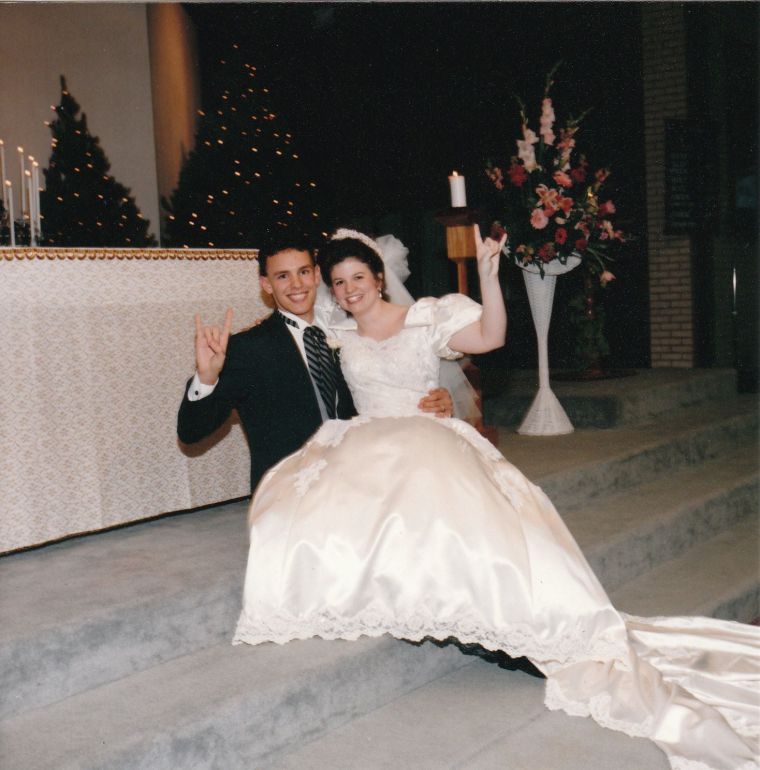
Twenty five years ago today they exchanged their vows at St. Frances Cabrini Catholic Church. It was a beautiful service shared with a crowd of friends and relatives. Maryellen glowed with the flush of love and anticipation and Scott had “the look” in his eyes that assured me that he would be forever faithful and loving to my daughter. Our family priest John Perusina said the mass and Scott’s Lutheran minister assisted with the proceedings. The bridesmaids wore blue and one of Maryellen’s childhood friends sang Sunrise, Sunset like an angel, making everyone in attendance cry as we recalled how quickly the years had gone by since the bride and groom had been children. It was a gloriously happy day that bode well for the future.

Maryellen and Scott moved to Beaumont after a memorable honeymoon in Yosemite National Park, yet another idea of Scott’s that was so perfectly suited to Maryellen. They set up housekeeping in a cute apartment and began their careers. It was a fun time and it was wonderful to see how happy they were and how well things were going for them.

Eventually Scott received an offer that he couldn’t refuse from a firm in Indiana and so the two of them were on the move. They purchased a lovely house in Lafayette and began to explore the midwest during their free time. They were only two hours away from Chicago and so that exciting city became a frequent destination. It was a time filled with new adventures and new confidence for them when all of us realized that they had indeed become a powerful team.

Four years after they married their first child, Andrew, was born and our visits to Indiana became ever more frequent as we enjoyed visits with our grandchild. I always felt so intensely happy to see the relationship between Maryellen and Scott growing ever stronger and thus it would be as one year flowed into the next and three more children joined the family as they moved again to Beaumont and finally back to the Houston area.

Maryellen and Scott have been models of love and dedication. They are beloved pillars of of their community known for their dedication to being exceptional parents and generous neighbors. They inspire others with their devotion to each other and to their sons. Together they have weathered the rollercoaster ride that is life and managed to overcome every challenge that appeared on their horizon.

In a very troubled world where it almost seems old fashioned to hold tightly to values and traditions Maryellen and Scott Greene have proven that the power of love is still one of the most priceless treasures that any of us might possess. For twenty five years they have steadfastly honored one another and passed on their mutual love to their sons who are growing in the same wisdom and age and grace that they have so beautifully exhibited.

Somehow I am overwhelmed by the rapid passage of time. In my mind they are still the twenty something young adults with so much hope in their eyes and a whole lifetime ahead of them. They have done a remarkable job of cherishing the promise that they made on that day in the glow of tiny lights from the Christmas trees on the altar. They have fulfilled all of their vows and done the hard work of keeping the flame of their never ending love alive. It makes my heart burst with joy to know that they are such incredibly fine people.

Happy Twenty Fifth Anniversary, Mr. and Mrs. Greene. May you enjoy many more wonderful days together as you share a special love. You are a blessing to all of us.

In It For The Outcome

Teachers-teach-because-they-care.-Teaching-young-people-is-what-they-do-best.-It-requires-long-hours-patience-and-care.--300x300I happened upon a discussion of the holiday calendar for this school year on the Facebook wall of a teacher friend. She had originally been opposed to working through the Friday just before Christmas, but had changed her mind once she began enjoying the full two weeks of leisure time that this year’s schedule afforded. She and other teacher friends were quite happy with the fact that they have been able to take trips, totally relax and just enjoy a much needed break from the stresses of educating youngsters. Then the parents came out of the woodwork revealing a truth that has long troubled those of us whose profession is to teach. Namely there was a flood of complaints about having to find babysitters during such a long stretch of time away from school. In other words, schools in the minds of many adults are not just institutions of learning, but also convenient agencies for caring for children so that the parents will be able to work.

The babysitting aspect that schools have somehow inherited over time demeans the professionalism of teachers, and often flies in the face of research regarding when and how long children should be left at the doorstep of our nation’s centers of education. I have worried for some time about youngsters dragging into schools so early in the morning that they are half asleep or in tears. So too is my concern with many of the programs that keep them until late in the afternoon. This of course allows parents to conveniently complete their own work days without having to worry themselves with making additional arrangements for the care of their children, but it also requires teachers to work sometimes ungodly hours that include not only preparation for teaching but also development of ideas to keep the children occupied for long stretches of time. It is little wonder that my teacher friends are rejoicing over having a brief respite from their duties. Even worse, however, is the all too prevalent feeling that today’s educators are viewed with so little regard that many parents think of them as being little more than nannies whose function is not just to educate but also to accommodate work schedules.

I have nothing against working parents. I was a mother who worked as well. Ironically I often had to rely on my mother-in-law to care for my own children when they were sick or after they arrived home from school because I was required to stay beyond the regular hours for various programs designed to provide a safe and secure place for our students to be until their parents had finished their work days. I know how demanding it can be to be a mother and a reliable employee at one and the same time, but I have to admit to resenting that my hours at work were often dictated more by the needs of parents than either those of my students or me and my fellow teachers. It was assumed that we would be the caretakers even while our own children sometimes had to learn how to survive with a latchkey and stern warnings about how to behave while we were gone.

On most school days teachers leave home earlier than their children and return around the dinner hour. If they had the luxury of relaxing for the rest of the evening it would be all well and good but the reality is that most educators spend several hours each evening planning and grading and sometimes even conferencing with parents by phone or email. Days during the school year are long and too often filled with stress. Weekends are not much better from August to the end of May, so whenever I hear parents complaining about the free time that teachers enjoy I have to hold my anger in check.

The truth is that there are few professions that are as demanding as teaching, and those who survive for the long haul do so with earnest dedication and love for the work. The pay doesn’t even begin to equal the amount of effort required to do the job well, and the tangible benefits are minimal. There are rarely parades or honors or even discounts for teachers as there often are for soldiers or first responders. Educators toil quietly away year after year because they are genuinely altruistic and devoted to a purpose driven life. They are concerned about the outcome, not the income and yet they invoke a generalized ire for their profession and are rarely consulted as the experts that they are. Still they return year after year because in spite of all of the negativity swirling around them they are answering a calling the compels them to attempt to make a difference in the lives of their students. They are not average souls who would be unable to do anything else, but rather remarkable individuals who have chosen a vocation that requires sacrifice and a thick skin. Their ultimate reward is a self knowledge that what they do is perhaps the most important contribution to society, and at the annual holiday pause of their labors they desperately need a period of rest to revitalize themselves for the big push of the coming semester. I can’t imagine why anyone would complain about the inconvenience of not having teachers around to care for their children, and yet it happens all of the time, and I suspect that if it were possible many parents would require teachers to be on call year round with only a handful of holidays.

The best system that I ever encountered was at St. Anne’s Catholic School. All teachers had regular hours as part of their work contract. Any additional time spent at the school was optional and provided extra income. The before and after school programs were separate from the school itself and paid hourly stipends to those who chose to participate. Many teachers enjoyed being able to extend their pay by volunteering for such work, but they also appreciated that they were not conjoined with professional expectations. Perhaps because parents paid tuition and fees for every aspect of the education they treated the teachers with great respect and esteem. I have never before or since felt as appreciated as I did when I worked there. Nobody took me for granted and everyone appeared to understand how much effort I was putting into my work. I felt as though I was a member of a team in my communications with parents. I believe that the success of our students was built on a mutual regard for one another that is sometimes missing in public schools. There is all too often a generalized feeling that our nation’s teacher are a rather ignorant bunch that are the source of most of the world’s problems. It doesn’t seem to occur to everyone that teachers are often asked to be all things to all people with very little support and not much compensation.

I suspect that parents who complain about long holidays and summer vacations just haven’t thought about how their cries of woe actually sound. They are juggling their own problems and it is easy to view the teachers as the enemy when they appear to be lounging far too long during the holidays. Those who have to return to work the day after Christmas may not be able to understand why teachers really do need that extra time to recharge. It is convenient to view our educators as the source of childcare problems, but I would urge parents to think again before voicing such complaints. As a society we give so little credit to our teachers that it is a wonder that anyone ever wants to enter the profession. The very least we can do is smile with them when they get excited about having time to enjoy themselves. Take it from an old pro, they have earned every single minute of their free time and they will be all the better with our kids because of it. We should be happy when we hear that they are feeling good. It means that they will do a better job when the school bell rings again.

Hard Choices

winston_churchill

On New Year’s Eve my husband Mike and I went to see the movie The Darkest Hour which is a presentation of the early days of Winston Churchill’s tenure as Prime Minister of Great Britain. It was May of 1940, and Adolf Hitler was marching across Europe seemingly with ease. One country after another had fallen under his conquest and it appeared as though he was unstoppable. Many in Great Britain were certain that the only logical choice for the empire was to broker a peace deal that would allow them to maintain independence while acceding to German influence. There was much talk that Britain had neither the manpower nor the stomach to endure a war with the superior German forces. It almost seemed inevitable that the country would fall just as so many European nations had already done. It was indeed one of the darkest hours in the history of the country.

Winston Churchill had only recently replaced Neville Chamberlain as Prime Minister. The government had lost confidence in Chamberlain and his efforts to maintain peace with the Germans appeared to be appeasement rather than diplomacy. He was being blamed by some for the fall of so many of Britain’s allies and Churchill was reluctantly chosen to replace him as head of the government even though many believed that his tenure would be short-lived. He had not particularly distinguished himself in either World War I or his other forays into governing. Many thought that he would soon be replaced by Lord Halifax who was viewed as a more reasoned leader. Furthermore there was great concern about Churchill’s unwillingness to consider a peace accord with Hitler, whom he considered to be a despicable despot unworthy of deference of any kind. 

At the time the entire British army of 300,000 troops was hopelessly trapped by German troops in Dunkirk and seemingly on the verge of total destruction leaving Britain completely unprotected. In a desperate move Churchill commanded one of his admirals to distract the Germans so that civilian sailors might employ their crafts to rescue the stranded troops. It was a daring plan that many thought was dangerously foolhardy. Churchill understood that it was instead the country’s last hope, and he was joined by the King in believing that any peace deal with the Germans was unacceptable. He did not believe that Britain would really be allowed to be independent of Nazi rule, and he could not imagine being able to accept the sight of Nazi flags flying over Buckingham Palace. He remained firm in his resolve to fight off the invading German army one way or another.

Churchill ultimately garnered the support of the government as well as the people of Great Britain when he delivered a stirring speech in which he insisted that Britain would fight to the last man, and if that was not successful then they would rely on being rescued by the other nations of the commonwealth and the people of the new world. His unflinching challenge captured the imagination of his countrymen, and as Lord Halifax noted Churchill had commandeered the English language into the battle.

We know of course what the rest of history was. The United States entered the fray a year and half later, and Hitler split his forces and resources by embarking on a new front of war with Russia. Ultimately he was defeated and Britain never came under his rule. But for the courage of Winston Churchill many historians argue that Europe may have been dominated by Germany and been changed in ways that would have had even more horrific consequences for mankind than they did.

The Darkest Hour was a captivating movie and Gary Oldman did a yeoman’s job of portraying Winston Churchill. More importantly was its story which made clear the dire situation of the world in 1940. I learned many things that I had never before known and they gave me a better perspective of what it must have been like to live during that era, particularly in Europe. This truly is a movie that everyone should take the time to see, but sadly the audience on the day that I went was almost totally comprised of individuals either my age or older. I only saw three young men in the entire crowd which is truly a shame because I doubt that most of today’s millennials have any idea of how dangerous the world situation was back then. I hear so many people today complaining that this is the most menacing time in history, and while there is certainly a grain of merit in such pronouncements I also have to wonder if our present situation even compares to what was happening in the spring of 1940 when the very face of Europe and Asia was changing so rapidly that it appeared that there would be no way to stop the autocratic land grabs. It chills me to even consider what the world might have become without the courage and determination of Great Britain and its eventual allies in the fight against fascism and fanaticism.

There is a popular series on Amazon called The Man In High Castle that considers what the world would be like if Hitler had succeeded in his goal of world domination. It is a dark look at the possibilities that were actually closer to fruition than most of us ever thought. The United States was still little more than a second rate nation at the beginning of that war, totally ill prepared for the battles to come. In the first weeks of the conflict they were utterly befuddled and defeated, but somehow just as with the citizens of Great Britain the American people maintained their resolve to defeat the evil of Adolf Hitler and his Nazi party. With the combined efforts of some brilliant military men, the bravery of the troops, and the luck of bad decisions by Adolf Hitler good ultimately triumphed over evil, but it is horrifying nonetheless to even imagine how things might have been had the Germans actually won.

If you have not yet gone to see The Darkest Hour or have yet to even consider viewing it, I highly recommend that you do so. Be sure to take your middle school and high school age children with you as well as the young adults in your family. We learn from our history and the story outlined in the film is one that is probably not familiar to most of us when it should be. We face our own tyrants in today’s world and we need to consider the lessons learned in the past as we make important decisions. We also must ask ourselves just how willing we will be to look the other way when we see monsters denying people the human rights that we all deserve. When do we compromise with them and when is it time to draw a line. We need to know these things because the time may come when such hard choices will have to be made. 

The Builder

40e8039a1c47edf3e2821bc05c59f15a--basement-workshop-nail-storage-garage

There was a hardware store near our home that my father visited each Saturday with an almost religious fervor. It was a sacred place in which I ultimately felt the full extent of my father’s happiness. Happily he regularly took me on his weekly excursions and I always felt special as we wandered together through the aisles of tools and gadgets and fasteners while my dad explained the purposes of the different items. He was in his element inside that store and his face willingly gave away the happiness that being there provided him. Whenever I think of him I recall the bins of nails of every size and remember his lessons on why there were so many different kinds. I can still see him carefully weighing the proper variety for his latest project on the metal scales that hung from chains connected to the ceiling. I can smell the aromas of oil, wood, and metal that permiatted the concrete floors and the wooden studs of the walls. This was a cathedral dedicated to the carpenters, plumbers and electricians of this world. In Daddy’s case it was a shrine for all who love to build the edifices and implements that we use to bring us comfort.

My father never treated me as though I was too young to understand what he was doing. It didn’t seem to occur to him that as a girl I might not have been interested in the things that he so loved. He spoke to me about his passion for construction and explained the hows and whys of his work. Thus it was that he allowed me to sit at his side as he created a miniature replica of our first home. He carefully drafted a blueprint and showed me how to shrink the proportions of the rooms into a drawing that fit on a single sheet of paper. I could not have been more than four years old when he demonstrated the techniques of scale to me, for I had not yet started school when he first told me of his idea. Somehow Daddy assumed that I possessed enough intellect to understand his calculations in spite of my youthfulness, and he was so right. I was mesmerized by the process and willing to sit quietly on a stool while he demonstrated his skill at his drafting table.

The next phase of his work was to build a tiny house that would resemble our home in every imaginable detail. I was fascinated as he measured and cut pieces of balsa wood to create a frame for the structure. Even before he had inserted the walls and other features I was able to see the rooms unfolding just as I knew them to be. It took many weeks and many visits to the hardware store to finish the lovely reproduction. Sometimes weeks would pass before he had time to return to the task of making the tiny house that almost appeared to be the work of fairies rather than a man. I was astounded when it was finally complete because the details were so exact. He had somehow managed to create an illusion of cedar shakes and bricks and shingles that was a perfect copy of the house where we lived. He had designed the roof so that it could be lifted to reveal the interior rooms with their gleaming wooden floors and brightly painted walls. It was a masterpiece in my eyes and I felt a quiet joy in having observed the entire process. Sadly I have no idea what eventually happened to that wonderful creation. I would give anything just to see it once again and to explain to my children and grandchildren how wonderful it was to have been a witness to my father’s painstaking work.

My daddy was just as likely to educate me regarding other things that he built as well. When I was about seven we had moved to a new home and he was annoyed that we had to walk on the grass to get to the front door from the driveway. He muttered that the builder should have thought to create a sidewalk leading to the entrance. Before long he had decided to rectify the omission himself and once again he used the project as an opportunity to teach me about the proper methods for installing a concrete pathway.

He began by carefully digging out the grass in a pattern that resembled the desired design of what would be the final product. After seeming to take forever to level the ground and straighten the lines he next built a form with wood and and string, taking care to survey his measurements accurately. He allowed the structure to cure for a time to be certain that the ground was not going to shift. He also watched the drainage pattern and made adjustments to insure that there were not low points that would hold water. Then he began filling the bottom of the wooden platform with metal rebar and even bits of nails and other metal shavings left from other things that he had built. He told me that the metal was the secret ingredient for insuring that the sidewalk would last for years without cracks or erosion. Finally came the day when he mixed and poured the concrete spreading it until it was smooth and as perfect as he insisted that it should be.

Nobody was allowed to walk on his creation for days until he was certain that it was set exactly as he had hoped. He was quite proud of the outcome and so was I. Our neighbors commented on how nice it was and joked that they were going to hire him to build one for their houses as well. Daddy boasted that it was a fine structure that would last for a very long time. In fact it has endured even longer than he did. I recently drove past our old home and saw that the sidewalk was as strong as ever. It was not leaning nor did it have any cracks. It had withstood decades of use, sixty two years to be exact. As I saw how well it had performed I swelled with pride in knowing that my father had built it with his ingenuity and engineering skills. More importantly he had believed enough in me to share his knowledge with me, something that made me feel capable and appreciated.

To this very day I find great pleasure in sauntering through hardware stores. I especially enjoy the ones that are more in line with those of old. I prefer the bins of nails and bolts over the plastic packages that are the modern day norm. I consider an outing to Harbor Freight or Ace Hardware with my husband to be a delightful activity. Repairing things or building something is as much fun for me as taking a vacation trip.

I suppose that a psychologist would attribute my love of constructing to the tragic loss of my father when I was only eight years old. My childhood memories of him revolve around books and building and Texas A&M University football. I only truly know him through the brief amount of time that we shared, and yet it was so revealing of who he was that recalling the feelings that I felt provides me with comfort. He demonstrated his love for me by teaching me about the things that mattered so much to him. He was a great father if only for a very short time. 

While I will never truly understand some of the mysteries surrounding Daddy’s death nor the void that he left when he was gone, I treasure the recollections that he left me. The emotions that I associate with the simple act of wandering through a hardware store are visceral and as real as if he were standing next to me with his boyish grin of anticipation about the next thing that he was going to build. When I remember I am filled with pleasure and a sense of security because I know for certain how much he loved me, and for that I will always be grateful. He was a builder not just of things, but of beautiful relationships and dreams.