Triumph

mt-carmel

On September 1, 1965, the Mt. Carmel High School Class of 1966 began day one of senior year and what a time it would be. We were ready to take charge and end our four years with unparalleled accomplishments. Our student body leaders, Tom King, Terry King, Janice Lowe, and Jeannine Mandola were more than up for the task of celebrating the school’s tenth year of providing educational excellence to the young men and women of Houston. This was our time to shine and we took on the world with confidence and determination.

The Vietnam War was raging and dividing the nation. The editors of the school yearbook, Elke Ahr, Diane Martin, and Monica Krider chose to dedicate the 1966 edition of Zelo to peace. Our school would be touched by the tragedy of the far away war when a member of the Class of 1965, Mike Hoelcher, was killed in the service of our country. It brought home the reality that our days of comfort and youth were drawing to a close. Soon we would be moving into a new phase of life that would demand that we demonstrate the wisdom and grace that our parents and teachers had instilled in us. But at least for the coming months it was our moment to enjoy the fruits of our labors as students.

Our academics had become ever more rigorous. We learned how the world around us works in physics and began to better understand the politics of the United States in civics. Our mathematics ventured into the realm of Pre-Calculus, challenging us ever more. We became more and more proficient in languages like German and Spanish. We spent hours reading and doing research for our senior year English papers, the culmination of all that we had learned before. Our religion classes delved deeper into ethics and questions that have confounded philosophers and saints for centuries. There was no respite from the mountains of school work that never seemed to decline no matter how hard we worked.

Of course there was time for play and development of our extracurricular interests as well. Frank Abegg and Claudia Dean were tapped as editors of the CarmeLight newspaper. I must admit to being disappointed that I did not get the nod. Being the general editor was the one distinction that I had most desired because more and more I wanted to spend time writing. I was instead named the news editor along with Susan McKenna. My dismay was only a temporary setback and I was soon enough working long hours to meet deadlines and keep the news current and interesting. Our Forensics group was doing its own bit to burn the midnight oil in preparation for tournaments that they would win again and again. Paul Colby and Harry Butler continued to dominate in debate.

The Medical Careers Club brought home three awards for excellence that year and continued to grow in size and stature. I was proud to be the president of the organization but had quietly realized that medicine was not in my future. Judy Loisey, Frances Harris and Linda Derks led the Future Teachers club while Kit Lyle and Marjorie Neely were officers of the Mission Club dedicating most of their efforts to sending parcels to Vietnam. We had an active Civil Air Patrol with Mario Zuniga and Carl Eschbach as commanders. Jeannette Mikeska and Linda Daigle chaired the ever popular Dance Committee that stayed busy that year planning twelve special events. Frances Harris and Manuel Manriquez enriched the Spanish culture of our school with a moving Nativity presentation while the senior members of the Texas Association of German Students created a riotously funny skit called “Ich Spion” that featured the guys dancing in fake lederhosen.

Our sports programs brought us honor and winning seasons and even the possibility of beating our biggest foe, St. Thomas High School. The football team gained respect by defeating opponents like Jesuit, Alvin, Kelly, Kirwin and Bishop Byrne. We became the surprise of 2-AAA with a team led by standout players like Leonard Luna. Senior players, Mike Bole, John French, Mike Getz, Mike Villars, James Mushinski, Paul Jauma, Allen Bare, Tom King, Donald Descant, Paul Kasper, Terry King, Tad Trahan, David Sonsel, Ronald Block and Jack Villagomez made Friday nights more exciting than they had ever been even though our ultimate goal of finally winning against St. Thomas never came to pass. The varsity basketball team placed second in the district with Paul Kasper, Joe Madden and Leonard Luna playing key roles. The track team went even farther fielding both district and state championships with Pat Hulin, Leonard Luna, Johnny French, Ronald Block, Chris Nixon and Donald Descant. Not to be outdone, the ladies played hard at volleyball, basketball and swimming with Linda Wilson, Janice Repsdorph, Diane Martin, Ruth Hoesel, Janice Lowe and Jeanette Mikeska representing us with determination and pride. Of course our cheerleaders, Lucille Warchol, Tommy Morrison, Jeanette Mikeska, Johnny McAughan and Patty Balke were ever present to lead the student body in supporting all of our Carmel athletes.

Homecoming that year featured an amazing bonfire with Mary Jo Cipriano reigning as our queen. The football field and the dance that followed was awash with extravagant mums that only Texans understand and a beautiful and sweet court of young ladies who had exhibited their school spirit in a multitude of ways. Janis, Margaret, Stephany, Jeanette, Jeannine and Kit were all smiles and the rest of us would always remember them as Mt. Carmel royalty.

The Cadettes were winners on and off of the field, bringing home a first place trophy for the International Trade and Travel Fair Parade. Officers who had marched rain or shine for three years before earning their stripes were Janis Lowe, Kit Lyle, Ruth Hoesel, Judy Loisey, Jeannine Mandola, Margaret Rae, Karen Wilson, Cindy Cash, Carolyn Snow, Diane Martin, Susan Kelly, Lou Anne Bering and Janet Key. I was asked to be the official announcer during their routines on the football field which was a job that I loved. It also allowed me to attend the Cadette Ball in the spring. I always felt thankful to whomever had come up with the idea of including me in this wonderful organization. 

Of course Mt. Carmel High School was first and foremost about academics. Bill Winn and David Patton were finalists in the National Merit Scholarship competition while Paul Colby and Claudia Dean received letters of commendation. After years of hard work prompted mostly by fear of failing and a need to honor my father I had the number one rank and became the valedictorian with Judy Loisey as the salutatorian. Hard work paid off for those of us who were senior members of the National Honor Society including Mario Zuniga, Mike Petru, John Kurtz, David Patton, Richard Powers, Bill Bailey, Frank Abegg, Judy Loisey, Margaret Rae, Linda Caldwell, Linda Daigle, Claudia Dean and me.

With spring came the Junior Senior prom and the traditional senior trip to Bandera. One hundred forty four of us had made it to the finish line. We played in the sun, danced, rode horses and recalled four years of memories. We followed the traditions of presenting a senior play and crowning the Virgin Mary in May. We received our “Academy Awards” from the juniors and at long last gathered together in the gym on May 22, to receive our diplomas. It was one of those bittersweet days for which we had longed. It was the culmination of our accomplishments and our friendships. We would process into the building as a family and leave to travel in many different directions. There would be many whom we would never see again. Our days as high school students were done. It was time for us to begin to assume the mantle of adults and demonstrate to the world what it really means to be a graduate of Mt. Carmel High School.

The Good Times We Had

65-yearbookIn a valley near the east shore of Texas

‘Neath the vast and the clear Texas sky

Stands a monument to honor Our Lady:

It’s our own Mt. Carmel High.

Though it’s walls echo cheers and much laughter,

It’s for knowledge and culture we fight:

For with each passing year,

Our love grows more dear,

For we’re led by that great Carmel might.

While we sing of the praises of Carmel

We are loyal to the old brown and white:

Though our mem’ries dim

We’ll be true to Him

And to Her of the great Carmel might!

By the 1964-1965 school year those of us in the Class of 1966 were coming into our own. Gone were our childish expressions, replaced by the conviction that we were at long last on our way to adulthood and positions of leadership. Our resolve was reflected in our eyes and in the way we began to take charge and work together for the betterment of the school and the community. It was a year of learning about the history of our country and understanding the chemistry of life. Algebra II introduced us to our first inklings of higher mathematics and in our Religion classes we began to discuss very adult topics along with learning more about the Bible. Some of us came early in the morning to take Latin III in addition to being introduced to German. We expanded our horizons with Art, Mechanical Drawing, Choral, Clothing, and Home Economics. We had learned how to balance the rigor of academics with the growing number of activities in which we engaged.

I finally turned sixteen in November but still didn’t get to drive a car. That would have to wait for a later time when the burden of paying for insurance didn’t fall on my mom. It didn’t really matter because so many of my friends were willing to chauffeur me to all of the wonderful events that we would enjoy that year. Father Shane still insisted that we attend plays at the Alley Theater and concerts at the Music Hall. Of course I loved going to those special presentations that were making me the citizen of the world that he promised we would become. I remember how he taught us to wait for the signal from the conductor before clapping and we always felt a bit smug when students from the other schools brought their hands together at inappropriate moments.

So many of us were now officers in the various clubs and organizations. I was the Vice President of the ever growing Medical Careers Club. Paul Colby and Harry Butler were winning first place trophies in Debate. Sixteen of us became eligible for induction into the National Honor Society. Our junior representatives on the Student Council were Jeannine Mandola, Margaret Rae, Mike Bole, Judy Loisey, David Patton, Janis Lowe, Johnny McAughan and somehow even I earned a spot with that illustrious group. A large contingency of juniors worked as Library Assistants and became members of the Texas Association of German Students. Interest in The CarmeLight newspaper grew by leaps and bounds with the sports section becoming particularly popular under the guidance of Richard Powers. Father Franz asked a few of us to become members of the Chroniclers Club to maintain the history of our school. (To this day I wonder what happened to the work that we did.)  Linda Derks and Judy Loisey were installed as officers in the Future Teachers Club while the Choral Club grew large enough to fill a set of bleachers. The Dance Committee planed events for Halloween, Christmas, New Year’s Eve and Easter. The Mission club quietly performed good works for people in difficult situations. MIke Petru was one of the leaders of the Science Club. The Cadettes continued their pursuit of excellence with Margaret Rae, Judy Loisey, Janis Lowe,Ruth Hoesel, Jeanette Mikeska, and Kit Lyle earning officer positions. There was bowling and a Camera Club and even a swim team. A number of juniors posted wins in the annual Science Fair. Ruth Hoesel and Janis Lowe were All Stars of the first place basketball team. Janis Repsdorph and Margaret Rae served as captains of the volleyball teams. Of course we all loved watching our classmates on the football field, the baseball diamond and the basketball court. Everyone was busy and having fun.

Two events that I always recall from that year involved community service. Each homeroom collected food and gifts for a needy family at Christmas time. The students in my group were beyond generous and I loved shopping for the turkey with all of the fixings that we would eventually present to our family. We had enough funds to purchase lovely gifts for every member of the family and sharing our own good fortune with those who had less made Christmas all the more meaningful.

The other big project was collecting enough contributions to purchase an International Scout for missionaries who came to visit our school. They mentioned that their old auto had fallen apart from long and hazardous drives in the mountains of South America. They needed reliable transportation to get from one village to another. Somehow we managed to collect enough donations to provide them with a brand new vehicle designed for rugged terrain. It felt wonderful knowing that we had done something so remarkable.

Lyndon Baines Johnson was inaugurated as the 36th President of the United States in 1965. There were violent outbreaks in Selma Alabama as Dr. Martin Luther King Jr. led a procession of 4,000 from Selma to the state capitol of Montgomery. The Beatles and The Rolling Stones started a music invasion from England that would change the direction of music. Dr. Zhivago, The Sound of Music and Help were box office hits at the movies.

In the spring the Class of 1966 honored the seniors of 1965 with Davy Jones Locker a roast and a toast for the soon to be graduates. The nautical theme was spectacular particularly with the wit of Harry Butler who had a surprisingly humorous way with words. We were decked out as sailors and pirates as we gave our nods to each of the members of the class that had come before us. We also began tryouts for cheerleader with a huge group of students performing before the student body. There were even elections for Student Body offices.

I decided to run for Student Body Secretary. I wasn’t as well known as my opponents, Janis Lowe and Judy Loisey but I felt the need to push myself out of my comfort zone. I remember thinking that I was surely going to collapse from fear as I gave my speech to the entire school. My right leg was shaking so hard that I had to lean on the podium to stay upright. Once it was over I was relieved and proud of myself for doing something that had been so painful. I wasn’t elected but I do believe that giving that speech became in many ways the first day of the rest of my life because I was never again afraid to stand before a crowd and speak my mind.

We ended that school year knowing that we would return at the top of the student pecking order to begin our final year at Mt. Carmel High School. The time had flown by so quickly and we were poised to enjoy one of the best years of our lives. 

Wise Fools

64-yearbookThe school year of 1963-1964 began typically enough for the Class of 1966. We were sophomores, the “wise fools” as the strict Latin translation proclaims. We entered our second year of study with confidence, perhaps not fully understanding how much we did not yet know. It was a year of change and those of us from the female side of the student body were excited about the new uniforms that appeared to be a tiny bit more fashionable than the dull brown pencil skirts that we had worn as freshmen. We arrived all decked out in our brown and white plaid pleated skirts, white blouses, and dark brown blazers. At least for a time we were glad for the opportunity to wear something different.
The Carmelite Fathers were celebrating their one hundredth year of service in America and it seemed fitting that we would rechristen our yearbook with the name, Zelo, alluding to the motto of the Order of Carmelites, Zelo zelatus sum pro Domino Deo exercituum, “With Zeal I have been zealous.” We returned for our second year believing that we had the whole high school experience figured out. Gone were the fears that we might be unable to meet the demands of our teachers. We had formed strong friendships and alliances with one another and we felt ready for anything that might come our way.

We were admittedly a bit less interested in academics than in the social aspects of school but that is rather typical of sophomores. Our teenage years were in full bloom with many preparing to earn driver’s licenses and make the grand leap into more independent lifestyles. We tackled the logic and proofs of Geometry with Mr. Maroney and became ever more proficient in Latin with Sister Wanda. Father Donald led us through the fundamentals of Biology and taught us how to dissect a living breathing frog and keep its heart beating even as we opened its body for observations. I have long suspected that my ultimate reluctance to pursue a career in medicine began inside the Biology lab when I was certain that I was going to faint from the stench of formaldehyde and the sight of that tiny heart fighting for a survival that was doomed.

Once again I had an English class with Father Shane and just as with the previous year it would be the highlight of my day. My biggest surprise came from Speech and Debate. I was then as timid as a little mouse but I somehow discovered the bold nature of my personality when Mrs. Lamping taught us how to use not just our words, but also our voices to communicate with strength and determination. I soared under her direction and soon found myself competing in debates with my partner, Claudia. We would never find the momentum to have a consistently winning season but I would learn so much about people and my interests would begin to take form.

Our handsome and beloved President Kennedy was proving his own mettle in national affairs and becoming ever more popular. He had faced down the Soviets in the Cuban Missile Crisis and gained the respect of even his detractors. He was coming to Texas in the fall of our sophomore year with a short stop in Houston before traveling to Dallas. It was November and I had turned fifteen years old only days before. I remember sitting in English class when Sister Margit came to the door to announce that President Kennedy had been shot. She was always such a jokester that I at first thought that she had gone a bit too far with one of her impish pranks but the look on her ashen face told me that she was not attempting to fool us. Along with my classmates I felt as though someone had just punched me in the stomach. I remember sitting silently for hours waiting for the school day to end and wondering if the world as I had known it would ever be the same. This terrible day would become the defining moment of our sophomore year of high school, a turning point when everything that we had ever known seemed to suddenly change. I suppose that we all grew up just a bit on that day and lost the unfettered innocence that had once been ours.

We eventually carried on just as the country did. We relied on the rituals and routines of school to occupy our minds and our time. The newspaper and yearbook staffs preserved our memories, the sports teams represented us in combats with rival schools. I kept my membership in the Medical Careers Club even though I was beginning to doubt that I was suited for a life in medicine. I religiously attended the Saturday night dances where I enjoyed meeting up with my friends and watching the couples sway on the dance floor. My teachers and my classmates were feeling more and more like family and I found great comfort in being with them day after day.

It officially snowed in February and our teachers allowed us to run outdoors to catch snowflakes on our tongues. It was a rather pathetic but typical version of Houston snowfall but it got us temporarily out of our classes. Our basketball team celebrated its one hundredth victory that same month and I learned that the round ball was my favorite sport. There were spiritual retreats and Bunny Hops and more and more of my classmates driving to school for the very first time.

In the spring we had our annual fundraising drive. Each of us had to sell a case of World’s Finest Chocolate, a feat that was rather difficult given that most of the people in the neighborhood had children with their own cases of candy to sell. This meant that we had to use our salesmanship skills with strangers. My cousin, Ingrid, and I became a team, traveling with our moms to any place where we thought that potential customers might lurk. Our favorite spots were bowling alleys, ice houses, and trailer parks. We were thrown out of many establishments in our quest to sell our wares but usually not before we had managed to deplete our inventory just a bit more. Somehow we always managed to meet our quotas but it was difficult work. Mostly though it taught me that people are generous souls who are inclined to help even when they have little to give.

We ended our sophomore year far more knowledgeable and ready to become role models as upperclassmen. Many of us had moved up in the ranks of the various organizations and had made names for ourselves in academics and sports. We were halfway through our journey through high school but were yet to realize just how quickly time flies. We were anxious to move on and to be at the top of the pecking order. We had earned our places as school leaders and we felt more than ready to conquer the world.

The Beginning: 1962-1963

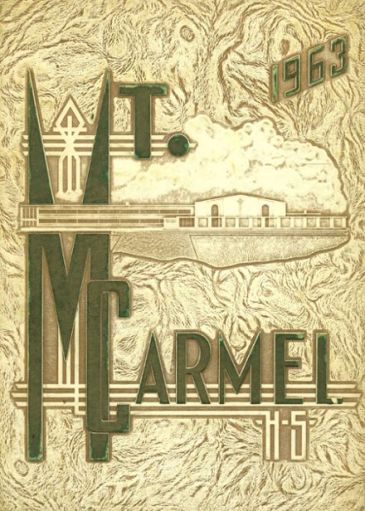
yearbookIn September of 1962, I entered Mt. Carmel High School as a freshman. I was not quite fourteen years old and looked as though I was only about ten. At under five feet tall and only about seventy pounds I was a tiny girl who didn’t appear to belong. I was both excited and terrified as I walked down the wide gleaming halls in the two story building that still looked as new as it had when it was built only a few years before. I had been warned that members of the upper classes might try to sell me an elevator pass and that I was to politely refuse to purchase one because there was no elevator in the building. It was easy to tell the fish from those who had already spent a year or more studying in those classrooms. We wandered with dazed looks on our faces as we attempted to take in the magnitude of our new phase of life.

The girls looked a bit uncomfortable in our brand new uniforms which seemed to have been designed to make us look as unattractive as possible. We would eventually grow to hate the brown and white pleated skirts, white button shirts, and brown flannel jackets that were our daily wear but in those early days it was all brand new and we did not yet understand how weary we would become of donning the same outfit every single day.

Our teachers were no nonsense as they outlined the requirements for each class. They insinuated that we would have to demonstrate our mettle or be left behind. It felt as though we were in a military boot camp as we wondered how it was even possible to read and report on a book each week while also writing two hundred word themes that would be due every Monday morning. It was difficult to work the combination locks on our lockers and still have time to rush to class from one floor to the next. There was so much to remember, so much to do and learn. I don’t recall much from the beginning because I felt as though I was in a daze but soon enough we all had adjusted to our routines.

The best part of being in high school was a new found freedom that we had never before experienced. Nobody was treating us like babies any longer. We became responsible for ourselves and it was exhilarating. There were also so many new faces with people coming from all over southeast Houston to join us in our adventure. At first I felt shy and self conscious, especially around the older students, but before long I was enjoying brand new friendships that would only grow as I worked my way through the next four years.

This was a year of profound change all around the world. Pope John XXIII died during that school term and would many years later become a saint. A little musical group from Liverpool, England would score a music hit with a catchy tune called I Want To Hold Your Hand. Rachel Carson would alert mankind to the dangers of polluting our environment in Silent Spring. Charles Schulz would introduce Happiness Is a Warm Puppy and Crick, Wilson, and Watson would earn the Nobel Price for Medicine and Physiology for determining the molecular structure of DNA. In my hometown of Houston Dr. Michael DeBakey used the first artificial heart during surgery.

I loved my teachers and my classmates almost instantly. Father Shane, my English teacher, would become a beloved icon and inspiration both for my writing and my career in education. Sister Wanda somehow made Latin fun and Father Bernard opened up the heavens for me in our Physical Science class. Father Franklin did his best to teach us Algebra I but I still suspect that I mostly self taught myself when I went home each evening to unravel the confusion that I felt after each of his lectures. Sister Francina was as sweet as can be but I often experienced stark terror whenever she began shuffling the index cards that contained each of our names so that she might randomly quiz us on the reading that we were supposed to have done the previous night.

Mostly though I loved all of the extracurricular activities associated with a high school. I joined the newspaper and became a cub reporter, although my contributions were minimal. I traveled with the Medical Careers Club on field trips to the Houston Medical Center thinking that I might one day pursue a degree in medicine. I loved our class journeys to the Alley Theater and to the Music Hall to hear the Houston Symphony. I became a member of the Student Council  and for a time marched with the Cadets drill team. Best of all were the Friday night football games where we all met to blow off the stress from studying and to just laugh and yell and be ourselves.

Mt. Carmel sponsored a dance every Saturday night in the school cafeteria. It was open to anyone willing to pay the small entry fee. Disc jockeys from radio station KNUZ played the latest music and sometimes even secured live bands. They advertised on the radio so we usually drew a nice crowd. I went almost every Saturday night and loved listening to the music and visiting with my classmates. I learned the true meaning of being a wallflower as I often found myself relegated to sitting in the metal chairs that lined the perimeter of the dance floor. Somehow I still managed to enjoy the evening even when I never got the opportunity to hit the dance floor.

I was in awe of the older students in the school. I thought that Gerri Gallerano was the most beautiful girl that I had ever seen and since she always smiled at me when she passed in the hallway I knew that she was also quite sweet. I formed a new friendship with a girl named Claudia who had gone to my previous school but whom I had never really known that well. Her sister Camille was a senior who kept us well informed regarding the dos and don’ts of high school society. She was so down to earth and would serve as a major inspiration for me for years. I never really got to know many of the juniors but since my cousin, Ingrid, was in the sophomore class, as was my next door neighbor, I felt more comfortable with them. I had major crushes on several of the sophomore boys but their names will go with me to the grave.

The freshman year of the Class of 1966 would prove to be quite wonderful. Somehow we managed to meet all of the impossible deadlines that our teachers set for us while we were being transformed from babies into bonafide teenagers. We had little warning that the our innocence and that of the world would soon be put to the test. For the time being we lived in a comfortable world where the halls were filled with our laughter and we were certain that the hopes and dreams that we whispered to one another as we walked from class to class would surely come true.

I now look at the cute little faces of my classmates in the yearbook for 1962-1963 and I wonder how I possibly felt intimidated and shy around anyone. All of the kids wear expressions that are so sweet and eager to please. Their smiles are genuine and inviting. It is easy to see that we were all good people beginning a four year journey in which each of us would be forever changed.

Fire

fire-generic-750xx724-407-0-38When my youngest brother, Pat, announced to our mother that he wanted to become a firefighter I suspect that she believed that he was just going through an adolescent phase that would soon enough pass. She told him that she would not give him her blessing to enter the Houston Fire Academy until he had first earned a college degree, a requirement that he dutifully completed. With his diploma from the University of Houston in hand he returned to her once again to announce that he had applied to become a candidate for the Houston Fire Department. This time he was only informing her, not asking for her permission. Shortly thereafter he began his training and was so taken with the lessons and skills that he learned that he graduated number one in his class. It was a proud day for him and all of our family when he earned his badge and a job at the downtown Houston Fire Station Number One.

Pat threw himself wholeheartedly into his work and it was not long before there was a major fire in the downtown area that was so large that it made the nightly news and there in a photograph for the ages stood my brother aiming a stream of water at a wall of red flames that dwarfed him. The image showed his back with his last name emblazoned on his jacket. It was a frightening reminder of just how dangerous his job really was. As a family we tried not to think too much about the kind of things that might happen to him but again and again there were reminders that firefighters literally place their lives on the line each time that they respond to a call for help. They never quite know what kind of situation awaits them and for the most part they rarely discuss what they have seen with those of us who would rather not be reminded of the dangerous possibilities.

Pat was as happy with his career as anyone that I have ever known. He spoke glowingly of the brotherhood and friendships that he shared with his crew members. He proved his mettle as a leader and began to work his way up the ranks, eventually becoming a Captain at one of the neighborhood stations. It was apparent that his men loved him as much as he loved them. They became a second family for him in an environment where he felt confident that he was living his dream.

He returned to school first to earn an advanced degree in Public Administration and then another in Fire Safety. He became such an expert in his field that Mayor Lee Brown tapped him to become the director of the Fire Academy. It was a post that he cherished because it allowed him to share his expertise with young men and women who were as eager to serve as he had always been. He upgraded the rigor of the training process with an eye to preparing his charges for the special demands of being a first responder in one of the nation’s largest cities. It was a very happy time for him but before long he was moving into other arenas of leadership.

He became a District Chief and then a Regional Chief. He helped to investigate fires and to set and maintain high standards for all of the firefighters in the city, all the while humbly doing his work without mentioning his ever growing status within the department. He was always far too busy working for the betterment of Houston to brag about his accomplishments but the men who had worked for him often whispered their admiration.

One of Pat’s most exciting moments came when he accompanied a group of Houston firefighters to New York City on the occasion of the opening of the 9/11 memorial. They traveled by motorcycle all the way from Houston and then participated in a parade in downtown New York. He was so moved by the stories of bravery that he heard from comrades from all around the world. It was a grand moment in which he truly realized the importance of his work and stood shoulder to shoulder with people who understood the unique challenges and joys of being a firefighter.

I can’t imagine what kind of courage it must take to don the heavy equipment of a firefighter and hop onto a truck for a ride to an unknown disaster. On any given day our firefighters know that they may walk into situations from which they will never return. Even in the best of circumstances they often experience damage to their lungs from the continual exposure to smoke. They may fall from the rafters of an attic or have a ceiling come down on their heads. They encounter life and death situations over and over again and are only able to relax once they are safely back at the station. Still they eagerly report to work again and again just as Pat has always done.

Pat Little has served the City of Houston with pride and enthusiasm for thirty six years. He has tirelessly worked during hurricanes, floods, freezes and even when he felt sick. On some nights the alarms awakened him so many times that he had little sleep. There were Thanksgiving and Christmas days when he was faithfully executing his duties while the rest of us were relaxing and celebrating without him. Missing even a single day of work was always anathema to him. He rarely complained when he had to be absent for the milestones of his children or when he had to forego special occasions because he was saving a life. Now his outstanding and selfless career is finally drawing to a close. On Sunday his crew is hosting a party for him and on October 11, he will retire for good. He will be remembered and revered by both family and fellow firefighters for the joy and dedication that he brought to his job for all of those thirty six years. I have little doubt that given the opportunity he would gladly relive his life as a firefighter all over again.

Congratulations, Chief Patrick Little, on a job well done. We are all proud of you and humbled by your quiet courage and your unflagging determination to make a lasting difference in the world. You have done well in a world that is all too often marked by evil and greed. You are our hero, a man who has shown the meaning of service.