Unrest

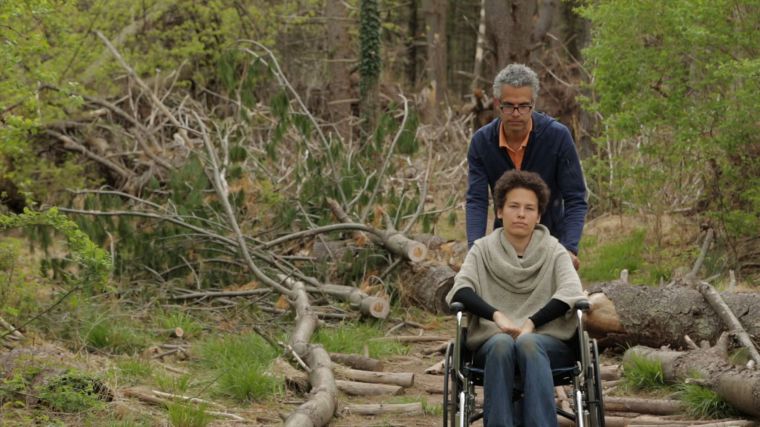
omar-jen-wheelchair-woodsShe is incredibly bright and beautiful, a graduate of Harvard who was about to complete her doctorate at Princeton. She was in love with a brilliant man and the two of them travelled the world together. They made plans to marry, have a family, build their stunning careers together, and then she caught the flu. It was a particularly harsh case with fevers of one hundred four degrees. When she was well once again she felt debilitated, but thought little of the residual effects. She had after all been very ill. She told herself that it would simply take time to regain her energy, but something was very wrong because instead of growing stronger she began to feel more and more weak. There were even times when her mind did not seem to work properly. She was unable to find the proper words to express herself. It was all so frightening.

Eventually her symptoms became so concerning that she sought the expertise of a medical doctor. He insinuated that it was all in her head, diagnosing her with what used to be known as hysteria. He suggested that she was reacting to some deep seated trauma that she most likely was unable to remember. He sent her home with no real explanation for what was happening, and she began to wonder if she was indeed going crazy. That’s when she got an idea.

The next time her symptoms became so severe that she literally collapsed in pain, unable to move or express herself, she asked her husband to film the incident. She took the video to a neurologist who was stunned by what he saw. He eventually told her that she had ME. Myalgic Encephalomyelitis, a strange disease that is thought to afflict ten to fifteen million people worldwide. There is no definitive test for the illness and no cure. The diagnosis is made based on symptoms alone which include excessive fatigue after mental or physical activity, intolerance to exercise, joint and/or muscle pain, memory problems, difficulty walking, sore throats, headaches, flu-like symptoms, sleep disturbance, bowel problems and mood swings.

The disease is also known as chronic fatigue syndrome and affects those who have it along a spectrum from individuals who endure a mild attack and then recover fully, to those who become completely homebound and bed ridden. There is no known cause but the disease appears to follow otherwise fairly typical and minor illnesses like the flu. Some believe that the roots of the problems lie in hormonal or allergy issues, but none of the research has proven any of the theories. It is a greatly misunderstood disease that sometimes results in psychiatric diagnoses rather than physical ones.

The woman whose life was so impacted by ME is Jennifer Brea, and she has a debilitating case of the disease that has radically altered the trajectory of her life. In a fashion keeping with her personality she decided to film her journey along with that of four other victims so that she might shed light on a mostly misunderstood illness. In conjunction with Sundance Films she created the documentary. Unrest, that chronicles her experiences as well those of the four others whose lives have been so radically changed after contracting ME. The film debuted on the PBS program Independent Lens this January and its power to visually explain what happens to those who have ME is emotionally visceral.

Jennifer Brea holds back nothing in her depiction of what ME has done to her and the relationship that she shares with her husband. She honestly expresses the fears and disappointments that plague her as much as the symptoms. She presents a compelling argument for more research by noting that those who are stricken often become like missing persons as they are forced to be hostages to their illness. She tells a compelling story of families broken apart and individuals losing their identities all while the rest of the world remains mostly ignorant of the horrors of this strange condition.

Her own story is one of the love that she and her husband share in spite of the problems that have so changed the way that they once thought they might live. She wants to be able to give him the kind of relationship that she had thought they would have, but instead is continually thwarted by recurrences of the most trying symptoms. Her husband has nobly stood by her, but even his patience is often tried by the confusing nature of his wife’s illness.

Ms. Brea shows a family in Sweden whose child was institutionalized in a psychiatric facility because doctors there were unwilling to accept a diagnosis of ME for her. Brea also introduces us to a woman who had been a happy wife and mother, one who had no idea that she would eventually be confined to bed with her own husband believing that she was just insane rather than physically ill. Her marriage deteriorated and she struggled to survive. When one of her daughters came down with the same disease her world unraveled even more.

The film is so personal, so real that those of us viewing the stories become involved with the characters, particularly Jennifer Brea herself. We watch her gaining strength and find ourselves hoping as much as she and her husband do that she will somehow miraculously improve. We cry with empathy as we become all too familiar with the struggles associated with ME.

Unrest is a touching and important documentary and quite worthy of the accolades that it has received. Hopefully it will also become the impetus for more research into the mysterious illness that it depicts with so much unflinching insight and compassion. At the present time very little is being done to learn how and why this illness affects certain people. There is only a smattering of interest in finding something that will cure those afflicted with its devastating symptoms. It is a grand mystery that shows no signs of being solved while real people suffer from the misunderstandings and lack of knowledge surrounding it. Hopefully Jennifer Brea has opened a door of awareness that will ultimately lead to the studies that will eradicate it or at least lead to more hopeful treatments. Perhaps just by spreading information about ME Unrest will at the very least bring more compassion to those who deal with its tragic effects.

Abundance

vans-2015-summer-geoff-rowley-footwear-collection-11My grandmother was one of those people who saved all of her nice things for some future day when she would need them. We used to joke that our Christmas gifts to her would be stored away and not seen again until the things that she had been using were worn beyond usefulness. When she died there were items still wrapped in cellophane and stored in boxes. I suppose that hers was the habit of a woman who had lived in a state of poverty for most of her life. She was brought up to use what she had rather than to concern herself with acquiring abundance. I suspect that there were many people of her generation and economic status who did exactly the same thing. It sometimes made us sad that her tendencies prevented her from fully enjoying the advantages that we sought to give her. I suppose that it mattered little to her because by then she was set in her ways, but it always amused me that we kept trying to provide her with luxuries even as she resisted our efforts. Perhaps in some ways she was actually wiser than we were because she was perennially happy with little more than our presence. The things we brought her were not required to make her smile.
I was reminded of my grandmother recently as I helped a friend to dispose of her deceased father’s possessions. I realized as we packed away boxes and boxes of items that he had accumulated that most of us probably own more than we ever really use. When all is said and done we are drowning in stuff and yet we continue to shop and add to our collections. I wondered if we have our priorities straight or if we are simply addicted to consumption, victims of enticing commercialism that convinces us of what we must have rather than what we actually need.

I mentioned to my friend as we worked that perhaps we would all be best served by pursuing memories rather than things. She smiled knowingly and noted that she had planned a summer trip to Alaska because of that very idea. It occurred to me that we don’t always recall all of our purchases, but we do think about experiences time and time again. Our trips and outings are the stuff that often make us the happiest and leave the longest lasting impressions.

I have two friends who live frugally so that they will be able to take phenomenal trips each year. They have travelled the world and seen wonders. The wisdom of their choice to buy vacations rather than things really made sense when their home was flooded by hurricane Harvey this past August. The one thing that they did not lose was the joy that their journeys had brought them. They were certainly devastated by the damage done to their abode, but somehow I found comfort in knowing that they still had memories that not even floodwaters could wash away. What after all, do we really require to live full lives? Is there a way to enjoy ourselves and still be mindful of our tendencies to waste our resources and purchase more than we truly need?

Years ago a cousin noted that we begin our time as an adult in a tiny apartment which soon becomes too full, so we move until we have accumulated so much more that we are once again searching for room to store everything that we own. The practice continues again and again and in many ways we end up with bigger and bigger homes not so much because we actually want the space, but mostly because our possessions have overtaken us. I have often felt guilty as I fill every nook and cranny including the attic with my acquisitions and  wonder if I need to scale back.

What would I truly want to keep if I were somehow forced to pare down my life to a barer minimum? I suppose that it would require a bed on which to sleep with enough linens to have a clean surface for my slumbers and a blanket to keep me warm. A chest to hold my socks and underwear, pajamas and some clothing would probably be good to have. I’d want a table and some chairs for partaking meals, and a couch on which to sit whether I’m reading or visiting with friends. I have to admit to my need to own a television if for no other reason than to have access to the news, but in reality because I enjoy relaxing with shows that touch my imagination. A few lamps would be nice and bookcases to hold my treasured volumes, but I suppose that I might even eliminate that necessity by purchasing electronic copies of my favorite titles. I’d need a refrigerator and a stove and I’ve grown accustomed to having a microwave oven, a coffeemaker and a toaster. I could wash dishes by hand but I wonder if that method is as efficient as doing a load now and again in the dishwasher. I also must have a clothes washer and dryer or at least a clothesline in my backyard along with some cleaning tools to keep things tidy. A few changes of clothing and some towels would round out my needs, and yet I own so much more than that and seem to think that it is important to preserve it all in a kind of shrine to my accumulations that takes twenty seven hundred square feet plus a garage and an attic to store. I don’t want to live like a monk, and I find nothing wrong with decorating and collecting, but I sometimes imagine my children and grandchildren one day culling through my things and wondering what to do with all that I possess. 

My mother once told me that she had never been owned by things. She commented that she might have carried all that really mattered to her in two suitcases which is in fact what she did in the last two and one half years of her life. She spent those months living with me and my brother with little more than a weeks worth of clothing changes, her bible, and a radio for listening to Houston Astros games during baseball season. She had uncluttered her life so totally that she had few worries related to possessions. When she died the distribution of her estate was uncomplicated and debt free. My brothers and I could not have had an easier task. Her life was in order because so little of it focused on things.

I know people in Houston who are back in their houses after having to leave when four feet of water flooded the insides back in August. They once again have walls instead of bare studs, but they walk on concrete floors and sit on lawn chairs. Somehow they are happy because they feel the warmth and security that they worried had been destroyed by the waters. They realize that it was never the things inside that made their houses feel like home. Perhaps each of us should consider how much we truly need and begin to live with less dragging us down. We may find freedom, joy and purpose in learning to live with what we need rather than being possessed by our wants. Perhaps my grandmother had the right idea all along.

Love Honor Cherish

15975072_10211601975865667_328586816067567646_oParenting is one of the most difficult tasks that we humans attempt to master. It pains us to see our children hurting, but we know that we will never be able to completely eliminate struggles from their lives, so we teach then how to effectively deal with both trials and tribulations. We hope that our foundation will help them when we launch them into the adult world. Mostly we pray that they will know how to surround themselves with good people who love and care about them as they begin their independent journeys without us. So it was with my two girls.

Like any other parent I did my best and hoped with all of my heart that my efforts would be enough. My eldest Maryellen had always made me proud, and she appeared to have a good head on her shoulders as she left our home to become educated by others at the University of Texas in Austin. There were some shaky moments in her early days there when I received phone calls and heard the strains of uncertainty in her voice, but she managed to make it through the rough patches and secured a place for herself among friends both new and old. Along the way she met a young man named Scott through the encouragement of one of her more gregarious friends.

At first Maryellen was tentative about being more than just a good pal to Scott, but before long she was drawn to his good nature and his intellect and they began to date. Her face would light up whenever she spoke of him and I could tell that her relationship with him was far more special than any that she had ever experienced. He had a way of understanding her and treating her as an equal that pleased her. Even his gifts to her at Christmastime were astutely thoughtful and romantic. I found myself believing that she had found the man of her dreams and when I finally met him I was pleased to sense that he was a truly good person who respected and cherished her as much as I did.

Maryellen and Scott enjoyed a delightful courtship at the university, peppered with serious study sessions and fun times with a group of remarkable friends. They cheered the Longhorns at football and basketball games and enjoyed the same music and movies. Mostly they talked and realized how neatly their hopes and dreams meshed with one another. They fell in love.

I was quite pleased when they announced that they were engaged. They were both mature and thoughtful individuals who had transitioned well into adulthood. They both were within striking distance of earning degrees in the respected fields of business and engineering. Their futures were promising and together they were certain to be a power couple, but more importantly they shared values that would help them to build a life of love and devotion.

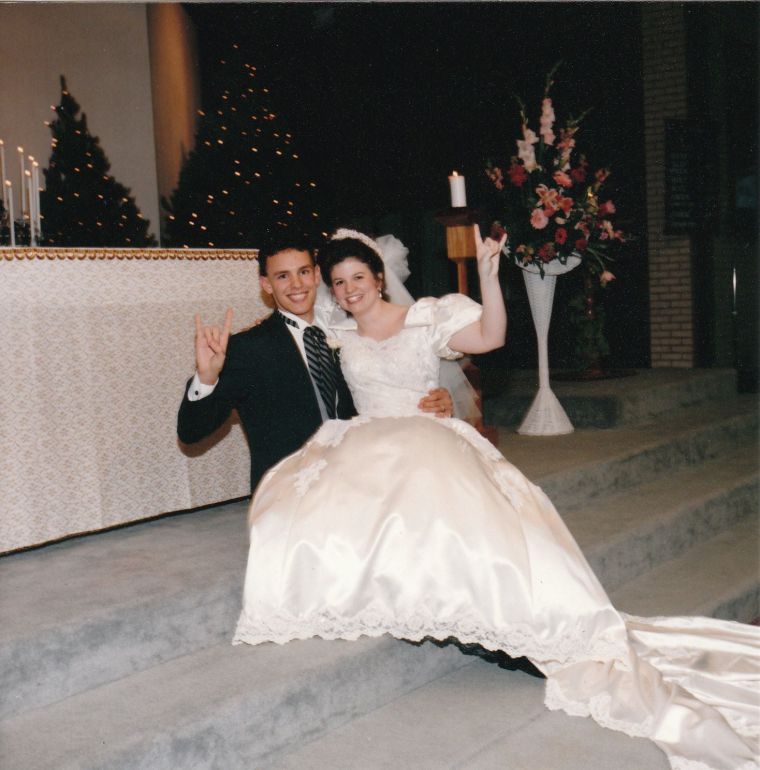
Twenty five years ago today they exchanged their vows at St. Frances Cabrini Catholic Church. It was a beautiful service shared with a crowd of friends and relatives. Maryellen glowed with the flush of love and anticipation and Scott had “the look” in his eyes that assured me that he would be forever faithful and loving to my daughter. Our family priest John Perusina said the mass and Scott’s Lutheran minister assisted with the proceedings. The bridesmaids wore blue and one of Maryellen’s childhood friends sang Sunrise, Sunset like an angel, making everyone in attendance cry as we recalled how quickly the years had gone by since the bride and groom had been children. It was a gloriously happy day that bode well for the future.

Maryellen and Scott moved to Beaumont after a memorable honeymoon in Yosemite National Park, yet another idea of Scott’s that was so perfectly suited to Maryellen. They set up housekeeping in a cute apartment and began their careers. It was a fun time and it was wonderful to see how happy they were and how well things were going for them.

Eventually Scott received an offer that he couldn’t refuse from a firm in Indiana and so the two of them were on the move. They purchased a lovely house in Lafayette and began to explore the midwest during their free time. They were only two hours away from Chicago and so that exciting city became a frequent destination. It was a time filled with new adventures and new confidence for them when all of us realized that they had indeed become a powerful team.

Four years after they married their first child, Andrew, was born and our visits to Indiana became ever more frequent as we enjoyed visits with our grandchild. I always felt so intensely happy to see the relationship between Maryellen and Scott growing ever stronger and thus it would be as one year flowed into the next and three more children joined the family as they moved again to Beaumont and finally back to the Houston area.

Maryellen and Scott have been models of love and dedication. They are beloved pillars of of their community known for their dedication to being exceptional parents and generous neighbors. They inspire others with their devotion to each other and to their sons. Together they have weathered the rollercoaster ride that is life and managed to overcome every challenge that appeared on their horizon.

In a very troubled world where it almost seems old fashioned to hold tightly to values and traditions Maryellen and Scott Greene have proven that the power of love is still one of the most priceless treasures that any of us might possess. For twenty five years they have steadfastly honored one another and passed on their mutual love to their sons who are growing in the same wisdom and age and grace that they have so beautifully exhibited.

Somehow I am overwhelmed by the rapid passage of time. In my mind they are still the twenty something young adults with so much hope in their eyes and a whole lifetime ahead of them. They have done a remarkable job of cherishing the promise that they made on that day in the glow of tiny lights from the Christmas trees on the altar. They have fulfilled all of their vows and done the hard work of keeping the flame of their never ending love alive. It makes my heart burst with joy to know that they are such incredibly fine people.

Happy Twenty Fifth Anniversary, Mr. and Mrs. Greene. May you enjoy many more wonderful days together as you share a special love. You are a blessing to all of us.

The Builder

40e8039a1c47edf3e2821bc05c59f15a--basement-workshop-nail-storage-garage

There was a hardware store near our home that my father visited each Saturday with an almost religious fervor. It was a sacred place in which I ultimately felt the full extent of my father’s happiness. Happily he regularly took me on his weekly excursions and I always felt special as we wandered together through the aisles of tools and gadgets and fasteners while my dad explained the purposes of the different items. He was in his element inside that store and his face willingly gave away the happiness that being there provided him. Whenever I think of him I recall the bins of nails of every size and remember his lessons on why there were so many different kinds. I can still see him carefully weighing the proper variety for his latest project on the metal scales that hung from chains connected to the ceiling. I can smell the aromas of oil, wood, and metal that permiatted the concrete floors and the wooden studs of the walls. This was a cathedral dedicated to the carpenters, plumbers and electricians of this world. In Daddy’s case it was a shrine for all who love to build the edifices and implements that we use to bring us comfort.

My father never treated me as though I was too young to understand what he was doing. It didn’t seem to occur to him that as a girl I might not have been interested in the things that he so loved. He spoke to me about his passion for construction and explained the hows and whys of his work. Thus it was that he allowed me to sit at his side as he created a miniature replica of our first home. He carefully drafted a blueprint and showed me how to shrink the proportions of the rooms into a drawing that fit on a single sheet of paper. I could not have been more than four years old when he demonstrated the techniques of scale to me, for I had not yet started school when he first told me of his idea. Somehow Daddy assumed that I possessed enough intellect to understand his calculations in spite of my youthfulness, and he was so right. I was mesmerized by the process and willing to sit quietly on a stool while he demonstrated his skill at his drafting table.

The next phase of his work was to build a tiny house that would resemble our home in every imaginable detail. I was fascinated as he measured and cut pieces of balsa wood to create a frame for the structure. Even before he had inserted the walls and other features I was able to see the rooms unfolding just as I knew them to be. It took many weeks and many visits to the hardware store to finish the lovely reproduction. Sometimes weeks would pass before he had time to return to the task of making the tiny house that almost appeared to be the work of fairies rather than a man. I was astounded when it was finally complete because the details were so exact. He had somehow managed to create an illusion of cedar shakes and bricks and shingles that was a perfect copy of the house where we lived. He had designed the roof so that it could be lifted to reveal the interior rooms with their gleaming wooden floors and brightly painted walls. It was a masterpiece in my eyes and I felt a quiet joy in having observed the entire process. Sadly I have no idea what eventually happened to that wonderful creation. I would give anything just to see it once again and to explain to my children and grandchildren how wonderful it was to have been a witness to my father’s painstaking work.

My daddy was just as likely to educate me regarding other things that he built as well. When I was about seven we had moved to a new home and he was annoyed that we had to walk on the grass to get to the front door from the driveway. He muttered that the builder should have thought to create a sidewalk leading to the entrance. Before long he had decided to rectify the omission himself and once again he used the project as an opportunity to teach me about the proper methods for installing a concrete pathway.

He began by carefully digging out the grass in a pattern that resembled the desired design of what would be the final product. After seeming to take forever to level the ground and straighten the lines he next built a form with wood and and string, taking care to survey his measurements accurately. He allowed the structure to cure for a time to be certain that the ground was not going to shift. He also watched the drainage pattern and made adjustments to insure that there were not low points that would hold water. Then he began filling the bottom of the wooden platform with metal rebar and even bits of nails and other metal shavings left from other things that he had built. He told me that the metal was the secret ingredient for insuring that the sidewalk would last for years without cracks or erosion. Finally came the day when he mixed and poured the concrete spreading it until it was smooth and as perfect as he insisted that it should be.

Nobody was allowed to walk on his creation for days until he was certain that it was set exactly as he had hoped. He was quite proud of the outcome and so was I. Our neighbors commented on how nice it was and joked that they were going to hire him to build one for their houses as well. Daddy boasted that it was a fine structure that would last for a very long time. In fact it has endured even longer than he did. I recently drove past our old home and saw that the sidewalk was as strong as ever. It was not leaning nor did it have any cracks. It had withstood decades of use, sixty two years to be exact. As I saw how well it had performed I swelled with pride in knowing that my father had built it with his ingenuity and engineering skills. More importantly he had believed enough in me to share his knowledge with me, something that made me feel capable and appreciated.

To this very day I find great pleasure in sauntering through hardware stores. I especially enjoy the ones that are more in line with those of old. I prefer the bins of nails and bolts over the plastic packages that are the modern day norm. I consider an outing to Harbor Freight or Ace Hardware with my husband to be a delightful activity. Repairing things or building something is as much fun for me as taking a vacation trip.

I suppose that a psychologist would attribute my love of constructing to the tragic loss of my father when I was only eight years old. My childhood memories of him revolve around books and building and Texas A&M University football. I only truly know him through the brief amount of time that we shared, and yet it was so revealing of who he was that recalling the feelings that I felt provides me with comfort. He demonstrated his love for me by teaching me about the things that mattered so much to him. He was a great father if only for a very short time. 

While I will never truly understand some of the mysteries surrounding Daddy’s death nor the void that he left when he was gone, I treasure the recollections that he left me. The emotions that I associate with the simple act of wandering through a hardware store are visceral and as real as if he were standing next to me with his boyish grin of anticipation about the next thing that he was going to build. When I remember I am filled with pleasure and a sense of security because I know for certain how much he loved me, and for that I will always be grateful. He was a builder not just of things, but of beautiful relationships and dreams. 

Fortunate Son

5377620The little child that lives inside each of us never quite goes away, not even as we age and mature decade after decade. Our memories of childhood whether magical or nightmarish linger inside our very souls and color the way that we view the world. Those like myself lucky enough to have known mostly love are often guided by the nostalgia of kindnesses and happy times. For others overcoming painful experiences is a lifelong battle. During the holiday season we often become more acutely aware of our long ago histories, and depending upon how they are affecting us we either feel an exhilarating happiness or a sense of sadness. Thus is the power of our pasts and our emotions.

I once wrote a paper detailing the folk history of my grandfather. Rather than guiding him in any particular manner I simply asked him a series of questions and then allowed him to respond in a way that revealed his personal take on the world in which he had lived and grown. He was approaching his hundredth year when I undertook this project and I uncovered a theme in his way of dealing with the ups and downs of life that he somehow passed down to me. Every single story that he told me involved elements of strength, courage and love. It was his personal point of view. His heroes were the people who overcame difficulties through not just their own determination, but with the assistance of caring individuals who often appeared serendipitously to save them. He firmly believed in the idea of personal accountability, but understood that everyone struggles, and when things become almost too much to bear there always seems to be someone who arrives to help.

Convinced that we each have an inner strength in spite of the problems that stalk us, and realizing that we are never truly alone was my Grandpa’s foundational philosophy and the cannon of his life. His was one of those nameless stories that never lead to fame or riches of the concrete kind, but rather the wealth of friendships and love that is far more substantial than the ephemeral nature of titles and things. By the time that he had reached his one hundred eighth year he had become an inspiration to all of us fortunate enough to have known him, and I was chief among his fans. I suppose that I either consciously or unconsciously modeled my own personality after his. I adopted his optimism even in the face of difficulties and soldiered through irritations and tragedies by reminding myself that I came from strong ancestors who refused to let anyone grind them down.

I often thought of my grandfather as a young virtually orphaned boy who never knew his mother, and yet honored and cherished her by naming his daughter after her. He spoke of her a hundred years after she had left him with a profound reverence as though her death in childbirth had proven to him how much she had loved him. The sacrifice that she made to bring him into the world was the foundation upon which he built the entirety of his extraordinary character. The fact that his father abandoned him meant less to him than the knowledge that his mother had died giving him the opportunity to live. His devotion to her was as deep as if she had raised him into an adult.

It was his grandmother who did the job of guiding him into a purpose driven life, and she did so with great care, providing him with wisdom and an unstoppable sense of humor. She gave him the tools that he would need to continue even after she too had died before he was quite ready to be alone. At the age of thirteen h head already risen to a level of maturity that was far beyond his years, so when he was charged by a judge to select a guardian he decided upon an uncle who seemed to be quite noble and honest. This man was so upstanding that my grandfather ultimately adopted his name to honor him for his morality and character. Indeed he also emulated the traits that he saw in this individual who was kind enough to take on the duties of helping a teenaged boy even though he himself was barely into manhood.

Grandpa was stalked by bad fortune. Not so long after he chose the man who would be his surrogate parent a deadly hurricane came to Puerto Rico. My grandfather’s uncle who was a graduate of West Point and a military man served his country by traveling to the devastated island to direct the distribution of aide and supplies. While there he contracted typhus and died. My dear grandfather was alone once again, and so affected by his multiple losses of loved ones that he was rather confused for a time. He bounced around the country doing jobs wherever work was to be found, living in boarding houses and drinking more than he should have to still the sadness that sometimes threatened to overwhelm him. On one particular evening he experienced a moment of clarity, raealizing that he had become his own worst enemy. He thought about his mother and grandmother and uncle and suddenly felt their spirit reminding him that he was meant to be better than he had allowed himself to become. He resolved at the moment to be the man that they had intended him to be, and with an iron will he turned himself around. Luckily he did so in time to meet my grandmother, the ultimate love of his life and the woman to whom he would surrender his heart. They became lovers, buddies, the best of friends.

The funny thing is that there was never really a time in my grandfather’s life when things came easily to him. He had to work hard and deal with tragedies that broke his heart, but never his will. Somehow regardless of his circumstances he found ways to survive and to find that one tiny speck of hope that kept him going year after year. When he was one hundred eight years old he had lost his beloved wife, his son and one of his daughters. Even some of his grandchildren had preceded him in death. Most of the friends in his age group had left this earth years before, and yet he rarely complained other than to note that he missed them all.

I always enjoyed visiting my grandfather in the tiny house where he rented a room from a widow who needed the extra income to stay afloat. He maintained his independence with a fierceness that I so admired. Much as he had done throughout his life he found ways to keep moving forward even when times became tough. When he grew older he became a bit more nostalgic, and even found ways to understand and forgive his father whom he kindly referred to as a bit of a reprobate, a man whom he nonetheless had grown to love or at least accept.

I find myself thinking of my grandfather more and more often these days, and when troubles come my way I wonder what he would do in similar circumstances. I know that he would somehow find the silver lining that he insisted is a part of every situation. He had been a penniless, homeless, seemingly unwanted orphan who was dropped on his grandmother’s doorstep like a stray cat, and yet he rose above the hurt and anger that might have been his guiding light. He chose instead to focus on the positive aspects of his story and those of the people he had met along the way. He saw himself as someone whose life had been blessed again and again.

We mostly choose how to view our individual stations in life. In the proverbial way of the glass we either decide that our lives have been half empty or half full. Grandpa taught me to choose the optimistic path, to proudly be a Pollyanna. What I have encountered has not always been pretty, in fact it has often been scary and wrought with tears. My grandfather showed me that rather than wallowing in the pity that may indeed be rightfully mine, I always need to ultimately find a way to pluck up my courage and move forward once again. Like him I have repeated the drill time and time again, and along the way discovered new friends, new allies and great love. My grandfather’s worldview has been one of the most amazing gifts of my life. He was indeed a fortunate son just as he believed and I inherited his wealth.