The Journey to the Future

pioneers-usa-02

I’m beginning to understand my paternal grandfather more without gaining any concrete knowledge about his life before he met my grandmother. I’ve been researching the hints that he gave me about his heritage and in the process my understanding of what life may have been like for him has become clearer. At the same time I’ve learned more about life in the United States in the part of the world where he grew up as a boy. By following the tiny red thread of comments that he left I see a picture of the influences that touched him both as a boy and a young man.

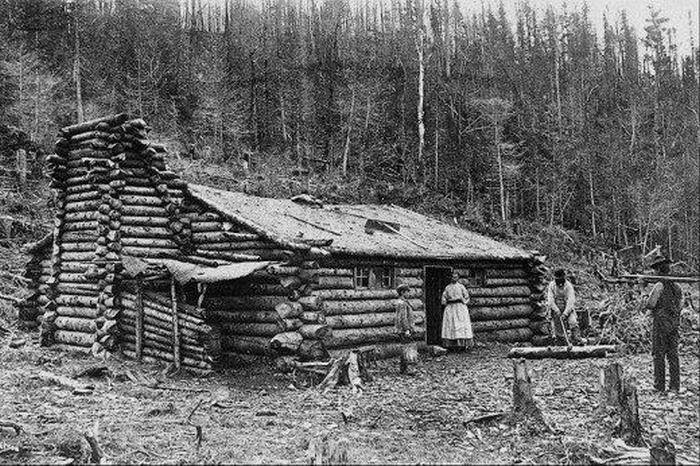
He always insisted that he was Scotch Irish which always seemed to be an oxymoron until I learned about the people from southeastern Scotland who journeyed on a odyssey that took them first to Ireland and eventually to the hills of Virginia and Kentucky in search of a home where they might be free to live and think without rancor. In the woods and secluded areas of what we now call Appalachia they found a way to be left alone, at least for a time. Just as my grandfather described they lived far from towns and cities in isolation among the forests and in the shadow of the mountains. They mostly farmed and kept to themselves often retaining the distinctive accents that they had brought from across the ocean.

The Civil War changed things for the entire country and the people in western Virginia were particularly affected by the strive and divisions that were literally tearing the nation and whole families apart. In choosing sides brother sometimes turned against brother and hard feelings, combined with the violence of war, left a lasting impact on the people who had always wanted little more than to live their lives without interference. With the end of the war the feuding that had disrupted routines often continued and as shown in a recent episode of American Experience on PBS it sometimes reached epic proportions as in the violent rivalry between the Hatfields and McCoys.

By the waning years of the nineteenth century the Industrial Revolution was changing the face of the United States and few were entirely immune to its effects. In the parts of Virginia, West Virginia and Kentucky near where my grandfather spent his boyhood businesses from the northeast came in search of coal to drive the industries that depended on that black substance from the earth. The land on which my grandfather lived was filled with it. In fact he told vivid stories of his grandmother owning a small coal mine on her property.

With the mines came railroads and strangers whose interests had little to do with the people in their way. The once pastoral land was stripped of trees and filled instead with mining operations including barracks style housing for the workers. Sometimes the labor of digging into the earth imposed itself on the land of the farmers. Where people and animals had once roamed free there were now restrictions on where passage was afforded.

Those with enough gumption to leave generally did better than those who decided to keep their families intact by staying. Once my grandfather lost the woman who had raised him (his grandmother) he had little reason to remain on the land. He was barely thirteen at the time and mostly on his own although he stuck around long enough to help out his father for a time. As soon as he was able, however, he struck a blow for freedom traveling in search of an acceptable way of life just as his Scotch Irish ancestors had done before him. He only returned to his boyhood home once and learned that there was nothing to keep him there.

My grandfather often spoke of the hardships of his youth and the intelligence of his grandmother in keeping both of them fed and safe. She was a rather amazing woman, living alone with a child and commanding respect from the community. She was light years ahead of the general customs of the time with her independent spirit and folksy knowledge of medicine. She owned rights to a coal mine on her property and kept her farm going without the aid of any man other than a boy. From what I can tell she was somewhat like the other hardscrabble women in that part of the country where shrinking violets never made it very well.

Grandpa entered the twentieth century ready to be part of the great move of progress that defined the United States throughout that era. He was part of the building boom that created iconic structures from sea to shining sea. He was on the move not so much to hide away but to experience the modernization of the country. He was proud of the work he did and the inventiveness of the United States. He saw his life from the promise of the windshield and not from the nostalgia of the rearview mirror. His philosophy was to embrace progress and to build a better future. I suppose that’s why he said little about his world back in the hills of Virginia. The past didn’t matter to him as much as the present and what was still to come. Perhaps he understood that standing still and looking back leads to stagnation and stagnation leaves one without hope.

The world is ever changing and my grandfather taught me not to be afraid of letting go of the past. He believed that the good old days are always ahead of us, not behind. We can treasure our history but it would be foolish to be mired in it. Progress marches on and the wise know when its time to join the future.
A Sense of Happiness

FireAntStoryTX102112

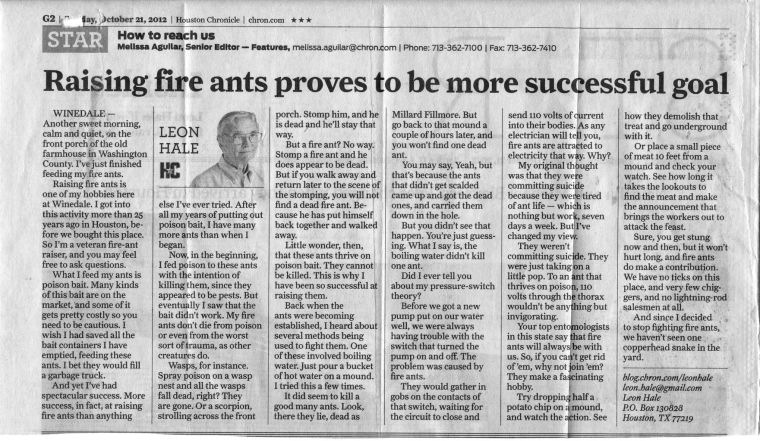
Does anybody remember Leon Hale? He was a writer for both The Houston Post and The Houston Chronicle who traveled around the city of Houston and the state of Texas writing about this and that. His columns revealed a man who was always on the lookout for a good story, and over the years he found hundreds that delighted readers like me. His best ones were often about rather ordinary people who came to life under the magic of the words he chose to use to describe them. His talent was so profound that he somehow made the mundane incredibly interesting. He had an eye for finding the beauty in a single moment or face or comment.

I know I would have enjoyed sitting down with Leon Hale to talk about his decades of adventures with folks. I would have liked to ask him how he developed his writing craft so well, but I suppose I already know many of the answers because he was masterful at noting even the tiniest details about his subjects and then finding words and phrases that painted pictures without so much as a single photograph. His was indeed a brilliant talent that brought me many years of joy. Even on days when I was too busy to peruse the other pages of the newspaper I found time to see what Mr. Hale had to say and I was never disappointed.

Leon Hale taught me as much about humor, love, acceptance and other such positive characteristics of the human heart as the sermons I heard in church. He got me to thinking about the best inclinations of humankind and his stories were as uplifting to my spirit as readings from a book of meditations. He also had a knack for describing people and situations with unique combinations of words that invariably brought out emotions that either made me laugh or cry. I literally felt as though I knew him and the people that he introduced in his tales.

The glory days of local newspapers are dimming. Houston was once a two newspaper town long before it was even close to being the forth largest city in the country. The Houston Post, which was always my personal favorite, went the way of dinosaurs long ago and The Houston Chronicle is just a shell of its once glorious self. A Sunday morning edition used to be so big that it came in two separate rolls from the paperboy. Now it is so slim that it’s hardly recognizable. It’s surface area is vastly diminished as is the quality of writing between its pages. Before long it won’t be too far different from the little suburban newsletters that come out once a month.

It was the printing press that wrought dramatic change in the world. As ordinary folk had more and more access to books and newspapers equality became more possible. The new revolution has been on the technology front with news and print entertainment on demand at any given moment. A morning or evening run of a hard copy is old news by the time it arrives and is less and less cherished by avid readers than it once was. Computers allow us to see the latest information whenever we wish. Blogs provide us with almost infinite numbers of writers that we might follow. The new Leon Hales can live and write in Texas and then publish for a worldwide audience within minutes.

I am definitely an electronic reader. I use my various devices to read wherever I go. I don’t have to cull through dogeared magazines about topics that have little interest for me when I wait to see my doctors because I have my trusty phone to keep me apprised of breaking news or to provide me with columns from writers that I enjoy. I even have a Kindle app that allows me to read from the latest best selling books. Still, there is something about the look and feel of paper and printed letters formed from ink that adds to the reading experience. Actually holding a physical copy of writing is as enticing to the senses as wearing fine perfume.

The glow of letters on a screen just ins’t as exciting as holding a printed version of a story or a book and I always have the sense that I may be missing something important whenever I read from an electronic device. I understand and learn best when I have a fully kinesthetic experience in which I can actually manipulate the words by circling or underlining them or making comments in the margins. I like to put paper tabs on certain pages or turn down the corners of the sections that contain my favorite passages. Not even mechanical highlighters on ebooks do the job as well for me. My photographic memory feels a bit lost in the world of computers, notepads and phones. I have to spend too much time remembering where all of my information is stored. With a paper copy I know exactly where to look.

Several years ago I rid myself of all of my long playing record albums and I had quite an extensive collection They took up a great deal of room in my house and I was more inclined to play CDs which were far easier to store and rarely had a scratchy sound from overuse. Eventually even my CDs became rather arcane and I was more likely to stream music to one of my devices. Low and behold LPs became a thing again, a kind of homage to authenticity in music.

One of my grandsons is slowly building a collection of records from artists of my generation. He finds them in thrift shops and half price stores. It pains me to know what a treasure trove of music I once had that I might have given to him as a gift. Instead I was a bit too quick to convert to the new ways. For some reason I have not been able to do the same when it comes to the written word. I still have books and magazines all over my house. Some are growing so old that the paper inside is yellowed and fragile which makes them even more precious in my mind.

I suppose that there is a good argument for conserving natural resources by using only electronic versions of writing. I think of all of the trees that were cut down just to satisfy the human search for knowledge. While the Amazon forest burns we might consider being more conscious of the cost to our world of eschewing more modern methods for reading. Perhaps it’s time for me to retrain my brain to be more appreciative of the evolution of the reading experience. It’s certainly more democratic and inclusive. Nevertheless, I still miss sitting with the latest copy of Leon Hale’s column and reading with enthusiasm as my fingers become smudged with newsprint and the paper makes a crinkling sound as I hold it on my lap. I can almost see it, hear it, and feel it now. It gives me such a visceral sense of happiness. I miss that.

Conversations in the Hallway

AlexisHowes_EvolutionPoster_TelephonePicture4

I was recently reminded of the time when I was a teenager and every home had one phone that was usually attached to a wall in the hallway of the home. It’s central location was designed to make it accessible to everyone in the family who needed to use it. It also made every conversation a bit more public than one might desire, especially a high schooler intent on talking privately with a friend.

When I was still a small child my mom and dad purchased a bench with a couple of built in shelves that held the family phone and a couple of ginormous directories that supplied the numbers of individuals and businesses. Someone had gone to a great deal of trouble to make the strange piece of furniture look attractive with its mahogany finish on the wood and brocade upholstery on the seat. Our family kept it dusted and our mom swept under its legs regularly to insure that it appeared to be a purposeful and attractive addition to our home’s decorating scheme. In spite of its important function it never looked quite right.

I vividly recall a time when our phone was on a party line which other neighbors shared. It was not unusual at all to pick up the receiver only to hear the voice of the lady next door babbling away with a friend. In such cases making a call became a game of first come first serve unless there was an emergency. We had to wait patiently for the line to become free and so my mom instructed me in the etiquette of sharing phone time with others. It required a quick hang up at the first sound of other voices using the services and a pledge to never reveal what might have been heard in the brief second of listening. It was indeed a rather strange situation that only lasted during my earliest childhood years.

My family moved the telephone bench from one home to another, proudly ensconcing it midway in the hallway of each new address. I found it to be extraordinarily uncomfortable for a call that lasted more than a couple of minutes which probably played right into my mom’s parental plans. By the time I was a teen it had become intolerable to be tied to such a public place when talking seriously with my friends. I eventually convinced my mother to invest in a long cord that allowed me to stretch the phone into one of the rooms located along the hallway where I might close the door to gain a small sense of privacy. Even then my brothers mischievously found excuses to walk in and out of whatever entry way I had chosen, gleefully stepping over me and laughing at my attempts to enjoy a bit of dignity during my conversations.

I was at least happy that our family phone was not located in the kitchen as I had seen in some other homes. I tried to imagine attempting to have a serious conversation in the most central part of a house. Somehow I managed to be grateful for the long cord and that provided me with a semblance of freedom from being observed while I engaged in what I considered to be quite serious discussions with my peers. The only setback was my mother’s insistence that I make my phone calls as brief as possible to keep the one phone free for the use of other members of the family.

Over time the bench that had once been a source of pride for my parents became worn. Its legs were wobbly and the brocade fabric on the seat began to fray. Almost everyone had observed my ingenious way of using the long cord to escape the prying eyes and ears of anyone else who happened to be in the hallway, and before long everyone was escaping behind one of the doors to talk. The bench sat forlornly empty and without purpose. I’m not certain when it disappeared but one day it just wasn’t there anymore. When not it use the phone sat on one of the bookcases that lined one wall of the hall.

I eventually moved out of the house and into a place of my own. It was a small apartment with a phone located in the expanse of the combined living room and kitchen. By the time my husband and I purchased our first home the age of multiple phones had arrived, so we had one conveniently hanging on the kitchen wall and one in our bedroom. Our daughters would never experience the frustration of being on full display to the family while attempting to engage in a serious conversation with a friend. Nonetheless I found myself becoming my mother as I restricted the amount of time they were allowed to spend in the frivolous pursuit of talking with people that they had spent an entire day with at school. With the invention of the portable phone that required no cord the transition to an audience free phone call seemed complete but there was so much more to come.

My how the world has changed! We actually have landline phones all over the house that are so rarely used that I often wonder why we bother having them. For now their main purpose lies in being connected to the home alarm system and serving as a backup in case of a cell phone malfunction. Whenever anyone comes to visit they arrive with their own phones which they are able to use wherever and whenever the mood strikes them. Those phones are not only a source of communication but also entertainment. They are encyclopedic in the amount of knowledge that they are able to convey with just a few strikes of the keys. The young folks using them would be appalled at the idea of having to share one device with an entire family. They can’t even imagine being tied down by a cord  that is connected to a wall. The very idea is so foreign to them that even careful description don’t convey what it was like back in the day. They laugh at the very oddity of it.

I admittedly never leave home without my phone. It is my map on the road, my guardian angel in an emergency. With rare exceptions it has made my life easier. I can call or text and almost instantly be in contact with the people I need to reach. It has kept me linked to friends in faraway places and to the happenings of the world. I now know when a child is missing or a cataclysmic event has taken place within minutes. I sit more patiently waiting my turn in some office because I have games to amuse me. I don’t have to carry a bulky camera on my trips because my phone takes and stores images of all of the places I have been. Who knew that a tiny object that fits inside my purse would have more power than the entire room of computers at NASA that were used to safely guide a human to the moon? I never imagined such a thing back when I picked up the receiver only to learn that I would have to wait until our neighbor finished her conversation on the party line that we shared. We have come such a long long way and as long as we don’t become addicted to the power of our phones, it is good.

The Happy Place

The road

When summer days get so hot that hardly anyone is stirring outside I often think of the trips that we took to visit my grandparents in Arkansas when I was still a young child. Grandma and Grandpa fulfilled a long held dream by purchasing a little farm in a tiny town called Caddo Gap. My grandmother had spent time growing up not far from there and she still had siblings in the area. Her mother, father, grandmother were buried nearby on land that was once their homestead and is now part of a national forest.  She had fond memories of life in the country and while she never learned to read and write, her head was filled with knowledge of how of nature. She was a master gardener whose thumb was so green that it sparkled brighter than an emerald.

My grandfather spent his boyhood somewhere in a nameless place in view of the hills of Virginia. He too loved the quiet and serenity of being far away from the noise of the city, and so it should have been of little surprise to us that he and his best buddy, my grandmother, one day pulled up stakes from Houston and began an adventure that would bring them some of the happiest days of their lives.

My grandpa was a rambling man without roots or obligations until he met my grandmother when he was in his forties. He had been searching for something that he couldn’t find at the bottom of a bottle of booze or in the countless boarding houses where he lived while following opportunities to work. By his own admission he often felt abandoned. His mother had died when he was born and he was taken to live with his grandmother who passed when he was barely in his teens. The guardian that he chose to tend to his affairs died unexpectedly from typhus not long after Grandpa reached an age at which he became an independent adult. His life was untethered and dreary. Then one day he met a lovely woman, a widow who cooked in a boarding house in Oklahoma where my grandfather had landed while in search of a job. The rest would be one of the world’s great love stories as Grandpa fell head over heels for the tiny lady who would prove to be his savior.

They had two children together and continued to move from place to place until my grandfather grew old and retired from working. At first they settled in a house in the Houston Heights but the city was already growing faster than they wished. They longed for quiet and a rendezvous with nature. It surprised us all when they announced their plan to move away to begin a new kind of life when they were in their late seventies. With great anticipation they packed up all of their belongings and made the journey to their new home.

Theirs was a busy but idyllic life. They awoke before dawn each day to tend to the cow and the chickens. By the time the sun rose they had already completed hours of labor and they would continue their toil until late into the night. They grew a variety of crops using the knowledge that was stored in my grandmother’s head. They carefully tended each plant and when it was time to harvest and preserve their bounty they existed on only a few hours of sleep each night. Their cellar was filled with racks of canned corn, tomatoes, squash, green beans, pickles, peppers and other varieties of fruit and vegetables. Their huge freezer held fish that they had caught, deer meat for which  they had hunted, and even delicacies like squirrel that my grandmother turned into a delightful fricassee. They lived off of the land and became one with it. They were happier than they had ever been. 

We spent our summers visiting them and grew to love their way of life as much as they did. We always felt so much anticipation as we left from our home early in the morning and drove all day long to reach the road that carried us over the Caddo River and wound into the hills toward their house. The path was a narrow gravel affair that only allowed for one car at a time in some spots, so our parents had to honk the horn when they reached a blind spot to warn anyone coming from the other side that we were on our way. When we finally reached our destination we were always greeted by Grandma’s collie, Lady, who barked a greeting while wagging her tail. Soon enough my grandparents would emerge from their screened porch with smiles and open arms ready to hug us until we could hardly breathe.

Our days would be filled with milking the cow, gathering peaches from the big trees that shaded the driveway, exploring the hills behind the farm, visiting with neighbors, and learning new skills from both of the grandparents. Grandma showed us how to make biscuits and pasteurize milk. She demonstrated how to capture lightning bugs and put them in a jar so that they became a home made flashlight. She designed nets from old t-shirts with which we might capture a butterfly when the morning came. Always she cautioned us to free our captives when we were done.

Grandpa taught us how to milk a cow and catch a fish. He let us watch while he repaired things, explaining what he was doing as he worked. He proudly took us with him on his daily journeys into town where he introduced us to his friends and bought us sodas from huge chests filled with ice.

At night we sat on the screened porch and chatted about this and that. Grandpa always spoke of things he had read in The Saturday Evening Post or The Reader’s Digest and Grandma showed us how to embroider and crochet. We laughed and talked about a hundred different things. We had no electronic games or cell phones to distract us, so all of our attention was focused on the grandparents as was theirs on us. Once in a great while we might adjourn to the living room to watch a favorite television program but that was mostly rare.

We went to bed in a house without air conditioning. Instead it was cooled by the breezes that came through the open windows that were designed to keep the air moving with cross currents. It was still in the dark with only the sounds of animals breaking the silence. There might be a moo or a bark or the howl of some kind of wild cat. It was magical.

My grandparents lived on the farm for only about ten years. My grandmother began to lose her energy and realized that something was wrong. A local country doctor diagnosed her with cancer so she and Grandpa decided to move back to Houston for more advanced treatment. By the time they sold their place and found a new home in Texas her situation was dire. There was little more that the doctors could do than keep her comfortable until she died.

We would all remember those halcyon days in the country with the greatest of pleasure. Grandpa would get a dreamy look in his eyes whenever he spoke of them. We would think of them as the highpoint of our childhood, and even many decades later I can still see the road that led us to our happy place. It is as vivid as if I were there once again.

Don’t “Love” Things

man in bus
Photo by Pixabay on Pexels.com

We are in one of those cycles where everything we own is breaking down. In just the last few weeks we’ve had a repairman out to replace the heating element in our oven and even as I write this we are replacing our nineteen year old air conditioning system. What’s truly funny is that most of the houses on my block were built in the same year and now I watch the various trucks bringing specialists to repair or replace items similar to those with which we have also had problems. All things wear out. It is inevitable.

I went to Catholic schools and I recall the nuns telling us that we should not love inanimate objects. It was supposedly bad grammar to imply that we felt an emotional attachment to stuff. Instead we were instructed to simply say that we liked things or enjoyed owning them. I don’t know why I’ve always remembered that admonition. It causes me to think a bit more intently about becoming attached to possessions. In the final analysis they do not define who we are and we most certainly can’t bring any of them with us when we die unless we choose to build burial chambers like the ancient Egyptians. Even then none of our belongings do anything other than just sit until some archeologist digs them up. Perhaps the nuns were right to correct our thinking by requiring us to use words indicative of giving objects less value than people.

During a recent trip to the Texas Hill Country I walked through a number of antique shops with my daughter and grandchildren. We enjoy perusing the aisles of things that once belonged to strangers. I often find myself wondering what their stories were and why they eventually ended up being sold rather than treasured. Perhaps there was just too much left behind when some soul died. Now they sit in dusty warehouses bearing price tags and waiting for someone to find enough interest in them to take them to a new home. There is something a bit dreary about that, and yet I also see folks smiling with delight if they find an item that tickles them. I suppose that recycling yesterday’s treasures can be a good thing.

My own home is filled with objects that once belonged to a departed family member. I have become a kind of curator for the history of the family. I inherited that task from my mother-in-law who was able to tell a story about most of the items that she owned. Now I am the keeper of the tales. My grandchildren have suggested that I take photos and attach comments or create a video that will alert them to the personal value of the various items that fill my rooms. I suppose that means that they too would like to keep some of the more special things, not so much for value but as reminders of the journey of our family over time. With my two daughters and seven grandchildren I would like to think that the most important of the pieces will find a new resting place once I am gone. Perhaps my nieces and nephews might enjoy a trinket or two as well.

The things are not the people, but they nonetheless tell a story of them. Through the various objects I get a glimpse of the times in which they lived and the colors and styles that they liked. I can run my fingers over a table top or hold a dish and feel a connection to the past in knowing that my ancestors once used them. I find a kind of spirituality in the scratches and wear and tear. It is as though a tiny part of the people who used them lingers.

I now have the oak table on which my mother-in-law served me tea on so many Sundays. She imparted her loving wisdom over steaming cups of Earl Grey. She taught me so many valuable life lessons as we sat together. She outlined the history of her life and that of her family, a group that was adventurous and hardy. Her aunt had owned the table before her, and prior to that it had belonged to a lady who sold her house and all of its furniture so that she might go live with her daughter. That table has had a great run and even now I use it for big family gatherings and my own little tea parties. It is so much more than just a hunk of wood.

My mother and father were married at a little church in College Station, Texas near the campus of Texas A&M University. They had no guests or receptions. It was just the two of them pledging their love to one another. They moved into an upstairs bedroom that they rented from one of the professors and began their lives together with little more than a wing and a prayer. My father began to purchase silver place settings for my mother one piece at a time according to what he was able to afford. He chose a pattern called “First Love” for her and little by little presented her with enough to use for a nice gathering. The very last thing that he bought for my mother before he died was a set of ice tea spoons that he was going to present to her on their eleventh wedding anniversary. I remember that my mom and I both cried when she opened the lovely box wrapped in silver paper. To me that silver speaks volumes of my father’s love for my mother and the thoughtfulness that was so much a part of his character. The set is one of my most precious treasures and it gives me great joy to share it at special dinners with family and friends.

I have a small collection of enamel ware that came from my Slovakian grandmother. She used the bowls each Christmas Eve to hold oranges and nuts for our annual party at her house. When she died my mother and her siblings allowed me to choose a few items from her home. I took a couple of books that had belonged to my grandfather and those enamel bowls and coffee cups that will forever remind me of her.

So while I agree that we should not love things, I also know that some of them are incredible keepsakes that have far more meaning than might be apparent. I genuinely hope that the most wonderful among them will never be relegated to a dreary antique store waiting to be enjoyed once again. I’d like to believe that their stories will live on in the homes of my children, grandchildren and maybe even my great grandchildren. They were once rather profoundly used in moments of great love by the people who came before me, and that is what makes them pricelessly meaningful.