
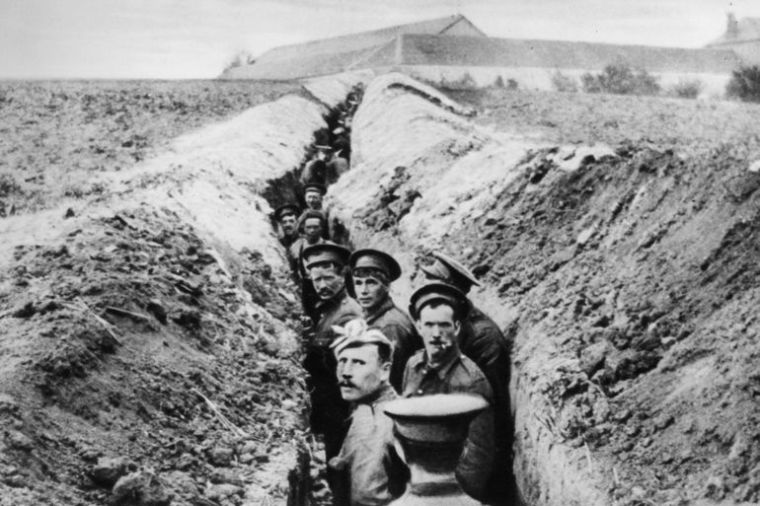
 It was a dark time in history. The world was engaged in a heinous war whose purpose seemed unclear to most who tried to understand why millions of young men were dying. The brutality of the battles was unimaginable. Modernity had changed the nature of fighting in truly horrific ways. Mankind had not yet outlawed the use of chemicals as weapons. Nothing, it seems, was taboo, and so young men were permanently mutilated by agents like bombs and sarin gas. Never before had there been such murderous activity in mankind’s seemingly relentless quest for power. World War I is a war that we often ignore when in reality its effects continue to plague us to this very day.
The United States initially watched events unfold from afar. It’s hard for us to believe but our nation was very much a kind of backwater region at the onset of the twentieth century. Most of the world powers still thought of our government as a fluke in the annals of history, hardly worth noticing when compared to the vast influence of Austria-Hungary, Germany or Great Britain. Militarily the United States was ranked number seventeen, just behind Serbia. Few paid much attention to our still very young country as they engaged in an epic struggle in Europe.
At the beginning of World War I the United States was in debt and still far more rural than urban, but it had incredible natural resources and manpower which became a lifeline for nations like Britain and France during the fighting. With so many of their young workers unable to farm or work in factories it fell to the United States to supply the food and material needed to survive. The USA became a beehive of activity all while insisting on a neutral stance regarding the war. Initially most Americans were disinclined to become involved in a dispute that seemed to be more of a disagreement between royal relatives than a meaningful cause. Instead they enjoyed the fruits of commerce that were occasioned by the war.
The war that was supposed to be resolved in a matter of weeks dragged on with horrible consequences for European nations. The citizens watched helplessly as their youth were killed or maimed in heretofore unseen numbers. After almost four years of fighting France was on the verge of capture and collapse. Britain was little better. Russia was boiling over with a revolution that would dramatically alter the course of that country for the next hundred years. It appeared that Germany would soon dominate Europe. The United States enjoyed its relative safety and newfound prosperity while Europe burned.
Germany believed that it might break the will of Britain and France, thereby winning the war, if only the United States were prevented from sending supplies, and so they boasted that ships traveling across the Atlantic toward Europe would no longer be safe. Their gamble backfired and resulted in a declaration of war from the United States. Within months hurriedly trained American soldiers and weapons, began arriving to bolster the Allies, breaking the stranglehold that Germany seemed to have on the continent. By turning the tide of the war and helping the Allies to win the United States earned the respect of all the world. Suddenly our country had become a superpower and a king maker. For better or worse we have played that role ever since.
A hundred years ago President Woodrow Wilson justified our country’s involvement in war as a way of spreading liberty and democracy. It is an idea that is bandied about to this very day, but then as now a sizable number of people question the arrogance of interfering in the affairs of other nations. Such thinking was again used successfully as a rationale for World War II but lost its luster during the engagement in Vietnam. Presently the world finds itself in a confusing quagmire in the Middle East, a part of the world many of whose problems began with the peace negotiations at the end of World War I. One hundred years later we are seeing the results of arbitrarily dividing the spoils by redrawing colonial maps in a manner meant to punish the losers rather than consider the needs of the people living in the areas once ruled by European monarchs. The roots of today’s problems were unwittingly planted by power brokers whose intent had little to do with spreading freedom.
The world changed dramatically a hundred years ago particularly for the United States. We took on a mantle of responsibility back then that has always had an aura of discomfort. By nature we want to be the good guys, the heroes, but tiny voices of caution echo inside our heads. Part of our nature wants to be left alone, just as our forefathers who fought for their independence from an ever invasive government. Another side of our personalities feels compelled to constantly fix whatever we see as being broken including other governments. The tension between these two points of view are as prevalent today as they were back then. Our divisions are in reality nothing new.
One hundred years ago even as we appeared to be saving the world conditions were ironically far from ideal in our own backyard. Women were still fighting to win the right to vote. Race riots broke out in cities across the country in the summer of our victory. Many of those who had spoken against going to war languished in prisons. We still had much to do at home before serving as advisors to the world. Hypocrisy quietly reigned much as it often does.
Everything old becomes new again. After a hundred years much of the idealistic thinking of those who supported World War I has been tarnished by reality. We find ourselves feeling anxious as the world smolders as though coals of discontent from our past have once again caught fire. We ask many of the same questions and silently worry that a truly peaceful world is a pipe dream, the stuff of fools. We wonder if our warlike natures will always and for all time inevitably take hold. We would sometimes like to wish ourselves back to a time when we were number seventeen in the world and nobody expected much from us, but we know that our ship has sailed and now we much pray for the wisdom to find answers that will do the least harm. As we do so we would do well to remember the lessons from history.
 Try to imagine this scenario. Groups of Americans from the United States begin to peacefully demonstrate against the president of our country in locales all across the country. The government sends in the military to quell the disturbances and in a show of force they gun down protesters. This angers even more people who join the rebellion which grows angry and violent. There are enraged armed mobs in your town fighting against the soldiers. You watch as the disturbances grow into all out civil war. The lines between enemies are blurry and take on a religious aspect as well as political. Splinter groups form, some of which are barbaric. You and your family members are caught in the crosshairs. Bombs from the government come into your neighborhood. Bullets from the rebels forces lodge in the walls of your home. Terrorists taking advantage of the unrest kill your friends and relatives in the most brutal manners. What was once a place of peace has become hell on earth. You do not want to leave your home but fear that if you do not, you and those that you love will surely die. A final blast of chemical weapons from the government forces convinces you that it is no longer safe to stay in the place that has always been your refuge. You watch children who live near you dying in the cruelest manner. You can’t take the horror any longer and so you decide to flee.
 Death is inevitable, or so the saying goes. We all know that there is no such thing as immortality. Sooner or later everyone of us will die. I tend to believe that it is more difficult for the living to accept death than the person whose life has ended. Whether one believes as I do that eternal life waits on the other side, or that the whole adventure simply ends, doesn’t make the pain of losing someone much better. Laying a loved one to rest is one of the most horrific aspects of living. The process rents our hearts in two, and often to our surprise the feelings of utter sadness remain firmly lodged inside our souls just waiting to be tickled back to life when we least expect them.
 Last Sunday was a dreary day, a kind of last hurrah for winter in the south that always seems to arrive in the first weeks of March. The rain washed out my plans to tinker in my yard so I ended up at Costco along with a huge crowd that included some of my neighbors. I suppose that we all decided to go in spite of the weather, or maybe because of it.
  I suspect that there are often times when those of us who are adults wish that we might return to that age of innocence that was ours when we were children. We long for the times when we were yet to realize that evil and hatred exist in our midst. We ask ourselves when we began to lose our sense of wonder. How is it that we find ourselves lacking in trust? What makes us so afraid and reluctant to take risks? When do we begin to pull back on exploring the people and the world around us? Is it in fact true that ignorance is bliss? Does knowing too much make us unhappy?
  All It Takes Is A Little Love