Victoria and Albert

Victoria and Albert

Until the reign of the present day queen, Victoria had held her office longer than any other monarch in the history of Britain. Her influence on Europe and the world was enormous and the story of her relationship with Albert became the stuff of fairytales. She was the transitional figure between the nineteenth and twentieth centuries, seeing and bringing changes to the country that brought the nation into the modern world. Her children and grandchildren had a profound effect on history in two major wars and their impact continues into the present day. We all seem to have a kind of fascination with Queen Victoria, and in particular her consort, Prince Albert.

Victoria and Albert were first cousins who fell in love, married and together had nine children. Albert’s influence on Victoria was enormous and while she clung tenaciously to her own independence as a monarch she supported many of his ideas for modernizing the country that she ruled. He was a somewhat forward thinking man with varied interests that kept him continually engaged. After his death Victoria went into a state of depression and mourning, never again wearing anything but her widow’s weeds. 

After watching the changing of the guard at Buckingham Palace our group traveled by Tube to the Knightsbridge area of London where the Victoria and Albert Museum is located. The station exit revealed a lovely neighborhood filled with trees and refined looking buildings. Only a few steps away was the museum that we were seeking. It is an imposing structure that opened up into a decidedly open and airy hall once we were inside. It showcases a cornucopia of art, sculpture, textiles, furnishings, ceramics and decorative pieces. Founded in 1852, the museum was named for the queen and her husband. It houses a permanent collection of more than two million objects, and best of all there is no charge to see most of the works of art.

After first stopping for a brief respite and a small snack we wandered from one section of the building to another delighting in the glorious sampling of art that was on display. I was particularly taken by one hall that featured works by Rodin and other sculptors. We enjoyed watching a young woman creating a pencil drawing of one of the sculptures. She told us that she had been working on it everyday for weeks and she was in hopes of completing in on that day. She mentioned that many artists find inspiration at the Victoria and Albert, and I too felt that there was a lively spirit to the place that made it something more than just a repository for old things.

I was particularly taken by an entire hall that featured the craftsmanship of Islamic artists. The rugs, textiles, vases, bowls, and woodcarvings were so delicate and uniquely colorful. They seemed almost to have been crafted by heavenly personages rather than humans. There was a lightness about them that was otherworldly. I was transfixed by the beauty and found a kind of serenity in simply gazing at the various objects.

Another room was set up to show the clothing and furnishings of various eras. It was so interesting to the trends and the fashions of each historical period. I found myself marveling at how small the sizes were compared to what we use today. We humans have certainly grown larger over time thanks to the abundance and variety of food that is now available to us. The everyday diets that we take for granted were once the domain of only the wealthiest, and even they did not enjoy the miracles of interstate commerce that bring us delights from all over the world.

As someone who has always loved fashion I delighted in a room that featured women’s clothing from different eras and decades. I am old enough to have remembered the lovely fitted dresses and suits that the women wore in the nineteen fifties and the mini-skirts and mod styles that I donned in my college days at the end of the nineteen sixties. The styles that were featured were so lovely and amazingly so classic that if someone were to wear them today they would no doubt look quite fashion forward.

The museum complex features a large splash pool where youngsters played excitedly while their parents watched with unadulterated joy. I smiled at the relaxed and lively spirit of the place where every person seemed to have a contented smile permanently affixed to his/her countenance. I imagined that Prince Albert in particular would have been quite proud that even us common folk were able to view so many treasures. I felt so welcome and so relaxed there and might have stayed far longer but for the fact that we had a reservation for Skye Garden and needed to depart.

I spent my last moments in the gift shop which was the most wonderful of all such places in London. I purchased two tea towels crafted from extraordinary patterns. I plan to use them whenever I have a tea time with my grandchildren or my niece. I also chose an apron that was so lovely that I can’t imagine actually using it while cooking. Nonetheless it will be nice to don at the last minute for the Sunday dinners and special occasion extravaganzas that I so love to provide to family and friends.

In a single day I had mulled over the long history of England and the role of royalty in the modern world. Somehow the Victoria and Albert Museum had helped me to understand the symbolic significance of the monarchy. I suspected Victoria and Albert’s influence in making more recent kings and queens more caring about the people. I felt more and more kinship with the idea of having a royal presence and I somehow began to realize what the Queen represents. 
A Walking Timeline Through History

Trafalgar Square

When the best laid plans go awry, pathways to new adventures often show themselves. We were to have spent our morning watching the changing of the guards and our afternoon at Westminster Abbey. The cancellation of the tradition of pomp and circumstance at the palace had sent us scurrying to the Gothic church far earlier than intended, so once we were finished with our tour we became untethered and aimless wanderers around London.

The roads almost inevitably lead us past the halls of Parliament where protests centering on the Brexit issue were a constant feature during our time in the capitol city. We glanced disappointedly at Big Ben which was shrouded by the apparatus of reconstruction save for the face which never changed because it was not working. We wondered as we longed to hear the famous chimes if somehow all of our planning was doomed to go up in flames, but we soldiered on, walking past a highly secured area that housed the home of the outgoing Prime Minister.

There was much stirring behind the gates. We saw official looking men wearing formal  jackets filled with medals leaving the premises with grim expressions. It told us that Theresa May was no closer to creating a plan for transitioning Britain from the European Union to a  more nationalist entity. There was a noticeable tension in the air that hovered over the halls of government and the silence of Big Ben added a metaphorical touch to the chaos.

After walking for what had seemed like many miles Trafalgar Square was in view and husband Mike became quite animated by the thought of seeing the iconic tribute to those who had fought so valiantly in World War I. First, however we would pause for lunch in a nearby pub where I admittedly struggled to find something that appealed to me on the menu. I generally eat a very light midday meal and there was very little of that sort to be found among the traditional English food being offered, so I essentially skipped eating and instead enjoyed a lemonade and a much needed rest for my feet. I used the time to find and purchase the tickets that we would use later that night to see the choral concert at Westminster Abbey.

Once everyone was refueled we headed to Trafalgar Square which was quite joyfully bursting with life, mostly from tourists and street artists. The atmosphere reminded me of the area around St. Louis Cathedral in New Orleans, Louisiana. There were accomplished musicians and singers entertaining the crowd with performances worthy of Albert Hall. Using only chalk and their imaginations many individuals drew masterpieces on the grand sidewalks of the square. A gigantic fountain surrounded by enormous lion sculptures served as a photo opportunity for everyone who passed by, and of course there was the famous obleisk honoring the courage of those who defended the nation in World War I.

This was indeed a happy area where the tension surrounding the government buildings was replaced with a kind of serendipitous celebration of art and humanity. It felt good to be there and somehow made up for the botched intentions of our morning. We all realized that while we had not achieved what we had planned, we had stumbled upon something that was nonetheless glorious.

Just beyond all of the revelry lay the National Gallery which like so many sights in London was open to the public at no cost, so we decided to partake of its vast collection of paintings and sculpture in the time remaining before our evening engagement. This would prove to be a wonderful decision because some the the most famous artists the world has ever known were featured in the multi-story galleries.

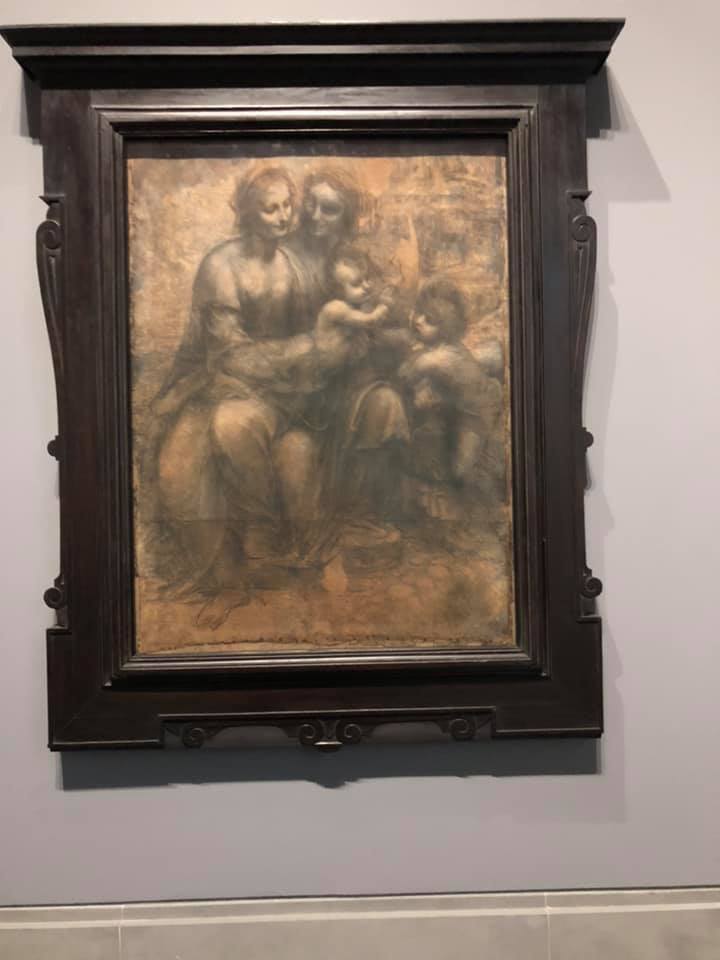
I enjoyed so many of my favorite painters and was filled with appreciation for some about whom I had known nothing. Without a doubt, however, the experience of wandering without warning into a room containing the work of Leonardo da Vinci was the highlight of the visit for me. The funny thing is that I had spied his drawings from out of the corner of my eye and had noted that I felt drawn to to them before I realized that the great master had created them. There was a kind of lively charisma to even the preliminary sketches that elevated the pieces to a level unmatched by any of the other artists.

I might have stood transfixed in that room for hours were it not for the fact that we had agreed upon a meeting time in the coffee shop, and that hour was drawing near. It was with great reluctance that I took one final glance at the glorious paintings and headed down to meet with the rest of our party.

We enjoyed a bit of respite and a great deal of animated conversation over steaming cups of Earl Grey tea as we spoke of our favorite works of art. We all agreed that we had somehow been led to a most enjoyable afternoon by the “gods of travel” and we promised that if we had some additional time later in our trip we would gladly return to this wondrous place to be certain that we had not missed anything.

When we emerged into the late afternoon air we saw that the festivities taking place in Trafalgar Square had not abated. It seemed to be an oasis of cheer and goodwill which was perhaps the intent when it had been designated as a memorial to all that is good about Britain. After the horrors of World War I the citizens needed to remember, appreciate, and celebrate the many sacrifices made. I thought it fitting that the joy of peace time was still very much in the air.

We walked away with an even greater sense of the spirit of London and its people. In a single day we had looked far back into their history and gazed at the gravity of their present. It had been like walking a human timeline during which we witnessed the resilience of the people. We realized that they had made mistakes before, and perhaps were enduring them even now, but always they seemed capable of adjusting their course and moving on the right side of history.

Wonders of the World

British MuseumThe Bloomsbury area of London is the home of the university of London, Kings Cross Station, and the British Museum. A short stroll in almost any direction leads to lovely sights. In May the gardens and window boxes are filled with lovely flowers of every hue. Tiny markets offer fresh fruit and sweet bouquets. It’s a pedestrian world in which the sidewalks are filled with walkers strolling more leisurely than in the heart of the city. It is a place where lingering just a bit longer is in fashion.
On the first full day of our trip we chose to eschew hurry, and instead enjoyed a scrumptious English breakfast buffet in our hotel. We feasted on fried, scrambled and poached eggs with little English sausages, baked tomatoes and sautéed mushrooms. We enjoyed steaming pots of Earl Gray tea or tasted the brew from the latte machine. Crusty loaves of bread beckoned us and a bounty of pastries were ours for the taking. We had our choice of cereal and fresh fruit, cheese and pancakes. It was a good way to start our adventures for we would walk ten of thousands of steps, many miles in a single day.

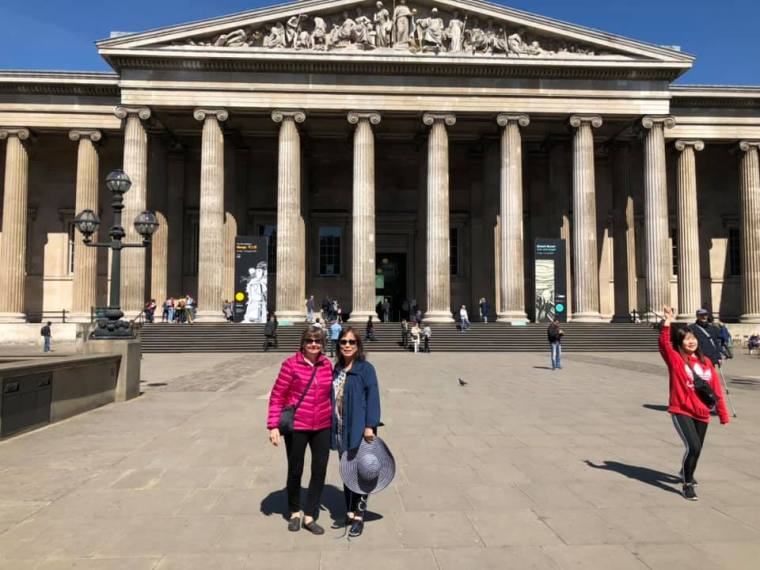
Our quest was to visit the British Museum about which we had long heard. The building in which great treasures are housed is an imposing structure which would be worth a look even without ever going inside. Once we had entered we were in awe of the great halls and sensed that we were about to see magical things that we had only before read about in books. After gathering and studying a map we decided to go first to the Egyptian section where we were immediately taken aback by the presence of the Rosetta Stone, an imposing treasure that would have been worth the trip all by itself. 

From that first moment we were in awe of the treasures that were displayed for what seemed like miles. It was difficult to know where to first look or what direction to follow. The trove of artifacts was so expansive that it gave me the feeling of being an adventurous archeologist who had suddenly stumbled upon a great find. I felt humbled as I gazed at items so exquisite and so old that I had difficulty processing an image of the creative and skilled people who had made such things in a time when tools were simple and scarce. I found my mind going far back into the history of mankind, and I marveled at the human connections that I felt with the people who had left such incredible marks on the world. I also thought of those who were simply nameless persons attempting to deal with the challenges of living, often under great duress.

I was brought back to present day reality only when I saw a group of young school boys careful taking notes about what they were seeing. They were so cute in their jackets with crests on the breast pockets and their earnestness in deciphering the mysteries of the many artifacts that they passed. I suppose that I will always love children and feel proud of the tiny contribution that I have made in the long range history of a generation. I think that we humans create because we have always desired to find some kind of purpose to our existence,

I was so caught up in seeing Roman statues, Greek urns, and Chinese porcelain that I hardly noticed that six hours had passed and it was time to enjoy a traditional afternoon tea gathering. Our group ate little sandwiches filled with chicken, salmon and eggs. There were scones and cakes and tiny cookies. We relaxed and chatted about what we had seen and how we felt. We worried just a bit about how so many things had been brought to Britain from the places where they were found. We wondered if they had simply been confiscated or if there had been permission, agreements, and payments for taking such things. I suppose that there are many different points of view as to the ethics of having such museums, particularly when the items include actual mummies. Is it wrong to raid a sacred tomb, or should we honor the purpose of such rituals by leaving them intact?

After refueling ourselves and debating the pros and cons of how and whether or not we were somehow complicit in the rightness or wrongness of such a museum we continued our study of the many different rooms. We saw Mayan carvings, and intricate woodworking from Abysinnia. We walked past glorious creations from India and Japan. Our heads were swirling from trying to read the descriptions of what we saw and achieve some kind of understanding of the magnitude of the glories of each culture represented in space after space.

Soon it was nearing five in the afternoon, and we realized that we had literally spent an entire day mesmerized by what we had viewed. Nonetheless there was still more to see, but that would have to be for another day, perhaps on another trip. The doors were closing and we were explorers forced to reluctantly set our adventures aside.

Russell Square near the museum was by that time filled with tourists and locals enjoying the coolness of the afternoon under enormous trees. They lolled in the grass and sat smiling on benches. There was an unspoken collegiality between all of us as we exchanged smiles and greetings. We felt as though we welcome in this place and it felt so good.

We finished our day in Callahan’s pub in our hotel. We feasted on a variety of food. I chose bangers and mash which were as tasty as I had hoped they would be. I enjoyed a nice glass of wine while my travel companions chose ciders and beers. We played a game on a large table and watched soccer on the television above our heads. We got to know some of the locals who came to the pub of an evening just to have a swig and a bit of conversation. It was a fun closing of a perfect day in Bloomsbury in London town.

Discovering a Remarkable Story

beige analog gauge
Photo by Ylanite Koppens on Pexels.com

I loved my maternal grandmother, Maria Bartacovik Ulrich, but never really knew her. She was a sweet presence in my life, but because she spoke little or no English and I had no knowledge of her Slovakian language we communicated mostly with facial expressions. She was a short, round woman filled with the wrinkles of old age. She kept her hair in a long braid that trailed down her back, at least until she became seriously ill and her daughters cut it to make the task of maintaining it easier. She seemed to be of another world, another century and I always longed to be able to ask her questions and learn more about the girl she had once been. Instead we exchanged smiles as she called me “pretty girl,” and while I loved the simplicity of her greeting I wondered if she actually knew my name or those of my many cousins.

Grandma Ulrich padded around her home in her bare feet which were tiny but often appeared swollen. At gatherings she prepared cups of coffee for all of her guests, bringing the watery brew proudly in enamel cups filled with more milk and sugar than java. I loved that gesture which she repeated hundreds of times when the members of her family filled her home with raucous conversation. I saw her as an exceptional hostess who wanted us to feel welcome in her domain, and we always did.

Grandma Ulrich had lovely blue eyes, and as I gazed into them I wondered what thoughts were behind them. It would not be until long after she was dead that I would do enough research and ask enough questions to learn a tiny bit about her. It amazed me to find that this shy and unassuming woman had traveled alone from her hometown in the Slovakian region of Austria Hungary to Bremen, Germany where she boarded a steamship bound for Galveston, Texas. She came to meet my grandfather who had arrived before her to pave the way of their new life together. Somehow it almost seems inconceivable that such an unassuming woman would have the courage to embark on a journey to a world of which she knew very little. She must have been very much in love, and perhaps she was guided by the exuberance of youth as well.

She arrived not too many years before the outbreak of World War II and for all intents forever lost track of her family back home. My eldest aunt says that Grandma worked as a cook for the laborers on a large farm in an area of Houston on the east side of town. Later she tried a variety of jobs including laboring as a cleaning woman in a large downtown building. When her English improved she even found work behind the counter of a small bakery. This was a daring Grandma Ulrich that I had never known, and even now I have a difficult time imagining the woman who was frightened to leave her home as such a courageous person.

My grandmother was a woman of her times without benefit of any form of birth control other than abstinence, and so she had one baby after another. There were nine pregnancies in a row including one in which she carried twins. By the time my mother, the youngest of her children, was born Grandma had buried two of her babies. Her body must have been in a state of hormonal hell as she yo-yoed from conception into post partum depression again and again. Her tiny home and her life was dominated by rowdy children whom she dearly loved, but I can’t fathom that she ever had a moment to herself.

At some point my grandmother showed signs of a mental breakdown and she was taken away by force to the state hospital in Austin. It was a traumatic time for her and for her children who rarely spoke of it, carefully guarding a secret that was too painful to mention. Once Grandma returned home she would never again have enough trust to leave the safety of her house without putting up a fight. She was content to simply create a daily routine and quietly live out the rest of her days.

I am fascinated by the woman who was my grandmother. I suppose that if truth be told we, her grandchildren, took her for granted. She was someone who was just there, an almost invisible presence in our lives. She seemed simple and yet she was so complex. We thought her witless and yet she must surely have had thoughts and dreams. Like so many women her contribution to the world was unseen and under appreciated. We did not think to connect the dots of her existence and the incredible impact it has had on the world. We assumed that she would not have been interested in knowing that from her humble beginnings in America have come engineers, doctors, teachers, accountants, business leaders, athletes, lawyers. Members of her now very extended family are brilliant and beautiful, and genetics tells us that her contribution to such success is present in all of us. Most importantly the lessons that she taught her children have been passed down through the generations. We may not have been able to communicate with her but her children knew and understood her messages of integrity and hard work. She modeled a steadfastness for them that they emulated often without even realizing how deeply her character had imprinted on them.

If by some magic I were able to see my grandmother again and actually speak with her without the restrictions on communication that once defined our relationship I would want to know everything about her. I have grown to understand how amazing she was and how worthy of my attention to her story should be. Like so many many women she was dutiful and in her role she built the foundation of a family and the future. Her contributions are incalculable but her legacy continues to blossom. Now I finally realize through discovery of her remarkable story that this tiny quiet woman was a tower of strength and I feel honored to be part of the world that she helped to build.

And Still I Try

book book pages bookcase browse
Photo by Pixabay on Pexels.com

I don’t just like to write. I also love to read. I am in awe of great writers, and they are many in number. Some of them are friends of mine while others are strangers who become like friends through their words. There are those who have a knack for choosing just the right words, the most stunning imagery, the clearest poetic phrasing. I am often moved by their ability to convey a universe of ideas in the space of a sentence or paragraph. These are the true masters among us whose canvases are blank sheets of paper and whose art is created from combinations of letters, words, and punctuation. It’s a simple enough exercise, and yet some of us still draw stick figures when we attempt to write, while others join the infinite with their masterpieces. I am transformed by their work, even while I am a bit jealous of it. I want to reach their level of of excellence knowing that my own efforts are mostly feeble, and still I try.

I was listening to a program on National Public Radio that spoke of the emotions elicited by great art both visual and audible. Music by far is the most likely to stir something in our souls that brings us to tears. Studies show that paintings are often the most vivid representations of life, but we humans rarely gaze at them long enough to become as emotionally involved as we do when we hear songs or symphonies. When we read we often skim so quickly over the words that we absorb only a minimal appreciation for what they are conveying, but when those same words are acted by great players we may find ourselves sobbing. Music and acting are so fluid, while canvases and manuscripts may appear static, leaving us with little more than a passing idea of what they actually represent. When we actually take the time to allow our minds to feel the content of a great work of visual or written art we are transformed.

My father had an appreciation for all forms of art. He played music while he read, a daily routine that included hours of perusing newspaper columns, books of poetry, novels, and nonfiction. He returned to stanzas and passages again and again. Repeating the rhythms and phrases that most appealed to him. He memorized the best of them, ready to quote them in appropriate moments. Bookstores were his galleries, places where he found hidden jewels that appealed to his senses. He held books and printed papers as though they were treasures to be treated with the highest regard. He transferred his love for the written word to me. He showed me how to be discerning in my search for the artistry of a great poet or author, My high school English teacher, Father Shane, transformed my sensibilities into an art form of itself by insuring me that being a studied appreciator of great writing is a kind of accomplishment in its own right.

The best writers among us invert the world as we see it, turn it upside down and inside out making even the hideous beautiful. They appear to have a gift, a natural genius that makes it easy and inevitable that they will leave us breathless with their creations. Still we know from stories and examples that they have to work hard to hone their craft. They don’t simply peck out five hundred words in an hour to reveal thoughts and ideas so memorable that they will last through the decades and centuries. We hear of F. Scott Fitzgerald driving himself almost insane in his attempts to reproduce the beauty of The Great Gatsby. Shakespeare’s works were both brilliant and ordinary depending on which of his plays is being considered. The demon of perfection haunts writers and sends them into fits of desperation. There is no feeling as dreaded as having a block that creates an almost impenetrable wall between ideas and final copy.

I wonder how a J.K. Rowling is able to fashion and sustain a story and characters so perfectly that her books become beloved treasures, keepsakes to visit again and again. How does a Tolkien create entire worlds with a make believe history that seems so real, while others are one trick ponies or abject failures in spite of Herculian efforts? Is it possible to push ourselves to find our own inner genius and then demonstrate it to the world, or is the mark of greatness limited to only a select few?

I read, and read and read, learning new ways of saying old things. I practice and practice, but find myself falling short of the goals that I set for myself. My time is growing short. I am not a Grandma Moses who will suddenly stun the world with my talent, and yet I would like to be. I would so enjoy finding that sweet spot that might touch a place in a reader’s heart that makes them cry for joy. I want to transcend the ordinary and find my personal best, which I sense is buried somewhere inside of me. I suspect that I will know when I have managed to get closer to my ultimate goal, but I worry that there is some calculus that will keep me forever making only closer and closer approximations of what I want to achieve.

Reading and writing have become my routines. I push myself to exercise my mind the way some work on their bodies. I find peace in my experiments with words, and inspiration in the genius of those who have already accomplished what I hope to one day achieve. Writing is my Holy Grail, my Mt. Everest, my nemesis and my consolation, and still I try.