Escape from the Rat Race

ratrace1The trouble with the rat race is that even if you win, you’re still a rat. – Lily Tomlin

I was a full fledged member of the rat race for most of my life. I’d leave home before sunrise and often did not return until after dark. I would hurriedly throw together dinner or maybe even bring home burgers or fried chicken if I was really tired. Most evenings I graded papers and did lesson planning until nine or ten while running loads of wash and getting my daughters settled with their homework. My husband Mike was engaged in a similar whirlwind of work activity during the week. On weekends we cleaned, mowed and repaired and somehow managed to find a bit of time for visiting with friends and family. So it went year after year until we one day ended our labors and retired.

We were not unlike most of the people that we knew. Everyone was seemingly rushing somewhere, part of that great rat race that consumes so much of our lives. Little wonder that at the end of our toil we had grown fat and out of shape. Being healthy takes time and attention and we were barely able to fit all of our responsibilities into our calendars. The prospect of spending time that we didn’t have to shop for healthy foods and then prepare them was overwhelming, and so we often opted for frozen items that allowed us to just pop our dinner into the oven without additional effort. The weight came on us in such small increments that we hardly noticed the real expansion of our girths.

Now and again we resolved to do better. We joined Weight Watchers online or paid for membership in an exercise program or a gym. We’d do well for a time and then a rush of activities would overtake our best intentions. Those night time meetings at school or the big project at work stole away yet a bit more of our time. We were exhausted from juggling so many balls and running so constantly. It was easier to set our personal goals aside and just go with the flow that always felt so hectic but was at least familiar.

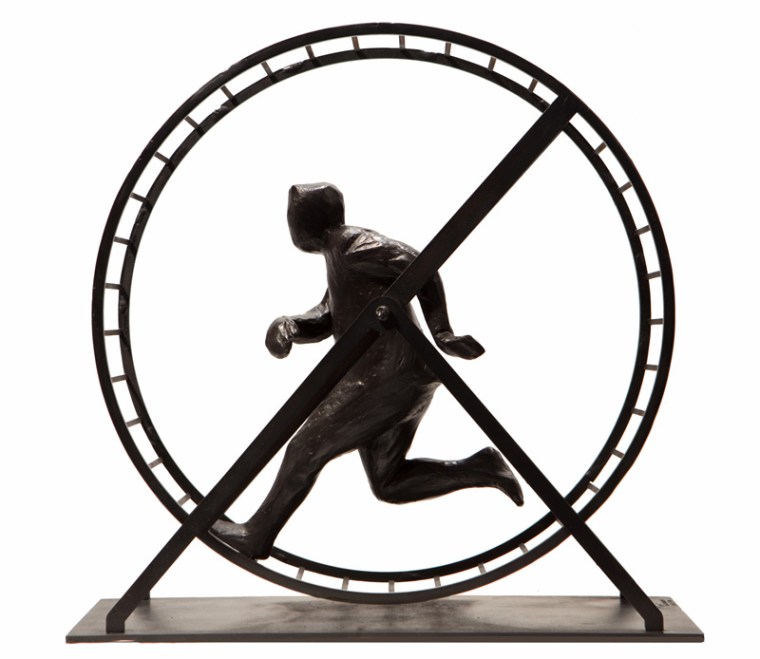
I’d get a routine of weekend meal preparation going and my mother would become ill. I’d have to tend to her needs rather than spending time in my kitchen being a nutritionist. I’d try again and again but there always seemed to be something that was more demanding of my attention. I’d just keep running on that little hamster wheel telling myself that one day I would finally find the time to do the kinds of things that would make me a stronger, healthier person. Of course that day never really came, at least not until I was face to face with a life and death situation. At that point I understood the folly of my ways.

I’ve spoken of my new found efforts to concentrate more on the well being of my body and that of my husband. His stroke has shown us that a lifetime of running at full tilt and ignoring the warning signs that we were abusing our health has lead to conditions that need not have occurred. We may be a day late and a dollar short, but now we are changing our ways in earnest. Still I have to wonder why we ignored this incredibly important facet of living for so long. In the name of being good employees, faithful family members and loyal friends we time and again put our own needs behind everyone and everything else. In retrospect it was a foolish choice.

I am reminded of the instructions for flying in which the adult passengers are always told to put the oxygen on themselves before helping their children. The reason is quite simple. If the adult passes out, he/she is of little use to the youngster. In other words it is up to each of us to prioritize the healthful habits that we need so that we will then be able to take care of everything else. If only our society emphasized this important idea regarding our health as well as the airlines do with respect to oxygen perhaps we would all be better. Sadly we openly encourage participation in the rat race as the ultimate goal of life.

I have worked for many different organizations and bosses. Some of them understood the importance of maintaining a healthy balance between work and personal needs. They were compassionate with employees who required time to heal themselves and even encouraged everyone to take care of home life first. On the other hand I have been employed by people who seemed to believe that the best workers were the ones who were willing to sacrifice home, hearth and family for the good of the firm. They voraciously ate up most of the hours in the day and chastised anyone who dared to suggest that the work was not their main priority. I watched the employees in such places fall apart both physically and mentally. Unfortunately it is not all that uncommon for people to find themselves in situations that slowly but surely begin to beat them down.

I know all too well how difficult it is to be an exemplary employee, an outstanding parent, a good daughter, a devoted wife and also someone who cares for herself. I have been a bonafide member of the rat race and I know how debilitating it can be. In the midst of the daily run it is often difficult to even know where the pack is leading. We just follow out of habit and tell ourselves that it is the right thing to do because we have been taught from birth to follow that old ethic that we achieve success through hard work, discipline and sacrifice. The trouble is that we  misinterpreted the idea when we set aside the aspects of living that make our bodies and minds function more efficiently.

One thing that I appreciate about the younger generation is that more of them appear to understand the importance of good nutrition and regular exercise. They create blocks of time to take care of themselves and that is a very good routine to develop. I have a grandson for example who schedules his time in the gym just as he does his college classes. Exercising is a regular part of his day that is as important to him as eating, sleeping and studying. If he maintains those kind of habits for a lifetime I suspect that he will have fewer health problems later. He is quite wise to set his priorities now so that they become second nature.

I suppose that it is never too late to change and I am certainly in the process of doing so. I’ve learned from my own mistakes and I don’t plan to turn back. If I were to give a single bit of advice to those of you who still find yourselves being torn asunder by the stresses of daily living, it would be to jealously guard  the special times devoted to the sole purpose of making yourselves healthier in body and mind. You may have to learn how to say no to some of the multitude of requests that come your way, but stand tall and don’t let anyone intimidate you. Step away from the rat race and you will finally see the road ahead.   

A Knock at the Door

knock-door-e1412094721215.jpg

It was nine thirty on a Saturday night. We were watching a Poirot mystery on television when there was a loud knock at our door. By the time I walked down the hallway to peek outside whoever had been there was gone. I had just settled back into my chair when there was another banging noise. This time I dashed to the entryway more quickly and turned on the porch light. I saw two young boys who appeared to be around fourteen or fifteen years old. One of them sprinted away quickly and the other stood like a deer in the headlights exclaiming his sorrow for bothering us and adding that he was just trying to sell Girl Scout cookies. Of course I understood immediately that we had been pranked. I sensed that the boy who didn’t manage to get away was someone I had seen in the neighborhood. He seemed very familiar and the more I thought about it, the more certain I was that he often plays basketball just down the street with a number of his friends.

There was a time when teenage mischief was almost a right of passage. My own girls wrapped houses with toilet paper and celebrated when our home was decorated with long strands of tissue as well. I did a bit of knocking on doors and making silly phone calls in my time. Such tricks are generally done with no ill intentions and I suspect that the young boys who visited our home were just continuing the tradition of being silly on a Saturday night. Nonetheless I found myself quite troubled after our surprise visitors had left, not so much because they had bothered me, but because I worried about what might happen to them if they continue their nighttime visits to other homes.

The world is not the same as it once was. When I was young we rarely locked the doors to our home until just before going to bed. Even then we slept with our bedroom windows wide open because our home was not air conditioned. The only thing between us and a home invader was a screen which might have easily been removed. In those days it never even occurred to us to worry that someone might attempt to do us harm while we were dreaming. Our world seemed so innocent and safe.

Now we live in times of uncertainty. We hear of criminals breaking into houses on a regular basis. There is fear in people’s minds. Many of them install cameras and alarms to warn them of danger. Others add an arsenal of guns and ammunition to their security program in case they need to defend themselves. Doors are now routinely locked all day long. In some ways we act as though our castles are under siege, and I suppose that it is rather prudent to be safe rather than sorry. The problem is that in such an environment individuals may act before they have all of the facts. Those same outrageous boys who came to my door might find themselves on the wrong side of a gun if they hit a home with a very nervous and excitable person inside. They might literally be injured or even killed all because they thought it was funny to scare people.

Years ago two of my daughter’s friends decided to pull a prank on her. They dressed in dark ninja style clothing and crept up to our back window and peered inside while we were watching a movie. Since I recognized them immediately their joke backfired. I was livid, not because I did not have a sense of humor, but because I knew for a fact that many of my neighbors were armed and would not have hesitated to shoot at strangers wearing dark masks while creeping through the dark of night. I scolded the boys for their stupidity while my heart raced at the thought of what might have happened to them had they been seen by someone who did not realize who they were. I was upset that they had been so unthinking.

I feel the same way about the two boys who were out having fun when they targeted our home. I know from an online neighborhood chat room that there have been several incidents of strangers knocking at night to determine if anyone is at home. So far nobody has been robbed or hurt but the comments that people make regarding what their response will be if anyone threatens their personal space make me realize that those boys are at great risk. Many of my neighbors insist that they will call the police. Others assert that they will shoot first and ask questions later. Such is the reality of today’s world, and such is the danger that the boys might encounter.

On that chat line I asked parents of teenagers to have a talk with their children emphasizing that they should not engage in reckless behaviors. I would be gravely upset if I learned that the young people were hurt or killed, but I would also understand why someone might overreact when they feel threatened. It’s up to teachers and parents to instruct the young on the folly of pranks that involve frightening people. What may have once seemed to be innocent fun is likely to be interpreted as a reason for defense in today’s environment.

Teenagers’ brains are still developing. They often do things that are more risky than they ought to be. I was the quintessential good girl and yet I also engaged in adventures that in retrospect might have resulted in great harm to me and my friends. I once crawled under the fence of a property where trucks were stored near my grandmother’s house. An armed guard roamed the area. I had no business in there but I thought it was exciting to be able to come and go without being caught. My antics were silly but they gave me a rush, made me laugh and felt liberating. It never once occurred to me that I might have been in danger.

It is imperative that we speak frankly to our kids before we let them lose on the world at large. Sometimes we shelter them because we do not want them to be fearful when we might be wiser to discuss the realities of various situations in which they may find themselves. We need to be frank with them about peer pressure and how to extricate themselves from situations that feel uncomfortable or wrong. We should discuss how to behave if they are stopped by the police. Just as most parents practice fire drills and show their kids where to go if a tornado hits, so too must we review the skills they will need when they are not with us.

Time and again experiments show that our children just don’t think when danger is lurking. They go with strangers to look for a lost dog. They follow other kids into strange places. They simply have not internalized the necessary skills for keeping themselves safe because we haven’t instructed them as well as we should.

We certainly don’t want to make our teenagers paranoid. Most of the time they will be just fine. What we must do is provide them with the survival tools they will need in those rare cases when things just don’t seem right to them. If we have practiced such things and given them the reasons why they should be vigilant and resourceful they should be okay.

I can’t help thinking about the two visitors to my home and wondering if they are still engaged in an activity that may one day end in tragedy. I hope that perhaps their parents will be informed by someone who knows them and that they will put a stop to their dangerous behavior. It’s sad that we have reached this point, but it is the new normal. It’s up to us to instruct our youth and then hope that they remember what we have taught them.

Stubby

20621877_10214162618681608_1562985905440264416_n

Who knew that a tiny gecko was capable of bringing so much joy? No, I’m not speaking of the Geico gecko even though he is a rather dashing fellow. I am referring to a resident of our backyard whom we have named Stubby.

Stubby lives underneath a potted hibiscus plant that sits on top of two bricks on our patio. We first noticed him several weeks ago when he found the confidence to come out from the safely of his abode to sun himself while we ate dinner. Part of his tail was missing and not even the passage of time has remedied his affliction like we thought it might. He’s a rather ordinary fellow all in all but he has a charisma that draws our attention to his antics. Since we eat outside most evenings we now look for him, and so far he has not failed to greet us.

He is quite fond of entertaining us by climbing onto the seat of a wrought iron chair near his domicile. Once he reaches his perch he celebrates by puffing up his mouth until it reveals a brilliant red color. He’s a bit of a show off but that’s actually what makes him so much fun to observe. He’s quite a character with a penchant for being a star. We’ve noticed a number of tiny offspring wandering not too far from him and wonder if he is their proud father.

I suppose that it may sound a bit sad or even crazy that we derive so much joy from Stubby, but our interest is easily explained. We’ve had quite a round of trauma of late. We’ve had to change our lifestyles as well as our outlooks. We’ve come to appreciate the blessings that we have, and one of them is having a remarkable creature like Stubby right in our own backyard. We are actually quite happy that he has so graciously accepted our hospitality. I suppose that his antics are one way that he demonstrates his gratitude for our largesse.

I worried a bit about Stubby when our grand dog Cooper came to visit recently. I didn’t know if the little pup would chase or harm our resident gecko. Luckily Cooper is a bit overweight and as a result slow on his feet. If he even noticed Stubby he didn’t let on. Instead he ran straight for the fence where our neighbors’ dog greeted him with a bark. He proceeded to mark his territory and let out a warning salvo. After that he simply went in that direction every time we let him out just to see what was happening next door.

Cooper is quite fun in spite of his lack of athleticism. He is a very polite and laid back dog so he doesn’t perform any daring feats like Stubby, but he has the warm heart of a lover. He likes to sit next to my husband Mike and only requires a little scratch or two now and again for thanks. I suspect that he is still pining a bit for his brother dog Shane who recently crossed the Rainbow Bridge. We try to be very accommodating to Cooper’s every need in this difficult time for him. Mostly he’s willing to placate us as long as we feed him at the correct time.

It is little wonder that even soldiers with PTSD are often advised to get a service dog for companionship. Pets have a way of diffusing stress in the most amazing ways. They make us laugh and fascinate us so well that we forget the cares and woes that may be demanding our attention. They are actually as good at making us feel better as a cocktail of psychotropic drugs. I don’t advocate eliminating medications in favor of a pet, but I think that adding them to the pharmaceutical mix is a powerful antidote to anxiety and sadness. I know that it works quite well for me just to allow myself to be almost hypnotized by the things that they do so well.

Birds also have an incredible capacity to  bring us peace of mind. We have a single hummingbird that flits from one side of the yard to another. His speed is so remarkable that sometimes it’s difficult to keep up with him. I never fail to smile when I see this wonderful creature, but my favorite among the feathered friends is a dove who perches on our roof and sometimes dares to get rather close to us as he balances on the rim of our fountain preening himself and partaking of a drink. I like hearing his cooing which is as soft and comforting as a lullaby. He has a mate that has been absent of late. I wonder if she has been busy nesting or raising her young. I long for her return because the two of them are so much more magnificent together. I hope that she has not run afoul of some terrible injury, but for now I have no way of knowing what has happened to her.

We’ve got a rather impressive colony of bumblebees in our yard contrary to the thinking that they are almost extinct. I managed to step on one a while back and learned that I am allergic to its venom. I got quite dizzy and my tongue began to swell. Sadly I suspect that my attacker didn’t do so well either. I felt guilty for walking around without shoes and causing the demise of a worker who was only doing the job that came naturally. Now I am more careful as I stroll through the grass. I know that the lovely flowers that adorn my garden are enhanced by the bees who spread pollen even as they enjoy the nectar.

I’ve often thought that I might have enjoyed a lifetime of interacting with animals. ( I can hear my teaching colleagues laughing as they think that maybe I did work on an animal farm now and again. Of course I’m just kidding.)  Nature’s creatures can be so very interesting and I think they actually teach us a bit about ourselves. They remind us to enjoy the beauty and variety of the natural world. They demonstrate how much bounty is to be found in the plants, the trees, the sun and the rain that we all too often take for granted and don’t even notice. They invite us to slow down and live a bit in the moment so that the scales that are blinding us from seeing our blessings fall from our eyes.

I know that Stubby will one day reach the end of his days on our patio. I’ll be a bit sad when he no longer joins us for dinner. He’s helped me to deal with situations that are so difficult with a much bigger smile on my face than might otherwise not have been there. He’s adorable and I’d like to believe that he likes us as much as we like him. Of course I understand his anatomy and realize that he does not have the capacity for such feelings, but I guess that if a gecko can become a television celebrity, so too is it reasonable to think that maybe just maybe Stubby knows that he is bringing us happiness. Either way I’m just glad that he is here right now. He’s the right guy in the right place at the right time.

Remembering A Wonderful Life

1892_small_fullsize

The classic movie It’s A Wonderful Life considers the difference that one individual might make in the world. The premise is that if the hero had never lived everything in his town would have turned out differently. It demonstrated that while each of us only touch a limited number of lives, our impact is nonetheless profound.

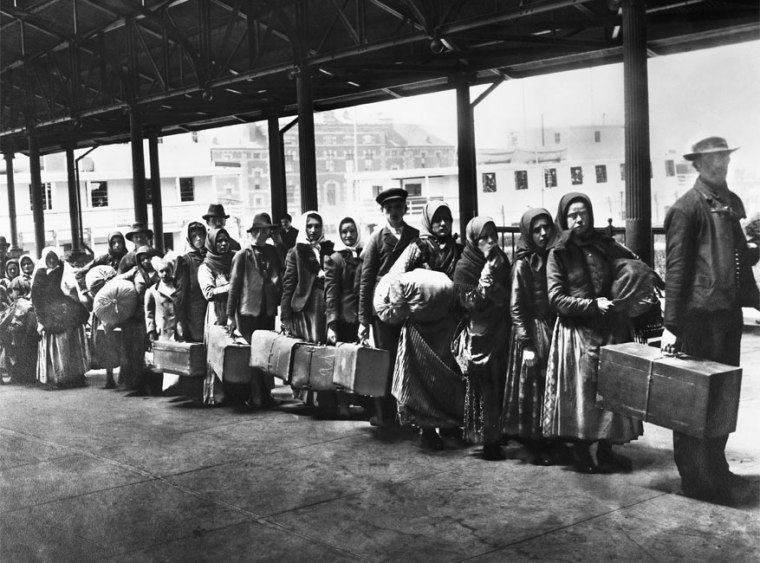
I was thinking about this when the new RAISE immigration plan was announced. I wondered what might have happened if such a law had been in effect when my grandfather first wanted to come to the United States from Austria Hungary. He had only minimal education and no real skills beyond a willingness to do the most detestable of jobs. His English was minimal. He came with little more than the clothes on his back and did the kind of manual labor that is brutal and dirty. He was frugal and saved money until he was able to send for my grandmother. She had even less to offer our great country than he did. She spoke no English and her education was virtually nonexistent. Once she had arrived she worked as a cook, a cleaning lady and at a bakery until she began to have children and then she rarely left her home again. My grandfather eventually settled on a job at a meat packing plant. He cleaned carcasses and equipment, hardly a grand career but certainly a noble way to provide for his family. From his meager salary he built a tiny house for which he paid cash and there he raised eight children.

According to the point system of the RAISE plan Grandpa would hardly have been a candidate for immigration. There was little to indicate that he would be of great economic use to the United States. I am rather certain that he would have been denied entry to our nation. What a loss that would ultimately have been.

All four of my grandfather’s sons served proudly in the military during World War II. During their lifetimes they worked hard at their jobs, rarely missing even one day of work. Two of them were employed by the United States Postal Service and two worked for Houston Lighting and Power. His daughters held a variety of positions that included teaching, doing research for a high blood pressure study, serving the United States Postal Service and working at a Naval Station. Their children, my grandfather’s grandchildren, were even more remarkable. Among them were accountants, teachers, managers, businesspersons, firefighters, and engineers. In fact my brother coauthored the program for the navigational system of the International Space Station. I wonder who would have done that if my grandfather had never come here?

It’s difficult to imagine how different the lives of countless individuals might have been had my grandfather never been granted permission to immigrate to the United States simply because his education was lacking, his skills were so basic and his English was wanting. On the surface he most certainly may have appeared to be a risk, and yet he was a proud American who encouraged his children to always work hard and be their very best. When many citizens were struggling to survive during the Great Depression he kept his family safe in a home that he had build one section at a time, paying for each addition as he went. He was frugal and refused to even accept even charitable gifts, insisting that he wanted to earn whatever he had. He was exactly the kind of American that has made this country great, but with a law like RAISE he might never have stepped on our shores.

With each successive generation his successors have become ever more important contributors to American society. There are medical doctors and those with PhD’s in public health and mathematics. There are teachers, accountants, nurses, electricians, business people, builders, athletes, ministers and scientists. The talent pool that has come from him has widened and the future of his great great grandchildren appears to be even brighter. His was the American dream and it was fulfilled beyond even his own expectations. Certainly it has made a difference to the country in a measurable way, but what if he had never been allowed to come?

My grandfather’s story is not that unusual. It has been repeated many times over in the history of our nation. Individuals who came with little or nothing to recommend them went on to build families whose impact was monumental. If we were to take away all of their contributions how different would our land be? How can we ever know who among us will be the teacher that we need, the inventor who will make our lives better, the leader who will find solutions to our biggest problems? Each of us traces our ancestry back to some distant place and in most cases the person who first ventured here was desperate to find a better way of life, but did not appear to be outstanding on the face of things. How can we use a point system to determine which people will ultimately have the best impact on our land?

I have taught thousands of immigrant children. Many of their parents spoke no English, but they were good people who did their share of work, often the dirtiest and least desirable. Like my grandfather they wanted a better life for their children and sacrificed greatly to make it happen, many times by working multiple jobs. Among my students from such families are college professors, medical doctors, nurses, engineers, teachers, police officers, soldiers, fire fighters, mechanics, builders, accountants, biologists, chemists, mathematicians, physicists, psychologists, public health administrators, computer programmers, public administrators, school principals, counselors, lawyers and even politicians. In a single generation they have fulfilled the hopes of their parents and are actively contributing to society in thousands of ways. They are the true face of immigration, not the hopeless gang members and welfare takers that fear mongers sometimes portray them to be. 

I respectfully submit that we should carefully consider what we might be missing if we restrict immigration to our country as outlined in the RAISE bill. Skimming what appears to be the cream of the crop from various foreign nations may or may not be the answer to a better economy. Sometimes the desire that comes from someone desperate to improve his/her condition cannot be measured by a rubric, just as the worth of my grandfather might have been considered rather low. What made him a good candidate for consideration was the “ganas” burning inside his belly. All he needed was an opportunity to demonstrate just how valuable he truly was. Thankfully he was given that gift and what a difference it has made to the United States.

We certainly want the best for our nation but we need to consider the consequences of limiting ourselves to rubrics that fail to recognize the intangible values that make truly good citizens like my grandfather and his descendants. The issue is far too complex to delineate with numbers. Human beings will surprise us again and again. We need to be open to thinking outside of the box, because it is beyond the confines of our imaginations that the best things happen. Let’s keep our lives wonderful and welcome the tired and the beleaguered. From them may come just the people that we have been waiting for.

Summers and Huckleberry Finn

1622398_origI have to admit that I have never much liked August for the same reason that I used to have an aversion to Sunday evenings. August meant that it was nearing the time when I would have to return to school, something I did both as a child and later as an adult. August seemed to be the dog days of the entire year, a month in which the heat had built to a climax and the fun and relaxation that I had enjoyed in the summer was in its waning days. When August came around I was generally filled with a sense of dread knowing that my vagabond adventures would soon be replaced by early rising each morning and working on school related projects until late in the evening. I seriously didn’t want to even think about all of the labors and restrictions on my time that lay ahead.

Don’t get me wrong. I was a devoted student as a child and once I became a working adult I threw myself wholeheartedly and enthusiastically into the teaching profession. I enjoyed being in school, but I had a love/hate relationship with the entire experience. On the one hand I felt a rush of excitement about the new challenges that I would most certainly encounter in each new year, but on the other hand I fully understood how much intensity I would surely throw into my labors. Thus each time August rolled around I longed to extend my freedom and relaxation just a bit longer.

When I was a child I had the luxury of enjoying all thirty one of the final days of my annual holiday. Not even once did we return to the classroom before Labor Day. The trend of beginning  the school year before the eighth month of the year had ended did not come about until I had been working for a time as a teacher, and so our family often planned a big vacation to cooler climes to take a break from the heat. Some of our best vacations to places like Montana and Wyoming happened during the first couple of weeks in August. I didn’t even think about school until the middle of the month, and even then the transition from vagabond days to almost total preoccupation with work were usually gradual enough to help me grow accustomed to a return to my labors.

All of that began to change over time. The old school year ended later and later and the new one began earlier and earlier. Expectations regarding professional development became more demanding, so much so that I often spent most of June attending classes designed to improve my teaching. By the first week in August I was already planning lessons and visiting the school to prepare my classroom. My summers became more and more constricted as did those of my daughters who had to attend practices and complete summer assignments.

When August rolled around we were no longer able to make family plans because everyone in the household was quite busy gearing up for the coming months. I adapted to the changes albeit a bit grudgingly. I knew that many of my friends had little sympathy for me because they worked all year long with only one or two weeks of vacation. It was difficult for them to understand just how much I needed the down time of a full three months when such an extended break was an unheard of luxury for them. What I knew is that very few of them would be grading papers and creating lessons at eleven in the evening and all weekend long just to stay afloat of the demands of their jobs. The extra work that I did at home every day of the school year was easily equivalent to the eight to ten hour days that they spent at their jobs all summer long. In other words our labors were equivalent, even though they were not performed in the same time frame.

Now I’m watching the demands of the school year begin as soon as August rolls around. A grandson who is in his middle school orchestra has already been practicing for several weeks for a performance that his group will give to returning teachers. Another grandson is working with his band from seven in the morning until five at night. Teacher friends are attending conferences and training sessions that will dovetail with requirements to be on duty beginning early in August. Many schools will open their doors to their students by the middle of the month, making the summer seem shorter and shorter. Soon the buses that stop at my corner will be rolling again and everyone will be in full swing.

Part of me feels quite sad about the abbreviated summer vacation for students and teachers even though it really doesn’t affect me anymore. In retrospect I think that as a youngster I learned as much during my time off as I did during the school year, maybe even more. By the age of fifteen I had a job as a receptionist for our family doctor from June through August. I learned how to work with the public and deal with emergencies. I became an expert at keeping books and running a small office. I developed people skills and found talents that I had no idea even existed. I also learned how to spend and save the money that I earned in a wise and reasonable manner. I would have been unable to go on my senior trip or purchase a class ring without the income that I generated during the three months that were mine to use in exploring the world.

Those three months also allowed me to read purely for pleasure. It was in my self selected forays into literature and nonfiction that I have the most wonderful memories and grew most fond of reading. I had time to learn how to dance and twirl a baton, how to paint and mold clay into sculptures. I enjoyed being creative with the other kids in the neighborhood and spent hours writing and performing in backyard plays or creating a neighborhood newspaper. I had bridge tournaments with friends and made my first attempts at cooking. I had time to do exciting things that I was too busy to tackle during the school year when my teachers filled my calendar with assignments of their choosing. Summers were glorious moments spent on my grandparents’ farm soaking in their folk wisdom. It was an opportunity for education of a different sort than the kind that is ruled by curriculum guidelines or a scope and sequence of learning. Summer was the frosting on the cake of my learning.

I suppose that today’s kids have little idea of what they are missing. They go with the flow and follow the new rules because it has always been that way for them. Everything in their lives is far more organized than my experiences were. I don’t see many children playing outside even on the hottest days. Summer jobs like the ones I had are hard to find. It’s a different world and I suppose that everyone takes the new ways for granted just like I did those glorious three months of freedom. Perhaps it is best to prepare students for the realities of a world that is far different from the one that existed when I was growing into an adult. With air conditioning there is little difference between August and November, so schools may as well be open for business. Still I find myself wondering which way really is the most effective. Somehow I think that I would not be nearly as interesting if I had not had those precious three months each year in which to develop myself just as I wished. Those were my Huckleberry Finn moments and I am all the richer for enjoying them.