What Would Mama Do?

Risk Uncertainty

For me uncertainty is perhaps the most bitter pill. I like to be able to plan. Being ahead of the game is deeply rooted in my DNA. As a student I was that kid who had the research paper completed two weeks before it was due. As a teacher I had an outline of how and when to sequence my curriculum before the bells rang on the first day of school. I have my home decorated and presents wrapped under the tree long before the Christmas revelry begins. I do these things just in case something unforeseen happens. I am generally ready for any eventuality. I pride myself in being prepared, but this pandemic has thrown all of my organizational skills askew. The only thing that I feel sure about is that I have very little idea of what may happen next.

My calendar is blank at this point. The trips that I planned are canceled. The evening with Elton John is no more. The graduation parties have been rescheduled for later dates. I have no clear guidelines, no rubrics to tell me when the routines that made me feel so secure will return. I can only surmise when or even if normal will return and for someone like me that is a very scary prospect. I understand that there is much in this world that I cannot control. To lose the little bits over which I previously had command is difficult.

My mother was buffeted by challenges for her entire life. She became rather philosophical about the lack of influence that she actually had over so many aspects of her life. She became a free spirit of sorts, allowing events to happen all around her without getting overly anxious about them. She scaled down her wants and her needs and found ways to happily accept life as it unfolded.

In our Friday evening adventures I witnessed her childlike joy in getting a free ice cream cone at  Gringos or walking up and down the aisles at the local Walmart. She had learned how to enjoy each moment no matter how simple it might have seemed. Sometimes when I was with her I would become impatient, looking at my watch, thinking of how much time I was wasting when my schedule told me there were so many things to do.

When I think of my time with my mother now I see the wisdom in her willingness to release her need for control. She understood that the world was going to unfold as it was meant to be and that the secret to enduring the tough times was to find those very little things that brought her happiness. For her that might mean lingering over a cup of coffee in the early morning or spending time conversing with her sisters. She got as much joy out of driving along the seawall in Galveston as taking a grand vacation to the Bahamas. She had been forced by circumstances to reduce her life to its simplest priorities and rather than expending energy decrying her fate, she embraced it with joy.

I keep thinking that I need to employ a bit of her seemingly ridiculous optimism during this time of pandemic. When I think too far ahead or attempt to put myself back into the driver’s seat I sometimes find myself drifting toward sadness. I think too much about the past and worry that my future will not include the wondrous adventures that I have already had. I wake up each morning wishing for things that are not yet possible instead of glorying in the blessings that are right in front of me.

When I ask myself’ “What would Mama do?” I know the answers. She would be giddy over the sunshine of the spring days. She would spend hours reading the many books that line my shelves. She would cook and watch the birds in the garden. She would see each day as a wonder. She would tell me to relax and quit attempting to bend the arc of history to suit my own desires. She would urge me to understand and love even those who annoy me with behaviors that seem selfish and destructive. She would encourage me to enjoy the moment and count my blessings.

The world is attempting to restart but I keep being told that I am one of the vulnerable ones who needs to do the younger folk the favor of staying safe at home. The thought of many more weeks of not knowing what to expect or how to plan ahead is difficult for me but I intend to do my best. Each of us has a role to play in the rebuilding process and I suppose that mine is to stay the course of avoiding contagion while continuing to teach my little band of students. In the  meantime  I’ll do my best not to overthink a situation filled with so many  possible outcomes. I’ll try to let go.
Learning From The Past for A Better Future

london-black-death-plague-1665

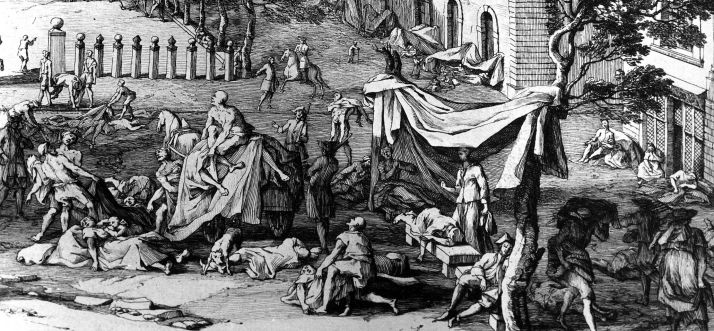
This is not the first time in history that the world has suffered through a pandemic that altered the lives of people around the globe. We’ve all heard of the Black Plague from the Middle Ages, the bubonic plague that sent Isaac Newton into quarantine, and the Spanish flu of 1918. Our medical knowledge and communication mechanisms made it incredibly difficult to stop the spread of disease in each of those eras leading to dramatic alterations of societies and even a lowering of the average life span. It would take centuries of research and decades of twentieth dedication to finally discover to a more comprehensive understanding of how and why such diseases suddenly appear, run amok in the human population and then eventually burn out. Scientists would learn how to treat and even prevent the most dreaded infections but they would also come to the undeniable conclusion that new strains of virus and bacteria are certain to find their way into the human body again, threatening worldwide medical emergencies.

Just as we humans evolve so to do all aspects of the natural world. In a kind of symbiotic dance organisms fight for survival just as we do. In spite of our human brilliance we are continually challenged by disease. In most cases we have a somewhat clear understanding of how things work and what processes work in the fight against the threats to our general well being. The microbes that we cannot see with naked eye have to adjust to our educated assaults on them and so there is an underworld determined to take hold of our well being that goes unnoticed until a stealthy take-over arises. So it is with Covid-19, a new type of Coronavirus that has emerged to confound us.

Everything about this virus is confusing. We attempt to discern it’s patterns and just when they appear to be clear we see behaviors that don’t make sense. It is as though this tiny organism is playing with us, taunting us with its power to change our daily lives. We reel both from the deaths that it has incurred and the confusion it has set loose on society. We prefer routine and a sense of control, both of which feel more like chaos in the moment. Our calendars are useless. Our plans are on hold. Our economic security is as threatened as our health. How can it be, we wonder, that something that we cannot even see has so much power over us? What can we do, we ask, to reclaim our lives as they once were? Why, we plead, is there no clear pathway to feeling secure once again? Such is the very nature of pandemics.

Books have been written about death overwhelming the world in the form of illness. Albert Camus gave us a philosophical glance into how such moments affect our very natures in The Plague. Katherine Porter provided us with a movingly human portrait of the impact of the Spanish flu in Pale Horse, Pale Rider. In A Journal of the Plague Year Daniel Defoe provides a harrowing account of living during the 1665 plague that visited London with death and destruction of an unimaginable sort.

These accounts and others remind us of both our human frailties and our unwavering strength as living beings. From time to time throughout our history we have been jolted from our complacency into the frightening need to protect ourselves and those we love. We are no different from the people who have endured such wide sweeping contagion in the past. We feel the need to be cautious but also understand that survival is additionally about being able to provide for ourselves. Our dilemma becomes an almost unanswerable question of when to stay in the protection of our homes and when to resume the cadence of daily life without danger. Sadly the experts among us are as uncertain as we are as to which will be more deadly, returning to the crowded streets or remaining behind closed doors. They cautiously advise us and we would do well to heed their advice even as they admit their own uncertainty.

We can learn from history and from science when we are greeted by a new strain of disease but we must understand that it may or may not follow past protocols, especially one like Covid-19 that does not always behave in totally predictable ways. We do not know how or when or even if it will return in massive waves. We are unsure that catching it and surviving it leads to permanent immunity. We can only experiment to find adequate treatments. We can work on finding a vaccine but it may take time to determine if such a remediation will actually work. In the meantime economies across the globe are in a shambles. People have lost their jobs and businesses and much of their funding for retirement. They worry that their homes may be the next thing to go. Some even struggle just to have food to eat. Little wonder that depression and even anger is creeping into the atmosphere like a miasma.

The balance between maintaining control of the disease and keeping the world of work and commerce alive is tricky and if we are completely honest nobody is able to say with total confidence what is the best course of action. It’s easier to opt for staying safely at home if an income is still coming each month. It’s far more difficult to see continued lockdown as a viable route for those who have lost their livelihoods with no hope at present of finding new employment. Our compassion has to include not just those who are sick but also those who worry about how to survive in the future.

The authors and historians of old tell us that what we face around the globe is oddly echoed in moments of the past. The descriptions of life during earlier pandemics might have been written only last week. The same fears and horrors have stalked humanity again and again. Somehow those left to pick up the pieces found ways to rebuild and move forward again just as we surely will. The important thing will be to be certain that we do not do so without regard for those hardest hit by both disease and economic catastrophe. Those of us who have should be fully aware of those who have not.

If we leave this historic moment without learning from its lessons we will have missed an opportunity to become better than we were only weeks ago. How we choose to behave in the coming weeks will determine the trajectory of history. If we selfishly move forward without regard and respect for both the virus and the economic health of the world I fear that the fatalities of both body and spirit will be innumerable. If, on the other hand, we are able to be the good news that we so desire I think that we will ultimately be just fine. I believe that we have it in us to be the change that we wish to see in the world. We just have to learn from the past and strive for a better future.

Stick With the Plan

1_How_to_make_a_bed_in_your_car_person_sleeping_in_a_car

Back when our girls were in middle school and high school we took long car trips each summer with our gear stowed in the back of our truck. We generally made reservations at campgrounds before hitting the road, but sometimes our wanderlust led us to unexpected places where we needed to find a spot to pitch our tent for an evening. On one such occasion we decided to take a little detour to Yellowstone National Park on a return trip from Glacier National Park in Montana. It was a bit of a drive to say the least but we were young and adventurous back then. We assumed that somebody would have a little patch of ground for camping available so we didn’t really think there would be a problem bunking down for the night. We were wrong.

This was the year of the big fires in Yellowstone so many of the usual camping areas were closed down to protect both the wildlife and the tourists. We spent several hours hiking around the parts of the park that were still open and gazing at Old Faithful, then as the sun went down on the horizon we set out in search of a place to stop for the night. To our dismay nothing was available anywhere. As the clock ticked we even tried hotels and motels but there was no room at the inn. In a state of exhaustion we eventually found a spot to park the truck and curled up into uncomfortable balls hoping to get some rest inside the confines of the truck.

I doubt that any of us other than Mike slept much at all. By morning we felt grouchy and unkempt but we suffered silently while Mike searched for a service station where he might fill up the tank with gasoline and rustle up some food for breakfast. When he went inside to get the grub and pay for the gas all hell broke loose inside our vehicle as the girls and I vented our crankiness and frustrations. It was a prize winning bitch fest that ended as suddenly as it had begun as soon as we saw Mike emerge from the convenience store bearing coffee, milk and donuts. With a satisfied grin on his face he passed out the goodies while exclaiming how proud of us he was. “You are really troopers!” We simply sat silently exchanging Cheshire Cat grins with one another while munching on our makeshift breakfast. 

The way many of us are now feeling during our period of isolation reminds me of that time of long ago. We had been cooped inside that truck for long stretches of time during our cross country travels. When we had the luxury of unwinding in the open air and enjoying a warm shower before lying down to sleep we adjusted well, but when the uncertainty of finding a place to rest became real it rocked our sense of security and we lost our decorum. I think that the long stretch of time locked mostly in our homes during the pandemic has frayed our nerves in a similar manner and as a result we are all over the place in our interactions with one another. Our anxieties however they may lead us are making us snap at those who appear to disagree with our way of thinking. Petty fights are breaking out more and more often.

There seem to be three camps right now: those who have decided that the whole situation is an overreaction that must end, those who are so fearful that they will be wary of leaving their homes for an indefinite period of time, and those who believe that if we use data, caution and proper measures for returning to the business of living we should eventually be okay. In the moment our nerves are exacerbating our clashes of opinion. We are sometimes aiming our anger at one another rather than the problems.

This pandemic has created a big gooey ball of difficulties that range from illness to economic loss to psychological concerns. I am by nature a data driven person. Everyone who knows me realizes that I always put people first but sometimes efforts to help individuals require objective analysis and this is true now more than ever. We cannot draw conclusions until we have all of the information that we need. We should not make life threatening decisions without considering all of the pros and cons. Most importantly we need to understand the concerns of all the stakeholders. Rushing forward one way or another may lead to more dire consequences so it is in our best interests to be rational rather than emotional.

Inside my personal memory from our traveling days lies a kind of moral. Each of us indeed feels the brunt of negative emotions when things go awry but in the end the hero of the story is the guy who gases up the car, brings food to everyone and then after eating calls ahead to the next town to find a campsite where we might rest and decide on the next moves. This is exactly how my story reached a happy conclusion. The bickering between me and my daughters was an understandable outcome, but it was Mike with his steadfastness and calm who saved the day.

For as long as I can remember that same Mike has always counseled us to “stick with our carefully thought out plans.” That sage advice has worked out well for our family time and again and it has only been when we deviate that problems have occurred. Perhaps it would be wise for our country to consider the merits of staying the course of rational and data driven decisions even when the road gets a bit rough. If we do this properly and together we will be all the better for our resolve.

Politely Inviting More Caring Disagreement

you way or my high way different opinion,opposite disagreement o

Some things that I see and hear both embarrass me and make me feel quite sad. For example, I understand how eager many people are to return to work or a normal routine in the time of pandemic. I am fully aware that some are desperately wondering what they are going to do if this nightmare lasts much longer. They have lost their jobs or perhaps are hourly wage earners who have been unable to work for weeks. It has to be a terrible situation in which to find oneself. Nonetheless when I see a group of protesters in Michigan carrying guns and waving Confederate flags in an attempt to get the governor there to lift the restrictions on their lives I can’t help but wonder what guns and flags have to do with making a valid argument. In fact, such things only tend to make most of us turn away in disgust.

I believe without reservation that everyone has a right to an opinion and even to protest certain decisions. That being said I find it totally inappropriate to bring guns and flags that should be relegated to old history to a protest. The arguments for a particular point of view should be articulated with supporting facts, not insults. Why turn an important discussion into a school yard brawl?

We have a very young woman in our area who was recently elected to the position of Harris County Judge. I was a bit shocked at this development because I was a big fan of the incumbent, Ed Emmett. I believe that he always did a great job, most especially during the dark days of hurricane Harvey. It seemed a bit unfair to unseat him after he had been such a strong presence in a number of disastrous situations. Nonetheless, the election was fair and the voters had spoken. The new Harris County Judge is Lina Hidalgo is a somewhat inexperienced woman in her twenties who initially worried me, but I have changed my tune.

I don’t agree with everything that Judge Hidalgo does or says. In fact I rarely agree with everything that any politician does or says, but in this time of Covid-19 I have changed my opinion of her. I have been greatly impressed by her dedication and compassion. She has worked tirelessly in a stress filled environment and somehow manages to calmly come back day after day to support the people of the Houston area. Her pronouncements are always beautifully worded and based on the most recent information available to her. In spite of her good intentions I hear people bashing her facility with the English language, which is actually quite wonderful, and they question every decision that she makes.

It would not bother me at all if those with differing ideas were to voice their concerns rationally and respectfully but instead they hurl insults that sometimes devolve into racist and ageist stereotyping. I see no place for ugliness in a time when we are all reeling from the events that surround us. Our goal should only be to work together to do whatever it takes to eliminate this scourge from the face of the earth. Making our arguments political or offensive only averts our focus from finding our way out of this situation. Arguing as though we are children is of no substantive help. 

It has become popular of late to be brash and to behave like a bully to win a debate. For some reason there are many who see such boorish behavior as strength. I see it as a smokescreen to hide a lack of factual information and an inability to pose a persuasive point of view. People who are void of logic and carefully researched data usually don’t have to use meaningless rhetorical devices nor do they have to put down people based on xenophobia.

The most intelligent, knowledgeable and truthful people that I know have told me that Covid -19 poses more questions than answers right now. Nobody is certain about anything related to this virus. It will only be after a careful analysis and a certain amount of time that we will have a better idea of what will actually work best to combat this pandemic. In the meantime there are a number of cautionary practices that may help to stem the tide of contagion. We will have to wait and see what happens in the future. Meanwhile those who are guiding us  are using the best guesses as to what will work. We have to be patient with them as well as each other as we navigate our way to the other side, and there will eventually be another side.

This is America, land of the free, but if we are wise we will avoid abusive language when we strongly disagree. We will not imply threats with guns or flags of civil unrest. We will be certain that our comments reflect a loving concern for all. Nobody is immune from the horrible changes and pain that Covid-19 has wrought on the world. Each of us worries about the future. Let’s at least try to do so with a bit of love, politely inviting more caring disagreement.

Living From Day to Day

beautiful-sunset-sky-with-birds-royalty-free-image-865856136-1547059564Regardless of what may be happening with respect to the rest of the population I won’t be leaving my home to resume my normal activities anytime soon. My cautionary tendencies are screaming at me to take a wait and see approach to attempts to restart my routines once again. In spite of my own feeling that I am not one of the vulnerable ones despite my age, I happen to live with someone who has heart disease and I love him enough to make a few sacrifices to keep him safe. Besides, I have no assurances that my body would respond well to an infection of Covid-19. I may be kidding myself in thinking that I am made of steel.

Years ago my husband, my mother-in-law, and I came down with hepatitis A. They sailed through a relatively mild two week case while I spent three months sapped by the illness with my doctors wondering if I would ever become well again. I did finally overcome the infection but I spent over twelve weeks in quarantine, only leaving my home to visit my doctors. It took me many more weeks to regain my energy.

I suppose that my point is that I am not ready to take any unnecessary risks so I will continue staying home until it is very clear that the danger has passed. In the meantime I know how to keep myself busy but I will surely miss my encounters with people. I know that my writing has become a bit boring. I tend to find my inspiration by being part of the world at large. For now I am limited to watching my neighbors from my front room window and checking the pulse of humanity from posts on Facebook and news stories from journalists who don’t necessarily share my views. My borders have become smaller and smaller but I feel guilty to complain because my “prison” is filled with luxury.

Last year around this time I was in London. Perhaps the most fascinating place that I visited was the London Tower, home of Willam the Conqueror and countless monarchs which eventually became better known as a place of imprisonment and execution. I walked through cold stoney rooms where people had spent years languishing in isolation as criminals. They left intricately carved graffiti on the walls that speak of their frustration even centuries later. My temporary time of being shut off from society does not hold a candle to what they must have endured so I know that one way or another I will manage to get through this.

My head is filled with so many questions and concerns that it’s sometimes difficult for me to string words together in a coherent sentence. I am a thinker by nature but I have to be careful not to let my thoughts take me too far down a rabbit hole. I’d be much better off doing something constructive like Sir Isaac Newton who invented Calculus after he was sent home from Cambridge during a plague. I doubt that I will ever be quite that brilliant but it inspires me to use my time constructively rather than dwelling on possibilities that may or may not unfold. Perhaps I may use this time to relearn Calculus since I haven’t done anything in that realm since I was eighteen years old. I might even end up with a healthier mind.

It’s not as though I am incommunicado. I still speak with family and friends. Zoom, FaceTime, and Skype have been godsends in keeping me linked with people. I send texts and voice my feelings on Facebook. I read voraciously. The world is literally at my fingertips in one form or another. My worst days stuck inside are indeed mostly pleasant.

I found a list of books about plagues on the BBC website. I bookmarked the article that outlined the various volumes. It might be fun to take a look at some of them. I read The Plague by Albert Camus when I was in high school and recall being fascinated by it. Maybe it’s time to read it from the perspective of someone who is older, wiser, and has seen the actual ravages that a plague can inflict on the world. Maybe I can even set my mind to writing my own historical fiction book or story about Covid-19.

I sometimes wonder when I will feel safe enough to reintegrate with the life outside my home. The doctors in my family urge me not to be in a hurry to demonstrate my courage. They speak of their own worries for themselves and their children. They seem to believe that our dangers are far from being over. They are unwilling to suggest a time when it might be totally safe for me to emerge from my cocoon so I will just take things one day at a time, one week at a time, one month at a time without trying to gaze too far into the future and hopefully without letting my very vivid imagination get away from me.

The Spanish flu pandemic of 1918 was horrific. Writer Katherine Porter lived through that terrifying experience and later wrote a semi-autobiographical piece about a young woman who survived the epidemic. During an interview not long before Ms. Porter died she revealed that of all the tragic events of the twentieth century it was the 1918 influenza outbreak that most affected her. In fact she spoke of never having been able to totally get over the horror of what she saw during that time.

We are living history even from inside our homes. The children of the future will want to know what we did and what we saw. There is something both exciting and terrifying at one and the same time. My only hope is that however each of us chooses to react to the situation we will do so with the intention of making it a bit easier for everyone else. For me that means staying put for a bit more time.