Not Today!

Churchill War Rooms

Our trip to London had been carefully planned, but in our concern with hundreds of little details it had never occurred to me that scheduling a visit to the Churchill War Rooms at the end of a week of seeing all of the major sights would turn out to be so perfect. In fact by learning about so much of the history of this great city I truly understood what was at stake when Adolf Hitler threatened to overtake the whole of Europe with his warped political philosophies. In an effort to keep the peace much of the continent had bowed to his demands only to realize that his appetite for domination was not easily sated. For a time Great Britain seemingly stood alone in its determination to remain free from Nazi tyranny and the consequences for doing so were grave. Somehow through the inspired leadership of Winston Churchill the people fought valiantly against the greatest of odds.

History will never know how things might have ended had Great Britain compromised with Germany as some desired. It is uncertain if the people would have been able to endure the unrelenting attacks from the air on London were it not for Churchill’s determination to convince the citizens that surrender was not an option. The entire world might be very different today if Britain had fallen before the United States eventually entered the war. Instead the people of the British Isles fought with every fiber of their courage even as the landscape around them was turned to rubble. They were a proud and determined people with a leader who loved his country and its freedoms so much that he was committed to making whatever sacrifices needed to save Britain from unwanted domination.

The Churchill War Rooms were hastily created in an underground area near the government offices in the center of the city of London. They became the nerve center for the planning of strategies and battles. While they now appear secure from dangers above ground the fact is that they might have been instantly destroyed had an enemy bomb caused the building above them to fall. The honeycomb of offices, sleeping quarters, and conference rooms was improvised to provide safety to the key leaders of the war effort, including Winston Churchill. Today it stands as a vivid reminder of what was at stake not just for the people of Great Britain, but for the entire world during those fateful years when evil was overtaking most of Europe, Africa and the Pacific.

I had not realized how deeply affected I would be by viewing the Churchill War Rooms, but as I walked through a maze of rooms left just as they had been on the day that war ended for Europe I was moved to tears at virtually every turn. Because I had spent a week learning so much of about this great country I was able to fully understand both the fears and the determination that the citizens must have felt as the specter of pure evil hung over them. They were literally on the brink of losing all that they had ever cherished, and after fifty seven straight nights of bombing over the city they must have felt even more terrified. Somehow their leaders found the inspiration needed to keep hope alive, and much of what they did took place in the tiny rooms below the ground.

The tour of the Churchill War Rooms lays out both the brilliance of leaders like Winston Churchill and the humanity of the British people. I literally heard their voices telling the story of one of the darkest times in history. I saw their faces in countless photographs and films, and witnessed the devastation that seemed almost unending. All of my senses were immersed in a retelling of the horrors of the time and the bravery of a generation that said a resounding “No!” to those who would enslave nations.

I felt humbled beyond words and filled with my own private thoughts as I slowly wound my way through the tales of privation, loss, and courage. The ghosts of the people who had worked there came fully alive as did all of the citizens who chose to stand firmly against surrender. I felt the spirit of good versus evil, right versus wrong. I understood the humanity of what had happened before I was even born.

When I returned to the light of a gloriously beautiful day I was happy that I had time to sit quietly and collect my thoughts. I had been moved from one emotion to another and I needed a moment to simply meditate on what I had seen. Never before had I quite understood what my parents and grandparents had felt during that terrible war. Not once had I realized why occasions like D-Day in Normandy were so important to them. I had not fully comprehended how frightening life must have been nor had I felt so grateful for freedom.

As we walked through lovely gardens in sight of those underground bunkers I felt a sense of profound appreciation for the most simple aspects of the world. I saw the flowers and the birds in a new light. I felt gratitude for the people of Britain for holding the line against the evil that threatened the future into which I came.

I smiled when we encountered a political demonstration in the streets in front of Parliament. It was a raucous affair decked with flags and the nation’s colors. Traffic was stopped for miles around. The sound of bagpipes filled the air. People spoke their minds without worry. It was a show of freedom that might not have been there had things gone differently during World War II. I silently gave thanks for the folks who had said to Adolf Hitler, “Not today!”

Demonstration.jpg

God Bless America/God Save the Queen

The Guards

Ironclad plans for a trip are fine until they fail. One of the most positive aspects of traveling independently is the ability to make last minute corrections. Such was our decision one morning at breakfast when we realized that if we hurried over to the Russell Square underground station and headed for Buckingham Palace we might be just in time to see the changing of the guard that was to be held that morning. After all the rest of our day was dedicated to places where there was no need of tickets, so we had all of the flexibility that we needed. We took a deep breath, entered the fray of early morning crowds headed to work and girded our loins for whatever we might find ahead.

The train was so packed that we felt like sardines and it only became worse as we drew closer to our destination. Our foray inside a crowded train would be good practice for the swarm of humanity that we would find waiting at the gates to Buckingham Palace. We realized immediately that we would not get a prime view of the proceedings, but at least we were there and we’d have to just do our best to catch a glimpse of the proceedings here and there.

Unfortunately most of the best spots right along the fence line were taken by very tall men who further blocked the view by raising their arms to hold their cameras high in the air. Husband Mike and my brothers had no trouble looking over the shoulders of the lucky ones who had arrived early enough to stake out a claim to prime property, but my sisters-in-law and I were unable to see much even when we stood on tippy toe. Sister-in-law Becky decided to choose a different point of view and went to the very back of the crowd so that she might see the troops as they marched into the palace grounds. Allison and I found ways of glancing down low and in between the bodies of those who blocked our normal sight of vision. All in all it was a frustrating situation but one that we learned how to eventually make work.

By the time the proceedings began the area was a mass of humanity all craning their necks to see the red coated military men marching proudly across the grounds. They played traditional pieces that most of us had expected to hear, so a sense of great satisfaction swelled over the crowd. I saw enough of the upper half of their bodies to feel a sense of exhilaration, and I had perfected my method of finding tiny holes in the wall of people to make me feel as though I was part of something quite grand.

Standing on my toes and bending down became my official “modus operandi” so I hardly noticed that people from behind were pushing forward to get a view of their own. A woman who had a birds eye view in the front row suddenly became overcome by claustrophobia and decided to leave. Before doing so she offered her spot to me. I could not believe my good fortune as I suddenly stood right behind the fence along with the row of tall men. I was mesmerized by the sheer beauty of what I saw.

The soldiers with their red jackets and polished brass buttons stood tall and stately with their heads proudly bearing the black bearskin helmets that are the trademark of their station and their duties. I saw that they were not just showmen because the guns that they carried were real and quite powerful. They were indeed trained and equipped to be guards. I later learned that many of them had served in dangerous places like Afghanistan. Their precision bespoke of discipline and pride in their work. I was almost giddy at the wondrous sight that I was watching unfold. It was as though I was part of a living fairytale not unlike the ones that my father had so often read to me. I felt like Cinderella.

We were entertained by military songs and modern music, marching, and even a mounted cavalry wearing riding boots and a different sort of cap featuring horse hair. The pageantry was even more glorious than I had imagined it would be and my companions and I were quite delighted.

As is my way I found myself thinking of the rag tag revolutionaries of the colonies of north America who had the audacity to rebel against such a well trained and disciplined army of red coats back in the eighteenth century. It must have required an enormous amount of frustration over the political situation to risk fighting such a group. Little wonder that the prevailing belief was that the so called patriots would soon be put down by the seemingly superior forces and normalcy would return. I’m not so sure that I would have had the courage to side against such a powerful army, and yet I know from the study of my family tree that there were indeed ancestors who chose to join the revolution to free themselves from what felt like tyranny.

I suppose that we Yanks are the wild children of Great Britain. We came from the same stock but the new world changed us. We were far enough away from the old ways that we began to question the authority of a king who was making our lives more and more difficult. We had risk taking in our DNA. Our thinking diverged from the land of our origin and in the end we eschewed royalty and opted for freedom, even though our first form of it was far from perfect. It would take some time before we freed our slaves and allowed women to move to the front so that they too might participate in the grand experiment of the republic.

My spot along the fence of Buckingham Palace standing as an equal to the big tall men who had at first blocked my view felt like yet another metaphor for how far I have come from the time of my ancestors. I have roots in Great Britain that make me proud, but in the end I am a foreigner in that land. Neither I nor anyone not born of the Windsor family will ever be royal, but in my country anyone might aspire to be President. That is the grand difference that came from the revolution of long ago.

I possess all of the traits of an American including great pride in my country and a kind of brash sense of equality with every other human, but I still cherish the traditions of my history. I felt a kinship and a sense of friendship as I watched the ceremony unfolding before me, knowing also that I would not have been standing there were it not for the opportunities that the United States has given me. God bless America and God save the Queen!

A Walking Timeline Through History

Trafalgar Square

When the best laid plans go awry, pathways to new adventures often show themselves. We were to have spent our morning watching the changing of the guards and our afternoon at Westminster Abbey. The cancellation of the tradition of pomp and circumstance at the palace had sent us scurrying to the Gothic church far earlier than intended, so once we were finished with our tour we became untethered and aimless wanderers around London.

The roads almost inevitably lead us past the halls of Parliament where protests centering on the Brexit issue were a constant feature during our time in the capitol city. We glanced disappointedly at Big Ben which was shrouded by the apparatus of reconstruction save for the face which never changed because it was not working. We wondered as we longed to hear the famous chimes if somehow all of our planning was doomed to go up in flames, but we soldiered on, walking past a highly secured area that housed the home of the outgoing Prime Minister.

There was much stirring behind the gates. We saw official looking men wearing formal  jackets filled with medals leaving the premises with grim expressions. It told us that Theresa May was no closer to creating a plan for transitioning Britain from the European Union to a  more nationalist entity. There was a noticeable tension in the air that hovered over the halls of government and the silence of Big Ben added a metaphorical touch to the chaos.

After walking for what had seemed like many miles Trafalgar Square was in view and husband Mike became quite animated by the thought of seeing the iconic tribute to those who had fought so valiantly in World War I. First, however we would pause for lunch in a nearby pub where I admittedly struggled to find something that appealed to me on the menu. I generally eat a very light midday meal and there was very little of that sort to be found among the traditional English food being offered, so I essentially skipped eating and instead enjoyed a lemonade and a much needed rest for my feet. I used the time to find and purchase the tickets that we would use later that night to see the choral concert at Westminster Abbey.

Once everyone was refueled we headed to Trafalgar Square which was quite joyfully bursting with life, mostly from tourists and street artists. The atmosphere reminded me of the area around St. Louis Cathedral in New Orleans, Louisiana. There were accomplished musicians and singers entertaining the crowd with performances worthy of Albert Hall. Using only chalk and their imaginations many individuals drew masterpieces on the grand sidewalks of the square. A gigantic fountain surrounded by enormous lion sculptures served as a photo opportunity for everyone who passed by, and of course there was the famous obleisk honoring the courage of those who defended the nation in World War I.

This was indeed a happy area where the tension surrounding the government buildings was replaced with a kind of serendipitous celebration of art and humanity. It felt good to be there and somehow made up for the botched intentions of our morning. We all realized that while we had not achieved what we had planned, we had stumbled upon something that was nonetheless glorious.

Just beyond all of the revelry lay the National Gallery which like so many sights in London was open to the public at no cost, so we decided to partake of its vast collection of paintings and sculpture in the time remaining before our evening engagement. This would prove to be a wonderful decision because some the the most famous artists the world has ever known were featured in the multi-story galleries.

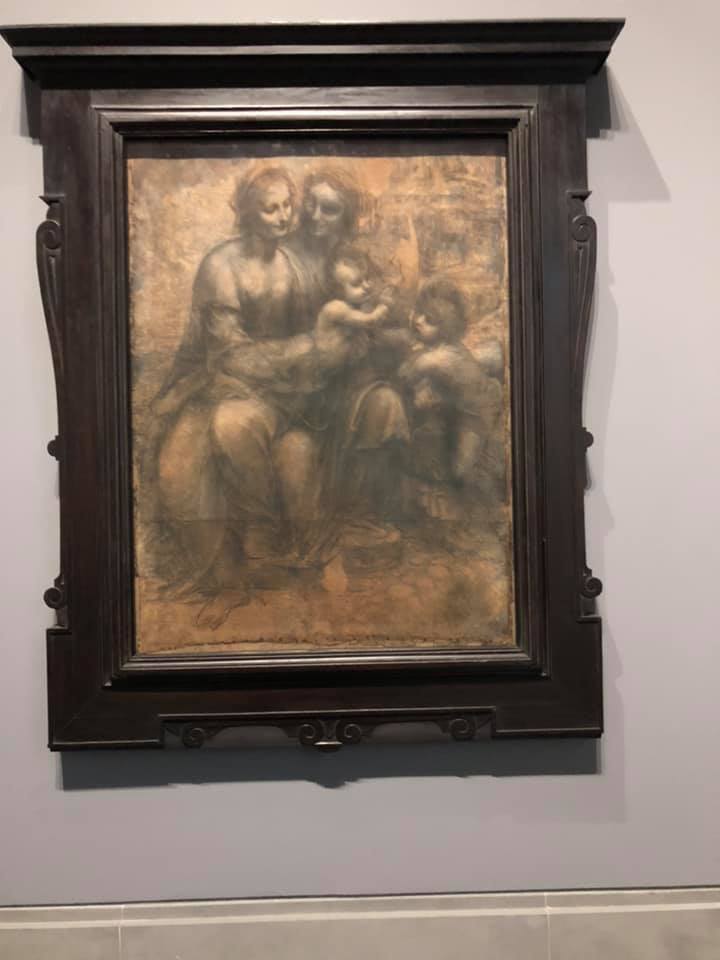
I enjoyed so many of my favorite painters and was filled with appreciation for some about whom I had known nothing. Without a doubt, however, the experience of wandering without warning into a room containing the work of Leonardo da Vinci was the highlight of the visit for me. The funny thing is that I had spied his drawings from out of the corner of my eye and had noted that I felt drawn to to them before I realized that the great master had created them. There was a kind of lively charisma to even the preliminary sketches that elevated the pieces to a level unmatched by any of the other artists.

I might have stood transfixed in that room for hours were it not for the fact that we had agreed upon a meeting time in the coffee shop, and that hour was drawing near. It was with great reluctance that I took one final glance at the glorious paintings and headed down to meet with the rest of our party.

We enjoyed a bit of respite and a great deal of animated conversation over steaming cups of Earl Grey tea as we spoke of our favorite works of art. We all agreed that we had somehow been led to a most enjoyable afternoon by the “gods of travel” and we promised that if we had some additional time later in our trip we would gladly return to this wondrous place to be certain that we had not missed anything.

When we emerged into the late afternoon air we saw that the festivities taking place in Trafalgar Square had not abated. It seemed to be an oasis of cheer and goodwill which was perhaps the intent when it had been designated as a memorial to all that is good about Britain. After the horrors of World War I the citizens needed to remember, appreciate, and celebrate the many sacrifices made. I thought it fitting that the joy of peace time was still very much in the air.

We walked away with an even greater sense of the spirit of London and its people. In a single day we had looked far back into their history and gazed at the gravity of their present. It had been like walking a human timeline during which we witnessed the resilience of the people. We realized that they had made mistakes before, and perhaps were enduring them even now, but always they seemed capable of adjusting their course and moving on the right side of history.

Saving A Mind

colorful fluorescent lamps
Photo by Timea Kadar on Pexels.com

The world can often seem to be far more violent than it once was, but even a brief glance at the past proves that we have always had evil in our midst. The biggest difference between now and then is that we hear about every instance of criminal or terroristic behavior almost instantly regardless of where it happens. Not that long ago we maybe heard a one minute blurb on the nightly news or read about the incidents in our local newspaper. It was easy for knowledge of such things to slip through the cracks so to speak. Those who committed heinous crimes usually did not achieve the level of notoriety that they do in the current climate. There was not as much incentive for copy cats. There was not as much information for those with sick minds to emulate.

I have a fascination with people and the way they do things. My interest made me a good educator because I did not just provide information to my students, but I was also understanding of who they were and what they needed to be confident and successful. I quickly learned that the teen years are difficult for even the most gifted and mentally healthy young people. In following my students after they graduated from college and entered their twenties I realized how confusing it can be to transition into the adult world. What I found in my observations is that there are certain situations that lead to more frustrations and tendencies to feel lost and abandoned. Our journeys through life require love and support which is not always forthcoming for every person. Feelings of alienation are amplified by mental illnesses and a sense of aloneness.

If we examine the lives of criminals and those who do horrendous things there are often commonalities. Loss of a parent or loved one can trigger unresolved anger, particularly at certain critical ages or when the individual has other mental problems. So many of our offenders are people who have been abused or who have disorders of the mind that have been improperly treated. They are already filled with frustrations and then some comment or incident triggers the rage that has been seething inside of them. In the aftermath of their criminal acts there always seem to be individuals who noted disturbing behaviors in them but felt helpless to do anything about them.

The conundrum that we have is how to balance our right to individual freedom with common sense approaches to treating conditions that may lead to tragedy. At the present time our society bends in favor of caution with regard to personal rights. We are more likely to defer to a person’s decision to be left alone, even when our instincts tell us that trouble is brewing in his/her mind. Our laws only allow us to force therapies and treatments in extreme cases. Furthermore, we often ignore cues as being just the way a certain individual is rather than seeing them as signs of greatly needed attention.

When we couple all of this with the generalized anger that is so commonplace today, we are creating human time bombs that have the potential to go off at any moment. While we rant over things that make little or no difference in people’s lives we miss opportunities to help someone overcome the war raging in the mind. Over and over again we ask why we have so many guns or bombs or implements of violence while showing little or not interest in discovering why we have such broken beings. Maybe because we are still too timid to speak of the diseases that exist in the mind or to tackle childhood abuses that so often lead to monstrous adults.

We ask when we will have enough courage to take away the means of violence, but we rarely ask when we will have enough courage to attack the problems of the mind that so often lead to that violence. We act as though noting the mental problems of a criminal are akin to excusing the acts rather than admitting that we somehow missed the cues that might have prevented the murderous rage from ever happening, and there are always signs.

There were teachers, students and parents who expressed their fears of the young men who wreaked mayhem at Columbine long before anything happened. Their concerns were all but ignored. There was a psychiatrist who noted that the crazed attacker of a movie theater was dangerous, but she was ignored. Nobody really listened to the mother of the autistic loner who was afraid of her son who would later kill little children at an elementary school. The list goes on and on and on yet we still do not insist that our system of mental health needs a full overhaul. We continue to avoid the family with the strange acting child or teen. We forget to support and counsel someone who has experienced a tragic loss.

When my father died I was only eight years old. Few adults thought that I had any real idea of what had happened or that my emotions were developed enough to really matter. The truth is that I was filled with a mixed bag of confused feelings. I was depressed but mostly angry. Luckily my mother created an environment in which I was able to eventually sort the toxic thoughts that ran through my mind. I experienced stability and kindness that helped me to feel secure in a moment when my world felt so chaotic. It took a long while to reach a point of well being, but the healthy routine of my world along with an entire village of people who were interested in helping me led me out of the darkness. As an educator I know that far too many young people in similar situations who feel totally alone and hopeless. Unless their anxieties are addressed they will only grow more and more angry over time. Before long society will simply view them as troublemakers and evil doers. We will have missed the opportunities to help them to become better versions of themselves.

When a shooting or other violent act occurs it should be a reminder to us that we have much work to do to save more minds. We inoculate against disease and treat illnesses of the body routinely, but we are still way behind when it comes to the mind. It’s time we attempt to catch up.

You Are Where You Belong

blur cartography close up concept
Photo by slon_dot_pics on Pexels.com

Everything you did brought you where you are now, where you belong.

—-Bran, Game of Thrones

Both the books and the HBO series of the epic Game of Thrones have been an international success making countless individuals famous and wealthy, not the least of which is the author, George R.R. Martin. Like The Lord of the Rings the story serves as a kind of fantastical history of mankind with a cast of characters with both godlike abilities and disappointing human frailties. GOT as it came to be known is made exciting with dragons, magic, battles and intrigue but at its heart is the story of people. It is one gigantic metaphor for all that each of us endures as we march steadfastly on our personal hero’s journey.

I once wrote an extensive paper about my paternal grandfather for an oral history/folklore class. I interviewed the patriarch of my family over a period of countless hours learning as much about the facts of his life as possible, as well as determining the overriding theme of his existence as revealed by his words and the things that he chose to remember. By the time that I made my recordings he was over one hundred years old and had experienced the most incredible events of the twentieth century which he often used as a comparison to the nineteenth century into which he was born. While his life was filled with hardship and abandonment much like Jon Snow in Game of Thrones he harbored little ill will toward those who had chosen to neglect him, instead patterning his life after those he most admired.

Grandpa often spoke of everyday heroes like the grandmother who raised him with a kind of reverence for nature and people. He was apt to recall a strong man from his childhood community who performed unbelievable feats. He borrowed his name and his greatest admiration from an uncle who had graduated from West Point. He regaled us with stories of people of honor and integrity as though they had been gallant knights of old. He almost pridefully boasted of his own prowess in being immune to the ravages of the smallpox epidemic that overtook his town as well as his determination to boldly walk away from what he believed to be his drunken ways. He journeyed alone from one place to another until he found his ultimate purpose in life which was to love and care for the fair maiden, Minnie Bell, his wife and my grandmother. He was loyal to her and to his children, and he overcame one challenge after another with the overriding belief that his journey was exactly as it had been meant to be.

I cut my teeth on stories from my grandfather and the fairytales that my father read to me. My own life was punctuated with tragedies that changed my course again and again. While I am at heart a person of routine I had to learn how to adapt to sudden and unexpected changes just as we all do. Life is never a straight open road, instead it is a series of twists and turns and rocky pathways. We have to not only be willing to endure the surprises that await us but also to deal with them. Like my grandfather I not only learned how to don my armor in difficult times, but also how to appreciate how each little alteration of the journey seemed to lead me to people and places that I was destined to encounter. Everything brought me to this very moment in time and I know that it is exactly where I belong.

Each of us is a character in our own epic story in which we meet villains, heroes, brave knights who protect us. We are sometimes betrayed, but more often we find comrades who stand beside us through the worst that nature or mankind throws in our paths. We ourselves falter and learn and grow. We are surprised by those who rise to occasions when we had underestimated their bravery. We are humbled by those who seem lost and then fight to redeem themselves. We find true love when we least expect it. We learn how to appreciate the best of our days because we understand that there will also be those that leave us exhausted and bereft. If we are wise we are flexible and willing to embrace change for it is as inevitable as the rising and setting of the sun.

The stories that we tell, that we read, that we cherish have only so many themes, so many literary devices. No matter how fantastical they may be, in the end they are based on our common human experiences and they center on people and how they adapt to the forces that enter their lives. Our history is in fact a personal tale that should remind us of our imperfections and the power of mercy and redemption in moving us forward.

We are living is strange time. All the progress of mankind should be making us happy but instead the world is tinged by discontent. We are walling ourselves off inside our castle keeps, when our knowledge should tell us that eventually the things that we most fear will find a way inside. We need to be open to alliances with those who differ from us and we must develop alternative ways of thinking. We need to search for the real heroes who are often the quiet ones rather than those who boast. Mostly we must remember that each of us has a grand purpose that is not nearly as ordinary as we may believe. Let us rejoice and be happy in the good that we have done and show mercy when we falter, never forgetting that we are just where we belong.