Facing Our Failures

Failure.jpgThere is a trite little platitude that goes something like this, “Failure is not an option.” In reality it is a very human trait to fail at something even after exerting great effort to succeed. We all find ourselves in the midst of a fiasco now and again. It is part of who we are as people. We may fail a class even though we thought we were prepared. A relationship may sour in spite of our efforts to save it. We find ourselves being fired from a job or unable to successfully complete an important project. We wreck our car in the split second of a careless moment. We say and do exactly the wrong thing in a situation with our children. We fudge on a diet or exercise program. We inevitably make mistakes in the course of living our lives.

Perhaps instead of suggesting that there is something innately wrong in failing, we should instead concentrate on how we will behave once the genie is out of the bottle, the milk is spilled, the horse is out of the barn. Our character is often defined more by how we react to failure than how we reach success. It really doesn’t matter how many times it may have taken us to achieve a goal as much as how resolved and persistent we have been in getting there. Our willingness to keep trying often determines the trajectory of our lives. Those who adapt optimistically to their circumstances are likely to ultimately overcome even the most challenging situations. In addition, we need to teach ourselves and others how to identify toxic situations and to recognize when to walk away from them.

I know a man who literally spent almost a decade attempting to earn a college degree. He had to work to pay his tuition and the coursework was sometimes quite difficult for him. He would joke that he was going to be the oldest graduate ever. Nonetheless, he kept his eye on the prize, never giving up, even when it seemed hopeless. The day came when he held his diploma in his hand. Ultimately it was his unstoppable tenacity that earned him a great job and his willingness to keep trying against all odds has become his hallmark. He has risen to the top of his profession, admired by peers and bosses alike as someone with a dogged willingness to get the job done. He is the go to man when the situation gets tough. Everyone knows that he will not take no for an answer.

Beethoven composed symphonies even after becoming deaf. Thomas Edison had to create hundreds of prototypes before finally finding a lightbulb that would work. Albert Einstein was thought to be a slow learner at school. Abraham Lincoln was initially seen as someone incapable of achieving much of merit. Walt Disney was told that he had no creative instincts. The list of so called failures who eventually became famous for their contributions to the world is long because the reality is that we all hit walls from time to time.

Too often we dwell on the things that we have done wrong rather than just picking ourselves up, deciding how to improve and then moving on. When we become captive to the negativity associated with failure we give up, run away. We assume that there is no reason to keep banging our heads against walls. We end up with regrets. We think of our might have beens. The go getters, instead, dust themselves off and get back in the saddle. They learn from each unsuccessful iteration and apply their new found knowledge to improving their lots. They remain unafraid to take risks.

I sometimes wonder if our society creates individuals who give in to failure because of the ways that we speak of it and react to it. In schools there is linear progression of learning with tests along to the way provide evidence of accumulated knowledge. Students mostly move in lock step from one skill to the next. For those who may take a bit longer to master concepts the process becomes a series of failures that all too often result in a feeling of hopelessness. I all too often heard the refrain, “I’m just not good in math.” The truth was that everyone of those who uttered such remarks was more than capable of becoming adept with numbers. They just took longer to grasp the ideas. With a bit of effort and encouragement they were eventually able to achieve a high level of comfort with very complex algorithms. They felt a sense of accomplishment that in turn lead to a greater willingness to explore even more difficult ideas.

When I was in middle school a gym teacher told me that I was the clumsiest, least athletic person that she had ever met. She ridiculed all of my efforts to please her. As a result I mostly traveled through life thinking of myself as a total klutz, unable to even catch a ball. It was not until I met a professor in college that my attitude changed. He convinced me that I too could be skilled if shown the proper techniques. He insisted that my old teacher had been remiss in expecting me to possess natural born abilities in sports. He taught me the fundamentals and my world as well as my attitude was transformed.

We certainly value the child who is capable of taking the school team to the championship. We send our finest debaters to the competition. Still we must be willing to provide opportunities to shine for those who are not as gifted. It is up to us to model behaviors that will teach them that improving is just as important as winning the prize. We have to let them know that they will ultimately find their pathways by participating in many different experiences.

I am particularly taken with the attitudes of my twin grandsons. They are incredible athletes but they do not measure success by the number of medals or trophies that they earn. Instead they focus on being their personal best. Their goals always involve moving just a bit closer to a better individual record. If doing so happens to give them a championship it is wonderful. If it only demonstrates that they are getting closer to their goals they are just as happy. They have already developed a way of thinking that is going to take them far. Would that we might be able to do the same for everyone.

Failure never feels good. It is a downer that we don’t want to experience but it sometimes happens. If we can analyze our situation and make improvements our mistakes will not have been for naught. We are all on a journey. How well we do depends on our ability to adapt and become stronger. That requires a positive willingness to keeping trying to find our way. If we keep the faith it will happen. Perhaps our new mantra should be, “Giving in to failure is not an option.” We would be wise to teach that to our children as well.

Speak Out

censorship-1.gifAttending college was one of the most exciting times of my life. My professors challenged the status quo of my beliefs and taught me how to think critically. They were never satisfied with having me simply regurgitate what I had learned. They insisted that I show evidence of having considered the pros and cons of every argument or theory. They showed me the importance of viewing the world from multiple points of view. I remember attending events featuring some of the most controversial speakers of the era. It mattered not whether I agreed with them, but rather that I allow myself to widen my own horizons. Some of those that I heard were brilliant and I wrote others off, but always there was the sheer enjoyment of becoming familiar with new and intriguing philosophies.
When I became a teacher I was enthralled with the idea of showing my students how to become critical thinkers. Even in mathematics classes we compared and contrasted differing methods for solving problems and began to discuss the merits of each. I once prefaced such an exercise by having my students read accounts of a Revolutionary War battle written by four quite different individuals. One was the eyewitness account of a patriot, another was from a letter written by a British soldier. Still another was penned by Winston Churchill for his famous history and the last was from the point of view of a bystander who had little interest in choosing sides. The students immediately realized that how we see the world is influenced by all of the complexities of our lifetime. They began to question who had been in the right and wondered if we ever get a totally unbiased reporting of events. It was quite rewarding to watch the scales fall from their eyes and to experience their enthusiasm in being able to engage in a debate.

I am and always will be a staunch proponent of free speech. Unlike many people that I know, I actually enjoy hearing from individuals whose opinions are diametrically opposed to mine. When in their company I listen with as open a mind as I might possibly muster, realizing that my own thinking is rooted in the totality of my lifetime. My goal is not to catch them in mistakes but to truly learn from them. It is rather amazing how much I derive from even the most ridiculous sounding ideas. I have always felt that we tend to spend too much time composing our responses and not nearly enough attempting to understand why people believe as they do.

Obviously there are many instances in which I am not even minutely swayed by someone’s beliefs, particularly when I sense that they are evil or violent. I have read Mein Kampf not because I am a follower of Nazi propaganda, but because I think it is important to know what lies in the minds of such people. Perhaps the biggest mistake that too many make is running away from the rants of those who would impinge on our freedoms. In truth we should make ourselves aware of even their most rancid and unbearable thinking. I agree with the Godfather that it is important to keep our enemies close.

I abhor censorship of any kind. Free speech is perhaps our most important right as citizens. When I write my blog each weekday I am fully aware that I will annoy or even anger some who read my words, but I will fight to the death for my right to state what I believe. I will do the same for anyone else, even those with whom I totally disagree. The hallmark of totalitarianism is the tendency to eliminate the written or spoken words of those voicing alternative points of view. A free nation insures free expression of ideas in all phases of society. If someone urinates on a cross and calls it art I may choose to disagree and even feel offended, but I will never insist that the offering be destroyed.

I am somewhat befuddled by the current trend to shut down free speech at universities that were once bastions of open expression. I don’t personally like Ann Coulter but I have no problem with having her speak on the campus of any college including my alma mater. I don’t have to attend the event and I certainly don’t have to agree with anything that she says. What I should insist on is that she have her opportunity to speak her mind without interference. Sticks and stones may break my bones, but her words will never hurt me. In fact, I suspect that her audience would be rather small if not for all of the unearned publicity that she gets each time a group of students threaten violence if she shows up to give a speech.

The history of the world is filled with instances of book burnings and executions of people whose thoughts and words seemed controversial. The Spanish Inquisition was a dark time of squelching ideas. Members of ISIL destroy anyone and anything that is offensive to them. Surely the examples of Nazi and Communist oppression should teach us that it is in an open society that we progress as humans, not one in which we refuse to allow alternative points of view. Unfortunately I fear that we are presently on a razor thin line between wanting to be inoffensive and becoming unthinking censors. It is my love of liberty that tells me that we must be very careful in protecting our rights as free men and women. All of us should be loudly complaining any time that there are attempts to silence any among us, regardless of whether we agree with that individual’s beliefs or not.

With regards to what I am presently witnessing I am reminded of the now famous words of Pastor Martin Niemoller:

First they came for the socialists and I did not speak out because I was not a socialist. Then they came for the trade unionists and I did not speak out because I was not a trade unionist. Then they came for the Jews and I did not speak out because I was not a Jew. Then they came for me and there was no one left to speak for me.

Speak out loudly and clearly. Let no one take away the free speech of any among us.

When Happiness Is Lost

635954839284874644-229042456_Depression

I often write about being optimistic and choosing to be happy. Of course such prescriptions are fine and dandy for those of us who are not afflicted with clinical depression, but for those who are it is virtually impossible to simply will away dark feelings.

My mother was one of the happiest people on the planet as long as she was not in the throes of her bipolar disorder. When the illness hit, she was literally unable to just wish its debilitating symptoms away. One of the characteristics of her disease was a profound sadness that would overtake her with life changing consequences. She often sat in the dark, drapes drawn tightly closed, crying and worrying for no real reason at all, unable to even venture into her front yard. It was both frightening and heartbreaking to see her in this condition. It was so contrary to the person that she really was.

Mama had shown early signs of her illness that my brothers and I failed to understand. There were times when she would suddenly take to her bed for several days. We always just assumed that she had a bad cold or a virus but it was far more sinister than that. She was fighting away the melancholy that paralyzed her. In the years before her disorder became full blown and noticeably chronic she would feel down for a few days or a week and then somehow return to the person that we knew so well. Unfortunately, in 1969, she experienced a psychotic break that began with crying jags and paranoid fears. Eventually she literally believed that the FBI was trying to frame her for selling drugs. She was convinced that all of us were going to be sent to jail. Her anxiety was so acute that she was in terrible physical pain and even thought that she had died and then miraculously come back to life.

I remember one of my very sweet uncles coming to visit her during this time. He pleaded with her to pull herself together. He reminded her that she had children for whom she needed to care. He argued that she had a wonderful life, filled with love. He felt that she only needed to choose to be happy and all would finally be well. Of course we all learned that such wishful thinking was not going to materialize. It was only after a long hospital stay and medication that she was able to return to us as the person who had always possessed a sunny disposition.

My mother mistakenly believed that her illness had been an anomaly, something that would never happen again. She insisted that she was cured and that she knew how to care for herself in the future. We naively agreed with her, thinking that the worst was behind us. Little did we realize that her condition was chronic, a never ending series of ups and downs taking over the chemistry of her brain. Only with the continual help of psychiatrists would she be able to function. It was a bitter pill for her and a challenge for those of us who loved her. We had to monitor her life to an almost invasive extent because whenever we became lax so did she, and the symptoms would return even worse than the times before.

My mother was known to her doctors as a noncompliant patient. She never admitted that she had a psychological problem, instead blaming me and my brothers for her condition. She wanted desperately to prove that she never needed psychiatric care and that her illness was a figment of our imaginations. Her reluctance to accept her diagnosis and continue her therapy on a regular basis lead to one relapse after another. Her life became far more difficult than it had to be.

Mama had brilliant and caring doctors who became frustrated with her unwillingness to follow their directions. They knew as we did that as long as she followed their instructions she was able to work and be like a ray of sunshine in everyone’s lives. Sometimes her medications had to be changed, but the results were always miraculous. To her detriment and our frustration she chose to discontinue her treatments again and again. As she did so the magnitude of her depression and mania increased. It was as though she was stressing her brain to the point of bursting.

I always understood that my mother wanted to feel normal, and visiting psychiatrists and taking numbing medications with troubling side effects was annoying to her. She gained enough weight from using her drugs to go from being a slender woman to one who was rather heavy. She experienced involuntary tongue flicks and other nervous system twitches. Her ankles would swell to three times their normal size. She hated those things and would quit taking her pills in the hopes of ridding herself of their effects. Of course she would ultimately become very sick again and her doctors would have to restart her therapy from ground zero. It was a hard way of living and I always empathized with her. I tried to imagine what it was like to feel so seriously sad as she often did. I wanted to understand her pain.

Depression is a very real disease for many unfortunate souls. It is not related to an inability to see the glass as half full. Nobody consciously wants to endure its effects. Happily there are ways of improving as long as one is willing to ask for and accept help. It can be a tricky process with a great deal of trial and error in implementing a viable plan. Because it is often a lifetime disorder it can become overwhelming. The important thing is for the depressed person and those around him/her to understand that it is a true medical condition much like diabetes or heart disease. There are treatments that will ultimately work, but they often take time.

Our laws prevent us from forcing adults to accept psychiatric care unless they are deemed to be a danger to themselves or others. While this protection prevents innocents from being falsely forced into therapies that they do not need, it also sometimes makes it very difficult to get a recalcitrant patient the care that they require. All too often families simply look the other way when their loved ones refuse to accept the treatments that they most certainly need. Such situations create very uncomfortable relationships that are painful to everyone concerned. Still I am convinced that it is up to those who love the sick person to insist by hook or crook that they receive the medications and therapies that they need. We can’t just walk away and hope for the best for them.

Mental illness and particularly depression too often results in dire consequences if left untreated. It is a lifetime battle but it need not overcome those who are afflicted. Each of us must learn to see the symptoms and guide those that we know and love to find the help that they need. Perhaps if we all agree to become more educated about the effects of such chronic diseases we will be more likely to deal with their effects more openly. There is nothing about depression or mental illness that should make us feel ashamed. Just as we would seek the best possible treatments for cancer or heart disease so too must we learn how to properly react to mental health issues. We can all be happy but some of us require a little push to get there. Our happiness and that of others need not be lost.

Keep On Trucking

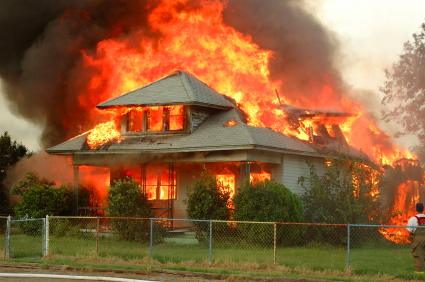
Burning-HouseOn Good Friday I was preparing food for our family’s Easter celebration when a heavy cloud of dark smoke suddenly poured from my oven. As I ran across the room to turn down the heat a small flame erupted in the bottom corner of the appliance. I called for my husband to come help with the situation and just as he raced down the stairs an inferno engulfed the entire cavity. We reached for the fire extinguisher that we store in our pantry but when we attempted to open the oven to apply the fire retardant it was latched shut. Our only option was to yank the appliance out of the wall just enough to create a small crack that allowed us to spray away. Luckily our efforts worked and the blaze was soon out leaving behind a rather nasty mess and an oven that was undoubtedly ready for the scarp heap.
In the same week my daughter was happily driving her new car when she approached a red light. Of course she halted as required but sadly the youngster behind her was so busy texting that he didn’t notice that the traffic was at a standstill. He plowed into the back of her auto with full force. Her beautiful car was a shambles of its former self.

Meanwhile across town a friend went to bed admiring the wood flooring that had just been placed in his home. He was proud of the dramatic and lovely change it had made in his abode. When he arose the following morning expecting to see the gleaming planks he was instead greeted to a most disastrous sight. Water covered the area that had looked so wonderful only hours before, ruined by the overflow from a toilet that had run all through the night.

Each of these incidents were maddeningly inconvenient and costly. It would take days, even weeks to repair the damage that was so unexpected, but eventually all would be set right once again. All three of us were fortunate to have the ability to overcome our disasters, unlike so many whose lives spin frighteningly out of control. While these examples were fixable they demonstrate the importance of keeping the events that occur in our lives in perspective.

My house didn’t burn down as it might have. My daughter walked away from her accident unscathed. My friend’s home was not flooded so badly that it was rendered uninhabitable. Sadly I know people who have faced far worse.

One of my aunts who was in her nineties at the time watched helplessly as her home burned to the ground, eliminating everything that she owned including irreplaceable family heirlooms and treasures. I have known several people whose loved ones have died in car accidents, including myself. I have friends who used to live in New Orleans who came home to total devastation after hurricane Katrina. Such losses are indescribable. They haunt the psyche for years and leave scars that tend to quietly inflict pain. 

We all want to think that we have a modicum of control over our lives but reality demonstrates time and again that the possibility of the unexpected happening is always there. At any given moment our lives might be thrown into utter chaos. We don’t dwell on such facts because we would be immobilized with fear if we did. Instead we go about our daily lives sometimes sweating a bit too much about the small stuff instead of focusing on our blessings. We take the food on our tables for granted. We forget to tell our family members and friends how much we love them. We grumble and complain.

Of course my husband and I were upset over the prospect of having to purchase a new oven and repair the damage to our cabinetry. We certainly might have used the money in other ways, but once the smoke had settled so to speak we began to realize how fortunate we were. Had we both been in another room our kitchen might have been far more damaged, perhaps even destroyed. In another time in our lives we might not have had the money to purchase a new oven and would have had to scramble to find a way to fix the problem. As it was, we had just received a tax refund that essentially covered the costs.

My mother lived on the economic edge for most of her life but she nonetheless always remained optimistic. She used to brag that God loved her so that He somehow took care of every problem that arose for her. Such was her faith that she told us when we were children that she had a money tree from which she would pluck funds when they were needed. She herself lived without an oven for several years because hers had quit functioning and she did not have the funds to get a new one. Rather than complaining she made do until she had accumulated enough to get a new one. She joked that by the time she finally had a way to bake again she realized that she really didn’t need to roast or broil. She didn’t allow herself to worry over things that were in reality inconsequential.

The truth is that there are people on this earth who will never have an oven or a car or a wooden floor. They live in places racked by famine, disease and war. Their lives are so out of their own control that they only have the freedom to exist, and sometimes even that liberty is taken from them. We on the other hand enjoy luxuries that we take for granted, worrying over problems that in reality don’t matter as much as we may think.

I am an admitted control freak even though I have learned time and again that so much of what happens is beyond my reach. The only thing over which I have total power is my own attitude. I can choose to stew over the randomness of occurrences or I can choose to roll with the punches and take the actions needed to set myself aright. There is little point in crying once the milk is flowing across the floor.

I take heart from the courage of the incredible people that I know such as the mother whose six month old son was diagnosed with leukemia who kept a smile on her face throughout her years long ordeal. I think of the friend whose daughter was killed by a drunk driver. She has channeled her grief into counseling others and spreading healing by sharing her own story. I marvel at the woman who had to reinvent herself after hurricane Katrina at a time in life when she should have been retiring comfortably. I am daily inspired by a former student whose brother was murdered and her fight to bring justice for him and all individuals marred by violence. I think of a dear friend who daily cares for a husband sidelined by a severe stroke and dementia. All of these individuals have risen from the ashes of their circumstances in triumph. They have found new meaning for their lives and new appreciation for even the smallest of blessings just as my mother always did.

I know not what challenges will come my way. None of us ever do. My only hope is that I will find the inner strength and positive attitude that will allow me to keep my footing and keep on trucking along. It is after all the best that we might do regardless of the circumstances.

The Old Is New

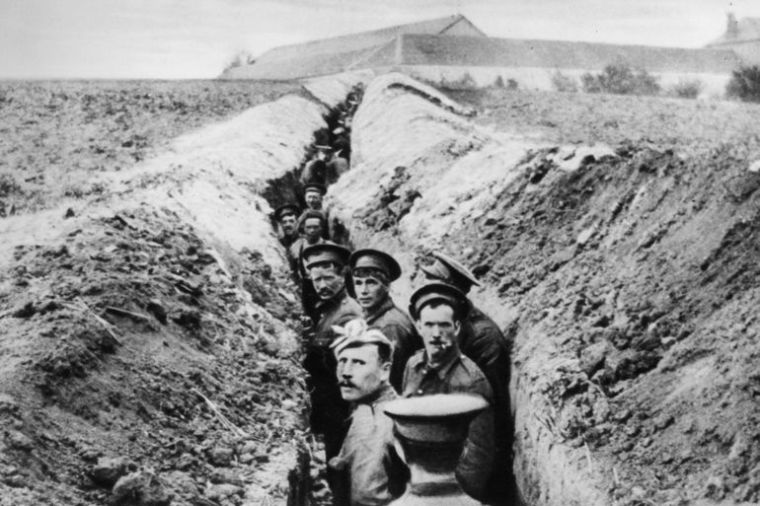
In The TrenchesIt was a dark time in history. The world was engaged in a heinous war whose purpose seemed unclear to most who tried to understand why millions of young men were dying. The brutality of the battles was unimaginable. Modernity had changed the nature of fighting in truly horrific ways. Mankind had not yet outlawed the use of chemicals as weapons. Nothing, it seems, was taboo, and so young men were permanently mutilated by agents like bombs and sarin gas. Never before had there been such murderous activity in mankind’s seemingly relentless quest for power. World War I is a war that we often ignore when in reality its effects continue to plague us to this very day.

The United States initially watched events unfold from afar. It’s hard for us to believe but our nation was very much a kind of backwater region at the onset of the twentieth century. Most of the world powers still thought of our government as a fluke in the annals of history, hardly worth noticing when compared to the vast influence of Austria-Hungary, Germany or Great Britain. Militarily the United States was ranked number seventeen, just behind Serbia. Few paid much attention to our still very young country as they engaged in an epic struggle in Europe.

At the beginning of World War I the United States was in debt and still far more rural than urban, but it had incredible natural resources and manpower which became a lifeline for nations like Britain and France during the fighting. With so many of their young workers unable to farm or work in factories it fell to the United States to supply the food and material needed to survive. The USA became a beehive of activity all while insisting on a neutral stance regarding the war. Initially most Americans were disinclined to become involved in a dispute that seemed to be more of a disagreement between royal relatives than a meaningful cause. Instead they enjoyed the fruits of commerce that were occasioned by the war.

The war that was supposed to be resolved in a matter of weeks dragged on with horrible consequences for European nations. The citizens watched helplessly as their youth were killed or maimed in heretofore unseen numbers. After almost four years of fighting France was on the verge of capture and collapse. Britain was little better. Russia was boiling over with a revolution that would dramatically alter the course of that country for the next hundred years. It appeared that Germany would soon dominate Europe. The United States enjoyed its relative safety and newfound prosperity while Europe burned.

Germany believed that it might break the will of Britain and France, thereby winning the war, if only the United States were prevented from sending supplies, and so they boasted that ships traveling across the Atlantic toward Europe would no longer be safe. Their gamble backfired and resulted in a declaration of war from the United States. Within months hurriedly trained American soldiers and weapons, began arriving to bolster the Allies, breaking the stranglehold that Germany seemed to have on the continent. By turning the tide of the war and helping the Allies to win the United States earned the respect of all the world. Suddenly our country had become a superpower and a king maker. For better or worse we have played that role ever since.

A hundred years ago President Woodrow Wilson justified our country’s involvement in war as a way of spreading liberty and democracy. It is an idea that is bandied about to this very day, but then as now a sizable number of people question the arrogance of interfering in the affairs of other nations. Such thinking was again used successfully as a rationale for World War II but lost its luster during the engagement in Vietnam. Presently the world finds itself in a confusing quagmire in the Middle East, a part of the world many of whose problems began with the peace negotiations at the end of World War I. One hundred years later we are seeing the results of arbitrarily dividing the spoils by redrawing colonial maps in a manner meant to punish the losers rather than consider the needs of the people living in the areas once ruled by European monarchs. The roots of today’s problems were unwittingly planted by power brokers whose intent had little to do with spreading freedom.

The world changed dramatically a hundred years ago particularly for the United States. We took on a mantle of responsibility back then that has always had an aura of discomfort. By nature we want to be the good guys, the heroes, but tiny voices of caution echo inside our heads. Part of our nature wants to be left alone, just as our forefathers who fought for their independence from an ever invasive government. Another side of our personalities feels compelled to constantly fix whatever we see as being broken including other governments. The tension between these two points of view are as prevalent today as they were back then. Our divisions are in reality nothing new.

One hundred years ago even as we appeared to be saving the world conditions were ironically far from ideal in our own backyard. Women were still fighting to win the right to vote. Race riots broke out in cities across the country in the summer of our victory. Many of those who had spoken against going to war languished in prisons. We still had much to do at home before serving as advisors to the world. Hypocrisy quietly reigned much as it often does.

Everything old becomes new again. After a hundred years much of the idealistic thinking of those who supported World War I has been tarnished by reality. We find ourselves feeling anxious as the world smolders as though coals of discontent from our past have once again caught fire. We ask many of the same questions and silently worry that a truly peaceful world is a pipe dream, the stuff of fools. We wonder if our warlike natures will always and for all time inevitably take hold. We would sometimes like to wish ourselves back to a time when we were number seventeen in the world and nobody expected much from us, but we know that our ship has sailed and now we much pray for the wisdom to find answers that will do the least harm. As we do so we would do well to remember the lessons from history.