Our Unique Selves

the-danger-of-uniqueness-1058x426People are fascinating to me, and I don’t just mean the rich, the famous or the accomplished. I am interested in the common everyday person like myself. I long to hear people’s stories. When I go to Walmart I’m not looking for crazies so that I might laugh. Instead I find myself wondering how each person got to this moment in time and what his/her past and future may be. I understand that some of the most compelling histories are found in the lives of the most ordinary people and that it is virtually impossible to judge a book by its cover.

I knew a woman who cleaned houses for a living. She rarely wore anything other than torn jeans and stained t-shirts. Her hair was long and stringy. She appeared to be little more than a good ole Pasadena gal, but upon further research I learned that she had an MBA from Harvard and a very successful business caring for homes in River Oaks.

I once had a student who appeared to be little more than an arrogant bad boy who drove his teachers to the brink of insanity. He befriended me and ultimately told me stories that made me cry when I was alone in my home. He had a single mom who struggled to keep the family from being homeless and wandering the streets. Life was as tough as it gets, and yet this young man found the time to attend church with a friend. The services provided him with solace in a world that was mostly cruel to him. He had been born again and wanted more than anything to be a good and Christlike person. He confessed to me about something that was bearing down on his conscience and desperately wanted to know what to do.

He and his mom and sister had been on the verge of being evicted. There was no food in the house. Things looked quite grim. They walked to a nearby Walmart to see what groceries they might afford with the few dollars that his mother had left. While they were perusing the aisles the boy’s mom noticed a cart with an expensive purse sitting in the child seat. The woman who owned the handbag was far away with her back turned as she searched for a particular product. Her bulging wallet was visible and just begging to be taken. My student’s parent grabbed the billfold and whispered for her children to follow her quickly away from the scene. When the coast was clear she opened the wallet to find over five hundred dollars inside. She immediately cried tears of joy and told her children that they would be able to keep their apartment and eat well on that day.

My student, her son, was conflicted. He knew his mother to be a good and honest woman but she was desperate. He also realized from his recent religious conversion that what his mom was doing was very wrong, and yet he remained guiltily silent. The theft bore down on his mind and he was not sure what he should do. His dilemma easily explained his surly behavior and the fact that he was unable to focus on his school work. It would have been easy to simply write him off, but in hearing his story I understood the depth of his morality and the pain that worrying about his mom had wrought.

People are always so much more than they seem, but we don’t often hear their entire stories. That is where my most passionate interest lies. I truly enjoy discovering the essence of the people that I meet and I suppose that I have always been that way. My mother used to chide me for staring at strangers. I certainly meant nothing by doing that. I simply wanted to know them better. I liked to read faces and body language. I desired to know why someone was angry for no apparent reason. I realized that we are who we are because of a totality of experiences.

I think that it would be quite wonderful just to sit across from someone and say, “Tell me all about your life. I want to know what it has been like for you.” I suspect that if I were to do so I would find out that almost everyone begins with similar hopes and dreams, but the serpentine nature of reality often sends him/her along routes that challenge and sometimes even defeat. Those people who seem ridiculously strange are more often than not just victims of situations over which they have lost control.

Fighting one’s way out of poverty or abusive situations is much more difficult than it may appear. The sad truth is that we are not all equal in terms of intelligence. I have encountered so many individuals with major learning disabilities who struggle mightily to learn. Others are afflicted with mental illnesses that stalk them so often that they are unable to create routines for working and achieving success. Then there are those with major health problems. The list of reasons why some people remain in a state of economic or psychological distress are quite real and often not of the individual’s making. As a society it is up to those of us fortunate enough to lead relatively stable lives to help those who are less able but we don’t always do that. We instead look the other way or poke fun at those who are different.

I’ve also known people who are far more remarkable than they are willing to let on. They tend to be quite humble individuals who rarely toot their own horns. Sometimes it is only when they have died that we really begin to know them through the eyes of the people whose lives they impacted. As stories of their generosity, contributions and talents are shared we realize that a saint or a rock star was hiding in plain site, but we had no idea because they would never have sought recognition for their incredible deeds. My cousin who passed away just before Thanksgiving was one of those souls. All of us were stunned to hear of the innumerable kindnesses to one person after another that he displayed all very quietly. We knew he was a good man, but never quite realized the extent of his largess.

Most people have a hobby of some sort, but mine is learning about others. I would love nothing better than to make appointments everyday to just listen to the folks with whom I have been acquainted and those that I have yet to meet. I can only imagine how many wonderful things I would learn. This world really turns from day to day not so much from the movers and shakers but from the millions of nameless individuals who rise with the sun and do their best to make the most of the cards that have been dealt them. It is in their stories that we find profound truth and maybe even inspiration. We need to hear from them because each person is a beautiful and unique gift to our world who deserves to be celebrated and understood.

A Mind Is A Terrible Thing To Waste

agy_rajz_radir-400x200There was an old advertisement that asserted, “A mind is a terrible thing to waste.” I’ve often thought of those words as I have seen more and more individuals afflicted with Alzheimer’s disease or dementia. Watching someone who once bore a quick wit slowly but surely become less and less aware is one of the saddest and most difficult aspects of growing older. It is especially hard on the caretakers of those individuals.

I used to possess a photographic memory. I was literally able to recall the exact page number and positioning of a fact from a textbook. I once answered a question on a history test while visualizing the caption under a photograph that contained the information. Back then I took my ability for granted, assuming that I would always be able to pull information from my brain with little or no effort. I have unfortunately learned as I age that I am less and less able to quickly find the information that I need from the recesses of my gray matter.

I’ve read that exercising the brain is as important as keeping the body healthy. Experts claim that performing mental activities regularly helps to keep forgetfulness at bay. That is partly the reason why I write daily and tutor young people in mathematics. Such activities force me to push my mind as much as working out on the elliptical activates the muscles in my legs. Nonetheless I all too often find myself groping for a familiar word or having to review a geometric definition for the umpteenth time. Just as my gait has slowed, so too has my mental acuity.

I don’t generally worry that I will somehow become less able to function with my mind because my genetics seem to be less inclined toward senility and more toward broken bones or gastrointestinal diseases. My grandfather was still reading and discussing lengthy history books at the age of one hundred eight and my mother was sharp and witty until the moment that she drew her last breath. I haven’t seen evidence of diminished brain capacity even among my aunts and uncles. Still I worry simply because I have seen so much of it in the families of my neighbors and friends.

There is a man who lives near me who is my age. He recently began to frighten me a bit because his behavior became erratic and he was making inappropriate comments. I found myself avoiding conversations with him because I truly wasn’t sure that I was safe around him. Soon enough another neighbor revealed that the unfortunate soul was suffering from early onset Alzheimer’s disease. His wife had asked that we not drive him to the store for cigarettes and wine as we had unwittingly been doing.

Not long after hearing the reasons why the neighbor was acting so strangely his wife asked my husband to drive her to the scene of a car accident in which he had been involved. She tearfully recounted how he had stolen her car keys and snuck out of the house in an attempt to run away. He only got a few blocks down the road before he had wrecked the car. He could not remember how to call home but luckily his wallet contained the necessary information to alert his frantic family. As my husband drove her she literally begged for advice as to how to deal with the situation. She has been attempting to work which requires leaving him home alone. She was beginning to realize that he probably was no longer able to fend for himself in her absence.

The plight of those who have brain disorders along with the members of their families are heartbreaking. I have a dear friend who cannot leave her husband without finding a kind soul who will watch him in her absence. Her life has become far more insulated that it should be at her young age. One of my aunt’s lives in a retirement community with a husband in his nineties who is mostly unaware of his surroundings. She and her sister care for him without complaint but I know that they are the kind of women who love getting out and about, a freedom that they rarely enjoy these days.

A woman that I have known for years now lives in Georgia in a small apartment caring for her husband whose mental and physical health has been severely stressed by multiple strokes. Her days are repetitive and she is far away from friends and family. She is very much alone in her labors save for the visiting nurses who come a few times each week to give her an hour or so to herself. I talk with her via Facetime as often as I can but she really needs so much more support and it is not very abundant.

Still another friend visits her ninety something mother at a nursing home multiple times every single day just to be certain that her mom is getting the care that she needs. My longtime friend is a true angel who rarely complains that she must schedule her days to include those regular visitations. When she does have to leave town she has to find people who are willing to perform her duties. Sometimes that means hiring strangers and hoping that they will fulfill the responsibilities properly. In truth her trips are tainted with worry because few people invest the level of loving care into the duties as she does.

None of us ever really know when we or a loved one might begin to slowly lose mental capabilities. There are foods that we might eat and physical and mental exercises that will help, but in many cases the onset is simply inevitable. As more and more baby boomers age the epidemic only grows, impacting so many lives. Paying for care is increasingly expensive and usually results in families spending the victims into poverty. Some care facilities will accept Medicare once the individual is literally dead broke, but others are reluctant to deal with the multitude of paperwork involved. Many of those with brain disorders therefore stay at home, taxing the resources and patience of family members.

We hear a great deal about the medical needs of young people which is as it should be, but the stories of the elderly often remain hidden and forgotten secrets. We don’t often think of the individuals like my neighbor who spend their days in a kind of confused state. He was once a rather entertaining fellow who enjoyed attending parties and regaling us with funny stories. Now he barely makes sense as he reaches into the recesses of his mind for words and ideas. He is incredibly healthy aside for his Alzheimer’s. He might otherwise have been out enjoying his retirement with hobbies and trips. Now he is confined to a life so unlike his personality and even our attempts to visit with him seem to fall on a kind of blankness in his mind. It is so difficult to communicate with him on any meaningful level.

As more and more people enter the years when such diseases begin to show their symptoms we need to fund the kind of research that will result in improved memory or even a cure. It is not just the afflicted who suffer but their families and friends as well. Perhaps it is time that we have a month dedicated to learning more about such debilitating diseases. Maybe our sports teams need to wear special uniforms to remind us of those who are suffering. Yes, the mind is indeed a terrible thing to waste and yet somehow we have so many whose essence is being slowly erased and we do so little to talk about what we might do to help.

The Numbers In My Head

numbersThis morning I sent birthday greetings to a school friend who turned sixty nine. I’ll be joining her in the last year of my sixties in November. The numbers that I carry in my head just don’t compute. My living aunts are now in their mid to late nineties. My children are well into their forties. I have grandchildren in college. Most of the time I feel much younger than I actually am, but then something happens that sobers me and sends me into a tizzy, like hearing that the son of one of my friends from childhood has died from a heart attack, or that a young woman that I once mentored at work is being treated for cancer.
I am at a somewhat lovely age in that I no longer have to report to work each day. I am free to travel or do whatever pleases me from hour to hour. I still possess almost boundless energy but when I exert myself too much my body reminds me that I am no longer a spring chicken. I’ve got arthritis in my knees and I administer a daily injection of an experimental drug in the hopes of producing stronger bones than the ones left in a lacy swiss cheese condition by my osteoporosis. I act as though I have all of the time in the world to fulfill the goals and dreams that I continue to create for myself, often forgetting that my time on this earth is becoming more and more limited. Those numbers in my head as well as the realities of our human existence talk to me in the dark of night and urge me to seize each day.

I have already lost so many friends with whom I spent my youth. In my mind’s eye I still see them as being vibrant and beautiful. They ran with me and laughed at the clock and thought little of illnesses or endings. It did not occur to me that they would be missing at the very time when we might have had the most fun together, when our labors were done and we were free to roam the earth in search of more adventures. Watching them leave has been difficult and has prompted me to think of my own mortality. Even worse have been the deaths of the children of my peers, the young adults whose passing seems so terribly out of sync with the way things should be. In a perfect world I have the ability to order from least to greatest. In truth occurrences are random in their probabilities.

Mostly I don’t dwell on such things, but there are moments when there is so much suffering around me that it is impossible not to face the facts of life. I realize that if I add multiples of ten to my age I become very old, very quickly. In my mind the nineteen nineties were only yesterday but they actually happened almost thirty years ago. Each day, week, month, year is flying by at warp speed taking me into a future that is more uncertain than any era in which I have so far lived. The dominoes of my life will begin to fall with greater and greater rapidity. I don’t want to think about those things until tomorrow, but they will surely come at a steady pace. The numbers in my head are truth tellers. The math leads to one and only one conclusion, and like J. Alfred Prufrock I rage against the dying of the light.

I want to be prepared for what lies ahead. I want to meet my fate with optimism and courage. I do my best to find happiness even in the darkest hours, but I now understand the fear and the anger that my best friend felt as she understood that her cancer was slowly stealing away her life. I am more open to being sympathetic to the relentless monotony of my aging aunts who are confined to wheelchairs and small rooms. I think of my mother measuring out her days as she grew ever more ill and weak, wanting desperately to leave me with her wisdom. I was confused when my hundred year old grandfather continually spoke of being tired and missing all of his friends and loved ones. I had little patience with the thought of surrendering to fate. I viewed myself as someone who might be dancing jigs right up until my very last breath. That was, of course, before I witnessed people my age being cut down by illnesses that changed them. They had once been warriors like me and it was incongruously difficult to imagine them bedridden and unable to take on the world by storm as they always had. The numbers caught up with them just as they will one day do with me and everyone else that I know, which means that I must begin to focus more and more on what is really important. I have to face the fact that I do not have forever.

People are always more important than things, but things steal our time and energy. When the clock is ticking we have to choose what to push aside. That visit that we speak of making needs to be put on our calendars today, ahead of the cleaning and the repairs of our stuff. Those thoughts that we have wanted to express must be recorded now, not after we take out the trash. The dishes will wait but the call to someone important may come too late if we hesitate. The numbers are there, telling each of us that there is a limit to the count of the days that we each have on this earth. We have to make the best of every single moment before we are no longer able.

I suspect that I may sound a bit morose today. I am thinking of the lost opportunities that I had to celebrate with those who are now gone forever, the moments when I was too preoccupied to really listen to what they had to say. I wrongly believed that there was plenty of time and that I had far more important tasks to perform than lingering just a bit longer with them. Now I see. Now I understand.

My life has been all about numbers. I am a mathematics teacher. I have told my students that the ciphers and algorithms never lie. They link us to both the past and the present. They explain the workings of our world. Now the numbers tell me to embrace the beauty of love and friendships every moment of every day. They remind me of the limits that I am approaching and of the need to prioritize my energies. The numbers will eventually terminate, just as they should. My faith tells me that I will one day find the infinite peace of everlasting life, but until then I must listen to the gentle whispers of the numbers chiding me to live with gusto and an open heart.


When Happiness Is Lost

635954839284874644-229042456_Depression

I often write about being optimistic and choosing to be happy. Of course such prescriptions are fine and dandy for those of us who are not afflicted with clinical depression, but for those who are it is virtually impossible to simply will away dark feelings.

My mother was one of the happiest people on the planet as long as she was not in the throes of her bipolar disorder. When the illness hit, she was literally unable to just wish its debilitating symptoms away. One of the characteristics of her disease was a profound sadness that would overtake her with life changing consequences. She often sat in the dark, drapes drawn tightly closed, crying and worrying for no real reason at all, unable to even venture into her front yard. It was both frightening and heartbreaking to see her in this condition. It was so contrary to the person that she really was.

Mama had shown early signs of her illness that my brothers and I failed to understand. There were times when she would suddenly take to her bed for several days. We always just assumed that she had a bad cold or a virus but it was far more sinister than that. She was fighting away the melancholy that paralyzed her. In the years before her disorder became full blown and noticeably chronic she would feel down for a few days or a week and then somehow return to the person that we knew so well. Unfortunately, in 1969, she experienced a psychotic break that began with crying jags and paranoid fears. Eventually she literally believed that the FBI was trying to frame her for selling drugs. She was convinced that all of us were going to be sent to jail. Her anxiety was so acute that she was in terrible physical pain and even thought that she had died and then miraculously come back to life.

I remember one of my very sweet uncles coming to visit her during this time. He pleaded with her to pull herself together. He reminded her that she had children for whom she needed to care. He argued that she had a wonderful life, filled with love. He felt that she only needed to choose to be happy and all would finally be well. Of course we all learned that such wishful thinking was not going to materialize. It was only after a long hospital stay and medication that she was able to return to us as the person who had always possessed a sunny disposition.

My mother mistakenly believed that her illness had been an anomaly, something that would never happen again. She insisted that she was cured and that she knew how to care for herself in the future. We naively agreed with her, thinking that the worst was behind us. Little did we realize that her condition was chronic, a never ending series of ups and downs taking over the chemistry of her brain. Only with the continual help of psychiatrists would she be able to function. It was a bitter pill for her and a challenge for those of us who loved her. We had to monitor her life to an almost invasive extent because whenever we became lax so did she, and the symptoms would return even worse than the times before.

My mother was known to her doctors as a noncompliant patient. She never admitted that she had a psychological problem, instead blaming me and my brothers for her condition. She wanted desperately to prove that she never needed psychiatric care and that her illness was a figment of our imaginations. Her reluctance to accept her diagnosis and continue her therapy on a regular basis lead to one relapse after another. Her life became far more difficult than it had to be.

Mama had brilliant and caring doctors who became frustrated with her unwillingness to follow their directions. They knew as we did that as long as she followed their instructions she was able to work and be like a ray of sunshine in everyone’s lives. Sometimes her medications had to be changed, but the results were always miraculous. To her detriment and our frustration she chose to discontinue her treatments again and again. As she did so the magnitude of her depression and mania increased. It was as though she was stressing her brain to the point of bursting.

I always understood that my mother wanted to feel normal, and visiting psychiatrists and taking numbing medications with troubling side effects was annoying to her. She gained enough weight from using her drugs to go from being a slender woman to one who was rather heavy. She experienced involuntary tongue flicks and other nervous system twitches. Her ankles would swell to three times their normal size. She hated those things and would quit taking her pills in the hopes of ridding herself of their effects. Of course she would ultimately become very sick again and her doctors would have to restart her therapy from ground zero. It was a hard way of living and I always empathized with her. I tried to imagine what it was like to feel so seriously sad as she often did. I wanted to understand her pain.

Depression is a very real disease for many unfortunate souls. It is not related to an inability to see the glass as half full. Nobody consciously wants to endure its effects. Happily there are ways of improving as long as one is willing to ask for and accept help. It can be a tricky process with a great deal of trial and error in implementing a viable plan. Because it is often a lifetime disorder it can become overwhelming. The important thing is for the depressed person and those around him/her to understand that it is a true medical condition much like diabetes or heart disease. There are treatments that will ultimately work, but they often take time.

Our laws prevent us from forcing adults to accept psychiatric care unless they are deemed to be a danger to themselves or others. While this protection prevents innocents from being falsely forced into therapies that they do not need, it also sometimes makes it very difficult to get a recalcitrant patient the care that they require. All too often families simply look the other way when their loved ones refuse to accept the treatments that they most certainly need. Such situations create very uncomfortable relationships that are painful to everyone concerned. Still I am convinced that it is up to those who love the sick person to insist by hook or crook that they receive the medications and therapies that they need. We can’t just walk away and hope for the best for them.

Mental illness and particularly depression too often results in dire consequences if left untreated. It is a lifetime battle but it need not overcome those who are afflicted. Each of us must learn to see the symptoms and guide those that we know and love to find the help that they need. Perhaps if we all agree to become more educated about the effects of such chronic diseases we will be more likely to deal with their effects more openly. There is nothing about depression or mental illness that should make us feel ashamed. Just as we would seek the best possible treatments for cancer or heart disease so too must we learn how to properly react to mental health issues. We can all be happy but some of us require a little push to get there. Our happiness and that of others need not be lost.

Keep On Trucking

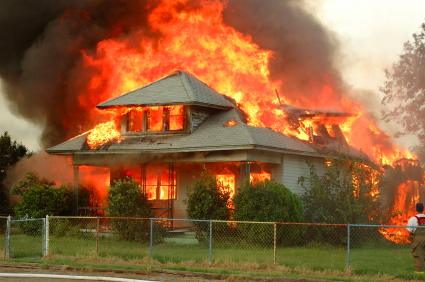
Burning-HouseOn Good Friday I was preparing food for our family’s Easter celebration when a heavy cloud of dark smoke suddenly poured from my oven. As I ran across the room to turn down the heat a small flame erupted in the bottom corner of the appliance. I called for my husband to come help with the situation and just as he raced down the stairs an inferno engulfed the entire cavity. We reached for the fire extinguisher that we store in our pantry but when we attempted to open the oven to apply the fire retardant it was latched shut. Our only option was to yank the appliance out of the wall just enough to create a small crack that allowed us to spray away. Luckily our efforts worked and the blaze was soon out leaving behind a rather nasty mess and an oven that was undoubtedly ready for the scarp heap.

In the same week my daughter was happily driving her new car when she approached a red light. Of course she halted as required but sadly the youngster behind her was so busy texting that he didn’t notice that the traffic was at a standstill. He plowed into the back of her auto with full force. Her beautiful car was a shambles of its former self.

Meanwhile across town a friend went to bed admiring the wood flooring that had just been placed in his home. He was proud of the dramatic and lovely change it had made in his abode. When he arose the following morning expecting to see the gleaming planks he was instead greeted to a most disastrous sight. Water covered the area that had looked so wonderful only hours before, ruined by the overflow from a toilet that had run all through the night.

Each of these incidents were maddeningly inconvenient and costly. It would take days, even weeks to repair the damage that was so unexpected, but eventually all would be set right once again. All three of us were fortunate to have the ability to overcome our disasters, unlike so many whose lives spin frighteningly out of control. While these examples were fixable they demonstrate the importance of keeping the events that occur in our lives in perspective.

My house didn’t burn down as it might have. My daughter walked away from her accident unscathed. My friend’s home was not flooded so badly that it was rendered uninhabitable. Sadly I know people who have faced far worse.

One of my aunts who was in her nineties at the time watched helplessly as her home burned to the ground, eliminating everything that she owned including irreplaceable family heirlooms and treasures. I have known several people whose loved ones have died in car accidents, including myself. I have friends who used to live in New Orleans who came home to total devastation after hurricane Katrina. Such losses are indescribable. They haunt the psyche for years and leave scars that tend to quietly inflict pain. 

We all want to think that we have a modicum of control over our lives but reality demonstrates time and again that the possibility of the unexpected happening is always there. At any given moment our lives might be thrown into utter chaos. We don’t dwell on such facts because we would be immobilized with fear if we did. Instead we go about our daily lives sometimes sweating a bit too much about the small stuff instead of focusing on our blessings. We take the food on our tables for granted. We forget to tell our family members and friends how much we love them. We grumble and complain.

Of course my husband and I were upset over the prospect of having to purchase a new oven and repair the damage to our cabinetry. We certainly might have used the money in other ways, but once the smoke had settled so to speak we began to realize how fortunate we were. Had we both been in another room our kitchen might have been far more damaged, perhaps even destroyed. In another time in our lives we might not have had the money to purchase a new oven and would have had to scramble to find a way to fix the problem. As it was, we had just received a tax refund that essentially covered the costs.

My mother lived on the economic edge for most of her life but she nonetheless always remained optimistic. She used to brag that God loved her so that He somehow took care of every problem that arose for her. Such was her faith that she told us when we were children that she had a money tree from which she would pluck funds when they were needed. She herself lived without an oven for several years because hers had quit functioning and she did not have the funds to get a new one. Rather than complaining she made do until she had accumulated enough to get a new one. She joked that by the time she finally had a way to bake again she realized that she really didn’t need to roast or broil. She didn’t allow herself to worry over things that were in reality inconsequential.

The truth is that there are people on this earth who will never have an oven or a car or a wooden floor. They live in places racked by famine, disease and war. Their lives are so out of their own control that they only have the freedom to exist, and sometimes even that liberty is taken from them. We on the other hand enjoy luxuries that we take for granted, worrying over problems that in reality don’t matter as much as we may think.

I am an admitted control freak even though I have learned time and again that so much of what happens is beyond my reach. The only thing over which I have total power is my own attitude. I can choose to stew over the randomness of occurrences or I can choose to roll with the punches and take the actions needed to set myself aright. There is little point in crying once the milk is flowing across the floor.

I take heart from the courage of the incredible people that I know such as the mother whose six month old son was diagnosed with leukemia who kept a smile on her face throughout her years long ordeal. I think of the friend whose daughter was killed by a drunk driver. She has channeled her grief into counseling others and spreading healing by sharing her own story. I marvel at the woman who had to reinvent herself after hurricane Katrina at a time in life when she should have been retiring comfortably. I am daily inspired by a former student whose brother was murdered and her fight to bring justice for him and all individuals marred by violence. I think of a dear friend who daily cares for a husband sidelined by a severe stroke and dementia. All of these individuals have risen from the ashes of their circumstances in triumph. They have found new meaning for their lives and new appreciation for even the smallest of blessings just as my mother always did.

I know not what challenges will come my way. None of us ever do. My only hope is that I will find the inner strength and positive attitude that will allow me to keep my footing and keep on trucking along. It is after all the best that we might do regardless of the circumstances.