The Glory

St. Paul's Dome

St. Paul’s Cathedral has a storied history. It has existed in one form or another in the heart of London for over fourteen hundred years. Built originally by monks in medieval times it endured neglect and fires. Over time there were many different versions of the structure, but it is the majestic architectural creation of Sir Christopher Wren that stuns visitors today. Wren’s masterpiece eschewed the dark stone, heavy pillars and stained glass of other churches and instead featured a massive dome hovering overhead like a window into heaven. There is a lightness and airiness about the interior not seen in other churches of the era. It has a modern, yet classic feel that is incomparable.

We traveled to St. Paul’s Cathedral on a Friday morning. We had enjoyed a foretaste of what we would see during Evensong the afternoon before when we were treated to the voices of a magnificent choir and a tradition that reaches back in time. The Church of England came about in the reign of Henry VIII when he broke with Rome and declared that as king he had the right to serve as the head of the Church in England. His was not a reformation, so the services and prayers continued in the same vein as those of the Catholic Church. Which is perhaps why, as a Catholic, I felt so at home in the cathedral.

We were fortunate to find a wonderful guide to take us through the church and to explain each aspect of the history and the architecture. St. Paul’s Cathedral has been the site of many famous events including the Diamond Jubilee of Queen Victoria and the state funeral of Winston Churchill. To this day it is a gathering place where people sun on the steps and drop in for prayer in the chapel or noon day services. It is both a working church and a tourist attraction whose income from visitors provides financing for upkeep and renovations. 

The high altar was eventually changed during the reign of Queen Victoria when it was encrusted with the kind of heavy gilding so popular during that era. It had a cleaner look in its original iteration as designed by Wren, and wondered what he might think were he to see it now so dark compared to the rest of the structure. In some ways there is a kind of disconnect between the heaviness of the altar and the etherial feel of the  rest of the cathedral.

The choir stalls were also changed by the addition of dark and heavy woodwork during Queen Victoria’s reign. Nonetheless the cathedral is still dominated by the dome that makes it so unique. That pediment stands out in the London landscape from every angle whether day or night. It is a glorious beacon representing so much that is great about the city and its people.

During World War II London endured fifty seven straight nights of bombing from the German Luftwaffe. Parishioners served as security for the building hoping to protect the structure in the event that it became a target. One evening the people noticed a fire breaking out as the bombs burst overhead. They called for help in putting out the flames, and firefighters worked tirelessly to save the beloved church from destruction. When morning came virtually every building that had surrounded the cathedral was demolished, but St. Paul’s stood rock solid thanks to the heroics of the people who had been watching over it.

The basement of St. Paul’s serves as a crypt and memorial for many of London’s most imminent citizens including Admiral Nelson and the Duke of Wellington who is beloved for saving the country from Napoleon’s domination. Much like Westminster Abbey it is a repository of much of the nation’s history.

There is a stairway that leads to the top of the grand dome. My brothers, Mike and Pat, navigated the winding and narrow passages along with my sister-in-law, Allison, to enjoy the sweeping vistas of the city and a closer look at the construction and magnificence of the the building. Sadly my knees would not hold up under such stress so I joined my husband Mike and sister-in-law, Becky for tea while the younger among us enjoyed the adventure of the climb. In another decade I surely would have been right there with them, but I have learned to respect the signs that such adventures are past.

St. Paul’s Cathedral is a marvel of architecture and a treasure for all of the people of London. I felt a very spiritual connection to the church that was different from the awe of Westminster Abbey. It is a place where worship rather than history plays a more dominant role. It is a showpiece, but also a refuge from the hustle and bustle of the city. It has a calming presence that made me want to just sit and linger and meditate. I truly felt God’s presence there.

I would see the dome of St. Paul’s on the horizon again and again during my time in London. Sometimes it was like a beacon of hope, others it was a compass point helping me to find my way. Always just seeing it brought a sense of calm to me. It is one of those places that I will certainly conjure up when I feel the need to meditate on the goodness of humans, for that is what I felt there from the moment that I first entered.

Even now as think about St. Paul’s Cathedral my heart slows, my mind focuses and I feel a sublime sense of well being. I see the minister who looked at my face and smiled as though he knew the content of my heart as he invited me to attend Evensong. There is an otherworldly essence there that will sustain me whenever I close my eyes, quiet my heart, and remember the glory.

God Bless America/God Save the Queen

The Guards

Ironclad plans for a trip are fine until they fail. One of the most positive aspects of traveling independently is the ability to make last minute corrections. Such was our decision one morning at breakfast when we realized that if we hurried over to the Russell Square underground station and headed for Buckingham Palace we might be just in time to see the changing of the guard that was to be held that morning. After all the rest of our day was dedicated to places where there was no need of tickets, so we had all of the flexibility that we needed. We took a deep breath, entered the fray of early morning crowds headed to work and girded our loins for whatever we might find ahead.

The train was so packed that we felt like sardines and it only became worse as we drew closer to our destination. Our foray inside a crowded train would be good practice for the swarm of humanity that we would find waiting at the gates to Buckingham Palace. We realized immediately that we would not get a prime view of the proceedings, but at least we were there and we’d have to just do our best to catch a glimpse of the proceedings here and there.

Unfortunately most of the best spots right along the fence line were taken by very tall men who further blocked the view by raising their arms to hold their cameras high in the air. Husband Mike and my brothers had no trouble looking over the shoulders of the lucky ones who had arrived early enough to stake out a claim to prime property, but my sisters-in-law and I were unable to see much even when we stood on tippy toe. Sister-in-law Becky decided to choose a different point of view and went to the very back of the crowd so that she might see the troops as they marched into the palace grounds. Allison and I found ways of glancing down low and in between the bodies of those who blocked our normal sight of vision. All in all it was a frustrating situation but one that we learned how to eventually make work.

By the time the proceedings began the area was a mass of humanity all craning their necks to see the red coated military men marching proudly across the grounds. They played traditional pieces that most of us had expected to hear, so a sense of great satisfaction swelled over the crowd. I saw enough of the upper half of their bodies to feel a sense of exhilaration, and I had perfected my method of finding tiny holes in the wall of people to make me feel as though I was part of something quite grand.

Standing on my toes and bending down became my official “modus operandi” so I hardly noticed that people from behind were pushing forward to get a view of their own. A woman who had a birds eye view in the front row suddenly became overcome by claustrophobia and decided to leave. Before doing so she offered her spot to me. I could not believe my good fortune as I suddenly stood right behind the fence along with the row of tall men. I was mesmerized by the sheer beauty of what I saw.

The soldiers with their red jackets and polished brass buttons stood tall and stately with their heads proudly bearing the black bearskin helmets that are the trademark of their station and their duties. I saw that they were not just showmen because the guns that they carried were real and quite powerful. They were indeed trained and equipped to be guards. I later learned that many of them had served in dangerous places like Afghanistan. Their precision bespoke of discipline and pride in their work. I was almost giddy at the wondrous sight that I was watching unfold. It was as though I was part of a living fairytale not unlike the ones that my father had so often read to me. I felt like Cinderella.

We were entertained by military songs and modern music, marching, and even a mounted cavalry wearing riding boots and a different sort of cap featuring horse hair. The pageantry was even more glorious than I had imagined it would be and my companions and I were quite delighted.

As is my way I found myself thinking of the rag tag revolutionaries of the colonies of north America who had the audacity to rebel against such a well trained and disciplined army of red coats back in the eighteenth century. It must have required an enormous amount of frustration over the political situation to risk fighting such a group. Little wonder that the prevailing belief was that the so called patriots would soon be put down by the seemingly superior forces and normalcy would return. I’m not so sure that I would have had the courage to side against such a powerful army, and yet I know from the study of my family tree that there were indeed ancestors who chose to join the revolution to free themselves from what felt like tyranny.

I suppose that we Yanks are the wild children of Great Britain. We came from the same stock but the new world changed us. We were far enough away from the old ways that we began to question the authority of a king who was making our lives more and more difficult. We had risk taking in our DNA. Our thinking diverged from the land of our origin and in the end we eschewed royalty and opted for freedom, even though our first form of it was far from perfect. It would take some time before we freed our slaves and allowed women to move to the front so that they too might participate in the grand experiment of the republic.

My spot along the fence of Buckingham Palace standing as an equal to the big tall men who had at first blocked my view felt like yet another metaphor for how far I have come from the time of my ancestors. I have roots in Great Britain that make me proud, but in the end I am a foreigner in that land. Neither I nor anyone not born of the Windsor family will ever be royal, but in my country anyone might aspire to be President. That is the grand difference that came from the revolution of long ago.

I possess all of the traits of an American including great pride in my country and a kind of brash sense of equality with every other human, but I still cherish the traditions of my history. I felt a kinship and a sense of friendship as I watched the ceremony unfolding before me, knowing also that I would not have been standing there were it not for the opportunities that the United States has given me. God bless America and God save the Queen!

A Walking Timeline Through History

Trafalgar Square

When the best laid plans go awry, pathways to new adventures often show themselves. We were to have spent our morning watching the changing of the guards and our afternoon at Westminster Abbey. The cancellation of the tradition of pomp and circumstance at the palace had sent us scurrying to the Gothic church far earlier than intended, so once we were finished with our tour we became untethered and aimless wanderers around London.

The roads almost inevitably lead us past the halls of Parliament where protests centering on the Brexit issue were a constant feature during our time in the capitol city. We glanced disappointedly at Big Ben which was shrouded by the apparatus of reconstruction save for the face which never changed because it was not working. We wondered as we longed to hear the famous chimes if somehow all of our planning was doomed to go up in flames, but we soldiered on, walking past a highly secured area that housed the home of the outgoing Prime Minister.

There was much stirring behind the gates. We saw official looking men wearing formal  jackets filled with medals leaving the premises with grim expressions. It told us that Theresa May was no closer to creating a plan for transitioning Britain from the European Union to a  more nationalist entity. There was a noticeable tension in the air that hovered over the halls of government and the silence of Big Ben added a metaphorical touch to the chaos.

After walking for what had seemed like many miles Trafalgar Square was in view and husband Mike became quite animated by the thought of seeing the iconic tribute to those who had fought so valiantly in World War I. First, however we would pause for lunch in a nearby pub where I admittedly struggled to find something that appealed to me on the menu. I generally eat a very light midday meal and there was very little of that sort to be found among the traditional English food being offered, so I essentially skipped eating and instead enjoyed a lemonade and a much needed rest for my feet. I used the time to find and purchase the tickets that we would use later that night to see the choral concert at Westminster Abbey.

Once everyone was refueled we headed to Trafalgar Square which was quite joyfully bursting with life, mostly from tourists and street artists. The atmosphere reminded me of the area around St. Louis Cathedral in New Orleans, Louisiana. There were accomplished musicians and singers entertaining the crowd with performances worthy of Albert Hall. Using only chalk and their imaginations many individuals drew masterpieces on the grand sidewalks of the square. A gigantic fountain surrounded by enormous lion sculptures served as a photo opportunity for everyone who passed by, and of course there was the famous obleisk honoring the courage of those who defended the nation in World War I.

This was indeed a happy area where the tension surrounding the government buildings was replaced with a kind of serendipitous celebration of art and humanity. It felt good to be there and somehow made up for the botched intentions of our morning. We all realized that while we had not achieved what we had planned, we had stumbled upon something that was nonetheless glorious.

Just beyond all of the revelry lay the National Gallery which like so many sights in London was open to the public at no cost, so we decided to partake of its vast collection of paintings and sculpture in the time remaining before our evening engagement. This would prove to be a wonderful decision because some the the most famous artists the world has ever known were featured in the multi-story galleries.

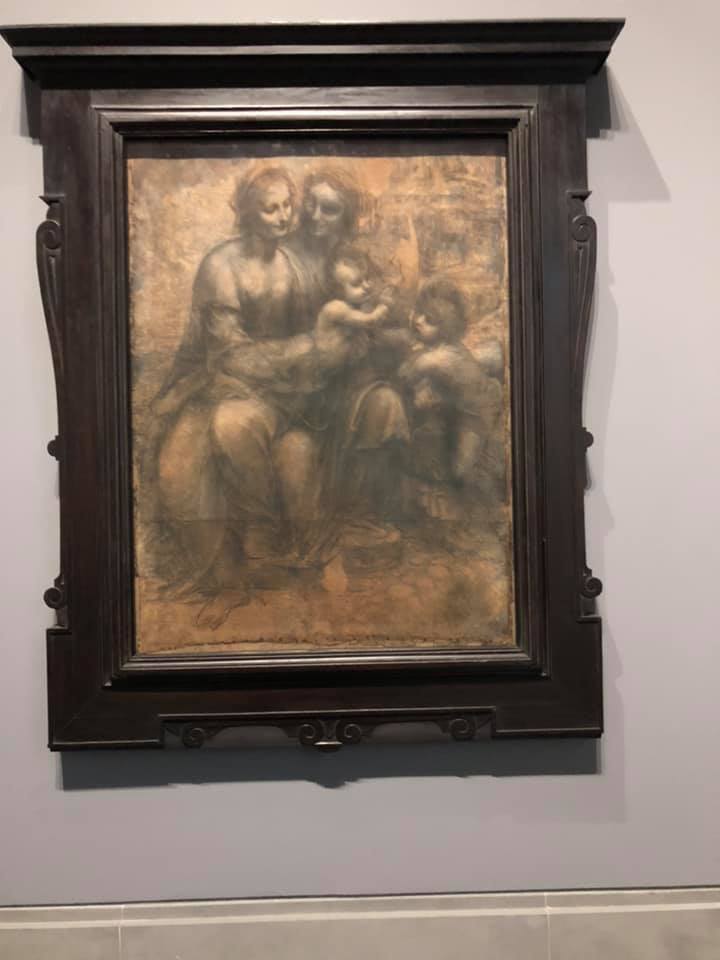
I enjoyed so many of my favorite painters and was filled with appreciation for some about whom I had known nothing. Without a doubt, however, the experience of wandering without warning into a room containing the work of Leonardo da Vinci was the highlight of the visit for me. The funny thing is that I had spied his drawings from out of the corner of my eye and had noted that I felt drawn to to them before I realized that the great master had created them. There was a kind of lively charisma to even the preliminary sketches that elevated the pieces to a level unmatched by any of the other artists.

I might have stood transfixed in that room for hours were it not for the fact that we had agreed upon a meeting time in the coffee shop, and that hour was drawing near. It was with great reluctance that I took one final glance at the glorious paintings and headed down to meet with the rest of our party.

We enjoyed a bit of respite and a great deal of animated conversation over steaming cups of Earl Grey tea as we spoke of our favorite works of art. We all agreed that we had somehow been led to a most enjoyable afternoon by the “gods of travel” and we promised that if we had some additional time later in our trip we would gladly return to this wondrous place to be certain that we had not missed anything.

When we emerged into the late afternoon air we saw that the festivities taking place in Trafalgar Square had not abated. It seemed to be an oasis of cheer and goodwill which was perhaps the intent when it had been designated as a memorial to all that is good about Britain. After the horrors of World War I the citizens needed to remember, appreciate, and celebrate the many sacrifices made. I thought it fitting that the joy of peace time was still very much in the air.

We walked away with an even greater sense of the spirit of London and its people. In a single day we had looked far back into their history and gazed at the gravity of their present. It had been like walking a human timeline during which we witnessed the resilience of the people. We realized that they had made mistakes before, and perhaps were enduring them even now, but always they seemed capable of adjusting their course and moving on the right side of history.

The Appointment

blue and silver stetoscope
Photo by Pixabay on Pexels.com

We never really know when something that we say or do will have a stunning effect on someone. I can think of instances when certain people briefly entered my life and left impressions so strong that I still think of them and feel thankful that my path crossed with theirs. In such moments it felt as though we had been meant to encounter one another for all time in a kind of spiritual appointment.

When I entered my sixties I had mostly been lucky enough to have little need of doctors, but I decided that it was time for me to have a better than usual checkup. I’d heard of an executive screening at Kelsey Seybold Clinic that included all kinds of tests and a conference with the doctor all within the span of a couple of hours. The appointment included breakfast after the required fasting and a personal conference with the doctor to discuss problems and further steps. It was a kind of concierge setting with no waiting and a very personal feeling.

I didn’t know any of the doctors at the clinic so I randomly chose a Dr. Dickerson and then jumped through each of the diagnostic hoops. When the time came for my diagnoses I met a man who exuded interest in my case, but admitted that he had almost nothing to discuss in our guaranteed time together because he had found nothing troubling about my health. He laughingly asked me if there was anything concerning me that I wanted to share with him. Thinking quickly I began to discuss my mother’s difficulties with bipolar disorder and the toll her illness had taken on her and on me in the forty years since she first showed symptoms of being mentally ill.

Our discussion began with generalizations but soon led to my full-blown admission of the struggles that had continually worried me. I spoke of the guilt that I often felt for having to be so aggressive in my mother’s care. I described the chasm that had developed between my mother and me because of the role reversal in which I so often had to become the adult. Not long into the conversation I realized that Dr. Dickerson had a crystal clear understanding of what was happening and how both my mother and I felt about it. He admitted that psychiatry was one of his areas of interest and continued to to probe my state of mind, sometimes helping me to fill in the blanks when I struggled to describe my frustrations. Ultimately I cried openly, letting out all of my fears and anger without filters. It was something that I had never before done.

Dr, Dickerson allowed our conference to continue for over an hour during which time he gave me a new and healthy perspective regarding my role as a caretaker for my mother. He suggested that I use my experiences to help others in similar situations. He believed that my teaching skills and my love of writing might gain even more purpose if I were to honestly describe the journey of our family and the love that had glued us together even in the most desperate times. He asked me to focus more on my own compassion and strength rather than on the mistakes I felt I often made, and his parting prescription was that I write a book about what our family had learned about mental illness.

I have written that book which still languishes because of fears that I have of hurting someone who may misunderstand my message. I’ve had to think about that conference with Dr. Dickerson again and again because his words indeed made me feel healthy and brave. His name is included in my dedication because I don’t believe that I would have had the courage to put my feelings and my history into words without him. As I do my best to finally go public with my story I also cling to the advice that he so wisely gave me on that fateful day. When my story eventually sees the light of day it will be in great part because of the encouragement that I received from Dr. Dickerson.

I never had the privilege of returning to see Dr. Dickerson again. Changes in insurance and the policies at Kelsey Seybold Clinic made that impossible. Nonetheless I have always believed that somehow he and I were fated to meet if only that one time. Never before or since had anyone tapped so clearly into the turmoil that raged inside my head over the uncertainty that I had always felt regarding the role I played in getting psychiatric help for my mother. I had the support of very close individuals but I still constantly questioned myself and worried that I was not doing enough or even perhaps doing too much. Dr. Dickerson cleared the demons from my head and demonstrated kindness at a time when I surely needed it.

It’s amazing how such chance encounters happen. They always feel planned even as they are serendipitous. It is as though the heavens themselves conspired to create the intersection that made the powerful moments occur. There is a miraculous feeling to them, an other worldly aspect that can’t be explained. They are beautiful and memorable, but often fleeting, a single moment in time that provides us with whatever it is that we truly need.

I know that somehow I was supposed to meet Dr. Dickerson and that I was deigned to heed his words. I will always be thankful for my encounter with him as well as other times when I suddenly found myself in the right place at exactly the right time. Those appointments seemed random, but I believe that they had been made before I even knew that I needed them. Miracles abound.

Time To Find Them

alternative alternative energy clouds eco energy
Photo by Pixabay on Pexels.com

We have so many problems across the globe that should be addressed now rather than later, but so often efforts to do something are thwarted by political differences. We have a tendency to wait until something so egregious happens that we are forced to take action, often in a highly draconian way. It seems to me that we too often fail to use the highly creative talents of mankind that are no doubt out there stewing in some unexpected corner. There are great ideas in unexpected places and the people who have them would be more than happy to offer them, but they have no resources for making their inventiveness known.

I have a former student who is one of those individuals who thinks outside of the box. Along with some of his very bright friends he has proven his innovative mettle on a number of occasions. Sadly his ideas have languished in his mind simply because to actually execute them would cost money that he does not have. He needs investors but is not privy to the kind of wealthy folk who might be willing to make a slightly risky investment with their finances. So his brain just smolders with creative genius that goes nowhere.

Aside from landing a spot on Shark Tank the average Joe has neither the resources nor the wherewithal to even know how to bring an idea to life. I have little doubt that the history of the world is awash with books, inventions, and even theories that were never known. How many of these brain children may have changed the world if only there were an avenue for making them real?

I got an email from Salman Khan recently that intrigued me. For those unfamiliar with the name, Khan is the creator of Khan Academy, an online fountain of learning. He himself began by making little mathematics videos for the purpose of tutoring a relative. His efforts ultimately led to a worldwide phenomenon, but not before he had exhausted his own savings and found an influential patron who kickstarted his business when it was about to disappear for lack of funds.

No long ago I attended a speaking engagement at Rice University in which Khan outlined his own entrepreneurial history and his plans for the future. I filled out a form asking to be part of Khan’s email exchanges and was happy to see a message from him announcing a contest that he is sponsoring for young people ages thirteen to eighteen. Essentially he is looking for an unusually extraordinary methodology for teaching some concept. The winner of the competition will receive a $250,000 scholarship. The individual’s teacher will get $50,000 and his/her school will be awarded $100,000.

Something tells me that there will be some extraordinary responses to this call for ideas.  There is nothing like the possibility of a cash prize to bring a world of hypotheses forward. So I began to imagine just how many grand discoveries might be unleashed if we were to make such opportunities available to everyday folk on a regular basis. Think of the possibilities that we might explore.

We know that we need to develop alternative energy sources but we speak more of what we plan to take away from mankind than how we intend to replace what we need with viable substitutes. Why can’t we continually have national contests to find great minds and ideas wherever they may be? Who decided that someone has to live in Silicon Valley or work at a university or major corporation to be taken seriously? Think of the power of incentivizing progress by actively attempting to access genius, not based on grades, test scores or degrees but on real insight.

I know of a man who has been attempting for years to develop a windmill that would operate in a normal backyard, virtually taking the average consumer of electricity off of the grid. He has been unable to develop the buzz that he needs to kickstart interest in spite of great sacrifice and effort on his own part. Where are the kind of patrons he needs to keep his idea alive? Why can’t he be awarded funding to continue his work by some person, group, or government agency willing to invest in possibilities?

There was a time when artists, scientists, and philosophers were supported by those with wealth for little more than the germ of inventiveness. Nonetheless such individuals had to be somehow discovered, and then as now it was a matter of knowing the right people. We need to develop a conduit that will work for anyone in the world, a kind of marketplace in which problems are stated and individuals have the opportunity to receive support and funding for possible solutions. Instead of taking money from the wealthy in high tax rates, why not make it possible for them to get even better tax cuts by investing in research and development of new technologies and methods for industry and education in areas that demand attention. We need to make it easier for inventive souls and those with influence to connect, and it will take more than just a Kickstarter or Go Fund Me proposal.

Climate change is real and disasters related to this phenomenon are already bringing pain and suffering to people all over the world. Get the competitions going now for great ideas. Offer scholarships to young people who think out of the box. Fund the man who is so close to making backyard windmills a reality. Find the people with quirky but interesting hypotheses. Make it possible for individuals like my former student to connect with people who will understand the power of his thinking. Incentivize the search for ideas so that anybody anywhere might be the next titan of energy or the savior of the oceans and waterways.

We need more, not less of people like Elon Musk or Bill Gates. Such thinkers are all around us often quietly grasping the heart of what we need to do, but without the wherewithal to be heard. It’s time to find them.