Whodunnit?

Jack the Ripper

It’s rather ironic and appropriate that it is a dark and rainy day as I write about the Jack the Ripper Tour that we took while we were in London. It was a Friday evening at the end of a week in which the sun had shone gloriously on us every single day. We had seen so many of the treasures that make the city so remarkable and had enjoyed good food in spite of rumors that the cuisine often leaves something to be desired. Everything about our visit had been picture perfect, so it was only right to have a threat of rain as we boarded a double decker tour bus in search of the infamous places where five women were brutally murdered by a killer who was never found, but came to be known as Jack the Ripper.

We used our age and the fact that we were the first to arrive at the bus station to be the first in line to enter the bus. This advantage gave us a seat at the top of the bus that had a cover so that our enthusiasm was not the least bit dampened by the chilly precipitation that was moving over the city. A gifted movie director could not have created a better backdrop for the tale that our guide was about to unfold. His thick Scottish accent only made the experience seem somehow a bit more sinister.

I suppose that I had thought that a visit to London’s east end and the Whitechapel area would have taken me back in time to a place where the clock stood still. I did not expect to instead see modern buildings and signs of great progress that cloaked the poverty and want that had once defined the area. The story that we were hearing was of people whose existences were so dreary that they had often lost hope. In particular the women whose lives were so brutally taken were victims not just of a murderous rage, but of a society that had thrown them into the trash heap long before they were killed.

As I listened to the circumstances of each woman who met such a merciless ending I felt that the real tragedy lay in the way that they were perceived by a society. They were attempting to survive in a world so cruel that they had little hope of finding a semblance of peace. These ladies were sometimes abused by men, spurned as being somehow indecent, and left to their own limited resources to get from one cruel day to the next. As our journey through their nights of horror progressed I found myself pondering the sadness of their fates, and seeing them as vivid examples of the societal problems that have challenged women throughout history.

There was one victim who had come from Sweden to learn the housekeeping trade. At some point she became pregnant without benefit of marriage and was thus spurned forevermore. Left alone in a city that was foreign to her with no support systems of family or friends she had to turn to any means possible just to have food and a place to stay at night. She was at the mercy of people who viewed her as a fallen woman and her opportunities for a decent life were forever gone.

Another of the victims had been thrown out of her home by her husband, a situation that was quite common at the time. She ended up in a poor house lodged in a building that is still standing to this very day. There she had a bed and food, but few prospects for a better future. Eventually she left to be on her own, only to somehow encounter the man who murdered her.

There have been hundreds of theories about who Jack the Ripper might have been. Some believed that he got away with his crimes because he was a man of influence, perhaps a royal personage or someone who worked in law enforcement. Others considered that he might have been a doctor, a barber or a butcher because of his seeming skill in ripping the bodies of his victims apart. The saddest aspect of his crime spree is that he was almost operating in plain sight, but because his victims were at the bottom of the societal pecking order his actions seemed to have gone unnoticed. He was simply one of many men who preyed on the hopelessness of women caught in untenable situations.

Our group became rather quiet by the end of our journey. Somehow we were all thinking less on the idea of whodunnit and more on the sadness of the five women’s lives. In an ironic twist they are now remembered and even mourned. We fidgeted as we thought of their how awful they were treated not just by the killer but by all who saw themselves as more decent. They lived in the darkest shadows of a city where status was parceled out with a punishing stinginess. Simply by dent of birth they were relegated to unimaginable hardship. The true crime was the way in which they were shunned so cruelly by people who never took the time to know them.

At the end of the tour we were left at the Sherlock Holmes Pub where I suppose we were supposed to enjoy some merriment and a few laughs after our evening’s entertainment. Somehow instead we felt the need to just go quietly back to our hotel where we said little about what we had seen. Each of us were left with our own thoughts, and mine we steeped in great sadness with a touch of anger that anyone would ever have to live as the five women did. How many more like them were there? How many more like them live in fear even now? What must we do to ultimately end the cruelty that reduces the status of little girls and leads them into lives of domination and hurt? What will it take for us to make keeping them safe a priority no matter where they may live? That is a more important question than solving an old crime.

The Glory

St. Paul's Dome

St. Paul’s Cathedral has a storied history. It has existed in one form or another in the heart of London for over fourteen hundred years. Built originally by monks in medieval times it endured neglect and fires. Over time there were many different versions of the structure, but it is the majestic architectural creation of Sir Christopher Wren that stuns visitors today. Wren’s masterpiece eschewed the dark stone, heavy pillars and stained glass of other churches and instead featured a massive dome hovering overhead like a window into heaven. There is a lightness and airiness about the interior not seen in other churches of the era. It has a modern, yet classic feel that is incomparable.

We traveled to St. Paul’s Cathedral on a Friday morning. We had enjoyed a foretaste of what we would see during Evensong the afternoon before when we were treated to the voices of a magnificent choir and a tradition that reaches back in time. The Church of England came about in the reign of Henry VIII when he broke with Rome and declared that as king he had the right to serve as the head of the Church in England. His was not a reformation, so the services and prayers continued in the same vein as those of the Catholic Church. Which is perhaps why, as a Catholic, I felt so at home in the cathedral.

We were fortunate to find a wonderful guide to take us through the church and to explain each aspect of the history and the architecture. St. Paul’s Cathedral has been the site of many famous events including the Diamond Jubilee of Queen Victoria and the state funeral of Winston Churchill. To this day it is a gathering place where people sun on the steps and drop in for prayer in the chapel or noon day services. It is both a working church and a tourist attraction whose income from visitors provides financing for upkeep and renovations. 

The high altar was eventually changed during the reign of Queen Victoria when it was encrusted with the kind of heavy gilding so popular during that era. It had a cleaner look in its original iteration as designed by Wren, and wondered what he might think were he to see it now so dark compared to the rest of the structure. In some ways there is a kind of disconnect between the heaviness of the altar and the etherial feel of the  rest of the cathedral.

The choir stalls were also changed by the addition of dark and heavy woodwork during Queen Victoria’s reign. Nonetheless the cathedral is still dominated by the dome that makes it so unique. That pediment stands out in the London landscape from every angle whether day or night. It is a glorious beacon representing so much that is great about the city and its people.

During World War II London endured fifty seven straight nights of bombing from the German Luftwaffe. Parishioners served as security for the building hoping to protect the structure in the event that it became a target. One evening the people noticed a fire breaking out as the bombs burst overhead. They called for help in putting out the flames, and firefighters worked tirelessly to save the beloved church from destruction. When morning came virtually every building that had surrounded the cathedral was demolished, but St. Paul’s stood rock solid thanks to the heroics of the people who had been watching over it.

The basement of St. Paul’s serves as a crypt and memorial for many of London’s most imminent citizens including Admiral Nelson and the Duke of Wellington who is beloved for saving the country from Napoleon’s domination. Much like Westminster Abbey it is a repository of much of the nation’s history.

There is a stairway that leads to the top of the grand dome. My brothers, Mike and Pat, navigated the winding and narrow passages along with my sister-in-law, Allison, to enjoy the sweeping vistas of the city and a closer look at the construction and magnificence of the the building. Sadly my knees would not hold up under such stress so I joined my husband Mike and sister-in-law, Becky for tea while the younger among us enjoyed the adventure of the climb. In another decade I surely would have been right there with them, but I have learned to respect the signs that such adventures are past.

St. Paul’s Cathedral is a marvel of architecture and a treasure for all of the people of London. I felt a very spiritual connection to the church that was different from the awe of Westminster Abbey. It is a place where worship rather than history plays a more dominant role. It is a showpiece, but also a refuge from the hustle and bustle of the city. It has a calming presence that made me want to just sit and linger and meditate. I truly felt God’s presence there.

I would see the dome of St. Paul’s on the horizon again and again during my time in London. Sometimes it was like a beacon of hope, others it was a compass point helping me to find my way. Always just seeing it brought a sense of calm to me. It is one of those places that I will certainly conjure up when I feel the need to meditate on the goodness of humans, for that is what I felt there from the moment that I first entered.

Even now as think about St. Paul’s Cathedral my heart slows, my mind focuses and I feel a sublime sense of well being. I see the minister who looked at my face and smiled as though he knew the content of my heart as he invited me to attend Evensong. There is an otherworldly essence there that will sustain me whenever I close my eyes, quiet my heart, and remember the glory.

The Tower

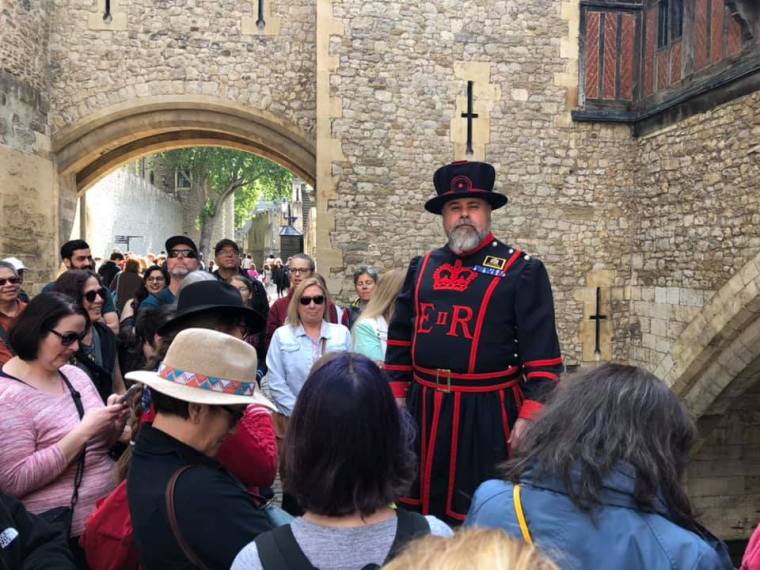
Beefeater

In the heart of London along the River Thames lies one of the most extraordinarily historical places in London. Known as the Tower, it is a complex of buildings dominated by a white castle built by William the Conqueror shortly after the battle of Hastings in 1066. It is an impressive fortification with its moat, narrow winding staircases, and vast rooms. It was originally designed both as a home for the king and a defensive keep. Over time it became better known for the prisoners that were held on the premises and the executions that took place on the green. It is an imposing and improbable complex whose elevations seem both in and out of place in the modern world.

Some time ago I learned that my lineage can be traced back to William the Conqueror and from there to Vikings. I suppose that such is a somewhat dubious honor given that the Norman king was so often resented by the people of England who saw him as a bloodthirsty outsider. Nonetheless his legacy in creating the famous white tower remains as a reminder of the often violent and dangerous history of Britain.

What was once designed as living quarters for the first Norman king has evolved over time in its use, and now stands as a museum and respository of many stories. Visiting the Tower of London is perhaps the most fascinating tour in all of the city, complete with legends about the ravens who have lived on the premises for most of its existence. It is said that as long as they remain Britain will not fall and great efforts are made to keep them happy and willing to stay as permanent residents of the compound.

Countless mysteries and tragedies unfolded in the Tower. Richard II, the protector of his child king nephew, took both the little monarch and his brother there for safe keeping, but they subsequently disappeared thereby leaving the throne to him. Years later when the bones of two children were found buried under a set of stairs it was conjectured that they must have belonged to the long missing brothers. 

It was in that Tower that Anne Boleyn awaited her tragic fate once Henry VIII had decided that she was no longer of use to him. Later she would be publicly executed for treason on the grounds. Lady Jane Grey would serve as Queen for nine days after Henry’s son James died without an heir, and then lose her life when Mary I laid claim to the throne by right of being Henry’s eldest daughter. Elizabeth I would also spend time imprisoned in the Tower but was luckily spared a death penalty and eventually given the throne. Other famous prisoners like Sir Walter Raleigh spent years behind the walls as condemned persons before being put to death.

One of the most interesting areas of the Tower complex is a building in which prisoners left graffiti on the walls. Over time they meticulously carved intricate signs that they had been there. These were no ordinary scrawlings, but rather beautifully carved inscriptions left in the stone for all time. They told of the long days of isolation that the captives had to endure and their determination to leave their mark on history in spite of their wretched conditions.

The Tower complex also features a sampling of the crown jewels including the largest known diamond in the world. It displays goblets and plates of gold, as well as jeweled crowns and scepters. It is a remarkable showcase that points to the wealth of the monarchy and the traditions that have both evolved and continued over time.

A tour of the Tower grounds includes a rather jolly session with a Beefeater who reveals the history, the stories and the secrets of the complex. The Beefeaters live and work inside the Tower walls and provide visitors with an in depth detail of information. Our particular guide had a rather wicked sense of humor that added to the interest of his tales. He provided a voice to the people who had lived and worked and even died in that fascinating place.

The history of the world is one of violence and tragedy as people fought to gain and retain power. Their’s was not so much a fairytale as a story of intrigue, jealousies, and betrayals. Perceived treason brought imprisonment and death. Choosing sides carried dangers for both noble men and women as well as the common folk. The walls of the Tower of London indeed seem to talk of the fears and horrors of real people who either fought to maintain a hold on their power or suffered because they appeared to be threats. The chronicles of lives celebrated and lost are written in the very stone of this place. There is something majestic, awe inspiring, frightening and evil about what happened within at the Tower making the ravens that act as sentinels seem an appropriate symbol of both the ingenuity and the flaws of humankind.

I left the Tower of London in a rather pensive state of mind. It is a glorious edifice that is a remarkable reminder of the steadfastness and resilience of our humanity, but it is also a respository of our imperfect natures. It is a place where we should surely learn the lessons that history attempts to teach us. Our time on this earth is short in the grand scheme of the universe. The possessions that we accumulate are unworthy of our focus. We will all soon enough become ashes but our actions while still on this earth will have far reaching consequences. Let us hope that we have made good choices and demonstrated honor and integrity rather than greed. The history of mankind is littered with far too much hatred. It is our duty to work toward the good insofar as possible. Power comes and goes and too often corrupts, as we humans continue to work toward a more perfect union of our differences. 

Victoria and Albert

Victoria and Albert

Until the reign of the present day queen, Victoria had held her office longer than any other monarch in the history of Britain. Her influence on Europe and the world was enormous and the story of her relationship with Albert became the stuff of fairytales. She was the transitional figure between the nineteenth and twentieth centuries, seeing and bringing changes to the country that brought the nation into the modern world. Her children and grandchildren had a profound effect on history in two major wars and their impact continues into the present day. We all seem to have a kind of fascination with Queen Victoria, and in particular her consort, Prince Albert.

Victoria and Albert were first cousins who fell in love, married and together had nine children. Albert’s influence on Victoria was enormous and while she clung tenaciously to her own independence as a monarch she supported many of his ideas for modernizing the country that she ruled. He was a somewhat forward thinking man with varied interests that kept him continually engaged. After his death Victoria went into a state of depression and mourning, never again wearing anything but her widow’s weeds. 

After watching the changing of the guard at Buckingham Palace our group traveled by Tube to the Knightsbridge area of London where the Victoria and Albert Museum is located. The station exit revealed a lovely neighborhood filled with trees and refined looking buildings. Only a few steps away was the museum that we were seeking. It is an imposing structure that opened up into a decidedly open and airy hall once we were inside. It showcases a cornucopia of art, sculpture, textiles, furnishings, ceramics and decorative pieces. Founded in 1852, the museum was named for the queen and her husband. It houses a permanent collection of more than two million objects, and best of all there is no charge to see most of the works of art.

After first stopping for a brief respite and a small snack we wandered from one section of the building to another delighting in the glorious sampling of art that was on display. I was particularly taken by one hall that featured works by Rodin and other sculptors. We enjoyed watching a young woman creating a pencil drawing of one of the sculptures. She told us that she had been working on it everyday for weeks and she was in hopes of completing in on that day. She mentioned that many artists find inspiration at the Victoria and Albert, and I too felt that there was a lively spirit to the place that made it something more than just a repository for old things.

I was particularly taken by an entire hall that featured the craftsmanship of Islamic artists. The rugs, textiles, vases, bowls, and woodcarvings were so delicate and uniquely colorful. They seemed almost to have been crafted by heavenly personages rather than humans. There was a lightness about them that was otherworldly. I was transfixed by the beauty and found a kind of serenity in simply gazing at the various objects.

Another room was set up to show the clothing and furnishings of various eras. It was so interesting to the trends and the fashions of each historical period. I found myself marveling at how small the sizes were compared to what we use today. We humans have certainly grown larger over time thanks to the abundance and variety of food that is now available to us. The everyday diets that we take for granted were once the domain of only the wealthiest, and even they did not enjoy the miracles of interstate commerce that bring us delights from all over the world.

As someone who has always loved fashion I delighted in a room that featured women’s clothing from different eras and decades. I am old enough to have remembered the lovely fitted dresses and suits that the women wore in the nineteen fifties and the mini-skirts and mod styles that I donned in my college days at the end of the nineteen sixties. The styles that were featured were so lovely and amazingly so classic that if someone were to wear them today they would no doubt look quite fashion forward.

The museum complex features a large splash pool where youngsters played excitedly while their parents watched with unadulterated joy. I smiled at the relaxed and lively spirit of the place where every person seemed to have a contented smile permanently affixed to his/her countenance. I imagined that Prince Albert in particular would have been quite proud that even us common folk were able to view so many treasures. I felt so welcome and so relaxed there and might have stayed far longer but for the fact that we had a reservation for Skye Garden and needed to depart.

I spent my last moments in the gift shop which was the most wonderful of all such places in London. I purchased two tea towels crafted from extraordinary patterns. I plan to use them whenever I have a tea time with my grandchildren or my niece. I also chose an apron that was so lovely that I can’t imagine actually using it while cooking. Nonetheless it will be nice to don at the last minute for the Sunday dinners and special occasion extravaganzas that I so love to provide to family and friends.

In a single day I had mulled over the long history of England and the role of royalty in the modern world. Somehow the Victoria and Albert Museum had helped me to understand the symbolic significance of the monarchy. I suspected Victoria and Albert’s influence in making more recent kings and queens more caring about the people. I felt more and more kinship with the idea of having a royal presence and I somehow began to realize what the Queen represents. 

God Bless America/God Save the Queen

The Guards

Ironclad plans for a trip are fine until they fail. One of the most positive aspects of traveling independently is the ability to make last minute corrections. Such was our decision one morning at breakfast when we realized that if we hurried over to the Russell Square underground station and headed for Buckingham Palace we might be just in time to see the changing of the guard that was to be held that morning. After all the rest of our day was dedicated to places where there was no need of tickets, so we had all of the flexibility that we needed. We took a deep breath, entered the fray of early morning crowds headed to work and girded our loins for whatever we might find ahead.

The train was so packed that we felt like sardines and it only became worse as we drew closer to our destination. Our foray inside a crowded train would be good practice for the swarm of humanity that we would find waiting at the gates to Buckingham Palace. We realized immediately that we would not get a prime view of the proceedings, but at least we were there and we’d have to just do our best to catch a glimpse of the proceedings here and there.

Unfortunately most of the best spots right along the fence line were taken by very tall men who further blocked the view by raising their arms to hold their cameras high in the air. Husband Mike and my brothers had no trouble looking over the shoulders of the lucky ones who had arrived early enough to stake out a claim to prime property, but my sisters-in-law and I were unable to see much even when we stood on tippy toe. Sister-in-law Becky decided to choose a different point of view and went to the very back of the crowd so that she might see the troops as they marched into the palace grounds. Allison and I found ways of glancing down low and in between the bodies of those who blocked our normal sight of vision. All in all it was a frustrating situation but one that we learned how to eventually make work.

By the time the proceedings began the area was a mass of humanity all craning their necks to see the red coated military men marching proudly across the grounds. They played traditional pieces that most of us had expected to hear, so a sense of great satisfaction swelled over the crowd. I saw enough of the upper half of their bodies to feel a sense of exhilaration, and I had perfected my method of finding tiny holes in the wall of people to make me feel as though I was part of something quite grand.

Standing on my toes and bending down became my official “modus operandi” so I hardly noticed that people from behind were pushing forward to get a view of their own. A woman who had a birds eye view in the front row suddenly became overcome by claustrophobia and decided to leave. Before doing so she offered her spot to me. I could not believe my good fortune as I suddenly stood right behind the fence along with the row of tall men. I was mesmerized by the sheer beauty of what I saw.

The soldiers with their red jackets and polished brass buttons stood tall and stately with their heads proudly bearing the black bearskin helmets that are the trademark of their station and their duties. I saw that they were not just showmen because the guns that they carried were real and quite powerful. They were indeed trained and equipped to be guards. I later learned that many of them had served in dangerous places like Afghanistan. Their precision bespoke of discipline and pride in their work. I was almost giddy at the wondrous sight that I was watching unfold. It was as though I was part of a living fairytale not unlike the ones that my father had so often read to me. I felt like Cinderella.

We were entertained by military songs and modern music, marching, and even a mounted cavalry wearing riding boots and a different sort of cap featuring horse hair. The pageantry was even more glorious than I had imagined it would be and my companions and I were quite delighted.

As is my way I found myself thinking of the rag tag revolutionaries of the colonies of north America who had the audacity to rebel against such a well trained and disciplined army of red coats back in the eighteenth century. It must have required an enormous amount of frustration over the political situation to risk fighting such a group. Little wonder that the prevailing belief was that the so called patriots would soon be put down by the seemingly superior forces and normalcy would return. I’m not so sure that I would have had the courage to side against such a powerful army, and yet I know from the study of my family tree that there were indeed ancestors who chose to join the revolution to free themselves from what felt like tyranny.

I suppose that we Yanks are the wild children of Great Britain. We came from the same stock but the new world changed us. We were far enough away from the old ways that we began to question the authority of a king who was making our lives more and more difficult. We had risk taking in our DNA. Our thinking diverged from the land of our origin and in the end we eschewed royalty and opted for freedom, even though our first form of it was far from perfect. It would take some time before we freed our slaves and allowed women to move to the front so that they too might participate in the grand experiment of the republic.

My spot along the fence of Buckingham Palace standing as an equal to the big tall men who had at first blocked my view felt like yet another metaphor for how far I have come from the time of my ancestors. I have roots in Great Britain that make me proud, but in the end I am a foreigner in that land. Neither I nor anyone not born of the Windsor family will ever be royal, but in my country anyone might aspire to be President. That is the grand difference that came from the revolution of long ago.

I possess all of the traits of an American including great pride in my country and a kind of brash sense of equality with every other human, but I still cherish the traditions of my history. I felt a kinship and a sense of friendship as I watched the ceremony unfolding before me, knowing also that I would not have been standing there were it not for the opportunities that the United States has given me. God bless America and God save the Queen!