
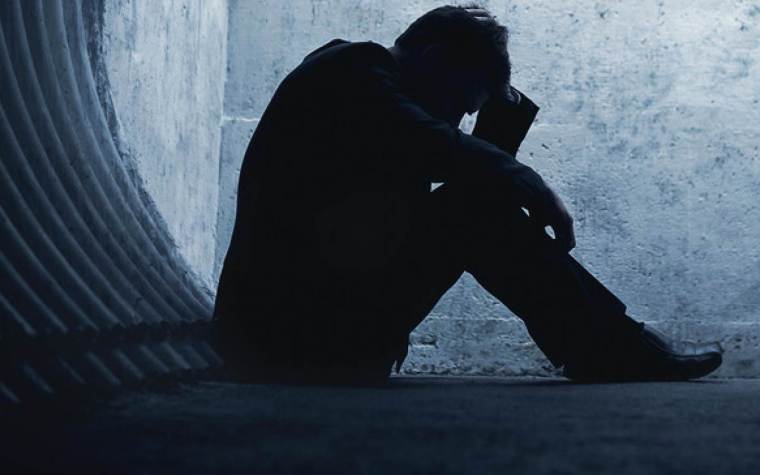
I often write about being optimistic and choosing to be happy. Of course such prescriptions are fine and dandy for those of us who are not afflicted with clinical depression, but for those who are it is virtually impossible to simply will away dark feelings.
My mother was one of the happiest people on the planet as long as she was not in the throes of her bipolar disorder. When the illness hit, she was literally unable to just wish its debilitating symptoms away. One of the characteristics of her disease was a profound sadness that would overtake her with life changing consequences. She often sat in the dark, drapes drawn tightly closed, crying and worrying for no real reason at all, unable to even venture into her front yard. It was both frightening and heartbreaking to see her in this condition. It was so contrary to the person that she really was.
Mama had shown early signs of her illness that my brothers and I failed to understand. There were times when she would suddenly take to her bed for several days. We always just assumed that she had a bad cold or a virus but it was far more sinister than that. She was fighting away the melancholy that paralyzed her. In the years before her disorder became full blown and noticeably chronic she would feel down for a few days or a week and then somehow return to the person that we knew so well. Unfortunately, in 1969, she experienced a psychotic break that began with crying jags and paranoid fears. Eventually she literally believed that the FBI was trying to frame her for selling drugs. She was convinced that all of us were going to be sent to jail. Her anxiety was so acute that she was in terrible physical pain and even thought that she had died and then miraculously come back to life.
I remember one of my very sweet uncles coming to visit her during this time. He pleaded with her to pull herself together. He reminded her that she had children for whom she needed to care. He argued that she had a wonderful life, filled with love. He felt that she only needed to choose to be happy and all would finally be well. Of course we all learned that such wishful thinking was not going to materialize. It was only after a long hospital stay and medication that she was able to return to us as the person who had always possessed a sunny disposition.
My mother mistakenly believed that her illness had been an anomaly, something that would never happen again. She insisted that she was cured and that she knew how to care for herself in the future. We naively agreed with her, thinking that the worst was behind us. Little did we realize that her condition was chronic, a never ending series of ups and downs taking over the chemistry of her brain. Only with the continual help of psychiatrists would she be able to function. It was a bitter pill for her and a challenge for those of us who loved her. We had to monitor her life to an almost invasive extent because whenever we became lax so did she, and the symptoms would return even worse than the times before.
My mother was known to her doctors as a noncompliant patient. She never admitted that she had a psychological problem, instead blaming me and my brothers for her condition. She wanted desperately to prove that she never needed psychiatric care and that her illness was a figment of our imaginations. Her reluctance to accept her diagnosis and continue her therapy on a regular basis lead to one relapse after another. Her life became far more difficult than it had to be.
Mama had brilliant and caring doctors who became frustrated with her unwillingness to follow their directions. They knew as we did that as long as she followed their instructions she was able to work and be like a ray of sunshine in everyone’s lives. Sometimes her medications had to be changed, but the results were always miraculous. To her detriment and our frustration she chose to discontinue her treatments again and again. As she did so the magnitude of her depression and mania increased. It was as though she was stressing her brain to the point of bursting.
I always understood that my mother wanted to feel normal, and visiting psychiatrists and taking numbing medications with troubling side effects was annoying to her. She gained enough weight from using her drugs to go from being a slender woman to one who was rather heavy. She experienced involuntary tongue flicks and other nervous system twitches. Her ankles would swell to three times their normal size. She hated those things and would quit taking her pills in the hopes of ridding herself of their effects. Of course she would ultimately become very sick again and her doctors would have to restart her therapy from ground zero. It was a hard way of living and I always empathized with her. I tried to imagine what it was like to feel so seriously sad as she often did. I wanted to understand her pain.
Depression is a very real disease for many unfortunate souls. It is not related to an inability to see the glass as half full. Nobody consciously wants to endure its effects. Happily there are ways of improving as long as one is willing to ask for and accept help. It can be a tricky process with a great deal of trial and error in implementing a viable plan. Because it is often a lifetime disorder it can become overwhelming. The important thing is for the depressed person and those around him/her to understand that it is a true medical condition much like diabetes or heart disease. There are treatments that will ultimately work, but they often take time.
Our laws prevent us from forcing adults to accept psychiatric care unless they are deemed to be a danger to themselves or others. While this protection prevents innocents from being falsely forced into therapies that they do not need, it also sometimes makes it very difficult to get a recalcitrant patient the care that they require. All too often families simply look the other way when their loved ones refuse to accept the treatments that they most certainly need. Such situations create very uncomfortable relationships that are painful to everyone concerned. Still I am convinced that it is up to those who love the sick person to insist by hook or crook that they receive the medications and therapies that they need. We can’t just walk away and hope for the best for them.
Mental illness and particularly depression too often results in dire consequences if left untreated. It is a lifetime battle but it need not overcome those who are afflicted. Each of us must learn to see the symptoms and guide those that we know and love to find the help that they need. Perhaps if we all agree to become more educated about the effects of such chronic diseases we will be more likely to deal with their effects more openly. There is nothing about depression or mental illness that should make us feel ashamed. Just as we would seek the best possible treatments for cancer or heart disease so too must we learn how to properly react to mental health issues. We can all be happy but some of us require a little push to get there. Our happiness and that of others need not be lost.
 On Good Friday I was preparing food for our family’s Easter celebration when a heavy cloud of dark smoke suddenly poured from my oven. As I ran across the room to turn down the heat a small flame erupted in the bottom corner of the appliance. I called for my husband to come help with the situation and just as he raced down the stairs an inferno engulfed the entire cavity. We reached for the fire extinguisher that we store in our pantry but when we attempted to open the oven to apply the fire retardant it was latched shut. Our only option was to yank the appliance out of the wall just enough to create a small crack that allowed us to spray away. Luckily our efforts worked and the blaze was soon out leaving behind a rather nasty mess and an oven that was undoubtedly ready for the scarp heap.
  I vividly remember having the measles. It seemed to be the final insult in a year that had brought me nothing but grief. My father had died only months earlier leaving me confused and bereft as our family struggled to find its footing. We had moved into a house that was nothing like the ones we had been considering at the time of his death, but it had brought us great comfort in the short time that we had lived there. We had gone full circle, returning to the neighborhood and the school that we had left only a year before. The people who lived near us and those who attended our church had been welcoming and we had been gradually settling in to a new way of life without Daddy.
 I was twenty years old when my mother had her first mental breakdown. Mine had been a somewhat sheltered life. Aside from my father’s untimely death when I was only eight, I had not seen much of the dark side of existence. I certainly knew nothing about mental illness and the dramatic symptoms that seemed to so suddenly change my mom from a strong, independent woman into someone paralyzed by depression, paranoia and manic episodes. As I witnessed her decline that summer I was overtaken by a state of anxiety that made me feel as though I might surely die. I would visit her during the daylight hours and then return to my apartment in the evenings where I attempted to understand what was happening and to rally help for her among my aunts and uncles whom I was certain would have much better insights into her condition than I had. Mostly though I suffered from my own form of mental stress experiencing panic attacks that threatened to render me useless in the battle to bring my mother back to a healthy state of mind.
  All It Takes Is A Little Love